Specs are compiled from manufacturer listings and verified buyer reviews and can change over time — please confirm the key details on the product page before buying.
You land, you switch your phone on, and your home carrier quietly starts charging you for every map lookup. A worldwide hotspot device fixes that by putting a private Wi-Fi network in your pocket that works across many countries without a physical SIM. The short answer on which one to buy: the GlocalMe MeowGo G40Pro is the pick most travellers should start with, because it reaches 200+ countries and regions and tops out at 390 Mbps (megabits per second — the download speed that decides whether video calls stay smooth).
This guide is built by comparing the manufacturers’ published specifications and the patterns across verified customer reviews, so you get each pick’s real strengths and trade-offs instead of marketing spin.
Below you will find the coverage, battery and device-limit figures that actually change how a trip feels, plus the trade-offs nobody puts on the box. These are the details that separate a genuinely useful worldwide hotspot device from one that quits on day three.
Top Picks
How To Choose The Best Worldwide Hotspot Device
Most buyers pick a global hotspot by the biggest country number on the box. That is the wrong first filter. What matters is whether the device can find a strong local carrier where you are standing, and whether its battery lasts longer than your travel day.
Coverage is a carrier question, not a country question
A country count tells you the device is allowed to connect there. The real question is how many networks it can choose from. A hotspot with access to hundreds of carriers will hunt down the strongest signal automatically, so you are not stuck on a weak one while a better tower sits nearby.
Check whether the listing names specific carriers or a carrier count. A named carrier list is what keeps calls stable in a valley, on a train or inside a concrete hotel room.
Preloaded data buys you breathing room, not a free trip
Several of these devices ship with a small data bundle already active, which is enough to get you through the airport and to your hotel. After that you buy top-ups by the day, month, region or gigabyte. Read the size and the validity window of that starter bundle before you assume you are covered for a two-week trip.
Battery hours matter more than milliamps
A bigger battery number looks better, but the hour rating is what you actually live with. Match it to your longest day away from an outlet, then decide whether you also want the hotspot to double as a power bank for your phone.
How many devices can share the connection
A solo traveller needs very little. A family with two phones, a tablet and a laptop needs headroom. Pick a device limit above your real count so nobody gets bumped off when everyone opens a map at once.
Side-by-Side Comparison
| Model | Best For | Coverage | Max Download Speed | Connected Devices | Amazon |
|---|---|---|---|---|---|
| GlocalMe MeowGo G40Pro★ Best Overall | Most travellers | 200+ countries and regions | 390 Mbps | 10 | Amazon |
| GlocalMe UPPPocket-Size Pick | Light packers | 200+ countries and regions | — | 8 | Amazon |
| Global Pocket WiFi T8Instant-Start Value | Instant start abroad | 140+ countries and regions | — | 8 | Amazon |
| Topmifi Global | Family trips | 140+ countries and regions | 150 Mbps | 10 | Amazon |
| Verizon Jetpack AC791L | Long haul and RV | 180+ countries | 300 Mbps | 15 | Amazon |
| Linklan eSIM Hotspot | Crowded tables and teams | 180+ countries and regions | 433 Mbps | 16 | Amazon |
| SIMO Solis 5G | Rugged 5G travel | 135+ countries | — | 16 | Amazon |
| NETGEAR Nighthawk M7 Pro | Heavy data users | Up to 2,000 sq. ft. | 10 Gbps | 64 | Amazon |
Detailed Reviews
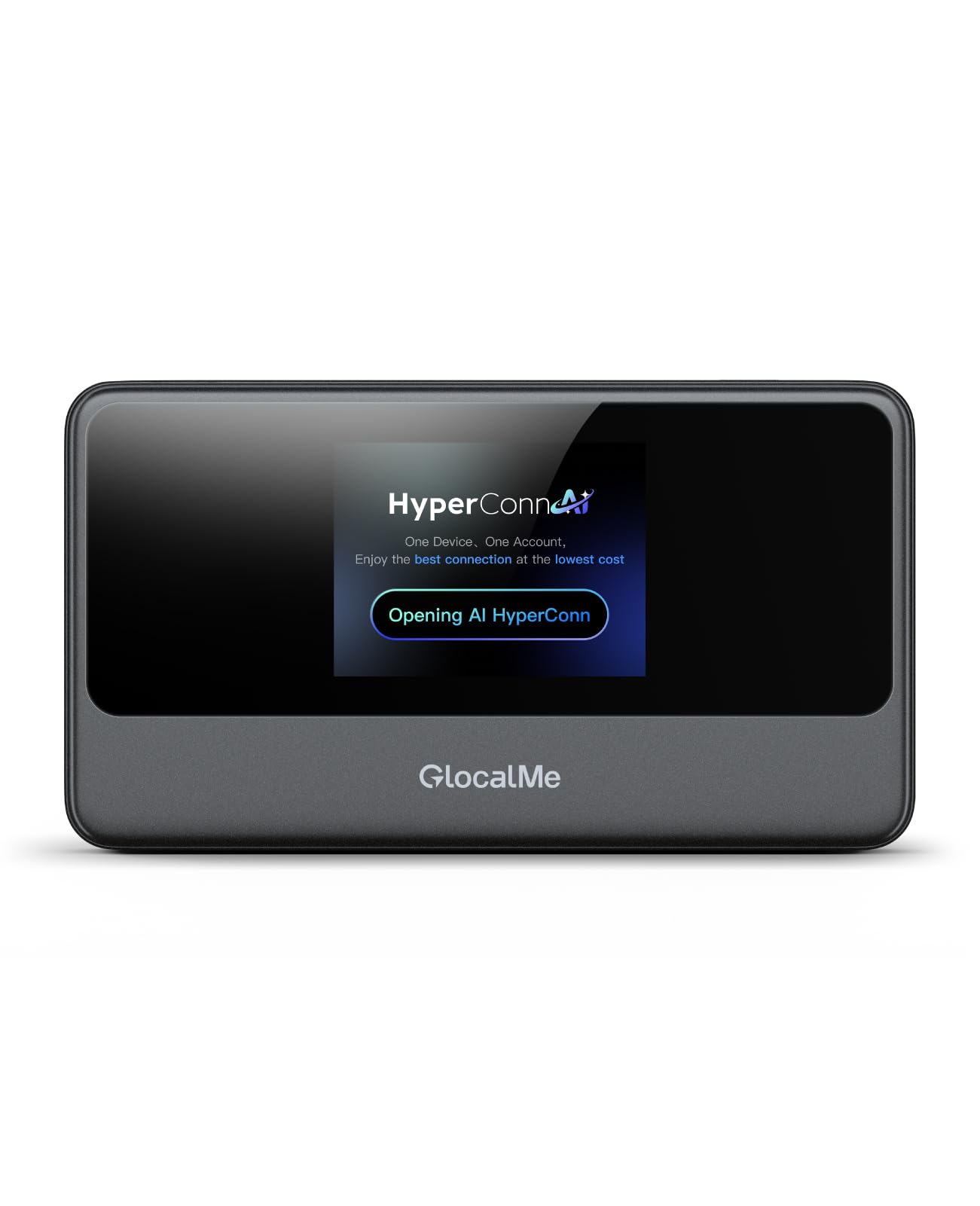
1. GlocalMe MeowGo G40Pro Upgraded 4G+ Mobile Hotspot Device
Our pick — 4.0+★ from 500+ verified ratings; the strongest balance of quality and price.
The one that chases the strongest tower across 200+ countries and regions without an airport SIM.
The headline figure here is the connection ceiling: a 390 Mbps download rate and a 150 Mbps upload rate (upload being how fast your photos and video calls travel out). Cat13 4G+ technology is the reason, and it is what makes the difference between a video call that holds and one that stutters. If your work rides on a stable link abroad, this is the number to care about.
It reaches 200+ countries and regions through access to 390+ global carriers, and it picks the strongest local signal on its own instead of making you choose. Buyers report it holds a usable signal in mountain and valley terrain where weaker hotspots drop out. It also shares to 10 devices at once, so one hotspot can carry two phones, a tablet and a work laptop.
Battery is rated at 3200mAh for over 15 hours of use, which comfortably covers a travel day. It ships with 1.1GB of global data to get you started, then you top up by day, month, region or gigabyte — and there is no contract or SIM card needed.
Where the MeowGo pulls ahead
- 390 Mbps down and 150 Mbps up beats the Topmifi Global’s 150 Mbps on paper
- 200+ countries and regions with automatic carrier selection
- Over 15 hours of use from a 3200mAh battery
- Shares to 10 devices and works with or without a physical SIM
What to weigh first
- Sits in the mid tier on price, so budget travellers pay for speed they may not need
- 1.1GB starter data runs out fast if you stream
Best for: anyone whose trip spans several countries and who cannot afford a dropped call.
Think twice if: you travel once a year to a single destination — the cheaper picks cover that fine.
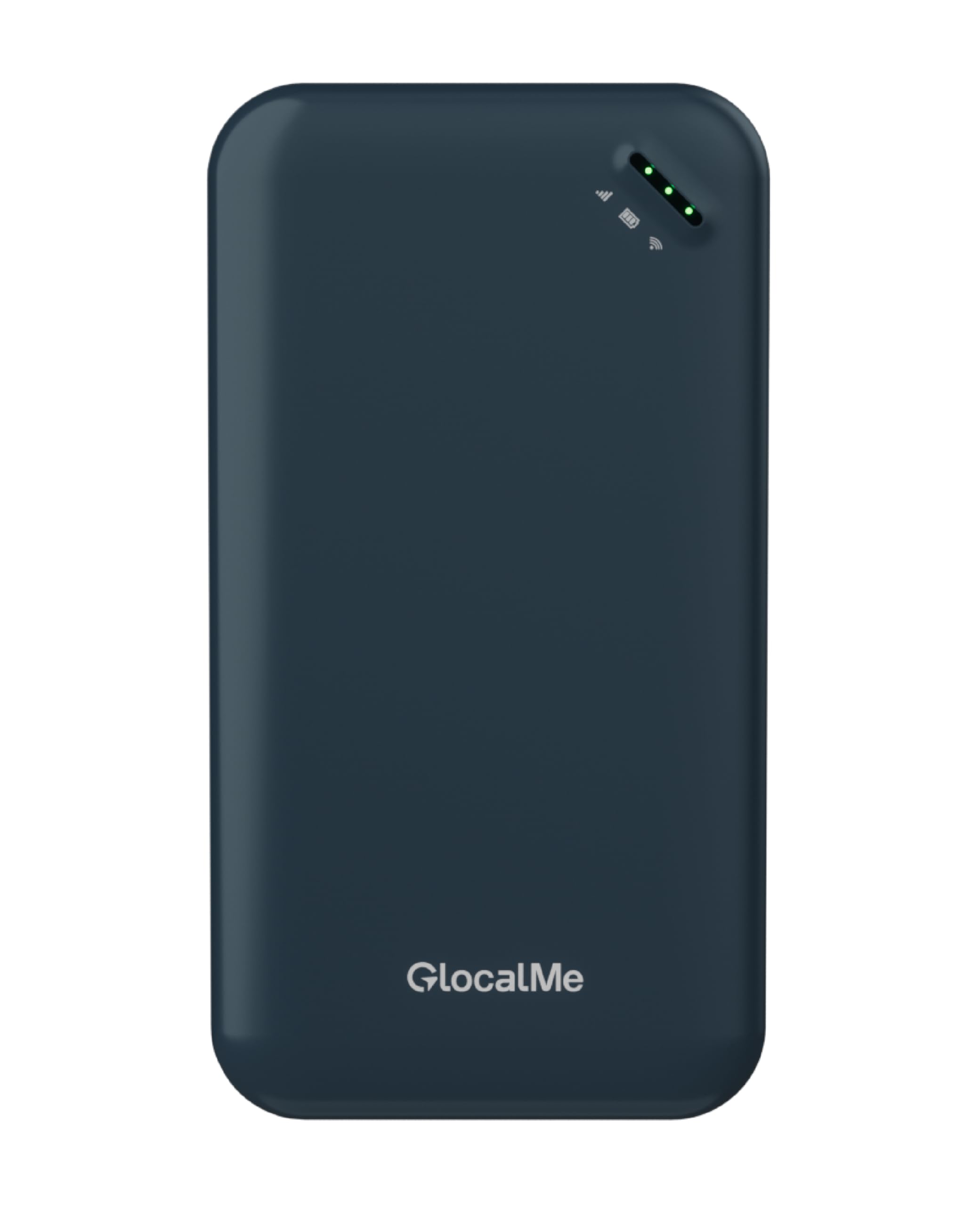
2. GlocalMe UPP 4G Portable WiFi Hotspot
A slim travel stick that covers 200+ countries and slots into a jacket pocket without a bulge.
It is the same global reach as the MeowGo — 200+ countries and regions through 390+ carriers — packed into a far smaller body. That is a real trade: the UPP reaches the same 200+ countries and regions as the MeowGo and actually edges it on coverage breadth versus the 140+ countries of the Pocket WiFi T8. Travellers who move between continents get more network choices here than on the cheaper T8.
The setup is what wins people over. It arrives with 1.1GB of global data valid for 90 days, and you register in the GlocalMe app to claim extra data — so it is ready before you even pack. It shares to 8 devices, which is comfortable for a couple or a small family, and it uses a 5 GHz frequency for the Wi-Fi link. There is a 3,000mAh battery rated for over 13 hours of continuous use.
Here is the number that decides it for many buyers: 13 hours of use versus the 15 hours on the Pocket WiFi T8. The UPP is the smaller, lighter device, and it pays for that with slightly shorter battery life. If your days are long and outlet-free, factor that in.
Why it earns a spot: it is a genuinely compact global hotspot with real 200+ country coverage, a 90-day starter data window long enough to cover a whole trip, and app-based top-ups that do not lock you into a contract.
One honest limit: 8 devices and over 13 hours is plenty for a couple, but a larger group will feel both ceilings.
Reach for this if: you want maximum global coverage in the smallest bag footprint.
Look elsewhere if: you travel with more than eight devices or routinely go 14+ hours between charges.
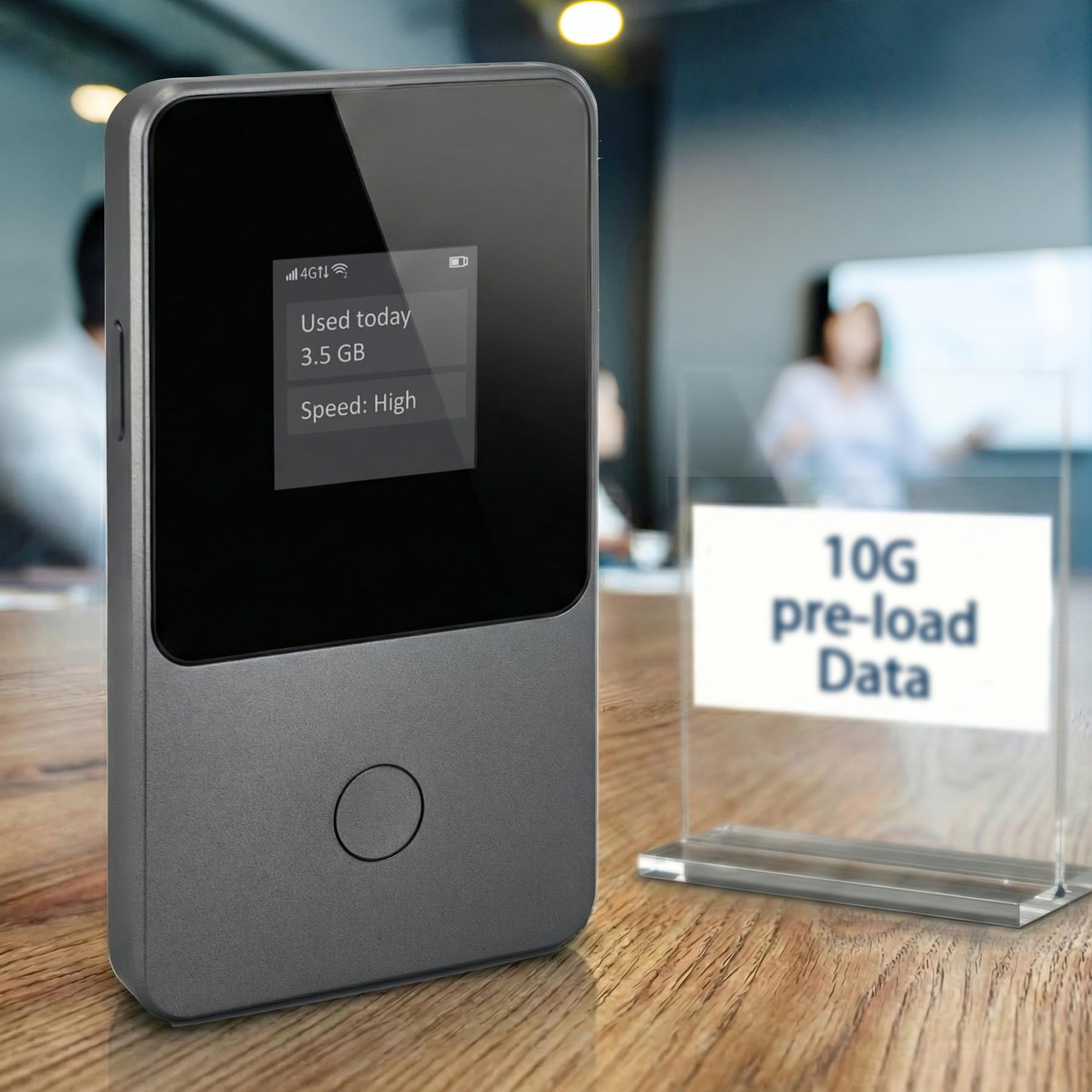
3. Global Pocket WiFi Hotspot T8
Ten gigabytes loaded and waiting, so you are online before the taxi leaves the airport.
The starter bundle is the whole pitch. This one ships with 10GB of preloaded US data ready to use, which is a far larger starting allowance than the 1.1GB on the GlocalMe devices. You unbox it, power it on, and connect — no top-up, no waiting, no local SIM hunt on arrival. That alone makes it a smart first device for someone who wants to be online the second they land.
Coverage runs to 140+ countries and regions on eSIM (a virtual SIM that downloads the local plan instead of a plastic card), and it can pull from over 300 global carriers. Eight devices can share it at once, and the 3500mAh battery is rated for up to 15 hours of continuous use. At 100g it is light enough to live in a coat pocket.
The trade-off is geographic. Where the UPP covers 200+ countries and regions, this one covers 140+ — about 43% fewer on paper. If your itinerary hugs Europe, the Americas and Asia, you are covered. If you roam to more remote regions, check the country list before you commit.
The value read: 10GB of preloaded data plus a 3500mAh battery rated for 15 hours is a strong opening hand for a mid-tier device — it beats the Topmifi Global’s 12 hours of rated use.
The caveat: 8 devices and 140+ countries means it is built for typical tourist routes, not extreme destinations.
Go for it if: you want the biggest starter data bundle and the least setup friction.
Pass on it if: your destinations sit outside the common 140+ country list.
4. Topmifi Global Portable WiFi Hotspot
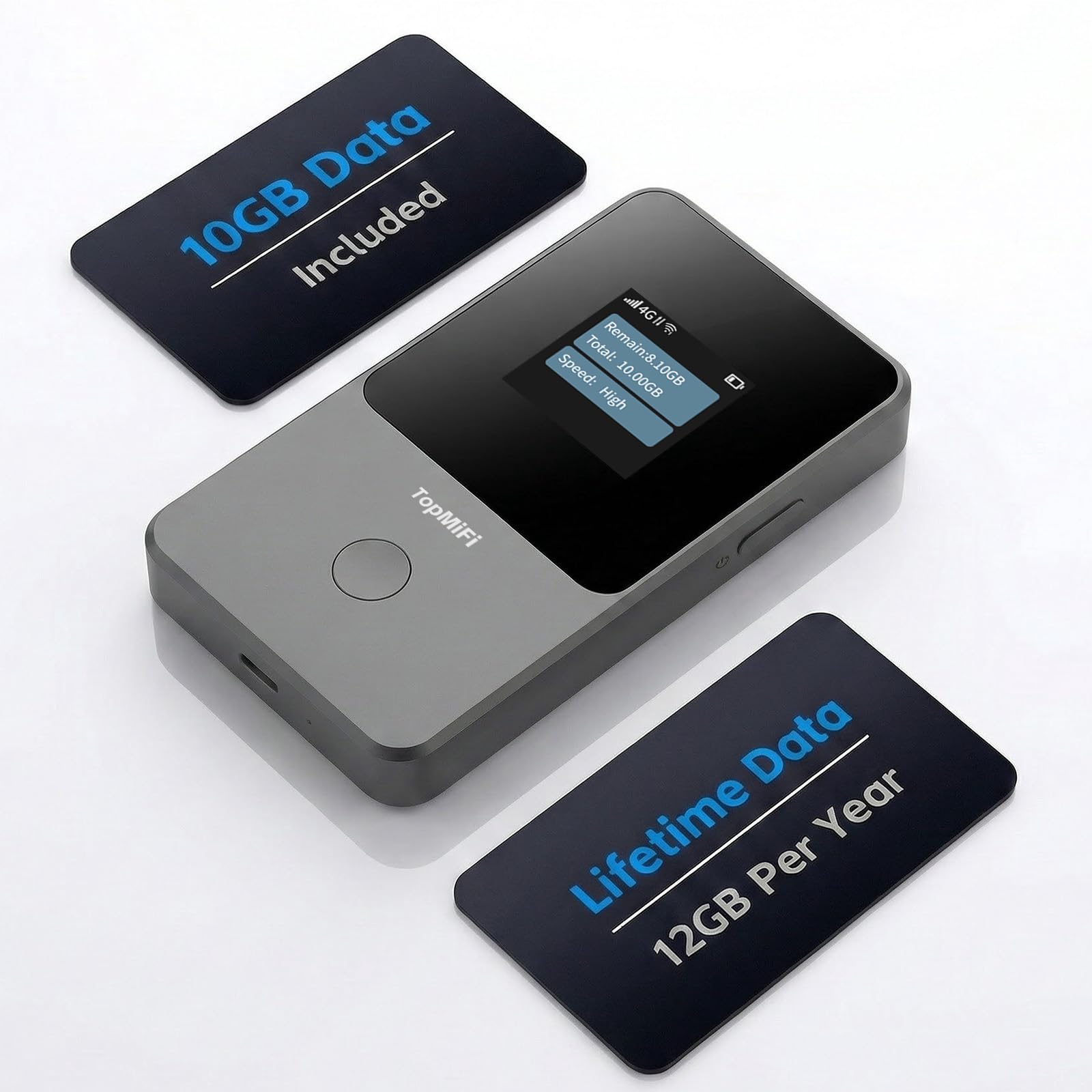
Ten seats at the table, plus a yearly data allowance that keeps coming back.
Most global hotspots make sharing a scramble. This one takes 10 devices at once, so two phones, a tablet, a smartwatch and a laptop can all ride the same connection without pushing anyone off. It covers 140+ countries and regions on Cloud SIM (a virtual SIM that connects you to a strong local network automatically), and it can latch onto carriers like AT&T, T-Mobile and Vodafone.
Data is the interesting part: it includes 10GB of USA data plus 12GB per year of free data. You top up through the H5 web interface — no app lock-in — and you can buy a day pass or a traffic package. A 3000mAh+ battery is rated for up to 12 hours of continuous use.
Compare that battery to the T8’s 15 hours and you see the compromise. Going with the Topmifi costs you 3 hours of rated runtime versus the T8, and its 150 Mbps download figure is well below the MeowGo’s 390 Mbps. It also runs dual-band Wi-Fi, which is where its extra device headroom comes from. Its real strength is setup: power it on, connect, and it holds the link without further fiddling.
Why families like it
- Ten-device sharing beats the GlocalMe UPP’s 8-device limit
- 12GB of free data a year plus 10GB of USA data to start
- Dual-band Wi-Fi and web-based management, no app required
Where it gives ground
- 12 hours of rated use is on the shorter side next to the T8’s 15
- 150 Mbps download caps it for heavy streaming
Built for: the trip where four people share one connection and nobody wants to be the one who ran out of data.
Not ideal for: a single user chasing the fastest speeds on the list.
5. Verizon Wireless Jetpack Netgear AC791L
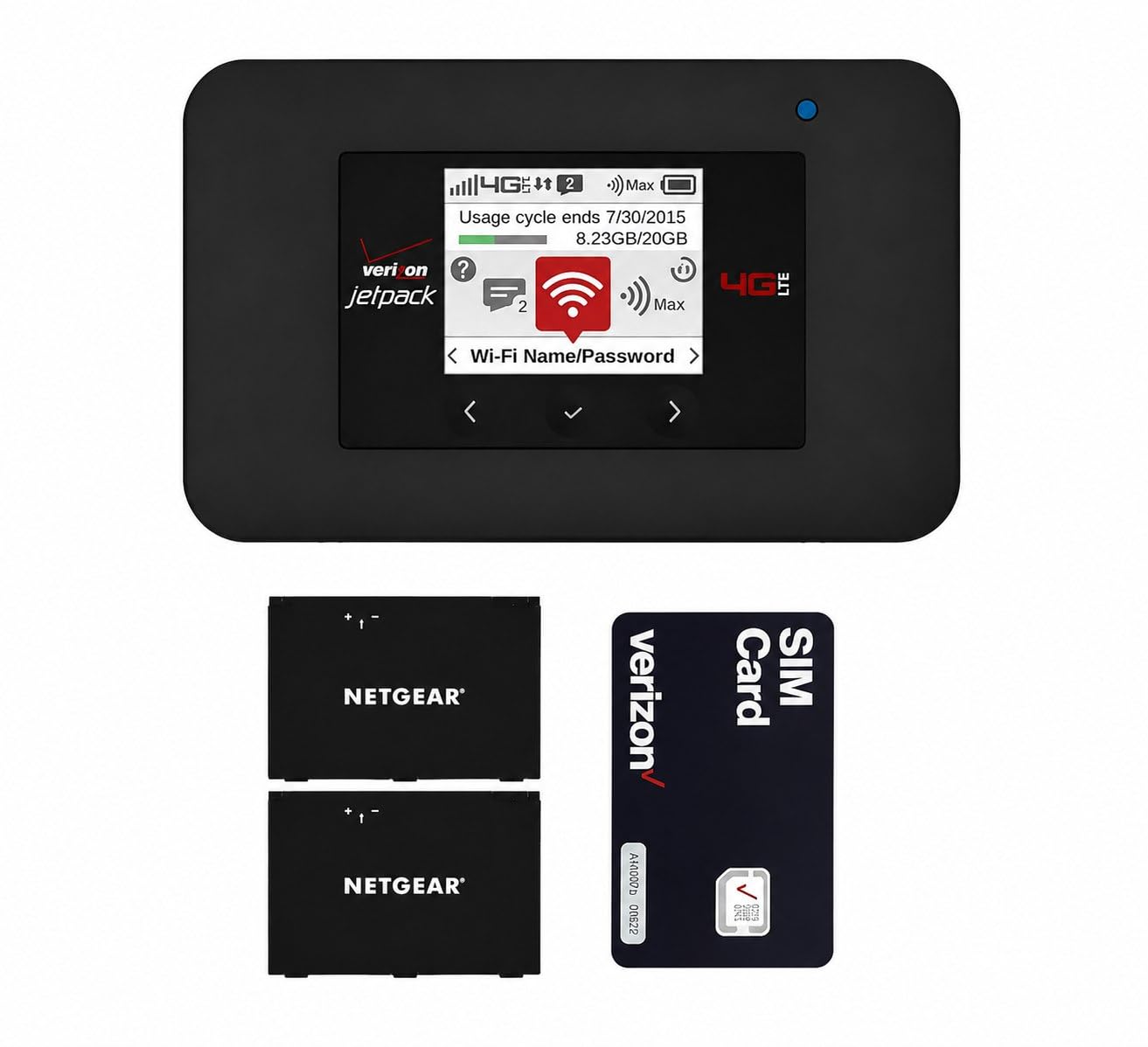
Two batteries, twenty hours and a socket for an external antenna — the RV crowd’s favourite.
Where most of these devices sweat battery anxiety, this one leans into it. The 4340mAh battery is rated for up to 20 hours of active use and 48 hours of standby, and it ships with two batteries for extended use. It can also work as a power bank to top up your phone, which is a genuinely useful second job when you are off-grid.
It is built for hard use. A 1.77-inch LCD display with sensor buttons shows network status, data usage and settings, and a soft-touch coating keeps it grippable. It is open up in over 180 countries and supports 5 LTE and 4 3G bands, so it works with Verizon, AT&T, T-Mobile and most US carriers. It links to 15 Wi-Fi devices at once.
The part serious travellers notice is the two MIMO connectors (ports for an external antenna, sold separately). In poor-signal areas you can add one and reach where a bare hotspot cannot. The honest trade-off: this needs an APN setup for some carriers and a data plan for USA use, so it is not the plug-and-play option the eSIM units are.
The standout: 20 hours of active use and two batteries beat every other pick here on sheer runtime.
The catch: setup is more hands-on, with APN configuration on some networks and a data plan required.
Right for you if: you want runtime over everything and may add an antenna for weak-signal terrain.
Skip the hassle if: you want to land, power on and be online without touching settings.
6. Linklan eSIM Global WiFi Hotspot
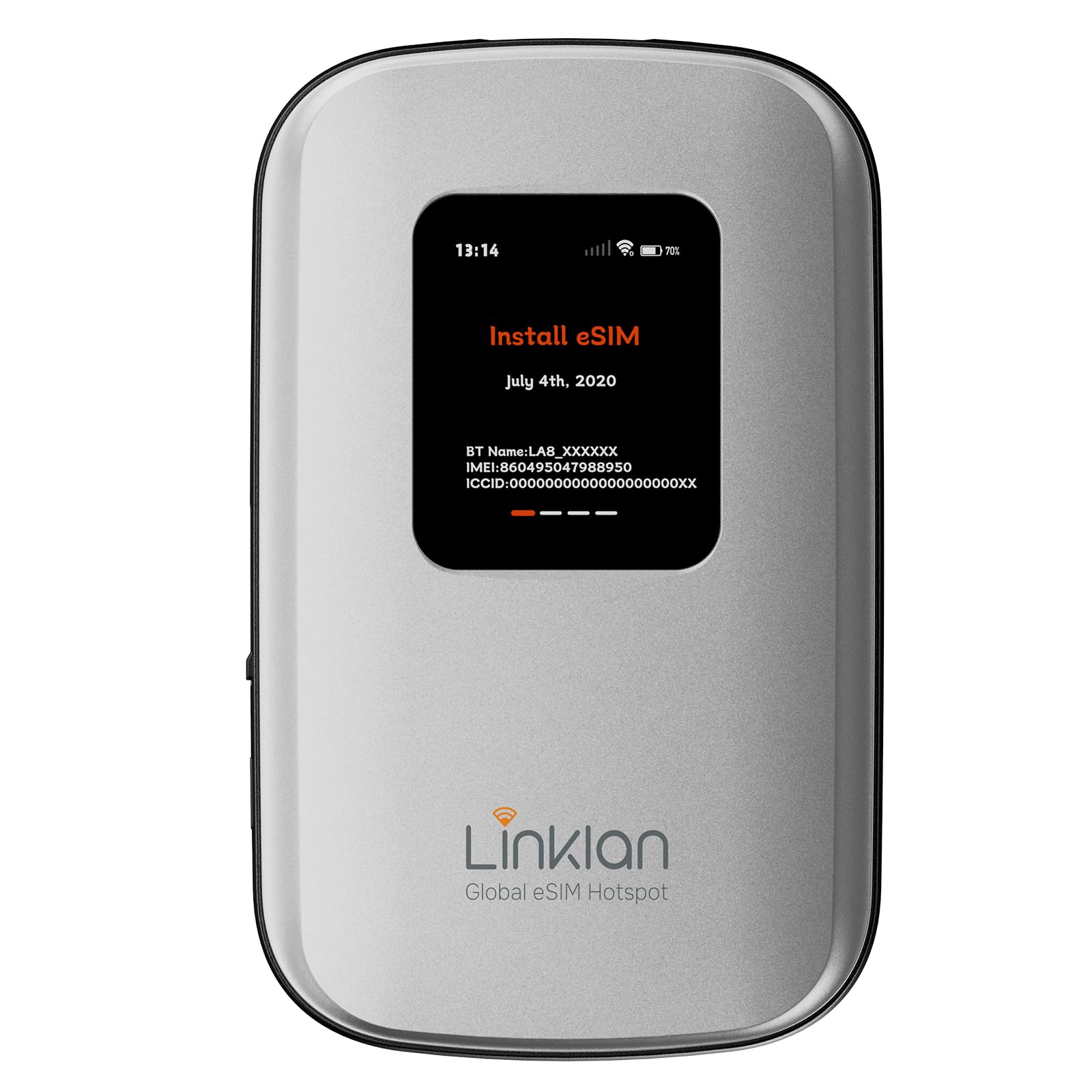
Sixteen devices, a 5000mAh tank and a five-minute eSIM activation before you board.
If you travel with a team, this is the headroom pick. It supports up to 16 devices at once — double the 8 on the GlocalMe UPP — so a whole hotel room of laptops and phones can share one link. Coverage runs across 180+ countries and regions with support for 30+ global frequency bands, which is what helps it find a usable network in unusual places.
Battery is a 5000mAh cell rated for 12+ hours of continuous use and a full recharge in about 5 hours. Speed is dual-band Wi-Fi up to 300 Mbps, with peak speeds up to 433Mbps on the eSIM side. Activation is GSMA-compliant eSIM (a certified virtual SIM standard), and you can trigger a local plan in about 5 minutes through the app.
One important detail: the Wi-Fi here runs on a 2.4 GHz single-band frequency. That is the wider-reaching band, good through walls and across a campsite, but it is not the faster 5 GHz lane some rivals use. You also get a physical SIM slot and a 4G-to-WAN/LAN mode if you need a wired option.
What it solves: 16 devices and a 5000mAh battery make it the pick for crews, temporary offices and families who all need a seat.
What to know: the 2.4 GHz band trades some top speed for reach — fine for browsing and calls, less so for the fastest downloads.
Pick it when: device count and battery capacity matter more than peak speed.
Look past it when: you want the fastest single-user throughput.
7. SIMO Solis 5G WiFi Mobile Hotspot

The only 5G pick here, wrapped in an IP54 shell and backed by monthly lifetime data.
This is the one that leans modern. It runs 5G and 4G LTE across 135+ countries, connects automatically to the strongest available carrier, and includes 1GB of global data every month as a lifetime plan. There is a SignalScan feature that lets you switch to a stronger carrier by hand if the automatic pick disappoints. It carries Wi-Fi 6 on a dual-band setup, with a LAN port at 1 Gbps.
The build is what separates it from the plastic sticks. An IP54 rating (a standard that means it is shielded from dust and water splashes) keeps it working when you get caught in the rain, and it is ruggedized against drops. A 2.4-inch LCD touch screen shows data usage, signal strength and Wi-Fi credentials at a glance, so you can check your remaining data without opening an app. It doubles as a power bank when your phone runs low, and it supports 16 devices — enough for your phone, laptop, and the kids’ tablets at once.
Buyer feedback on connectivity is mixed: some praise the automatic carrier switching, others report dead zones on their routes. Some find reliability and value inconsistent, with reports that it does not work everywhere and that the cost feels high for what you get. It suits buyers who want 5G and a rugged body, provided their destinations fall inside its 135+ country list.
The 5G case
- Only pick here with 5G, plus 4G LTE fallback
- IP54 ruggedized against dust, splashes and drops
- 1GB of global data every month on a lifetime plan
- 2.4-inch touch screen and power-bank function
The fit check
- Reliability feedback is mixed — some routes see weaker coverage
- 135+ countries is narrower than the 200+ on the GlocalMe units
Worth it for: 5G speeds and a rugged body you can toss in a rucksack.
Check first: your destination list, since 135+ countries is fewer than some rivals offer.
8. NETGEAR Nighthawk M7 Pro Mobile Hotspot 5G mmWave

A multi-gigabit 5G powerhouse built for 64 devices and an 8K screen on the road.
The specs read like a home router in your hand. A 10 gigabits-per-second transfer rate and 5G mmWave (the high-frequency 5G lane built for short-range speed) put it in a different class from the 390 Mbps MeowGo and the 150 Mbps Topmifi. It handles 8K gaming, streaming and video calls, and it covers up to 2,000 square feet — enough to blanket a house or a large rental.
Connectivity is WiFi 7 with an exclusive 6 GHz band, which is the cleaner lane that avoids congestion from older devices. It is open up for AT&T and Verizon and built for international travel, with 64-device support and security tools like URL filtering, device blocking and an LCD passcode. It is a serious piece of kit for a family, a small office or a heavy user who cannot tolerate a slow line.
The trade-off is straightforward: this is the most capable and the most costly device on the list, and 64 devices is far more headroom than a solo traveller needs. It is also a renewed unit, so check the warranty terms before you buy.
The speed ceiling: 10 Gbps and WiFi 7 make this the pick when everything else feels slow.
The reality check: you pay for that headroom, and a single traveller will never use 64 device slots.
For heavy usage: a household, office or off-grid workstation that needs router-class throughput.
Overkill for: one person with a phone and a tablet.
Know the Specs
Max Download Speed (Mbps)
Mbps stands for megabits per second — the rate the data flows to your device. Higher means smoother video calls, quicker uploads and less buffering. The range here runs from 390 Mbps on the MeowGo to 150 Mbps on the Topmifi, up to the 10 Gbps Nighthawk. Match the Mbps figure to your heaviest task — 4K streaming or large uploads — not to email and maps.
Coverage Countries
The country count tells you where the device is allowed to connect on a local network. Look for how many countries and regions a unit lists, and whether it names carriers. A device covering 200+ countries gives you more options if your plans change mid-trip than one covering 140+.
Battery Hours and mAh
Milliamps (mAh) describe the battery’s size; the hour rating is what you feel. A 4340mAh battery rated for 20 hours outlasts a 3000mAh cell rated for 12. Use the hour figure to decide whether one device covers your longest day away from an outlet.
Connected Device Limit
This is how many phones, laptops and tablets share one connection at once. Ranges here go from 8 devices up to 64. Pick a device limit above your real count so nobody gets bumped when everyone opens a map or call at once.
Common Questions
Will a worldwide hotspot work without a physical SIM card?
Is a global hotspot better than buying a local SIM when I arrive?
How many devices can share one hotspot connection?
How long does the battery last on a worldwide hotspot device?
What is preloaded data and do I still need to buy a plan?
Will my worldwide hotspot double as a power bank?
Does a worldwide hotspot work on a cruise or in an RV?
What speed do I actually need for video calls and streaming?
Can I use a US data plan and international plans on the same hotspot?
What does an IP54 rating mean on a travel hotspot?
The Bottom Line
For most travellers, the best worldwide hotspot device is the GlocalMe MeowGo G40Pro, because it balances 200+ countries and regions with 390 Mbps speed and over 15 hours of use. If you want a bigger starter data bundle and the simplest arrival, the Global Pocket WiFi T8 ships with 10GB ready to go. And if runtime is your priority, the Verizon Jetpack delivers up to 20 hours of active use. Whatever you choose, check the country list against your route first — a hotspot that lacks your destination is dead weight.
How we choose
We do not accept paid placement. Every pick is matched to a real buyer and a real use-case; we do not hands-on test units.
Sources
Specifications: manufacturer listings and product documentation. Review insights: verified customer reviews, as of November 2026. Pricing: not shown on this page (it changes often); check the current price via the retailer link.
As an Amazon Associate, Tactical Gear Guy earns from qualifying purchases. This does not affect which products we feature.