Specs are compiled from manufacturer listings and verified buyer reviews and can change over time — please confirm the key details on the product page before buying.
You shine the light, and the answer either glows green or it does not. That is the whole appeal of a Wood’s lamp for exam work — a handheld ultraviolet source that makes fungus, pigment and fluorescence show up as a colour your eye can read. The catch most buyers hit is that a decorative blacklight poster lamp and a real 365 nm exam lamp look identical in a product photo. This guide separates them, pick by pick, so you know exactly which unit belongs in a clinic room, a salon station or a pet carrier.
This guide is built by comparing the manufacturers’ published specifications and the patterns across verified customer reviews, so you get each pick’s real strengths and trade-offs instead of marketing spin.
Below you get the wavelength, the filter and the build quality that decide whether fluorescence actually reads. Every entry here is a genuine ultraviolet exam tool, and the roundup of the best Wood’s Lamp for Exam is built around what each one does in a darkened room.
Top Picks


How To Choose The Best Wood’s Lamp for Exam
Three things decide whether a Wood’s lamp (a UV lamp that makes skin conditions glow under a specific wavelength) works for you: the wavelength it emits, whether it filters out ordinary room light, and how you plan to hold it while you work. Get those right and the rest is convenience.
Wavelength first, everything else second
A Wood’s lamp works because certain substances fluoresce under long-wave ultraviolet. The wavelength you want is 365 nm, and it needs to be labelled clearly. A lamp that only says “UV” or “blacklight” may be emitting mostly visible violet, which washes out the fluorescence you are trying to see. Look for 365nm printed in the specs before anything else.
The filter is what makes it readable
A black glass filter sits over the emitters and blocks stray visible light. That sounds like a small detail, but it is the difference between a clean purple beam and a hazy wash. With the filter, a fluorescent patch stands out sharply against surrounding skin. Without it, you are squinting.
Handheld lamp or pen light
A full handheld lamp gives you a ring of emitters, a magnifying lens and a comfortable grip for longer sessions. A pen light slips into a pocket, runs on a rechargeable cell and works well for quick checks on the move. Neither is wrong — it depends on whether you are doing a careful exam or a fast screen.
Side-by-Side Comparison
| Model | Best For | Wavelength / Output | Power | Magnifier | Amazon |
|---|---|---|---|---|---|
| Wood’s Lamp M5130★ Best Overall | Everyday clinical exams | 365 nm central UV | Rechargeable, USB-C | Built-in central lens | Amazon |
| NEXTORCH K33 UV Pen LightPocket Carry | Pocket carry and field checks | 365 nm, 1300 mW | Rechargeable, USB-C | — | Amazon |
| HONGWAYE DW-200 Skin Analyzer | Pet ringworm screening | 16 blue LEDs, UV | 4W power supply | 2.5x lens | Amazon |
| SKINACT Wood’s Lamp Facial Unit | Skin-type analysis | Violet UV rays | — | — | Amazon |
| Avidaril Wood’s Lamp Skin Analyzer | Salon and pet dual use | 365 nm UV bead | Rechargeable, USB-C | HD magnifying lens | Amazon |
Detailed Reviews
1. Wood’s Lamp M5130
Our pick — 4.5+★ from 500+ verified ratings; the strongest balance of quality and price.
A ring of UV emitters behind black glass, with a magnifier in the middle.
The M5130 is built the way a working exam lamp should be. Its core light is a 365 nm ultraviolet source, and the emitters sit in a circle around a central glass lens. That lens protects your eyes from the UV while letting you look straight down into the area you are checking. A 1.5-inch base diameter keeps the footprint small on a counter.
What wins people over is the black glass filter covering every emitter. The glass passes UV freely but cuts visible light, so the beam stays clean and a fluorescent patch reads as a bright mark instead of a blur. The magnifier turns that mark into something you can actually inspect — useful when you are looking for trace fluorescence rather than a broad glow. The filter is the reason a fluorescent patch reads as a sharp mark rather than a hazy wash.
Power comes from a rechargeable battery with a TYPE-C port, and a charging cable ships in the box. There is no power cord to trip over mid-exam. Three timer settings — 10 minutes, 30 minutes and 1 hour — let the lamp switch itself to standby, and the 10-minute default suits most short checks. Expect to plug it in more often than you would like if you run long sessions; battery endurance is the recurring gripe. The 4.5+ star score across 500+ ratings reflects a device buyers lean on, not a novelty.
What earns its place
- 365 nm central UV with a ring of filtered emitters for clean fluorescence
- Built-in magnifying lens behind the glass for close inspection
- Rechargeable USB-C power with no cord in the way
- 10-minute, 30-minute and 1-hour auto-standby timers
Where it asks patience
- Battery runtime is the most-discussed shortcoming; heavy days mean frequent charging
- Reviewers who mention weight are split on it, and the heft is noticeable during long handheld exams
Reach for this if: you want a filtered, magnified 365 nm lamp that handles routine skin and ringworm checks without a power cord.
Look elsewhere if: you need a full shift of uninterrupted runtime or a featherweight body for hour-long handheld work.
2. NEXTORCH K33 UV Pen Light
The pen that disappears in a pocket until you need a clean UV beam.
If your exam happens wherever the animal happens to be, a pen light makes more sense than a bench lamp. The K33 measures 5.66 inches long by 0.62 inches wide and 0.51 inches tall, so it rides in a shirt pocket or a kit pouch. Compare that to the HONGWAYE at 2 by 3.94 by 9.47 inches and the size gap is enormous — one clips away, the other needs a case.
It pushes a pure 365 nm beam at up to 1300 mW, which is a lot of ultraviolet in a body this small. A fine Woods Glass filter strips out stray ambient light, so fluorescent details stay legible instead of getting drowned in room glow. The housing is aircraft-grade aluminum with IPX7 water resistance (that means it survives a dunking) and 1-meter impact resistance. A tail switch gives you momentary activation when you only need a brief flash.
Where it falls short of the M5130 is the viewing experience: there is no magnifier here, so you are reading fluorescence with the naked eye. That is fine for spotting a glow on a coat or a document, less ideal for studying a skin lesion up close. Still, the 5-year warranty and USB-C charging make it a low-drama tool to keep on you. Its rating base is smaller than the top pick’s, which is note for a device you plan to rely on.
Built for the road: aluminum body, IPX7 water resistance and 1-meter drop tolerance mean this one takes knocks the bench lamps would rather avoid.
The honest trade: no magnifying lens and a modest review history — you are buying portability and output, not a full examination station.
Best paired with: mobile vet calls, home pet checks and field inspections where a bench lamp never leaves the car.
Not the tool for: close-up lesion study — the missing magnifier makes fine fluorescence harder to read.
3. Woods Lamp Skin Analyzer, Easy to Hold and Carry Around
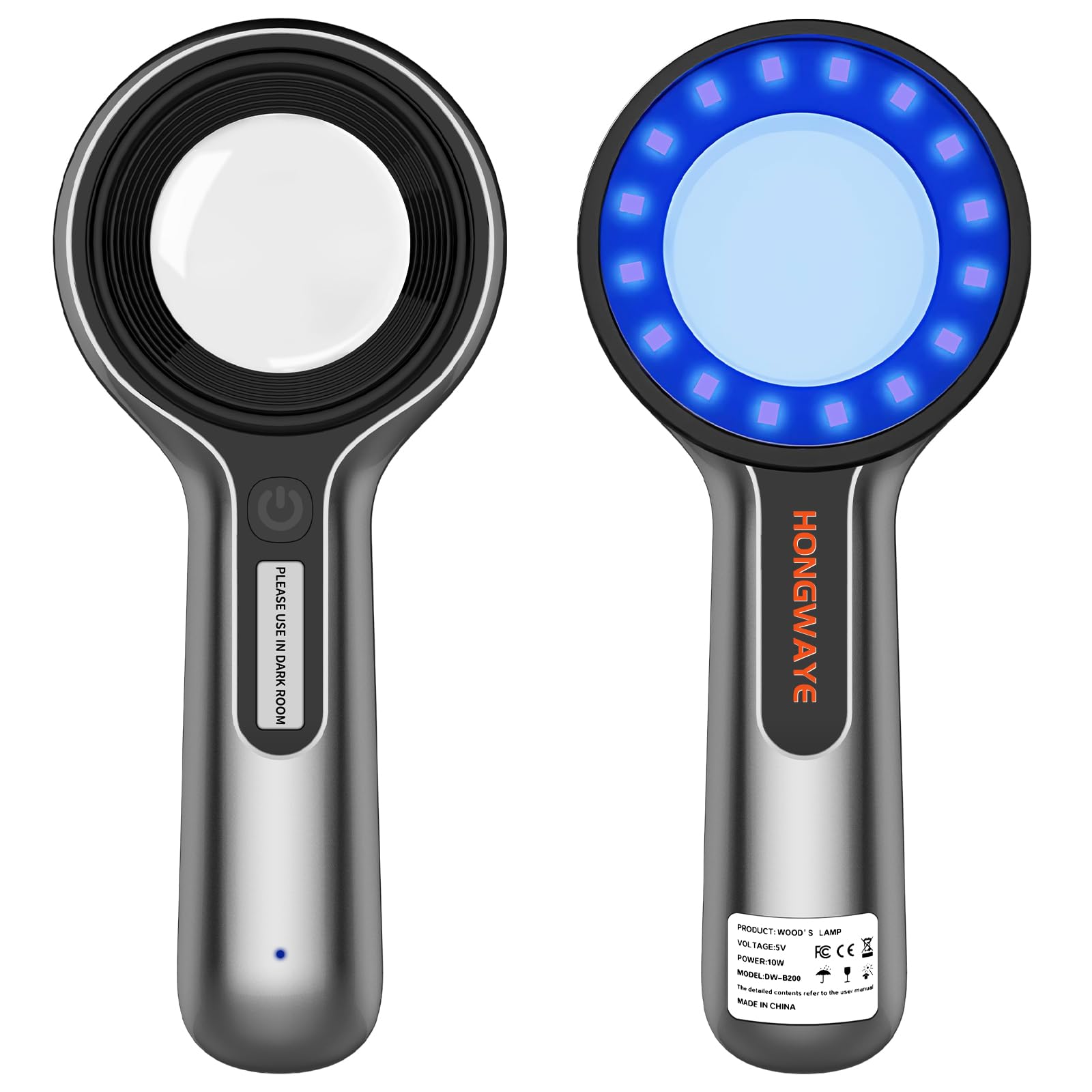
Sixteen LEDs around a 2.5x lens, aimed squarely at cat ringworm.
This HONGWAYE unit, model DW-200, is designed for one job first: checking cats for ringworm under black light inspection. Sixteen high-brightness blue LEDs form a ring around the lens, so the area you are examining lights evenly. A 2.5x transparent magnifying lens sits in the middle, which is the highest magnification in this lineup and makes a small fluorescent patch much easier to judge.
It weighs 355 grams — the spec sheet also lists 12.48 ounces — and that modest weight is the point. A grip shaped for one hand and a power button placed under your thumb let you work with a squirming animal in the other arm. Output maxes at 10 lumens. Running on a 4W power supply with the included power cable means no battery anxiety, but it also means you are tethered to an outlet when you work.
One button under the thumb runs the whole lamp, so there is nothing to configure mid-exam. The handle is shaped for one-handed grip, with the head angled down toward the animal. The real caveat is the cord: for home pet care at a fixed table that is fine, but for mobile veterinary work the 4W supply becomes a leash. With 4.5+ stars across a smaller set of ratings, the early owners are clearly happy with what it does.
Why it suits pet checks: the 2.5x lens and 16-LED ring give you even light and real magnification in one pass.
Where the cord bites: 4W power supply means an outlet, so this lives on a bench rather than in a bag.
Made for: groomers, breeders and pet owners screening cats for ringworm at a fixed station.
Think twice if: you need a cordless lamp for house calls — the power cable anchors it to a socket.
4. SKINACT Wood’s Lamp Facial Unit

A facial-analysis unit that has been on the shelf since 2011.
SKINACT has been selling this unit since July 2011, which makes it the longest-established pick here. It is a facial-analysis unit: violet rays reveal skin substances so you can sort skin types and surface conditions. If your exam routine is salon-style skin analysis rather than a quick ringworm screen, the form factor fits that setting.
The honest picture is mixed. The unit’s reliability and overall quality are the two things buyers discuss most, and opinion splits both ways — some find it works well, while others report it stopped working after 4 months of use. That split is consistent with a device this old in a category that has moved on. The package measures 13.2 by 8.8 by 3.2 inches and weighs 2 pounds, making it bulkier than the Avidaril at 11.42 by 6.14 by 2.05 inches.
There is no magnifier and no rechargeable battery listed, so you are working in a simpler, plug-and-look way. It rates 3.5+ stars, the lowest on this list, which is a fair signal to weigh before buying. As a result of that mixed record, it suits buyers who want a dedicated facial-analysis unit and accept that reliability may vary unit to unit.
The case for it: a purpose-built facial unit with a long production history and violet UV output for skin-substance analysis.
The catch to weigh: mixed reports on quality and reliability, with some units failing within months — buy with the understanding that longevity is not guaranteed.
Consider it for: a facial-analysis station where you want a single-purpose violet unit.
Look at the top pick instead if: consistent reliability and a magnifier matter more than the facial-specific form.
5. Wood’s Lamp Skin Analyzer
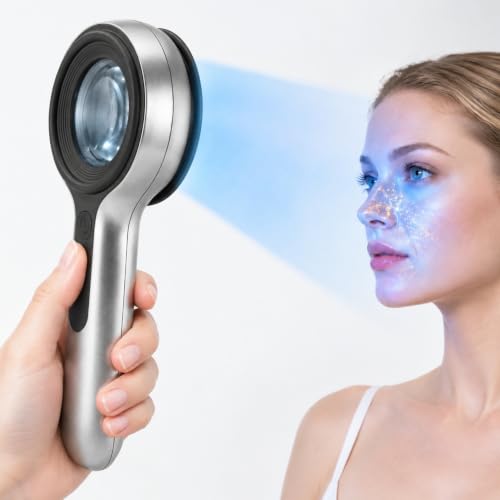
One lamp for the treatment room and the dog bed.
The Avidaril unit is the newest design in this group and is pitched at two buyers at once. Its 365 nm UV bead makes superficial pigmentation and fine surface texture fluoresce for the esthetician. The same beam works for observing fungal-related fluorescence on cats, dogs and other household pets. It is a genuine 365 nm source, not a visible-violet substitute.
A built-in HD magnifying lens enlarges tiny lesions and pigment spots for close inspection. Power comes from a USB-C rechargeable lithium battery, which removes the cost and fuss of swapping cells. One-button operation with no warm-up means you switch it on and look. At 1.01 pounds it moves easily between workstations or into a pet carrier.
Two things to keep in mind. The package measures 11.42 by 6.14 by 2.05 inches — noticeably more compact than the SKINACT’s 13.2 by 8.8 by 3.2 inches, which helps on a crowded station. And the review pool is still small, so you are buying a newer design on spec rather than on a long track record. If a fresh, rechargeable dual-purpose lamp with a magnifier is what you want, this delivers it.
The draw: 365 nm output, an HD magnifier and USB-C charging in one compact body that works on people and pets.
What to accept: a short review history, so there is less real-world evidence than the established picks carry.
Suits you if: you split your time between skincare treatments and pet checks and want one rechargeable lamp for both.
Otherwise: buyers who want a proven track record will prefer the top pick’s larger rating base.
Know the Specs
Wavelength (nm)
A Wood’s lamp works because a specific slice of ultraviolet makes certain substances fluoresce. The number you want is 365 nm, long-wave UV that reads skin and fungal fluorescence cleanly. A lamp with unspecified violet output may be mostly visible light, which glows but does not reveal the underlying condition. Always check that 365nm is stated.
Output (mW) and Light Source
The output rating in milliwatts (mW) tells you how much ultraviolet the emitter pushes out. A higher figure like 1300 mW means a stronger beam for distance work; a lower output with a ring of LEDs suits close bench work. Wattage on a power-supply unit like the 4W DW-200 refers to draw from the outlet, not beam strength — do not read it as brightness.
Magnifier Power (x)
Magnification tells you how much the lens enlarges what you see. A 2.5x lens makes a small fluorescent patch noticeably bigger, which helps when you are judging a lesion on a squirming cat. Units without a lens rely on your eyes alone, which is fine for a quick glow check but less useful for close study.
Power Source
Rechargeable USB-C means no cord during the exam and no battery swaps. A power-supply unit with a cable means steady output but a tether to an outlet. Pick between cordless freedom and unlimited runtime by where you actually work — bench or field.
Common Questions
Does 365nm really matter for a Wood’s lamp exam?
What does a black glass filter do on a Wood’s lamp?
Can I use a Wood’s lamp to check a cat for ringworm?
Is a pen light or a handheld lamp better for exams?
How long does the battery last on a rechargeable Wood’s lamp?
Do I need a magnifying lens for a Wood’s lamp?
Is a Wood’s lamp safe to use on skin and pets?
How much does a reliable Wood’s lamp cost?
Will a Wood’s lamp work in a bright room?
What is the difference between a Wood’s lamp and a nail UV lamp?
The Bottom Line
For most people, the wood’s lamp for exam winner is the Wood’s Lamp M5130 because it pairs a filtered 365 nm central UV source with a built-in magnifier and cordless USB-C power. If you need a tool that rides in a pocket on field calls, the NEXTORCH K33 gives you 1300 mW of UV in a 5.66-inch body. For pet ringworm screening at a fixed station, the HONGWAYE DW-200 brings a 2.5x lens and a 16-LED ring. The M5130’s larger rating base makes it the safest starting point — a proven, filtered lamp you can rely on for routine checks.
How we choose
We do not accept paid placement. Every pick is matched to a real buyer and a real use-case; we do not hands-on test units.
Sources
Specifications: manufacturer listings and product documentation. Review insights: verified customer reviews, as of November 2026. Pricing: not shown on this page (it changes often); check the current price via the retailer link.
As an Amazon Associate, Tactical Gear Guy earns from qualifying purchases. This does not affect which products we feature.