Specs are compiled from manufacturer listings and verified buyer reviews and can change over time — please confirm the key details on the product page before buying.
Buy the saw that matches the cut you make most often. If you are trimming shelves, notching deck boards, or framing a shed, the wrong tool turns a ten-minute job into an afternoon of splintered edges and burned blades. This guide sorts nine saws by the job each does best, from jig saws for curves to miter saws for repeated angles.
This guide is built by comparing the manufacturers’ published specifications and the patterns across verified customer reviews, so you get each pick’s real strengths and trade-offs instead of marketing spin.
A jig saw handles curves, a circular saw handles straight rips, and a miter saw handles clean crosscuts, so the first decision is the cut shape rather than the brand. Below you will find the wood cutting saw that fits your bench, your material, and the way you actually work.
Top Picks


How To Choose The Best Wood Cutting Saw
Start with the cut, not the catalog. A saw that makes the wrong shape of cut is useless no matter how much power it carries. Three families cover almost every wood job: the jig saw for curves and cutouts, the circular saw for straight rips and crosscuts, and the miter saw for repeated angled crosscuts on trim and framing stock.
Match the blade to the depth you need
A bigger blade reaches deeper into the wood. A 7-1/4-inch circular saw is the standard framing size, and a 4-1/2-inch compact model trades depth for control and portability. If you plan to cut thick posts or stacked lumber, check the maximum cut depth at 90 degrees before you commit — that single number decides whether the saw can finish the cut in one pass or forces you to flip the board.
Read the amp rating on corded saws
Amps measure how much electrical current the motor pulls. A 15-amp motor holds its speed through dense hardwood better than a 5-amp motor, which will slow and heat up when pushed. For light trim and plywood, a lower-amp saw is fine and lighter in your hand. For repeated rips in wet pressure-treated lumber, the higher amp draw keeps the blade moving.
Decide whether the cord is a problem
A corded saw gives you constant power with no charging wait, which suits a bench or a driveway. A cordless saw with a battery pack frees you to work on a roof, a fence line, or a remote deck with nothing to trip over. The trade is runtime: a cordless model depends on the pack you carry, and heavier cutting drains it faster.
Check the bevel range for angled work
Bevel is the tilt of the blade away from a square cut. A 45-degree bevel covers most trim and corner work, and a wider range like 50 or 56 degrees gives you more room on steep angles. If your projects are all square cuts, the bevel number matters far less than blade depth and motor strength.
Side-by-Side Comparison
| Model | Best For | Saw Type | Motor / Speed | Bevel Range | Amazon |
|---|---|---|---|---|---|
| BLACK+DECKER Jig Saw BDEJS600C★ Best Overall | Curves and cutouts | Jig saw, corded | 5 A / 3,000 SPM | 45 degrees | Amazon |
| Enventor Circular SawFastest Spindle | Fast straight cuts on a budget | Circular saw, corded | 10 A / 5,800 RPM | 0 to 45 degrees | Amazon |
| SKIL 5180-01Best Daily Driver | Everyday framing and ripping | Circular saw, corded | 14 A | 51 degrees | Amazon |
| WEN 3625 | Small spaces and mixed materials | Compact circular saw, corded | 5 A / 3,500 RPM | 0 to 45 degrees | Amazon |
| SKILSAW SPT67WL-01 | Professional-grade framing | Circular saw, corded | 15 A | 56 degrees | Amazon |
| WORKPRO 20V Mini Circular Saw | Cordless trim and DIY | Compact circular saw, cordless | 20 V / 4,500 RPM | 0 to 45 degrees | Amazon |
| MarvTool 10-inch Compound Miter Saw | Trim and crosscuts | Miter saw, corded | 15 A / 5,000 RPM | 0 to 45 degrees | Amazon |
| Metabo HPT C10FCG2 | Repeated angle cuts | Miter saw, corded | 15 A / 5,000 RPM | 0 to 45 degrees | Amazon |
| CRAFTSMAN V20 CMCS500M1 | Portable crosscutting | Circular saw, cordless | 4,000 RPM | 50 degrees | Amazon |
Detailed Reviews
1. BLACK+DECKER Jig Saw BDEJS600C
Our pick — 4.5+★ from 11,000+ verified ratings; the strongest balance of quality and price.
The curve-cutting specialist that handles everything a straight saw cannot reach.
A jig saw is the tool you reach for when the line you drew is not straight. This one runs a 5-amp motor up to 3,000 SPM (strokes per minute, meaning how many times the blade travels up and down each minute), so it chews through pine and plywood without stalling. Four curve settings let you dial in how aggressively the blade orbits, which is what keeps a tight radius smooth instead of splintered.
The 3/4-inch orbital blade action (a forward-and-back kick that adds cutting force) is the reason it does not bog down in thicker stock. Set it shallow for clean edges on veneered plywood, then open it up when you need to plow through a countertop cutout. The beveled shoe tilts to 45 degrees, so you can angle a cut into a corner without reaching for another tool. Its rubber handle keeps your grip steady through all of it.
What wins people over is how little fuss the tool demands — the ease-of-use verdict is far and away the most-praised thing about it, with cutting performance right behind. It weighs 4.6 pounds, which sits 4 pounds under the 8.6-pound SKILSAW SPT67WL-01, so you can hold it overhead for a ceiling cutout without your arm quitting. And it pulls the same 5 amps as the BLACK+DECKER jig saw’s direct corded competitor class, meaning it draws modest power while still slicing fast.
Where It Earns Its Keep
- Four curve settings give you real control over rounded cuts in cabinetry and decking.
- 3,000 SPM of variable speed lets you start slow in delicate material and speed up in framing lumber.
- 45-degree bevel plus an adjustable shoe with wire guard keeps your sightline clear.
- At 4.6 pounds it is light enough for overhead work that a full circular saw makes miserable.
What To Know Before You Buy
- Blade durability draws the only negative read — plan on replacing jig saw blades as they dull.
- The 3/4-inch orbital stroke is built for curves and cutouts, not long straight rips.
Best for: Anyone cutting curves, notches, sink cutouts, or shapes that a circular saw physically cannot follow.
Look elsewhere if: Your whole project is long straight rips in 2x lumber — a circular saw finishes those faster.
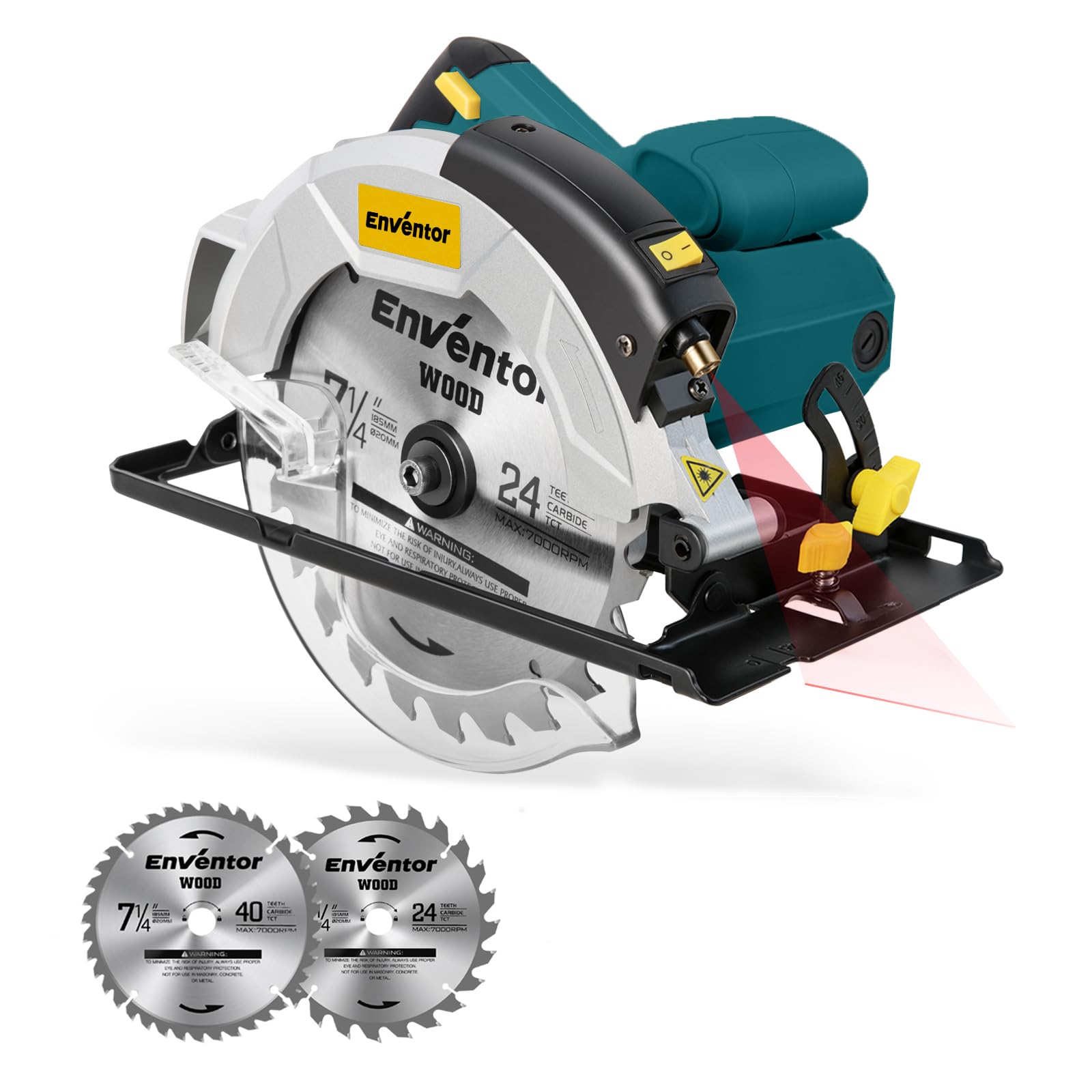
2. Enventor Circular Saw with Laser Guide
A 10-amp motor that spins faster than almost anything else on this list.
Speed is the headline here. The pure copper motor turns the 7-1/4-inch blade at 5,800 RPM, which is 2,300 RPM above the WEN 3625’s 3,500 RPM. In plain terms, the blade makes more passes per minute, so each tooth bites less and the cut stays cooler and quicker through laminate flooring and dry wood.
You get two blades in the box: a 24-tooth for fast framing cuts and a 40-tooth for smoother finish work. Swap between them with the rear axle lock button, which holds the spindle still while you loosen the bolt. The cutting depth reaches 62mm at 90 degrees and 42mm at 45 degrees, so you can set the shoe for a clean through-cut or a shallow groove.
The integrated laser guide throws a line down the middle of your mark, and the scale ruler on the base backs it up. A double protection switch means the power switch and the trigger both have to be engaged before the blade spins, which is the kind of safety detail that matters when you are reaching across a sheet. Owners consistently rank build quality at the top of what they like about it, with raw performance close behind.
The catch is the footprint. With a 6.56-foot cord and a laser that needs its two AAA batteries, this is a bench-and-driveway tool rather than a roof tool. The laser is a guide, not a guarantee — check your line against the blade on the first cut of a session.
Speed-to-cost read: If fast straight cuts in sheet goods and laminate are your whole job, this spins harder than the compact saws here and ships with both blades you need.
The honest limit: It is a corded 10-amp saw, so it will not match the 15-amp SKILSAW SPT67WL-01 in sustained torque through wet pressure-treated lumber.
Reach for this if: You want the quickest spindle speed in this group without paying premium money.
Think twice if: You need to cut away from an outlet — the cord and battery-fed laser both tie you to a power source.
3. SKIL 14 Amp 7-1/4-Inch Circular Saw 5180-01
Fourteen amps of framing muscle in a body light enough to carry all day.
The motor is the reason to pick this one. At 14 amps it holds speed through stacked lumber and repeated rips in a way the 5-amp compact saws in this group cannot. SKIL built it to shed weight too — it trims 15% off the older SKIL 5480 model, so the saw travels between cuts without dragging on your wrist.
The 51-degree bevel with a positive stop at 45 degrees is a real advantage over saws that cap at 45. That extra range means you can cut steep angles on stair stringers and rafter tails without resorting to a second tool. The included 20-tooth carbide blade is a workhorse for framing, and the improved dust blower keeps sawdust off your cut line so you can actually see where the blade is going.
What buyers value most is the money-to-capability ratio — value for money is the leading theme, with straightforward functionality right behind it. It starts, tracks, and cuts without fuss. The honest note is on cut quality and durability, where the feedback splits: plenty of buyers report smooth, no-bog cuts while others find it needs more patience to track a clean line. Some of that is technique and blade choice rather than the saw itself.
At 7.2 pounds it sits between the light compacts and the heavier professional models, which makes it a reasonable bench saw for someone who frames on weekends and hangs shelves on weeknights.
Why It Suits A Busy Bench
- 14 amps drive the blade through thick stock without the stall you get from small motors.
- 51-degree bevel with a 45-degree positive stop covers steep framing angles.
- Dust blower keeps the cut line visible so you steer the saw instead of guessing.
- 15% lighter than the model it replaces, which adds up over a long day.
The Trade-Offs Worth Knowing
- Cut quality feedback is mixed — a sharp carbide blade and steady feed solve most of it.
- It is corded, so long rips across a yard need an extension cord and a plan.
The verdict: A sensible mid-tier circular saw for someone who frames, decks, and shelves in the same week and wants the amps to back it up.
skip it if: You only ever cut small plywood panels — a lighter compact saw asks less of your arm.
4. WEN 3625 5-Amp 4-1/2-Inch Beveling Compact Circular Saw

The saw that fits where a full-size circular saw simply will not go.
This is a small saw with a wide job list. The 5-amp motor spins the 4-1/2-inch blade at 3,500 RPM and cuts up to 1-11/16 inches deep, which is enough for most trim, subfloor patching, and sheet goods. It also handles tile, drywall, sheet metal, ceramic, and PVC, so it earns its drawer space outside of woodworking too.
The included laser lights the cut line, and the base bevels from 0 to 45 degrees. A 24-tooth carbide-tipped wood blade comes in the box along with a dust extraction tube and a carrying case, so you are cutting the day it arrives. For a saw in this footprint the package is unusually complete.
Build quality is the standout — the material feel and fit are praised more than any other trait, with raw power the second theme. It is small enough to hold one-handed in tight spots and the case makes it easy to toss in a truck. Honest caveat: cutting performance gets a mixed read, and a recurring gripe is that square 90-degree cuts can wander if the base is not locked down carefully. Set your depth and bevel, confirm the shoe is tight, and it tracks straight.
Compared with the Enventor, this one is far slower at the spindle — 3,500 RPM against 5,800 RPM — but it reaches into corners and cabinets the bigger saw cannot touch.
Where it shines: Tight spaces, mixed materials, and anyone who wants a complete kit with a case instead of buying a blade separately.
Set-up matters: Lock the base and check the bevel before a critical square cut; the 1-11/16-inch depth limit means thick posts need a flip.
Your pick if: You work on cabinets, patch jobs, and small cutouts where a full-size saw is physically too big.
Not your pick if: You are framing a wall — this one reaches 1-11/16 inches, not through a full 2×4 in one pass.
5. SKILSAW SPT67WL-01 15 Amp 7-1/4 In. Sidewinder Circular Saw

Framing-grade power carried in the lightest body in its professional class.
Two numbers tell this story. The 15-amp motor triples the BLACK+DECKER jig saw’s 5-amp draw, so it holds torque through wet lumber and repeated rips where a smaller motor sags. And at 8.6 pounds it is the lightest professional circular saw in its class according to the maker, which is what makes a full day of overhead and ladder work tolerable.
The dual-field motor is the detail worth understanding. It spreads heat away from the windings so the motor runs cooler, and staying cool is what lets it keep going on long rips without smelling hot. A 56-degree bevel with a positive stop at 45 degrees covers steep and standard angles, and the 10-foot cord is long enough to keep the cord from snagging on sheet stock as you push forward.
Quality is what people talk about, and it is not marketing talk — the build feels professional-grade in the hand, and the smoothness through material is the second thing that gets noticed. Value for money lands right behind both. The saw ships with a 24-tooth SKILSAW blade and a multi-function wrench, so it is ready as delivered.
Here is the honest size-up: this is a saw for framing and ripping, and it is heavier than the compacts. At 8.6 pounds versus the 4.6-pound jig saw, you will feel it on a long ladder session. What you get for the weight is 15 amps of corded power with no battery swap.
Built For The Job Site
- 15-amp dual-field motor stays cool and keeps its speed through demanding cuts.
- 56-degree bevel range with a 45-degree positive stop handles steep framing angles.
- 10-foot cord keeps the line clear of sheet materials while you cut.
- Lightest at 8.6 pounds in its professional class, which matters on ladders.
Weigh It Honestly
- It is nearly twice the heft of the compact jig saw, so overhead trim work is a chore.
- A corded saw needs an outlet and a cord plan on any outdoor job.
Built for: Framers, remodelers, and anyone whose saw spends the day in pressure-treated lumber.
Not built for: One-off shelf cuts and curve work — the jig saw above is the better fit for that.
6. WORKPRO 20V 4-1/2″ Cordless Mini Circular Saw

No cord, three blades, and a battery that charges while you take a break.
The battery is the number that matters. A 4.0Ah (amp-hour, meaning how much charge the pack holds) 20-volt lithium-ion pack feeds the motor to a 4,500 RPM no-load speed, and the 2.4-amp charger refills it in as little as 2 hours. You get a 24-tooth alloy blade for wood, a 60T blade for wood and plastic, and a diamond blade for tile, so the kit covers three material types from one box.
Depth and angle both adjust freely. You can cut up to 1-11/16 inches at 90 degrees and 1-1/8 inches at 45 degrees, which covers bevels, framing edges, and trim without changing tools. A laser plus a parallel guide keeps your line honest, and the dust hose connects to a vacuum through the included adapter so your bench does not disappear under sawdust.
At 4.36 pounds it is easy to carry and easy to control one-handed, which is why owners note how convenient it is to move around a deck or a fence line. The rubberized handle cuts down hand fatigue during long sessions. Safety gets attention too: the switch locking mechanism stops the blade from kicking on accidentally, and the battery release button keeps the pack secure while you work.
The trade is depth and runtime. A 4-1/2-inch blade reaches 1-11/16 inches, so thick posts need a flip, and a cordless motor cannot out-torque the 15-amp SKILSAW on wet lumber. For decking repairs, fence boards, and trim away from an outlet, the freedom is worth it.
The value read: Three blades, a battery, a charger, a parallel guide, and a storage bag in one kit at a mid-tier position is a lot of tool for one purchase.
Plan around this: Depth stops at 1-11/16 inches and each charge runs through a defined amount of cutting, so big framing jobs want a corded saw.
Pick this when: Your cutting happens on a roof, a fence line, or a deck with no outlet nearby.
Pass when: You are cutting full-depth 2x stock all afternoon — the corded SKILSAW does that with less interruption.
7. MarvTool 10-inch Compound Miter Saw
A bench-station saw for repeated crosscuts that need to match every time.
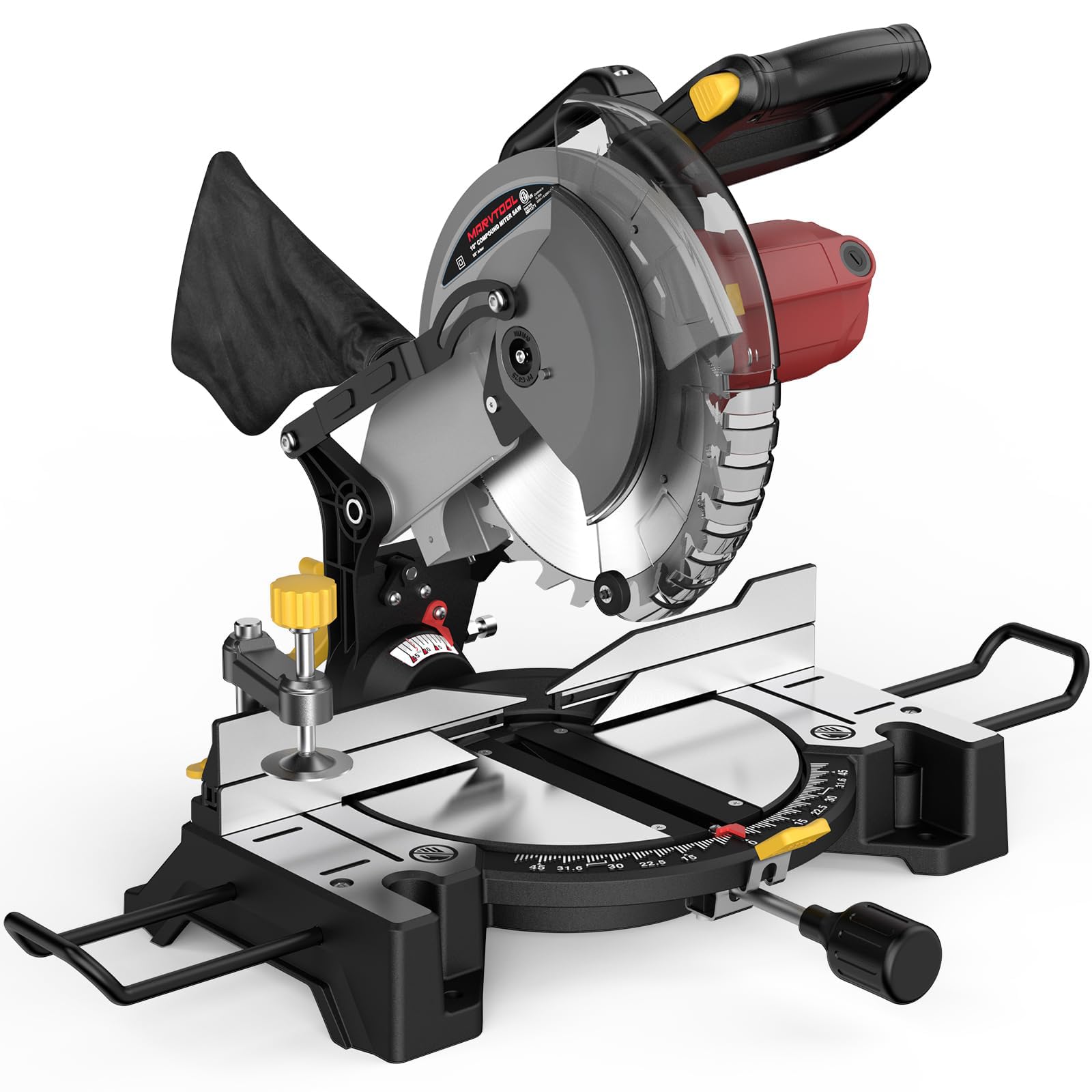
Miter saws answer a different question than circular saws: how do you cut the same angle again and again without re-marking it? This one runs a 15-amp motor up to a 5,000 RPM no-load speed, and the 10-inch blade crosscuts trim, laminate, and framing stock without asking you to hold a line freehand.
The 45-degree single bevel covers the angles that trim work needs, and a vise clamp secures the workpiece so your cuts stay precise rather than drifting. A transparent blade guard keeps the blade path visible while it cuts, and a dust collection bag catches the chips instead of spraying them across the shop. The extension table on either side supports longer stock so it does not tip mid-cut.
Weight is 20.5 pounds and the head locks down into the base with a release knob, so it stores in a compact footprint and travels like a portable tool rather than a fixed station. Performance is what gets singled out as its best quality, and value lands second. Cutting accuracy and power both get their own nods.
The honest weak spot is blade adjustment, where the feedback is split between owners who dial it in easily and others who need more time. Give yourself a session with a square and the bevel stops before the first trim job and this saw settles in.
Compared with the cordless WORKPRO, this saw is a station tool — it stays on a bench and handles repeated cuts, while the mini saw goes to the work.
Why it belongs: A 15-amp motor, a vise clamp, and an extension table give you repeatable crosscuts on trim without a second hand to hold the line.
One thing to budget time for: Blade adjustment is the most-mixed part of the picture, so square it up before you trust it on finish cuts.
Made for: Baseboard, casing, and shelving runs where the same angle repeats dozens of times.
Wrong tool for: Long rips down a sheet — that is circular saw work, not miter saw work.
8. Metabo HPT C10FCG2 10-Inch Compound Miter Saw
Fifty-two degrees of miter swing on either side, backed by a five-year warranty.
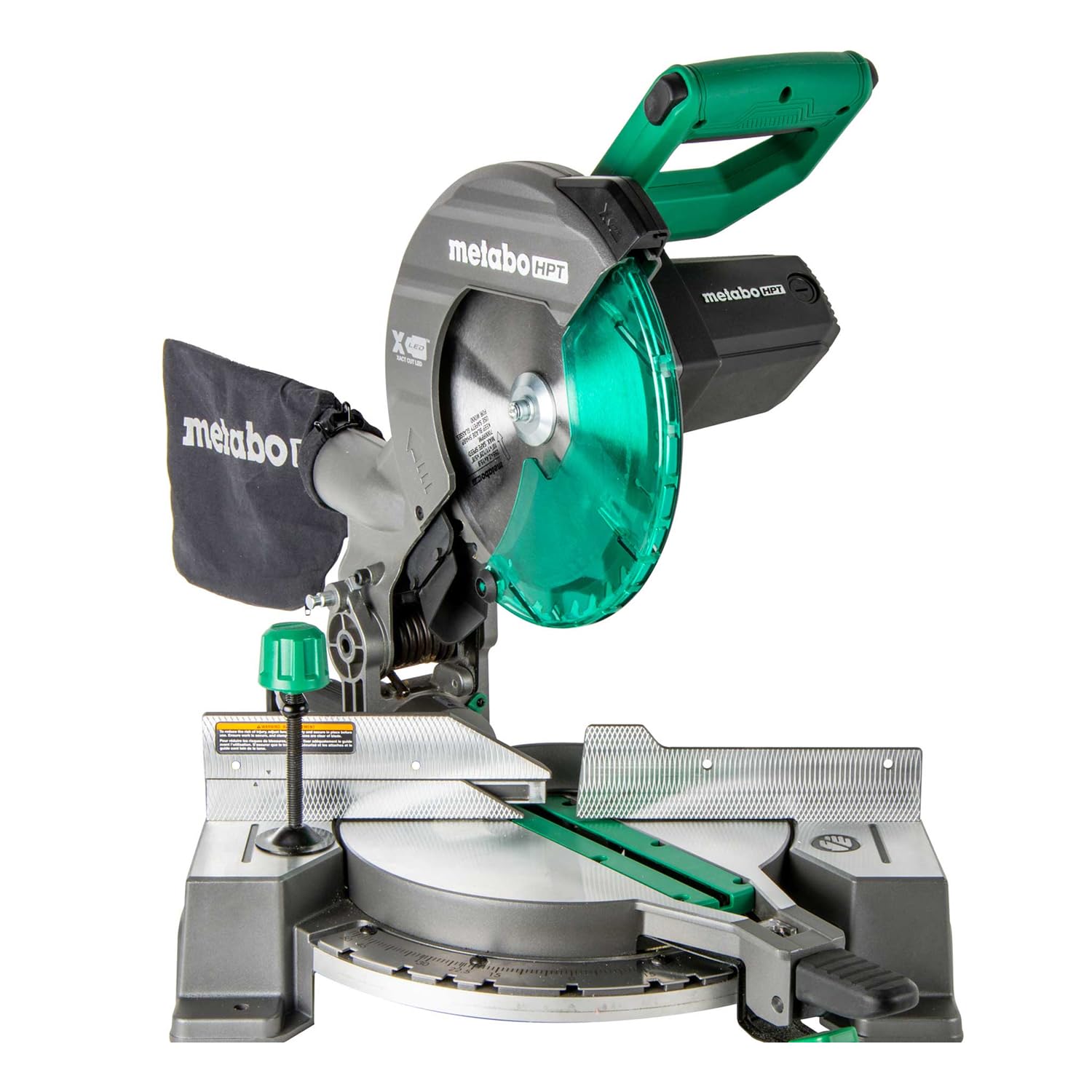
The miter range is what separates this saw from the cheaper 10-inch option. You can swing 0 to 52 degrees left and right, so the common angles and the odd ones both land without flipping your stock around. The bevel adjusts 0 to 45 degrees left with adjustable stops, and the 15-amp motor spins the 10-inch tungsten carbide blade to a 5,000 RPM no-load speed.
A large work table supports longer pieces so they do not sag at the cut, and the vice clamping system holds the workpiece steady for both safety and precision. The improved miter scale and controls are easier to read and set than a bare stamped dial. The head weighs 24.2 pounds, which is manageable to move between a bench and a truck, and the compact body stores without eating a whole wall.
Quality is the loudest theme in the feedback — the Japanese-engineered build reads as solid in the hand and the saw is described as suitable for first-time users as well as experienced ones. Cutting performance through straight and beveled cuts gets its own praise, and versatility and weight both register as pluses. The maker backs it with a five-year warranty.
Where the picture gets mixed is durability and adjustability — a small slice of feedback notes those, so treat the stops as something to verify and re-check rather than assume. That is normal for a miter saw at any tier, and it is a setup task, not a defect.
Against the MarvTool, this one covers a wider miter range and carries the longer warranty, and it asks for slightly more weight on the bench in return.
The Case For The Extra Range
- 0-52 degree miter left and right means fewer re-clamps for odd angles.
- Large work table and vice clamp support and secure longer stock.
- 15-amp motor at 5,000 RPM cuts through 4x4s and 2x6s without complaint.
- Five-year warranty from Metabo HPT covers the tool for the long haul.
What To Expect
- Adjustability draws a mixed note — verify the stops against a square when it arrives.
- At 24.2 pounds it is heavier to move than the 20.5-pound MarvTool.
Best fit: Trim carpenters and serious DIYers who need swing in both directions and want a long warranty behind the tool.
Think twice if: You cut only at 45 and 90 — the MarvTool covers those with less weight.
9. CRAFTSMAN V20 Cordless Circular Saw Kit CMCS500M1

A cordless kit that cuts 2x material and rides in the truck without a power cord.
This saw is built around freedom from the outlet. A 4,000 RPM motor turns a 6-1/2-inch blade for cross cutting or ripping 2x material, and the kit includes the battery and charger, so you are cutting the day it lands. The beveling shoe pivots to 50 degrees for angled cuts, which is more tilt than the 45-degree compact saws here.
The contoured over-molded handle is shaped to ease hand fatigue, and the compact body keeps the saw maneuverable on a ladder or a roof. Owners point to battery life and cutting performance as the strengths, along with how light and convenient it is around house projects. If you already run Craftsman V20 batteries, the pack drops straight into your existing kit.
The honest read is on build feel, where the feedback is split — a portion of owners note the tool does not feel as substantial as a pro-grade saw. It is not a framing saw and should not be asked to be one. For decking, fence repair, shelving, and crosscutting 2x material, it holds up.
Compared with the WORKPRO mini saw, this one carries a larger 6-1/2-inch blade and a wider 50-degree bevel, while the WORKPRO counters with three blades and a higher 4,500 RPM spindle speed. Both skip the cord; the choice is blade capacity versus blade variety.
What you get: A 6-1/2-inch cordless circular saw, battery, charger, 18-tooth blade, and hex wrench in one purchase.
Keep expectations level: Build feel is the most-mixed part of the response, so treat it as a home-projects tool and it rewards you.
The one to grab: Homeowners and Craftsman V20 owners who want a cordless saw for crosscutting and quick repairs.
Reconsider if: You frame walls or cut wet pressure-treated all day — a 15-amp corded saw is the right tool there.
Know the Specs
These four numbers drive every buying decision in this category. Once you know what each spec does on a real cut, the numbers point straight at the right saw.
Amps on a corded saw
Amps measure how much electrical current the motor pulls from the wall. A higher amp draw means the motor holds its speed better when the blade meets resistance, so a 15-amp motor pushes through wet 2x lumber while a 5-amp motor slows and heats in the same cut. For trim and thin plywood, a lower amp rating saves weight with no penalty.
RPM and SPM
RPM (revolutions per minute) tells you how fast a round circular or miter blade spins, and SPM (strokes per minute) does the same job for a jig saw’s up-and-down blade. Higher spindle speed means each tooth bites less and the cut runs cooler. It does not replace torque — a fast low-amp saw still stalls in dense hardwood, while a slower high-amp saw keeps cutting.
Maximum cut depth
Cut depth is the deepest pass the blade can make at a given angle, and it is limited by blade diameter. A 7-1/4-inch saw cuts deeper than a 4-1/2-inch compact, and a miter saw adds the advantage of a fixed station that handles thick stock without tipping. Check depth at both 90 and 45 degrees, because the angled cut is always shallower.
Bevel and miter
Bevel is the blade tilted sideways from vertical, while miter is the workpiece or saw head rotated to an angle in the horizontal plane. A single-bevel miter saw tilts one direction only; a circular saw’s beveling shoe tilts the whole base. Wider ranges like 51, 52, or 56 degrees cover steep trim and framing angles that a 45-degree cap cannot reach.
Corded versus cordless
A corded saw delivers constant power with no charging wait, which suits bench and driveway work. A cordless saw runs off a battery pack and frees you from the outlet on roofs, fences, and remote decks. The trade is runtime and torque: a battery pack drains under heavy cutting, and a cordless motor generally cannot match a high-amp corded motor in sustained load.
Orbital action on a jig saw
Orbital action kicks the jig saw blade slightly forward on the upstroke, which adds cutting force and speed in thicker material. Curve settings let you choose how much orbit the blade uses, and lower settings give cleaner edges in delicate material. For curves and cutouts the orbit helps; for straight decorative cuts you dial it back.
Common Questions
Can a jig saw replace a circular saw for cutting wood?
How deep can a 4-1/2-inch circular saw cut?
Is a cordless circular saw strong enough for decking and fence repairs?
What is the difference between a compound miter saw and a circular saw?
Do I need a laser guide on a wood cutting saw?
How many amps do I need to rip pressure-treated lumber?
Can a 10-inch miter saw cut a 4×4 post?
What bevel range do I need for trim and framing?
Should I run a dust bag or a vacuum hose on my saw?
How much does saw weight matter for overhead or ladder work?
The Bottom Line
For most people cutting wood at home, the wood cutting saw that earns the top spot is the BLACK+DECKER Jig Saw BDEJS600C, because it handles the curves, notches, and cutouts that a straight-blade saw simply cannot follow, and it does it at 4.6 pounds with four curve settings. If your work runs straight — decking boards, sheet goods, fence pickets — grab the SKIL 14 Amp 7-1/4-Inch Circular Saw, whose 14 amps and 51-degree bevel cover framing and steep angles in one tool. And for repeated trim cuts on a bench, the Metabo HPT C10FCG2 is the one to reach for, with a 0-52 degree miter swing and a five-year warranty behind it.
Curves want the jig saw, rips want a circular saw, and repeatable angles want a miter saw.
How we choose
We do not accept paid placement. Every pick is matched to a real buyer and a real use-case; we do not hands-on test units.
Sources
Specifications: manufacturer listings and product documentation. Review insights: verified customer reviews, as of November 2026. Pricing: not shown on this page (it changes often); check the current price via the retailer link.
As an Amazon Associate, Tactical Gear Guy earns from qualifying purchases. This does not affect which products we feature.