Specs are compiled from manufacturer listings and verified buyer reviews and can change over time — please confirm the key details on the product page before buying.
If your boards come out of the planer with dished ends or a rippled face, the machine is not the problem — the setup and the cutterhead are. This guide sorts the powered thickness planers that actually flatten a board cleanly. It tells you plainly which one suits a garage hobbyist, which one suits a cabinet shop, and which one you should leave alone if you only ever run soft pine.
This guide is built by comparing the manufacturers’ published specifications and the patterns across verified customer reviews, so you get each pick’s real strengths and trade-offs instead of marketing spin.
Every pick below gets judged on the things that decide whether a board comes out flat: cutterhead type, feed speed, depth of cut, and how the machine handles snipe. Read on for the picks that hold their settings pass after pass, sorted into the woodworking surface planer machine guide below.
Top Picks

How To Choose The Best Woodworking Surface Planer Machine
A benchtop planer does one job: it takes a rough, uneven board and brings it to a consistent thickness with a flat face. Two machines that look identical on the shelf can behave completely differently on figured maple or a twisted walnut plank. The four things below decide which camp a planer falls into.
Cutterhead type: three blades, spiral, or helical
A three-knife cutterhead uses long straight blades that strike the wood in one clean chop per revolution. It is simple and proven, and the DEWALT machines here use it to good effect. A spiral or helical cutterhead (the same idea under two names — many small carbide or high-speed-steel inserts set in staggered rows) slices at a shear angle instead of chopping. That shearing action is why these heads run quieter and leave fewer tear-out marks on grain that changes direction.
Feed speed and cuts per inch
Feed speed is how fast the machine pulls the board through, and it directly sets the surface quality. A slower feed means more cuts per inch (CPI), which translates to a finer finish straight off the bed. A two-speed gearbox lets you run fast for stock removal and slow for the final pass — worth having if you plane rough lumber down in stages rather than buying pre-surfaced boards.
Depth of cut per pass
Depth of cut is how much material the machine removes in a single pass. Taking lighter passes protects the motor and the blades, but it also means more trips through the machine. A machine that allows a deeper pass saves you time on thick stock — as long as you respect the manufacturer’s stated maximum for narrower boards.
Snipe control and table support
Snipe is the dip carved into the leading and trailing ends of a board when the cutterhead loses support as the wood enters or exits. Long infeed and outfeed tables, a carriage lock, and a four-post head design all fight it. If you build furniture with visible end grain, snipe control is the feature you will notice most.
Side-by-Side Comparison
| Model | Best For | Cutting Width | Depth of Cut | Cutterhead | Amazon |
|---|---|---|---|---|---|
| DEWALT DW735X★ Best Overall | All-round shop workhorse | 13 inches | 0.13 inches | Three-knife, two-speed | Amazon |
| WEN PL1326Quiet Spiral Pick | Quiet spiral cutting on a budget | 33 centimeters | — | 26-insert spiral | Amazon |
| DEWALT DW734Fine-Finish Pick | Fine finish on portable jobs | 12.5 inches | 0.13 inches | Three-knife, 96 CPI | Amazon |
| Cutech 40800H | Deep passes and batch thicknessing | 13 inches | 0.25 inches | Spiral, 2-speed | Amazon |
| RIKON 25-135H | Smooth finish with repeatable setup | 33 centimeters | 0.125 inches | 26-insert helical-style | Amazon |
| FindBuyTool 13-Inch | Tight-tolerance batch work | 13 inches | 0.12 inches | 4-row helical, 40 inserts | Amazon |
| JET JWP-13BT | Shop with a 2 HP circuit ready | 13 inches | 0.13 inches | Helical-style, 26 inserts | Amazon |
| Makita 2012NB | Jobsite portability and low noise | 11.86 inches | — | Disposable double-edge blades | Amazon |
| WEN PL1252 | First planer on a tight budget | 12.5 inches | 0.125 inches | Two-blade, reversible | Amazon |
Detailed Reviews
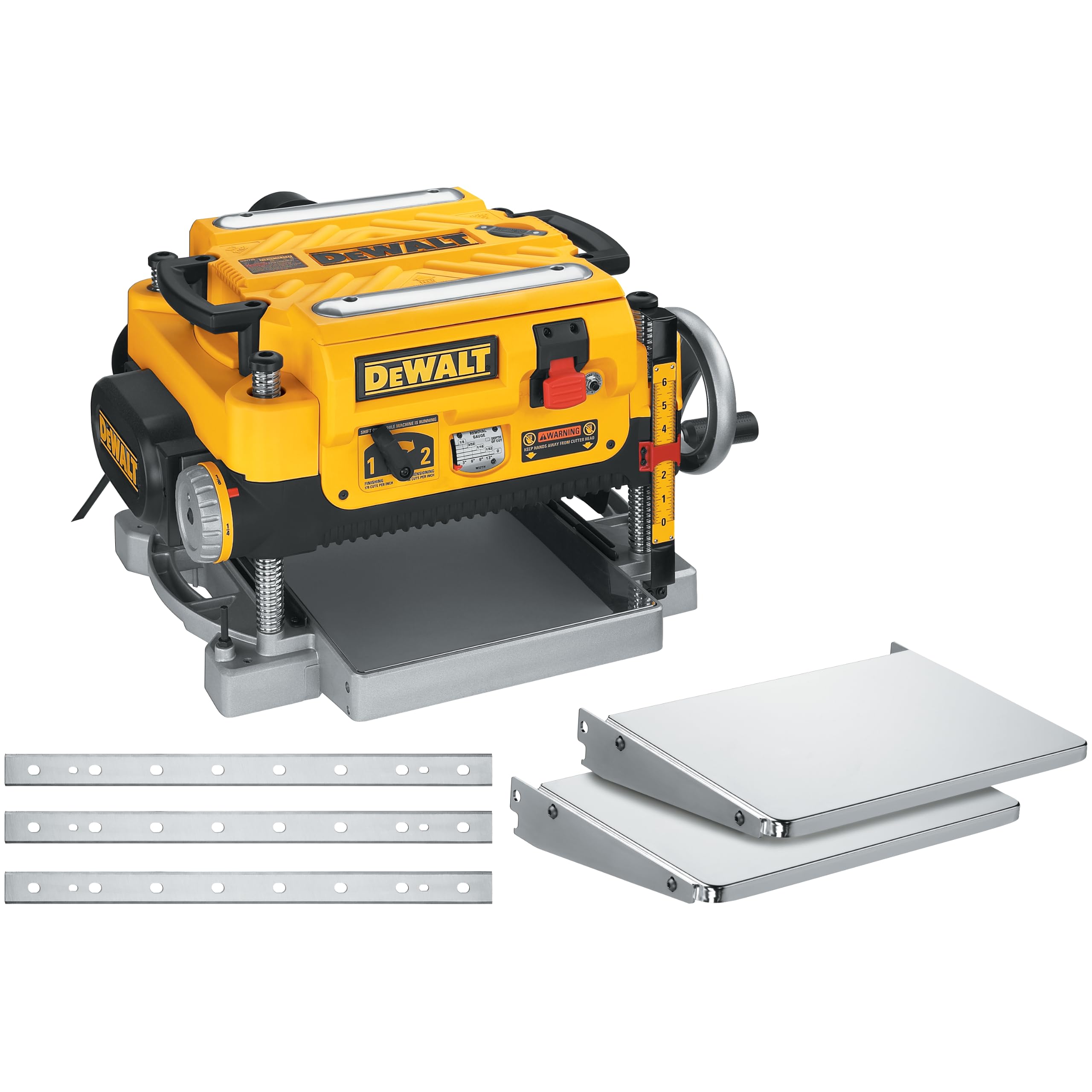
1. DEWALT Thickness Planer (DW735X)
Our pick — 4.5+★ from 7,500+ verified ratings; the strongest balance of quality and price.
Two feed speeds and a 13-inch throat make this the planer most small shops end up buying.
What decides a planer’s worth in a real shop is whether it can take a rough-sawn board down in one session and then give you a finish-ready face on the last pass. The DW735X answers both with its two-speed gearbox, letting you switch feed speed to tune cuts per inch at 96 or 179 CPI. High CPI means more knife strikes per inch of travel, so the slow setting leaves a surface you can sand lightly rather than scrub.
Under the hood sits a 15 amp, 20,000 rpm motor driving a cutterhead at 10,000 rpm. That is the muscle for wider and thicker stock, and the three-knife cutter head is rated for longer knife life with faster changes. A fan-assisted chip ejection system vacuums chips off the cutterhead and blows them out of the machine, so the bed stays clear instead of loading up with shavings mid-pass.
The snipe fight is handled mechanically: a 19-3/4 in. cast aluminum base versus a standard 10 in. base, and an automatic carriage lock reduces the movement that causes snipe without you engaging anything by hand. The 4.5+ star average across 7,500+ ratings backs that up, with owners ranking build quality first and value and ease of use close behind. The honest catch is the cutterhead type: unlike the WEN PL1326 below with its 26-insert spiral head, this one uses straight knives, and some owners do report blades chipping. At 102 pounds it also stays put on a bench rather than traveling to a jobsite.
Where It Delivers
- Two feed speeds give you 96 or 179 cuts per inch, so the final pass is finish-ready
- Automatic carriage lock and a rigid 19-3/4 in. aluminum base tackle snipe without hand adjustment
- Fan-assisted chip ejection keeps the cutterhead and bed clear during a long session
- Material removal gauge and extra-large thickness scale make each pass predictable
- Ships with infeed and outfeed tables plus an extra set of knives
What To Weigh First
- Straight knives, not inserts — blade chipping shows up in some owner reports
- At 102 pounds it is a fixed bench machine, not a carry-to-site tool
- Noise is the most-discussed negative, so plan your ear protection before the first board
Buy this if: you want one planer that handles rough stock and fine finishing passes in a home or small professional shop.
Think twice if: you need to move the machine between sites, or you specifically want replaceable insert tooling instead of straight knives.
2. WEN PL1326 15-Amp 13-Inch Spiral Benchtop Thickness Planer
Spiral insert tooling and a 13-inch throat without the premium-cutterhead sticker shock.
You get a spiral cutterhead (a rotating head with many small replaceable blades) at the value end of the market, which is the upgrade most planer owners wish they had bought first. It uses 26 staggered and rotatable HSS blades (high-speed steel inserts you can spin to a fresh edge when one nicks). That setup produces a clean, smooth finish instead of the chopping marks straight knives can leave on tricky grain.
The numbers behind it are solid: a 15A motor generating 10,000 RPM at a 26 feet per minute feed rate, planing boards up to 6 inches thick and 13 inches wide. An onboard material removal gauge tells you the cutting depth of each pass, so you are not guessing how much you are taking off. It also includes a depth stop and an adjustable dust port for hooking up extraction.
Owner reports credit the build quality first, and the spiral head runs quietly enough for a garage shop. What is worth knowing before you buy is weight — at 36.74 kg versus 29.03 kg for the WEN PL1252 below, so it is a bench fixture rather than something you tuck under an arm. The other honest note is the cutting width listed in metric: the 33 centimeter spec is the same 13-inch capacity, just recorded differently.
The winning detail: 26 rotatable inserts mean a nicked edge gets turned rather than replaced, which stretches the tooling budget over a long project.
Know going in: at 36.74 kg it needs a dedicated bench spot; the smaller WEN PL1252 shows how much lighter a sub-30 kg machine feels by comparison.
Reach for this if: you want spiral-head smoothness and 13-inch capacity while keeping to mid-range money.
Look elsewhere if: you plane from a truck bed or your bench has to double for other work.
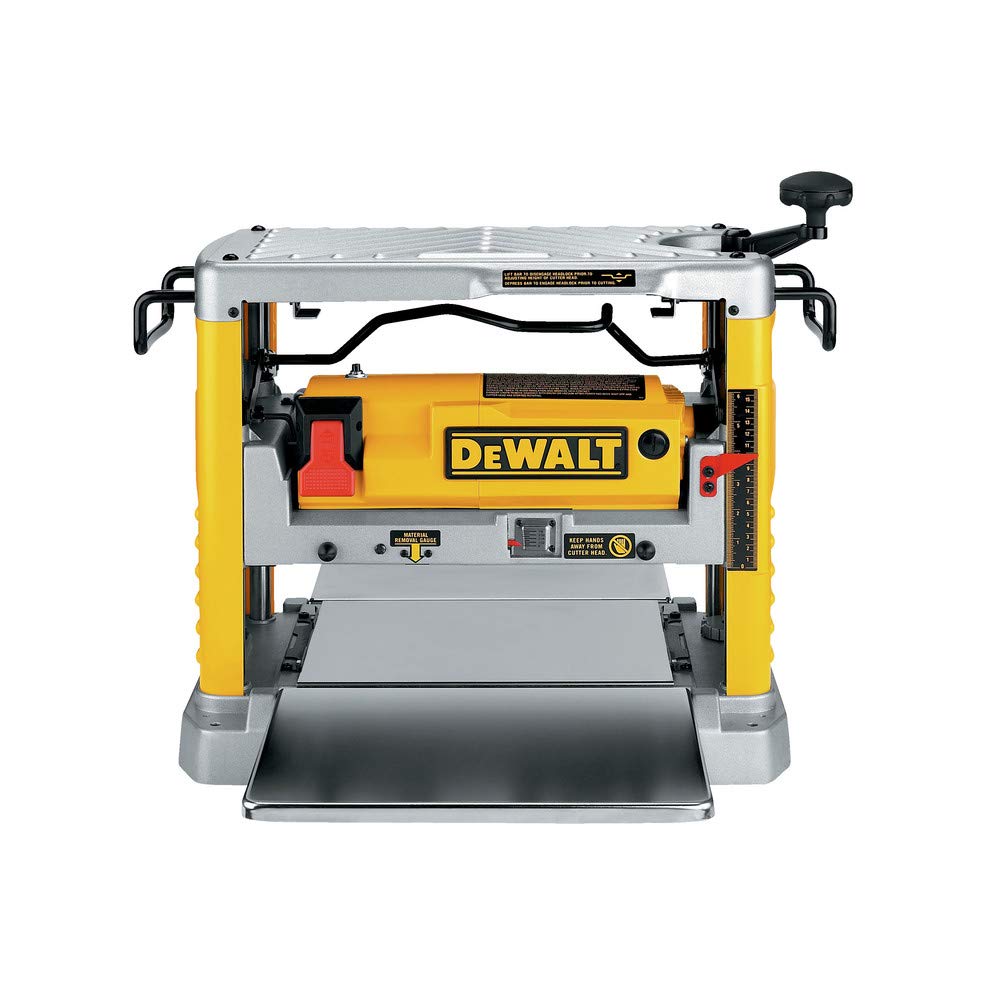
3. DEWALT DW734 Benchtop Planer
A 12-1/2-inch machine that trades width for one of the finest portable finishes going.
Strip the marketing away and the DW734 is built around one number: 96 cuts per inch. A three-knife cutterhead spinning at 10,000 rpm, driven by a 15 amp, 20,000 rpm motor, delivers that density. More cuts per inch means the knives shave finer, and DEWALT rates it as one of the finest finishes of any portable planer. On soft pine through to ebony, the surface leaves the bed ready for light sanding rather than heavy work.
Snipe is addressed with a four-column carriage lock that drastically reduces the movement causing it, and extra-long infeed and outfeed tables give 33-1/2″ of material support. Long tables matter on anything over a couple of feet — a short table lets the board tip and carve a dip into the end. The material removal gauge and extra-large thickness scale keep each pass honest, and a turret depth stop lets you snap back to your most-used depths quickly.
Knife changes are built to be quick, and the disposable reversible knives extend knife life. This is the narrower sibling of the DW735X — 12.5 inches of cut width against 13 inches — so if you regularly plane glued-up panels just over a foot wide, the extra half inch matters. Buyers report it works well straight from the start with a simple setup, and for a workshop that planes a steady stream of boards it earns its place.
The finish story: 96 cuts per inch off a three-knife head is the reason this machine punches above its frame size on surface quality.
Practical limit: the 12.5-inch cutting width rules out panels wider than that, so check your widest glue-up before you commit.
It suits: the woodworker who planes mostly furniture-scale stock and wants a near-finished face from the machine.
Not for: anyone routinely running panels past 12-1/2 inches wide — step to a 13-inch machine instead.
4. Cutech 40800H 13-Inch Spiral Cutterhead Benchtop Planer
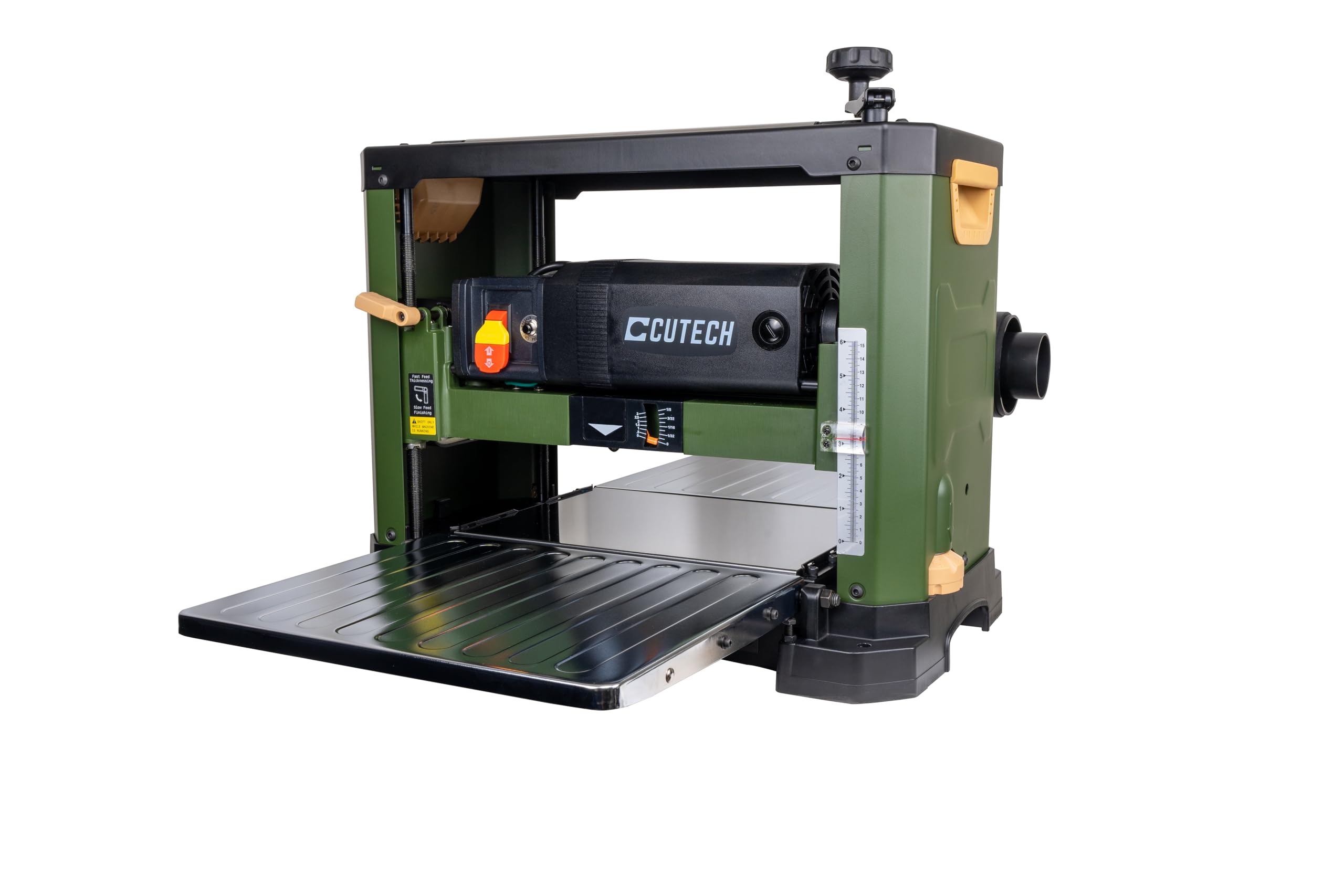
Deep passes, two feed speeds, and a repeat depth stop built for churning out matching boards.
When you are thicknessing a stack of boards to the same dimension, the two features that save the most time are a repeat depth stop and a way to feed boards back without walking around the machine. This Cutech has both. Its comprehensive 8-position depth stop lets you snap to a set thickness again and again, and board return rollers on top send the stock back to the front for the next pass.
The cutting side runs a spiral cutterhead with 6 rows of staggered inserts, and it takes a 0.25 inch depth of cut versus 0.13 inches the DEWALT DW735X allows. Deeper passes mean fewer trips through the machine on thick stock. A 2-speed feed lever slows the rate to 16-fpm for hardwood and figured wood, where a fast feed would tear the grain. The depth-of-cut indicator on the front shows how much the next pass will remove, and a flip dust hood either blows chips out the back or drops down to connect a collector.
Snipe gets its own treatment: 4 lead screws and a patented coupling design automatically minimize it without the extra snipe lock some machines need. The inserts are two-sided and sit in alignment, with a non-cutting edge that keeps them from skewing. Worth flagging honestly — this is a newer listing with a small review base, so you are leaning more on the specification sheet than on a long track record. The spiral head’s low amp draw and quieter cut are the dependable wins.
The fit: shops or serious hobbyists planing matched batches where the 8-position stop and return rollers pay off daily.
The catch: a limited review history means early adopters carry more of the proof burden than they would with an established model.
5. RIKON 25-135H 13-Inch Planer
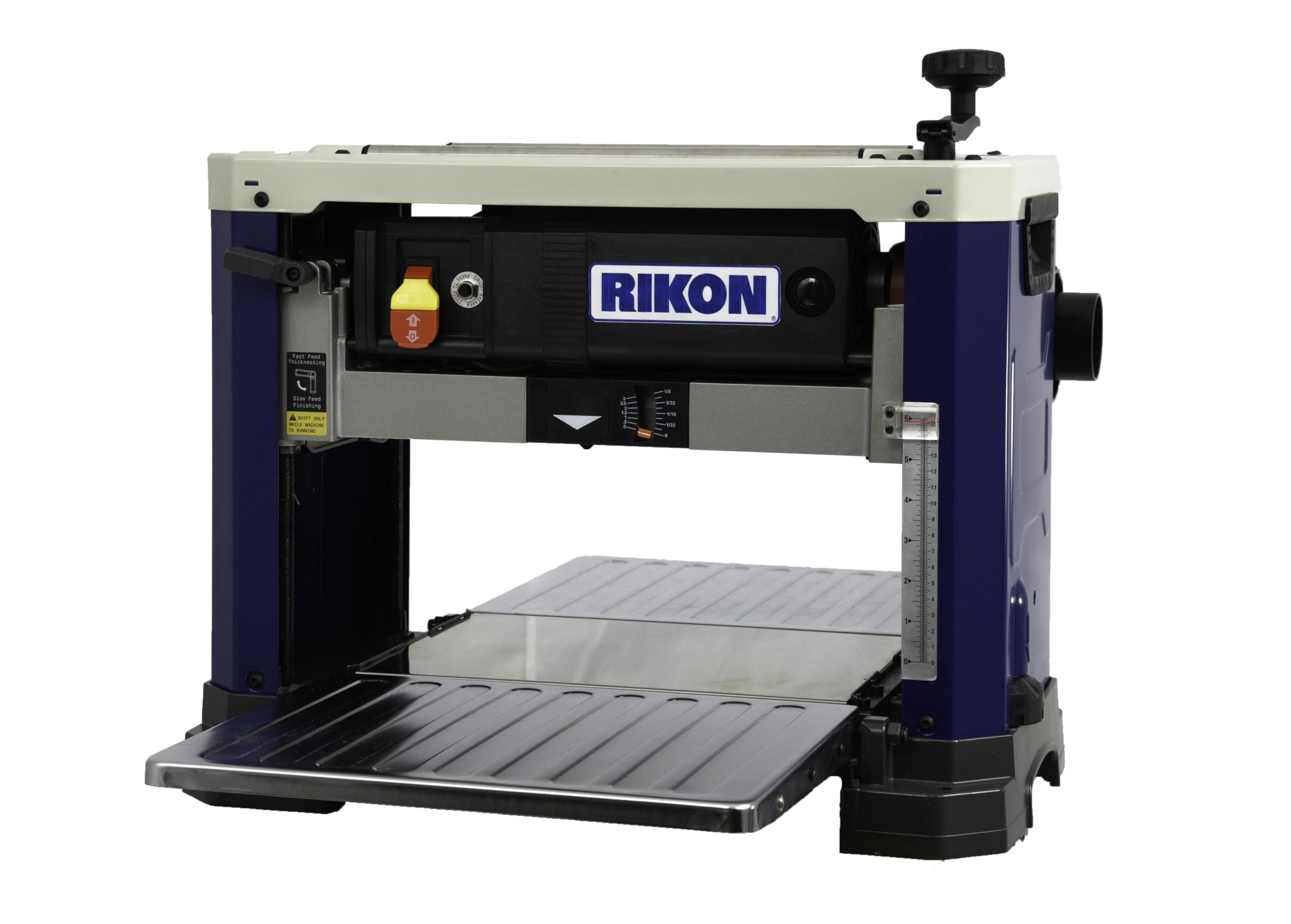
A six-row helical head with rotatable inserts, tuned for repeatable stock thickness.
For a hobbyist stepping up from a straight-knife machine, the appeal here is the cutterhead: six rows carrying 26 two-edge HSS inserts. When an insert wears or gets nicked, you rotate it to a fresh edge instead of replacing a long blade. That is routine maintenance you do sitting at the bench rather than a knife-setting job with a jig.
It planes stock up to 13 inches wide and 6 inches thick, with up to 1/8 inch depth of cut on boards 6 inches wide or less. Two feed speeds — 16 or 26 SFPM — let you pick between faster material removal and a smoother finished surface depending on the job. A threaded 4-post head support, depth gauge, thickness scale, and repeat-cut control work together to hold stock thickness steady across a run.
What owners notice first is the finish. The six-row helical head leaves boards with a 150-grit surface straight off the bed, and setup takes minutes. The trade-off to plan around is the tables: the infeed and outfeed tables cannot be adjusted, and that limitation comes up enough to matter, so levelling is done through the bed and head rather than the extensions. It ships with a dust hood and a 4 in. to 2-1/2 in. adapter for common collectors and shop vacuums.
The Case For It
- Six-row helical head with 26 two-edge inserts you rotate, not replace
- Two feed speeds at 16 or 26 SFPM to trade speed for surface quality
- Threaded 4-post head support holds the cutterhead steady for a 150-grit surface off the bed
- Dust hood plus a 4 in. to 2-1/2 in. adapter covers most collectors and shop vacs
The Practical Catch
- Fixed infeed and outfeed tables — you cannot adjust them for levelling
- Hobbyist-scale review base, so the track record is shorter than the big brands
Worth it if: you want a helical head and quick setup, and you are comfortable working around non-adjustable tables.
Move on if: you insist on tunable table geometry for fine snipe control.
6. FindBuyTool 13″ Benchtop Thickness Planer
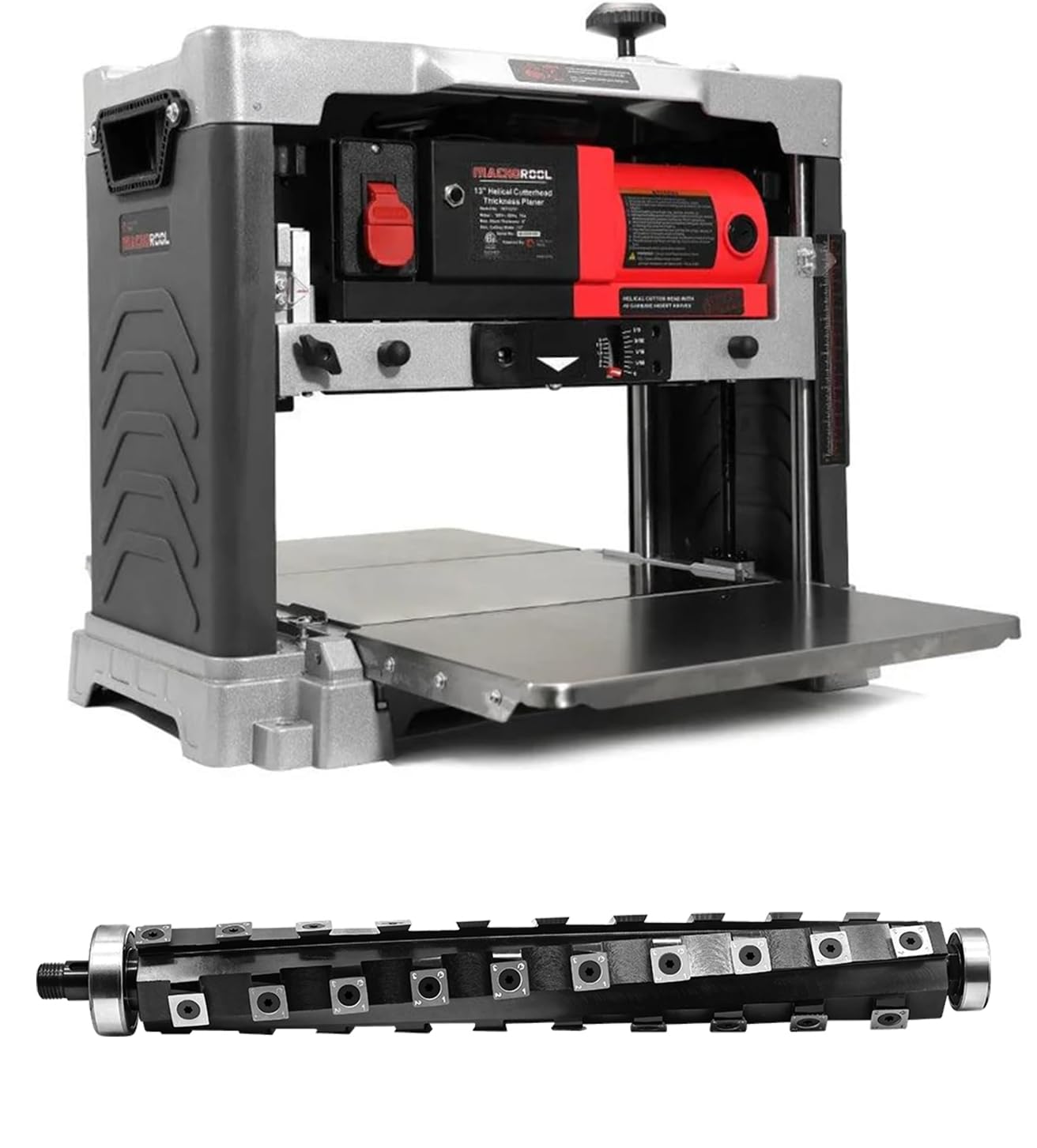
Forty carbide inserts and a sub-0.1 mm thickness tolerance for matched part runs.
If your projects hinge on parts that fit together — drawer sides, frame rails, ladder rungs — consistency between boards is the whole game. This planer targets that directly. Its 4-row helical cutterhead holds 40 pre-installed tungsten carbide inserts, and the machine is rated for a thickness tolerance under 0.1 mm. That means boards come off the same run within a hair of each other, which saves you from hand-sanding parts to match.
The motor is a 120V 15A unit reaching 20,000 RPM with a 27.5 FPM feed rate. Built-in overload protection cuts the motor automatically under extreme loads, which protects it when you push a hard pass. Planing width is 13 inches and max depth is 1/8 inch, with the manufacturer advising light passes to avoid overloading the machine.
The 4-column design and anti-wobble cast-aluminum base give a stable platform, and mounting holes let you bolt it down to a bench for extra rigidity. Eight depth-stop settings handle batch thicknessing, and folding extension boards extend the overall length to 27.4 inches for material support. The 4-row helical cutting produces finer chips, which helps chip removal and reduces clogging and airborne dust. Owners mention boards coming off the bed with a 220-grit surface, held within 0.003″ of each other across a run.
The tolerance edge: a 4-row head with 40 inserts plus sub-0.1 mm tolerance is why matched-part runs come out consistent without extra sanding.
One to know: the manufacturer’s own guidance is light passes under 1/8 inch, so plan on more trips for very thick stock.
Go here when: fit consistency between boards matters more than raw removal speed.
Consider the alternative if: you need maximum depth per pass and would rather not bolt the machine in place.
7. JET 13-Inch Benchtop Thickness Planer (JWP-13BT)

A 2 HP helical-head planer built to hold flat boards on a cast iron bed.
The draw that separates this machine is its helical-style cutterhead with 6 rows of 26 individual quick-change high-speed steel inserts. Six rows spread the cut load, which is the arrangement that produces a smoother, quieter cut than a straight-knife head on the same job. Behind it sits a 2 HP, 15-amp motor turning the cutterhead at 10,000 RPM.
Flatness is helped by a precision-machined cast iron bed and steel cover, which assist in keeping boards flat while cutting down snipe. The four-post design controls and supports the cutterhead from all four corners. Capacity runs to 13 inches wide and 6 inches deep with a maximum depth of cut of 1/8″. Adjustable folding infeed and outfeed tables level to the bed and fold away to save space when stored, and an adjustable depth stop keeps repetitive cuts consistent.
This pick asks for attention on power supply. Some customers note 15 amp fuses blowing repeatedly, so give the machine a circuit that can carry the load rather than sharing one with other tools. Blade durability is a mixed area too — several note inserts dulling quickly — and opinions differ on cutting performance, noise, and precision. The build itself is described as sturdy with heavy-duty parts; what the machine needs is a proper circuit and careful pass depth.
The strong point: a cast iron bed and 4-post head support hold boards flat, cutting snipe while the 2 HP motor drives a 6-row helical head.
Supply caution: 15 amp fuses blowing repeatedly is a recurring theme — a dedicated circuit is the smart move before the first board goes in.
Best matched to: a shop with a dedicated 15 amp circuit and the patience to take moderate passes on hard stock.
Think it over if: your bench shares one circuit with a dust collector and a table saw.
8. Makita 2012NB 12″ Portable Planer

A quieter 83 dB planer you can actually move to the jobsite.
Most benchtop planers get bolted to a bench and stay there. This one is built for the opposite — a compact, lighter frame meant for carrying to the jobsite. The number that stands out is 83 dB, which the manufacturer calls the quietest planer in its class.
The 4-post design with diagonal cross supports keeps the machine stable, and large table extensions support the workpiece as it exits. Cutting width is 11.86 inches. Blade changes are engineered to be faster and easier, using disposable double-edge blades. That blade system is the maintenance routine here — no insert rotating, just swap the blade when it dulls.
Reviewers point out glassy smooth surfaces and little or no snipe straight from the start, with the 83 dB operation and solid build getting frequent mention. The honest caveat is tear-out on highly figured wood, which the double-edge blade design is less forgiving of than a spiral head. If you routinely plane curly or burl stock, a helical machine like the Cutech or FindBuyTool will treat that grain more kindly.
Why It Stays in the Truck
- Compact and lightweight frame built for carrying to the jobsite
- 83 dB operation, the maker’s claimed quietest in its class
- Faster, easier blade changes using disposable double-edge blades
- 4-post design with diagonal cross supports and large table extensions for stability
Where It Gives Ground
- 11.86-inch cutting width is the narrowest here
- Tear-out reported on highly figured wood — the double-edge blade design is less forgiving than a spiral head
The right call for: mobile work, small garages, or anyone who values a quiet machine and quick blade swaps.
Pass it by if: your stock is wide and highly figured — a spiral head serves that grain better.
9. WEN PL1252 Benchtop Thickness Planer

The entry-level planer that lets you learn thicknessing without tying up a fortune.
A first planer should teach you the rhythm of light passes and grain direction without demanding a shop budget. This WEN does exactly that. It planes boards up to 6 inches thick and 12.5 inches wide, with a 15A motor generating 20,000 cuts per minute at a 26 feet per minute feed rate. You can adjust the depth anywhere from 0 to 1/8 of an inch with each pass, so you learn to take light bites rather than hogging off material.
The cutting setup is a two-blade head running two reversible 12.5-inch SK5 blades (model BP122K). Two blades are simpler and cheaper to maintain than a multi-insert head, and reversible means a fresh edge when one wears. The cast iron base gives it more stability than its price suggests. Owners praise it for handling softer woods like cedar, and the 26 FPM feed is fast enough to run cutting boards in batches.
Durability is where you should set expectations. The two-blade design is the least forgiving of the cutterheads in this list, and blade chipping comes up. Snipe and noise also draw mixed remarks. On weight, at 29.03 kg versus 36.74 kg for the WEN PL1326 — noticeably easier to move around the shop. For a hobbyist planing pine and cedar, it is a sensible starting machine; for figure-heavy hardwood, step up to a spiral head.
Value read: a 15A motor, cast iron base, and 12.5-inch capacity at the entry level — enough to learn on without overcommitting.
Realistic limit: two blades and a reversible SK5 design are the least tear-out-resistant setup here, so figured hardwood is where it shows its budget roots.
Ideal first planer for: the hobbyist starting on pine, cedar, and mild stock who wants to learn light-pass technique.
Step up instead if: your woodpile is full of curly or burled boards.
Know the Specs
Spiral vs. Straight-Knife Cutterheads
A straight-knife head uses long blades that chop at the wood in a flat arc. That is simple and it works, and the DEWALT machines here show how fine a finish it can produce at 96 cuts per inch. A spiral or helical head uses many small staggered inserts set at a shear angle. The shear slices rather than chops, which is why spiral machines run quieter and leave fewer tear-out marks on grain that changes direction. The trade-off is maintenance style: straight knives get replaced or resharpened as a set, while inserts get rotated one at a time.
Cuts Per Inch and Feed Speed
Cuts per inch (CPI) is how many knife strikes land on every inch of board as it travels through. A slower feed rate raises CPI and gives a finer surface. A faster feed lowers CPI and removes more material in the same time. Machines with a two-speed gearbox let you pick — fast for rough stock removal, slow for the final finishing pass. If a planer lists only one speed, that speed is a fixed compromise between speed and surface quality.
Depth of Cut and Pass Discipline
Depth of cut is how much material a single pass removes, and every machine has a stated maximum. Respecting that max protects the motor and keeps the blades sharp. The Cutech runs up to 0.25 inches, while the FindBuyTool caps at 1/8 inch and advises light passes. Deep passes save trips but strain the motor; light passes protect the tool but take longer. On hard stock, lighter is nearly always wiser.
Dust Collection and Port Sizing
Chips have to go somewhere. A planer either blows chips out on its own or connects to a collector or shop vacuum through a dust port. Port sizes vary, so check the adapter before you buy — the RIKON includes a 4 in. to 2-1/2 in. adapter to fit common collectors. Spiral and helical heads cut finer chips, which helps chip removal and reduces clogging and airborne dust compared with coarser straight-knife shavings.
Common Questions
Will a benchtop planer fit on a standard workbench?
What is snipe, and which planers reduce it?
Does a spiral cutterhead really cut quieter than straight knives?
How much material can I remove per pass?
Do I need a dust collector to run one of these planers?
How wide a board can each planer handle?
How thick a board will these machines plane?
What maintenance does a helical or spiral head need?
Is a 15 amp planer going to trip a standard circuit?
Can one of these planers handle figured hardwood without tear-out?
The Bottom Line
The woodworking surface planer machine that comes out ahead for the widest range of shops is the DEWALT DW735X, because its two-speed gearbox gives you slow, finish-ready passes and fast roughing in the same machine. If a quieter spiral head is what you are after, the WEN PL1326 brings 26 rotatable inserts and 13-inch width to a mid-range bench. And for running batches of matching boards, the FindBuyTool 13-Inch holds a sub-0.1 mm tolerance across a run. Match the cutting width to your widest glue-up, the cutterhead to your grain, and the amp draw to your shop circuit.
How we choose
We do not accept paid placement. Every pick is matched to a real buyer and a real use-case; we do not hands-on test units.
Sources
Specifications: manufacturer listings and product documentation. Review insights: verified customer reviews, as of November 2026. Pricing: not shown on this page (it changes often); check the current price via the retailer link.
As an Amazon Associate, Tactical Gear Guy earns from qualifying purchases. This does not affect which products we feature.