Specs are compiled from manufacturer listings and verified buyer reviews and can change over time — please confirm the key details on the product page before buying.
If your charger takes all night, you already know the problem: you are stuck waiting for a battery instead of using your gear. The picks below charge fast, and each one fits a different job — charging AA and AAA cells, filling a car battery, or topping up power tool packs. Read down to the one that matches what you actually need to charge.
This guide is built by comparing the manufacturers’ published specifications and the patterns across verified customer reviews, so you get each pick’s real strengths and trade-offs instead of marketing spin.
Speed is only half the story, though. You also need a charger that handles the battery type you own and protects it from overcharging. This walkthrough breaks down both, so you can sort the good chargers from the slow ones and find the right fit among the options for the World’s Fastest Battery Charger.
Top Picks


How To Choose The World’s Fastest Battery Charger
The shortest answer: match the charger to the battery chemistry you own first, then look at the amps. A charger with giant current output can still be useless on your cells if it does not recognize their type. Speed is built on three numbers — output current, charging stages, and proper termination at full charge.
Start With The Battery Chemistry
Chemistry decides nearly everything. A lithium iron phosphate (LiFePO4) pack needs a different charging voltage curve than a lead-acid car battery, and these two groups cannot share one setting. That is why “all-in-one” chargers spell out their supported types on the box. A charger built for Li-ion cells such as 18650s will not safely charge a car battery, and vice versa.
Battery size matters too, in a concrete way. Some chargers accept cells up to a stated length in millimeters, which is the number that tells you whether a 26650 cell will physically drop into the bay. If a bay only fits standard AA cells, a longer cell simply will not seat, no matter how fast the electronics are.
Then Read the Output Current in Amps
The output current, measured in amps, is the rate at which power flows into the battery. A higher-amp charger fills a cell faster than a lower-amp one, and that is the single number that sets charging speed. A 15-amp charger for car batteries moves meaningfully more power than a 2-amp hand-held charger, but the bigger number only helps when your battery and wiring can accept it.
Watch the amps split across slots. A two-slot charger that advertises a high total figure often divides that power between the two bays. Fill both slots and the per-battery speed drops; charge one cell alone and it fills much faster. That behavior is worth knowing before you compare headline numbers.
Smart Stages and Full-Charge Shutoff
A fast charger that never tapers off is a risk to the battery. Smart chargers step the voltage down as the cell fills, then switch to a trickle or float mode to hold the charge without cooking it. Stage counts (7-stage or 9-stage charging, for example) describe how many of these steps the charger runs. More stages generally means gentler handling of the last stretch of the charge.
Automatic detection of the battery voltage and chemistry is a real convenience on car-battery chargers. With it, the charger picks the right profile for a 6V or 12V or 24V battery on its own. Without it, you are expected to select the mode yourself, and getting that choice wrong is a common source of trouble.
Understand the Trickle and Pulse Modes
Trickle and float modes are maintenance, not fast charging. They hold a battery full over long storage, and they are why a good charger doubles as a winter maintainer. Pulse repair, or desulfation, is a separate claim: it is meant to break down buildup on lead-acid plates and restore some lost capacity. None of these chargers can activate a completely dead battery; pulse repair only helps a weak lead-acid battery that still holds some charge.
The safest read on pulse repair is to treat it as a bonus. Buy the charger for its charging speed and safety protections first; consider any repair benefit as a helpful extra.
Side-by-Side Comparison
| Model | Best For | Output Current | Battery Types | Charge Time (Stated) | Amazon |
|---|---|---|---|---|---|
| Panasonic BQ-CC65 eneloop Charger★ Best Overall | AA and AAA rechargeable cells | 1 A (up to 4 A current rating) | eneloop / NiMH AA and AAA | 2 hours for 2 cells, up to 4 hours for 4 | Amazon |
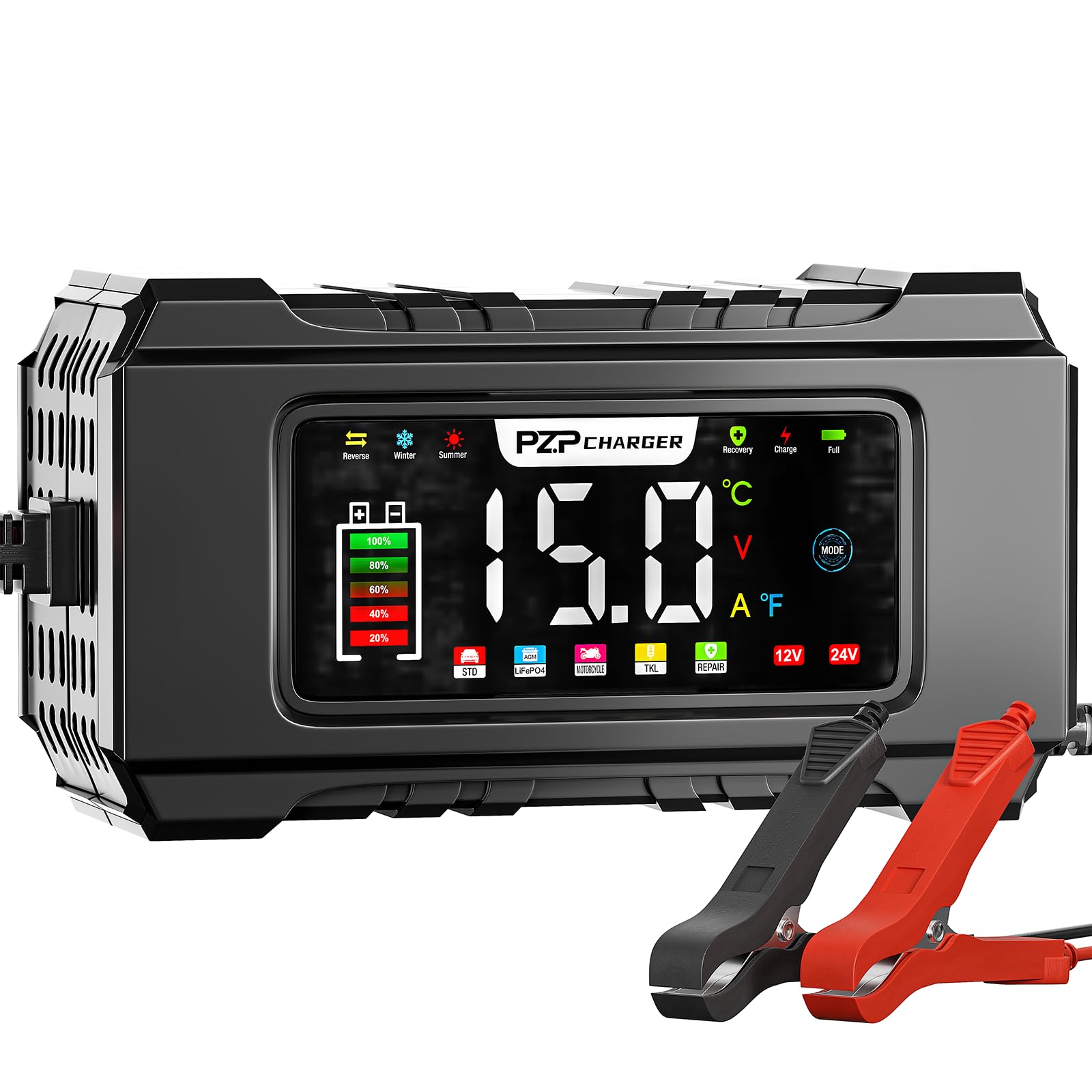
| PZ.P 15-Amp Smart ChargerRapid Car Charger | Cars, trucks, boats, deep-cycle batteries | 15 A (12V) / 8 A (24V) | LiFePO4, lead-acid, AGM, GEL, SLA, Flooded | Not stated by maker | Amazon |
| Nitecore UMS2 Dual-Slot ChargerEDC Pick | Li-ion cells and EDC gear | 3000mA one slot / 4000mA two slots | Li-ion, IMR, LiFePO4, Ni-Cd, Ni-MH | Not stated by maker | Amazon |
| MIEKLALE 8+2 Bay Charger | Mixed batches of many cells | 2 A per channel | Li-ion, LiFePO4, RCR123, 18650, 9V, NiMH, NiCd AAA/AA | Not stated by maker | Amazon |
| E-FAST 0-20A Smart Charger | Large vehicle and deep-cycle batteries | 20 A (12V) / 10 A (24V) | LiFePO4, flooded, gel, AGM, SLA | Not stated by maker | Amazon |
| YHCHKJ 20A Smart Charger | Garage and seasonal battery care | 20 A max (12V 5/10/20A, 24V 3/5/10A) | Lithium, LiFePO4, lead-acid Wet/Gel/AGM | Not stated by maker | Amazon |
| CRAFTSMAN CMXCESM258 | Seasonal and infrequently used vehicles | 12 A | Standard, AGM, deep-cycle, LiFePO4; 6V and 12V | Not stated by maker | Amazon |
| DEWALT DCB1112 Fast Charger | DEWALT 20V and FLEXVOLT packs | 12 A | DEWALT 20V MAX and FLEXVOLT batteries | 45 minutes | Amazon |
| Schumacher SC1446 Wheeled Charger | Shop and roadside engine starting | 10 A charge / 40 A boost / 200 A start | 6V and 12V standard, AGM, gel, deep-cycle | 135-minute timer | Amazon |
Detailed Reviews
1. Panasonic BQ-CC65AKBBA Super Advanced eneloop Charger
Our pick — 4.5+★ from 800+ verified ratings; the strongest balance of quality and price.
A four-bay AA and AAA charger that tells you exactly what each cell is doing while it fills.
If your daily recharge routine runs on AA and AAA eneloop cells, this is the one to reach for. The headline spec is the charging time: a fully drained set of 4AA or 4AAA eneloop pro cells refills in up to 4 hours, and a pair of 2AA or 2AAA in 2 hours. Standard eneloop cells land at up to 3 hours for four, or 1.5 hours for two. The charger reads each battery individually rather than treating the whole bay as one lump, so one tired cell does not dictate the timing for the others.
What wins people over is the information on screen. Four separate LCD indicators report charge and discharge time, cell voltage, and the mAh (milliamp-hour) discharge level for each battery. That matters if you are trying to sort healthy cells from tired ones; you can see which one is lagging before you commit it to a device. There is also a USB port rated at 5V 1A on the charger, useful for topping up a phone or small gadget while your cells refill.
The honest catch is in the spec sheet: the listed amperage is 1A, which is slower than a dedicated high-current charger for other battery sizes. Compare that to the PZ.P car charger’s 15A output and the gap is obvious — this is a set-it-on-the-bench charger for AA and AAA cells, not a car-battery unit. Set it up on the workbench or kitchen counter and let it work. The 4-hour full-bay time is honest and reasonable for a cell this size, and the 225 g body stays put on the counter.
Where it earns its keep
- Per-cell LCD shows voltage, time, and mAh for all four bays at once
- Four cells from dead to full in up to 4 hours
- USB port (5V 1A) charges a phone or accessory in the same spot
- Ends the charge itself when a cell hits full, so nothing gets cooked
What to know before you commit
- Built for eneloop and NiMH AA/AAA only — it will not charge a car battery or loose 18650s
- 1A listed amperage makes it the slowest pick here for raw fill speed
- Eneloop pro cells are not included in the box
Best for: anyone who lives on AA and AAA rechargeables, especially eneloop owners who want to see each cell’s health on the screen.
Look elsewhere if: you need a high-amperage car-battery charger — that job belongs to the PZ.P or E-FAST models below.
2. PZ.P 15-Amp 12V/24V Smart Battery Charger
Fifteen amps into a 12V battery, with a color screen that reports temperature and charge percentage as it goes.
Start with the amperage, because it is the whole reason this charger exists. It pushes 15 amps at 12V and 8 amps at 24V, which is well above the 1-amp, 2-amp, and standard slow-charger range. The PZ.P runs nine sequential charging stages that taper the current down as the battery fills, then switch automatically to a float or trickle mode so the battery sits at full without cooking during winter storage. Compare the 15-amp figure to the Panasonic’s 1-amp amperage above and you see two completely different tools — this one is built to move serious power into a car battery, not to top up an AA cell.
The display earns its place in real use. It reports charging voltage, current, internal temperature in both Fahrenheit and Celsius, charge percentage, and separate summer and winter modes. In direct sunlight on a driveway that is the info you need: you can watch the percentage climb and see if the charger has started tapering. The charging cable runs 6.7 ft to reach a battery tucked out of sight, and the charger operates between 14°F and 82°F. Temperature compensation is there because cold and hot batteries accept charge differently.
Here is the honest limit. This is a battery charger, not a jump starter — the maker states plainly that it cannot activate or charge a completely dead battery, and it will not start your engine. So the pulse-repair mode can only tidy up a battery that still has some life left. Treat the 18-month warranty as the safety net for anything that slips through.
Why it lands where it does: the combination of 15 amps, temperature compensation, and a readable color screen makes it the fastest practical option for a car, boat, or lawn-mower battery that still holds a charge — most owners who review it find the straightforward setup and multiple charging modes easy to live with.
But know this going in: a dead-flat pack is out of scope, and the charger will not stand in for a jump starter on a cold morning.
Reach for this if: you maintain cars, trucks, motorcycles, boats, or mowers, and want a fast, smart charger that will also act as a winter maintainer — the multiple charging modes and large screen suit a garage workbench.
Pass if: your battery is completely flat and you need it started on the spot.
3. Nitecore UMS2 Intelligent Dual-Slot USB-C Charger
A pocketable two-bay charger that reads battery health on an LCD and runs off USB-C power.
For torch batteries and pocket gear, the UMS2 gets its speed from math that is easy to miss. The advertised 4000mA total is only available when you pair the charger with a high-output QC power source and fill both slots. With a standard 5V/2A USB source, the ceiling drops to 1000mA per slot. So the number on the box reflects the best case — check your power brick before you expect full speed. The Panasonic charger above is designed for eneloop cells only, so this is the one in the group that handles high-speed Li-ion cells like 18650s; compare the 4000mA figure to the Panasonic’s 1-amp amperage and the two are in different leagues.
Quality is the thing that stands out across the reviews. It is a well-built little brick, and the LCD reports battery health, charging status, and the current charging mode as it works. Compatibility is wide: 18650s, 21700s, 16340s, 14500s, plus rechargeable AA, AAA, and C and D cells. The charger picks the right current and voltage for the cell it sees, which is what protects the battery. The package also throws in an organizer to keep cells tidy on the go, and at 5.56 ounces it slips into a pack without adding noticeable bulk.
Two real caveats. Some users find the USB power path limiting — the high current needs a matching adapter and quality USB-C cable, and the charger is only as fast as the source feeding it. And a few buyers have flagged durability over time, so treat the plastic housing gently in a range bag. Charge two 18650s at a time or one at higher current, keep it on a shelf not a hard-case floor, and it handles the daily job well.
You want this when: you carry 18650 or 21700 cells in flashlights and gear, and want a small dual-bay charger that reads out battery health instead of blinking a single light.
Think again if: you do not own a high-output USB-C power source — the full 4000mA speed needs one.
4. MIEKLALE 18650 8+2 Bay Battery Charger with LCD
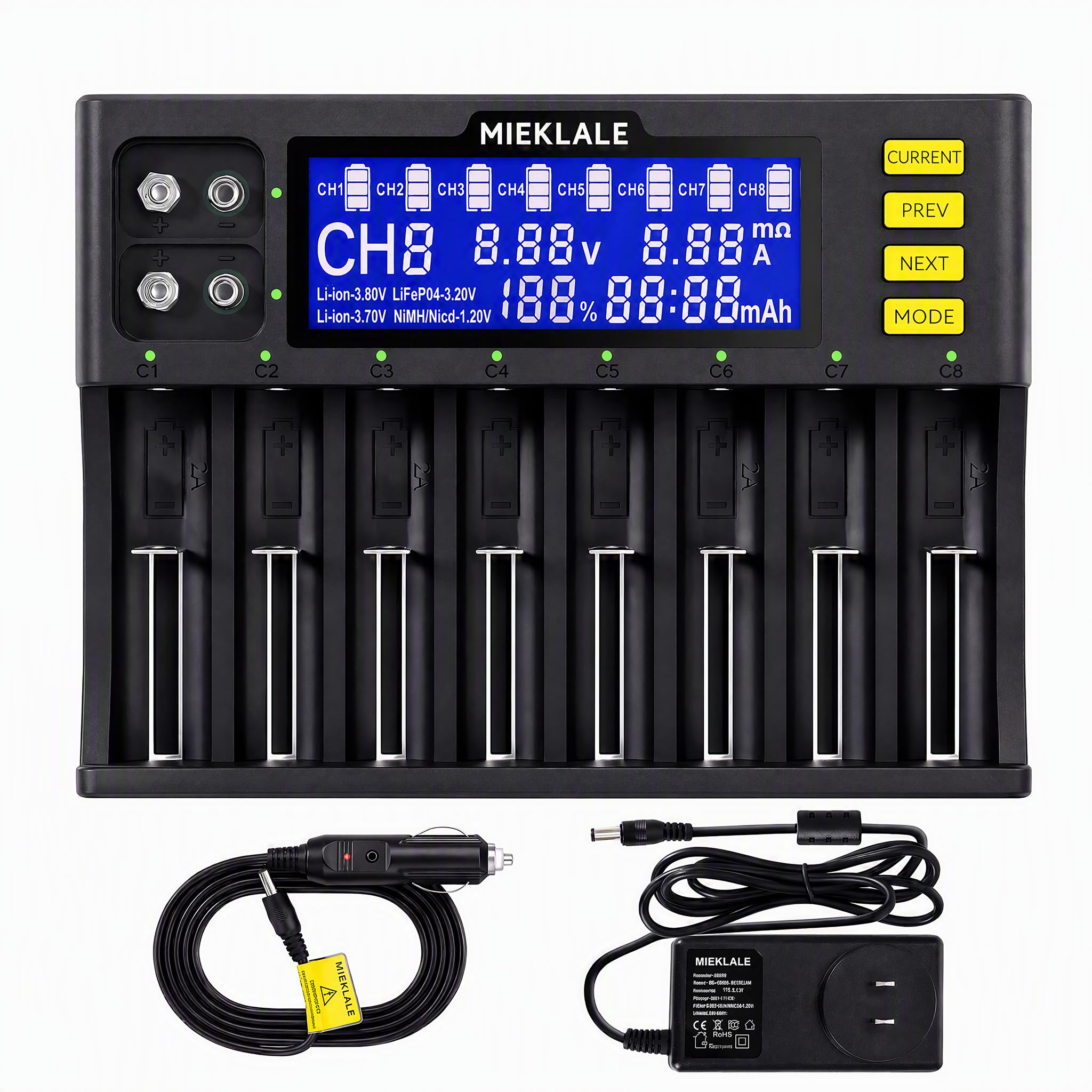
Ten charging bays and a 12V/4A brick that fill a whole drawer of mixed cells at once.
If you own a pile of cells, the port count is the spec to weigh first: this charger runs eight main bays plus two extra, 10 slots total, each capable of 2 amps. The PZ.P charger above has a single port, so if the job is refilling everything from one bag in a single session, this is the better fit — you are not funneling your cells through one bay at a time. It handles cells up to 72mm in length, which is long enough to seat 26650s and other large-format cells. It supports Li-ion, LiFePO4, RCR123, 18650, 26650, 10440, 14500, and 9V, plus NiMH and NiCd AAA and AA. One exclusion is worth noting: it does not charge the 1.5V Li-ion versions of AA and AAA.
The screen earns its keep on a charger this busy. It puts voltage, current, charging time, battery capacity, energy percentage, and internal resistance up together, so you can spot a weak cell fast. Five current levels let you choose between a gentle slow charge and a quicker one. The bundled 12V/4A power adapter and a car power cord make it usable in an office, garage, or vehicle. Owners tend to highlight reliability and quality first, and it is reassuring that the charger has overcharge, over-discharge, short-circuit, and reverse-connection protection built in, plus it spots a bad battery on its own.
The catch is the missing 1.5V Li-ion support — if your drawer is full of those cells, this is not the charger for that job. Batteries are not included either, so budget for cells separately. For the mixed-brand, mixed-chemistry piles most people actually have, it is the efficient choice.
The case for it: 10 bays at 2 amps a slot turn “charge them one by one” into a single sitting, and the combined display reads like a dashboard for every cell in the charger.
One more thing: it tops out at 2 amps per channel, so it is fast by volume rather than by raw per-cell current.
Made for: the tinkerer with a drawer full of mixed cells who wants to wake up to a full set rather than a queue.
Not the pick if: your batteries are 1.5V Li-ion AA or AAA cells, which this charger specifically does not take.
5. E-FAST 0-20A 12/24V Automatic Smart Battery Charger

Twenty amps into a 12V system, built to wake up the vehicles that sit the longest.
The reason to start here is raw current: 20 amps at 12V and 10 amps at 24V, which is more power into the battery than the 15-amp PZ.P above. That figure matters on a farm, in a yard, or anywhere a lawn mower, boat, or deep-cycle pack sits idle for months. It also runs a 7-stage automatic process — desulfurization, trickle charging, constant current, constant voltage, current detection, compensation, and floating — stepping through each stage on its own as the battery’s state changes. You plug it in and it reads the battery; you do not pick the stage.
The protections are thorough for a charger in this range. Reverse polarity, overheating, overcurrent, overvoltage, and short-circuit protection cover the common mistakes, and the charger adapts to over-cooled and overheated conditions. It draws from a 100-240V input, so it travels between plug standards. The screen shows each stage and battery status — real-time voltage, current, temperature — and when the battery is full it displays “100%” and stops. Owners tend to talk about ease of use and charging speed, and the compact form fits under a bench or in a truck cab.
The clear limit: this cannot activate a completely dead battery, repair a damaged one, or jump-start a car. So the pulse-repair feature is a matter of refreshing — helping an older or idle battery recover lost performance and holding a charge it still has. Understand that going in and it does exactly the job it is built for.
Settings it gets right
- 20 amps at 12V, 10 amps at 24V — the highest 12V figure on this list
- 7 automatic stages run from desulfation through to float
- Substantial protection set: reverse polarity, overheating, overcurrent, overvoltage, short circuit
- 100-240V input and UL listed
Limits to plan around
- Will not resurrect a completely dead battery or jump-start an engine
- No trickle-only storage mode setting to lock manually — it manages that automatically
- No pulse-repair on a damaged battery beyond its stated scope
Pick this for: big batteries in mowers, tractors, boats, and RVs where 20 amps cuts real time off the job.
Time to look on: if a jump start is part of what you need — that is the Schumacher wheeled charger’s job.
6. YHCHKJ 20A Car Battery Charger
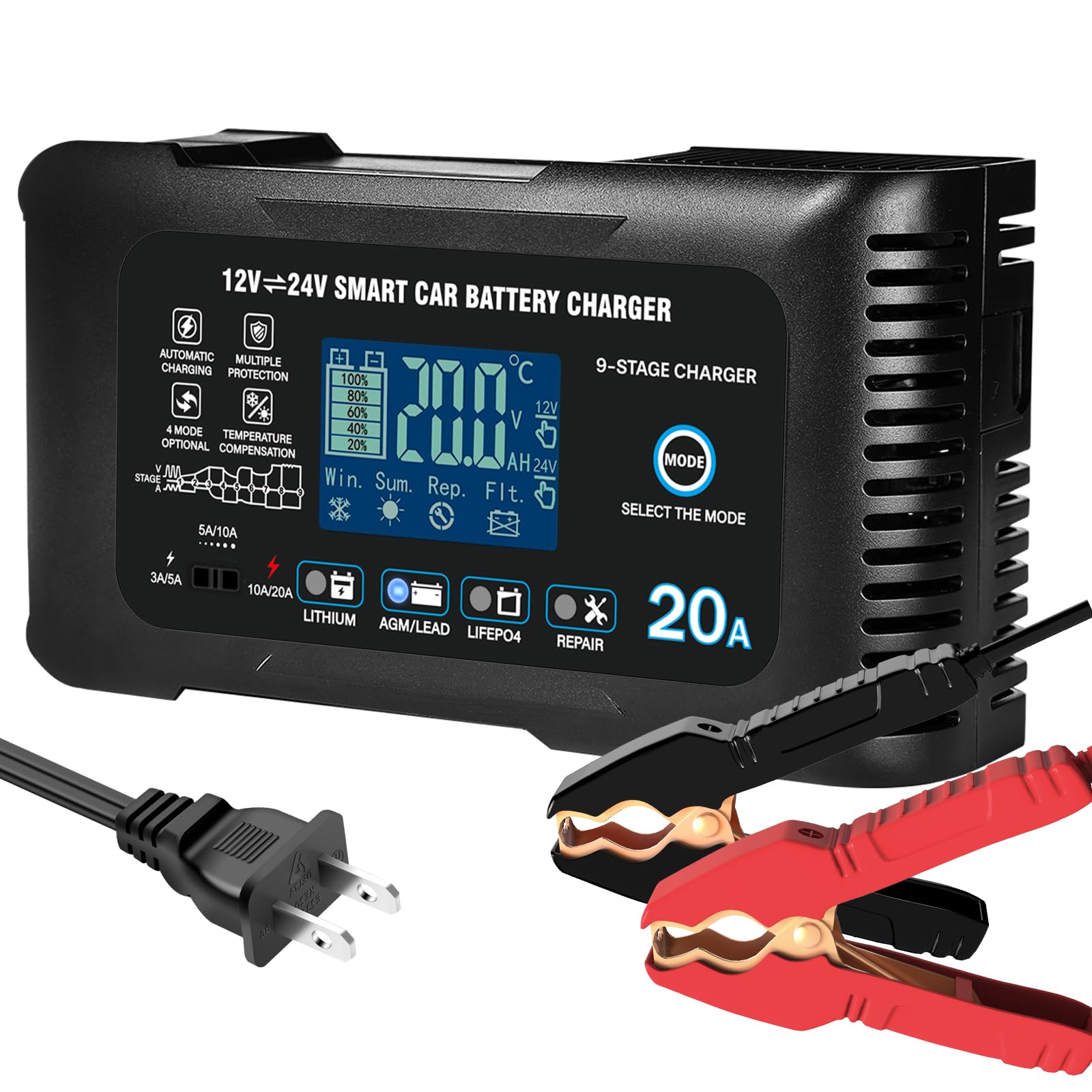
A one-button 20-amp charger that reaches lithium packs and lead-acid alike, in a lightweight chassis.
What sets this apart is the adjustable current. You choose 12V at 5A, 10A, or 20A, or 24V at 3A, 5A, or 10A. That flexibility matters because a small motorcycle battery does not want a full 20 amps shot into it, while a big truck or RV battery wants all the speed you can give it. The top mode matches the E-FAST above at 20 amps; the lower settings are the difference, letting you slow down for a smaller pack. It charges Lithium, LiFePO4, and lead-acid in wet, gel, and AGM versions, and the 1.2 lb body means it hangs or stows without any strain.
The display does the reporting work: it shows charging voltage and current, internal temperature, charge percentage, and summer or winter mode. Just plug in, pick the battery type and current, and let it work. The protections list is long — overheating, overcurrent, overcharge, short circuit, temperature compensation, fireproof materials, and a cooling system — which is what lets it act as a months-long winter maintainer. The pulse-repair mode is there to restore lead-acid capacity on a weak battery, and the trickle mode keeps it topped up after the main charge finishes.
One thing to know: the minimum starting voltage is 2V, and this is not a jump starter. If the battery is dead flat, it falls outside what this charger can do. A 24V battery that has been over-discharged needs the powerful mode described in the manual. Owners tend to praise reliability and straightforward operation, and the 5-year after-sales service is the manufacturer’s safety net.
Standout spec: the 3-level current selection (12V 5/10/20A, 24V 3/5/10A) is what makes a single charger safe for both a scooter pack and a big RV bank.
Watch the fine print: a sub-2V battery will not trigger the charger at all, so you need a different tool for a jump-start situation.
Right for you if: you want one garage charger for a mix of battery sizes, with manual control over how hard it charges.
Not the one for: engine starting on dead-flat batteries — that is outside its stated range.
7. CRAFTSMAN 12A Car Battery Charger & Maintainer, 6V/12V
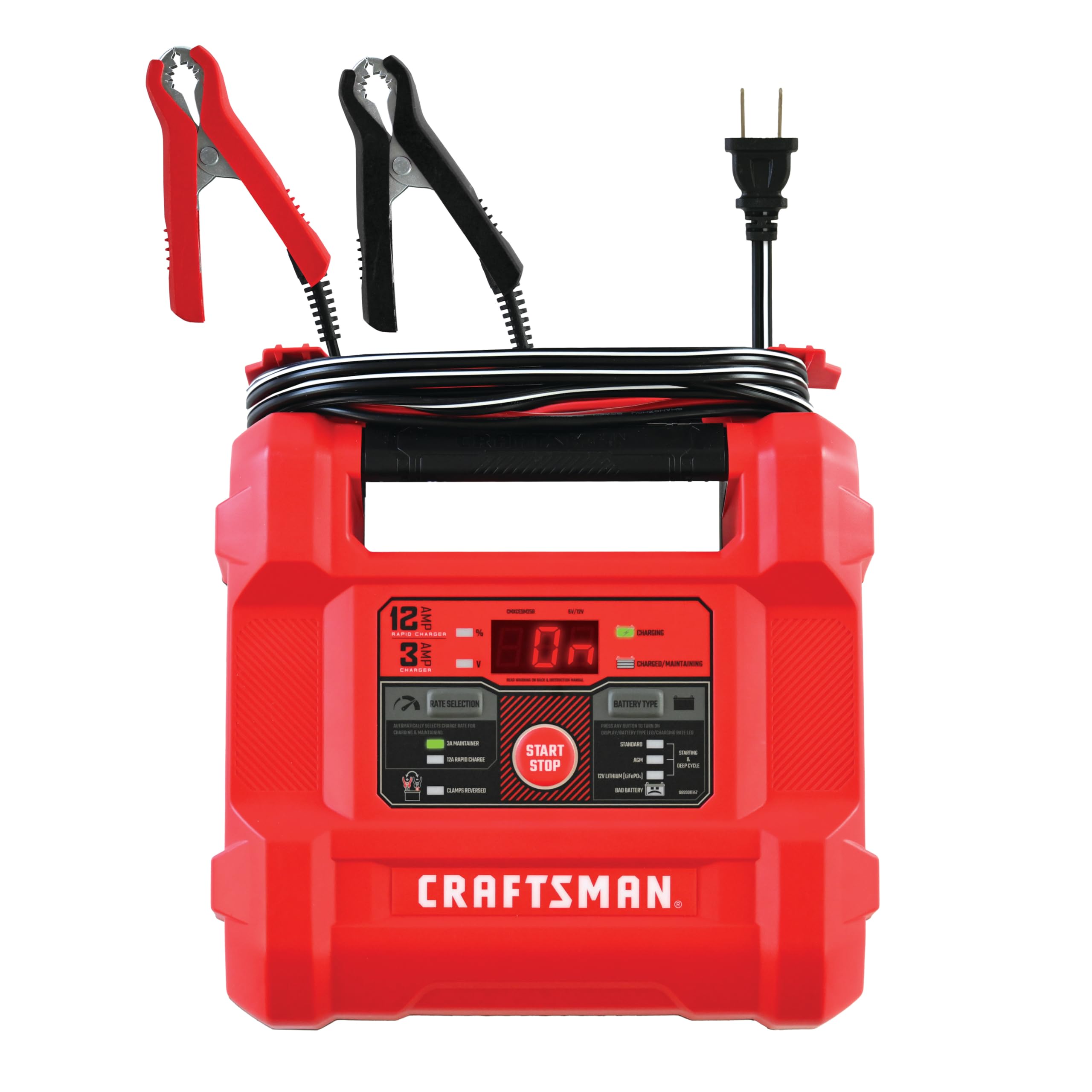
A 12-amp garage charger with a desulfation mode, built for the car that sits for weeks.
The device is a four-in-one: it charges, maintains, tests, and restores. At 12 amps it moves real power into a battery, and it handles standard, AGM, deep-cycle, and 12V lithium LiFePO4 batteries, plus 6V batteries. Auto voltage detection picks the right profile for a 6V or 12V battery without you choosing. That is the practical win for an owner who keeps a seasonal vehicle — connect it, walk away, and the smart trickle charging keeps the battery from going flat over winter. The 3.4 lb body, 6-foot AC cord, and 6-foot battery cables give it 12 feet of reach, which helps when the battery sits deep under a hood.
The reason people keep buying a name like this: the advanced desulfation mode and multi-stage charging algorithms are designed to hold battery life. Reverse hook-up protection guards against the mistake of clamping the leads the wrong way. Reviewers tend to start with the charge speed, and the lightweight build makes it easy to hook up and move. Beyond the charge itself, it is meant to prevent a roadside emergency before it happens — keep a battery topped up in winter and you skip the morning it will not crank.
Set expectations on the build. The housing on this charger is widely described as feeling cheaply made, which is worth weighing against a heavier-duty unit for regular shop use. Auto voltage detection is also a limit worth knowing — the charger decides, and if you need to force a setting it is not the tool for that. For a seasonal or infrequently used vehicle, though, it does its job as intended.
Why it earns its rating
- 4-in-1: charge, maintain, test, restore in one unit
- 12A rapid charging for standard, AGM, deep-cycle, and LiFePO4
- Auto voltage detection for 6V and 12V batteries
- Reverse hook-up protection and 12 feet of total reach
Honest trade-offs
- Build quality gets mixed feedback — it feels lighter duty than the price implies
- Battery life results are mixed for some buyers
- Auto detection leaves little manual override
Best used for: the car, boat, or mower that sits for weeks, where maintain-and-restore matters more than a workshop-grade housing.
Consider a heavier unit if: you will use it daily in a shop, where the lighter build will show.
8. DEWALT DCB1112 Fast Charger, 20V + FLEXVOLT

A 12-amp shop charger that blows air across a hot pack to cut the wait between cuts.
On a job site the delay between two dead packs is the enemy, and this charger answers with 12 amps and a stated 45-minute charge time. That is quick enough to drop a depleted pack on and be back to work while the other pack runs the tool. Two details back that speed up. An internal fan circulates air across the batteries, which reduces hot and cold pack delays so the charger does not sit idle waiting for the pack to cool. And a two-stage LED state of charge indicator tells you how full the pack is at a glance, so you are not guessing.
Compatibility is the other half of the value: it takes DEWALT 20V MAX and FLEXVOLT 20V/60V MAX batteries. If you already run DEWALT tools, this charger keeps one family of packs topped up without a second brand’s charger on the bench. Thru-hole wall mounts (screws sold separately) let you bolt it to a wall over the bench, keeping it out of the sawdust. It is built for the person who owns the brand’s tools and wants a faster cycle than the stock charger gives.
Two things to weigh honestly. It only charges DEWALT 20V MAX and FLEXVOLT packs, so it is no help for other brands. And the battery life side gets mixed readouts — some packs die early, which is about the pack, not the charger. Speed is what this charger is genuinely known for, and the fan-backed cycle time is the reason to buy it.
Genuine fast charging in practice: the fan cooling is the practical detail — keeping air moving over a pack lets the charger keep its rate up instead of pausing for a hot battery to cool.
The honest trade: this is a one-brand charger. If you do not already own DEWALT tools, its speed is not accessible to you.
For DEWALT owners, it is the fast charger that shortens the wait between packs and mounts on the wall by the bench.
For everyone else: it simply will not charge your packs, so look at the multi-format models above.
9. Schumacher Electric SC1446 Wheeled Charger

A wheeled shop charger that charges at 10 amps and also jump-starts at 200 amps.
This is the one that doubles as a jump starter, and the number to look at is 200 amps of engine start, paired with a 40-amp boost to quickly revive a deeply discharged battery. The charging side runs 10 amps into a 6V or 12V battery, and a 135-minute manual timer gives you direct control over the charging process. That control is the whole appeal for a shop or a serious DIY mechanic; you set the time instead of leaving a fully automatic charger to guess. It handles standard, AGM, gel, and deep-cycle batteries across automotive, marine, and power sport vehicles.
The reach is generous: the wheeled chassis, 8.91-inch depth and 33.37-inch overall height, and 29.9 lb bulk mean it rolls to the vehicle rather than needing the vehicle to come to it. Owners in the field typically value the sheer versatility and the multiple charging options, and some specifically note the manual operation without microprocessors — that is the draw for anyone who prefers hands-on control. The manufacturer has been making this kind of equipment since 1947, which is the heritage note behind the wheeled design.
The catch, and it is a fair one, is that the reviews on reliability and charging performance are mixed; this is a big, manual machine that expects an operator, not a plug-in-and-forget unit. It is also the heaviest and most substantial option on the list, so it is home-shop gear, not something to carry to the trailhead. For that shop role, the combination of 200-amp starting and timer-controlled charging is exactly the versatility it is built for.
The fit: home garages and small shops that want one heavy machine to charge, boost, and jump-start a fleet of vehicles — and are happy to give up automatic control for a hand-set timer.
The skip: anyone who wants a light, fully automatic charger to leave on a battery indefinitely.
Know the Specs
Amp Rating and Charging Speed
Amps measure how much current the charger pushes into the battery, and higher amps mean a faster fill. That is the cleanest speed comparison you can make between chargers built for the same battery type. A 15-amp or 20-amp car charger moves far more power than a 1-amp cell charger, but they serve different jobs. On multi-slot chargers, remember the total amps split between the bays, so filling both slots means each cell gets less.
Battery Chemistry and Compatibility
Each battery chemistry takes its own charging profile. Lead-acid (wet, gel, AGM, SLA) and lithium iron phosphate (LiFePO4) need different voltage curves, and Li-ion cells like 18650s are different again. A charger that does not list your battery type may push the wrong voltage and damage it. Always check the supported chemistry list on the charger first, then confirm your cell length fits if it is a bay charger — some accept cells only up to a stated length in millimeters.
Charging Stages and Termination
A stage is one step in the charging process, and stage counts (such as 7 or 9) describe how many steps the charger runs. More stages generally means a gentler taper near full charge, then a switch to float or trickle so the battery is held at full rather than overcharged. Automatic termination at full charge is the key safety feature — it is what stops a charger from cooking a battery left connected for hours or days.
Pulse Repair and Desulfation Explained
Pulse repair sends short bursts of current to break down sulfation, a buildup on lead-acid plates that robs a battery of capacity. It is marketed as reviving weak batteries. The honest limit: none of these chargers can activate a completely dead battery or repair a damaged one, and they are not jump starters. Treat pulse repair as a useful extra for a battery that is weak but still alive, not as a rescue tool for a dead pack.
Common Questions
What actually makes a battery charger the fastest?
Can a 20-amp charger overcharge a small motorcycle battery?
What is the difference between a battery charger and a jump starter?
Can these chargers revive a completely dead battery?
Do I need to match the charger’s battery chemistry to my cells?
How long should a car battery take to charge on a fast charger?
Will a DEWALT 20V charger charge my other-brand tool batteries?
What does the LCD on a battery charger actually tell me?
Is a charger with a USB port worth it for travel?
Can I leave a smart charger connected to my battery all winter?
Why does my charger need an input voltage listed in volts?
The Bottom Line
For most people the winner is the Panasonic BQ-CC65 eneloop charger, because it handles the AA and AAA cells that most households actually recharge, shows each cell’s health on its LCD, and delivers a fully drained four-cell set in up to 4 hours. If you need to fill a car, boat, or mower battery fast, grab the PZ.P 15-Amp charger, whose 15 amps and nine charging stages make it the fastest practical option for lead-acid and LiFePO4 packs. And for a drawer full of mixed cells charged in one sitting, the MIEKLALE 8+2 bay charger turns that queue into a single session — a solid reason to start there if volume is your priority.
How we choose
We do not accept paid placement. Every pick is matched to a real buyer and a real use-case; we do not hands-on test units.
Sources
Specifications: manufacturer listings and product documentation. Review insights: verified customer reviews, as of November 2026. Pricing: not shown on this page (it changes often); check the current price via the retailer link.
As an Amazon Associate, Tactical Gear Guy earns from qualifying purchases. This does not affect which products we feature.