Specs are compiled from manufacturer listings and verified buyer reviews and can change over time — please confirm the key details on the product page before buying.
You get two screens for your Xbox fastest with a matched dual monitor pack — two identical panels in one box, same 1920×1080 resolution, same refresh rate, same picture. Buy one pair and you are done. The alternative is buying a single monitor twice and bolting both to a gas-spring arm. That gives you far more freedom in size and angle, but check two numbers before you order: your screen’s weight and its VESA pattern (the square bolt-hole layout on the back, either 75x75mm or 100x100mm).
This guide is built by comparing the manufacturers’ published specifications and the patterns across verified customer reviews, so you get each pick’s real strengths and trade-offs instead of marketing spin.
Below you will find matched pairs and single arms sorted by what they actually do on a desk, from curved 27-inch twins to a heavy-duty arm built for ultrawides. Every entry here is a serious contender for the best Xbox dual monitor setup you can put together right now.
Top Picks

How To Choose The Best Xbox Dual Monitor Setup
Two screens on an Xbox is not the same job as two screens on a work laptop. On a console you are usually running one game on the main panel and something else — a stream, a party chat window, a guide — on the second. That changes what matters. You want matched panels so the picture does not jump in brightness or colour as your eye moves across the seam, and you want a refresh rate high enough that fast camera pans stay clean.
Matched pair or two singles on an arm
A dual pack is the low-effort route. Both panels arrive identical, both carry the same 1920×1080 resolution and the same refresh rate, and you set them up once. An arm is the flexible route: you pick any two screens you like, then mount them on a gas-spring arm that lifts them off the desk. The arm route costs you a compatibility check — each arm holds a stated weight range, and your monitor has to sit inside it.
The numbers that actually decide it
Refresh rate is the headline. 75Hz redraws the image 75 times a second, which is smooth for strategy and slower-paced titles. 120Hz and 240Hz redraw far more often, so a fast flick of the camera leaves less smear behind it. Response time works alongside it: a 1ms figure is the panel’s stated pixel-switch speed, and a lower number means less ghosting — the faint trail behind a moving object.
Then check the physical side. A 27-inch curved panel is a big object; two of them side by side need desk width and a viewing distance that suits the 1500R curve (a gentle bend where the edges wrap slightly toward you). A 22-inch or 24-inch pair fits tighter spaces and keeps both screens inside your field of view without turning your head far.
Ports and mounting before you commit
Confirm the inputs match your console and your capture card or switcher. HDMI is the common link; DisplayPort appears on some panels and is useful if you also run a PC through the same screens. If you plan to wall-mount or arm-mount, verify the VESA pattern is listed as 75x75mm or 100x100mm and that your desk can take a clamp — glass and plastic surfaces are usually off-limits for a C-clamp.
Side-by-Side Comparison
| Model | Best For | Screen Size | Refresh Rate | Mount / Load | Amazon |
|---|---|---|---|---|---|
| Kado Dual 2-Pack 27″ Curved★ Best Overall | Big curved pair for console gaming | 27″ (1500R curved) | 75Hz | — | Amazon |
| ErGear Dual Monitor ArmTop Performer | Owners of two screens who want them off the desk | 13″–32″ | — | 4.84–19.8 lbs per arm | Amazon |
| Acer Dual Monitor ArmBest Reach | Tall, wide-reaching adjustment | 17″–32″ | — | 4.4–19.8 lbs per arm | Amazon |
| VIVO Dual Ultrawide Mount | Two ultrawide panels on one arm | Up to 35″ | — | 26.4 lbs per arm | Amazon |
| 2X Pack 24″ FHD 100Hz | Budget pair with 100Hz and speakers | 24″ | 100Hz | Wall mount ready | Amazon |
| ViewSonic VA2456A-MHD dual pack | Arm-mounting an IPS pair | 24″ | 120Hz | Head-only, VESA ready | Amazon |
| Kado 2-Pack 22″ Flat | Small-desk flat pair | 22″ | 75Hz | — | Amazon |
| GRIFEMA Gas Spring Arm | Tight-budget arm for small screens | 13″–32″ | — | 4.4–19.8 lbs per arm | Amazon |
Detailed Reviews
1. Kado Dual Monitor 2-Pack 27″ Curved 1500R 1920×1080 75Hz
Our pick — 4.5+★ from 400+ verified ratings; the strongest balance of quality and price.
Two 27-inch panels with a 1500R bend, so the edges of your game lean toward you instead of away.
The pair arrives matched at 1920×1080 across 27 inches, which is the size where a two-screen setup starts to feel like a wall of picture rather than two windows. Each panel runs at 75Hz with FreeSync on board — FreeSync being the handshake that lets the screen match its refresh to the frame rate the game sends, so you get less tearing when the action dips. A 2000:1 contrast ratio backs the blacks, and the stated 98% sRGB coverage is the colour range figure, meaning the reds and greens in a game look like the ones the artist picked.
The curvature is the reason to pick this over a flat pair. At 1500R the panel bends on a gentle arc, so on a dual desk you get one continuous sweep across your vision instead of a hard seam in the middle. Once you sit behind the 1500R arc, two flat rectangles feel like a step back.
Built-in speakers mean you can skip a soundbar and still hear the game. Two 27-inch screens plus their stands is a lot of desk, so measure before you order — and if the stands crowd you, note the panels are standard desktop units rather than head-only VESA boards.
Where the Kado pair wins
- Matched 27-inch 1500R curved panels, so both screens curve identically.
- FreeSync plus 75Hz keeps console frame dips from tearing.
- 98% sRGB gamut for colour that matches the source.
- Built-in speakers free up desk space and a power outlet.
What to measure first
- Two 27-inch bodies need real desk width — check before you buy.
- 75Hz tops out the smoothness; fast shooters will want more.
- Full desktop monitors, not head-only boards, so arms need VESA checking.
Take the pair if: you want one box to solve dual-screen gaming and a 1500R curve is the look you are after.
Hold off if: your desk is narrow or your favourite games are twitch shooters that beg for a higher refresh.
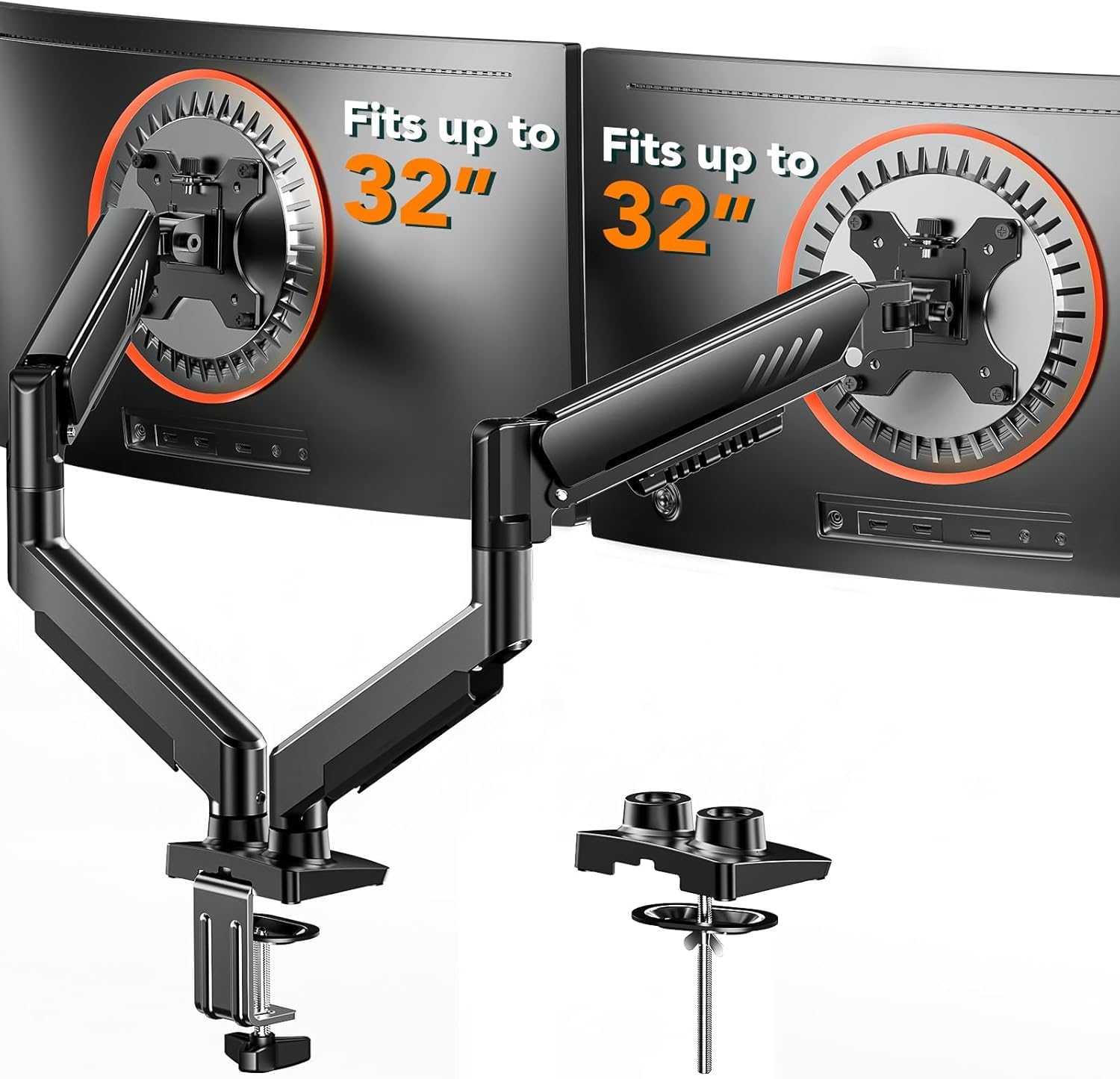
2. ErGear Dual Monitor Arm, Full Adjustable for 13–32″ Screens
The arm that takes two screens off the desk and holds both at whatever angle your neck prefers.
If you already own two monitors and want them floating, this is the practical answer. It fits 13″–32″ flat or curved panels and carries 4.84 to 19.8 lbs per arm — a slightly wider lower limit than the GRIFEMA arm below, which starts at 4.4 lbs. That extra room helps if you run a lighter 24-inch panel and want the spring tension to hold it still rather than drift up.
Setup is the part people dread, and the tool-free VESA plate is the fix: three steps and the screen clicks onto the arm without a screwdriver. The one-piece C-clamp grabs desks from 0.39″ to 2.56″ thick, or you can bolt through the desk with the grommet mount if the surface is thicker. Height runs up to 17.5″ and reach extends up to 18.1″. The head tilts +80°/-50°, swivels ±90°, and rotates a full 360° for portrait.
Owners single out the arm’s build quality. The VESA head is drawn tighter than earlier versions, and the core is tested for over 20,000 movement cycles — that is the up-down travel repeated again and again, and it is the number that says the spring will not go soft on you.
The honest note is the same one that hits every gas-spring arm: you have to set the tension to the weight of your screen. A light panel on full spring can fight you until you dial it down. Wooden desks are the recommended surface.
Why it earns its place: tool-free mounting and a 4.84 lb floor make it the most forgiving arm for mixed-size pairs.
What to expect: tension tuning is part of the job, and an occasional unit arrives needing that dial-in before it sits still.
Reach for this if: you have two monitors already and want them off the desktop with a clamp that fits thin and thick desks.
Skip the clamp plan if: your desk is glass, plastic, or hides a crossbeam underneath.
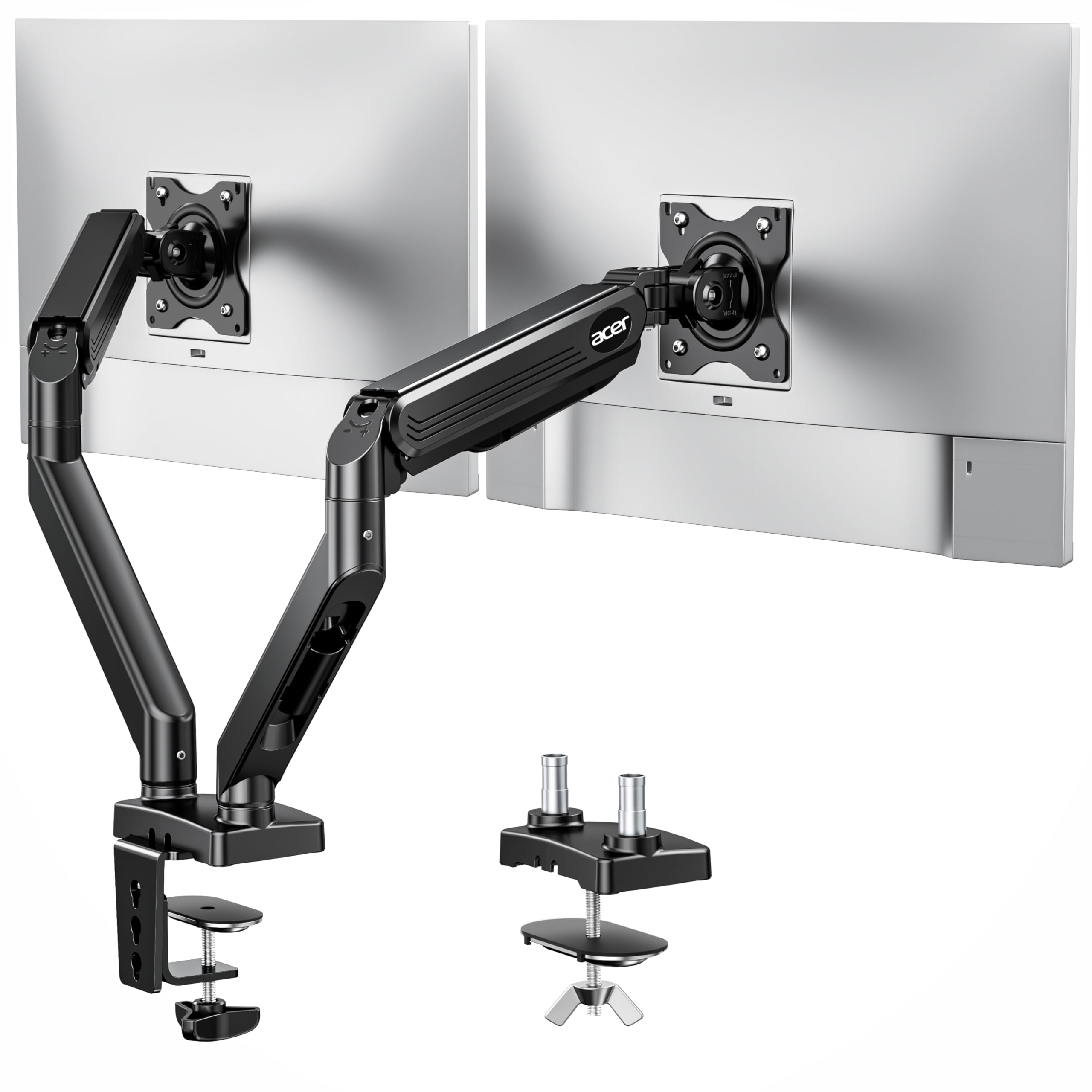
3. Acer Dual Monitor Arm
A gas-spring arm built for deep desks, with the longest reach and the tallest lift on this list.
The Acer arms out farthest of any mount here — 21.25 inches of extension against the GRIFEMA’s 16.54 inches, a 28% longer push away from the clamp. Height adjustment tops out at 18.1 inches, which is 0.6 inches above the ErGear on the paragraph above. If your desk is deep and your screens currently sit at arm’s length, this is the arm that pulls them close.
The tilt range is the widest of the group at 90 degrees maximum, against the ErGear’s 80. In practice that means you can angle a panel further down for a standing setup or flip it flatter for a shared view. Rotation is 360°, swivel is ±90°, and the arm can run dual horizontal, horizontal and vertical, dual vertical, or cross horizontal.
Note the minimum screen size: 17 inches, where the GRIFEMA starts at 13. That is a 31% wider floor, so small panels are not invited. Each arm holds 4.4 to 19.8 lbs, VESA is 75×75 or 100x100mm, and the gas lift passed over 20,000 durability tests. Clamp and grommet both work, the clamp fits desks from 0.59″ to 3.15″ thick, and the maker flags that glass or plastic surfaces are not suitable.
The motion is the trade-off. A gas arm moves at a touch of the hand, and that ease can drift until the tension screw is set right — heavier screens need more tension, lighter ones need less. Quality and sturdiness are the strong suits; the angle-holding is the part that needs dialing in.
The long-reach advantage: 21.25 inches of extension and 18.1 inches of lift put screens where shorter arms cannot.
The honest limit: set the tension screw to your monitor’s weight, or a panel can tilt after you let go.
Built for: deep desks and 17-to-32-inch screens that need to come closer or climb higher.
Not the pick for: a pair of small 13-to-15-inch monitors, which sit below its size floor.
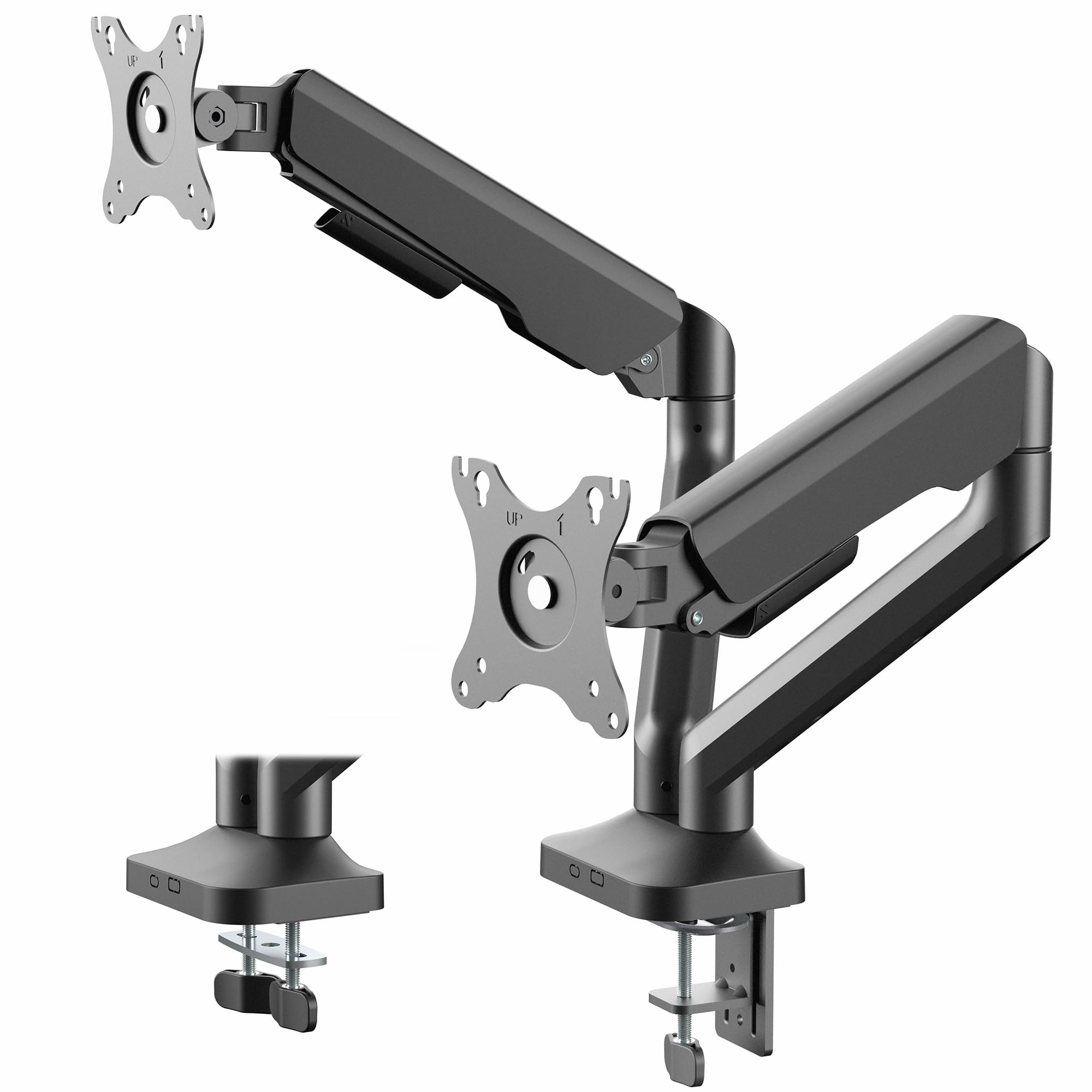
4. VIVO Dual Ultrawide Monitor Mount, Up to 35″ Screens
For the gamer running two huge curved panels who needs an arm that simply will not flinch.
Two 35-inch ultrawides is a serious load, and this mount is the one here rated for it: 26.4 lbs per arm versus the 19.8 lbs ceiling on the ErGear and Acer arms. Screen sizes up to 35 inches are supported with 75x75mm or 100x100mm VESA. If you are considering an ultrawide as your main gaming panel with a second wide screen beside it, the smaller arms on this list are the wrong tool.
The pneumatic arms counterbalance the weight so a big screen lifts and settles with a hand. Tilt runs +90° to -90°, swivel is 180°, rotation is 360°, and vertical travel is 10.8 inches. That is a shorter lift than the Acer’s 18.1 inches because the arm is built around holding heavy glass still rather than reaching far.
The clamp reaches desks up to 3.15″ thick, or 1.7″ with the grommet mount. Detachable VESA plates make hanging an ultrawide a two-person job done calmly rather than a wrestling match, and cable covers keep the wiring out of sight.
The catch is small-screen fit. This arm is tuned for weight, and a light 24-inch panel will not balance against a spring meant for 26.4 lbs. Pair it with the screens it was designed for.
The heavy-lift case: 26.4 lbs per arm and 35-inch support at a weight class nothing else here matches.
Where it stops: light panels have no counterweight to work against, so it wants big screens.
Made for: two wide or ultrawide monitors that need a spring arm rated well above the norm.
Think twice if: your panels are small and light — the spring is sized for heavier glass.
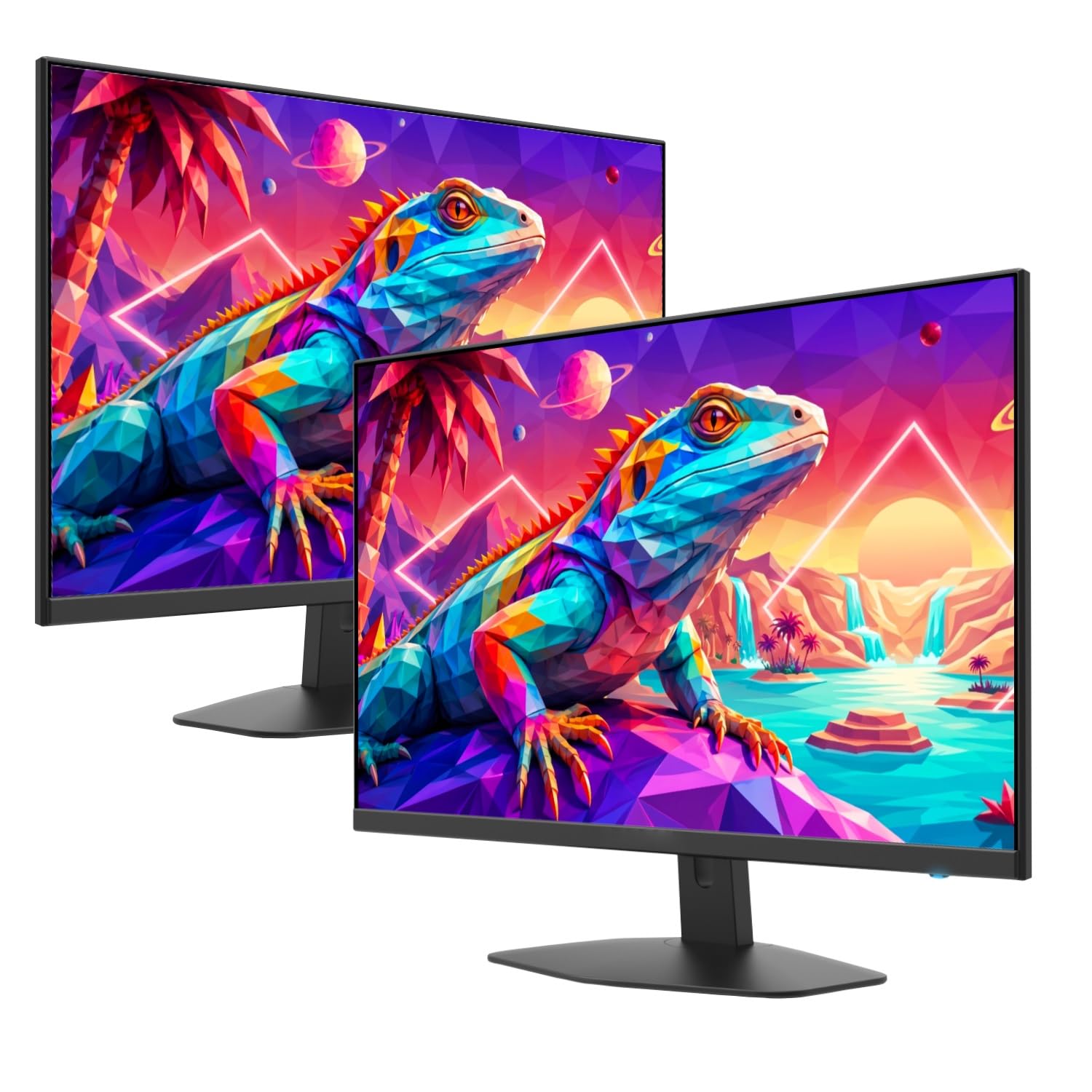
5. 2X Pack 24 Inch FHD 100Hz Monitor
Two 24-inch panels at 100Hz, with the fastest pixel response of any screen pair on this page.
Here is the value play in a dual pack: 100Hz on both panels, which sits between the 75Hz Kado pairs and the 120Hz ViewSonic set, and a stated 1ms BR response. BR means blur reduction — a mode that shortens how long each pixel stays lit, so motion trails shrink. For a console game with fast pans, that is the number doing the heavy lifting.
Both screens are 1920×1080 with a 100% sRGB colour gamut, so images across the seam look like one continuous picture. FreeSync is on board to keep the tear down when frame rates wobble. Brightness is stated at 250 cd/m2, and contrast at 1000:1.
Built-in speakers on each panel save you a soundbar and a cable. The matte finish keeps glare from a window off the picture, and wall-mount support is there if you would rather hang them than stand them.
The honest limit: 100Hz beats 75Hz but trails 120Hz and 240Hz, so a competitive shooter at high frame rates will want the faster pair further down. For strategy, co-op, and dual-screen browsing, this pair does the job.
The spec that sells it: 100Hz and a 1ms blur-reduction response in a matched two-pack.
Where it lands: fast enough for most titles, short of the 240Hz curved set for twitch play.
Great match for: a console setup that wants two identical 24-inch screens without paying for the fastest panel.
Look past it if: you play competitive shooters where every frame of refresh counts.
6. ViewSonic VA2456A-MHD_H2 24 Inch Dual Pack

A head-only IPS pair that assumes you are bringing your own arm and want 120Hz under it.
These two panels ship without stands. That sounds like a downgrade until you notice what it signals: this is a pair built to be VESA-mounted, which makes it the natural partner for the ErGear or Acer arms reviewed above. Two 24-inch 1080p IPS screens at 120Hz — IPS being the panel type that keeps colour steady when you view from an angle, so a second player sitting off to the side still sees the same picture.
The refresh rate is the reason to pick it over the 24-inch 100Hz pair. 120Hz redraws more often, and the frameless bezels mean the gap between the two screens stays thin. Anti-glare coating and a blue light filter are on board, and eye-care settings are aimed at long sessions.
Ports are broad: HDMI, DisplayPort, and VGA on each, plus 3.5mm audio. A contrast ratio of 1500:1 is the highest on this page, and it helps dark scenes hold detail. An HDMI cable is included for each display.
The screen quality is the point to weigh, not the value. Owners call the pair decent for the money but split on the picture, so treat it as a productivity pair rather than a colour-critical set. And because there are no stands, you are committing to an arm or wall mount from day one.
The case for the pair: 120Hz IPS panels at 24 inches with frameless bezels and three input types each.
Plan around this: no stands in the box, and the picture draws mixed feelings among owners.
Suits you if: you already have a dual arm and want a 120Hz IPS pair to hang on it.
Wrong choice if: you need screens that stand on a desk straight from the start.
7. Kado 2-Pack Dual 22″ Flat Screen 1920×1080 75Hz FHD Monitor
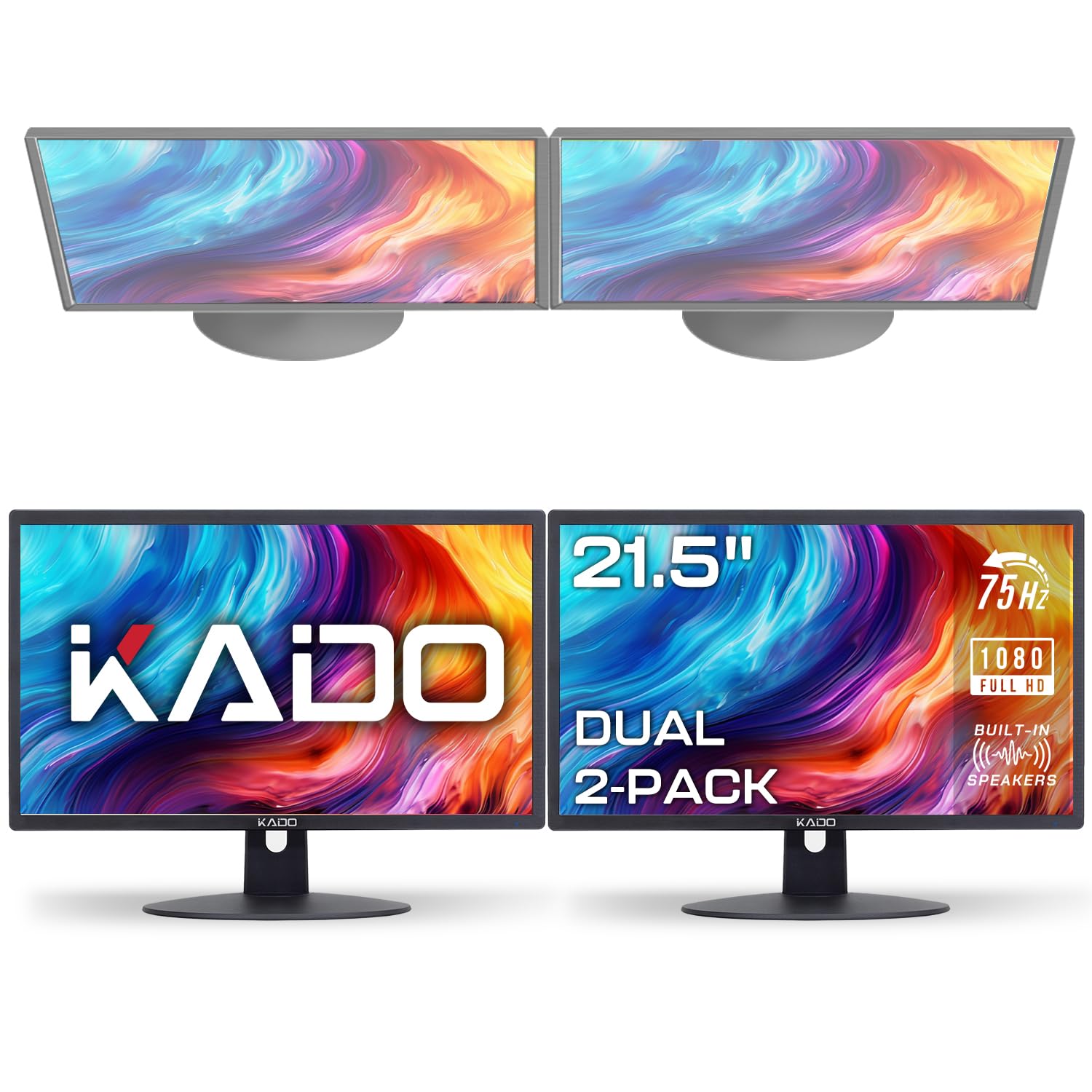
A flat 22-inch duo for tight desks, where a curved 27-inch pair would simply not fit.
Two flat panels solve the problem curved screens create for small spaces: with no wrap at the edges, the pair stays inside a narrower footprint and each screen faces you straight. At 1920×1080 across 22 inches, the pixel count is the same as the bigger pairs here, so you lose screen real estate but not resolution.
FreeSync, 75Hz, a 99% sRGB gamut, and built-in speakers round it out — the same 75Hz refresh as the 27-inch curved Kado pair, in a far smaller body. Contrast is 1000:1. It is a set for a bedroom desk or a secondary setup where the monitors sit close to your face.
Buyers report solid build quality and reliability. The weak spot is the speakers: several note the sound runs low, so a headset or a small speaker pair is a sensible add for anything beyond menu sounds.
Where it shines: flat 22-inch panels with 1080p resolution and FreeSync in a footprint that fits small rooms.
Add to the list: a headset or separate speakers, as the built-in audio runs quiet.
Best for: small desks and secondary setups that need two working screens without the bulk.
Not for: anyone wanting a large, rich pair or loud built-in audio.
8. GRIFEMA Gas Spring Monitor Mount
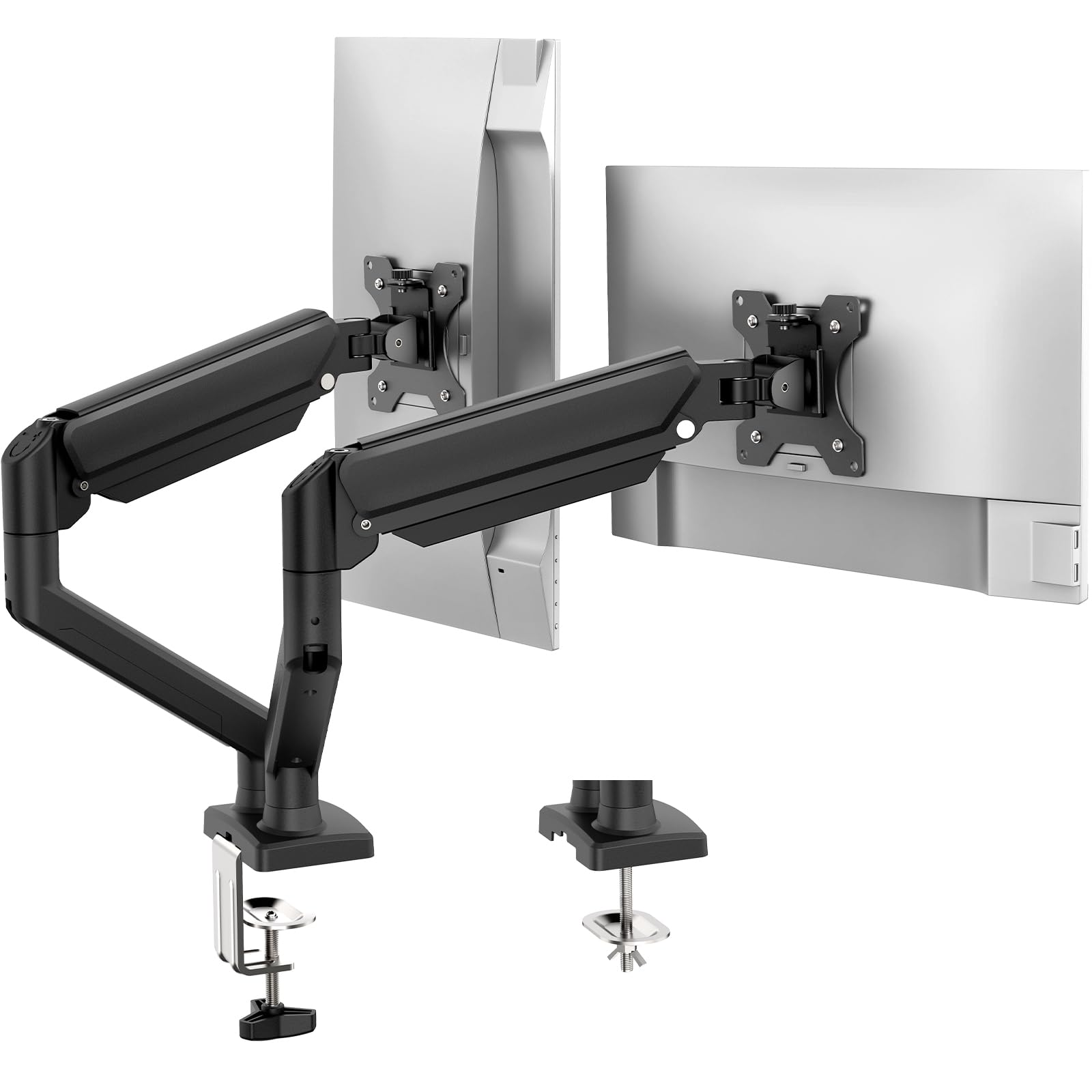
The entry arm that takes the widest range of screen sizes, down to 13 inches.
Where the Acer arm refuses anything under 17 inches, this one starts at 13 — a 31% wider opening for smaller panels. Extension reaches 16.54 inches against the Acer’s 21.25 inches, and height rises to a maximum of 20.08 inches. If your monitors are modest and your desk is shallow, the shorter reach keeps them in its balance rather than overextending.
The pneumatic spring gives one-hand adjustment across 360° rotation, ±90° swivel, and +90°/-45° tilt. VESA is 75x75mm or 100x100mm, and each arm holds 4.4 to 19.8 lbs, with a total of 8.82 to 39.68 lbs across both. The spring arm is tested for over 20,000 motion cycles, and the alloy-steel frame keeps it steady day to day.
Setup is 10 to 15 minutes by the maker’s estimate, and the C-clamp or grommet options cover most desks. Built-in cable management runs the wires along the arm and off your desktop.
The tilt range is the narrowest here at +90°/-45°, and the reach is shortest, so it is not the arm for a deep desk. For a compact two-screen rig, the fit is right.
The practical advantage: 13-inch minimum screen size and a 10-to-15 minute setup make it the easiest arm for small monitors.
The realistic limit: shorter reach and a -45° lower tilt mean it is not built for deep desks.
Go for it if: your screens are small, your desk is shallow, and you want a spring arm without the steepest spend.
Look elsewhere if: you need long reach or deep downward tilt on a big panel.
Know the Specs
Refresh Rate (Hz)
The number of times per second the panel redraws the image. 75Hz is fine for slow-paced games and browsing; 120Hz and 240Hz cut the smear on fast pans. Higher is smoother, but only if the game actually feeds frames fast enough to use it.
Response Time (ms)
How quickly a pixel switches from one shade to another. A lower figure means less ghosting — the faint trail a moving object leaves. On console this mostly shows up in fast panning shots.
1500R Curvature
The radius of the screen’s bend. At 1500R the edges lean toward you, so on a dual setup the two panels read as one arc. Flat panels suit small desks and tight spaces.
VESA Pattern
The bolt-hole square on the back of the screen, either 75x75mm or 100x100mm. Every arm here fits both, so check your monitor’s pattern before you order a mount.
Load Range Per Arm
How much weight one arm holds. A gas-spring arm needs a monitor inside its stated range to balance — too light and it drifts up, too heavy and it sags. Match the screen’s weight to the arm’s figure.
sRGB Color Gamut
The share of the standard colour range the panel shows. 98% and 100% coverage keep the two screens looking consistent, so your picture does not shift across the seam.
Common Questions
Can I use a dual monitor setup with an Xbox console?
Is 75Hz enough for Xbox gaming or should I get 120Hz or 240Hz?
Will these monitor arms hold two 32-inch screens?
What is the difference between a dual monitor pack and buying two screens on an arm?
How thick can my desk be for a C-clamp monitor arm?
Do curved monitors work with VESA arms?
Why does my monitor sag or tilt on a gas spring arm?
Is IPS better than the panel type in a curved gaming screen?
Can I mix a 27-inch curved screen with a 22-inch flat one on the same arm?
Do the built-in speakers on these monitors replace a soundbar?
The Bottom Line
For most people putting together a best Xbox dual monitor setup, the Kado Dual 2-Pack 27″ Curved is the one to start with. You get two matched 1500R panels at 1920×1080, FreeSync and 75Hz, and speakers built in — one box, one setup, no matching work. It holds 4.5+ stars from 400+ owners.
If you already own your screens and want them floating, the ErGear arm is the better buy, with its tool-free VESA plate and a 4.84 lb floor that fits a lighter panel. Running ultrawides? The VIVO mount carries 26.4 lbs per arm and takes screens up to 35 inches.
And if you are chasing every frame, reach for the Kado 240Hz curved pair — 240Hz and a 1ms response is the speed ceiling of this whole list. Match the pick to what you actually play, and you will not spend twice.
How we choose
We do not accept paid placement. Every pick is matched to a real buyer and a real use-case; we do not hands-on test units.
Sources
Specifications: manufacturer listings and product documentation. Review insights: verified customer reviews, as of November 2026. Pricing: not shown on this page (it changes often); check the current price via the retailer link.
As an Amazon Associate, Tactical Gear Guy earns from qualifying purchases. This does not affect which products we feature.