Specs are compiled from manufacturer listings and verified buyer reviews and can change over time — please confirm the key details on the product page before buying.
The hardest part of buying a wood nail gun is that “nail gun” covers four different tools. A framing nailer sinks 3-1/2 inch spikes into studs. A finish nailer sets trim. A flooring nailer locks tongue-and-groove boards down. Buy the wrong one and it simply will not hold your project together. This guide sorts that out first, then shows you which tool fits your job.
This guide is built by comparing the manufacturers’ published specifications and the patterns across verified customer reviews, so you get each pick’s real strengths and trade-offs instead of marketing spin.
Every pick below is air-powered, so you will need a compressor, and each one is aimed at a specific job rather than a general “does everything” promise. Below you will find the right Best Wood Nail Gun for the work in front of you.
Top Picks


How To Choose The Best Wood Nail Gun
Start with the nail, not the tool. The fasteners a nailer is built to fire tell you what job it can do, and no amount of power or features makes a trim gun drive framing spikes. Match the fastener first, then shop the features.
Match the gauge to the job
Gauge is the wire thickness of the nail, and the number runs backwards — a smaller number means a thicker, stronger nail. A 21-degree framing nailer fires full round head nails up to 3-1/2 inches long into studs and sheathing. A 15 or 16 gauge finish nailer handles 1-1/4 to 2-1/2 inch trim nails for baseboards and casings. An 18 gauge brad nailer and a 23 gauge pin nailer are for fine trim where a visible hole would ruin the finish.
Check the nail angle and collation
Framing nails come in angled strips, and the angle must match your magazine — 21 degree and 28 degree are the common ones here, and they are not interchangeable. Collation is how the nails are held together: plastic, wire weld, or paper tape. Buy the style your nailer lists, because a mismatched strip will jam or simply not load.
Decide if you need depth control
Depth-of-drive adjustment lets you change how far the nail sinks by turning a wheel or dial by hand. That matters most on finish and flooring work, where a nail set too deep leaves a crater you have to fill. On framing, a flush or slightly countersunk nail is usually fine, so depth control is convenience rather than a deal-maker.
Side-by-Side Comparison
| Model | Best For | Nail Type | Fastener Length | Weight | Amazon |
|---|---|---|---|---|---|
| Freeman PFL618BR★ Best Overall | Hardwood flooring installs | 16 ga T/L-cleats, 15.5 ga staples | 1-1/2″ – 2″ | 11.5 lb | Amazon |
| 3PLUS HDA1564SPTrim Specialist | Base, shoe, and cabinet trim | 15 ga angled “DA” finish | 1-1/4″ – 2-1/2″ | 5.51 lb | Amazon |
| 3PLUS H2190SPFraming Bargain | Framing on a tighter budget | 21° full round head framing | 2″ – 3-1/2″ | 10.69 lb | Amazon |
| NuMax SFR2190 | Framing, subfloors, fencing | 21° full round head framing | 2″ – 3-1/2″ | 8.6 lb | Amazon |
| Freeman PFR2190 | Framing with a long warranty | 21° full round head framing | 2″ – 3-1/2″ | 8.8 lb | Amazon |
| Metabo HPT NT50A5 | All-day brad work overhead | 18 ga brad | 5/8″ – 2″ | 2.9 lb | Amazon |
| Metabo HPT NP50A | Paneling and fine molding | 23 ga pin | 1/2″ – 2″ | 3.3 lb | Amazon |
| BOSTITCH BTFP71917 | Molding and baseboards | 16 ga finish | 1-1/4″ – 2-1/2″ | 7.3 lb | Amazon |
| BOSTITCH BTF83WW | High-volume framing and sheathing | 28° wire weld framing | 2″ – 3-1/4″ | 9.88 lb | Amazon |
Detailed Reviews
1. Freeman Pneumatic 3-in-1 2″ Flooring Nailer | PFL618BR
Our pick — 4.5+★ from 950+ verified ratings; the strongest balance of quality and price.
One tool that fires cleats or staples, so you never swap guns mid-floor.
If you are laying tongue-and-groove hardwood, this is the tool that does it. The 3-in-1 design fires 16 gauge T-cleats, 16 gauge L-cleats, and 15.5 gauge 1/2″ crown staples, all from 1-1/2″ – 2″ long. That means one gun on the job instead of three. It handles 1/2″ – 3/4″ flooring.
Floor protection is where this earns its keep. Two interchangeable no-mar base plates shield finished boards from scratches, and you swap between them to match your plank thickness. The extended-reach handle and light strike bumper cut down the fatigue of a long install. A semi-quick jam release gets you back to the drive blade fast if a fastener sticks.
The body is lightweight aluminum with an anodized aluminum magazine and heat-treated steel parts. You get a long-reach fiberglass mallet with a padded grip and a blow-molded case in the box. What wins people over is how reliably it drives: owners praise its driving performance above all, and the money saved over renting the same tool comes second. There is a subtle real-world advantage too — it runs fine on smaller air compressors, so you are not buying a huge tank to feed it.
Where It Delivers
- Three fastener types from one gun: 16 ga T-cleats, 16 ga L-cleats, and 15.5 ga 1/2″ crown staples.
- Two no-mar base plates protect finished flooring and swap to suit 1/2″ – 3/4″ boards.
- Runs on smaller compressors, so your air setup stays simple.
- Mallet and blow-molded case included — nothing else to buy to start.
What To Weigh
- At 11.5 lb versus the 3PLUS finish nailer’s 5.51 lb, overhead or ladder work gets tiring fast.
- Durability feedback is the one mixed note — treat it as a tool to maintain, not abuse.
- It is a flooring specialist; it will not frame a wall or hang trim.
The right call if: you have hardwood planks waiting and want to stop paying rental fees on every install.
The trade-off: it weighs 11.5 lb, so it is built to ride the floor, not to hang off a ladder all afternoon.
2. 3PLUS HDA1564SP 15 Gauge Angled Finish Nailer
The light, maneuverable trim gun that keeps a hand free for holding casing.
Weighing in at 5.51 pounds versus the Freeman flooring nailer’s 11.5 pounds. That matters when you are running baseboard along a whole house or reaching up to set shoe molding. It fires 1-1/4″ to 2-1/2″ 15-gauge “DA” style angled finish nails.
You set the nail depth by hand, with no wrench needed, so you can dial the nail flush to whatever material you are fastening. A no-mar tip (a soft pad that prevents dents) keeps the wood surface free of marks. The work contact element (a safety switch that blocks firing unless the gun is pressed against the work) stops the gun from firing when it is not pressed against the work — a real safety point on a tool that can put a nail through a finger. The 360° adjustable exhaust port (a rotating vent) aims air away from your face.
You get a lot of capability for the price — owners routinely rank its performance above pricier brands. One gun handles base, shoe, and cabinet work. The honest catch is durability: some long-term reports say these break down after a couple of months. Treat it as a value tool for a homeowner or a second gun for a pro, not a lifetime investment.
What the trigger gives you: an interchangeable trigger that swaps between single-shot and bumper-fire modes — precision for visible trim, speed for a long run of baseboard.
Who should look past it: anyone planning to hang trim every day for years should weigh that durability note before committing.
Buy it because: at 5.51 lb with tool-free depth control, it is the ideal first finish nailer for a homeowner’s trim projects.
Size up if: heavy daily production and long-term reliability matter more to you than a low entry point.
3. 3PLUS H2190SP 21 Degree Full Round Head Framing Nailer
A budget framing gun that keeps firing shot after shot without complaint.
Here is the number that tells you it is built for real work: buyers report it driving through 1000 nails without a stall. It fires 21 degree 2″ to 3-1/2″ full round head plastic collated framing nails — the standard strip that goes into studs, headers, and blocking.
Functionality is what this gun sells on, and it is the thing it gets called out for most. The 360° multi-directional exhaust cover turns to send air away from you, and the no-mar tip spares the surface you are working on. A dry-fire lockout stops empty fires that wear the motor and leaves you hunting for a missed nail. A hardened claw tip holds its grip when you toe-nail, and the two-mode switch flips between sequential and bump fire.
Speed and value are its story — it holds its own against the pricier NuMax and Freeman framing guns on entry cost. It is a little heavier than some buyers expect, so keep that in mind if you are working overhead, and jamming is the mixed note to respect: keep your strips clean and it runs well.
The honest read: a solid value framing gun for shed builds, fencing, and remodels where you want real 21-degree performance without a premium price tag.
The one to plan around: the weight — 10.69 lb with the big fastener range — so a belt hook or a second pair of hands helps on tall walls.
Best matched to: a DIY builder framing a shed, deck, or fence who wants one gun to handle 2″ through 3-1/2″ nails.
Consider the NuMax instead if: all-day speed and a lighter 8.6 lb body top your list.
4. NuMax SFR2190 Pneumatic 21 Degree 3-1/2″ Framing Nailer

The go-to framing gun for a basement build, a deck, or a fence line.
This is a framing nailer first and a value buy second, and the order matters. It drives 21 degree plastic collated full round head nails from 2″ to 3-1/2″ long and 0.113″ to 0.131″ in diameter — a full range of framing spikes. It goes into framing, subfloors, roof decking, pallet and crate assembly, and wood fencing. That is a lot of jobs on one tool.
The build is a one-piece hardened steel drive blade, which is the part that takes the real punishment on a framing gun. A dry-fire lockout stops empty fires, while the dual-mode trigger flips between single sequential fire for precision and bump fire for speed. Depth adjusts at the wheel by hand, and the no-mar tip keeps surfaces clean. The 360° adjustable exhaust points air away from your face.
Quality and functionality are what you hear about this gun, and for good reason — owners frame whole basements with it in a fraction of the time screws or hand nailing would take. It comes with NuMax’s 1 Year Limited Warranty and a 30 Day Wearable Parts Warranty. The honest follow-up question is weight: at 8.6 lb it is already lighter than both the 3PLUS and the Freeman framing guns, yet some owners still wish it were lighter for overhead work.
Why It Wins The Wall
- One-piece hardened steel drive blade resists the damage that ends framing guns early.
- 8.6 lb — the lightest of the three 21-degree framing guns here.
- Handles nails up to 3-1/2″ long, enough for subfloors, decking, and fencing.
- Anti-dry-fire mechanism protects the internals from empty strikes.
What To Know Going In
- Jamming and misfires come up as mixed notes — clean, straight nail strips prevent most of it.
- It is a framing gun only; trim and brad work need a finer tool.
Pick this one if: you want one framing nailer to carry you from footings to roof decking without a huge outlay.
Not your tool if: you need a nailer for 2-1/2″ trim — this one is built for framing lumber.
5. Freeman Pneumatic 21° 3-1/2″ Framing Nailer | PFR2190

Framing power backed by a seven-year warranty and a hard case to store it in.
Look at the warranty before anything else. Freeman covers this framing nailer with a 7 Year Limited Warranty plus a 90 Day Wearable Parts Warranty — a serious statement of confidence in the tool. That is the real differentiator against the other framing guns here.
On the job it fires 21 degree plastic collated full round head nails from 2″ to 3-1/2″ and 0.113″ to 0.131″ diameter, so it covers framing, subfloors, roof decking, crate assembly, and fencing. The core is a one-piece hardened steel drive blade, with an anodized aluminum magazine and cylinder for durability. Anti-dry-fire protection guards the internals, and the wheel adjusts depth by hand. The no-mar tip comes off when you want the aggressive teeth for precision toe nailing — a feature the bare framing guns here do not advertise.
Owners describe it driving framing nails without a single misfire — and there is money in the nails, too. A real-world upside is that 21-degree nails run cheaper than 34-degree paper tape nails, which adds up over a large build. At 8.8 lb it is noticeably easier to lift one-handed than the 10.69 lb 3PLUS, though it is not as light as the NuMax’s 8.6 lb. A blow-molded case comes in the box.
The case for it: that seven-year warranty on a pneumatic tool covers the parts that fail most, and the carry case keeps it protected in storage.
Reality check: nail capacity and jamming are the mixed notes, so load full strips and keep the magazine clean.
Reach for this if: a long warranty and included storage matter more to you than the lowest entry point.
Weigh the alternative: the NuMax runs a bit lighter at 8.6 lb and carries a larger buyer base.
6. Metabo HPT Brad Nailer, Pneumatic, 18 Gauge, NT50A5

At 2.9 pounds, it is light enough that your arm barely registers it.
Compare the weight: this brad nailer’s 2.9 lb body is lighter than any other tool in this guide, and lighter than many finish guns you will see. That matters to your shoulder when you peel off a whole kitchen’s worth of trim or hang cabinet crown.
It fires 5/8″ up to 2″ 18-gauge brad nails, so it handles everything from small casing to cabinet faces without leaving a nasty hole. The high-grade aluminum magazine is built for durability and to guard against jams. A selective actuation switch flips between bump fire and sequential fire, and the integrated air duster clears dust off the surface between shots. Depth adjusts with a dial, so you can set the nail flush to the work.
You can mount the ambidextrous belt hook on the left or right to match your reach. The kit includes the nailer, a tool bag, safety glasses, and a no-mar tip, and it is backed by a 5-year warranty. Quality is the consistent note buyers land on with this gun.
Why it earns its spot: a light body plus a 5-year warranty and the full starter kit make it the easiest brad nailer to live with for finish work.
The follow-up question: reliability is the mixed note here — some run well, some have issues — so buy it for the weight and warranty, and expect the tool to be as reliable as you care for it.
Ideal for: a trim carpenter or renovator who works overhead and needs a light brad gun that never drags on the wrist.
Look past it if: you plan on firing thousands of fasteners daily and want a heavier-duty finish platform.
7. Metabo HPT NP50A Pin Nailer Kit

The fine-trim specialist that leaves nearly invisible pin holes in molding.
Twenty-three gauge pins are the smallest fasteners in this whole group, and that is exactly the point. It drives 23-gauge pins from 1/2-inch to 2-inch long, so it is built for paneling, small molding, and fine trim where a bigger nail would show. If your project has delicate trim a brad would split, this is the tool that handles it.
Safety is where it is thoughtful. A trigger lock switch protects against unintentional use, and an automatic dry-fire lockout stops the tool from firing with 6 nails or less in the magazine — that prevents the tiny pins from misfiring. Depth of drive adjusts to flush or countersink into different materials, and the high-grade aluminum magazine guards against jams.
Owners describe the aluminum magazine and body as solidly built, and the light body makes it easy to maneuver along a delicate edge. It comes as a complete kit: the NP50A, safety glasses, two no-mar tips, a case, and lubricant oil, all under a 5-year warranty. The honest catch is a jamming note — some owners mention a jam roughly every fifth shot — and durability is mixed, so treat it as a fine-trim tool, not a daily production gun.
What Makes It Sharp
- Fires 23-gauge pins down to 1/2-inch, so it reaches into tiny trim where brads are too big.
- Automatic dry-fire lockout kicks in at 6 nails or fewer to keep the magazine feeding.
- Full kit with case, no-mar tips, and lubricant oil included.
- Trigger lock and 5-year warranty round out the package.
Where It Asks More Of You
- Jamming comes up as a mixed note — keep pins clean and the magazine seated.
- Pins are for detail and fine trim only, not for structural or framing work.
The specialist’s pick: buy it when the job is fine trim, delicate molding, or paneling that a standard nailer would damage.
Not for everyone: if you are hanging baseboard or casing, a 16 gauge finish nailer holds better.
8. BOSTITCH BTFP71917 Finish Nailer Kit
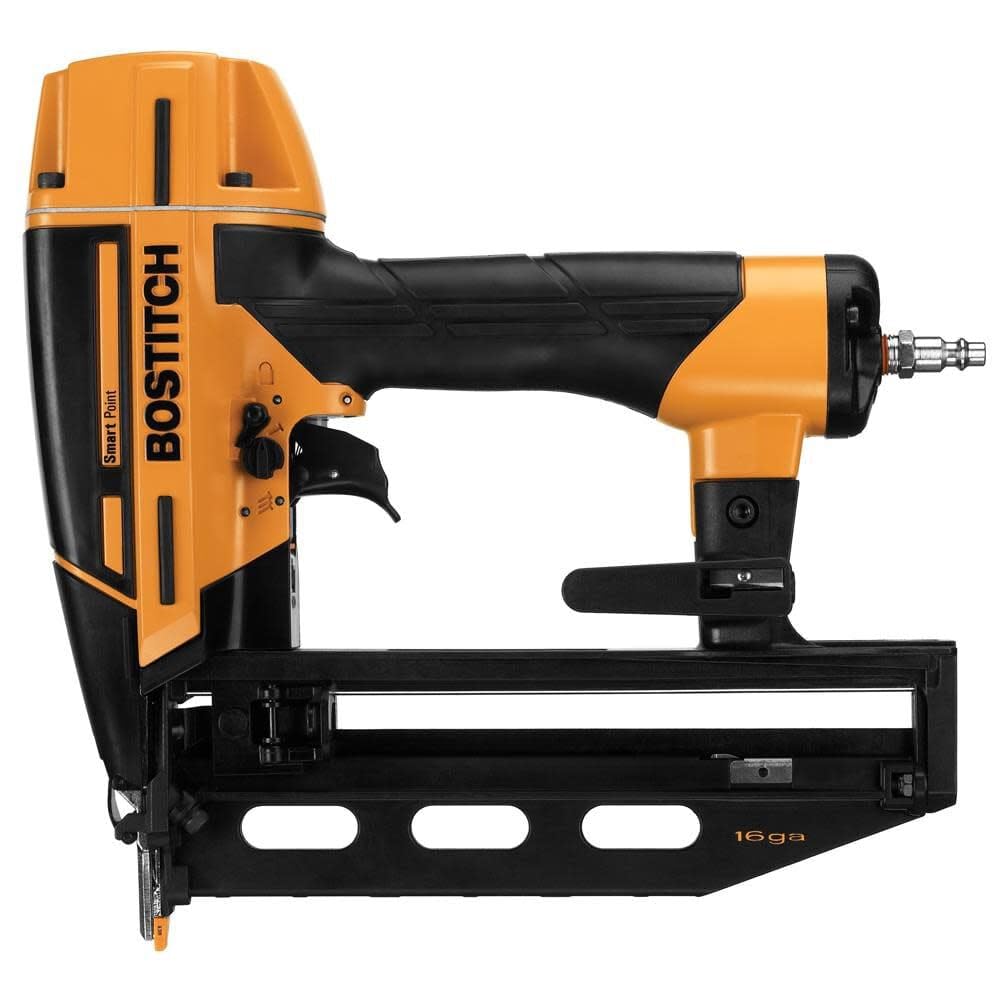
The finish gun that places nails precisely and leaves no marks doing it.
Smart Point is the standout here. The tip is designed to sit exactly where you want the nail without marring the surface, which is why precision keeps coming up in the conversation around this gun. It fires 16 GA finish nails from 1-1/4-inch to 2-1/2-inch — the standard range for baseboards, casings, and molding.
Dial-A-Depth lets you dial in the countersink of every nail, so you can set a row of trim flush without denting it. The oil-free operation reduces the risk of oil stains on bare wood, which is a real concern on a finish job. Tool-free jam release makes clearing a stuck nail quick, and a selectable trigger flips between sequential and contact operation. There is even a belt hook with an integrated pencil sharpener, a small touch that no other finish gun here offers.
The kit includes the nailer, a 1/4-inch air fitting, a carrying case, and extra no-mar tips, and it is covered by a 7-Year Limited Warranty (1-Year in production applications). It is light for a finish nailer at 7.3 lb. The honest follow-up: durability is the mixed note over the long haul, so this is best for steady remodeling rather than constant production work.
What earns it a place: the Smart Point tip plus Dial-A-Depth means you can hang molding and baseboard and trust the nail to land exactly where you aim.
Worth knowing: the tool-free jam release and oil-free design make it the friendliest cleanup of any finish nailer on this list.
The fit: homeowners and remodelers hanging molding, baseboards, and casings who want precise, mark-free placement.
Reconsider if: you need a contractor-grade tool for nonstop production — long-term durability is the trade-off here.
9. BOSTITCH BTF83WW Framing Nailer

An industrial-grade framing gun built to feed a nail gun all day without a stall.
If you are sheathing a whole wall, this is the difference between a productive day and a frustrating one. It runs 28-degree wire weld full round head nails that must be the kind this magazine accepts, between 2-inch and 3-1/4-inch long. The design is industrial grade, built for high-volume framing and sheathing work and powerful enough to drive into engineered lumber.
The low-profile body with enhanced ergonomics and balance keeps you in control on a long run. Tool-free features include depth-of-drive adjustment, a selectable trigger for single or multi-drive modes, and an adjustable rafter hook — that last one is a small but real convenience when you are working on a roof. A lightweight body at 9.88 lb keeps it closer to the NuMax’s 8.6 lb than to the 10.69 lb 3PLUS.
Owners describe it driving 28-degree wire weld nails without a misfire, and there is evidence of it chewing through serious volume — one owner ran around 2000 nails through it in a couple of days without a jam or misfire. That is the kind of run that earns a tool a place on a site. The honest note is weight: some owners find it heavier than they expected.
The case for it: 28-degree wire weld capacity plus a tool-free depth dial and rafter hook make it a no-fuss framing gun for sheathing and roof decking.
Worth planning for: at 9.88 lb it is on the heavy side, so budget your ladder time around a second hand or a hook.
Pick it for: serious framing and sheathing, where high volume and steady feeding beat a lower weight.
Move on if: you want one light gun for small jobs — a lighter framing nailer like the NuMax fits better.
Know the Specs
Gauge (Nail Thickness)
Gauge describes the wire thickness of the nail, and a smaller number means a thicker, stronger nail. A 21 or 28 degree framing nailer drives thick nails up to 3-1/2 inches long that hold studs and sheathing together. A 15 or 16 gauge finish nailer fires thinner nails for trim and casing. An 18 gauge brad and a 23 gauge pin are the finest, for detail work where a mark would show.
Depth of Drive
Depth of drive sets how deep a nail sinks into the wood. Tool-free depth adjustment means you turn a wheel or dial by hand instead of stopping to adjust with a wrench — you can set a nail flush or countersunk depending on the material. This matters most on finish and flooring work, where a nail set too deep leaves a hole that needs filling.
Dry-Fire Lockout
A dry-fire lockout stops the nailer from firing when the magazine is empty. On a pneumatic tool that prevents the internal parts from taking empty strikes, which reduces damage over time. Some guns lock out when a set number of fasteners remain — the Metabo HPT pin nailer, for example, stops firing with 6 nails or fewer.
Collation and Angle
Collation is how nails are held together: plastic, wire weld, or paper tape. The angle (21, 28) is the slant of that strip, and it has to match the magazine. Buy the wrong collation or angle and the strip will not load or will jam. The 21-degree, 28-degree, 15-gauge “DA”, 16-gauge, 18-gauge, and 23-gauge pin strips all behave differently — so read the tool’s fastener spec before buying nails.
Common Questions
Can I use a finish nailer for framing?
What size compressor do I need for a pneumatic nail gun?
Do all 21 degree framing nails fit any 21 degree nailer?
What is a dry-fire lockout and do I need it?
Are brad nails and pin nails the same thing?
Can I install hardwood flooring with a standard nail gun?
Will a nail gun dent my wood surface?
How do I stop nails from jamming in a framing nailer?
What is the difference between sequential and bump fire?
The Bottom Line
For most people buying a wood nail gun, the right first buy is the Freeman PFL618BR Flooring Nailer if you have hardwood waiting, because one tool handles cleats and staples and saves you the rental. If you are framing a wall, deck, or fence, grab the NuMax SFR2190 — its hardened steel blade and 8.6 lb body make it the framing workhorse. For finish trim, the BOSTITCH BTFP71917 places nails precisely without leaving marks. Match your nail to the job and any of these will serve you well.
How we choose
We do not accept paid placement. Every pick is matched to a real buyer and a real use-case; we do not hands-on test units.
Sources
Specifications: manufacturer listings and product documentation. Review insights: verified customer reviews, as of November 2026. Pricing: not shown on this page (it changes often); check the current price via the retailer link.
As an Amazon Associate, Tactical Gear Guy earns from qualifying purchases. This does not affect which products we feature.