Specs are compiled from manufacturer listings and verified buyer reviews and can change over time — please confirm the key details on the product page before buying.
Here’s the short answer: if you want one board that handles everything and stays flat for years, buy an end grain walnut board — the Babilonia 17-inch end grain model is the strongest all-rounder on this list, and it ships pre-oiled with an oil bottle in the box, so you can chop on it the day it arrives. Everything below sorts out the rest: a no-glue one-piece board for small counters, a personalized engraved board for a wedding gift, and a 30-lb John Boos butcher block for people who break down whole chickens.
This guide is built by comparing the manufacturers’ published specifications and the patterns across verified customer reviews, so you get each pick’s real strengths and trade-offs instead of marketing spin.
What separates a board that lasts from one that splits is the grain, not the brand name. End grain boards stand the cut ends of the wood fibers up toward the blade, so your knife edge slides between them instead of slicing across them — that is why butchers have used them for generations. Below you will find eight hardwood boards ranked by how they actually behave under a knife, so you can pick the right wood custom cutting boards for your counter.
Top Picks
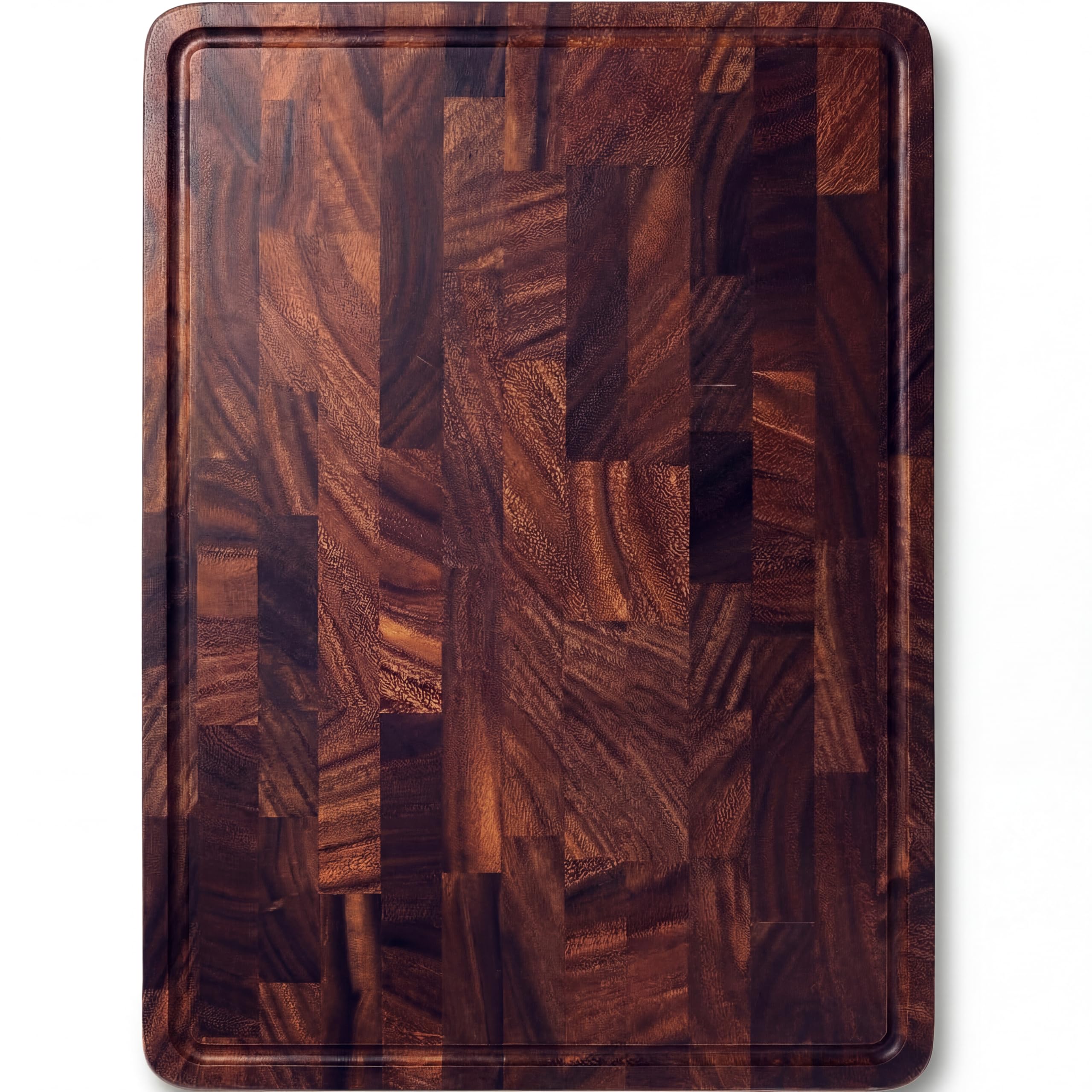


How To Choose The Best Wood Custom Cutting Boards
A wood cutting board is a two-part purchase: the wood has to be dense enough to survive a knife, and the board has to be heavy enough to sit still while you use it. Get those two things right and the rest is details.
End grain versus edge grain
End grain means the board is built so the cut ends of the wood fibers face up toward your knife. Your blade slips between those upright fibers instead of carving across them, which is why end grain boards show fewer marks and stay kinder to a sharp edge. Edge grain is the simpler, cheaper build — the fibers run flat across the surface, so it is firmer under the knife but shows scratch lines sooner.
Look for a board that states the technique outright. If the listing says “end grain” or “self-healing,” you know what you are getting; if it says nothing, assume edge grain.
Weight and thickness decide whether the board stays put
A board that walks across the counter while you chop is a board you stop using. Thicker stock — 1.25 inches and up — and a heavier board resist sliding and resist warping. Non-slip rubber feet solve the same problem on lighter boards by gripping the counter and letting air circulate underneath so the wood dries evenly.
One-piece construction means no glue lines to fail
Many boards are strips of wood glued edge to edge, and those glue joints are where splitting starts if the board dries unevenly. A one-piece board cut from a single log has no joints to fail — but it also comes in fewer sizes, because a single log only yields so much width.
Plan for hand washing, every time
Not one board on this list is dishwasher safe, and that is not a manufacturer being fussy. Heat and soaking swell the wood, then the drying cycle pulls the moisture out fast — that is the recipe for cracks. Warm soapy water, a quick towel dry, and a monthly wipe of food-grade oil keeps a hardwood board in service for years.
Side-by-Side Comparison
| Model | Best For | Material | Size (L x W x Thickness) | Weight | Amazon |
|---|---|---|---|---|---|
| Babilonia Walnut End Grain★ Best Overall | All-round daily prep | Walnut Wood | 17″ x 13″ x 1″ | 2.79 kg | Amazon |
| Brosisincorp Sapele One PieceSmall-Counter Pick | Small kitchens and solo cooks | Sapele Wood | 14.17″ x 9.45″ x 0.98″ | — | Amazon |
| Refine Kitchenware PersonalizedGift Pick | Engraved gifts | Maple or Walnut | Medium | — | Amazon |
| HexClad Large Walnut | Big prep jobs and serving | Walnut Wood | 19.5″ x 13.75″ x 1.25″ | 8 pounds | Amazon |
| Babilonia American Walnut 3-in-1 | Slide-to-pot cooking | Black Walnut | 15.7″ x 10.2″ x 1.7″ | 3.08 kg | Amazon |
| ArborDown Live Edge | Charcuterie and display | Black Walnut | 20″ x 10″ x 1″ | 5 pounds | Amazon |
| Bevel & Bond Maple End Grain | Heavy chopping with grip | American Maple | 17″ x 13″ x 1.75″ | 10 pounds | Amazon |
| John Boos Handle Board | Whole-animal butchery | Maple Wood | 24″ x 18″ x 2.25″ | 11 kg | Amazon |
Detailed Reviews
1. Babilonia Walnut Wood Cutting Board
Our pick — 4.5+★ from 350+ verified ratings; the strongest balance of quality and price.
A genuinely thick end grain walnut block that arrives oiled and ready for your first onion.
If you only buy one board, this is the one that keeps its manners. It measures 17 inches long, 13 inches wide and a full 1 inch thick, so there is room for a pile of onions and a full head of cabbage without shuffling anything to the side. One inch of walnut end grain puts real mass under the knife — the board sits down and stays down while you work.
What wins people over is the build. The walnut is cut using the end grain technique, so the cut ends of the grain face up and your knife edge slips between the fibers instead of slicing through them. That is the difference between a board that looks shaved and scarred after a year and one that still reads clean at the surface. It comes seasoned and pre-oiled, with an oil bottle in the box, so there is no waiting, no first coat, no weekend project before you can cook.
The 2.79 kg weight is what holds it still during heavy chopping, and there is a built-in groove to catch runoff and a built-in handle for lifting it to the sink. Straightforward care: mild soap, warm water, hand dry, cool dry storage. The honest catch is the trade-off every end grain walnut board carries — deep scratch lines eventually show up in daily use, so this is not the board to reach for when you are sawing through a frozen block or hacking at bones. Keep it for vegetables, cheese, charcuterie and normal meat prep and it will look after you.
What earns it first place
- End grain walnut construction is easy on knife edges and resists the shaved, scarred look of cheaper boards
- Comes pre-seasoned with an organic oil bottle included, so it is usable on day one
- Built-in juice groove and handle make carving and carrying simple
- Backed by a 2-year warranty and 24/7 customer support from BABILONIA
What to know before you commit
- Daily cutting pressure does eventually leave visible scratch lines in the surface
- Hand wash only and must be stored cool and dry — the dishwasher will ruin it
- Sized for a normal counter, not a commercial prep station
Buy this if: you cook most days and want one walnut board that handles vegetables, cheese and meat prep without dulling your knives.
Look at the John Boos instead if: you regularly break down whole chickens and need a 30-lb block under you.
2. Sapele Wood Cutting Board One Piece No Glue 14.17″L*9.45″W
Carved from a single log with no glue joints at all, in a footprint that fits a cramped counter.
This is the narrow-counter answer. At 14.17 inches long and 9.45 inches wide, it takes up far less real estate than the walnut end grain board above — the HexClad is 13.75 inches wide against this one’s 9.45 inches, and 20 inches long against 14.17 inches, so the sapele board is the obvious fit when your prep space is already crowded by a coffee machine and a knife block. Solo cooks and small kitchens are exactly who the 14.17″ x 9.45″ size was built for.
The construction is the story. It is a single solid piece of sapele, an African hardwood, with no glue and no joints anywhere in it — so there is no glue line to separate when the wood dries unevenly. Sapele’s interlocking grain is a closed grain, which makes it slower to take on moisture than acacia or plastic, and that is the property that keeps a board from warping and cracking. It is kiln-dried through a 491°F heating and baking process, then cooled and cured to balance the moisture inside the wood, and a coat of cutting board oil is pre-applied. At 0.98 inches thick it is a touch thinner than the walnut board’s 1 inch, which is worth knowing if you like a deep, heavy feel.
Both faces are usable — fruit and vegetables on the front, raw meat on the back — and there is a stainless steel handle for lifting or hanging it out of the way. Silicone feet on the sides let it stand upright so water drains and air moves underneath. The recurring note in the reviews is that a few buyers expected a wider surface than they got, so measure your counter before you click; the listing offers four sizes and the jump from 14.17″ to 14.96″ is not as small as it looks.
Where it wins: one-piece, no-glue construction in a compact footprint, with a closed-grain hardwood that resists moisture and a reversible double-sided surface for separating raw meat from produce.
The honest limitation: it is the thinnest board here at 0.98 inches and not the widest — if you regularly prep for four people, step up to a bigger size in the same line or move to the HexClad.
Reach for this if: you cook for one or two, your counter is tight, and you want a board with no glue joints to worry about.
Think twice if: you need a full carving surface — the 9.45-inch width leaves little room for a roast.
3. Refine Kitchenware Personalized Cutting Board
Your name burned into real hardwood — and if the spelling is wrong, that mistake lives on the counter forever.
This board exists for the gift moment, and it earns its place for that alone. You pick one of six engraving designs, then enter the name, monogram initial and optional date you want burned into the front face. It is made to order in Ohio from either light maple or dark walnut, and the natural variation in wood color and grain means no two boards come out identical. Wedding, anniversary and housewarming gifts are the obvious use — a personalized board is the kind of thing that gets kept rather than re-gifted.
You are not buying one fixed board here; you are choosing a configuration. The compact Single Handle board has a built-in handle. The Classic board comes in 0.75-inch thickness with cutout handles. The Thick board steps up to 1.25 inches, and there is an End Grain option on top of that. Juice grooves are available on the top edge, and handles and feet are paid upgrades selected separately — Classic boards take cutout handles, while Thick and End Grain boards take side or pocket handles plus installed black rubber or brass feet.
The board arrives finished with mineral oil and comes with care instructions: hand wash, dry promptly, oil as needed. The one caveat worth flagging is size. A few buyers expected a larger board than what showed up, and the feedback on dimensions runs mixed — so read the exact size and thickness attached to each customization option before you order, rather than assuming. Check your spelling twice while you are at it, since the engraving is front-only and made to your specification.
The gift case: six engraving designs, four text inputs, and a choice of maple or walnut, all made to order in the USA — which is more customization than any other board on this list gives you.
The size caveat: dimensions vary by configuration and expectations run mixed, so confirm the exact board you selected before paying.
The right call for: anyone buying a wedding, anniversary or housewarming gift that needs a name on it.
Not for: heavy daily meal prep — this is a gift board first, and the classic spec starts at 0.75 inches thin.
4. HexClad Rectangle Large Walnut Cutting Board
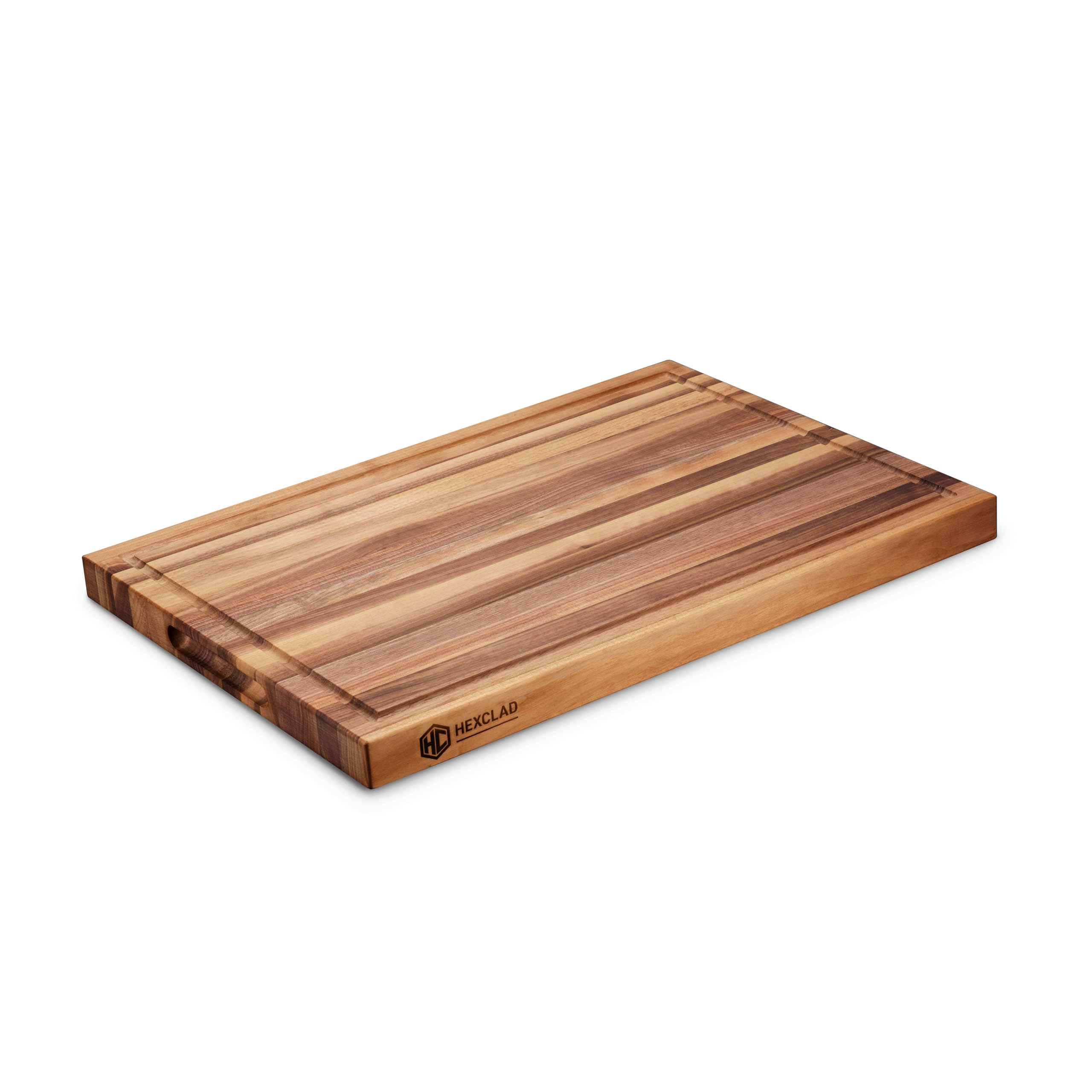
Twenty inches of walnut with a juice groove on one side and a flat plating surface on the other.
When a single onion feels like a chore, this is the board that stops the shuffling. It runs 19.5 inches long, 13.75 inches wide and 1.25 inches thick, and it weighs 8 pounds — that mass is what keeps it planted under a heavy chop. The Brosisincorp sapele board above is shorter and narrower at 14.17″ x 9.45″; the HexClad’s extra surface is the whole point when you are prepping a week of vegetables at once or carving a roast for company.
The two-sided design does real work. One face carries a groove that catches the juices from a roast or a pile of cut fruit, and the other face is flat for slicing, dicing and plating charcuterie. Recessed handles on the sides make it easy to flip mid-task and easy to carry to the table. Walnut’s density resists deep knife marks and helps block stains, and the maker points to the grain’s self-healing property — oiled end grain fibers can close back over light cuts.
The complaint that comes up after a year of use is scratches: this board will pick up wear faster than some buyers hope, especially if it lives on the counter and gets used every single day. The other thing to plan around is counter space — a board this size needs a real stretch of clear surface, and it is a lot to lift into the sink for washing. Hand wash only, and it wants oil now and then to keep the grain fed.
The case for the big walnut
- 19.5″ x 13.75″ of prep surface handles a full week of vegetables in one sitting
- Groove side catches juices; flat side plates charcuterie
- 8 pounds of walnut stays put under heavy chopping
- Recessed handles make flipping and serving simple
Where it asks more of you
- Daily use leaves visible scratches over time — oil it regularly to keep the grain closed
- Large footprint demands a wide stretch of clear counter
- Heavy enough that washing it by hand is a two-hand job
Worth it for: big-batch cooks and hosts who need one board that preps and serves.
Skip the upgrade if: your counter is tight and you prep for one — the smaller sapele board covers that job.
5. Babilonia American Walnut Cutting Board
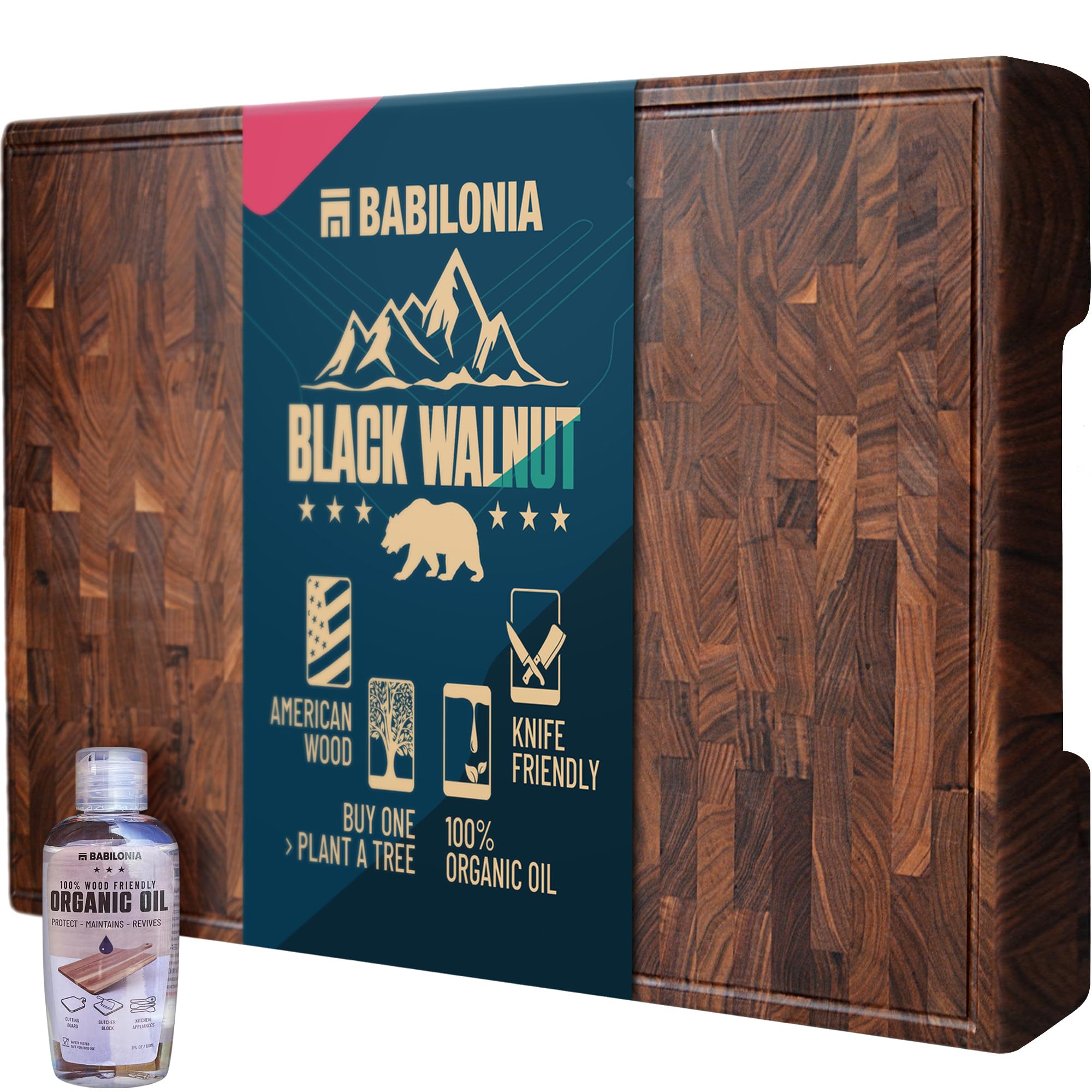
The board with a sliding plate that carries your chopped onion straight to the pot.
Most boards make you lift the whole block to move what you just chopped, and the Babilonia engineers clearly got annoyed by that. This one has a notch and a plate: chop, then slide the produce off into your pot or bowl without picking the board up. The maker calls it a 3-in-1 — butcher block, cutting board and serving tray — and the flip side doubles as a serving board with a hidden handle.
Underneath that trick is serious stock. It is 100% sustainable black walnut grown in America, crafted with the end grain technique, and a full 1.7 inches thick. That thickness is where it separates from thinner boards: many cutting boards run around 1.5 inches, which per the maker leaves them prone to cracking over time, and this one is built past that line for stability. The extra height also gives the self-healing end grain more material to work with. At 15.7 inches long and 10.2 inches wide it is sized for two people cooking together rather than a commercial kitchen — a size plenty of buyers specifically wanted.
It arrives pre-oiled with an organic oil bottle and a plate in the box, so it goes to work immediately. Hand wash, warm water, mild soap, cool dry storage, and it carries the same 2-year warranty and 24/7 support as the other Babilonia board here. The weight is the thing to reckon with: 3.08 kg is a substantial board, and the sliding mechanism adds a bit of fuss compared to a plain slab. If you want a simple board you throw down and chop on, the plain end grain walnut at number one is the easier everyday tool.
Who it’s built for: cooks who hate scooping chopped vegetables off a board — the notch-and-plate slide is a genuine kitchen shortcut, and the 1.7-inch thickness outclasses most boards at this size.
The trade: 3.08 kg and a two-piece design mean more to lift, wash and store than a plain single slab.
Go for it if: moving chopped food off the board is the chore you resent most, and you want extra-thick end grain walnut as a bonus.
Stay with the plain board if: you want one solid piece with nothing extra to wash.
6. ArborDown Live Edge Black Walnut Cutting Board

One slab of American walnut with the tree’s own edge left on, made to sit on a table rather than hide in a drawer.
This one is bought for how it looks on the table. The live edge keeps the natural contour of the log along one side, and because the board is handmade by Amish woodworkers in the USA from sustainably harvested American walnut, the grain pattern you get is the grain pattern you get — there is no matching pair.
Where it succeeds is presentation. Cheese, charcuterie, sliced bread and a fig-and-honey spread all look better on a live edge walnut slab than on anything square. The solid walnut construction is built to keep going for years with normal care, and the finish is smooth straight from the start. It is a serving piece with cutting duty as a bonus, not the other way around.
The two honest limits: size expectations vary — a handful of buyers found it smaller than they pictured, so read the 20″ x 10″ dimensions and hold a tape measure up to your table before you buy. And the hanging hole gets mixed feedback, so if you plan to hang it on a wall hook rather than store it flat, check what other buyers have said about that hole first. Hand wash only, as with every walnut board here.
Why hosts like it
- Live edge and natural grain make every board one of a kind
- Amish handmade in the USA from sustainably harvested black walnut
- Smooth finish and easy hand washing
- Sized for a dining table centerpiece at 20″ x 10″
Read this before ordering
- Some buyers expected a larger board than the 20″ x 10″ footprint delivers
- The hanging hole gets mixed feedback — check it if you plan to hang the board
- At 1 inch thick it is not a board for heavy cleaver work
The pick for: hosts who want a charcuterie board that looks handmade because it is.
Not the pick for: daily meal prep — 20″ x 10″ is a serving shape, not a butcher surface.
7. Maple End-Grain Cutting Board 17″ x 13″
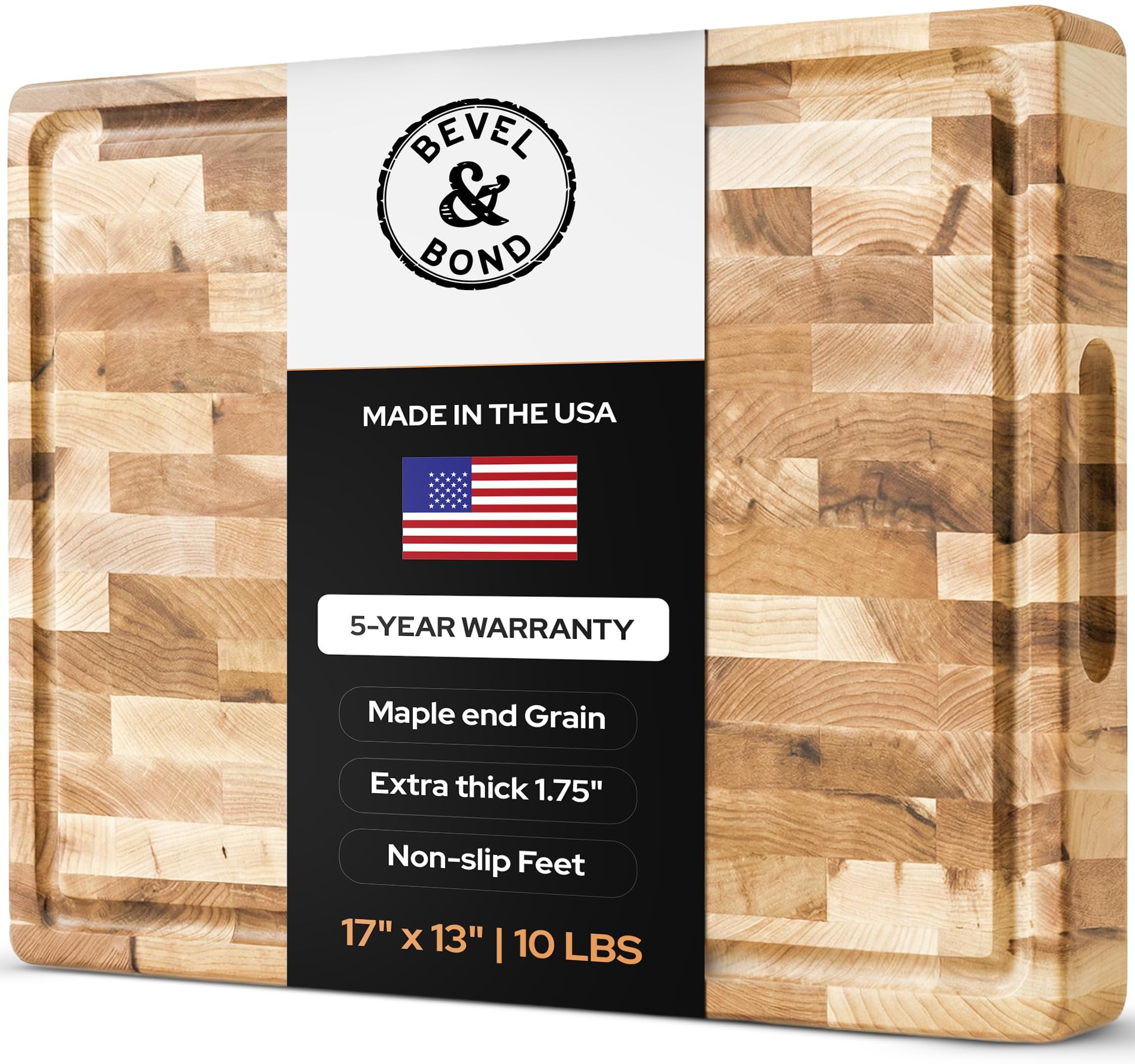
Ten pounds of American maple end grain with rubber feet, built to stay exactly where you put it.
Non-slip feet are the feature that quietly decides whether you enjoy a board. This one has installed rubber feet that grip the countertop and lift the board slightly so air moves underneath — a steadier, safer cutting experience with every use, and no wet wood sitting in a puddle on your granite. At 10 pounds it was never going to slide anyway, but the feet are what keep it planted when you are going at a roast with real force.
The construction matches the weight. It is a full 1.75 inches of end grain — the maker is direct about why, noting that many boards stop at 1.5 inches and are more prone to cracking over time, so this one is built past that for stability. North American hard maple is the wood: dense enough to last yet gentle on a knife edge, and it is the same species that has anchored high-end butcher blocks for a long time. The deep juice groove catches runoff from big cuts, and finger grips on both sides make the carry from counter to table manageable.
Care is simple but non-negotiable — hand wash with warm soapy water, towel dry, never soak, never dishwasher. It arrives pre-conditioned with a mineral oil finish, and a monthly wipe with Board Balm keeps it in shape. The maker backs it with a 5-year warranty and sends a complimentary tin of Board Balm when you register. The splitting reports that show up in the durability conversation are worth taking seriously for one honest reason: end grain this thick will crack if it is soaked or left wet, so this is a board for someone who will actually dry it.
What eleven pounds buys you
- 1.75 inches of end grain maple, built past the 1.5-inch mark where thinner boards crack
- Rubber non-slip feet grip the counter and let air circulate underneath
- Deep juice groove and finger grips on both sides
- 5-year warranty plus a complimentary Board Balm on registration
The care it demands
- End grain this thick will split if it is soaked or stored wet
- 10 pounds is a real lift to the sink and back
- Takes up more storage room than a thin board
Matches best with: home cooks who break down large roasts and want a board that never slides.
Look elsewhere if: you know you will not towel-dry it every time — wet maple end grain is where splitting starts.
8. John Boos Handle Boards Maple Cutting Board

The 30-lb maple block that has been the pro-kitchen default since 1887 — if your counter can hold it.
There is no pretending this is a board for everyone. It measures 24 inches long, 18 inches wide and 2.25 inches thick, and it weighs 11 kg — that is heavier and thicker than every other board on this page, and it will take over a chunk of your counter. What you get for the footprint is the most stable cutting surface here: solid maple edge grain construction, reversible sides, juice grooves, and a level surface that stays level under a cleaver.
Easy-carry metal side handles are what make a block this size workable — you are not going to tuck 11 kg under your arm and stroll to the sink, but the handles give you a grip. John Boos has been making these since 1887 for professional kitchens, and the craftsmanship is the reason this brand name still carries weight among chefs. It comes with an oil finish already applied.
The maintenance is the part to be honest about. Hand wash only, and the maker recommends Boos Block Mystery Oil and Board Cream, sold separately, to preserve the wood. Where the other maple board here ships pre-conditioned, this one wants a real oiling routine. That oiling matters more at this size, because a 2.25-inch slab that dries unevenly is a slab that can move. Buyers also split on the size — a lot find it perfect for every cutting job, and one noted it is not practical given its dimensions. Both reactions are fair; it depends entirely on how much counter you have.
The case for a 30-lb block: 24″ x 18″ of level maple edge grain with metal handles, juice grooves and reversible sides — a surface that does not move under anything.
The counter-space tax: 11 kg and 24 inches of length is a permanent commitment, and the oil and cream are sold separately.
Buy it if: you have the counter for it and you want the same block professional kitchens have used for generations.
Be realistic if: you work in a compact kitchen — this is furniture as much as it is a cutting board.
Know the Specs
End Grain vs Edge Grain
End grain means the cut ends of the wood fibers face up toward the knife. Your edge slips between the fibers instead of cutting across them, so the surface shows fewer marks and your knives stay sharp longer. Edge grain runs the fibers flat across the surface and is the firmer, simpler build — it resists heavy impact but takes visible scratches sooner. Both are real solid wood; the difference is how the board behaves under a daily knife.
Thickness and Weight
Thickness is measured in inches and weight in pounds or kilograms, and together they decide whether a board stays put. A 1-inch board is fine for vegetables and light slicing. Once you get to 1.7 inches and beyond — like the 1.75-inch maple or the 2.25-inch John Boos — the board has enough mass that it will not creep across the counter while you chop. Heavier boards are also harder to wash and store, which is the trade you are making.
Wood Species: Walnut vs Maple
Walnut is dense and dark, resists stains, and its tight grain helps block lingering odors from garlic and onion. Maple is the traditional butcher-block wood: hard, light in color, gentle on knife edges, and it wipes clean with warm soapy water. Neither is “better” — walnut suits a board that doubles as a serving piece, maple suits a board that takes heavy daily chopping.
Juice Grooves, Handles and Feet
A juice groove is a channel cut around the edge that catches runoff from a roast or cut fruit before it reaches your counter. Recessed or built-in handles let you lift and carry a heavy board without gripping the wet cutting face. Non-slip rubber feet grip the counter and lift the board so air circulates underneath — that airflow is what lets the wood dry evenly and resist warping.
Common Questions
Can I put a wood cutting board in the dishwasher?
How often should I oil a walnut or maple cutting board?
Is end grain actually better than edge grain for my knives?
What size cutting board fits a small kitchen?
Can I cut raw meat and vegetables on the same board?
How do I stop a cutting board from sliding while I chop?
Is a personalized engraved board a good wedding gift?
Will a wood cutting board warp or crack over time?
What is the difference between a butcher block and a cutting board?
Do juice grooves actually matter?
The Bottom Line
For most kitchens, the wood custom cutting boards winner is the Babilonia End Grain Walnut — 17″ x 13″ x 1″ of end grain walnut that arrives pre-oiled, with a juice groove, a built-in handle and a 2-year warranty, all wrapped around a cutting surface that is kind to your knives. If counter space is the constraint, the Brosisincorp Sapele One Piece gives you no-glue construction in a 14.17″ x 9.45″ footprint, and its closed-grain hardwood slows moisture uptake. And if you break down whole chickens and want a surface that never moves, the John Boos Handle Board at 2.25 inches and 11 kg is the block that pro kitchens settled on generations ago.
One practical nudge before you order: check the exact dimensions on the listing against your counter. Nearly every disappointment in these reviews traces back to a board arriving smaller or larger than the buyer pictured — and the boards that satisfy their owners longest are the ones that fit the counter they live on.
How we choose
We do not accept paid placement. Every pick is matched to a real buyer and a real use-case; we do not hands-on test units.
Sources
Specifications: manufacturer listings and product documentation. Review insights: verified customer reviews, as of November 2026. Pricing: not shown on this page (it changes often); check the current price via the retailer link.
As an Amazon Associate, Tactical Gear Guy earns from qualifying purchases. This does not affect which products we feature.