Specs are compiled from manufacturer listings and verified buyer reviews and can change over time — please confirm the key details on the product page before buying.
The problem with heating a tiny house with wood is not finding a stove — it is finding one that fits without eating your living room or failing to heat it. A stove that is too small leaves you feeding logs every half hour, while one built for a full house will turn a 200-square-foot space into an oven before it ever burns cleanly. This guide lines up eight solid-fuel stoves by what each one does well in a small space, so you can match the firebox, the footprint, and the burn style to your own floor plan.
This guide is built by comparing the manufacturers’ published specifications and the patterns across verified customer reviews, so you get each pick’s real strengths and trade-offs instead of marketing spin.
You will see what separates a stove that lives happily in a tiny home from one that only makes sense in a canvas tent. The right pick depends on firebox volume in cubic inches, chimney diameter and height, and whether the stove has secondary burn for a clean overnight load. Here is how the wood stoves for tiny houses stack up.
Top Picks


How To Choose The Best Wood Stoves for Tiny Houses
In a tiny house, a wood stove is doing two jobs at once: it is your heater and your cooktop, and it has to do them without a full masonry chimney or a dedicated hearth room. That changes what matters. The number that guides everything else is firebox volume — how much wood you can load at once — because that sets how long the stove runs between refills and how much heat it can throw into a small, well-insulated space.
Firebox size drives your refill rhythm
A larger firebox, measured in cubic inches, holds more wood so you reload less often. A small firebox heats fast but needs constant feeding. For an overnight burn in a tiny house, look at the firebox volume and whether the stove has an adjustable damper you can close down before bed. The Winnerwell Nomad lists a 450 cubic inch firebox, and the CHANGE MOORE lists 593 cubic inches — those are the two clearest capacity figures in this lineup, and both are sized for a small room rather than a whole house.
Chimney diameter and height set your draft
Draft is the pull of air up the pipe that keeps smoke going out instead of into your room. It depends on pipe diameter — listed in inches — and total chimney height. Too short and the fire smolders and smokes; too tall and the stove can over-draft and burn hot and fast. Check that the pipe diameter matches any stove jack or thimble you already have, and plan your total height before you buy. The KUNGKA stove, for example, runs 2.76 inch pipe and reaches 88.3 inches assembled, while the Winnerwell uses 2.1 inch pipe and tops out at 71 inches assembled.
Tent-rated versus residential-rated
Many of these stoves are built and sold for canvas tents and outdoor shelters. A few listings state plainly that the stove is not intended for residential use. If your tiny house is a permitted, lived-in dwelling, check your local code and the manufacturer’s own wording before you install one indoors. Treat tent stoves as outdoor and shelter heaters unless the maker clearly says otherwise, and always run proper ventilation and a fireproof surface beneath the stove.
Side-by-Side Comparison
| Model | Best For | Firebox / Body Material | Weight | Chimney Setup | Amazon |
|---|---|---|---|---|---|
| Tent Stove 7.3ft (KUNGKA)★ Best Overall | All-around shelter heating and cooking | Stainless steel body | 20 pounds | 6 chimney sections, 2.76 inch | Amazon |
| Ytaoeo Hot Tent Stove (Large)Best Value | Value setup with grill-top cooking | Stainless steel body | — | 7 pipes, 2.36 inch, elbow | Amazon |
| Guide Gear Outdoor StoveCrowd Favorite | Budget camp and backyard heat | Galvanized steel fire box | 42.4 pounds | 5 interlocking pipes | Amazon |
| YRenZ 1.6mm Tent Stove | Long-burn with easy ash cleanup | 1.6mm stainless, dual-layer | — | 7 sections, adjustable | Amazon |
| CHANGE MOORE Secondary Burn | Low-smoke overnight heat | 1.5mm 201 stainless, 593 cu in | — | Built-in chimney connection | Amazon |
| PAOOPA Cast Iron Stove | Cast-iron heat retention and cooking | Pure cast iron | 10.9 kg | Segmented pipes, detachable | Amazon |
| OneTigris Tiger Roar | Refined draft control and glass view | 304 stainless, 3mm top | 10 kg | 7 pipes, 45° and 90° elbows | Amazon |
| Winnerwell Nomad Small | Most compact premium pick | 304 stainless, 450 cu in | 14.1 pounds | 5 sections, 2.1 inch | Amazon |
Detailed Reviews
1. KUNGKA Tent Stove
Our pick — 4.5+★ from 70+ verified ratings; the strongest balance of quality and price.
The do-everything shelter stove that heats, boils, and folds away into its own chimney.
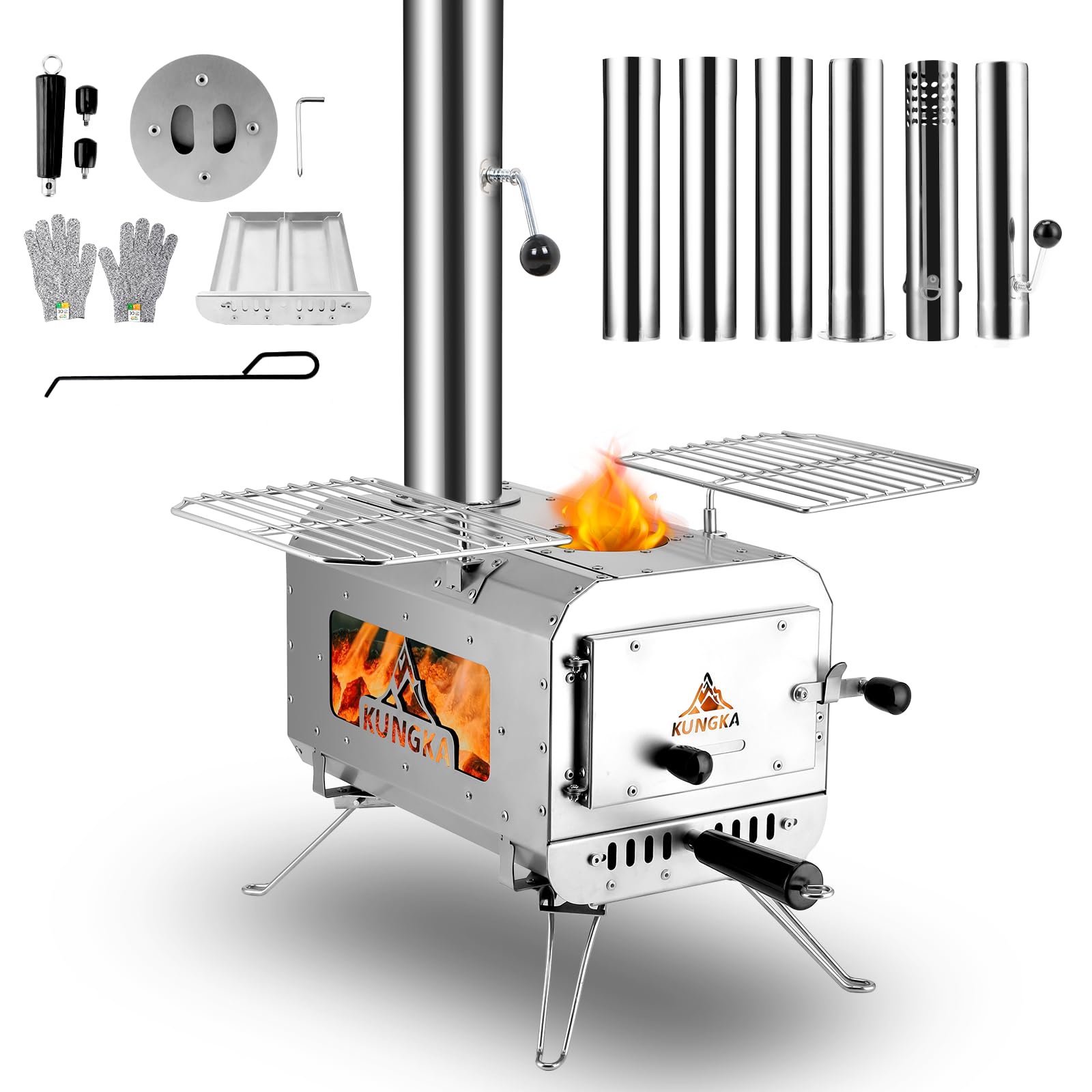
This is the pick for someone who wants one stove that handles cooking, hot water, and warmth without being the heaviest thing in the truck. It weighs 20 pounds, which matters when you are carrying it to a build site or loading it into a van. The body is stainless steel, chosen because it resists rust and carries heat well. Two air inlets plus a chimney damper let you dial the fire up or down, so you are not fighting a runaway burn in a small space.
What wins people over is the stainless steel body, which buyers describe as sturdy enough to take knocks. The stove is put together sturdy enough to take knocks, and buyers consistently call out the metalwork as the star of the package. The windows are a real bonus here: a door viewing window plus large side windows with heat-resistant glass let you watch the fire and judge the burn without opening the door and dumping smoke into your room. The 2.76 inch (7cm) pipe diameter and six chimney sections give you enough height to clear a tent jack, and a rain cap keeps snow out of the pipe on wet nights.
Here is the honest catch. Heat output earns mixed reactions — some folks find it warm and cozy while others say it can run hot if you load it heavily and leave the air open. The fix is simple: use the two air inlets and the damper to throttle it down once the space is up to temperature. The foldable legs and side tables that double as a storage rack make setup quick, and the chimneys and accessories stow inside the stove body when you break camp.
The Case For It
- 20 pounds — light enough to move solo from truck to shelter
- Door and first side windows with heat-resistant glass for watching the burn
- Two air inlets plus a chimney damper give fine control over the flame
- Six chimney sections at 2.76 inch pipe with a spark arrestor and rain cap
Where It Tests You
- Heat output runs strong on a heavy load, so throttle it down early
- Sold as a recreational outdoor stove, not a residential unit
The Verdict: This is the stove to pick if you want one lightweight unit for heat, cooking, and hot water on the trail or in a shelter.
Look Elsewhere If: You need a permitted indoor install — this one is built for tents and outdoor shelters.
2. Ytaoeo Large Wood Stove
A grid-top cooker that packs its own grill surface into the stove body.
If you plan to cook as much as you plan to heat, the flip-up BBQ grill cover and folding L-shaped handle earn this stove its place. The top cover flips into a BBQ grill, and an L-shaped handle folds out to add extra grilling space. That is a genuine second use for a small shelter where counter space does not exist. At 18.11″D x 9.84″W x 10.63″H, the footprint is narrow enough to tuck beside a wall or bunk.
The chimney kit is thorough: seven pipes at 2.36 inch diameter, an extra 90-degree elbow, and a dedicated spark-resistant pipe. That elbow is the part people miss — it lets you route the pipe out of a wall jack instead of straight up through the roof. The adjustable damper gives you control over airflow and flame, and the large heat-resistant glass window lets you check the fire and add wood without opening the door.
The recurring theme with this one is that it is put together well and sturdy, with heat output that people appreciate. Included heat-resistant gloves and an ash rake round out the safety kit. Just remember it is a shelter stove — you still need proper ventilation and a fireproof mat beneath it. For a small cabin or wall tent where you want griddle-and-grill capability without hauling a second cook setup, this is a smart value buy that beats buying a separate grill.
Cook and Heat: Seven pipes, a 90-degree elbow, and a grill-top cover make this a bigger cooking kit than the bare-bones camp stoves at the bottom of this list, and the foldable side shelves double as carry handles.
The Notice: Kettle is not included, so budget for your own pot if boiling water is the goal.
Reach For This If: You want grill-top cooking and flexible chimney routing in one package.
Pass If: You need a heavyweight firebox for all-night loads — this one is built for shorter, hotter burns.
3. Guide Gear Outdoor Wood Burning Stove
The backyard workhorse that has more owners than anything else on this list.
This is the crowd favorite by a wide margin — 4.0+ stars across 2,200+ owners, a volume none of the others here come close to. What has kept it popular is simple: a galvanized steel fire box with a heat-resistant finish, a strong cast iron front door with air vent holes, and a five-piece interlocking pipe set that all fits inside the stove for transport. The top platform works as a cooking surface for pots, pans, and a pan of bacon and eggs.
Compare it to the Ytaoeo and you see the trade. The Guide Gear is a much heavier animal at 42.4 pounds versus the 20-pound KUNGKA, so it is the one you set up and leave in place. Its dimensions of 20″D x 11″W x 13″H give it a deeper fire box than the smaller tent stoves, which is part of why people praise its quality and value so heavily. Assembly is straightforward, and it heats a wall tent quickly.
The honest part: durability and smoke show up as the sticking points. Some owners find the sheet-metal body does not hold up to years of hard use, and a few report smoke when the door is open or draft is poor. The mixed size feedback also means it is bulkier than a tiny-house floor plan might want. Treat it as a rugged backyard and car-camping stove rather than a compact indoor heater, and it will serve you well.
What Earns Its Keep
- Galvanized steel fire box with a heat-resistant finish
- Cast iron front door with air vent holes for control
- Five interlocking pipes and detachable legs, all nesting inside the body
- Top platform doubles as a cooking surface
What To Weigh
- 42.4 pounds is heavy for one-person moves
- Sheet-metal body shows wear over hard seasons
- Bulkier footprint than a tint tent stove
The Read: A proven, affordable choice for backyard and car-camping heat with a real cooktop.
Think Twice If: You are packing light or want a slim footprint for a tiny interior.
4. YRenZ Stainless Steel Tent Stove
Built around a removable ash drawer so cleanup stops being a chore.
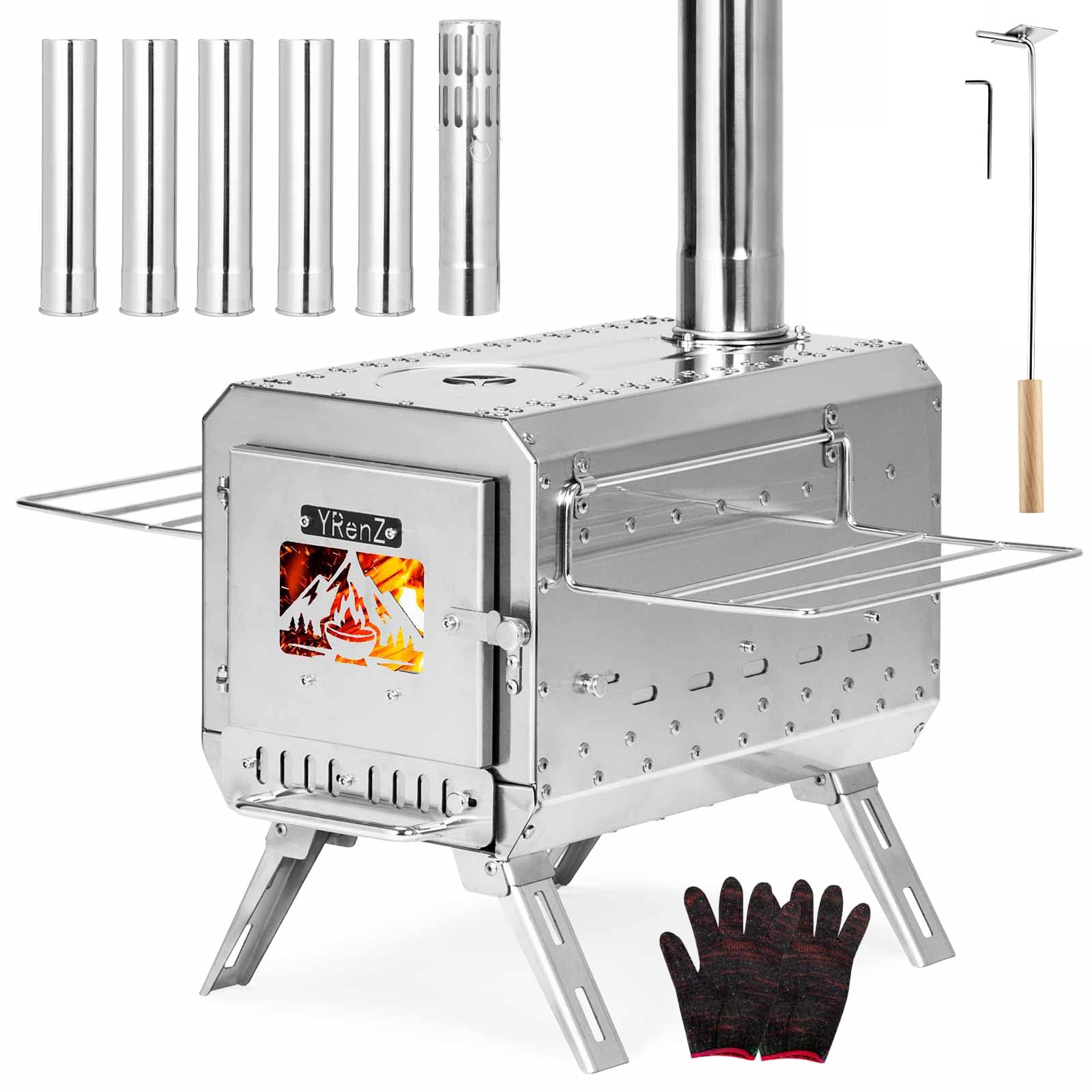
Cleanout is the thing that separates a stove you like from a stove you resent, and this YRenZ answers with a removable ash drawer that slides out. A removable ash drawer slides out, and the oversized firebox cuts down how often you need to refuel at all. The 1.6mm thick body gets top reinforcing ribs and a bent bottom for anti-deformation, so it holds its shape through hot and cold cycles.
The air system is the technical story: one primary and two adjustable secondary air inlets create full three-way combustion. In plain terms, that means more of the wood burns and less goes up the flue as smoke. A dual-layer heat insulation structure is designed to keep the outside temperature in check and extend how long the stove lasts. The riveted construction is meant to stop smoke leaking out at the seams.
A seven-section splicable chimney, height-adjustable and reaching 2m, lets you fit a range of canvas and wall tents. Premium stainless is used to avoid the odor and paint peeling you get with cheaper coated steel. If you cook, heat, and sweep ashes every morning in a tight cabin, this layout is worth a serious look — just confirm the clearance to your walls, since the insulated design still needs room to breathe.
Why It Works: The oversized firebox and ash drawer turn daily routine into a two-minute job, and the dual-layer shell is meant to hold up over long-term outdoor use.
The Fine Print: A 2m adjustable chimney is generous, but plan your roof jack height before the first fire.
Best Suited To: Cabin owners who sweep ashes every day and want it to take thirty seconds.
Skip If: You want the cheapest possible entry into wood heat — this one is built for the long haul.
5. CHANGE MOORE Hot Tent Wood Stove
The secondary-burn design that turns damp wood into a clean, steady flame.
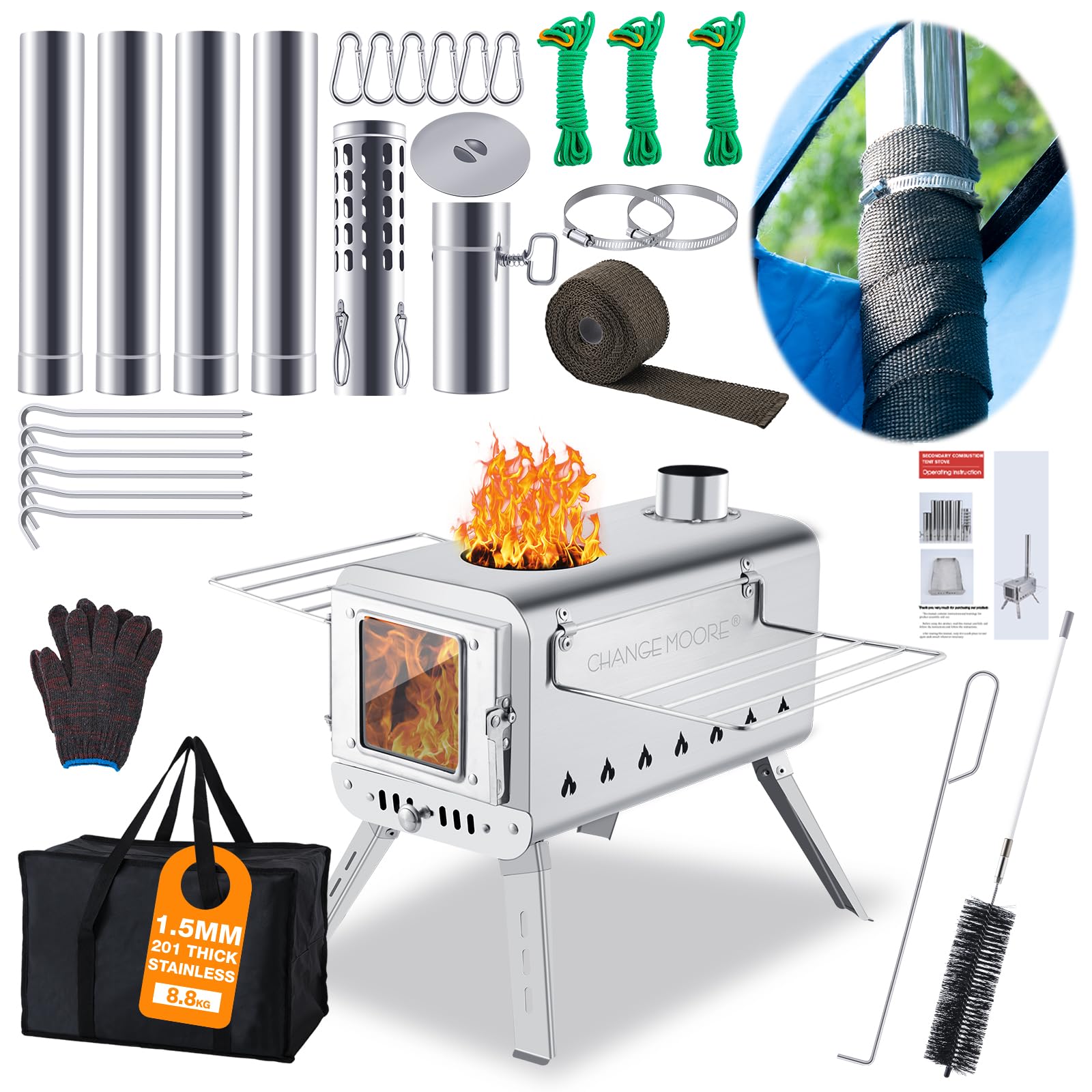
Here is the stove that lists the biggest firebox of the group: 593 cubic inches of interior space, which means a much larger wood load and a longer stretch between refills. The secondary burn system is the centerpiece — it re-ignites the gases that would otherwise leave as smoke, which gives higher flame temperatures and a more consistent output.
That design matters most in a small, sealed space where you do not want smoke. It reduces the carbon buildup that clogs a flue, and it is built to handle damp or low-grade wood without sputtering out. The body is 1.5mm 201 stainless steel, and the viewing window uses SCHOTT glass rated to 1000°C, so you get a clear, safe look at the fire. A removable burn plate and an included chimney brush make cleaning quick.
Owners praise the secondary burn for cutting smoke and the 593 cubic inch firebox for holding heat through a long overnight load. The built-in chimney connection and heat-resistant wrap are there to protect your hands. One tip from the maker: install the chimney before you light it, and never cool a hot body with water. For a tiny house that wants a long, low overnight burn with minimal smoke, this is the technical high point of the lineup.
Where It Shines
- 593 cubic inch firebox swallows a bigger load for longer burns
- Secondary combustion cuts smoke and carbon buildup
- SCHOTT glass window rated to 1000°C
- Removable burn plate and included cleaning brush
What To Note
- Large firebox takes up more floor than a small tent stove
- Keep water away from a hot body and glass
Top Choice For: Anyone fighting smoke and short burn times who wants a bigger box and cleaner flame.
Look Elsewhere If: Floor space is the tightest constraint in your build.
6. PAOOPA Cast Iron Heating Stove

Pure cast iron that soaks up heat and holds it long after the flame drops.
Cast iron behaves differently from thin steel: it takes longer to come up to temperature but keeps radiating once it is hot. This PAOOPA is built from pure cast iron at a 10.9 kg net weight for the medium, and the fully welded, airtight body lets you dial the combustion speed precisely. A secondary combustion design means you can load it at night, close the damper, and let it burn through to morning. The toughened glass window on the fire box door gives you a view of the fire.
It burns coal, firewood, branches, and wood chips — anything that combusts — so you are not locked to one fuel. The high-temperature coating is rated to 1832°F and designed to resist scratching, peeling, and blistering. Detachable segmented pipes and sturdy metal legs pack into the stove, and a handle makes it carriable. The compact footprint of 9.05″D x 9.05″W x 13.39″H fits into a corner of a small cabin or shed.
This is the pick for someone who wants a 10.9 kg pure cast-iron heater and cooktop in one, with a toughened glass window on the fire box door. Do keep in mind that cast iron is heavy and slow to respond compared to a steel tent stove — it rewards patience and a steady fuel supply, not quick hot bursts. For a rural build where the stove stays put and works every winter night, that trade is the whole point.
Built To Hold Heat: Ten-point-nine kilograms of pure cast iron keeps radiating warmth long after you close the damper, and the secondary burn is meant to carry a night load.
The Trade-Off: It is a heavier, slower-responding stove than the steel tent models — patience pays off.
Choose This For: A rural cabin or shed where a cast-iron heater and cooktop will live year-round.
Not For: Fast, light pack-and-go trips where every pound counts.
7. OneTigris Tiger Roar Tent Stove
The valve design that splits airflow up and down — and keeps smoke out of the tent.
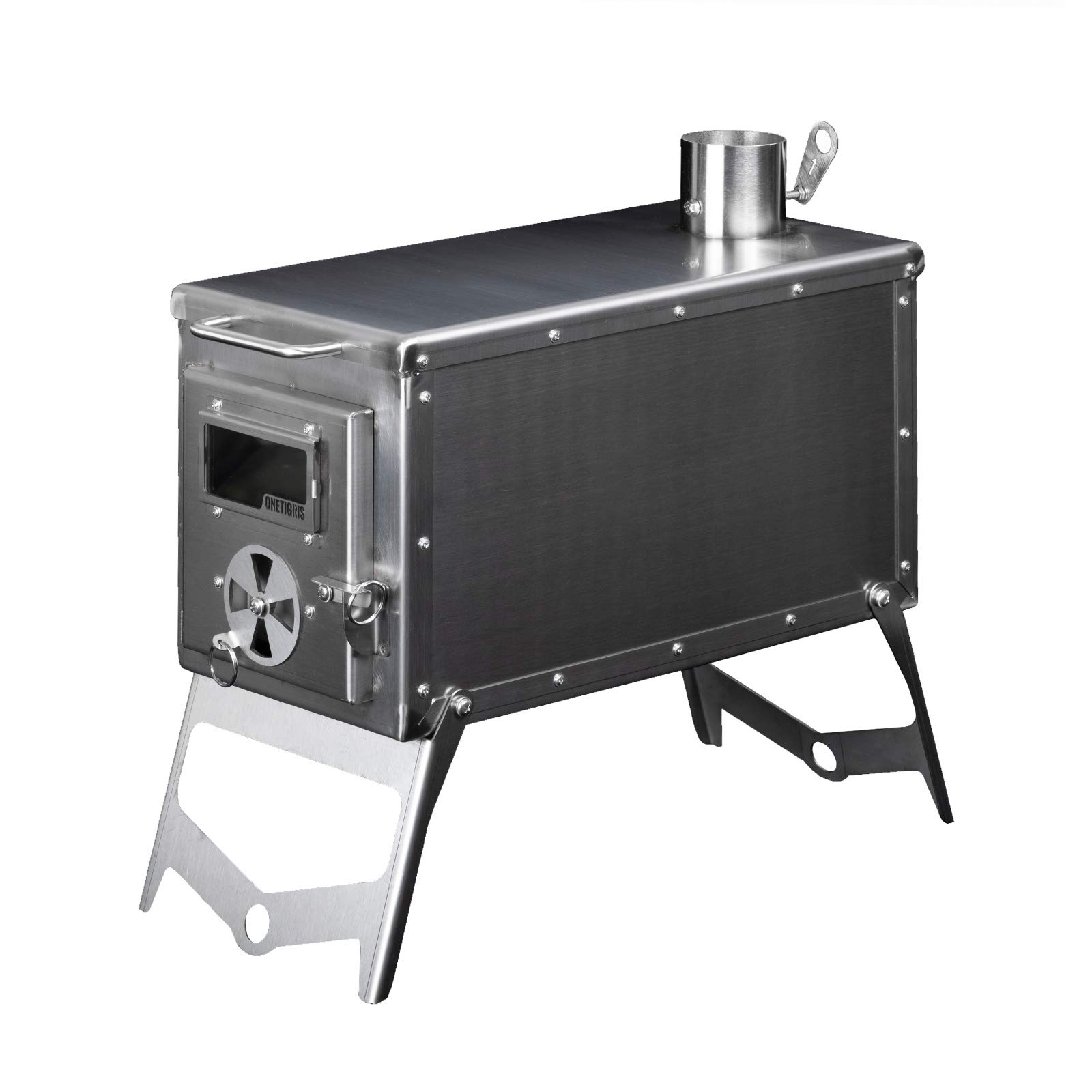
Draft control is where the Tiger Roar makes its case: its air intake valve splits incoming air to travel both upward and downward. Its air intake valve is designed to split incoming air so it travels both upward and downward, which controls how fast the fuel burns and keeps sparks and carbon from falling out of the inlet. That same design is meant to stop smoke from flowing back into the tent — the frustration that ruins a night when the wind shifts.
The build is 304 stainless steel, with a 3mm top panel to resist warping after it has been burned hard. The chimney and elbow pipes are 201 stainless. The viewing glass is German SCHOTT ROBAX glass-ceramic, rated to withstand short-term temperatures up to 760°C as well as rapid temperature swings. A guide flake inside the fire chamber slows the gas flow and cuts sparks, so no spark catcher is needed on top of the pipe.
The pipe kit is the most flexible here: seven sections plus two 45-degree elbows and two 90-degree elbows, so you can route it however your shelter demands. Size is what people praise most, and the heating performance has kept owners warm in genuine cold — one cold-weather account has it holding up in 3°F. A replacement glass and leather gloves are included. Expect to fiddle with the valve to find your sweet burn setting; it is a stove that rewards a little attention.
Why It Stands Out
- Split air valve controls burn speed and resists smoke backflow
- SCHOTT ROBAX glass-ceramic window rated to 760°C
- 7 pipe sections plus two 45-degree and two 90-degree elbows
- 3mm top panel and 304 stainless body
What To Watch
- Functionality draws mixed feedback — some setups need tuning
- Durability and smoke handling are the recurring gripes
Made For: Cold-weather shelters where smoke backflow would ruin the night.
Consider Carefully If: You want a set-it-and-walk-away stove — this one likes a tuned valve.
8. Winnerwell Nomad Small Tent Stove
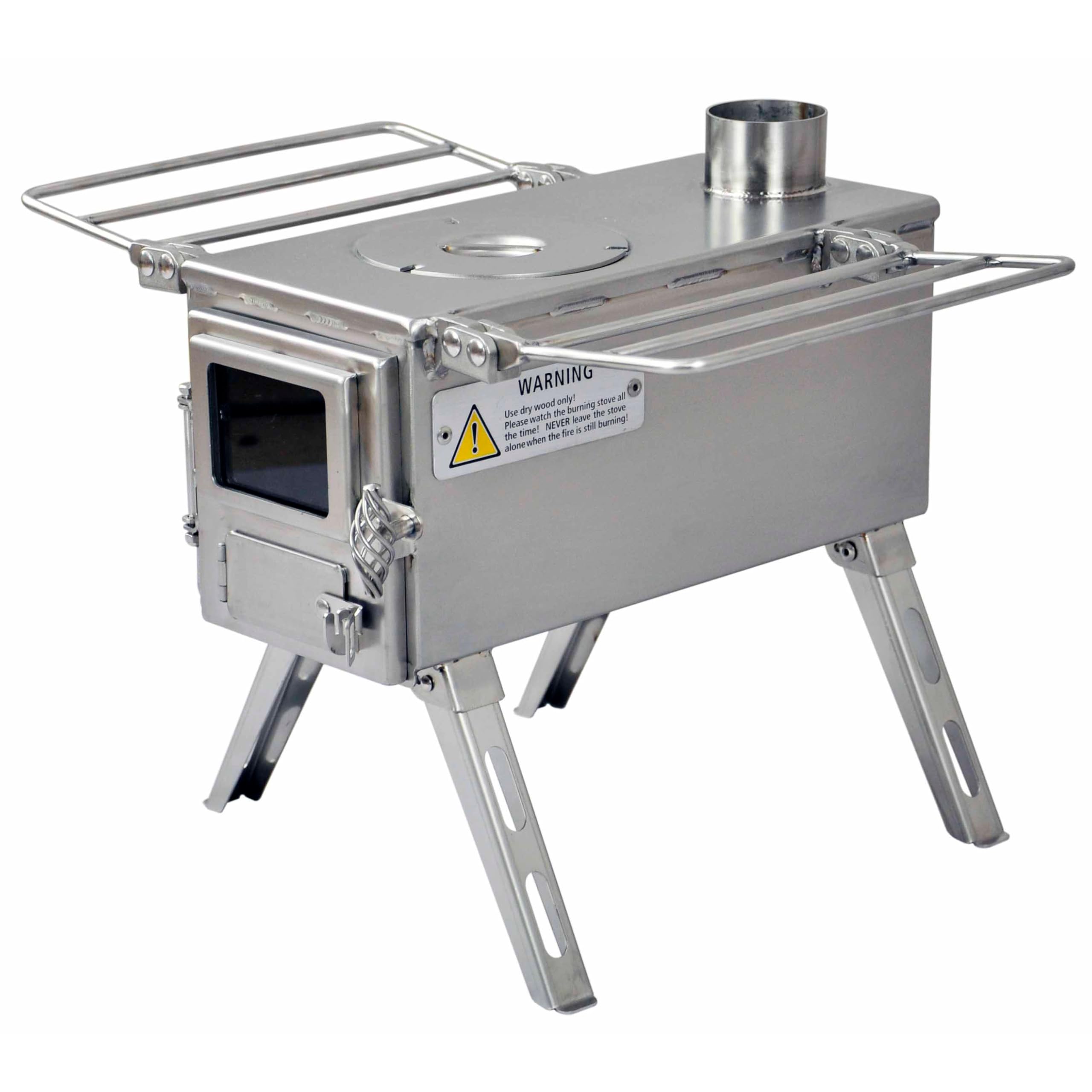
Packs down to 12.6 x 6 x 6 and still holds a 450 cubic inch firebox.
The number to know here is 14.1 pounds. That makes the Nomad the lightest full kit on this list, beating the 20-pound KUNGKA and leaving the 42.4-pound Guide Gear far behind. It folds its four legs flat under the stove, and the chimney sections stow inside the body. The side shelves become a carry handle, so you move it with one hand.
Do not mistake 14.1 pounds for weak — the 450 cubic inch firebox is a real fire chamber in 304 stainless steel. The 450 cubic inch firebox is a real fire chamber, and the body is built from 304 stainless steel chosen for corrosion resistance in harsh, wet conditions. The door has a viewing window so you can track the burn. The pipe is 2.1 inch diameter across five sections, with a spark arrestor and ash scraper included. Assembled, it stands 71 inches with the chimney on.
This is the stove for a tiny house or canvas shelter where floor space is precious and you want something you can carry in and out. It is sold as an ideal fit for small spaces like tiny homes, though the maker lists it as a recreational stove, so check your indoor installation requirements. Compared to the CHANGE MOORE’s 593 cubic inch box, this one trades raw capacity for a far smaller packed footprint — the right call if storage, not fire size, is your bottleneck.
The Compact Advantage: At 14.1 pounds and 450 cubic inches, it balances a real firebox against a packed size you can stow in a corner cabinet.
The Caveat: A smaller box than the CHANGE MOORE’s 593 cubic inches, so reload a touch more often on long nights.
Ideal If: Every square foot of your interior counts and you want a stove you can lift out by the handle.
Take a Pass If: You want the largest firebox for the longest overnight load.
Know the Specs
Firebox Volume (cubic inches)
This is how much wood fits inside the stove at once. A bigger box holds more fuel and runs longer between refills, which is why an overnight burn leans on capacity. The Winnerwell Nomad lists 450 cubic inches and the CHANGE MOORE lists 593 cubic inches — both are sized for a small room. If you plan to sleep through the night on one load, weigh the firebox figure against how much floor you can give up.
Chimney Diameter and Height
Pipe diameter, given in inches, affects how fast air is pulled up the flue, and total height sets the strength of that pull. Too little draft and the fire smolders and smokes; too much and it burns hot and fast. The KUNGKA runs 2.76 inch pipe and reaches 88.3 inches assembled, while the Winnerwell uses 2.1 inch pipe at 71 inches assembled. Match the diameter to your stove jack or thimble before you buy.
Secondary Combustion
Secondary combustion reintroduces air above the fire to burn off gases that would otherwise leave as smoke. The payoff is less smoke, less creosote, and steadier heat. The CHANGE MOORE and PAOOPA both lean on this design, and the CHANGE MOORE is described as handling damp or low-grade wood better as a result. In a sealed tiny space, cleaner burns mean fewer creosote cleanouts and a clearer glass to watch the fire through.
Body Material and Weight
Stainless steel resists rust and carries heat well; cast iron holds heat longer but adds weight. The trade shows up on the scale: a 304 stainless Winnerwell packs to 14.1 pounds, while the pure cast iron PAOOPA runs 10.9 kg. A heavy stove stays put and radiates slowly; a light one gives you portability and a quicker response. Match the material to whether the stove moves or stays.
Common Questions
Can a wood stove like these actually heat a tiny house through winter?
Are these stoves rated for residential installation inside a tiny house?
What is the difference between firebox volume and overall stove size?
How do I stop smoke from coming back into the room?
Can I cook on these stoves as well as heat with them?
How long does a firebox like the 593 cubic inch CHANGE MOORE burn overnight?
Which is easier to carry to a build site: stainless or cast iron?
How often do I need to clean these stoves and their chimney?
What clearance do I need between the stove and my walls?
Do I need a spark arrestor or a spark catcher on the chimney?
The Bottom Line
For most small-space buyers, the wood stoves for tiny houses winner is the KUNGKA Tent Stove because it balances a 20-pound body, controllable air, and cooking capability in one folding package. If low smoke and a bigger overnight load matter more than floor space, take the CHANGE MOORE and its 593 cubic inch firebox. And for the tightest interior where storage is the bottleneck, the Winnerwell Nomad packs to 12.6 x 6 x 6 and still holds a 450 cubic inch chamber. Whichever you pick, confirm the clearance and venting requirements for your build before the first fire.
How we choose
We do not accept paid placement. Every pick is matched to a real buyer and a real use-case; we do not hands-on test units.
Sources
Specifications: manufacturer listings and product documentation. Review insights: verified customer reviews, as of November 2026. Pricing: not shown on this page (it changes often); check the current price via the retailer link.
As an Amazon Associate, Tactical Gear Guy earns from qualifying purchases. This does not affect which products we feature.