Specs are compiled from manufacturer listings and verified buyer reviews and can change over time — please confirm the key details on the product page before buying.
The vise is the one tool in your shop that has to be right, because everything else you build passes through its jaws. Buy a flimsy one and you will feel it every time you tighten down on a piece of steel — the base creeps, the jaws slip, the handle flexes. This guide sorts the nine worth mounting, from a 6.5-inch-jaw workhorse to a 55.6-pound ductile iron professional model, so you can pick the one that matches the work you actually do.
This guide is built by comparing the manufacturers’ published specifications and the patterns across verified customer reviews, so you get each pick’s real strengths and trade-offs instead of marketing spin.
What separates a vise you keep for life from one you regret is mostly clamping force, jaw style, and how the swivel locks down. Below you get every spec that matters, explained plainly, plus the honest limits of each model. The right work bench vise turns your bench into a proper workstation for cutting, filing, and pipe work.
Top Picks

How To Choose The Best Work Bench Vise
Start with the work, not the spec sheet. A vise bolted to a home bench for occasional repairs needs different things than one bolted to a fabrication table that holds steel every day. Get these four decisions right and the model picks itself.
Material: ductile iron versus plain cast iron
Ductile iron bends before it cracks, which is why heavy-duty vises cast their bodies from it. The Yost and the Wilton both use ductile iron, and the Wilton’s movable jaw and base are cast from 60,000 PSI ductile iron — that PSI figure describes the metal’s tensile strength, or how much pull it takes before it fails. Plain cast iron models like the Forward and BESSEY list 30,000 PSI, which is plenty for home and garage tasks but a step down for daily metalworking.
Jaw width, opening, and throat depth
Jaw width is the width of the gripping faces — it sets how wide a workpiece you can clamp. Opening is how far the jaws separate, and throat depth is how far back the jaws reach from the front edge of the vise. A deep throat is what lets you drop a bracket or a bent part down into the jaws instead of clamping it at the edge. The Wilton’s 4-3/8-inch throat is the deepest here; the Forward’s 2.7-inch throat is the shallowest.
Clamping force and how the swivel locks
Clamping force is measured in pounds, and it tells you how hard the screw can squeeze. The PONY 6-inch rates up to 8800 lbs; the PONY 5-inch rates 5512 lbs. A swivel base lets you rotate the vise to reach the work, but the lock is what makes it useful — dual lockdowns hold the base still, while a single lock can let the body shift mid-cut.
Flat jaws, pipe jaws, and the anvil
Serrated flat jaws grip square stock and flat parts. Pipe jaws are curved teeth that bite round stock without letting it spin. An anvil surface on the back of the body gives you a flat steel pad for tapping and shaping. If you work on pipe or round bar at all, pay for the pipe jaws up front — adding them later means buying a different vise.
Side-by-Side Comparison
| Model | Best For | Jaw Width | Clamping Force | Weight | Amazon |
|---|---|---|---|---|---|
| Yost Vises 750-DI★ Best Overall | All-round shop work | 5 in | — | 27 kg | Amazon |
| Forward 0806Best Value | Home and garage jobs | 6 in | — | 13.96 kg | Amazon |
| VEVOR 6.5″ Bench ViseWidest Jaws | Widest jaws for the money | 6.5 in | 5520 lbs | 38.9 lbs | Amazon |
| PONY 5 Inch | Small bench, real grip | 5 in | 5512 lbs | — | Amazon |
| PONY 6 Inch 8800LBS | Heavy clamping on a budget | 6 in | 8800 lbs | — | Amazon |
| BESSEY BV-HD60 | Drill press and bench duty | 6 in | — | 29 lbs | Amazon |
| IRWIN 5-Inch Multi-Purpose | Mixed flat and pipe work | 5 in | — | 33.1 lbs | Amazon |
| IRWIN 6-Inch Heavy-Duty | Professional wood and metal | 6 in | 3000+ lbs | 30.9 lbs | Amazon |
| Wilton Mechanics Pro 865M | Fabrication and auto service | 6.5 in | — | 55.6 lbs | Amazon |
Detailed Reviews
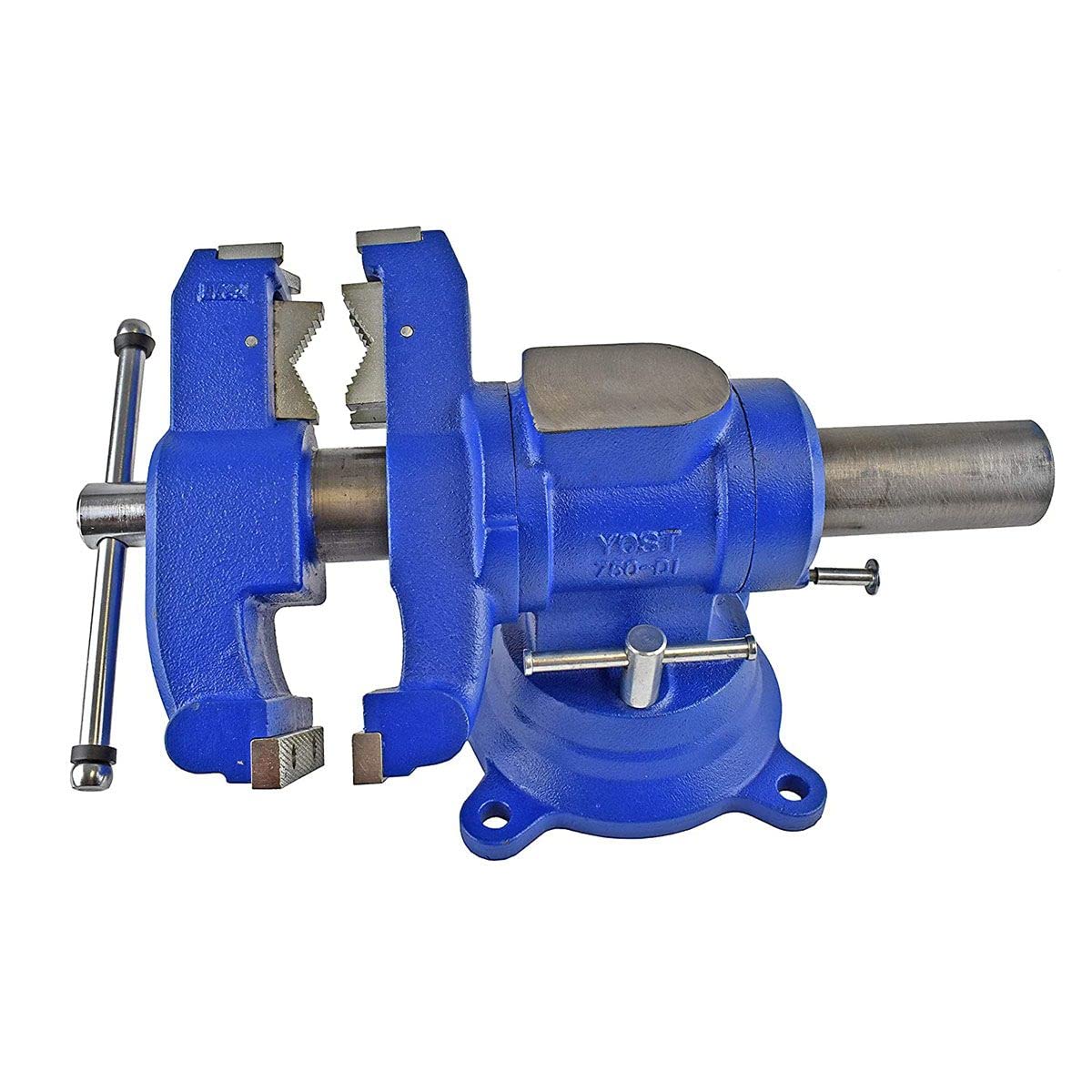
1. Yost Vises 750-DI Multi-Jaw Rotating Vise System
Our pick — 4.5+★ from 900+ verified ratings; the strongest balance of quality and price.
Two rotating axes and three jaw sets — the vise that repositions instead of making you reposition.
The feature that earns this one the top slot is the head. It spins a full 360 degrees and locks at twelve different positions, spaced every 30 degrees, while the body underneath swivels another 360 degrees on an interlocking V-grooved base held by two lockdowns. In plain terms, you can point the jaws wherever the work is and lock them there, instead of tilting the workpiece to fit a fixed vise. Three sets of replaceable hardened steel jaws handle flat stock, round pipe, and irregular shapes without you swapping anything.
It is built heavy on purpose. The body is cast from 65,000 PSI ductile iron and hardened steel, and the whole unit weighs 27 kg — about 60 pounds of mass that soaks up hammer blows on the large anvil surface instead of dancing across the bench. That is roughly double the Forward 0806 at 13.96 kg, and you feel the difference the first time you bear down on a file. What wins people over is the sheer build: the construction quality is the thing buyers talk about more than anything else, with long-term durability close behind. Owners describe the 65,000 PSI ductile iron body as outlasting the bench it is bolted to.
The catch is the rotation design itself. The head only turns when the jaws are open, so you cannot adjust the angle with a workpiece already clamped tight — a quirk that draws mixed feelings and is worth knowing before you buy. The other trade-off is mass: 60-odd pounds needs a solid bench and a helper to mount safely.
rotating multi-jaw grip
- Head rotates 360° with twelve lock positions, plus a second 360° swivel base
- Three replaceable hardened steel jaw sets cover flat, pipe, and V-groove work
- 65,000 PSI ductile iron body and a large anvil surface
- Backed by a 3-year limited warranty on castings
heavy bench footprint
- Head only rotates with the jaws open
- 27 kg of weight needs a stout bench and a second pair of hands
bolt it down: you want one vise that handles pipe, flat stock, and odd shapes without a second tool on the bench.
too much vise: your bench is light or you need to adjust the angle mid-clamp.
2. Forward 0806 6 Inch Bench Vise with Anvil and Swivel Base
A full six inches of jaw for a garage bench, with an anvil pad already built in.
Six-inch jaws, a 5-inch maximum opening, and a 2.7-inch throat cover the everyday range — holding a lawn mower blade, steadying a hinge for drilling, clamping a joint while the glue sets. The 3.5 x 3.5-inch polished steel anvil on the back gives you a flat pad for forming and shaping, so you are not hunting for a hammering surface mid-job. A 120-degree swivel base with dual lock-down nuts lets you angle the workpiece toward you, and three mounting holes anchor it to the bench.
The body is cast iron rated at 30,000 PSI tensile strength with a blue powder-coated finish, and it weighs 13.5 kg, versus the Yost’s 27 kg. That makes it the easier one to lift onto a bench alone, but it is also the reason it stays a home-and-garage vise rather than a fabrication-table tool.
anvil and swivel base: the jaws move smooth and tight and hold firmly, and the swivel does its job. This is the vise to buy when the work is real but not daily-industrial.
soft jaws wear: 30,000 PSI cast iron is a fair step below the ductile iron bodies on the premium picks, so treat it as a home-and-garage tool, not a shop-floor beater.
weekend garage pick: a 6-inch jaw, a working anvil, and a swivel base without paying premium-tier money.
pro shop skip: you clamp hardened steel every day and want ductile iron under the jaws.
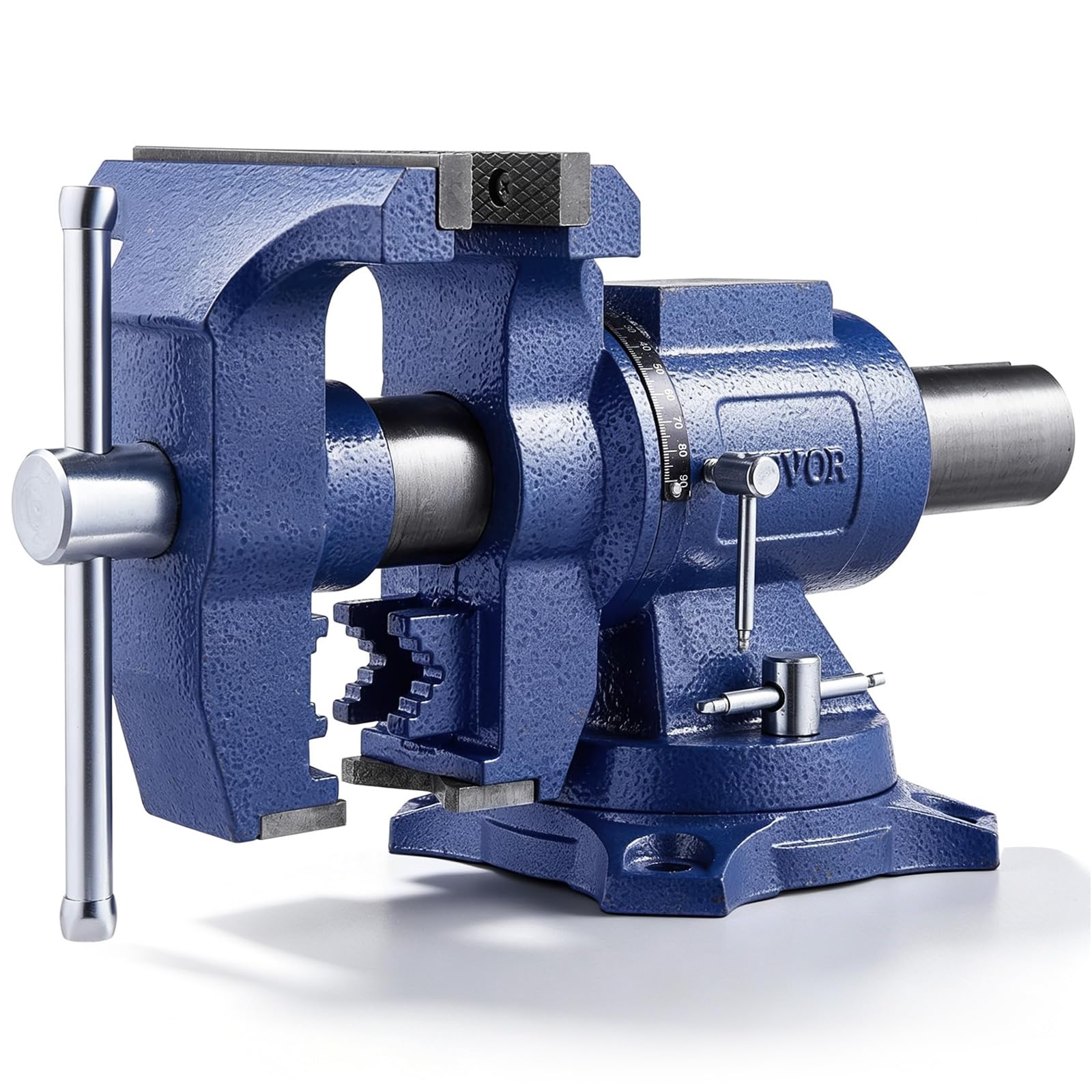
3. VEVOR Bench Vise, 6.5″ Jaw Width, 360-Degree Swivel Base
The widest jaw opening on this list, and the one that grabs round pipe without a fight.
At 6.5 inches, the jaw width here is the largest of the nine — a full inch and a half wider than the Yost’s 5-inch jaws. Combine that with a 5-inch maximum opening and you can seat wide flat stock and chunky parts that would hang off a smaller vise. The clamping force is rated up to 5520 lbs, and the ductile cast iron body is made to take long sessions of heavy work rather than the occasional Saturday job.
Where it earns its place for pipe work is the dedicated pipe and V-jaws. They clamp round pipe from 0.59 to 2.56 inches in diameter (15 to 65 mm), which covers most household and automotive plumbing sizes, and the V-shape centers irregular material instead of letting it roll. Both the head and the base swivel a full 360 degrees, so you can set an angle for welding or cutting and hold it there. A pair of 6-inch magnetic jaw pads comes in the box to protect finished surfaces from the serrations.
A 3.11 x 2.60-inch anvil pad rounds out the back for shaping and striking. The thing to know: this is a 38.9-pound vise, so plan the mounting before it arrives, and treat the ductile body as the durable part rather than assuming every component is equally tough. For a home shop that works pipe and flat stock in the same week, the jaw spread and pipe jaws together are hard to match at this tier.
budget bench pick: pipe repairs and mixed-shape clamping are on your bench regularly and you want maximum jaw width.
precision work no: you want a compact vise that stows in a tight corner — 38.9 lbs of ductile iron takes up real space.
4. PONY 5 Inch Bench Vise

Five inches of jaw with more clamp than most six-inch vises on the same bench.
Here is the number that matters: 5512 lbs of clamping force from a 5-inch jaw. The PONY 6-inch tops it at 8800 lbs, but for a vise this size, that figure is the reason it holds pipe and stubborn steel without the jaws creeping. The body and front jaw swivel 360 degrees both vertically and horizontally on a ductile cast iron base, so you can swing the work into a comfortable position and lock it. Heavy cold-formed steel channel beams cover and shield the screw, which keeps grit out of the threads and adds rigidity.
Jaw width is 5 inches, jaw opening is 5 inches, and throat depth is 2-5/8 inches, with an anvil work surface measuring 3-5/32 inches long and 2-9/16 inches wide. Permanent pipe jaws sit below the flat jaws so you can grab round stock without swapping inserts, and a pair of vise jaw pads is included to keep soft material unmarked. The flat jaw, pipe jaw, and anvil together cover grinding, cutting, gluing, sawing, and sanding at one station.
compact five inch body: a compact footprint that still clamps hard — the build is the standout, and durability is the close second in owner experience.
limited jaw opening: some find the dual-swivel setup takes a little getting used to before the locks feel natural; it rewards a few practice runs.
Mounted where it counts: with the base locked down, the serrated jaws bite and hold, and the orange body makes it easy to spot in a crowded shop.
small shop fit: a smaller bench that still needs serrated jaws, pipe jaws, and an anvil in one unit.
step up size: you routinely clamp stock wider than five inches.
5. PONY 6 Inch Heavy Duty Bench Vise, 8800LBS Clamping Force

Eight thousand eight hundred pounds of squeeze, and the front jaw stays shut around it.
Compare it straight to its smaller sibling: 8800 lbs of clamping force against the PONY 5-inch’s 5512 lbs. That is the biggest clamp rating on this list, and it is what makes this the pick for pressing bearings, holding welded assemblies, and clamping hardwood glue-ups that want to shift. The body is high-strength ductile iron with a 6000 PSI tensile strength, and the fully enclosed rear keeps dust and debris out of the vise body so the screw stays clean.
Underneath, an upgraded round slide bar runs smoother than a squared one, and the replaceable U-shaped steel piece is the part that wears — swap it and you extend the life of the vise. The base rotates a full 360 degrees for positioning, and replaceable pipe jaws handle round stock while a built-in anvil takes the hammering and shaping. Mounting screws and nuts are in the box, so install is a same-day job.
The honest caveat is the locking mechanism. It locks tight for most buyers, but the jaws can fail to align properly when pulled tight on some units — check the alignment early and exchange if it is off. Otherwise, compact size, solid weight, and easy installation make this a strong all-round performer for a home or professional workshop.
heavy steel pick: you clamp hard and want the highest rated holding force in the group.
measure bench first: you need perfect jaw alignment from the start — verify it before the return window closes.
6. BESSEY BV-HD60 Heavy Duty Bench Vise, 6 In.

A six-inch jaw and a big anvil, aimed squarely at the drill press crowd.
Six inches of jaw width and a maximum opening of 6 inches give you room to seat stock, and the hardened steel serrated jaws bite without needing a gorilla grip on the handle. The body swivels a full 36-degree rotation to angle the work, and three mounting holes hold it down solid. A large built-in anvil handles the shaping and hammering that would otherwise send you hunting for a pad.
The material is a 30,000 PSI cast iron alloy, and at 29 pounds it is heavy enough to feel planted but light enough to move without a second person. This is the vise that owners put under a drill press and leave there — the functionality lands, and the value reads well against the premium picks. Quality is the strongest theme in the feedback, with value for money right behind it, and a one-year warranty covers manufacturing defects.
drill-press steady hold: bolted to a drill press table or a bench where you need a big anvil and 6-inch jaws.
no pipe jaws: installation that some find finicky — plan the bolt pattern and bench height before you drill.
pairs with drill: large anvil, 6-inch jaws, and 36-degree swivel in a solid cast iron body.
pipe work no: you need one vise that also grips round pipe — this one has no pipe jaws.
7. IRWIN Tools Multi-Purpose Bench Vise, 5-Inch (4935505)
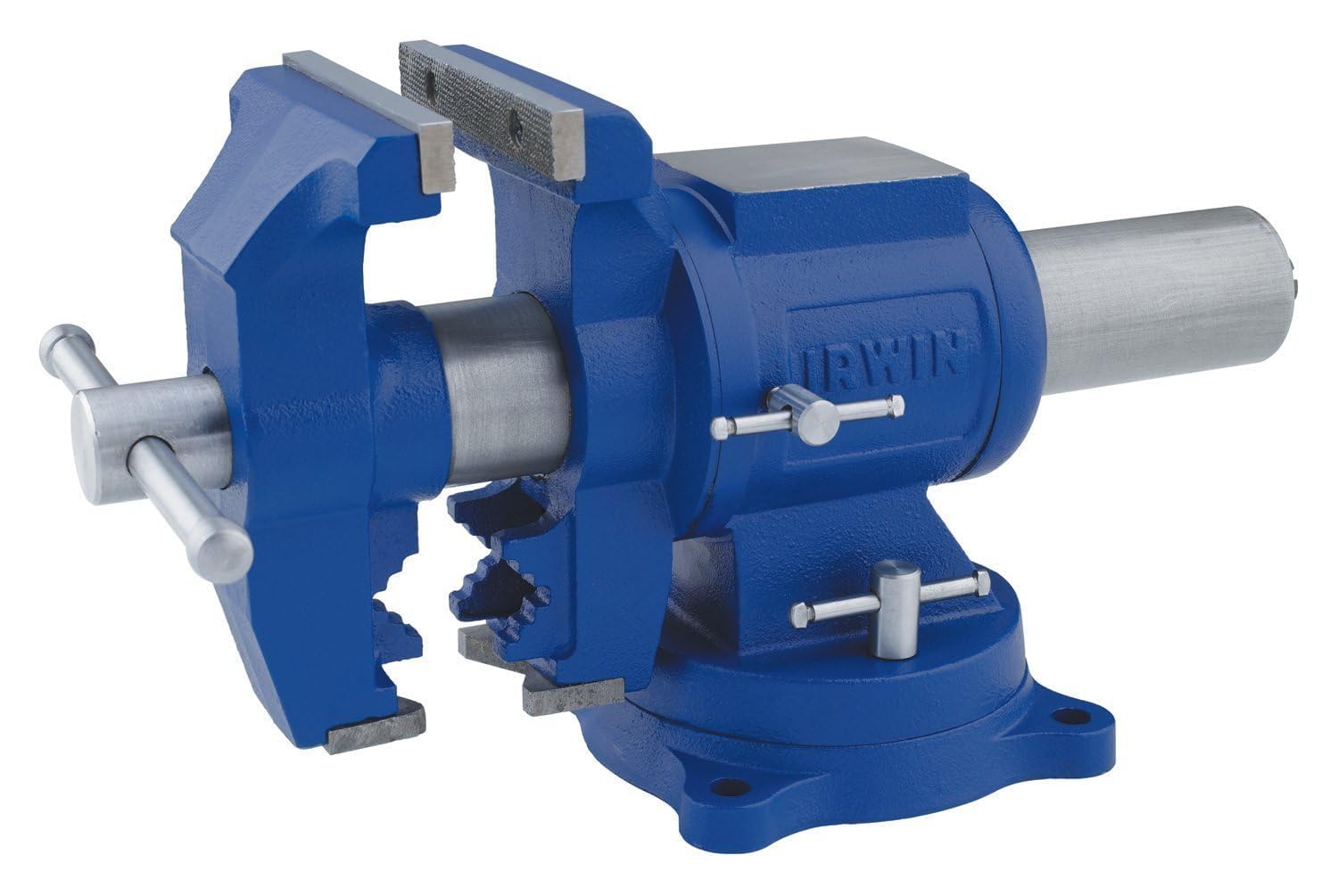
Rotating pipe jaws under flat jaws — the one-vise fix for a bench that does both.
Rotating pipe jaws are the whole reason to pick this one. Flip them down and you have a 5-inch flat jaw for wood and metal; flip them out and the same vise holds round pipe without a second tool. The base swivels 360 degrees so you can turn the work toward you, and an incorporated anvil at the back keeps the body steady while you hammer or shape against it. A fused steel handle takes the effort out of snugging the jaws down.
At 33.1 pounds of cast iron it sits between the lighter home vises and the 55.6-pound professional model. Precise jaw alignment is the part that keeps coming up — the teeth stay tight and square, which is exactly what you want in a vise you will load hundreds of times. The action on the moveable parts runs smooth, and the multi-purpose layout means it earns its bench space in a mixed shop.
What sells it is the range for the tier. It handles woodworking, assembly, and the odd metal job, and it stretches further than a fixed-jaw vise because the pipe jaws fold out when you need them. The trade-off is depth of capability rather than anything outright wrong: it is not a fabrication-grade vise, and serious metalworkers will want more clamping force than this class of vise provides.
versatile home pick: your bench sees both wood and pipe and you want one vise instead of two.
skip for daily pro: you need fabrication-level clamping force for steel every day.
8. IRWIN Multi-Use Bench Vise, Heavy-Duty, 6-Inch (4935506)

A 6-inch jaw with a deep 2-1/2-inch throat, built for the woodworker who also works metal.
The spec sheet reads like a working tool, not a display piece. High-quality grey iron is cast and then machined to close tolerances, which is what lets the body hold its shape under heavy pressure instead of flexing. The 6-inch jaw gives you width, and the clamping capacity runs to 4-1/4 inches with more than 3000 pounds of clamping pressure for heavy jobs. The fused steel handle lets you load it without fighting the grip.
Two details make it last. The long-barreled nut is dovetailed into the body so it cannot work loose, and the aligned main screw and nut cut down on wear over years of use. A safety stop keeps the slide from separating from the body if you run the jaw all the way out — a small thing that stops the front jaw from dropping off the vise.
The grey iron machined to close tolerances is the part that draws attention here, and the swivel base makes positioning easy for a vise this size. It is a 6-inch professional-pattern vise, not a mini pipe vise, so if round stock is a big part of your week look at a multi-purpose model with pipe jaws. For a woodworker or metalworker who wants 6 inches of jaw and a stable, machined body, this covers it.
fits busy bench: you want a machined 6-inch vise with a deep throat and a safety stop for edge-of-jaw work.
light use overkill: you need pipe jaws for round stock every week — this one is flat-jaw only.
9. Wilton Mechanics Pro 6-1/2″ Bench & Pipe Vise, 4-3/8″ Throat

The 4-3/8-inch throat that reaches into brackets other vises cannot touch.
Throat depth is the quiet hero here. At 4-3/8 inches it reaches deeper back into a bracket or fabricated part than the Forward’s 2.7-inch throat, and that is the difference between clamping a welded part by its edge and clamping it where the work actually is. The 6-1/2-inch jaw width and 6-inch maximum opening seat large parts, while replaceable pipe jaws grab round stock from 1/4 inch to 4 inches in diameter. One vise, flat and round, without swapping inserts.
The movable jaw and base are cast from 60,000 PSI ductile iron, and an enclosed spindle keeps lubricants in and contaminants out where they belong. A needle roller thrust bearing is what makes it easy to crank high clamping force on and back off again, and the precision-machined slide bar keeps the front jaw from shifting at any opening. For a fixed setup, the swivel base comes off and the body bolts straight to the bench.
At 55.6 lb it is the heaviest vise on this list, which is the point — that mass and the ductile iron are what hold steel steady for cutting, grinding, and filing. A lifetime warranty covers the whole thing against manufacturer defects, and Wilton sells replacement parts for the spindle, jaw inserts, pipe jaws, and base plate. The recurring oddity is that most of this vise is built to last, yet a slice of the feedback reports trouble within the first stretch of use, so inspect it on arrival and register the warranty early.
serious shop buy: deep throat, 6-1/2-inch jaw, and 1/4-to-4-inch pipe jaws with interchangeable replacement parts.
budget buyers pass: 55.6 lb and premium-tier cost mean you should have a bench rated for it before you buy.
Know the Specs
Clamping Force (lbs)
Clamping force is how hard the screw can squeeze a workpiece into the jaws, measured in pounds. A higher figure lets you press bearings, hold welded parts steady, and seat hardwood glue-ups without the piece creeping. The PONY 6-inch rates 8800 lbs, the VEVOR 5520 lbs, and the PONY 5-inch 5512 lbs — pick a rating that matches the hardest clamp you actually make, not the biggest number on the shelf.
Jaw Width vs. Jaw Opening
Jaw width is the width of the gripping faces, and jaw opening is how far they separate. These are not the same number: the Forward has 6-inch jaws but a 5-inch opening. Jaw width sets how wide a workpiece sits between the faces; opening sets how thick it can be. A wider jaw feels steadier on big flat parts, while a deep opening lets you swallow thicker stock.
Ductile Iron vs. Cast Iron (PSI)
Both are cast metals, but ductile iron bends before it cracks while plain cast iron is harder and more brittle. The PSI figure is the tensile strength — the Wilton and Yost use 60,000 to 65,000 PSI ductile iron, while the Forward and BESSEY list 30,000 PSI cast iron. For home and garage work, 30,000 PSI is plenty; daily metalwork favors ductile iron.
Swivel Locks and Throat Depth
A swivel base lets you rotate the vise to reach the work; the lock is what keeps it from moving mid-cut. Dual lockdowns hold the base steady through a cut, and the Yost adds twelve indexed head positions on its rotating top. Throat depth is how far back the jaws reach — the Wilton’s 4-3/8-inch throat tucks a bracket into the jaws, while a 2.7-inch throat like the Forward’s clamps at the edge.
Common Questions
Will a 6-inch bench vise fit the stock I work with?
What does 8800 lbs clamping force actually mean?
Do I need ductile iron instead of cast iron?
How do I bolt a bench vise to my workbench?
Is a swivel base worth it on a bench vise?
What is the difference between flat jaws and pipe jaws?
Can I use a bench vise as a press?
How much does a bench vise weigh, and does it matter?
Will a rotating head vise let me reposition work mid-job?
How deep does a vise throat need to be for bracket work?
The Bottom Line
For most people, the work bench vise winner is the Yost Vises 750-DI because its dual 360-degree rotation and three jaw sets cover flat, pipe, and irregular work without swapping tools. If you want the widest jaws and dedicated pipe jaws, grab the VEVOR 6.5-inch, and for the highest clamping force on this list, the PONY 6-inch is the one to reach for. Whichever you pick, bolt it over a solid part of the bench, match the material to your real work, and let the jaw width and throat depth guide the final call.
How we choose
We do not accept paid placement. Every pick is matched to a real buyer and a real use-case; we do not hands-on test units.
Sources
Specifications: manufacturer listings and product documentation. Review insights: verified customer reviews. Pricing: not shown on this page (it changes often); check the current price via the retailer link.
As an Amazon Associate, Tactical Gear Guy earns from qualifying purchases. This does not affect which products we feature.