Specs are compiled from manufacturer listings and verified buyer reviews and can change over time — please confirm the key details on the product page before buying.
Your body loses heat fastest when you stop moving, and that is exactly when a bad bag turns a cold night into a long, sleepless one. A zero degree mummy sleeping bag fixes that by trapping warmth close to your body while the mummy shape keeps dead air from gathering around your feet. Below you will find the picks that actually hold heat, plus the small spec details that separate a warm night from a shivery one. One honest note before we start: this list uses flexible matching for the 0°F rating class, so a few picks sit at 0°F and a few sit at neighboring cold-weather ratings and sizes that serve the same purpose.
This guide is built by comparing the manufacturers’ published specifications and the patterns across verified customer reviews, so you get each pick’s real strengths and trade-offs instead of marketing spin.
You will see fill type, temperature rating, packed weight, and internal dimensions side by side rather than isolated. That comparison is what makes a good zero degree mummy sleeping bag worth carrying instead of the heavy bag sitting in your garage.
Top Picks


How To Choose The Best Zero Degree Mummy Sleeping Bag
The first thing to understand is that a 0°F label is not a promise of comfort at 0°F. Makers rate bags differently, and the number you see printed usually describes the lower edge of survivable warmth, not the temperature where you will actually sleep well. Treat the rating as a starting filter and then look at fill, weight, and internal width.
Down fill versus synthetic fill
Down clusters pack down small for the warmth they deliver, which is why a down bag can weigh 2.38 lb and still hold cold-weather heat inside a backpack. The trade-off is moisture. Down loses loft when it gets soaked, so you need a shell that repels water and a dry camp setup. Synthetic fill is heavier for the same warmth but keeps working when damp. If you camp in humid or rainy country, that resilience matters more than the weight savings.
Shoulder width and the footbox
A mummy cut saves weight by trimming fabric around your legs. That same trim is what makes some bags feel like a straitjacket. Look at the shoulder width and the footbox shape together. A 37.5-inch shoulder and a square footbox give side sleepers and bigger frames room to move. A 32-inch shoulder with a tapered foot suits a back sleeper who wants to shave ounces. Neither is wrong, but pick to your body, not to the picture.
Hood, draft collar, and zipper
Heat escapes through three openings: your head, your neck, and the zipper line. An adjustable hood traps head heat, a draft collar seals the neck, and a draft tube runs behind the zipper teeth to block cold air from sneaking through. A no-snag zipper matters more than it sounds, since a jammed zipper at 2 a.m. means a cold scramble to get back inside.
Side-by-Side Comparison
| Model | Best For | Fill Type | Weight | Internal Size | Amazon |
|---|---|---|---|---|---|
| Teton Celsius Regular★ Best Overall | All-weather camping on a budget | Polyester fiber | 5 pounds | 79.92″L x 33″W | Amazon |
| AZITREK XXL Big and TallBig and Tall Pick | Side sleepers and bigger frames | Polyester | 6 pounds | 90″L x 37.5″W | Amazon |
| Coleman North Rim 0°FCold-Weather Workhorse | Campers up to 6 ft. 2 in | Coletherm polyester | — | 82″L x 32″W | Amazon |
| Kelty Cosmic Synthetic 0F | Backpacking with recycled fill | Recycled CirroLoft ECO | 4 lb. 12 oz. | 78.3″L | Amazon |
| SYWSKW Down with Pillow | Couples and family travel | Down | 2.6 pounds | 86.6″L x 33.46″W | Amazon |
| TETON Sports ALTOS | Cold sleepers who want room | Synthetic | 3.5 pounds | 84″L x 32″W | Amazon |
| QEZER 0 Degree Down | Backpacking in serious cold | 650FP white duck down | 3.5 pounds | 88.58″L x 32.28″W | Amazon |
| USGI ECW Military Bag | Rugged subzero use | 80% down / 20% polyester | 8 pounds | 84″L x 30″W | Amazon |
Detailed Reviews
1. Teton Celsius Regular, 25F, 20F, 0F Degree Sleeping Bag
Our pick — 4.5+★ from 3,500+ verified ratings; the strongest balance of quality and price.
The budget all-rounder that keeps its warmth promise and its price tag modest.
Warmth is the whole reason you buy a cold-weather bag, and this is where the Teton Celsius earns its place. It uses a double-layer fiber-fill construction with draft tubes along the seams, which stops cold air from creeping in through the stitching. The half-circle mummy hood wraps your head and keeps your pillow off the tent floor. At 4.5+ stars across 3,800+ owners, it is the safest starting point for a first serious cold bag.
The interior is where Teton made its name. A soft poly-flannel lining sits against your skin instead of the slick nylon you get on most mummy bags, and the flannel keeps the chill off your first minute inside. At 79.92 inches long and 33 inches wide, the regular fits most adult frames. It weighs 5 pounds, which is fine for car camping or a short hike in from the trailhead. Check it against the AZITREK above and it is the lighter of the two, at 5 pounds versus 6.
The flip side is heft. Five pounds on your back adds up over miles, and the mummy taper inside leaves less shoulder room than the AZITREK’s 37.5-inch cut. The stuff sack is a real stuff sack — Teton tells you to start at the bottom and stuff, then tighten the straps — so figure on a couple of tries to get it back in. Skipping a sleeping pad in freezing weather is the most common way people undercut this bag’s warmth.
What earns it the top spot
- Double-layer fiber fill with draft tubes keeps cold air out along the seams
- Flannel lining feels warm on contact instead of clammy
- Half-circle mummy hood holds head heat and protects your pillow
- Stuffs into the included sack with heavy-duty straps
Where it asks a trade-off
- 5 pounds is backpacking weight, not ultralight weight
- Mummy taper at 33 inches is snug for broad shoulders
- Warmth relies on pairing it with an insulated pad
Reach for this if: you want proven cold-weather warmth for weekend camping without paying premium prices.
Look elsewhere if: you are covering long trail miles and every pound counts.
2. AZITREK 0 Degree Mummy Sleeping Bag XXL Big and Tall
Built for campers who have never fit inside a standard mummy bag — and are tired of pretending they do.
If you have ever woken up with a zipper pressed into your shoulder, this is the bag that ends it. The AZITREK measures 90.2 inches long and 37.5 inches wide, and that width is the number that matters most — it is 5.5 inches wider than the Coleman North Rim’s 32-inch cut. For side sleepers, the peanut-shaped body and roomy square footbox mean you can roll from shoulder to shoulder without fighting the fabric. The 0°F-to-30°F range covers real winter use, not just cool nights.
Insulation comes from a double-layer system they call Dually, plus a U-shaped draft collar at the neck and a soft cuff around your face. Both features exist to seal the two spots where body heat leaks out. The 2-way zippers are built to stay jam-free, which matters when you need to get out fast. The included compression sack pulls the whole thing down, and this is where the design earns its keep for a restless sleeper who wants room but still needs to pack it into a vehicle.
Six pounds is the honest cost of all that extra fabric. This is a car-camping and basecamp bag, not a summit bag. A limited lifetime warranty backs it, and the moisture-shedding shell shrugs off a dew-soaked tent morning. Owners consistently praise the build quality, though as a recently listed bag it has a small but clean track record rather than a decade of field reports.
Room to spread out: The 37.5-inch shoulder and 90.2-inch length give big frames and side sleepers the space standard mummies never offer.
The weight question: Six pounds is the trade for that space, so plan it around a vehicle or a short carry rather than a long trek.
Fits you if: you are broad-shouldered, a side sleeper, or simply claustrophobic in a narrow mummy.
Not the one if: you are counting ounces for a backcountry trip.
3. Coleman North Rim 0°F Sleeping Bag
A name-brand subzero bag with a washable shell and a five-year warranty behind it.
The measurable draw here is the insulation. Coleman uses Coletherm hollow polyester, a fill designed to hold heat with less bulk than standard fiber, and wraps a Thermolock draft tube behind the zipper to stop body heat escaping through the teeth. The adjustable hood lets you dial in the balance between keeping warm and letting air in, which is the fix for that stuffy feeling around 3 a.m. Rated to 0°F, it holds up on genuinely cold nights.
The fit is aimed at taller campers, sized for people up to 6 ft. 2 in, and it measures 82 by 32 inches. Where Coleman wins is upkeep: the bag is machine washable, so a season of sweat and dirt does not mean hand-scrubbing in a tub. A five-year limited warranty backs it, longer than most budget bags offer.
Two honest notes come up again and again with this bag. It is bulkier than its spec sheet suggests, so give it room in the car. And the zipper is the recurring gripe — treat it gently, especially on cold mornings when the fabric stiffens. That is no reason to skip a name-brand bag at this price, but the zipper is the one part to baby.
The practical wins
- Coletherm hollow polyester fill holds heat with less bulk
- Fits campers up to 6 ft. 2 in
- Machine washable shell makes cleanup simple
- Five-year limited warranty backs the build
What to watch for
- Bulkier than expected when packed
- Zipper needs gentle handling to last
- Shorter reach than the 90.2-inch AZITREK
Buy it for: dependable brand-name cold-weather warmth you can machine wash and trust season after season.
skip it if: you are over 6 ft. 2 in or want a lighter pack weight.
4. Kelty Cosmic Synthetic 0F Degree Mummy Sleeping Bag
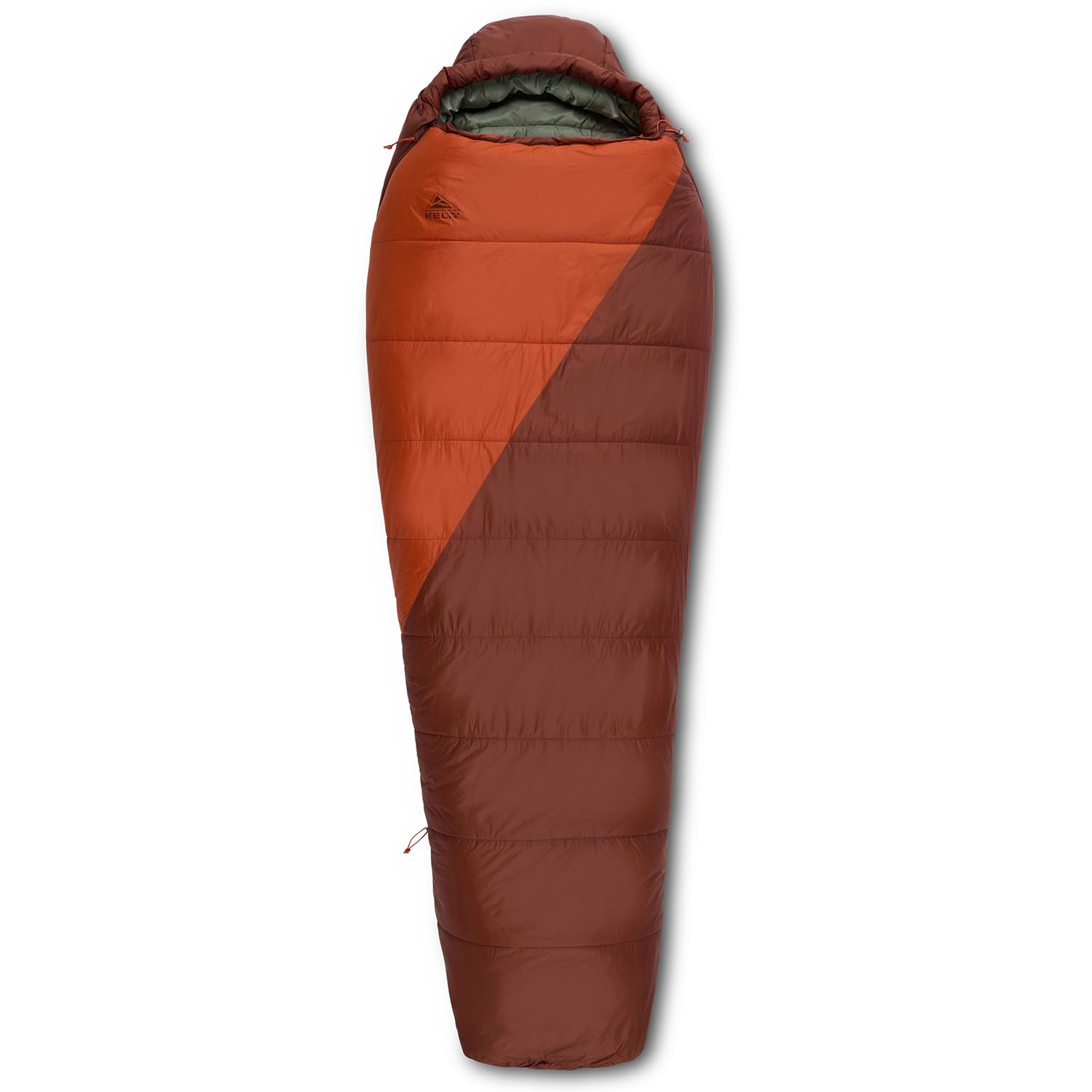
Down-level warmth from recycled synthetic fill, without the down price or the down fuss.
Kelty’s angle is simple: hold 0°F warmth while staying synthetic. The CirroLoft ECO fill is recycled, compresses well for the warmth it delivers, and keeps working when damp — the property that makes synthetic the safer bet in wet weather. It carries 61.2 oz. of that insulation inside a 78.3-inch shell, so the fill-to-length ratio is generous for the size. The expanded natural-fit footbox gives your feet room to flex instead of pressing against a taper.
Heat retention on this bag is engineered, not left to chance. A contoured hood, full draft collar, offset quilting, and full-length draft tube all work the same job — one closes a gap, the next blocks a seam line. Dual locking sliders let you tune airflow without a fight, and the anti-snag treatment keeps the zipper moving. There is a zippered internal stash pocket for a phone or headlamp, which sounds small until you are fishing around in the dark.
At 4 lb. 12 oz., it slots between the Teton at 5 pounds and the SYWSKW down bag at 2.6 pounds. The stuffed size is 11.5 by 19 inches, and it comes with a compression sack with integrated straps. One honest catch: this is the shortest bag here at 78.3 inches, so it fits sleepers up to 6 ft. and no further. If you are taller, the 90.2-inch AZITREK is the obvious alternative. It is also a newer listing with light field history, so its long-term reputation is still unproven.
Fill that forgives damp: Recycled CirroLoft ECO keeps its warmth in wet conditions, which is the one thing down cannot do.
Worth it for: wet-climate backpackers who want zero-degree synthetic warmth and an expanded footbox.
Think twice if: you are over 6 ft. — the 78.3-inch length cuts it close.
5. SYWSKW Large Down Sleeping Bag with Pillow
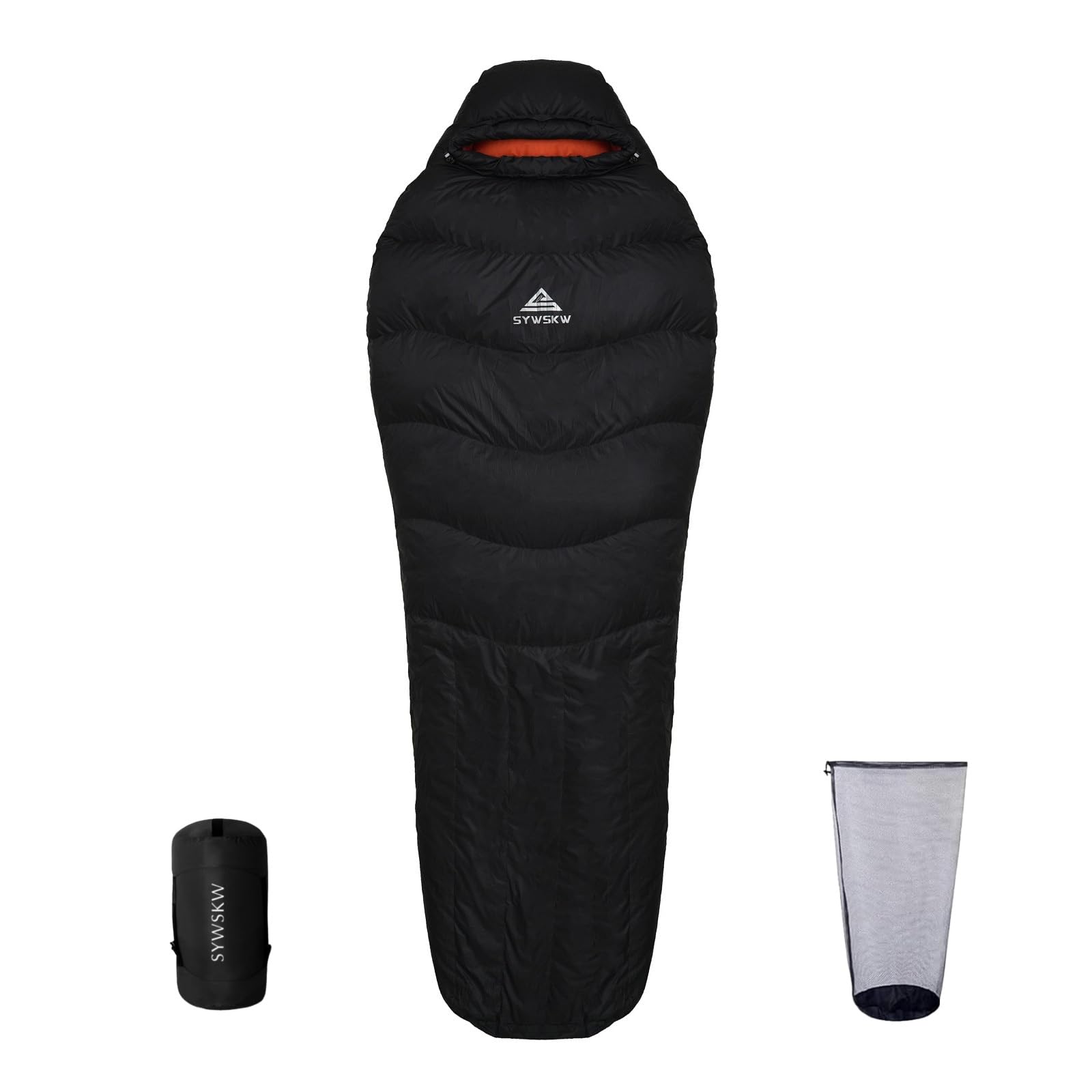
The bag that kills the packing argument — down warmth, a built-in pillow, and a two-person option.
Weighing 2.6 pounds, this is the lightest bag in the entire list. It compresses to a pack size of roughly 7.08 by 11.80 inches or 7.08 by 13.78 inches depending on the model, so it disappears into a daypack. The shell is 100% nylon, the fill is down, and the internal pocket gives you a spot for a phone or keys. For a couple or a family, two different-color bags zip together to form one double bag — a clever bit of design that turns two bags into one shared sleep system.
The 80g detachable pillow is the small feature that saves you from stuffing a jacket into a hood. The YKK zipper is the brand-name hardware here, and reflective drawcords help you find the bag at dawn or dusk. The widened 33.5-inch shoulder and 86.6-inch length give it real room, more than most ultralight down bags offer. Warmth comes in three fill weights — the 1.1 lb filling model for 3-4 seasons, and the 1.76 lb and 2.65 lb versions for winter or all-season use.
The honest catch is down’s old weakness. Get this bag soaked and it loses loft until it dries, which is why it pairs better with a dry camp and a tarp than a wet-weather slog. The zipper is the other split opinion — good for most, annoying to some. Lay it out on the floor for at least half an hour when you unbox it so the down can recover its full loft before your first night.
Two bags, one night: The zip-together design makes this rare among mummy bags — you can share warmth on a couples’ trip without buying a separate double bag.
Packability that wins: At 2.6 pounds and a compact pack size, it is the bag you reach for when space is the deciding factor.
Choose this if: you want light down warmth, a built-in pillow, and the option to zip two bags into one.
Keep looking if: your trips are wet and you need synthetic fill.
6. TETON Sports ALTOS Mummy Sleeping Bag

Teton’s lighter, roomier step-up bag for cold sleepers who want space without the tent-floor wrestling match.
If the Teton Celsius is the budget warhorse, this is the trimmed-up version. It weighs 3.5 pounds, a noticeable 1.5 pounds off the Celsius, and channels that savings into a roomier cut — 84 inches long by 32 inches wide, with a built-out footbox that gives your toes somewhere to go. The shell is water-resistant, so a damp tent floor or a foggy morning will not soak straight through. A compression sack is included, and Teton’s stuffing method is the same one they teach on all their bags.
What wins people over here is warmth for cold sleepers. The bag has a lined head and neck area that holds heat where it matters most, so people who always feel the cold tend to do better in this than in a thinner mummy. It is rated in the 20-degree and 0-degree class depending on the model, so match the rating to your trip. Value is another consistent theme — it delivers down-adjacent warmth at a synthetic price, and the included sack means no extra purchase.
Two things to know. The fit is split between owners who find it roomy and those who find it a little snug, so if you are broad, size up your expectations or look at the AZITREK’s 37.5-inch shoulder. The other catch is hand wash only — no machine cycle, so plan on a tub or a front-loader with care. Neither is a dealbreaker for a bag this warm at this tier, but both are worth knowing before you buy.
The case for the ALTOS
- 3.5 pounds — 1.5 pounds lighter than the Celsius
- Built-out footbox and 84-inch length give real room
- Lined head and neck hold heat for cold sleepers
- Water-resistant shell and compression sack included
The fine print
- Hand wash only, no machine cycle
- Split opinions on fit for broad frames
- Roomy but still a mummy — not a wide-cut bag
The right fit: cold sleepers who want a roomier mummy that still packs light and holds heat at the head and neck.
Less of a match if: you need a machine-washable bag or a wider shoulder cut.
7. QEZER 0 Degree Down Sleeping Bag
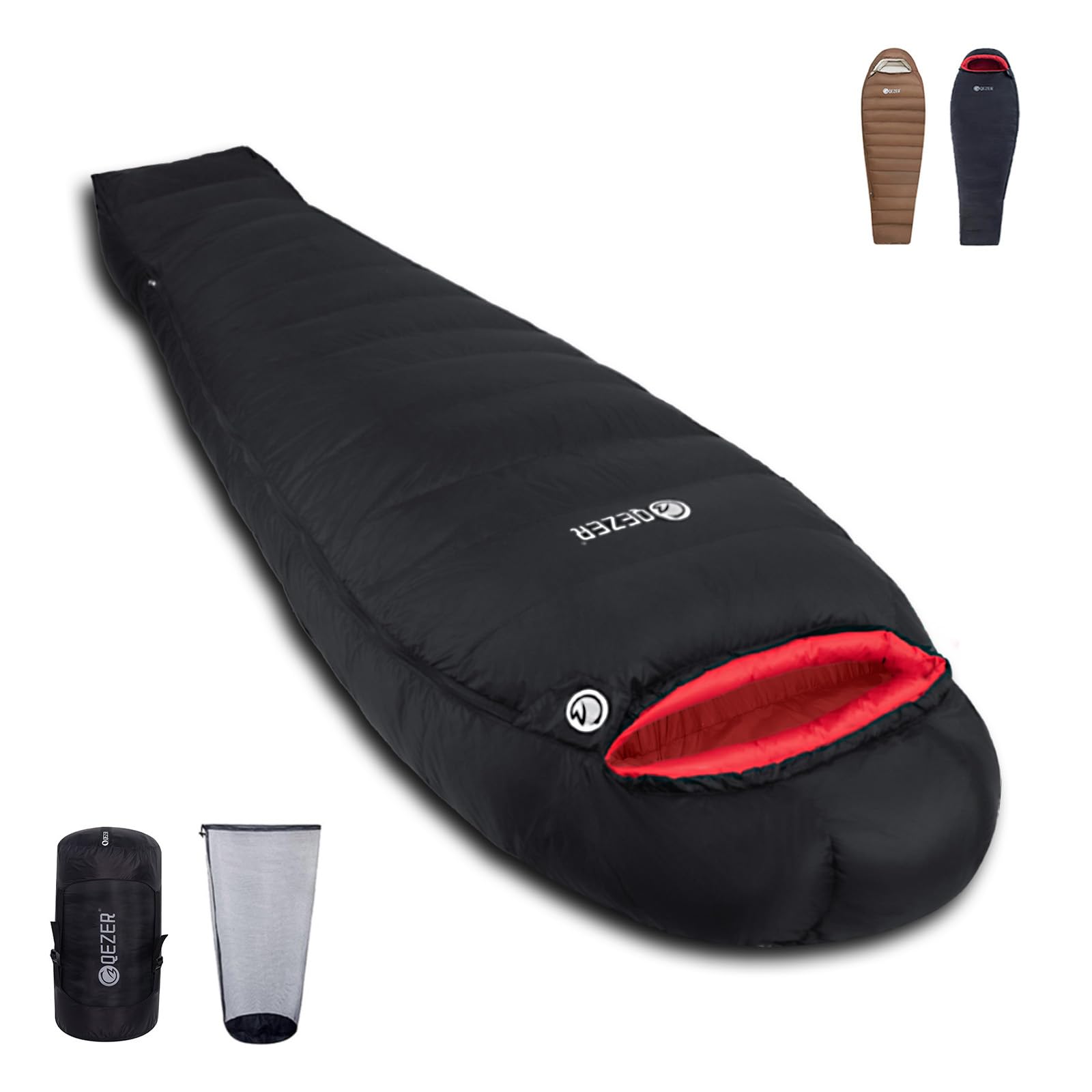
The down bag for real winter nights, built with baffles and a saddle neck that trap heat instead of leaking it.
The warmth engine here is 2.86 lb of 650-fill-power white duck down, rated to keep you warm between 0°F and 18°F. Vertical baffles are the detail that matters — they hold the down in place so it does not slide to one side of the bag and leave a cold streak. A windshield design at the zipper blocks air moving through the teeth, and the inner and outer 400T nylon shell keeps moisture from soaking the fill. Body heat stays in; outside air stays out.
The neck is where this bag gets interesting. It has a saddle-shaped neck that wraps tightly to stop heat escaping at the collar, plus an ergonomic footbox so your feet are not jammed against the end. The whole bag measures 88.58 inches long and 32.28 inches wide, so it is a full-length bag with genuine winter proportions. It compresses to a pack size of 17.32 by 8.66 inches at a package weight of 4.1 pounds — heavy for down, but that is what the fill weight buys you.
Storage is the honest catch with down this dense. QEZER ships a separate mesh storage bag and asks that you store it loose or hung rather than compressed, since long-term compression flattens the loft and steals warmth. Durability and the zipper are the two things that come up as watch points, so treat the zipper carefully and keep the shell clean. If you camp below freezing and want a bag that earns its down fill, this is the pick.
Down that stays put: The vertical baffles are the difference between a down bag that holds its warmth all night and one that lets the fill drift into a cold corner.
Best matched to: backpackers and winter campers chasing genuine subzero warmth from 650FP down.
Not for you if: you will not hang or store it loose between trips.
8. USGI Extreme Cold Weather ECW Down Sleeping Bag

A genuine military-issue subzero bag — heavy, overbuilt, and built to a spec, not to a marketing chart.
This is the heaviest bag on the list by a wide margin at 8 pounds, and the 8 pounds is the point. It is a real US military issue Extreme Cold Weather bag, made of a water-repellent poplin cotton outer shell with an 80% down, 20% polyester fill, and it is rated all the way down to -20°F. That is colder than anything else here. The construction is mummy style with a draw-cord hood, and it measures 84 inches long with a 30-inch shoulder tapering to 14 inches at the foot. The USA-made, mil-spec build is the whole appeal.
Buyers come to this bag for the warmth and the build, and it delivers both. The cotton-poplin shell shrugs off moisture better than the thin nylon on ultralight bags, and the fill mix is dense enough to hold heat on brutal nights. It ships new without tags, stored uncompressed so the down is at full loft when it arrives. If you want a bag engineered to a military spec rather than a marketing chart, this is the one.
The catch is exactly what you would expect from a military bag. Eight pounds is a commitment, and the 30-inch tapered cut is snug by any standard — narrower than the Coleman North Rim’s 32-inch shoulder and far narrower than the AZITREK’s 37.5 inches. This is a basecamp or truck-camping bag, not a backpacking bag. The reward for that trade is a -20°F rating and a build that shrugs off hard use.
Why it earns its keep
- Rated to -20°F — the coldest rating on this list
- 80% down, 20% polyester fill with a water-repellent cotton shell
- US military issue, USA made to an real spec
- Stored uncompressed so the down arrives at full loft
Who should pass
- 8 pounds is a load for vehicle or basecamp only
- 30-inch tapered shoulder runs snug for broader frames
- Military dimensions are less forgiving than cut-to-fit bags
Get it for: truck camping, basecamp, or a winter survival kit where the -20°F rating and rugged build matter more than weight.
Pass on it if: you plan to carry your bag on your back.
Know the Specs
Temperature rating (the 0°F label)
The 0°F figure on a bag is a target, not a promise. Makers test warmth differently, and the number usually describes the cold edge of survivable comfort. Your personal comfort depends on how you sleep, what pad sits under you, and whether you wear a hat. Treat 0°F as the starting filter, then look at fill type and weight to guess how warm the bag really sleeps for you. If you sleep cold, buy a bag rated lower than the trip forecast.
Fill power and fill weight
Fill power measures how much space down lofts into for its weight — 650FP and 680FP are the figures you see on this list. Higher fill power means more warmth per ounce. Fill weight is the actual amount of down or synthetic packed in. A bag with a lot of low-fill-power down can be warm but heavy, while a light bag with modest fill weight suits mild winter use. If you see “2.86lb” of down and “650FP” together, that tells you both how much and how efficient the fill is.
Packed weight and stuff size
Weight and pack size decide what kind of trip the bag is for. A 2.6-pound down bag packs small and belongs on your back. A 6- to 8-pound bag belongs in a vehicle or a basecamp pile. Look at the compression sack specs too — a bag that compresses to 11.5 by 19 inches will fit a pack differently than one that squishes into a 7.08 by 11.80-inch bundle. Match weight to your trail ambitions, not to the picture on the listing.
Shoulder width and footbox shape
A 30-inch shoulder tapers tighter than a 37.5-inch shoulder, and that difference decides whether you sleep in a bag or fight it. Side sleepers need more shoulder room to rotate; back sleepers can get away with a trimmer cut. The footbox is the other half — a square or built-out footbox lets your feet go flat, while a taper forces them to stay pointed. Read both numbers, then pick the one closest to your sleeping position.
Common Questions
Is a 0 degree mummy sleeping bag warm enough for winter camping?
Should I choose a down or synthetic fill sleeping bag?
Will a mummy sleeping bag fit a side sleeper?
What does fill power like 650FP actually mean?
How do I store a down sleeping bag so it keeps its warmth?
Does the zipper on a mummy bag really cause cold spots?
Can I zip two mummy sleeping bags together?
How much does packed weight matter for a zero degree bag?
Do I need a sleeping pad under a 0°F mummy bag?
The Bottom Line
For most campers, the zero degree mummy sleeping bag winner is the Teton Celsius Regular because it delivers proven cold-weather warmth, a soft flannel lining, and draft-tube construction at a value price — and it is the most-reviewed bag here by a wide margin. If you want room to roll over or a bigger frame needs space, grab the AZITREK XXL Big and Tall with its 37.5-inch shoulder and 90.2-inch length. And for genuine subzero basecamp duty, the USGI ECW is the one to reach for, with a -20°F rating and a real military build behind it.
How we choose
We do not accept paid placement. Every pick is matched to a real buyer and a real use-case; we do not hands-on test units.
Sources
Specifications: manufacturer listings and product documentation. Review insights: verified customer reviews, as of November 2026. Pricing: not shown on this page (it changes often); check the current price via the retailer link.
As an Amazon Associate, Tactical Gear Guy earns from qualifying purchases. This does not affect which products we feature.