Specs are compiled from manufacturer listings and verified buyer reviews and can change over time — please confirm the key details on the product page before buying.
If you are tightening a 9/16-inch bolt in a spot where your hand barely fits, the deciding feature is not the brand name — it is how few degrees of swing the ratchet head needs before it clicks onto the next tooth. A wrench that needs a wide arc simply will not turn in a cramped engine bay. Below you will find nine wrenches that all fit a genuine 9/16-inch fastener, each ranked on the things that actually decide whether it lives in your toolbox or your junk drawer.
This guide is built by comparing the manufacturers’ published specifications and the patterns across verified customer reviews, so you get each pick’s real strengths and trade-offs instead of marketing spin.
Each option here is measured on swing arc, tooth count, reach and finish, because those are the details that separate a smooth daily tool from one that fights you. Read on for the breakdown of the 9/16″ wrench options that hold up best.
Top Picks


How To Choose The Best 9/16″ Wrench
Value in this size bracket splits into three groups: the balanced mid-range ratchets that most home mechanics will actually reach for, the long-pattern and flex-head designs that trade a little bulk for reach, and the premium pieces built around a finer ratchet mechanism. Pick your group by where the bolt sits, not by the brand on the handle.
Swing arc first, everything else second
Swing arc is the smallest amount of handle movement the ratchet needs to catch the next tooth — measured in degrees. A 3-degree arc lets you work in a gap where a coarser head would just jam against the block. If your 9/16-inch bolts live in cramped spots, this number matters more than tooth count on its own.
Tooth count and how smooth it feels
More teeth in the ratchet head means each click is a shorter step, and shorter steps feel smoother in your hand. A 120-tooth head is the finest mechanism in this group. A 72-tooth or 90-tooth head is the everyday standard and still gets the job done in most home and automotive work.
Reach, offset and knuckle clearance
A long-pattern wrench stretches the handle out for more leverage and lets you reach bolts buried behind brackets. The trade-off is a bulkier tool in your bag. A 15-degree offset on the box end tilts it away from the surface, which keeps your knuckles off the metal when you are turning hard.
Flex heads go a step further — the box end tilts to approach an obstruction from an angle a fixed head cannot. That flexibility is worth having on suspension and exhaust work. It is worth less if all your bolts sit out in the open.
Side-by-Side Comparison
| Model | Best For | Head Type | Teeth / Size | Weight | Amazon |
|---|---|---|---|---|---|
| GEARWRENCH 86946 90T Combination★ Best Overall | Everyday all-round use | Combination, 12-point | 90-tooth, 9/16″ | — | Amazon |
| Meccion Open End RatchetingBest for Tight Spaces | Tight confined spaces on a budget | Box end, 12-point | 72-tooth, 9/16″ | 133 g | Amazon |
| Capri Tools 120-Tooth XLFines Teeth | Very tight spots and extra reach | Combination, 12-point | 120-tooth, 9/16″ | 4.8 oz | Amazon |
| GEARWRENCH 81657 Long Pattern | Long reach on fixed bolts | Box/Open end | 12-point, 9/16″ | 1.92 oz | Amazon |
| Jaeger Flex Head 4° Swing | Obstructed bolts at an angle | Flex box end, 12-point | 90-tooth, 9/16″ | 0.14 kg | Amazon |
| CRAFTSMAN CMMT42564 72T | Brand familiarity, chrome finish | Box end, 12-point | 72-tooth, 9/16″ | 0.1 kg | Amazon |
| TEKTON WRC23314 Reversible | Switching direction mid-job | Ratcheting box, 12-point | 72-tooth, 9/16″ | 4.32 oz | Amazon |
| Klein Tools 68415 Combination | General combination-wrench duty | Box/Open end | 12-point, 9/16″ | 3.2 oz | Amazon |
| Wera Joker 05073284001 | Fine ratchet and premium finish | Open end, ring ratchet | 80-tooth, 9/16″ | 0.12 kg | Amazon |
Detailed Reviews
1. GEARWRENCH 86946 Ratcheting Combination Wrench
Our pick — 4.5+★ from 900+ verified ratings; the strongest balance of quality and price.
The 90-tooth all-rounder that earns its keep on nearly every 9/16-inch bolt.
A 90-tooth ratchet head means 90 tiny steps around the circle, and that translates directly into a short swing you can work in a cramped gap. The 12-point box end grips both 6-point and 12-point fasteners, so you are not hunting for a second wrench mid-job. An 8.38-inch length gives you reach at the bench and enough handle to lean on when a bolt is stubborn.
The off-corner loading design presses on the flats of the bolt instead of the corners, which is what stops a soft or rusty fastener from rounding off. Alloy steel with a polished finish rounds out a tool built to be used, not admired.
What wins people over is the sheer build consistency, and functionality gets named again and again as the reason it stays in rotation. The one note worth knowing: ratcheting mechanism feedback is mixed, with a few long-term users seeing theirs loosen with heavy use. That is a small slice of a large crowd — the crowd favorite at 4.5+ stars across 900+ ratings — but size your expectations if you plan to hammer it daily.
Where it earns the top spot
- The 90-tooth ratchet keeps the swing short enough for confined work.
- Off-corner loading on both ends reduces the risk of rounding a bolt head.
- The 12-point box end fits 6-point and 12-point fasteners alike.
- Alloy steel with a polished finish and a standard limited lifetime warranty.
The honest caveat
- The ratcheting mechanism earns mixed feedback, with some reporting loosening over time.
- No flex head and no long-pattern reach, so deep-set bolts may want a different pick.
Reach for this if: you want one dependable ratcheting wrench for general home, bike and auto work and you value a proven track record.
Worth knowing: the ratchet is not the finest-toothed option in this group, so ultra-tight clearances favor the Capri or Jaeger picks instead.
2. Meccion 9/16 Inch Ratcheting Wrench
A 5-degree swing arc that sneaks into gaps a coarser wrench cannot reach.
Here is the number that decides the whole tool: a 5° ratchet swing action. That means the handle only needs to travel five degrees before the mechanism grabs again, which is exactly what you need when a bracket or firewall blocks your hand. For work where a standard wrench simply will not fit, that short arc is the feature that saves the job.
The 72-tooth, 12-point design delivers that arc, and the open-end ratchet setup extends the wrench to a wider range of applications than a box-only tool. Chrome vanadium steel forged with a grey nickel plated finish gives rust resistance to match the build. At 7.44 inches it is 18% shorter than the CRAFTSMAN CMMT42564 at 8.8 inches, so it tucks into tighter tool rolls.
The build is praised as well-made and heavy-duty, and it has taken on real grunt work — tightened excavator tracks is the kind of duty cycle that would break a flimsy tool. The catch: ratchet performance is the sore spot, with reports of a unit giving out in very short order. Pick it for occasional confined-space work rather than all-day professional abuse.
What it does best: a 5° swing arc in a compact 7.44-inch body, so confined bolts become reachable where other wrenches just spin.
The fair warning: ratchet durability is inconsistent — it handles a hard occasional job, but continuous heavy use is not where it shines.
Go here when: tight access is the whole problem and you want a compact, budget-friendly ratchet for home, DIY or bicycle work.
Look elsewhere if: you need a ratchet that will survive daily professional hammering, where the mixed ratchet feedback is a real risk.
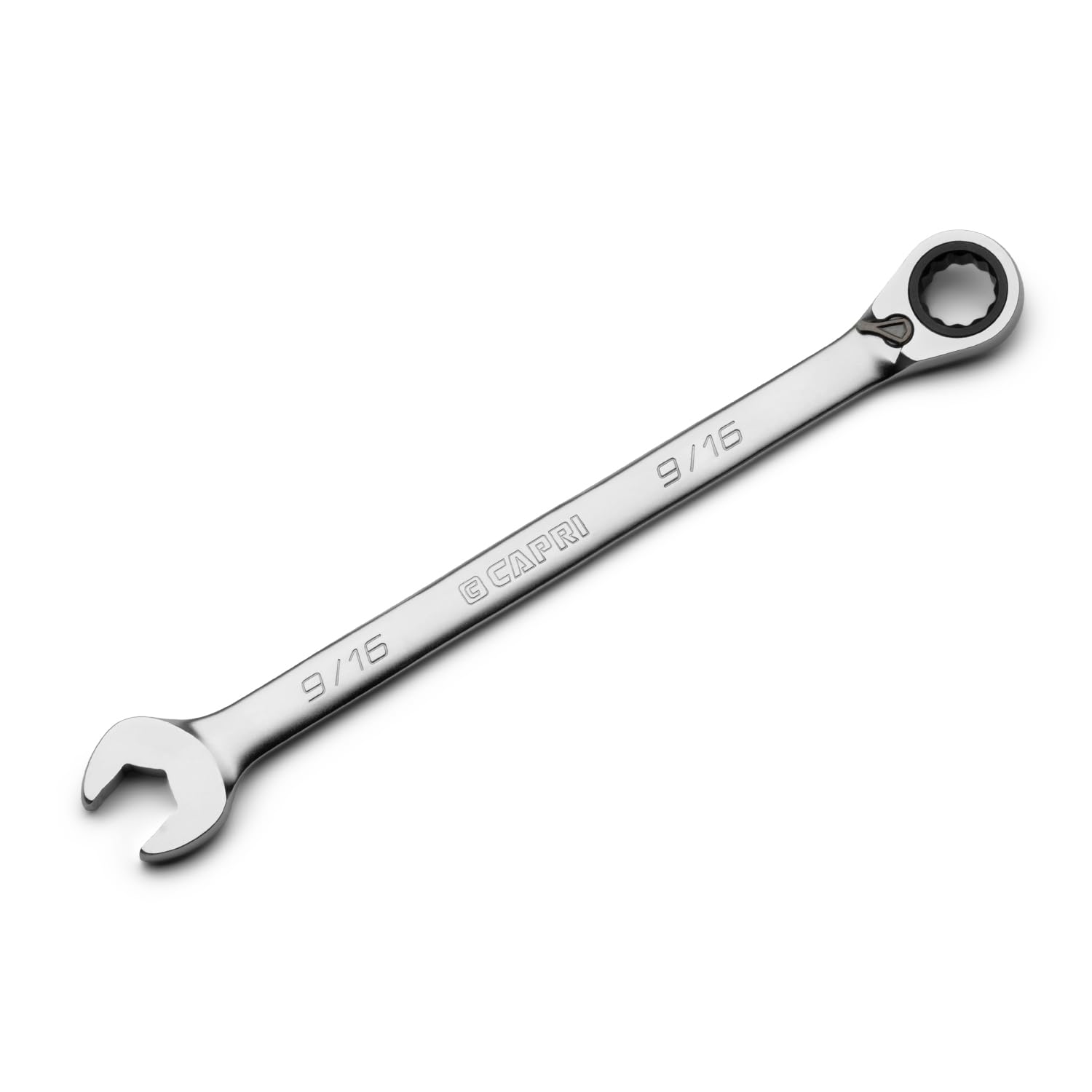
3. Capri Tools 9/16 in. Reversible Ratcheting Wrench
The finest-toothed head in this group, built to turn where others just spin.
Count the teeth and you understand the tool. A 120-tooth ratchet mechanism delivers a minimal 3-degree swing arc, and that is the tightest ratchet geometry on this list. Where a 72-tooth head needs more room to catch, this one clicks around in the narrowest clearance you are likely to face.
It is also a long-pattern piece, 20% longer than standard wrenches for more leverage and turning power. The 12-point WaveDrive box end spreads torque evenly across the bolt — that is the anti-rounding feature you want on worn fasteners. A 15-degree offset box end lifts your knuckles clear, and a reversible thumb switch flips direction without pulling the wrench off the nut. SatinChrome plating gives a matte, grippy texture that resists corrosion.
Quality is what people single out, and length is the next thing they bring up — extra reach that lets you get over obstructions. Weighing 4.8 ounces it carries more heft than the GEARWRENCH 81657 long pattern at 1.92 ounces, a trade for that extra reach and the deeper ratchet head. For what it does, that weight is the price of the leverage.
Why mechanics lean toward it
- The 120-tooth head gives a 3-degree swing arc — the tightest on this list.
- 20% longer than standard for extra leverage and reach.
- Thumb-switch reversal lets you change direction without lifting off the fastener.
- WaveDrive box end and 15-degree offset protect bolts and knuckles.
Weigh before you buy
- At 4.8 ounces it is the heavier long-pattern option here.
- The XL handle is long, so it may not fit every cramped tool pouch.
Pick this one if: your bolts live in the tightest spots and you want the smoothest, finest ratchet plus real reach to get there.
Skip the XL if: a compact tool that disappears into a small kit matters more to you than leverage.
4. GEARWRENCH 81657 Combination Wrench

A fixed long-pattern wrench that reaches bolts a stubby ratchet never will.
This is the non-ratcheting companion to the GEARWRENCH above, and its reason for being is reach. At 8.74 inches with a long-pattern length, the handle gets you over brackets and behind obstructions where a standard wrench runs out of steel. If your 9/16-inch bolts are simply buried, this is the reach tool.
Surface drive technology grips the fasteners better than a plain open end, an offset open end angle keeps your fingers clear, and full polish nickel chrome plating protects against corrosion for a long service life. Size is stamped on both sides and the head, so you can spot it in a dark drawer by feel. Alloy steel gives the tool its backbone.
Functionality is the praised strength — it works, and it is great for loosening stubborn bolts. The length is a genuine split decision: some appreciate the long reach, and some find it still is not long enough for the deepest jobs. Weight the 1.92 ounces against the Capri’s 4.8-ounce long pattern and this GEARWRENCH travels lighter in a bag.
Its specialty: pure long-pattern reach with a fixed box end and open end, so buried bolts are within arm’s length.
The trade to know: no ratchet mechanism, so tight quarter-turns mean lifting and resetting the wrench each pass.
Make it yours if: you need plain long reach and a light tool that slips into a pocket or small roll.
Pick a different tool if: you want ratcheting action — the fixed head means no short-arc turning.
5. Jaeger 9/16 Inch Flex Head Ratchet Wrench

The head tilts 180° so you can attack a blocked bolt from the one angle that works.
A fixed head is useless when an obstruction sits right where your handle wants to swing. The 180-degree flexible box end on this Jaeger tilts along with the directional arrow, letting you approach confined areas from an angle a rigid wrench simply cannot manage. That flexibility is the difference between finishing a suspension job and giving up on it.
Inside the 100% steel ratcheting box end sits a 90-tooth, 12-point mechanism that needs only a 4° turn movement. That short arc lets you work where a standard wrench runs out of swing. The finish is corrosion and rust proof, and the chrome vanadium steel build gives it a solid hand. It is backed through a return-it-if-you-don’t-love-it policy, and the brand donates to Habitat for Humanity.
Buyers describe the quality as solid and it stays useful in tight spaces. Weight runs at 0.14 kg against the CRAFTSMAN CMMT42564 at 0.1 kg — the flex joint adds a bit of mass in exchange for that adjustable head. The mechanism is the thing to check on arrival; a flex head that does not lock where you set it costs you the angle you bought it for.
What makes it different
- The 180-degree flex head reaches obstructions a fixed wrench cannot.
- A 4° swing arc fits where ordinary wrenches have no room to turn.
- The 100% steel ratcheting box end resists corrosion and rust.
- Backed by a return-or-replace guarantee.
Check this first
- The flex joint is the weak point to confirm — it must lock firmly at your chosen angle.
- At 0.14 kg it carries more weight than a fixed head like the CRAFTSMAN.
Best served to: anyone fighting bolts behind brackets, hoses or suspension components where angle access is everything.
Think twice if: you mostly work on open bolts — the fixed picks are lighter and simpler.
6. CRAFTSMAN CMMT42564 Ratcheting Wrench

A familiar, chrome-plated 72-tooth ratchet with a 15-degree knuckle-clearing offset.
The 72-tooth ratcheting box end opens access to tight spaces, and the 12-point head snaps onto a fastener quickly. A 15-degree box end offset tilts the head up and away, giving you extra knuckle clearance when you lean into a stubborn bolt. That combination is exactly the everyday recipe most home garages want.
Chrome plating resists corrosion, and large markings make it easy to spot in a crowded drawer. At 8.8 inches it is 18% longer than the Meccion at 7.44 inches, so it reaches a little further on the bench. Crafted from alloy steel and built to meet or exceed ASME specifications, at 0.1 kg it is also lighter in hand than the Jaeger flex head at 0.14 kg.
The trade is simple: this is a proven, familiar ratchet rather than the finest-toothed. A 72-tooth head needs more arc than a 120-tooth one, so ultra-tight pockets favor the Capri. If you already trust and know the brand, this is the no-surprise choice — and the chrome keeps it looking right in a good tool roll.
Where it delivers: a smooth 72-tooth ratchet with a 15-degree offset and a chrome finish that shrugs off corrosion.
One honest limit: a coarser head than the finest picks here, so the very tightest clearances go to a higher-tooth wrench.
Your pick if: you want a known, ASME-spec 72-tooth ratchet with good knuckle clearance for everyday garage jobs.
Not your pick if: the gap you are working in is tiny — step up to a finer-toothed head for that.
7. TEKTON WRC23314 Reversible Ratcheting Wrench

A drive switch that flips direction mid-job, so you never have to reset the wrench.
Here is the feature that separates it: a drive switch that lets you change ratcheting direction while you are working. On a job that alternates between tightening and backing off, that saves you from pulling the head off the fastener each time. The 72-tooth ratcheting box end needs only a 5-degree working swing arc, which is tight enough for cramped quarter-turns.
The 12-point box end fits multiple fastener types — 6-point, 12-point and square — so you do not need a second wrench for a different nut shape. A 15-degree offset on the box end creates clearance for your fingers and makes reaching around obstructions easier. Size markings are stamped permanently on both sides for quick identification, and the 4140 steel build is finished in satin chrome for grip and corrosion resistance.
The build quality is what gets noticed, with functionality a close second. It is a 4.32-ounce tool, which feels substantial without dragging a bag down. A no-time-limit, no-receipt warranty underlines that this is meant to be used hard. Check that the drive switch clicks crisply through both directions on arrival, since that switch is the core of the tool.
Built for real work
- The drive switch flips ratcheting direction without removing the wrench.
- A 5-degree swing arc suits cramped quarter-turn work.
- The 12-point box end grips 6-point, 12-point and square fasteners.
- Backed by a no-time-limit, no-receipt warranty.
What to keep in mind
- The reversing switch is the part to confirm on arrival — it must click firmly both ways.
- At 4.32 ounces it is a touch heavier in hand than the sleek high-polish dedicated ratchets.
Suits you if: your work flows from tightening to loosening and back, and you want to flip direction without breaking your rhythm.
Less ideal if: you want the absolute finest tooth count for the tightest gaps — a 120-tooth head goes finer.
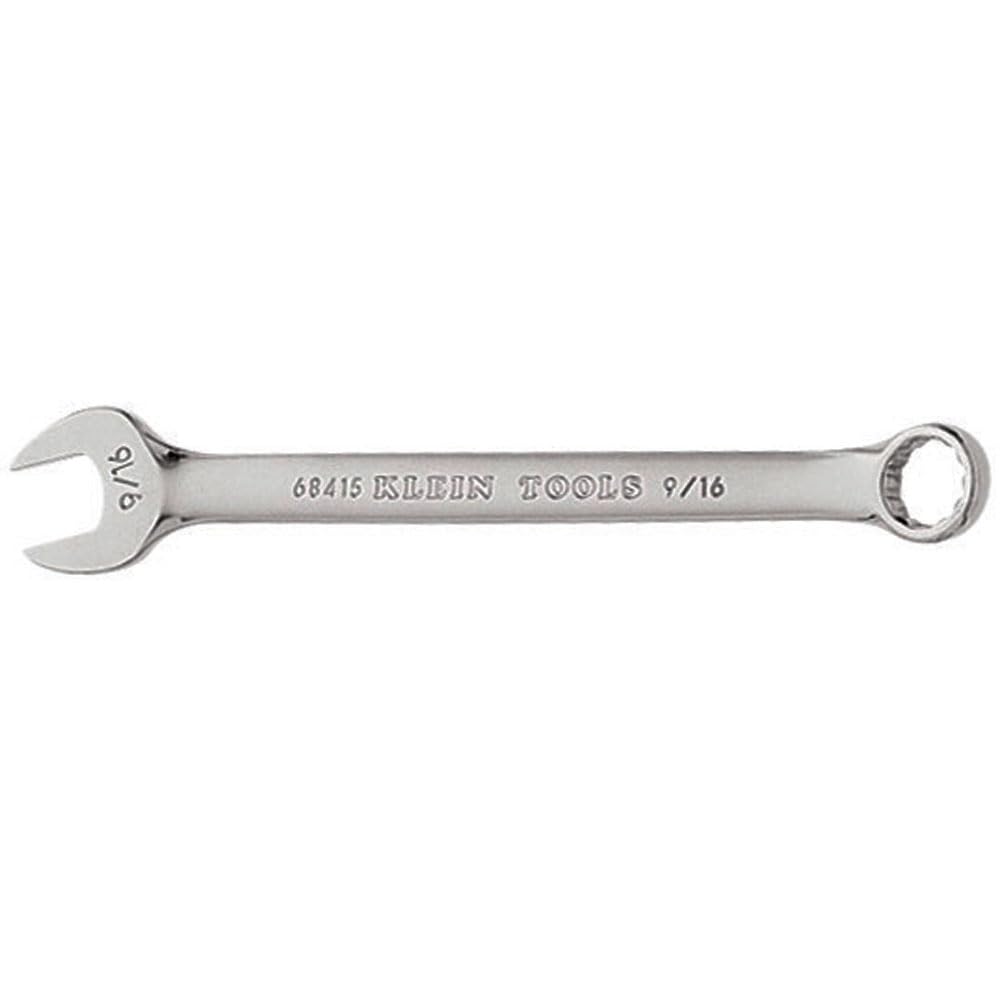
8. Klein Tools 68415 Combination Wrench
A no-nonsense forged combination wrench built for the toolbox drawer that gets worked.
Not every job wants a ratchet. This Klein is a straight combination wrench with matching-size open and box ends, forged from alloy steel, and it handles the plain turn-it-now duty that a ratchet can feel fussy for. It is a 7.5-inch tool stamped with a 12-point, 9/16-inch opening, so it sits in a compact pocket of a technician’s bag.
Both ends are offset at 15 degrees — the open end for confined working areas, the box end for clearance over obstructions. That double offset is the detail that saves your knuckles when the bolt is close to a bracket. Forged alloy steel with a nickel chrome plate and a brushed finish gives it corrosion resistance without the showroom shine.
This is the smallest-footprint pick here, aimed at the buyer who wants a solid forged wrench rather than a ratchet mechanism to rely on. The honest limit is that a fixed, non-ratcheting head means every quarter-turn is a lift-and-reset. If that wear on your wrist matters, look to the ratcheting picks above — but if you want a plain, tough forged wrench, this is squarely it.
What you are paying for: a forged alloy steel combination wrench with 15-degree offsets on both ends and a compact 7.5-inch reach.
The trade: no ratcheting mechanism, so repeated small turns cost a lift and reset every time.
Choose it for: a simple, tough forged combination wrench that lives comfortably in a small tool pouch.
Choose a ratchet instead if: you do many short turns and want the head to catch on its own.
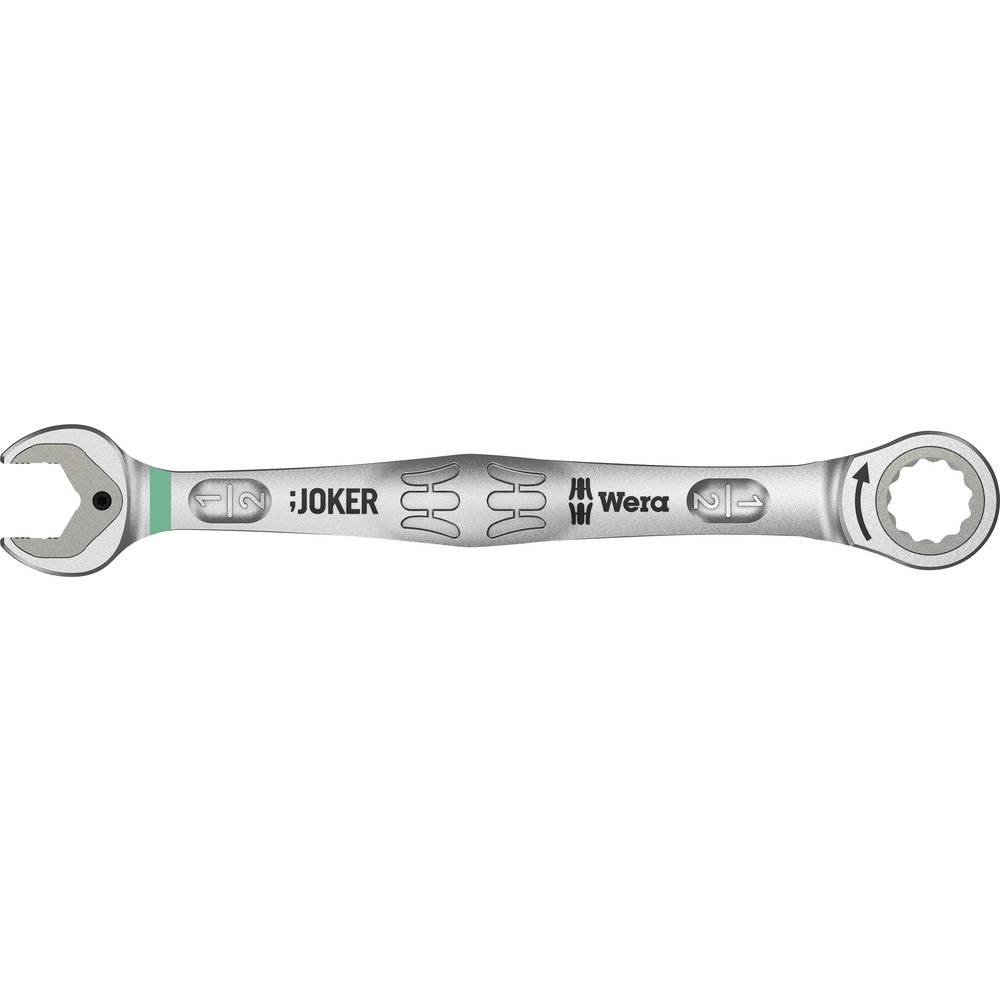
9. Wera 05073284001 Joker SB Ratcheting Wrench
A premium 80-tooth Joker with a fastener-hold function and serious torque transmission.
The Joker’s open end has a fastener hold function and a depth stop that keeps the open end securely seated on a fastener — an elegant way to stop the wrench slipping off while you are working blind. High torque transmission makes it a strong pick for tough unions, the kind of part a high-torque pipe union demands. It is a 9-inch tool, the longest here, so leverage is plentiful.
Inside the ring end is an ultra fine, very strong 80-tooth ratchet with a very small return angle of 29 — a fine-geared mechanism that takes tiny bites as you rotate. The 0.12 kg build is the lightest premium offering on this list. A brushed silver finish rounds out a tool that looks as serious as it performs.
What owners value most is the quality of the fine-toothed ratcheting end, and durability holds up under field conditions. Two honest notes: the value conversation is split — some find it worth it, others call it pricey — so buy it for the engineering, not the bargain. And the ratchet end runs large, with fit mentioned as too bulky for some hands. It is a 4.5+ star tool across hundreds of ratings, and it costs you precision bulk for its strength.
Where it shines: an 80-tooth ring ratchet with a 29 return angle, plus an open end that holds the fastener with a depth stop.
The compromise: the ratchet end is on the large side, so it may feel bulky in smaller hands and in very tight pockets.
Right for you if: you value a finely-toothed premium ratchet and the open-end hold function, and you want top-tier engineering in your kit.
Consider the value picks if: a bulkier ratchet head or a premium cost does not sit right with your setup.
Know the Specs
Swing Arc in Degrees
Swing arc is the smallest motion the ratchet needs to grab the next tooth, measured in degrees. A smaller arc lets you work where the handle has very little room to travel — a 3-degree arc is tighter than a 5-degree one, which in turn beats a coarser head. This is the number that decides whether a wrench works in a cramped engine bay. If your bolts sit in the open, a coarser head with a larger arc works fine.
Tooth Count
Tooth count is how many steps the ratchet completes around the circle. More teeth means shorter steps and a smoother feel in your hand. A 72-tooth head is a common everyday standard, a 90-tooth head is finer, and a 120-tooth head is the finest here. Higher tooth count pairs with a smaller swing arc, which is why tight-space work favors a high-tooth head.
Point Count and Fastener Fit
Point count describes the shape of the box end: a 12-point end grips 12-point, 6-point and square fasteners, making it more versatile than a 6-point-only head. The trade is a slightly smaller contact area per point. A 12-point box end is the flexible choice for mixed hardware.
Pattern Length and Offset
Pattern length is how long the handle runs — a long-pattern wrench reaches bolts a standard-length one cannot, at the cost of a bulkier tool. An offset angle, typically 15 degrees on the box end, tilts the head up to clear your knuckles and the surrounding metal. Reach and clearance matter whenever the bolt is buried or boxed in.
Common Questions
Will a 9/16-inch wrench fit a 14mm bolt?
What does swing arc mean on a ratcheting wrench?
Is a 12-point box end worse than a 6-point?
What is the difference between a combination wrench and a ratcheting wrench?
Do I need a flex head or a fixed head?
Will a long-pattern wrench round bolts more easily?
What material should a 9/16-inch wrench be made of?
How do I keep a ratcheting wrench from rusting?
Is a reversible ratchet worth having over a fixed one?
What length wrench do I need for tight engine-bay work?
The Bottom Line
The strongest all-round choice for the 9/16″ wrench job is the GEARWRENCH 86946, because its 90-tooth ratchet and off-corner loading cover everyday home and auto work without a weak spot you will hit often. If confined space is the real problem, the Capri Tools 120-tooth XL goes finer with a 3-degree arc and real long-pattern reach. And when a blocked bolt demands an angled approach, the Jaeger flex head with its 180-degree tilting box end earns its place in the bag. One last nudge: if you want one tool you can trust for years, the GEARWRENCH’s proven quality and 4.5+ star standing make it the safest first buy here.
How we choose
We do not accept paid placement. Every pick is matched to a real buyer and a real use-case; we do not hands-on test units.
Sources
Specifications: manufacturer listings and product documentation. Review insights: verified customer reviews, as of November 2026. Pricing: not shown on this page (it changes often); check the current price via the retailer link.
As an Amazon Associate, Tactical Gear Guy earns from qualifying purchases. This does not affect which products we feature.