Specs are compiled from manufacturer listings and verified buyer reviews and can change over time — please confirm the key details on the product page before buying.
Your voice is the product on every call, and a headset that lets a barking dog or a typing keyboard leak into the microphone quietly costs you credibility. The fix is not the most expensive model on the shelf — it is the one whose microphone actually separates your voice from the room. Below are nine work headsets with mics that each solve a different version of that problem, sorted by what they do best rather than by what they cost.
This guide is built by comparing the manufacturers’ published specifications and the patterns across verified customer reviews, so you get each pick’s real strengths and trade-offs instead of marketing spin.
Some headsets here clamp onto your head for eight hours and never complain, while others trade a little comfort for a microphone that shuts out the world. Either way, the goal is the same: you speak once and the other end hears you the first time, which is what the right work headset with mic delivers.
Top Picks


How To Choose The Best Work Headset with Mic
Start with the microphone, not the speakers. On a work call the person on the other end hears your mic, not your music, so a noise-canceling boom that sits near your mouth does more for your professional image than a bigger driver ever will. Everything else — comfort, battery, connection — is built around that one part.
Wired or wireless: which one survives your day
A wired USB headset draws power from the port, so it never needs charging and never drops a call — ideal for a fixed desk and back-to-back meetings. A wireless model buys you freedom to walk to the printer or the truck cab, but you are now responsible for charging it. Match the connection to how much you move.
Boom mic placement and noise rejection
A boom mic is the arm that reaches toward your mouth, and the closer it sits, the less room noise it picks up. Rotatable booms let you angle the mic exactly where your voice is loudest. Some headsets also mute by flipping the boom up, which is faster than hunting for a button mid-sentence.
One ear or two: the open-office decision
You stay reachable in the room with a monaural headset (one ear covered, the other open), so you still hear a colleague walk up or a phone ring on the desk. A stereo headset covers both ears for deeper focus and fuller sound. Pick based on if you need to stay reachable in the room or shut the room out.
Side-by-Side Comparison
| Model | Best For | Connection | Talk Time / Power | Driver Size | Amazon |
|---|---|---|---|---|---|
| BlueParrott B450-XT★ Best Overall | High-noise jobs on the move | Bluetooth 5 | 24 hours | 36 mm | Amazon |
| Poly Blackwire 3220Best Value | Fixed-desk stereo calls | Wired USB-C / USB-A | Bus-powered | 40 mm | Amazon |
| Jabra Evolve 20Long-Meeting Pick | Long meetings, low weight | Wired USB-A / USB-C | Bus-powered | 28 mm | Amazon |
| Poly Blackwire 3210 USB | Dictation and single-ear desk work | Wired USB-C / USB-A | Bus-powered | — | Amazon |
| OTYHVV Wireless Headset | All-day wireless with a dock | Bluetooth 5.2 + USB dongle | Up to 40 hours | 40 mm | Amazon |
| Lenovo Wireless VoIP | Teams-certified hybrid work | Bluetooth 5.3 + USB-A receiver | 31 hours talk | — | Amazon |
| Yealink UH37 | Call-center wired Teams calls | Wired USB-C / USB-A | Bus-powered | 32 mm | Amazon |
| Jabra Evolve2 65 Flex | Travel and hybrid portability | Bluetooth 5.2 + dongle | 20 hours | — | Amazon |
Detailed Reviews
1. BlueParrott B450-XT Bluetooth Headset
Our pick — 4.5+★ from 9,000+ verified ratings; the strongest balance of quality and price.
The trucker headset that turns a roaring cab into a quiet phone booth
If your call happens somewhere loud — a moving cab, a mower, a loading dock — the number to care about is the claim that this mic blocks out an industry-leading 96% of noise. That means the person on the other end mostly hears you and not the engine. It is the whole reason this model sits at the top of the list.
You get 24 hours of talk time on a charge, which is several long shifts without a cable. Charging runs through USB-C in about 3 hours, so one cable can cover your phone and headset together. The Class 1 Bluetooth (the long-range version of the radio standard) holds a connection up to 300 feet or 100 meters from your paired device — far enough to leave the phone on a desk and walk the whole floor.
Comfort is the honest split here. The thick padded headband and large cushioned earcup are built for hours on the road, and the box includes both a leatherette and a foam ear cushion so you can swap the feel. What wins people over is the build and the sound: quality is the most-discussed thing about this headset by a wide margin, and the noise cancellation lands right behind it. The trade-off is size and weight on a small ear during very long days, plus the occasional report of a unit giving out early. Sized honestly: most people are happy, and the few who are not usually wanted something lighter.
The IP54 rating means it shrugs off dust and splashes, which is why it keeps showing up on dashboards and in workshops. If you sit at one desk all day, a wired model lower down this list never needs charging. If you are mobile and loud, this is the one.
What earns the top spot
- The mic claims to block 96% of ambient noise, so your voice arrives clean from a noisy cab or job site
- 24 hours of talk time means days between charges
- 300 feet or 100 meters of Bluetooth range frees you from the desk
- IP54 protection against dust and moisture suits outdoor and vehicle work
Where it asks patience
- A full 3 hours to charge, so plan a top-up window
- The mono build and padded headband feel heavy on a small head across very long shifts
- A minority of units stop working early — treat the cable and hinge with care
Made for: drivers, farmers, landscapers, and anyone taking calls where the room is the enemy.
Look past it if: you sit at one desk all day and would rather never think about a battery.
2. Poly Blackwire 3220 Wired Headset with Mic
Big 40 mm drivers and a plug-in cord that never asks for a charge
Plug the USB-C cord into your laptop and you are on the call — no pairing, no charging, no battery percentage to watch. The cord ends in USB-C and includes a tethered USB-A adapter, so it fits whichever port your machine actually has. For a fixed desk, that simplicity is worth more than any wireless feature.
Inside sit 40 mm dynamic drivers (the round speakers that produce the sound), the largest on this list. That is 40 millimeters versus 28 millimeters in the Jabra Evolve 20 below — a real gap in speaker surface that shows up as fuller stereo audio when you switch from calls to music. The noise-canceling boom mic and conforming ear cushions add passive isolation, and the Dynamic EQ feature adjusts tone so your voice sounds natural on calls.
What buyers keep coming back to is that it simply works for work calls, with noise cancellation right behind. The honest catch is long-term reliability: some units hold up for years, others stop sooner than you would like, so treat the cord and headband gently. The over-ear cushions also seal in heat during a long afternoon, which is the price of that isolation.
What stands out: the 40 mm drivers out-size the 28 mm set in the Jabra Evolve 20, so stereo sound and music listening get more body for the same plug-and-play ease.
The real trade-off: this is a desk headset — the cord ties you to the machine, and reliability past the first year is the one thing that splits opinions.
Best fit: a hybrid worker with a dedicated desk who wants stereo sound and zero battery admin.
Pass if: you need to walk around during calls or take them from a moving vehicle.
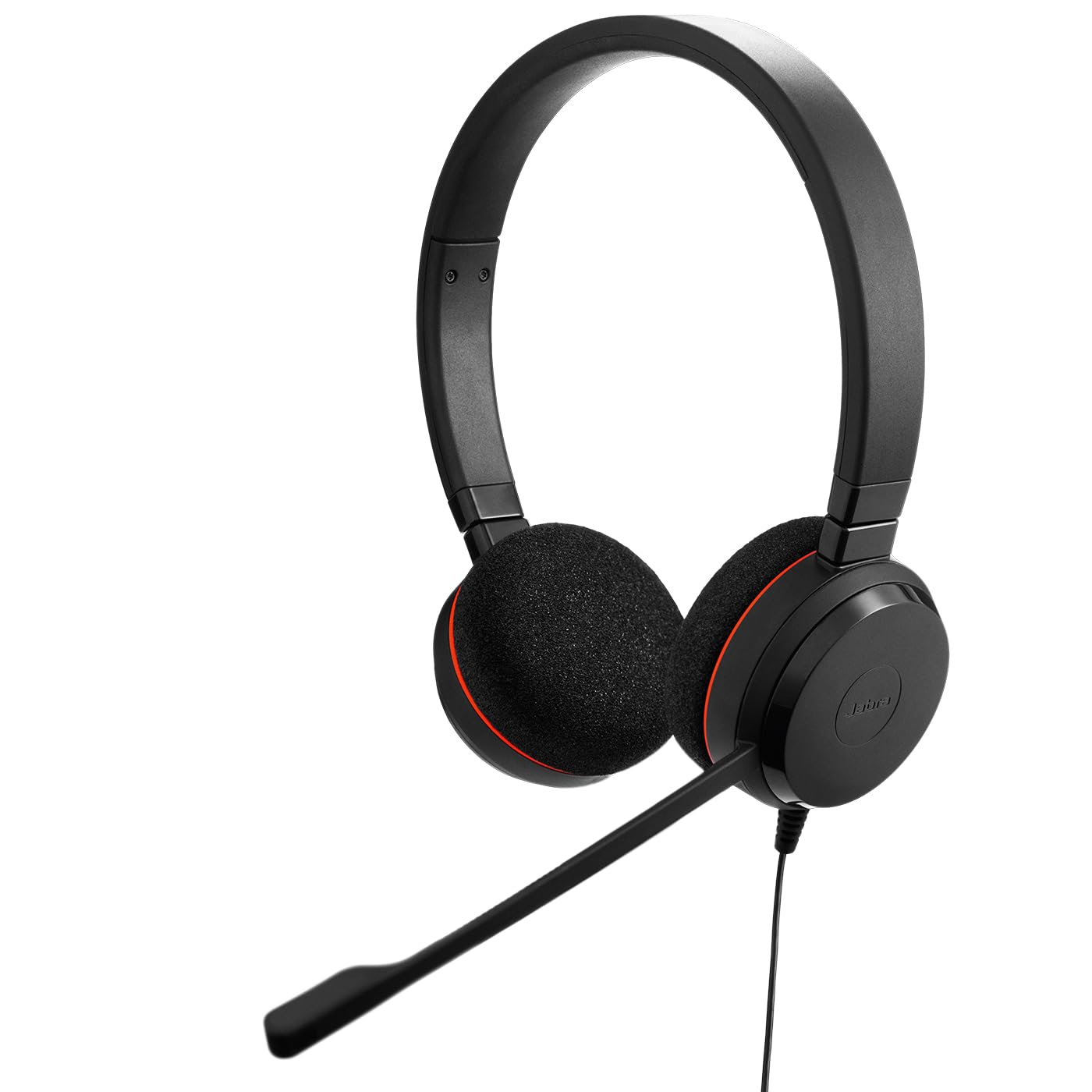
3. Jabra Evolve 20 Wired USB Headset
Certified for the big platforms and built to sit light for hours
Some employers will only sign off on a headset that carries a platform certification, and this one is certified for Avaya and Cisco while working with all the leading meeting platforms. That matters if you are buying for a team or a locked-down corporate laptop. Setup is just a USB-A or USB-C plug, then the call and volume buttons are right there.
The 28 mm speakers are the smallest here — 28 millimeters versus the 40 millimeters in the Poly Blackwire 3220 above — so music gets less body and the sound profile leans toward speech. What you give up in audio size you get back in weight: the lightweight frame with a choice of foam or leatherette ear cushions is designed to sit on your head through a long meeting block without pressing.
Comfort is the headline among the things people talk about, and the dual-ear design carries long call after long call. The recurring question is mic noise cancellation, which lands as decent rather than total — great for a quiet home office, less convincing against a busy call center. Connectivity with all the major platforms is the other quiet win.
The comfort angle: foam or leatherette cushions plus a light frame mean long meetings feel like less of an event.
The honest limit: 28 mm drivers trail the Poly 3220’s 40 mm for music, and the mic softens background noise rather than eliminating it.
Your headset if: you need a certified, platform-friendly wired set for long meeting days.
Think twice if: you split the day between calls and music and want speaker size to carry both.
4. Poly Blackwire 3210 Wired USB Headset

The single-ear set that reads your voice into medical software without a hitch
This wired single-ear model keeps turning up in clinical and dictation workflows, and for good reason — it is reported to work cleanly with Dragon medical software, which is the kind of thing that makes or breaks a documentation-heavy day. It connects over USB-C or USB-A through the included adapter, so it drops onto most desktops and laptops.
You get the same Dynamic EQ voice tuning and inline call and volume controls as its Poly sibling, plus the metal headband that bends instead of snapping. The monaural build keeps one ear free so you can still hear a colleague or a patient. It is a listening-capable headset too, not just a call device, and it handles both.
Reliability is the part that people praise, and clarity is right behind it, which fits a headset used for spoken-word work rather than music. The lean spot is durability across a heavy schedule and the mic’s modest noise rejection, so plan for the occasional replacement if you lean on it hard. For desk-based voice work, that is a fair trade.
Where it shines: clean, clear voice capture for dictation and documentation, with a single-ear design that keeps you present.
Where it gives: durability over a tough schedule and mic noise rejection are both moderate, not built for a factory floor.
Suited to: clinicians, doc-writers, and single-ear desk workers who live in voice software.
Not for: loud shared spaces where the mic has to fight the room.
5. OTYHVV Wireless Headset with Mic for Work
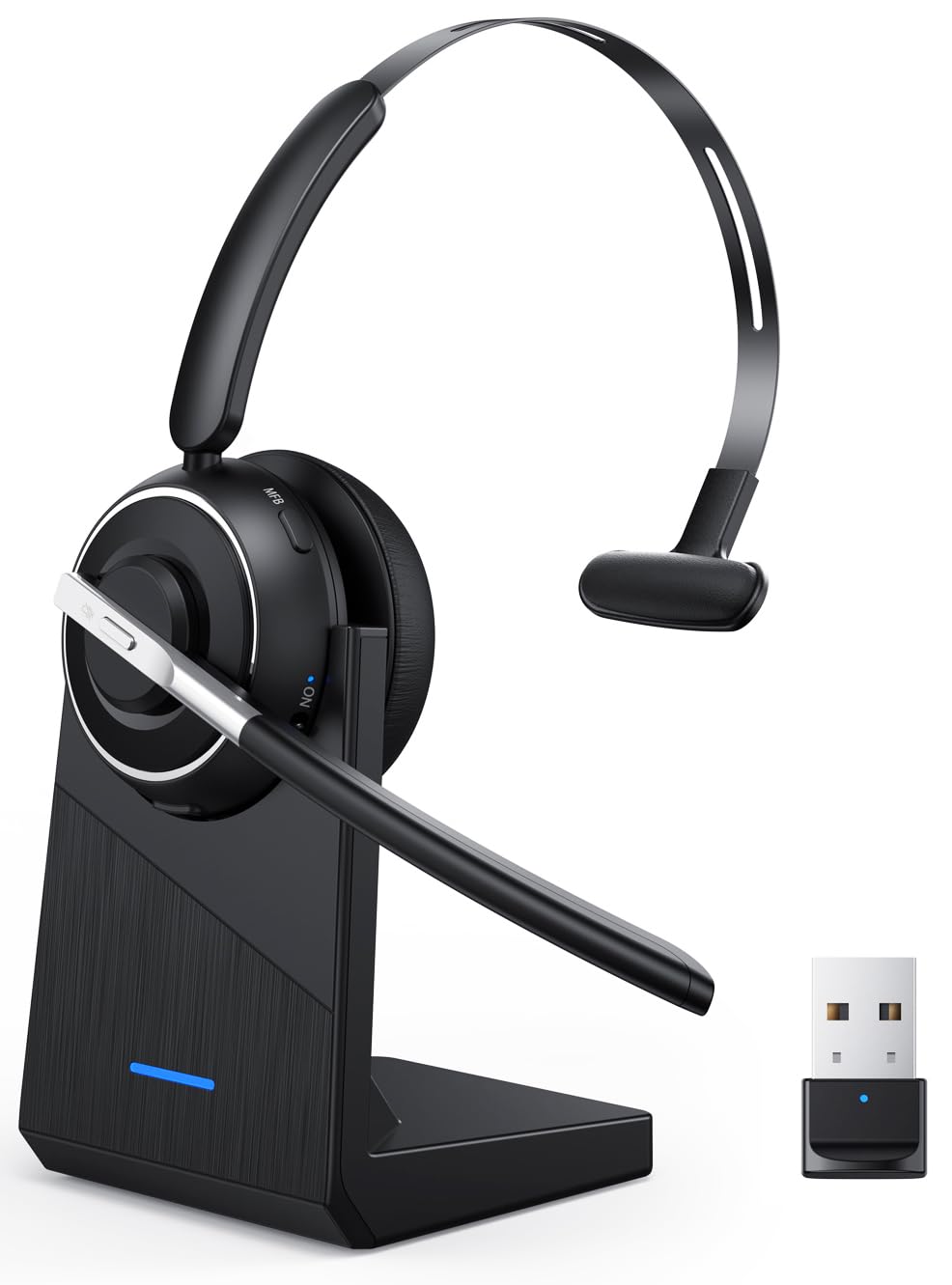
Five eight-hour shifts on one charge, with a dock to park it on
Forty hours of talk time is the headline, and it means roughly a workweek of shifts before you reach for a cable. When you do, a 2-hour recharge brings it back, and the charging stand keeps it topped up and the desk tidy between calls. For anyone who has watched a wireless headset die mid-meeting, that is the whole pitch.
The microphone rotates 270 degrees so you can aim the boom where your voice sits, and the maker claims it blocks 99.99% of background noise — dogs, keyboards, office chatter. Voice prompts announce “mute on” and “mute off” when you tap the side button, so you never wonder if you are live. The included USB dongle gives plug-and-play to a computer even if it has no Bluetooth, and the dock has a slot to store it.
Bluetooth 5.2 handles the wireless side, and a physical on/off toggle reconnects to your last device when you flip it. A 40 mm driver and 180 milliseconds of audio latency round out the spec sheet. The honest catch is that these are maker claims on a newer brand, so the guarantees you get from a legacy headset brand are thinner here — but the feature list is genuinely generous for the money.
Why it earns a spot
- Up to 40 hours of talk time with a 2-hour recharge
- 270-degree boom mic with spoken mute alerts
- USB dongle works on computers without Bluetooth
- Charging dock stores the dongle and keeps it ready
What to keep in mind
- Newer brand, so long-term support is a question mark
- Noise-rejection figures are maker claims, not third-party tested
Pick this for: all-day wireless calls where charging mid-shift is not an option.
Reconsider if: you want a long track record behind the brand before you commit.
6. Lenovo Wireless VoIP Headset

Certified for Teams, light enough to forget, and built to switch between two devices
If your workday lives inside Microsoft Teams, this headset carries the Teams open-office certification and is tune for UC platforms, which means fewer surprises when you join a meeting. A USB-A receiver handles the Teams functions, so keep it handy if that is your setup. Multipoint over Bluetooth 5.3 lets you stay connected to your laptop and your phone at the same time.
At 140 grams it stays light on your head, and adjustable memory foam earcups with a flexible headband are there for long sessions. Three-mic noise suppression works to drop background distractions so your voice comes through clean. The numbers on endurance are strong: up to 31 hours of talk time or 60 hours of music playback on a single charge.
Sound quality is the thing people rave about here, with noise cancellation close behind, and it holds up well for Teams meetings and daily calls. The note that recurs is Bluetooth connection stability — occasional drop-outs are the one knock — and durability over a long deployment is worth watching. For a hybrid worker whose life is Teams, the trade-offs land in the right place.
What makes it click: Teams certification plus up to 31 hours of talk time, so you join meetings without fiddling and last the week.
The caveat to know: Bluetooth stability is the recurring complaint, so keep the USB-A receiver as your backup path.
Right call for: a Teams-heavy hybrid worker who wants certified, lightweight wireless.
Maybe not if: you need bulletproof connection reliability above all else and plan to run on Bluetooth only.
7. Yealink UH37 USB Headset

Dual mics and a flip-to-mute boom for people who talk for a living
This is a wired headset aimed squarely at call centers and high-volume calling, and the microphone is the reason. Two noise-canceling microphones work together to keep your voice clean on Teams and Zoom, and the boom itself flips to mute the moment you need privacy — faster than finding a button when a call turns sensitive.
You get both USB-C and USB-A connection options, so it fits desktops, laptops, and mobile devices without an adapter hunt. The ear cups are soft breathable leather on a flexible metal headband that is meant to hold up to all-day wear. On-ear-shell controls handle calls and volume, and one touch can bring up Microsoft Teams directly.
Clarity is what people notice — being able to hear yourself well during calls — and the noise cancellation earns real praise for shutting out background sounds, right down to a cat meowing loudly. It plays nicely with Zoom and Teams, and it is considered worth the money. In a call center that is about as good a report card as a wired headset gets.
The case for it
- Dual noise-canceling mics keep your voice clean on Teams and Zoom
- Flip-to-mute boom gives instant privacy
- USB-C and USB-A both supported from the start
- Breathable leather cups and metal headband for long shifts
The fine print
- Wired only — you are tied to the desk during calls
- It is a calling tool, not a music-first headset
The pick for you if: you are on calls all day and want the mic to do the heavy lifting.
Look elsewhere if: you need to roam during calls or want full-fidelity music.
8. Jabra Evolve2 65 Flex Wireless Stereo Headset

Folds at a twist of an earcup, cancels the café, survives the commute
For the person who works from a train seat as often as a desk, the trick here is that the earcups fold together at the twist of one cup and slip into the included pouch. That is portability you can actually use, not a headset that lives permanently on a stand.
The noise-canceling side is layered: noise-canceling microphones work on what the other end hears, while hybrid active noise cancellation (ANC — electronics that mute the room for you) handles what reaches your ears. It is certified for Google Meet, Microsoft Teams, and Zoom, and connects over the USB dongle or Bluetooth 5.2 in minutes, with range up to 30 meters. Battery runs 20 hours and recharges in 2 hours. Super-soft foam fills the cushioned headband, and the rotating earcups rest on your ears without the clamping feeling.
The noise cancellation earns real praise, and the ability to hear-through when you need to is a favorite. The honest catch is connection stability — most report no trouble, but frequent Bluetooth drop-outs are the recurring complaint, and the mic on a call is only as good as that link. If you travel and want one headset to fold into a bag, this earns its premium standing.
Why travelers like it: folding earcups and a pouch turn a full stereo headset into something that lives in your bag.
What to watch: Bluetooth drop-outs are the recurring gripe — keep the dongle handy for a stable link.
Best for: hybrid and traveling workers who need a foldable, certified stereo headset.
Not ideal if: you sit at one desk and would rather a wired set never drop a call.
Know the Specs
Noise-canceling boom mic
A boom mic is the arm that reaches toward your mouth, and “noise-canceling” means it is tuned to favor the voice right in front of it over the room behind it. Getting the mic close to your mouth matters more than any single number on the box, because distance is what lets background noise sneak in. Some headsets mute by flipping that boom up, which is the fastest privacy switch you can get mid-call.
Talk time and charging
Talk time is measured in hours of active calling on one charge, and it tells you how many shifts you get before hunting for a cable. A long charge time works against you if you forget to plug in overnight, so check how fast it refills. Wired USB headsets skip this entirely — they draw power from the port, so they never need charging but do tie you to the machine.
Driver size in millimeters
The driver is the small speaker inside each ear cup, and its size is measured across in millimeters. Larger drivers usually mean fuller, more room-filling sound, which matters when you switch from calls to music. Bigger is not automatically better for speech, though — a smaller, tuned driver can keep voices crisp while staying light on your head.
Bluetooth version and range
The Bluetooth number tells you the generation of the wireless radio standard, and higher versions generally add stability and efficiency. Range, measured in feet or meters, is how far you can walk from the paired device before the audio drops. A long range lets you leave the phone on a desk and move around, while a shorter one suits a fixed room.
Common Questions
Will a USB headset work on a laptop that only has USB-C ports?
Is a wired or wireless work headset better for all-day calls?
How does a flip-to-mute boom help during a call?
What does an IP54 rating actually protect against?
Can a wireless headset connect to both my laptop and my phone at once?
What is the difference between monaural and stereo headsets?
How long does the battery really last on a wireless headset?
Do noise-canceling mics also block noise for me or just for the caller?
Will a Work Headset with Mic work with Microsoft Teams and Zoom?
Can I use a work headset for music as well as calls?
The Bottom Line
For most people who take calls in a loud place, the winner is the BlueParrott B450-XT, because that 96%-blocking mic and 24 hours of talk time mean your voice arrives clean and your charge lasts several shifts. If you sit at one desk and want stereo sound without a battery, grab the Poly Blackwire 3220 and let its 40 mm drivers carry the load. And when your day is certified for Teams on the move, the Lenovo Wireless VoIP is the one to reach for.
Start with the microphone, then match the connection to how much you move. The top pick carries 4.5+ stars from 9,000+ owners, and that consistency is the strongest signal in this category.
How we choose
We do not accept paid placement. Every pick is matched to a real buyer and a real use-case; we do not hands-on test units.
Sources
Specifications: manufacturer listings and product documentation. Review insights: verified customer reviews, as of November 2026. Pricing: not shown on this page (it changes often); check the current price via the retailer link.
As an Amazon Associate, Tactical Gear Guy earns from qualifying purchases. This does not affect which products we feature.