Specs are compiled from manufacturer listings and verified buyer reviews and can change over time — please confirm the key details on the product page before buying.
Goldfinches care about two things: a comfortable perch and fresh seed. Get those wrong and your feeder sits empty all season. We picked the feeders below on what actually brings yellow finches in: how many ports and perches they have, drainage that keeps Nyjer (the tiny black thistle seed goldfinches eat) from clumping, and mesh small enough to hold thistle seed but open enough for birds to cling. Short answer: start with the Veehoo mesh tube.
This guide is built by comparing the manufacturers’ published specifications and the patterns across verified customer reviews, so you get each pick’s real strengths and trade-offs instead of marketing spin.
Nyjer seed is expensive and it spoils fast when water gets in, so a feeder’s drainage and lid matter as much as its port count. Below you’ll find the ports, perches, capacities, and materials laid out clearly, plus the honest weak spot on each. These are the Yellow Finch Bird Feeders worth hanging where you can actually watch them.
Top Picks
How To Choose The Best Yellow Finch Bird Feeders
A finch feeder is not a generic bird feeder with a yellow coat of paint. Goldfinches and house finches are clinging birds — they hang sideways off a surface rather than standing on a flat platform. That one fact reshapes everything: the landing surface, the port size, and what counts as a good perch. Here is what actually decides whether your feeder stays busy or stays empty.
Match the opening to the seed, not the bird
Nyjer and thistle seed are tiny, so the feeder has to hold them without letting them pour out. Mesh feeders solve this with a fine wire grid — the Gtongoko, for example, uses 0.24-inch mesh openings. Tube feeders solve it with narrow feeding ports. When those ports or holes run small, tiny seed stays put but filling gets fiddly. When they run wide, seed spills on the ground. It is a genuine trade-off, not a flaw you can shop your way out of.
Count the perches and the ports together
A feeder with many ports and few perches will still only host a couple of birds at a time. Look for the two numbers to line up: the iBorn pairs 12 small ports with 8 metal perches, the Kingsyard tube runs 6 ports with 1.5-inch perches, and the Stokes Select lists eight perches. More perches mean more finches feeding at once and fewer squabbles at the dinner table.
Drainage is what keeps thistle seed from spoiling
Nyjer goes mouldy fast when water sits in the base, and mouldy seed is the fastest way to lose a flock. A feeder with drainage holes at the base — the Veehoo, iBorn, Kingsyard tube, and Gtongoko all list them — sheds rain before it reaches the seed. A lid or roof that overhangs the ports adds a second layer of protection.
Think about who is chewing on it
Squirrels and raccoons treat a finch feeder as a buffet. All-metal bodies and powder-coated finishes make the job harder for them — the Veehoo, iBorn, Gtongoko, and Kingsyard tube all list metal construction, and the Kingsyard mesh uses recycled plastic that the maker says resists denting and cracking. No hanging feeder is truly squirrel-proof, but metal slows the damage and keeps the feeder hanging straight.
Side-by-Side Comparison
| Model | Best For | Seed Capacity | Ports / Perches | Body Material | Amazon |
|---|---|---|---|---|---|
| Veehoo Metal Mesh Finch Feeder★ Best Overall | All-round first finch feeder | — | Mesh surface | Powder-coated metal | Amazon |
| iBorn Nyjer/Thistle Tube FeederMost Feeding Stations | Busy yards, many birds at once | — | 12 ports / 8 perches | Metal | Amazon |
| Gtongoko All Metal Mesh Tube FeederBest Seed Capacity | Larger seed loads, less refilling | 2.5 lb | Mesh surface / tray | All metal | Amazon |
| Kingsyard Metal Finch Feeder (Tube) | Keeping bigger birds off | 2 lb | 6 ports / 1.5″ perches | Metal and plastic | Amazon |
| Stokes Select Topsy Turvy | Tall, easy-to-clean tube | 1.5 lb | 8 perches | Alloy steel, aluminum, PVC | Amazon |
| Woodlink Audubon Die Cast Finch Screen | Set-and-hang, no assembly | 16 oz | Screen tube | Die cast aluminum | Amazon |
| Kingsyard Sliding Mesh Feeder | Big seed loads in a small hang | 3 lb | Mesh surface / built-in perch | Recycled plastic and metal | Amazon |
| Bird Quest SBF2Y Spiral Feeder | Style-first spiral design | 1.5 lb | Spiral surface | Stainless steel | Amazon |
| Aspects 402 Quick-Clean Thistle Tube | Long-haul build quality | 1.25 qt | 8 feeding stations | Die cast metal and polycarbonate | Amazon |
Detailed Reviews
1. Veehoo Tube Bird Feeder
Our pick — 4.5+★ from 200+ verified ratings; the strongest balance of quality and price.
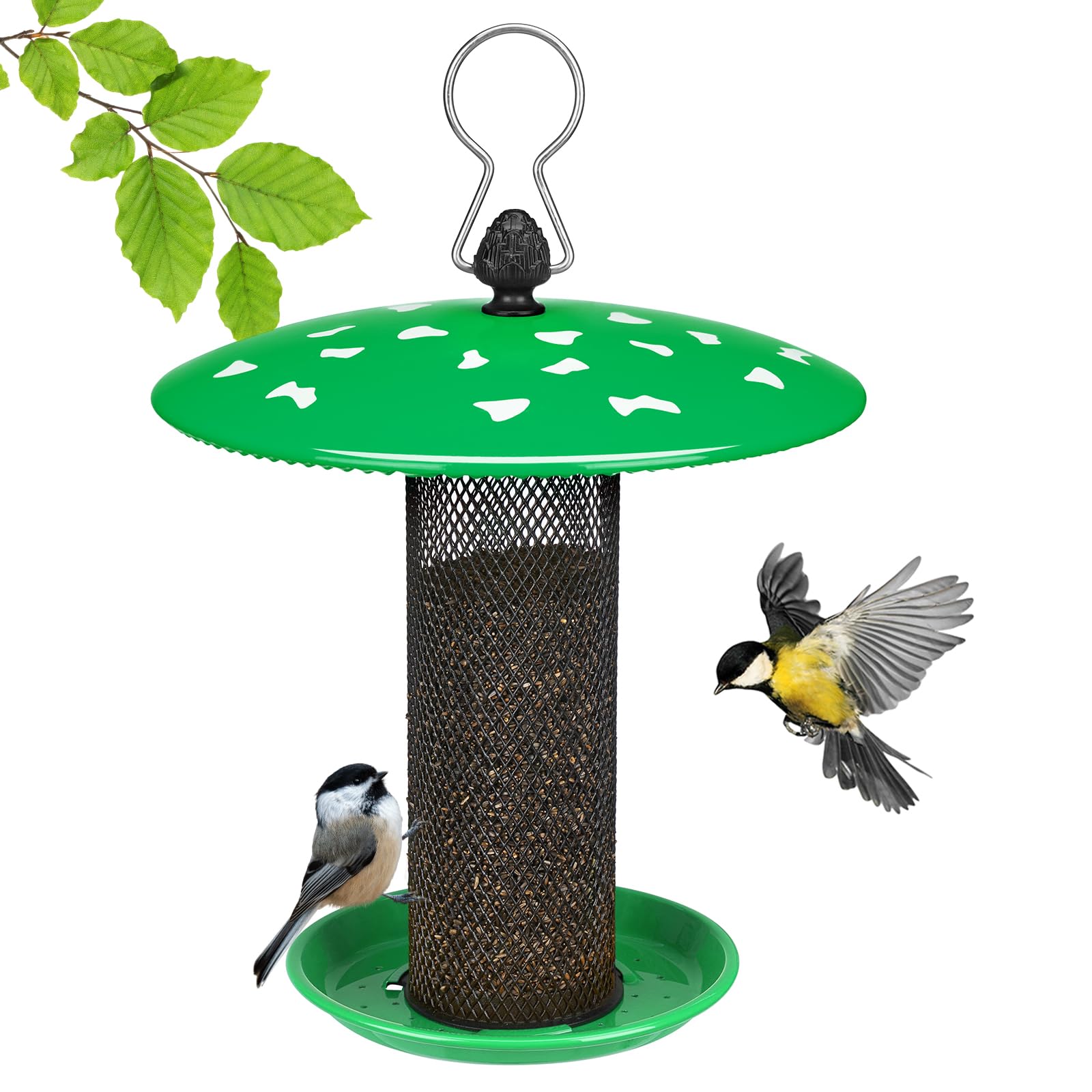
A mushroom roof and a diamond mesh wall, and the finches get a dry place to cling.
The job of a finch feeder is to hold tiny Nyjer seed and give clinging birds somewhere to grip. This Veehoo does both with a powder-coated wire mesh body and a dome-shaped lid that sheds rain off the top. The diamond mesh surface is the key move here — it gives goldfinches, chickadees, and house finches a whole wall to hang from, not two narrow perches. A bottom seed tray adds a landing spot underneath, and it comes with drainage holes to let water run out.
Buyers praise the easy top-fill and the drainage holes in the bottom tray. The feeder’s functionality is the thing that earns the most praise in the review pages, with ease of filling and cleaning close behind. You open the top, pour in nyjer or thistle, and it is done — no separate funnel, no unclipping a base. Powder coating over the metal is the rust defence, which matters when a feeder hangs through a wet autumn and a freezing winter. The all-metal build is also the reason it holds up to squirrel attention better than a plastic tube.
The honest catch is the tube width. Some owners expected a wider body than what arrives, so measure your seed scoop against the opening if you buy nyjer in bulk. The upside is that a narrower mesh keeps the seed where it belongs instead of raining it onto the lawn. It is also small enough to hang off a shepherd’s hook or a balcony bracket and not look like a bird hotel. For a first finch feeder or a second one to spread birds out, this is the cleanest all-round pick on the shelf.
What earns its spot up top
- All-metal powder-coated mesh body resists rust and squirrel chewing
- Mushroom-shaped lid sheds rain away from the seed
- Diamond mesh gives clinging finches a full wall to feed from
- Top opens wide for quick refills, and the bottom tray has drainage holes
What to know before you hang it
- The tube is narrower than some buyers picture from the photos
- Mesh body means seed can trickle out slowly in heavy wind
Go for it: anyone who wants a sturdy mesh feeder that hanging finches can cling to from day one.
Think twice: if you want a wide-mouth hopper for pouring nyjer from a big bag.
2. iBorn Finch Feeder 15 Inch
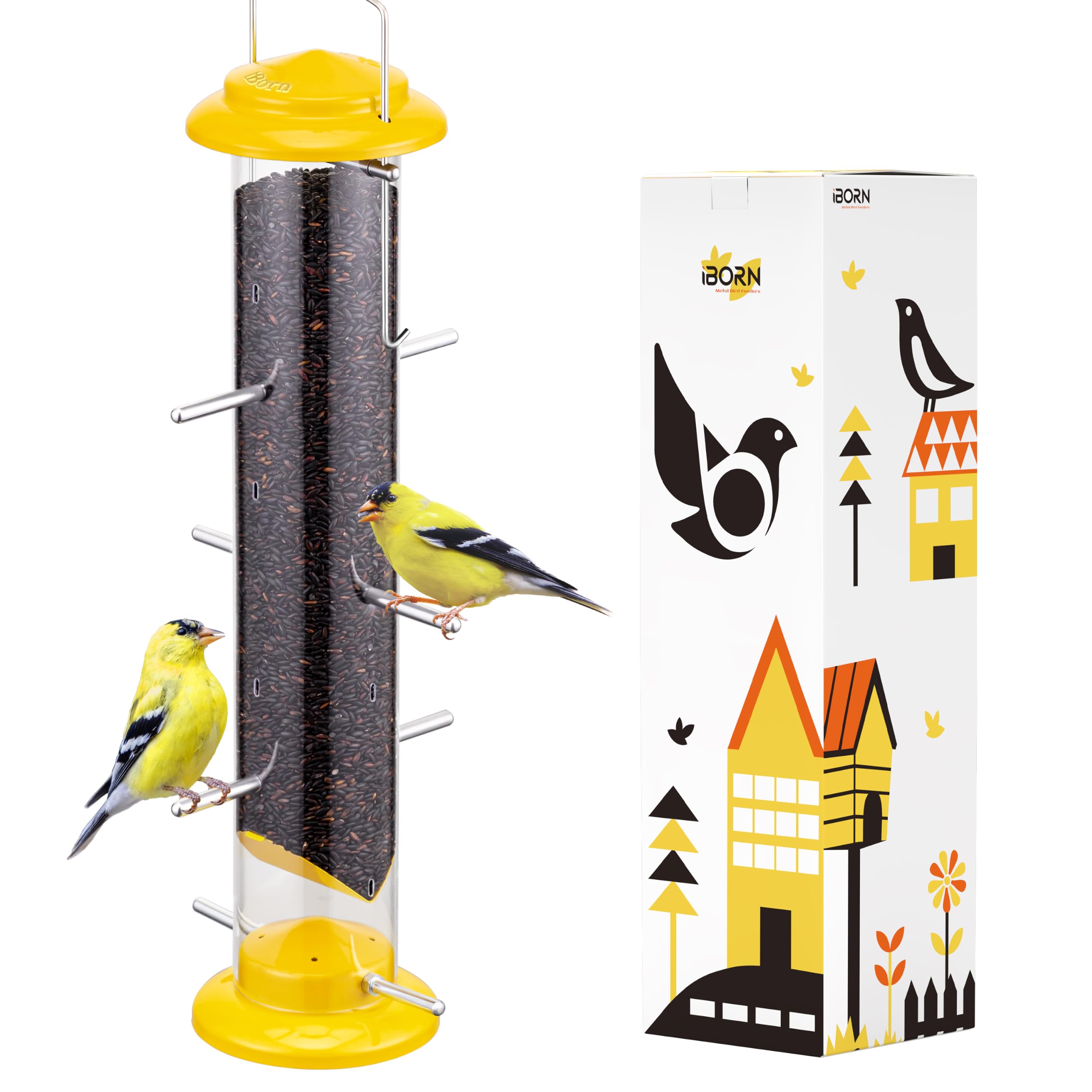
Twelve ports and eight perches — a finch feeding station built for a crowd.
If your goldfinches arrive in numbers, this is the one. The 15-inch tall tube carries 12 small feeding ports and 8 metal perches, so a flock can land and eat at the same time without shoving each other off. The yellow finish stands out against a green shrub, which is half the reason to pick a yellow feeder in the first place. Below the tube, a V-shaped spacer blocks food from piling up at the bottom, and four drainage holes at the base let water escape instead of soaking the seed.
What the review pages confirm again and again is quality and bird traffic — this feeder brings goldfinches, finches, chickadees, redpolls, and siskins, and owners say birds figure out the layout inside a week. The fixed metal hook is another quiet win. It clips onto a branch or pole and stays put, so the feeder does not swing on a windy day and spook the birds; a flimsy string would do exactly the opposite. The lift-lid and clear seed tube mean you can see when levels drop without unlatching anything.
Now for the trade you are making. The ports run small, and that is by design — thistle seed is minuscule and you do not want it pouring onto the grass. But small ports and longer seed mean filling takes a little patience. Pour slowly and you will not spill. The upside is real: the review pages note that seed stays in the feeder rather than raining onto the patio, and finches return once they have learned the routine. For a busy yard this is the most generous finch feeder in the group.
The crowd-pleaser: 12 ports and 8 perches is the most feeding capacity here, and the metal hook fights wind swing better than the string hangers on cheaper feeders.
Best if you feed a lot of birds: the port count and perch count are the highest in this lineup.
Look elsewhere if: slow, careful filling is a deal-breaker — the small ports need a steady hand.
3. Gtongoko Finch Feeder Copper
Two and a half pounds of thistle in one hang — fewer refills, less ladder work.
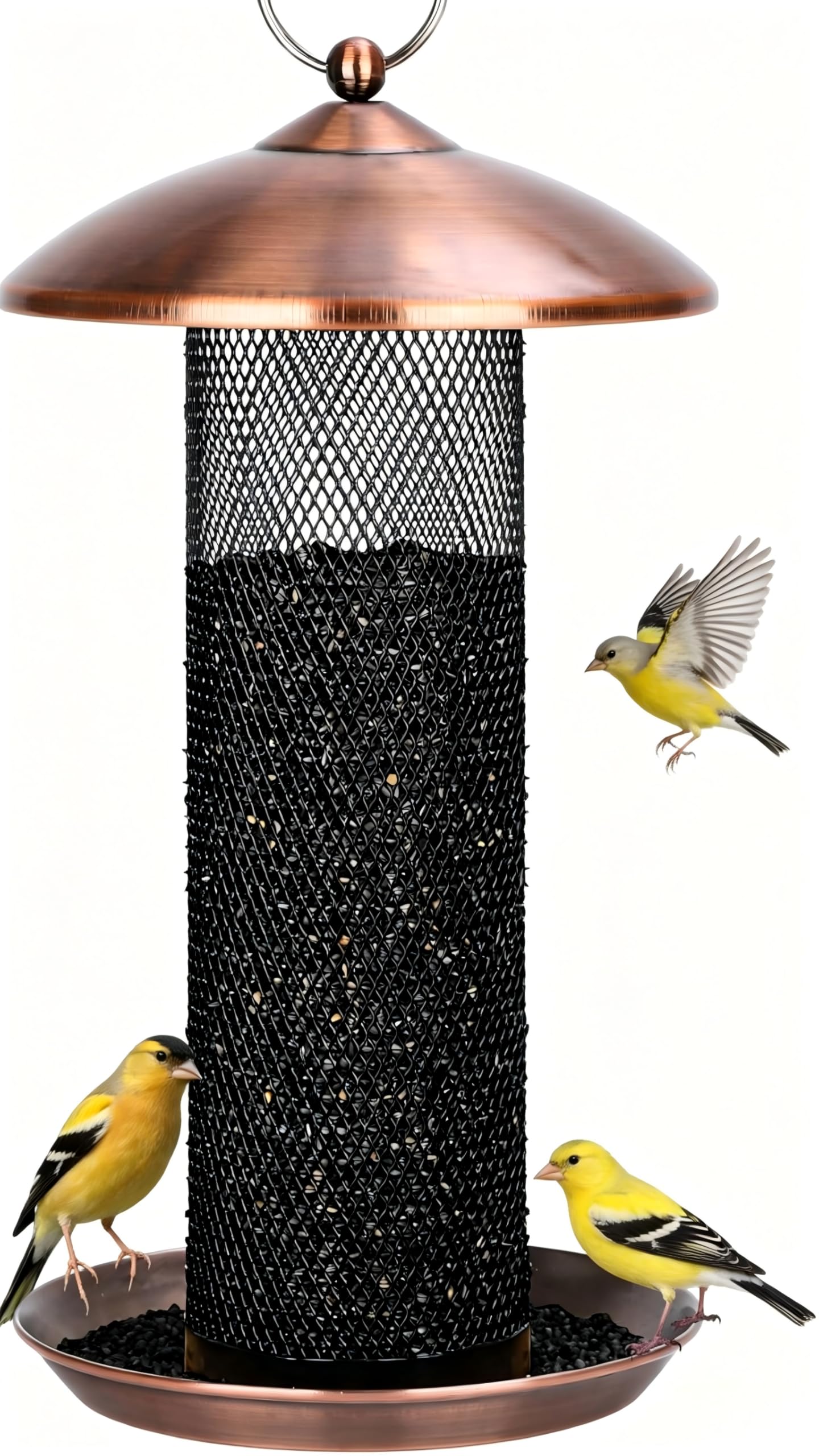
This feeder holds up to 2.5 lbs of seed, the largest capacity of any hanging finch feeder here. That means fewer refills: if you were filling a 1-pound feeder twice a week, this one cuts that to less than half as often. The mesh openings measure 0.24 inches, sized for nyjer and thistle, and the fine grid gives clinging finches a natural grip. A 6-inch weather-resistant lid keeps seed dry, and a matching 6-inch round tray underneath works as both a perch and a landing pad.
The build is all metal through and through — mesh body, lid, tray, and a closed hanging ring rather than an open hook. That closed ring matters in gusts, because it cannot slip off the branch. Refilling is tool-free: the wide opening and removable lid come off quickly, and the detachable tray lifts out for cleaning. Owner feedback on bird traffic here is strong; finches and other small birds find it, and the copper colour draws compliments for how it looks in the garden.
The honest read on durability is mixed in the review pages — some owners praise the sturdy metal, others note the mesh can bend or a feeder can fail after a month. Treat the mesh carefully, especially during cleaning, and avoid swinging it hard onto a post. It also tends to spill seed when knocked, which is the normal cost of a mesh design. If you want the biggest seed reserve and value durability as a fair-weather companion, the Gtongoko gives you the most seed per hang. It is also a bulkier feeder than the Kingsyard tube — the dimensions read 10.23″L x 5.51″W x 5.12″H against the Kingsyard’s 4″L x 15″W x 4″H, so allow a wider mount.
The argument for it
- Holds up to 2.5 lbs of nyjer or thistle seed, the largest load here
- 0.24-inch mesh is fine enough for thistle and grippy enough for clinging finches
- 6-inch lid plus drainage holes keep seed drier in wet weather
- Closed hanging ring stays put in gusty conditions
The honest trade-offs
- Mesh is the first thing to bend — handle it gently when cleaning
- Will spill seed when knocked, which is common with mesh feeders
Pick this for: yards where the seed bucket empties fast and you want fewer trips outside.
Skip if: you expect a feeder to shrug off heavy knocks without careful handling.
4. Kingsyard Metal Finch Feeders for Outdoors Hanging
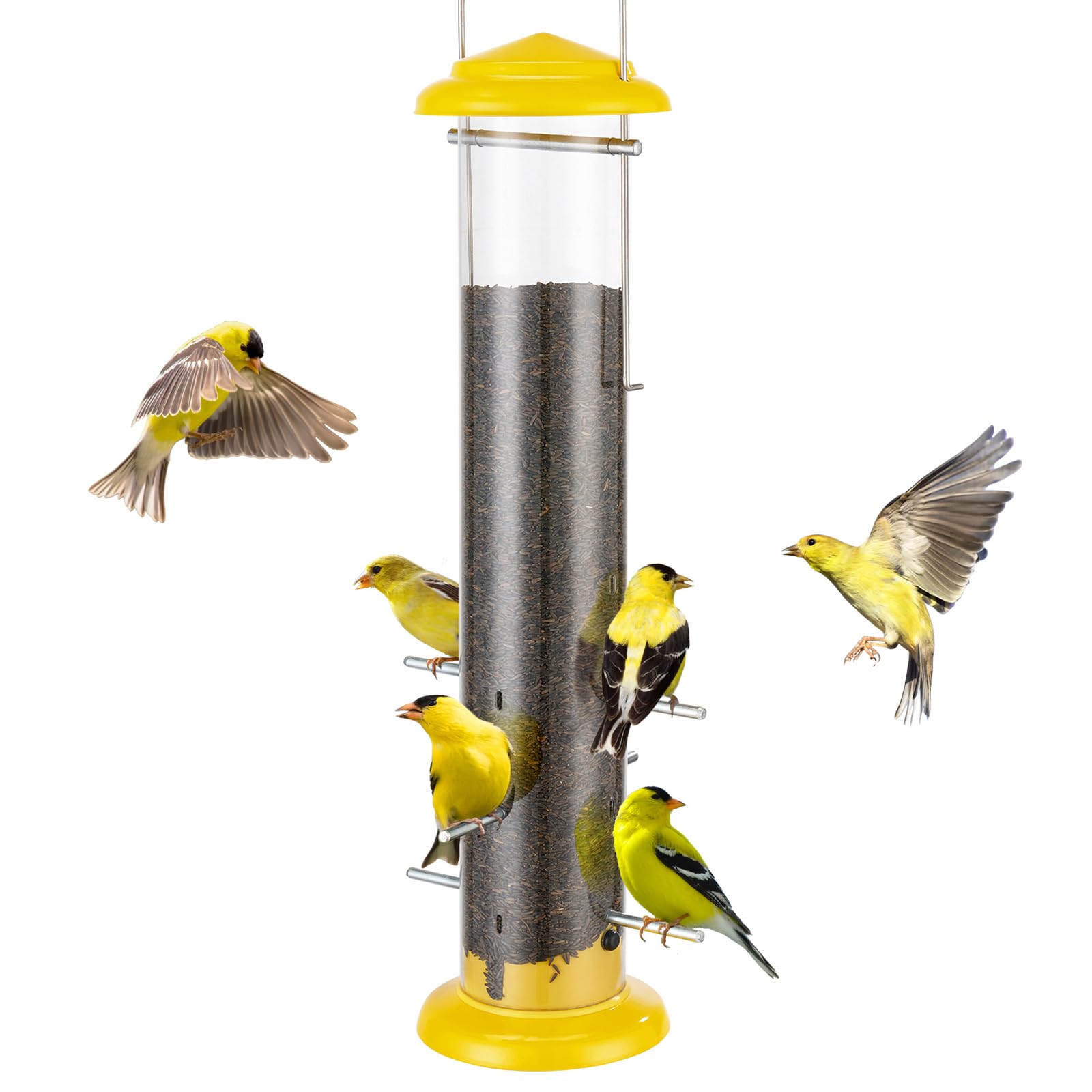
Perches sized to shut out the big birds, so the finches get the whole tube.
Here is a feeder with a specific guest list. The perches measure 1.5 inches — roomy enough for goldfinches, siskins, juncos, sparrows, and house finches, but too tight for a mourning dove to settle. Six narrow feeding ports around the clear tube let several of those small birds feed at once. The seed compartment is enclosed, so the ports themselves help keep rain out, and drainage holes in the base let any water that does get in run off. The lid is metal, as are the base and perches, with a powder-coated finish to fight rust through the year.
It is smaller than the Gtongoko mesh feeder — 4″L x 15″W x 4″H and 0.37 kg versus the Gtongoko’s 0.44 kg and far wider footprint — so it slips into tighter spots on a balcony or pole. The clear tube is a practical touch: glance at it from the kitchen window and you know whether refilling is due. Cleaning is faster than most tube feeders because the base releases with a press of a button, so you can dump old seed and rinse without taking the feeder down.
Buyers report goldfinches finding the six narrow ports within days. Goldfinches find it fast, and the reviews praise the look — the yellow and metal combination holds up on a patio. Some buyers mention that thistle seed works best if you fill slowly and let the narrow ports guide the seed; rush it and a few grains will bounce. Repeat goldfinch visits are the strongest signal a finch feeder can get. If you want a tube that keeps the big customers off and lets the yellow birds take over, this one is tailored for exactly that.
The right fit: card-carrying small-bird fans who want perches that quietly keep doves and grackles off.
The catch: 1.5-inch perches mean the biggest birds will simply move on to another feeder — that is the point, not a fault.
5. Stokes Select 38169 Topsy Turvy Finch Feeder

Eight perches on a tube that stands a hair under nineteen inches tall.
Most finch feeders are short and stubby; this one stands out because of its height. It runs 18.75 inches tall on a 5.5-inch footprint, which gives it the most vertical presence of any feeder here. Eight perches line the length of the tube, so there is room for a small flock to spread out along the height rather than crowd a single tray. The tube itself is a mix of alloy steel, aluminum, and PVC, built for outdoor hanging year round. Fill it with nyjer or thistle and you have a finch feeder that looks the part on a tall shepherd’s hook.
Owner feedback is warm on two fronts: bird traffic and build quality. Finches find it and keep coming back, and owners frequently rate it as their favourite finch feeder. Cleaning and filling are straightforward, which is the reward of a simple tube design — the top lifts for a refill, and the tube rinses out with a quick pass. The yellow finish is bright enough to spot from across the garden. For a straightforward single-tube feeder with a good perch count, this one delivers without fuss.
One thing to know going in: the feeding holes run small. That is good news for keeping tiny Nyjer seed contained but it means filling needs a steady hand, and some owners have found the openings narrower than they expected. If you buy nyjer in bulk and want to pour fast, take your time. The 1.5 lb capacity means regular refills in a heavy-traffic yard — plan to check it every few days in peak season. Weigh those against the perch count and the tall profile, and this is an easy tube to recommend to someone who wants a simple, good-looking feeder without the fuss of moving parts.
The style pick: the 18.75-inch height and eight perches give it a strong visual presence and plenty of landing room.
Reach for this if: you want a tall, simple tube with eight perches and a well-earned reputation for bird traffic.
Look past it if: you need a large seed reserve — 1.5 lbs needs regular top-ups in a busy yard.
6. Woodlink NAWLNT Audubon Finch Feeder 13-Inch
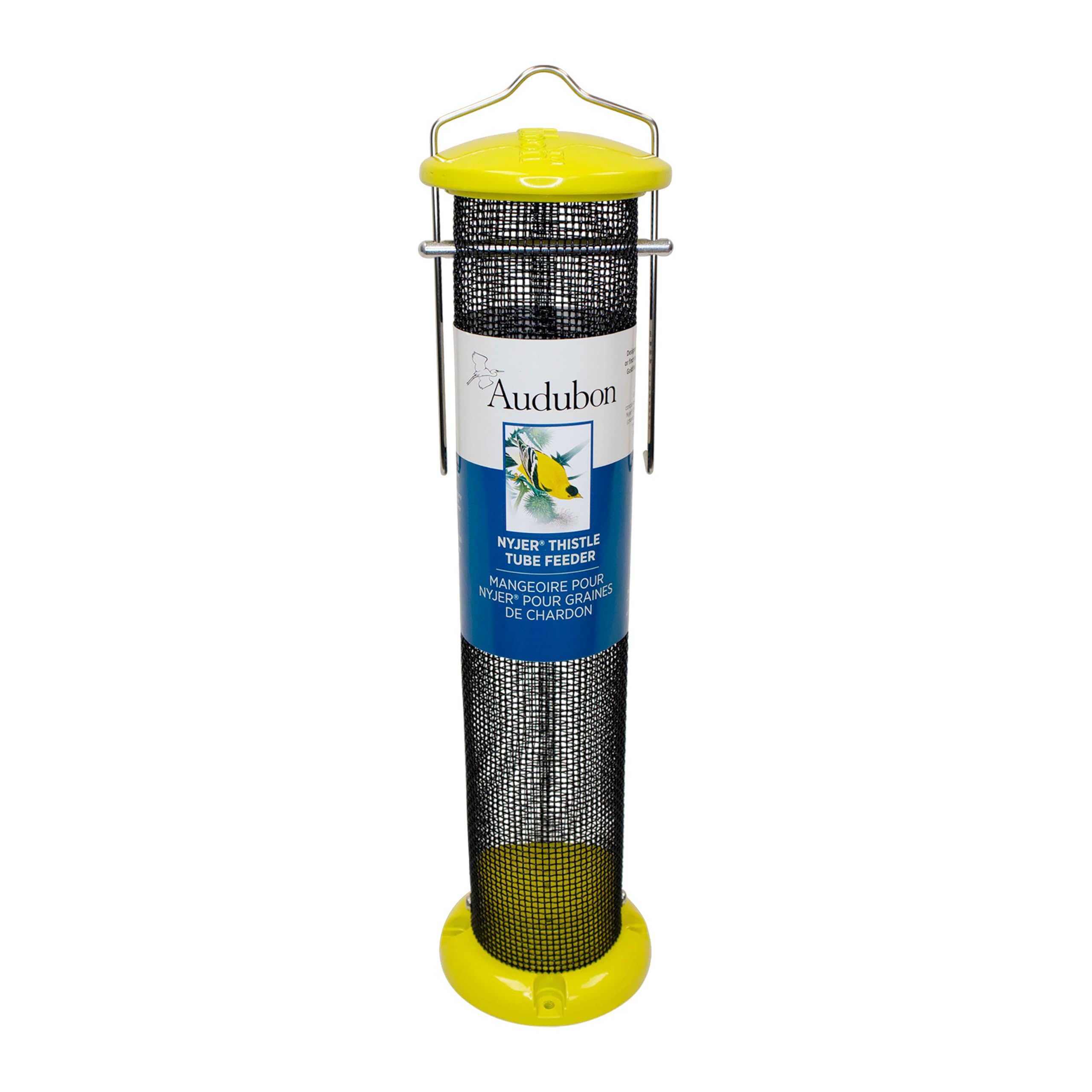
Die cast aluminum screen tube that hangs straight from the box, no tools required.
Some feeders arrive as a small project. This one does not. It comes ready to hang with no assembly, which is the reason to pick it if you are giving a feeder as a gift or you just want to get it up before the birds move on. The screen tube body is die cast aluminum, a material that stands up to weather without rusting away, and it arrives ready to fill with thistle or a finch seed mix. It holds 1 lb of seed — modest, but enough for a pair of goldfinches over a day or two.
The screen format gives clinging finches a textured surface to work across, and owners mention the design is well thought out and built to last. The 13-inch height is compact enough to hang from a smaller branch or a balcony arm, and the aluminum body holds its shape unlike cheaper metal feeders. It also lists a squirrel-proof claim, which in practice means the die cast aluminum resists chewing but squirrels still need a baffle. Read the seed-level hole pattern before you buy, and you will not be surprised by the capacity.
The catch is capacity. At 1 lb, this is a feeder for a light-traffic yard or a supplemental feeding spot rather than a main station. Some owners have found that finches take a while to warm to a new screen feeder, so give it a week or two before you decide it is not working. Once they do, the aluminum shell and simple fill make it a low-fuss daily feeder. Pick it for the no-assembly convenience and the die cast build — not for feeding a crowd.
Perfect for: gift-givers and first-time hangers who want a feeder up and running in one minute flat.
Be aware: 1 lb capacity and a screen format mean it is a supplement rather than a main station.
7. Kingsyard Metal Mesh Bird Feeder
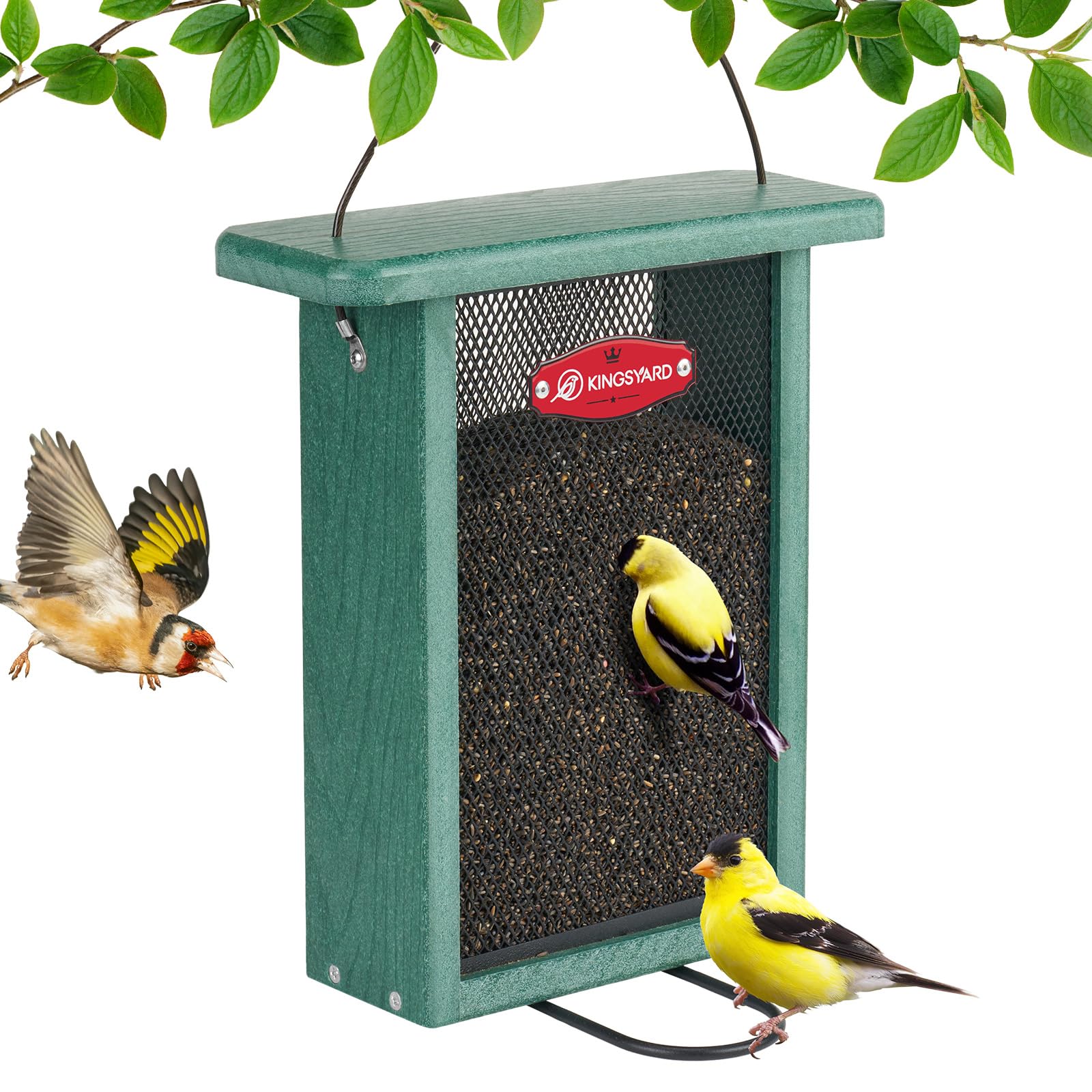
Three pounds of thistle in a mesh body, and both panels pull out for scrubbing.
If you want the most seed in a small body, this is the one. The mesh grid holds up to 3 lbs of nyjer or thistle — the largest load in this lineup — yet its footprint is just 7.8″L x 2.9″W x 9″H, so it hangs tight and won’t dominate a branch. The grid openings are sized for tiny Nyjer and thistle seed only, so fill it with fine seed and the birds will come. The maker lists goldfinches, chickadees, bullfinches, titmice, sparrows, and nuthatches for this design.
The body is recycled plastic rather than plain plastic, and the maker claims it handles rain, snow, strong sunlight, and cold without denting, cracking, or fading — a claim that matches the year-round use many customers note. Both mesh panels pull straight out, which makes cleaning far easier than narrow tube feeders; you can rinse the whole grid under a tap in seconds. A U-shaped perch at the bottom can be tucked away or expanded to give the birds more landing room, and the mesh itself is a natural clinging surface. Owner feedback highlights how strongly finches are drawn to it.
The one recurring complaint is the perch. Some reviewers point out the bottom perch doesn’t stay put, so check it’s seated firmly every time you refill, or leave it folded away and let birds cling to the mesh. Capacity and easy cleaning are the strengths here.
Why it works
- Holds up to 3 lbs of nyjer or thistle, the biggest load in this set
- Sliding mesh panels pull out for fast cleaning
- Recycled plastic body is built to resist weather year round
- Compact 7.8″L x 2.9″W x 9″H body fits tight spots
Where it asks patience
- The bottom perch can work loose — check it after each refill
- Mesh grid is for tiny Nyjer/thistle seed only, not mixed seed
The right match: high-capacity feeding on a compact mount where quick cleaning matters.
Not the one for: filling with mixed bird seed — this grid is sized for tiny thistle only.
8. Bird Quest SBF2Y 17″ Spiral Thistle Bird Feeder, Yellow

A yellow spiral of stainless steel that lets a flock feed along its whole coil.
A spiral feeder does away with ports and perches entirely. The coil runs 17 inches tall in stainless steel, and birds cling to any point along the spiral rather than lining up at fixed openings. That is why owners like it: with a spiral, several finches can feed at once because there is no single lane. It holds 1.5 lbs of thistle seed, and the yellow colour stands out cleanly in a garden. Hanging wire is included, so it is ready to go on a branch or hook.
The open coil draws finches fast, and the review pages credit the spiral shape for letting several birds cling and feed at once. What owners notice is how the seed drops through the coil as the birds feed, keeping fresh seed within reach instead of burying it at the bottom. Cleaning and filling are simple enough — a small scoop or funnel helps move seed into the coil opening. For someone tired of tube feeders that only let two birds eat at once, the spiral format is a genuine change of pace.
The stainless steel body resists rust better than plastic, and it carries a lifetime warranty on workmanship and normal wear and tear. The trade is capacity: 1.5 lbs runs out fast in a high-traffic yard. The spiral also lets seed trickle in a way that can scatter on the ground if the coil is bumped. If you want a feeder that looks different and gives a flock room to spread out along a full spiral, this is the pick. Plan on refilling often and keep it away from hard knocks.
The looker: stainless steel and a 17-inch spiral give it the most distinctive profile in this set, and the coil means more birds feed at once.
Choose it for: the spiral design that gives a flock room to feed all at once and the stainless steel body.
Go another route if: you want a big seed reserve or a feeder that will not trickle seed when bumped.
9. Aspects 402 Thistle Tube Feeder

Die cast caps, a UV-stabilised tube, and a base you pop off to clean in seconds.
This is the premium option, and it shows in the details. The tube is UV-stabilised polycarbonate, which resists the sun damage that clouds and cracks cheaper plastic over a few summers. The caps and base are heavy die cast metal, finished in antique brass. The maker rates the die cast caps and UV-stabilised tube for long outdoor life. Eight feeding stations ring the tube, and the capacity runs 1.25 quarts — enough to support a busy yard between top-ups. It weighs 1.2 pounds, so it hangs steady on a pole.
Two features make this tube easier to live with than most. The Quick-Clean base pops off, so cleaning is quick instead of a wrestling match, and a built-in seed deflector in the base lets birds draw out every last seed without waiting for gravity to feed the ports. Owners rate quality and ease of cleaning highest — it feels solid in the hand and looks the part on a shepherd’s hook. The antique brass finish draws compliments from owners who want their garden to look as good as it feeds.
The fair caveat is the value question: some owners find it on the spendier side for what it does. Nothing is wrong with the feeder — it is simply priced for a buyer who expects to hang one feeder for years rather than swap a plastic model every couple of seasons. If you have lost feeders to sun and rust before and want the last one you buy for a while, the die cast and polycarbonate build justifies the step up. If you are outfitting a whole yard with multiple feeders, the broad value here starts to pinch.
Reach for it: a long-view buyer who is done replacing faded plastic tubes and wants the last finch feeder they hang for years.
Think twice if: you are outfitting several feeders at once — this is the premium end of the range.
Know the Specs
Mesh openings versus feeding ports
A finch feeder holds tiny Nyjer and thistle seed, so the openings do double duty: they let birds feed and they keep seed from pouring out. A mesh feeder (the Veehoo, Gtongoko, and Kingsyard mesh) works like a grid wall — the birds cling to the wire and pick seed through the gaps. A tube feeder uses narrow round ports (the iBorn, Kingsyard tube, Woodlink, and Aspects) where the bird reaches in. Mesh tends to give more birds a place to cling at once; ports tend to control spill better. Either way, keep the openings sized for thistle seed and the finches will do the rest.
Capacity and how often you refill
Capacity is quoted in pounds or quarts and tells you how often you will be back out with the seed bucket. In this lineup that runs from a 16-ounce Woodlink to a 2.5 lb Gtongoko and a 3 lb Kingsyard mesh. A larger feeder means fewer trips but more seed on hand per hang, and more to empty out if you need to clean it. Pick a capacity that matches how many finches you actually feed — a lightweight supplemental feeder does not need three pounds of seed sitting in it going stale.
Common Questions
Will a mesh feeder work better than a tube feeder for goldfinches?
Can I put sunflower seed in a thistle feeder?
How do I stop seed moulding in the bottom of the feeder?
Are these finch feeders really squirrel-proof?
How many finches can feed at once?
Should I hang a finch feeder in the sun or shade?
Is 2.5 lb or 3 lb capacity too much for a small yard?
What does Quick-Clean mean on the Aspects 402?
Do I need to clean a finch feeder, or can I just keep refilling it?
The Bottom Line
For most yards, the best yellow finch bird feeders pick is the Veehoo Metal Mesh Finch Feeder. Its all-metal mesh body and mushroom roof give clinging finches a dry, grippy wall to feed from without narrow ports to fuss with. If you want the most birds feeding at once, choose the iBorn 15-inch tube with 12 ports and 8 perches. For the biggest seed load in the smallest hanging footprint, reach for the Kingsyard sliding mesh feeder at 3 lbs. The Veehoo is the crowd favourite at 4.5+ stars across 200+ ratings, so if you’re unsure, start there.
How we choose
We do not accept paid placement. Every pick is matched to a real buyer and a real use-case; we do not hands-on test units.
Sources
Specifications: manufacturer listings and product documentation. Review insights: verified customer reviews, as of November 2026. Pricing: not shown on this page (it changes often); check the current price via the retailer link.
As an Amazon Associate, Tactical Gear Guy earns from qualifying purchases. This does not affect which products we feature.