Specs are compiled from manufacturer listings and verified buyer reviews and can change over time — please confirm the key details on the product page before buying.
A year-round tent lives or dies on three things you cannot see in a product photo: how the fly sheds a wet snow load, how the poles behave when wind gusts hit camp, and whether the inside turns into a condensation swamp by morning. Miss any of the three and a “four-season” label means nothing. Get all three right and the shelter works in July heat and February sleet alike. This guide ranks eleven four-season shelters on those three jobs and names the one that fits how you camp.
This guide is built by comparing the manufacturers’ published specifications and the patterns across verified customer reviews, so you get each pick’s real strengths and trade-offs instead of marketing spin.
Snow, wind, or shoulder-season rain — the shelter you pick decides whether the trip keeps going, so here is how to read a spec sheet before you commit to any year round tent.
Top Picks


How To Choose The Best Year Round Tent
The word “four-season” gets printed on a lot of tents that are really three-season shelters with a slightly taller fly. A real year-round tent earns the name by handling cold, snow, and wind at the same time. Here is what actually separates them.
Read the waterproof rating, not the marketing word
Waterproofing is measured in millimeters of water column — the height of water a fabric can hold before it leaks through. A floor rated 5000mm shrugs off a soggy pitch; a fly rated 3000mm handles steady rain. Anything unrated is a guess. Look for the number on both the fly and the floor, because the floor is where most wet nights start.
Decide if you want a stove or not
A hot tent carries a stove jack — a fire-resistant opening in the roof wall where a chimney pipe passes through — so you can run a wood stove inside. That changes winter camping completely, but it also adds setup steps and a safety routine. If you camp cold but never below freezing, a sealed cold-weather tent without a jack is lighter and simpler.
Weigh double-wall against single-wall
A double-wall tent runs an inner mesh or nylon body inside an outer fly. The gap between the layers traps moisture and cuts condensation, which is why it stays drier in humid cold. A single-wall shelter is lighter and faster to pitch but asks more of its ventilation windows. For snow camping, double-wall tends to win.
Match the fabric to your climate
Synthetic nylon and polyester shed rain fast, pack small, and need a coating to breathe. Cotton canvas breathes on its own and holds heat gently, so it resists condensation without a coating — but it is heavy and wants a proper dry-out after a wet trip. Coastal damp favors synthetic; cold dry snow and long base camps favor canvas.
Side-by-Side Comparison
| Model | Best For | Waterproofing | Sleeping Capacity | Packed Weight | Amazon |
|---|---|---|---|---|---|
| Naturehike Dune Hot Tent★ Best Overall | Year-round base camp with a stove | 3000mm fly / 4000mm floor | 2 (inner tent) | 16.5 lbs | Amazon |
| GEERTOP 2 Person 4 SeasonStorm Shelter | Backpacking through storms | PU8000mm fly / PU5000mm floor | 2 | 7.4 lb | Amazon |
| OneTigris StellaFeatherweight | Fast solo and duo pitches | 3000mm | 1–2 | 4.4 lb | Amazon |
| Naturehike Massif Hot Tent | Winter camping with a porch | ≥3000mm | 2 | 10.47 lbs | Amazon |
| ALPS Mountaineering Tasmanian | Alpine double-vestibule shelter | 5000mm floor coating | 3 | 9 lbs 10 oz | Amazon |
| WaldZimmer Canvas Bell Tent | Snow camping with a chimney | Water-resistant canvas | 4–5 | — | Amazon |
| Teton Sports Canvas Tent | Family base camp in all seasons | Waterproof canvas | 6–8 | — | Amazon |
| NEMO Kunai | Mountaineering in extreme wind | Waterproof tub floor | 3–4 season design | 2550 g | Amazon |
| WHITEDUCK Regatta Bell Tent | Glamping camp with a wood stove | PFC-free water resistance | 6 | 60.6 lbs | Amazon |
| Kodiak Canvas Cabin Lodge | Long-stay cabin living in snow | Hydra-Shield canvas | Up to 10 (8 with stove) | — | Amazon |
Detailed Reviews
1. Naturehike Dune Hot Tent with Stove Jack
Our pick — 4.5+★ from 200+ verified ratings; the strongest balance of quality and price.
The double-wall hot tent that gives you a stove, a porch, and a summer mesh body in one package.
What you get for a mid-range spend is genuinely two tents in one. The inner sleeping body measures 86.6 x 59 x 63 inches — a queen air mattress and a dog fit side by side, and there is enough headroom to sit up. Pull that inner body out and the outer fly alone opens into roughly 81.8 square feet of covered shelter, which the maker pitches as roomy for 6–8 people as a sun shade. That vestibule space is where your stove, chairs, and wet gear live.
The fabric is the part that earns its keep in bad weather. The fly is 75D polyester with a silver coating rated 3000mm waterproof and UPF50+ for sun protection, and the floor steps up to 150D oxford cloth at 4000mm with every corner seam taped. The poles are 7001 aluminum alloy in an X cross structure, tied off with wind ropes for extra steadiness when the weather turns. A snow skirt seals the base against wind-driven snow.
Reviewers call out the appearance more than any other detail, with roominess a close second. Owners routinely report it behaving like a larger tent than its stated two-person rating, and the mesh inner plus four double-layered doors keep condensation from becoming a morning problem in warmer weather. The catch is honest: at 16.5 lbs packed into a 24.8 x 11.8 x 8.6 inch bag, this is a car-camping or motorcycle-trip shelter, and setup runs about 15 minutes against the 5 minutes of the GEERTOP below. The crowd favorite here holds 4.5+ stars across 200+ ratings, and for a stove-ready year-round base camp that is the number that matters.
What earns its place
- Removable inner body turns one tent into a stove shelter, a summer mesh tent, or an open sun shade
- 4000mm taped floor and 3000mm fly stand up to sustained rain
- Snow skirt and X-frame aluminum poles handle wind and drifting snow
- Four doors and a full mesh inner keep condensation down in warm months
Where it asks more of you
- 16.5 lbs and a 15-minute pitch make it a vehicle-based shelter, not a backpacking one
- You need to learn the fly-first sequence before a storm teaches it to you
Reach for this if: you want one tent that runs a stove in February and vents like a summer shelter in July, and you drive to camp.
Look elsewhere if: you are carrying your shelter on your back — the GEERTOP and OneTigris picks below weigh a fraction of this.
2. GEERTOP 2 Person 4 Season Tent
The waterproofing numbers on this dome are the highest in the group by a wide margin.
Start with the spec that decides wet nights: a PU8000mm fly and a PU5000mm bathtub floor, both in 20D ripstop nylon. That 8000mm fly means a tall column of water before anything seeps through, so a long rainy night in the backcountry stays outside where it belongs. The bathtub floor curls up at the edges so ground water cannot wick in at the seams. Compare that to the 3000mm fly on the OneTigris Stella below and the difference is stark.
It also pitches in about 5 minutes — the fastest full double-wall setup in this article — and the floor length runs 122 inches, 41% longer than the Dune’s 86.6 inches. At 7.4 lb it is the pack-friendly option among the full-coverage shelters, and the rainfly works alone as a lighter shelter with a front vestibule for cooking and gear. Reflective guy lines and reinforced stakes help you find and steady it after dark.
Build quality leads the feedback, with wind resistance close behind — this dome has held up in gentle snow and strong gusts. Be ready for a learning curve: the assembly process splits opinion, with the first pitch proving the hard part for plenty of buyers and later pitches going smoothly once the pole-and-clip sequence clicks. Give yourself a dry-run before you rely on it in weather.
Why the numbers matter: PU8000mm on the fly is the strongest rain defense here, and the 122-inch floor gives two adults real length.
The first-pitch friction: budget extra time the first time you set it up — the clip-on inner and pole routing are not obvious cold.
Pick this for: backpacking and shoulder-season trips where rain is the enemy and every gram counts against a full double wall.
Not for: anyone who wants to pitch blind in the dark on the first try — learn the sequence at home first.
3. OneTigris Stella 4 Season Camping Tent
At 4.4 lb, this is the tent you actually want to carry up the hill in October.
Here is the number that reframes everything: 4.4 lb against the GEERTOP’s 7.4 lb, a 68% lighter load on your back for a shelter that still claims four-season duty. The body is 20D nylon with a single-layer silicone coating, the floor is 40D nylon, and the whole thing carries a 3000mm waterproof rating. A removable blackout outer tent gives you a dark, cooler sleep in summer and can come off when you want the view.
Setup takes about 3 minutes — poles cross at the top of the dome and anchor at all four corners — and the package includes 10 stakes, 4 guy lines at 8.2 feet, and a storage bag. The setup footprint runs 6.9 x 4.1 feet with a 3.7-foot peak. That is a compact dome, and the size question is the one that splits opinion: plenty of buyers find it very roomy for one person with gear, while others find it tighter than expected for two.
Buyers praise the build quality for the price most, with the 3-minute setup a close second. Warmth in cool, dry conditions is a repeated theme, and the waterproofing holds up, though the mesh inner and single-wall ventilation need managing in humid weather. If you camp solo or as a close pair and count every pound, this is the sensible pick.
Reasons to carry it
- 4.4 lb is a genuine backpacking weight, 68% less than the GEERTOP
- 3-minute pitch with a simple crossed-pole dome
- Removable blackout fly adds summer flexibility
- Quality feel that reads above its tier
Size honestly
- A 6.9 x 4.1 foot floor is roomy for one and snug for two
- Humid nights need the vents open to avoid condensation
Best fit: solo backpackers and close-duo trips where a roughly four-and-a-half-pound pack weight is the whole game.
Skip if: you want to spread out — treat it as a one-person-plus-gear shelter and you will be happy.
4. Naturehike Massif Hot Tent with Stove Jack

A cabin-shaped hot tent built around a separate room, hall, and porch for cold-weather living.
The layout is the story here. This is a cabin-form tent with a dedicated room, a hall, and a porch, so your sleeping space stays separate from the stove and the muddy boots. The fly is 30D lightweight polyester with a silicone coating over a 70D nylon inner, water-resistant to ≥3000mm, held up by 7001 aluminum alloy poles in a cross frame. Two ventilation windows and the breathable mesh inner work together to cut condensation — the enemy of any winter night inside a sealed shelter.
At 10.47 lbs packed into 20.5 x 9 x 6.7 inches it stays portable for cycling, motorcycle, or backpacking travel, and it is a lighter carry than the 16.5 lb Dune above. A snow skirt seals the base against wind and snow, two doors give you options when the wind shifts, and the stove jack lets you run a camping stove for real warmth in snow. Tie down the stakes and wind ropes firmly before you light anything inside — the maker says so plainly.
Construction earns the most praise in this tent’s feedback, with value and spaciousness close behind, and the reinforcement at stress points gets noticed. Weather resistance is where the picture gets mixed: the tent skirts keep the inside dry, yet some buyers report rain and mud finding a way in around the base.
The layout advantage: a room-hall-porch split keeps your sleeping area clean and warm while the stove does its work.
The base seal matters: the skirt is your defense against wind-driven rain and mud, so stake it tight and choose high, draining ground.
Choose this if: you winter camp and want a proper porch to shed wet layers before you step into the sleeping room.
Pass if: you want a single open space — the teepee and Dune designs give you one room instead of three.
5. ALPS Mountaineering Tasmanian 3-Person Tent

Two doors, two vestibules, and a 5000mm floor coating — a true four-season dome for three.
Two-way entry is the feature you feel every single trip. This dome has a door and a vestibule at each end, so you never climb over your tentmate to get out at night, and each of you gets weather-protected storage outside the sleeping area. The base is 7 feet 8 inches by 6 feet 7 inches with a 54-inch center height, and the packed size is 23 x 7 inches at 9 lbs 10 oz total. That 43.5 square foot floor puts three sleepers inside with room to move.
The weather spec is the part that earns four-season status: a full-coverage fly, a 5000mm coating on the tent floor, fully closable vents, and weatherproof fly buckles. Inside, you get #8 zippers, mesh storage pockets, and a gear loft so small items stay off the floor and out of the damp. The free-standing pole system with clips snaps over the poles fast, which matters when the light is fading.
Quality is the aspect buyers praise most, with value close behind, and durability through wind and rain is a consistent theme. The generous pocket lining — all four walls lined with mesh pockets — wins fans who like their kit organized. Setup is where opinions split, with some finding it quick and others reporting about 30 minutes to assemble, so it rewards a practice run before the real trip.
The three-person edge: a 43.5 square foot floor and dual vestibules give a trio genuine space and two ways out.
Learn it once: the pole-and-clip routine can take up to half an hour cold — rehearse it once and it speeds up.
Right for: three-season-plus campers who want four-season protection and a vestibule for each occupant.
Wrong for: fast-and-light missions — the 9 lb 10 oz carry and a longer setup want a base camp, not a sprint.
6. WaldZimmer Canvas Bell Tent with Stove Jack

An 8.2-foot peak and a pre-cut chimney opening make this the canvas winter room.
The polycotton canvas shell is the reason to buy it. Cotton breathes, so the inside temperature changes gently instead of swinging, and the fabric holds heat without the condensation trouble that coated synthetics fight in cold weather. The floor is heavy-duty waterproof PVC at 500gsm, and a durable steel center pole with a triangle door pole and adjustable wind ropes keeps the whole bell stable. This 13 x 13 x 8.2 foot version sleeps 4–5 and gives you a 5-foot door height so you walk in upright.
Ventilation is solved properly: four double-layered windows — cotton on one side, mesh on the other — plus a double-layered door and four roof vents move air through while keeping insects out. A pre-cut stove jack lets you drop a chimney in, with a diameter you can trim to fit, and a plastic waterproof cap over the door pole stops rain leaking through the metal hole. The 2-foot side walls put the sloped canvas above head height so every inch is usable.
Durability and the easy setup are what keep owners happy, and the center pole stays steady when the wind picks up. Canvas needs some honesty from you, though: it has no PU coating, so the maker asks you not to leave it in sustained rain. Water seeping through the perimeter is the recurring gripe when a downpour outlasts the fabric’s breathability. Dry it fully before storage and it will last.
Canvas comfort: breathable polycotton and an 8.2-foot peak make this a room you can live in on a snowy trip.
Rain honesty: without a PU coating, canvas wants you to avoid prolonged rain — a long wet spell can seep at the base.
Made for: cold-weather campers who want canvas breathability, standing room, and a chimney for a stove.
Not ideal for: a wet-climate camper who expects to ride out days of driving rain — this shell prefers snow and short showers.
7. Teton Sports Canvas Tents

A canvas cabin for six to eight, with doors wide enough to walk a mattress through.
Waterproof canvas that still breathes — that is the core of this tent, and it is what keeps a big family space from turning humid. The floor measures 168 x 120 inches, giving 20160 square inches of room and a 78-inch interior height, so you can stand, stretch, and fit queen-size air mattresses with room to spare. Mesh screens run the walls for airflow and views, and the oversized front and back doors with extra-large zipper pulls let you haul gear in without a wrestling match.
Comfort details are built in for long stays: extra-high ceilings, a large awning over the entry, easy-access power ports to run a cord inside, and two loft and two pocket organizers to keep the clutter off the floor. Setup is a push-down top bar with pins and upright poles, and the carbon steel stakes drive through rough ground. A PVC rainfly adds a weather layer on top, though the footprint sells separately.
Quality and durability are what people rave about, and the wind and water stories back it up — this canvas shelter has held through winds past 35mph and kept a dry interior through heavy rain. Ventilation earns steady praise too, keeping a crowded tent from stuffy. For a family base camp that runs through all four seasons, that combination of space and breathable canvas is the point.
Why families love it
- 168 x 120 inch floor and 78-inch height fit the whole group and their gear
- Breathable waterproof canvas resists the humidity a big crowd creates
- Extra-wide doors, power ports, and four organizers for real living
- Proven stability in high wind and heavy rain
Plan around this
- The footprint is sold separately, so add it to your setup list
- Heavy canvas and steel stakes want a vehicle-based camp, not a hike-in
Best for: families and groups settling in for a season-long base camp where space and breathable canvas beat pack weight.
Look past it if: you are moving camp every night — the steel stakes and canvas want a permanent pitch.
8. NEMO Equipment Kunai 3-4 Season Backpacking Tent

Built like a sailboat sail to hold its shape when the ridgeline wind hits.
The shell is the differentiator. Dimension Polyant 375D X-Ply composite sailcloth reinforces the fly, a material borrowed from sails so it keeps its shape under high wind and blowing snow. The tapered profile, aggressive brow pole, and wind-blocking inner tent cut the shelter down to what resists gusts best, and the tub floor construction keeps you dry no matter how wet the ground runs under you. At 84 x 84 x 45 inches with a 37.9 square foot floor, it is a purposeful alpine shape rather than a roomy car-camper.
The whole thing weighs in around 2550 g and sets up free-standing on DAC poles, per the assembly notes. A large door vent and zippered mesh windows give you airflow when you need to vent a sealed winter shelter — a small detail that decides whether you wake to a dry inner wall or a wet one.
Build quality is the praise it collects, and this is a shelter aimed at mountaineers, not family campers. Size is the honest caveat: plenty of room for the person it is built for, cramped once you pack in a partner and gear. And this one sits at the premium end, which its reviews do not let you forget. If you climb ridges and camp where the wind howls, the sailcloth shell is the reason it is here.
The wind-proof shell: sailcloth reinforcement and a wind-blocking inner make this a shelter for exposed camps above the trees.
The honest size: a 37.9 square foot tapered floor is a mountaineer’s space, not a lounging space.
For the summit crowd: climbers and mountaineers who camp exposed and need a shell that keeps its shape in a gust.
Skip it for: family or base-camp use — the cramped footprint and premium positioning suit a solo alpine trip, not a group.
9. WHITEDUCK Regatta Canvas Bell Tent
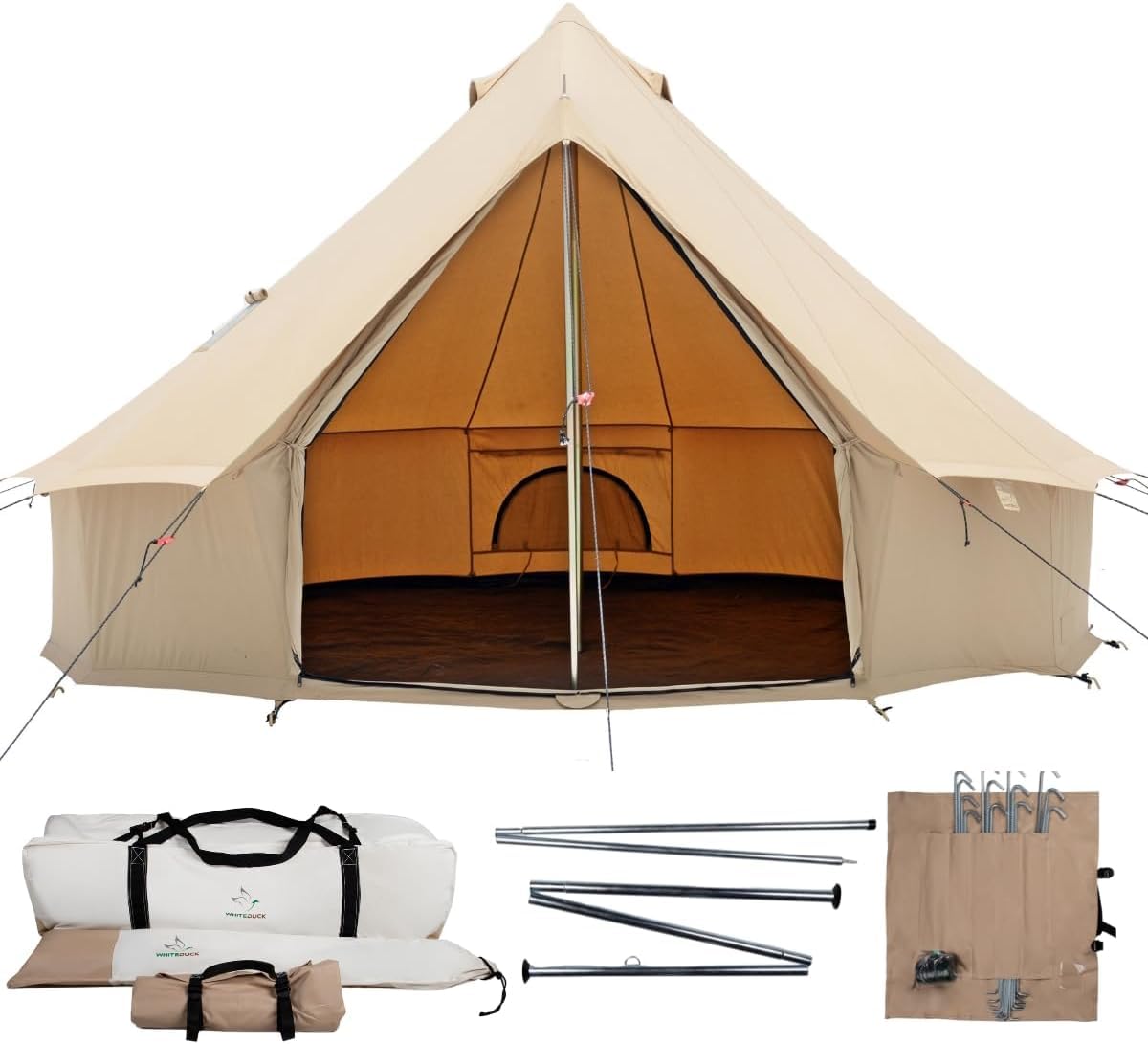
A breathable canvas yurt with a stove jack, built for a six-person camp that feels like a room.
Breathable performance canvas is the foundation, finished with a PFC-free water-repellent treatment — PFCs being the chemical coatings some outdoor gear uses to shed water, which this tent skips. It arrives with everything you need for a winter camp: a sewn-in groundsheet, a stove jack built from fire-retardant material for a wood stove, mesh windows, roof vents, poles, a tool kit, and a weatherproof bag. The flame-retardant version takes you further into four-season wood-stove camping.
Space is the luxury here. A standard wall height of 2 feet 7 inches runs taller than average bell tent walls, so you get more stand-up and walk-around room, and the tent sleeps up to six. Two-layered doors and windows seal out weather, an electrical cable outlet lets you run power to your devices, pockets keep personal items handy, and the heavy-duty zippers are built weatherproof. It comes in four sizes to fit different group strengths.
Weighing 60.6 pounds, this is clearly a drive-up camp, not a pack-in — the canvas yurt shape is meant to be a place you settle into. If you want a stove-warmed canvas shelter with genuine standing room and the fittings to match, this is the one that treats the tent like a room. Just plan the transport and give the canvas a thorough dry before storage.
What it delivers
- Stove jack, groundsheet, poles, tool kit, and bag all included
- Taller-than-average walls give real stand-up space for six
- PFC-free water-repellent finish on breathable canvas
- Two-layered doors and windows, plus an electrical cable outlet
Weigh the logistics
- 60.6 pounds is a vehicle-committed shelter — plan the drive, not the hike
- Breathable canvas needs a full dry-out to keep its finish and its smell clean
Fits best: glampers and family camps who drive in, want a wood stove, and value standing room over pack weight.
Does not fit: backpackers or anyone without a vehicle to move 60.6 pounds of canvas.
10. Kodiak Canvas Cabin Lodge Stove-Ready Tent
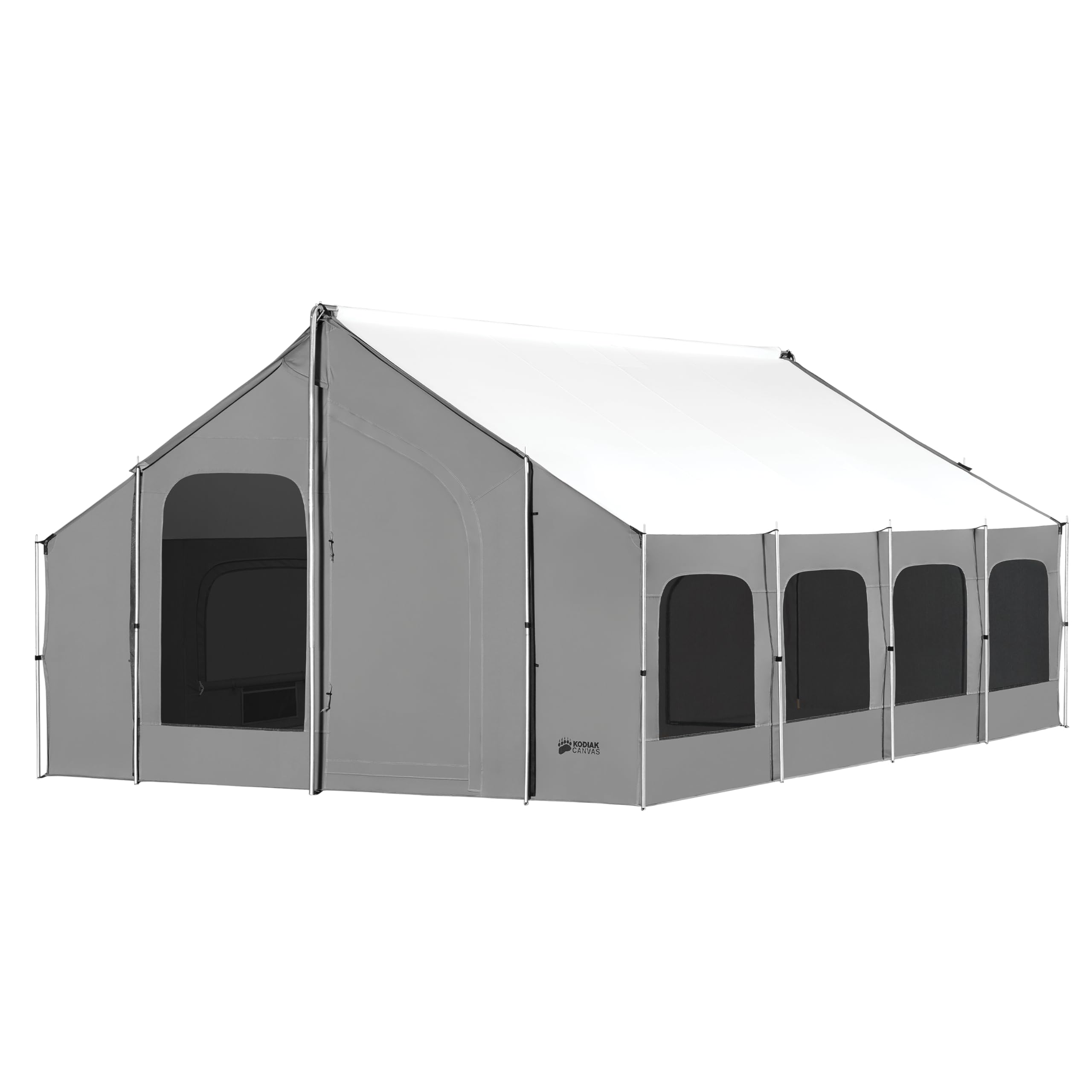
Vertical walls, 7.5-foot ceiling, and a stove jack — a canvas cabin you can walk around inside.
The dimensions read like a cabin: 12 x 16 feet of floor area with a 7.5-foot peak ceiling and vertical side walls that run 4 feet high. That shape means you stand up and walk around instead of hunching, which is what sets a cabin lodge apart from a dome or teepee. It sleeps up to 10 people, or 8 when you are running a stove inside.
The fabric is Hydra-Shield 100% cotton duck canvas — watertight yet breathable, which is the whole reason canvas minimizes the condensation that plagues synthetic shelters in cold weather. The floor is a tough 13.5 oz vinyl sewn in with welded seams to keep water out, and the stakes are heavy-duty 12-inch steel rods for a firm hold. A 5-inch stove jack is built in for wood-burning stove compatibility, so winter warmth is on the table, with the stove itself sold separately.
Ventilation is generous for a cabin: 9 large windows with no-see-um mesh screens, 2 vents, and 2 large D-shaped doors at each end. Assembly runs about 30 minutes and the maker says it wants two adults, which is fair for a shelter this size. What people praise most is the sheer quality, with durability close behind and the setup and value both landing well. The honest reality is the weight and footprint — this is a destination tent.
The cabin advantage: vertical walls and a 7.5-foot ceiling turn tent life into room life.
The two-person reality: a 30-minute setup for two adults is part of the deal — plan for it and it is painless.
Pick this for: hunters, snow-campers, and long-stay groups who want a walk-around canvas cabin with a stove jack.
Think twice if: you camp alone — the 12 x 16 foot size and two-adult setup demand a crew.
Know the Specs
Waterproof Rating in Millimeters
A waterproof rating is the height of a water column a fabric can hold before water pushes through — so a 3000mm fly handles steady rain while a 8000mm fly stands up to a hard, long downpour. Look at both fly and floor numbers. A floor at 4000mm or 5000mm keeps ground water out when the tent sits in a puddle overnight. No rating means no promise.
Packed Weight and Packed Size
The weight in pounds decides whether you carry the tent or drive it. A 4.4 lb shelter is a backpacking tent; a 10.6 lb teepee is a car-camping tent; 60 lbs is a canvas base camp. Read packed size alongside weight, because a heavy tent with a long bag is awkward on a pack even before the pounds bite.
Stove Jack and Snow Skirt
A stove jack is a fire-resistant opening where a wood stove’s chimney exits, letting you heat the inside of the tent. A snow skirt is the fabric flap at the base that you bury or weight down to stop wind and snow driving under the walls. Together they turn a cold-weather tent into a warm, sealed room — but only if you stake the skirt tight every time.
Double Wall vs Single Wall
Double-wall tents run an inner body inside an outer fly, trapping moisture between the layers so the inside stays drier. Single-wall tents skip the inner body, which saves weight but relies on ventilation windows to keep condensation in check. For cold, humid, snowy camping, the double-wall gap is worth the extra fabric.
Common Questions
What makes a tent genuinely year-round rather than just three-season?
How much waterproofing does a winter tent actually need?
Can I use a wood stove in any of these tents?
Which tent is lightest for backpacking through cold weather?
Does canvas or nylon breathe better in the cold?
How do I stop condensation inside a four-season tent?
How long should setup take for a four-season tent?
Will a queen air mattress fit in a two-person hot tent?
Do I need to dry a canvas tent after every trip?
Is a freestanding tent easier to pitch than a staked one?
The Bottom Line
For most buyers, the year round tent winner is the Naturehike Dune Hot Tent because it is the only pick that runs a stove in winter and vents like a summer shelter when the stove is out — a removable inner body, 4000mm taped floor (a waterproof coating rated to 4000mm of water pressure), and snow skirt in one car-camping package. If you want to shed weight on the trail, reach for the GEERTOP and its PU8000mm fly (a waterproof coating rated to 8000mm of water pressure) at 7.4 lb. For a walk-in canvas cabin with a stove jack (a fireproof port for a stovepipe), the Kodiak Canvas Cabin Lodge is the one, and a family base camp lands on the Teton Sports Canvas Tent. Whichever you pick, the top-rated tent here holds 4.5+ stars from 200+ owners, and reviewers credit its structure for the ranking.
How we choose
We do not accept paid placement. Every pick is matched to a real buyer and a real use-case; we do not hands-on test units.
Sources
Specifications: manufacturer listings and product documentation. Review insights: verified customer reviews, as of November 2026. Pricing: not shown on this page (it changes often); check the current price via the retailer link.
As an Amazon Associate, Tactical Gear Guy earns from qualifying purchases. This does not affect which products we feature.