Specs are compiled from manufacturer listings and verified buyer reviews and can change over time — please confirm the key details on the product page before buying.
If you shoot vertical moves — a slow rise up a product, a tilt down a face, a slide past a shelf — the one thing that ruins the shot is a rail that shudders or a motor that stalls halfway up. A proper Y-axis camera slider solves that by carrying your camera up and down on a driven carriage, so the motion is smooth, repeatable, and silent enough to record audio beside it. Below are nine sliders that actually travel vertically, sorted by what each one does best.
This guide is built by comparing the manufacturers’ published specifications and the patterns across verified customer reviews, so you get each pick’s real strengths and trade-offs instead of marketing spin.
Some rails climb on carbon fiber and a stepper motor, others lean on an app for keyframes; the difference matters once you mount a real camera. Here is how to match a Y-axis camera slider to the weight and height of your shot.
Top Picks

How To Choose The Best Y-Axis Camera Slider
The first trap most buyers fall into is buying on the horizontal load number. A slider that holds a heavy rig flat on its back can sag the moment you stand it upright. Every pick here publishes a separate vertical figure, and that is the number to build your kit around.
Read the vertical load rating, not the flat one
Gravity works against the motor when the rail stands up. A rail rated to 4.4 pounds lying flat may only hold 2.2 pounds at a 45° tilt and 2.2 pounds vertically, which is exactly how the NEEWER CS1M is specified. Add your camera, lens, and any cage to get a total, then compare it to the vertical number — not the headline flat one. If your rig sits near the ceiling of the flat rating, step up to a rail with headroom.
Stepper motor versus brushless stepper motor
The motor is what turns a hand-pushed rail into a repeatable move. A stepper motor (a motor that moves in fixed, counted increments) drives the carriage at an even pace and lets you set exact start and end points for time-lapse. A brushless stepper motor is quieter and smoother through slow moves. Noise matters more than you think: if the motor whines, it bleeds into your audio, so quiet operation is a real spec to hunt for.
Control: remote, panel, or phone app
You have three ways to drive the carriage. A hardwired remote gives you a physical handset with a screen for setting speed and photo counts. Onboard buttons let you set A and B points directly on the rail with no phone. A phone app open up multi-point keyframes and stop-motion. Solo shooters who demonstrate on camera tend to favor onboard or app looping; interview crews often prefer the simple remote.
Travel length decides the shot
A 15.7-inch mini slider suits tabletop product moves and food close-ups. A 31-inch rail gives you room for a slow interview push. A 48-inch rail covers a full-body vertical reveal. Longer travel means a longer, heavier rail, so match the length to your most common shot rather than the biggest one you can imagine.
Side-by-Side Comparison
| Model | Best For | Travel / Length | Max Payload | Motor / Control | Amazon |
|---|---|---|---|---|---|
| GVM 31″ Carbon Fiber Motorized Slider★ Best Overall | All-round vertical work | 31 inches | 20 pounds | Silent stepper motor / remote | Amazon |
| NEEWER 16in/40cm CS1MBest Value | Tabletop and phone moves | 16 inches | 4.4 pounds flat / 2.2 pounds vertical | 4-bearing manual carriage | Amazon |
| Accsoon Toprig 24″ S60 | Quiet interview and film work | 24 inches / 60cm | 4kg horizontal / 2.5kg at 90° | Brushless stepper / buttons + app | Amazon |
Detailed Reviews
1. GVM Motorized Camera Slider, 31″ Carbon Fiber Dolly Rail
Our pick — 4.0+★ from 100+ verified ratings; the strongest balance of quality and price.
The carbon rail that holds 20 pounds and still moves like a whisper.
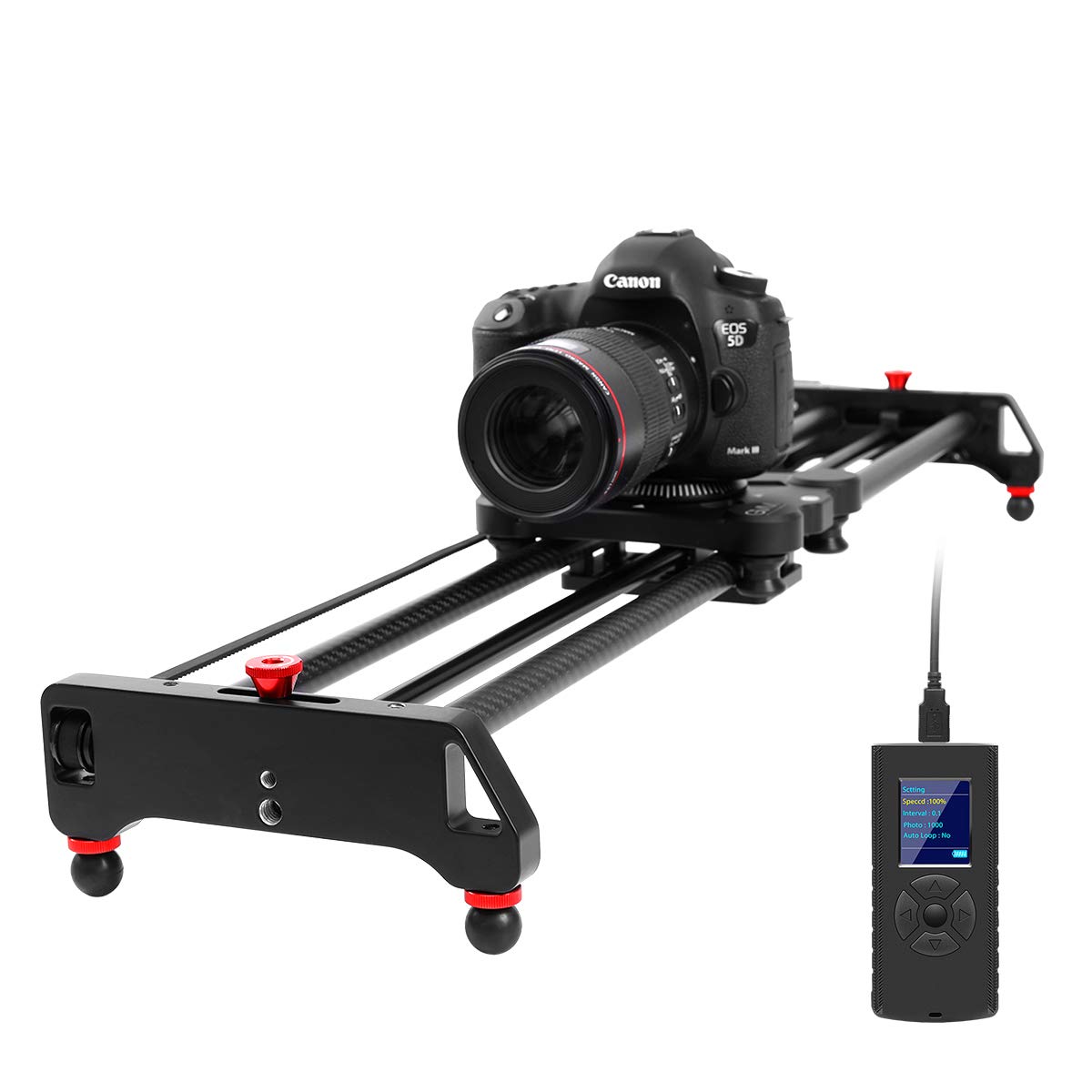
This is the pick that balances a long travel with real carrying muscle. The 31-inch rail is built from carbon fiber, which keeps the frame stiff while holding the whole thing to 10 pounds — so you can carry it to a location without a second set of hands. The motor is a silent stepper driver, the kind that moves in tiny counted increments, so your vertical push stays even from the first frame to the last. GoPro-style action cams and full DSLRs both fit the 1/4″ and 3/8″ screw ports.
Where it pulls ahead of the shorter NEEWER CS1M is pure capacity: 20 pounds versus 4.4, and a 31-inch rail versus 16. That gap is what lets you mount a heavier lens and still climb. The kit is genuinely complete — a remote control, an NP battery and charger, a ball head, a hex key, an extension cable, and six shutter release cables all come in the box, so you are not chasing accessories on a shoot day.
What wins people over is that the three shooting modes work exactly as described. Three shooting modes cover horizontal tracking, a 120° panoramic sweep, and vertical runs by adjusting the rod position. Two menus split video capture (even speed, auto round-trip between set points) from time-lapse (up to 1000 photos with an exact step distance). The honest trade-off: owners give the remote control mixed reviews, and a few find the menu setup slower than plug-and-go. Budget a little time to learn the menu before your first paid shoot.
Where it earns the top slot
- 20-pound payload on a 31-inch carbon rail — room for a real lens
- Silent stepper motor keeps motion smooth and audio clean
- Full kit included: remote, NP battery, charger, ball head, six cables
- 120° panoramic mode plus video and time-lapse menus
What to plan around
- The remote control gets mixed feedback — learn the menu before a shoot
- Setup is a touch slower than a plug-and-go rail
Reach for this if: you want one carbon rail that climbs vertically, sweeps 120°, and carries a heavier camera without straining.
Look elsewhere if: you need a featherweight travel slider — at 10 pounds this one expects a tripod and a plan.
2. NEEWER 16in/40cm Carbon Fiber Camera Slider CS1M
A 1.3-pound pocket rail that turns a phone into a dolly rig.
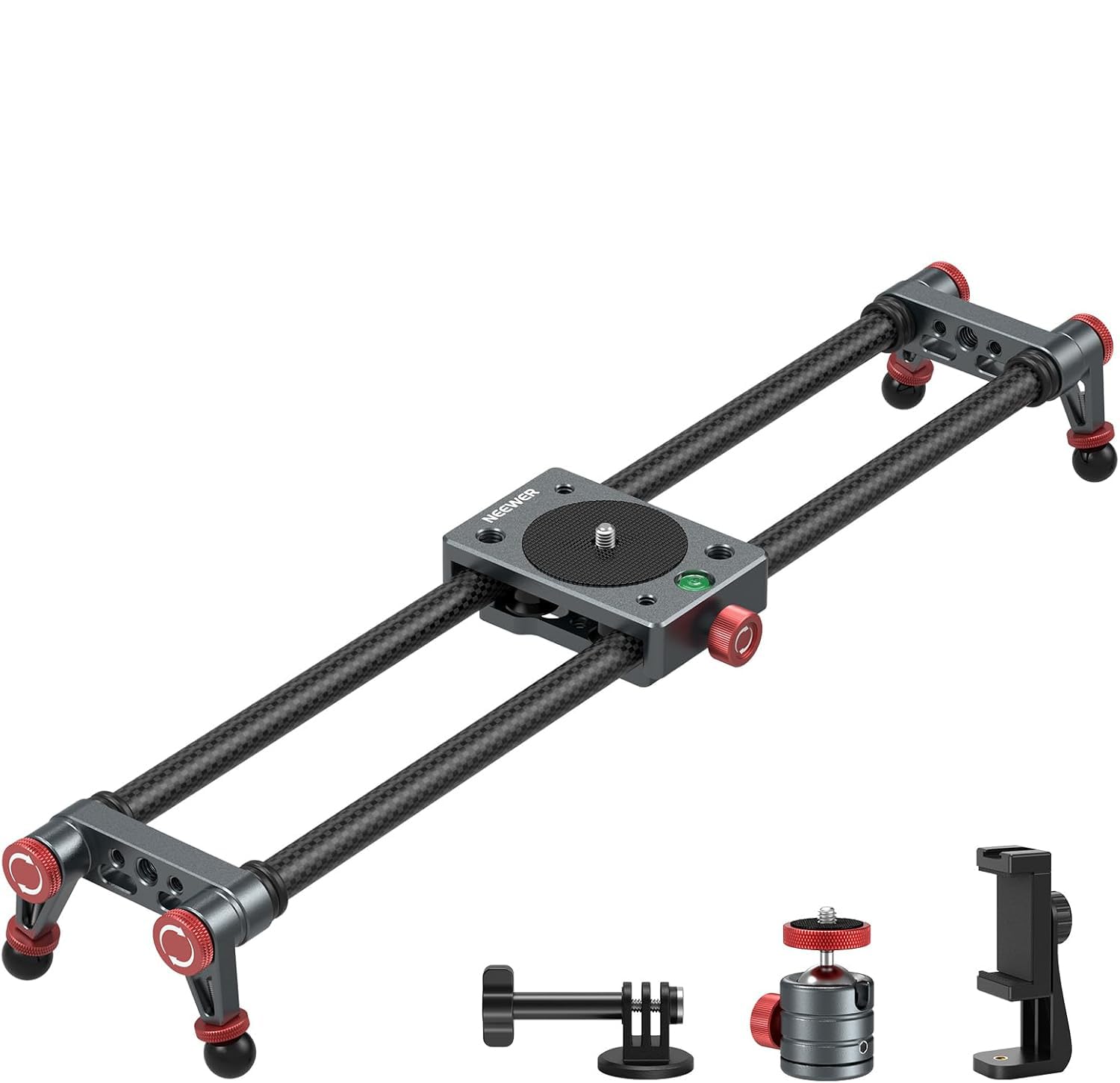
At 1.3 pounds, this NEEWER is the one you toss in a bag without thinking. For scale, the 10-pound GVM is roughly 7.7 times heavier — that is the difference between a studio rail and a travel rail. The carriage rides on four high-precision bearings, so a hand-pushed glide down the 16-inch rail is smooth and quiet, and a side tension knob lets you dial the drag to taste.
The clever part is the mounting freedom. A mini ball head gives 360° rotation and 90° tilt, and the top 1/4″ screw fits DSLRs, mirrorless bodies, action cams, and phones. A rotatable phone holder with an extra 1/4″ thread and a cold shoe lets you bolt on a small LED or a mic. The 360° adjustable legs lift from 2 to 5cm to level out on uneven ground, and a bubble level checks alignment fast.
Here is the honest limit on standing it up. The load rating is 4.4 pounds flat, 2.2 pounds at a 45° tilt, and 2.2 pounds vertically — so a phone, a GoPro, or a compact mirrorless climbs fine, but a full DSLR with a long lens is pushing it. That is a payload mismatch, not a defect. If your rig is light and your moves are small, this is the budget-friendly way into vertical slider work.
Best used for: tabletop and phone-driven moves, food and product close-ups, and any shoot where the rail has to disappear into a backpack.
Keep in mind: the vertical figure of 2.2 pounds caps what you can climb — pair it with light bodies, not heavy glass.
Go for it when: your camera is a phone, an action cam, or a small mirrorless and you want smooth vertical slides on a tight budget.
Step up instead if: your rig plus lens climbs above 2.2 pounds upright.
3. GVM 27″ Aluminum Alloy Motorized Slider
The 27-inch workhorse built for interview pushes and slow tripod tilts.
Owners describe this aluminum slider as one of the best affordable motorized options going, and the easy setup is a big reason why. The 27-inch rail is aluminum alloy rather than carbon, which trades some weight for stiffness and a lower entry pointorized slide travel paired with 360° pan rotation. That combination is what lets a foreground object slide past a background as you reveal a detail in a product shot.
Control stays on the device for basic moves. You position the shot, set A and B points, and adjust speed straight from the onboard controls, no app required. Enable looping and it will repeat the motion while you demonstrate a product or perform on camera. Go into the iFootage Moco app and the ceiling lifts to up to 8 keyframes with individual motion settings — enough for multi-step moves, time-lapse, and stop-motion.
Portability is the headline: roughly 1.9 lb (860 g) in an aluminum body, with built-in feet for tabletop setup and about 7 hours of horizontal battery run time. Supports up to 2.4 lb horizontally or 1.1 lb vertically, including accessories. A phone holder and quick-release plate are included; the pocket-camera and action-cam mounts plus a PD 30W charger are sold separately, so budget for those if your kit is not a phone.
The motion tinkerer’s deck: onboard A/B points plus 8 app keyframes give you more move-building than most mini rails — a good match for product, food, and tabletop shooters.
The real catch: the 1.1-pound vertical rating is light. A phone or DJI Osmo Pocket fits; a mirrorless body points you at a sturdier rail.
Made for you if: you film phone or pocket-camera moves on a table and want loop and keyframe control without a laptop.
Wrong tool if: your camera outweighs 1.1 pounds when mounted upright.
4. GVM Carbon Fiber Motorized Camera Slider 31″ with Remote

A 48-inch carbon rail that trades the remote for a phone app.
The 48-inch (120cm) rail hands you the longest travel here, which matters when a vertical move has to cross a whole body or a full product display. The carbon fiber body keeps a rail this long manageable — it comes in at 4 kg — and the stable carriage glides with multiple 1/4″ and 3/8″ screw ports on both sides and the middle. Owners rate it a great investment for videography, with build quality and smooth operation as recurring strengths.
Control moves to your phone. Instead of a hardwired controller, you manage the motorized motion through an iOS or Android app on a smartphone or tablet. The slider is a 6-in-1 tool: tracking shooting, panoramic shooting, time-lapse, video capture, free start and end points, and auto loop, with speed from 1% to 100% and photo counts up to 1000. Six shutter release cables plus an extension cable cover most camera bodies.
The quiet motor earns real credit — it is tuned so mechanical noise does not bleed into your recorded audio, which is exactly what you want on a long vertical push where clean sound matters. The catch: owners give the app controls mixed reviews, and setting start and end points is a manual step many would rather automate. Adjustable legs on both sides let you level the rail anywhere a slope fights you.
What sells it: 48 inches of carbon-fiber travel plus app-driven keyframes, with a motor quiet enough to keep off your audio track.
What to expect: you will set start and end points by hand more often than you might like — the controls are the part that gets mixed notes.
Reach for this if: your vertical reveal needs a long throw and you would rather program moves from your phone than a handset.
Skip over it if: you want one-touch automated point setting rather than manual entry.
5. Accsoon Toprig Motorized Camera Slider 24″ S60
A brushless motor rated under 30 decibels — quiet enough to shoot dialogue beside.
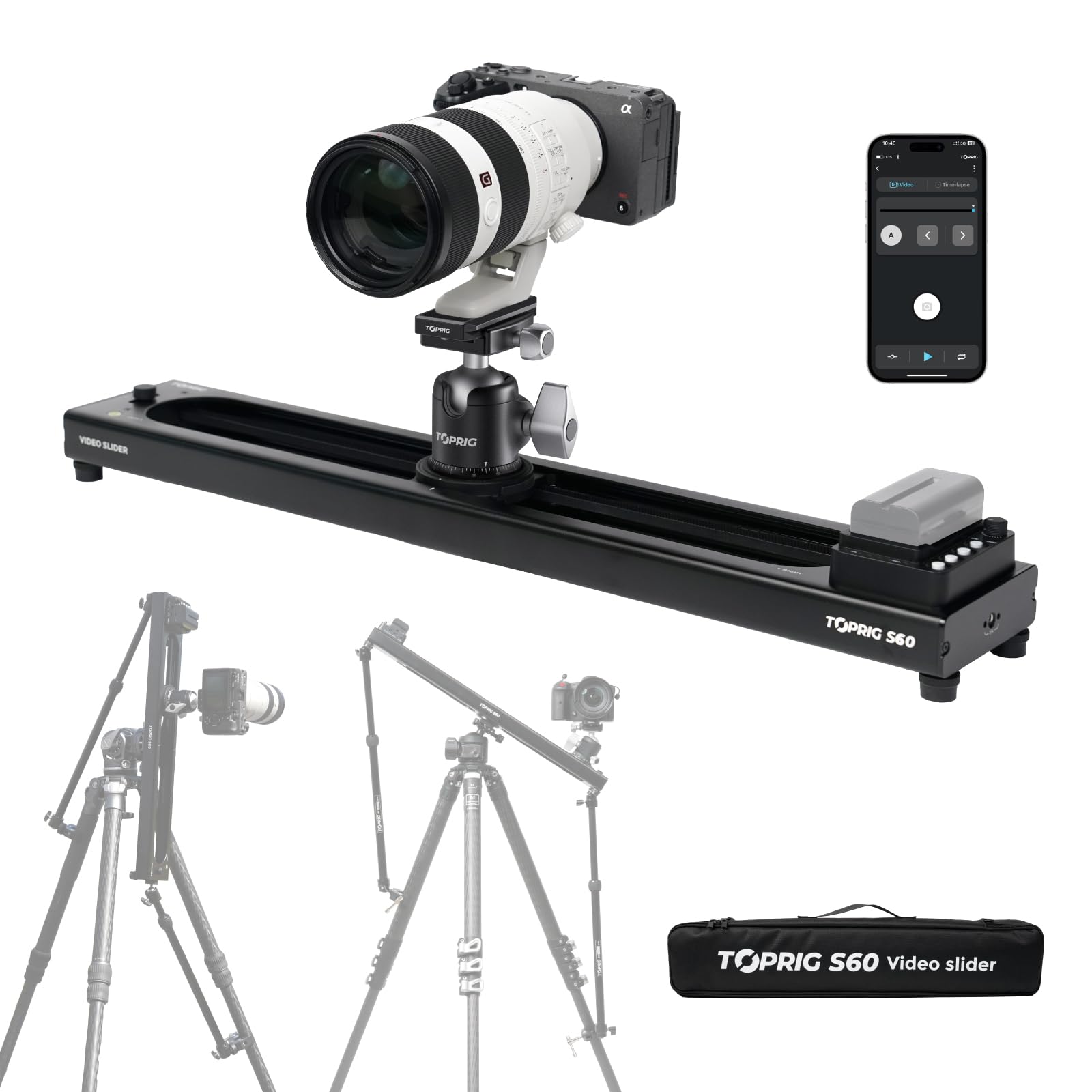
Noise is the spec that decides whether a slider belongs on a film set, and this Toprig is aimed squarely at that. Its ultra-quiet brushless stepper motor is rated at a noise level below 30dB — a whisper-quiet sound, per the maker — which cuts the worry of background buzz creeping into a recorded take. The 24-inch (60cm) aluminum rail weighs 3.3lb (about 1.5kg) and still holds lenses steadily, from a 200mm focal length down to a 24mm macro.
The control setup is two-way. Connect over Bluetooth to the Toprig app, or use the full-button panel directly on the rail. Video, time-lapse, and loop modes are there, with Point A and Point B moves you set in the app and a built-in speed knob for manual adjustment (0.1–5 cm/s). Startup is quick — power on and complete auto-calibration in 12 seconds before you shoot.
Load figures are per orientation: 4kg horizontal and 2.5kg at a 90° tilt, for GoPros, DSLRs, and smartphones. Two practical notes from the maker: batteries and the DC cable are not included, and if you run DC it should be 12V 3A — over-high voltage can leave the motor unable to detect stalls correctly. Build and functionality get mixed reviews, with some owners noting jitter, so test your rig’s weight and speed on a short move first.
The quiet-set case: below-30dB operation and a 12-second calibration suit interview and film work where sound and speed of setup both matter.
The fine print: batteries are sold separately and the power spec matters — feed it the wrong DC voltage and the motor may not read stalls.
Worth it for: dialogue-adjacent shoots and fast setups where a near-silent motor and 12-second calibration earn their place.
Not the pick if: you want everything in the box — this one expects you to bring the batteries and DC cable.
Know the Specs
Payload and vertical load ratings
A slider’s weight rating is not one number — it depends on the angle. Lying flat, a rail can hold far more than it can standing upright, because gravity pulls your camera away from the carriage instead of pressing it down. The NEEWER CS1M shows this clearly: 4.4 pounds flat but 2.2 pounds at a 45° tilt and 2.2 pounds vertically. Always add up your camera, lens, and any cage, then compare the total to the vertical or 45° figure for the shot you plan to make.
Stepper motors and noise
A stepper motor moves the carriage in tiny fixed steps, which is what keeps your vertical push at an even speed and lets you set exact start and end points for time-lapse. A brushless stepper motor is the quieter, smoother version — the Toprig S60 rates its motor below 30dB. Noise is not just a comfort issue: if the motor whines, a nearby mic can pick it up. That is why quiet operation matters as much as payload when you shoot video with live sound.
Travel length and rail material
Travel length sets the size of the move you can make. A 15.7-inch mini covers tabletop product shots; a 31-inch rail handles interview pushes and full vertical reveals; a 48-inch rail crosses a whole body or display. Carbon fiber keeps a long rail lighter and stiffer, while aluminum alloy tends to be stiffer and heavier at a given length. Match the length to your most common shot and let the material follow — a long rail you never carry is a liability on location.
Control methods
You drive the carriage three ways: a hardwired remote, onboard buttons, or a phone app. Remotes give a physical handset for setting speed and photo counts; onboard buttons let you set points on the rail without your phone; apps open up multi-point keyframes and stop-motion. The GVM 48-inch and 2-axis models run on an iOS/Android app, while the Accsoon Toprig offers both app and panel. Choose the route that matches how you shoot solo versus how a crew works.
Common Questions
What actually makes a camera slider a Y-axis slider?
How much weight can I hang vertically on these sliders?
Will these sliders work with a smartphone as well as a DSLR?
Do these motorized sliders come with the battery and cables I need?
Can a slider this compact still do time-lapse?
How quiet are these motors in a room with a microphone?
Will the app that controls the slider work on both iPhone and Android?
How do I mount a slider vertically on a tripod?
What is the difference between tracking and panoramic shooting on these sliders?
Do I need a specific charger for a motorized slider?
The Bottom Line
For most people, the y-axis camera slider that earns the top spot is the GVM 31″ Carbon Fiber Motorized Slider — it pairs a 20-pound payload and a 31-inch rail with a silent stepper motor, a full kit of cables and battery, and 120° panoramic plus time-lapse modes. If you shoot phone and tabletop moves, the IFOOTAGE Shark Slider Pico gives you 255mm of travel and 8 keyframes at under 2 pounds. And when a heavy camera needs a vertical rail that will not flex, the GVM 31″ Aluminum Track Dolly at 44 pounds of vertical load is the one to reach for. Match the vertical load rating to your rig’s total weight, and the right slider picks itself.
How we choose
We do not accept paid placement. Every pick is matched to a real buyer and a real use-case; we do not hands-on test units.
Sources
Specifications: manufacturer listings and product documentation. Review insights: verified customer reviews, as of November 2026. Pricing: not shown on this page (it changes often); check the current price via the retailer link.
As an Amazon Associate, Tactical Gear Guy earns from qualifying purchases. This does not affect which products we feature.