Specs are compiled from manufacturer listings and verified buyer reviews and can change over time — please confirm the key details on the product page before buying.
Before you buy a wood pellet burner to heat a room, decide one thing: do you want a stove that warms a whole house on a thermostat, or a patio unit that throws a visible flame at your feet? That choice matters more than anything else. Hopper size (how many pellets it holds), BTU rating (how much heat it puts out) and WiFi all come second.
This guide is built by comparing the manufacturers’ published specifications and the patterns across verified customer reviews, so you get each pick’s real strengths and trade-offs instead of marketing spin.
You will see how a 130 lb hopper changes your refill routine, why a 25 lb hopper suits a cabin better, and which control style keeps a room steady overnight. Each pick below earns its spot for a specific job, which is what makes a shortlist of the wood pellet burners here genuinely useful rather than a spec sheet in disguise.
Top Picks
How To Choose The Best Wood Pellet Burners
A pellet burner is only as good as its match to your room and your routine. A unit rated to heat 3,000 square feet is wasted money in a 400 square foot sunroom, and a small cabin stove will run flat out trying to cover an open-plan house. Start with the room, then work backward to the machine.
Match coverage to the room, not the brochure
The coverage figure tells you the floor area a stove is intended to heat under normal temperature conditions. Look at the range, not just the top number — a stove listed for 1,800 to 2,500 square feet is honest about its floor. If your space sits at the bottom of a range, the burner will cycle rather than strain, which is easier on the unit and quieter in the room.
Hopper capacity sets your daily routine
A hopper holds the pellets that feed the fire, and its capacity in pounds decides how often you refill. A 130 lb hopper swallows roughly three bags of pellets at once; a 25 lb hopper needs topping up far more often. If the stove lives where you pass it daily, a smaller hopper is no burden. If it heats a house through a cold snap, capacity is the difference between a chore and an afterthought.
Ignition and controls: push-button vs gravity
Auto ignition means the stove lights itself on command, often from a remote or a phone app. A gravity-feed stove has no blower, no circuit board, and no power draw — it lights manually and runs on natural draft. Pick electric ignition if you want a programmable thermostat and Eco cycling. Pick gravity feed if your priority is running through a power cut in silence.
Indoor stove or outdoor patio flame
These are two different animals wearing similar names. An indoor pellet stove is a sealed, vented heating appliance with a hopper and a thermostat. An outdoor pellet patio heater is a freestanding flame feature for a deck or patio, and it stays outside only. Decide which one you are shopping for before you compare a single BTU figure.
Side-by-Side Comparison
| Model | Best For | Hopper Capacity | Heat Output | Coverage | Amazon |
|---|---|---|---|---|---|
| Cleveland Iron Works Large Pellet Stove★ Best Overall | Whole-home heating with a big hopper | 130 lb | 29,501 BTU | 2,000–3,000 sq ft | Amazon |
| NUUK Outdoor Wood Pellet Patio HeaterBest Outdoor Flame | Patio flame and outdoor gatherings | — | 70,000 | 100 sq ft | Amazon |
| Greenstovehori 5 Max Outdoor Pellet StoveBest for Tent Camping | Hot tent camping with a built-in oven | — | — | 4–6 hours per full load | Amazon |
| ComfortBilt HP40 Alpine | Cabins and sunrooms on a thermostat | 25 lb | 26,224 BTU | 1,500 sq ft | Amazon |
| Castle 41278 Serenity | Programmable modes and easy cleaning | 40 lb | 32,000 BTU | 1,500 sq ft | Amazon |
| Bay Front Pellet Stove | Smart-home control and quiet running | 66 lb | 30,173 BTU | 1,800–2,500 sq ft | Amazon |
| Canyon Lodge Large Pellet Stove | Large spaces and mobile homes | 130 lb | 29,501 BTU | 2,000–3,000 sq ft | Amazon |
| US Stove GW1949 Wiseway | Off-grid heating with no electricity | 60 lb | 40,000 BTU | 2,000 sq ft | Amazon |
| Freedom Stove PS21 | Battery backup and app control | — | 34,700 BTU | 800–1,800 sq ft | Amazon |
Detailed Reviews
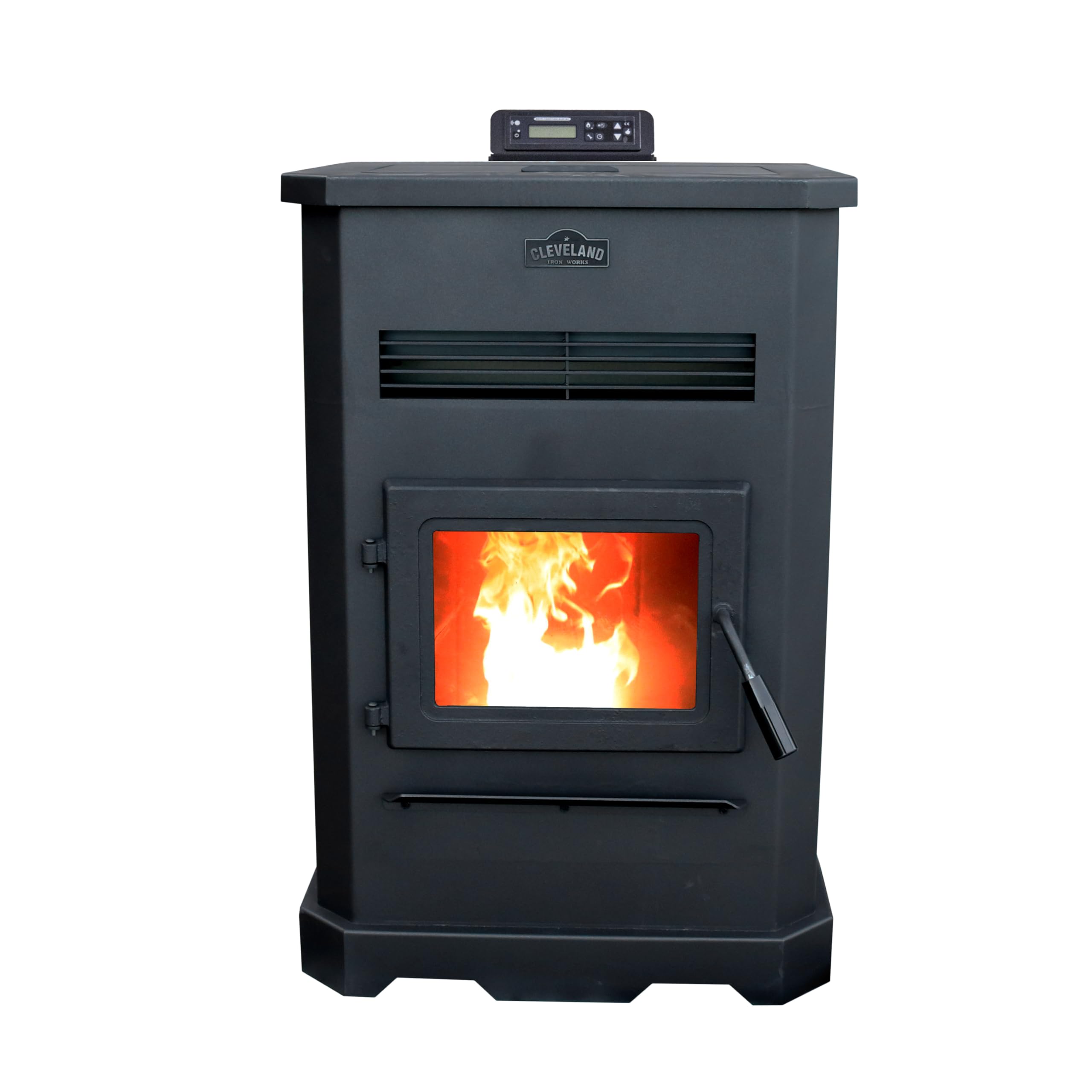
1. Cleveland Iron Works Large Pellet Stove – 130lb Hopper
Our pick — 4.0+★ from 50+ verified ratings; the strongest balance of quality and price.
The one that swallows three bags of pellets and forgets about you for days.
Fed by a 130 lb hopper, this cast iron stove covers a reported 2,000 to 3,000 square feet and puts out 29,501 BTU (British thermal units — the standard measure of heat a stove produces). In practice that hopper capacity is the headline: it takes roughly three full bags of pellets in a single fill, so the twice-daily scooping ritual most pellet owners know simply disappears from your schedule.
Set against the ComfortBilt HP40 Alpine, the hopper gap is stark. The Cleveland holds 130 lb where the ComfortBilt carries 25 lb. That difference decides how a cold week feels — one long refill interval versus constant top-ups. It is also a physically bigger machine, at 27.6 inches deep by 24.49 inches wide by 36.75 inches tall, so measure your hearth pad before you commit.
Owners consistently report the house warms up and stays warm, which the 29,501 BTU output supports. Built-in WiFi puts the thermostat and fan settings on your phone, which suits anyone who wants to nudge the room temperature from the sofa. The honest catch is that this is a 209.4 pound cast iron appliance. It is a permanent installation, not something you wheel between rooms.
Where this stove earns its keep
- 130 lb hopper holds about three bags of pellets, so refills are rare instead of daily
- 29,501 BTU output for a claimed 2,000 to 3,000 square feet of coverage
- Built-in WiFi lets you adjust heat without leaving the couch
- Cast iron build that reads as solid the moment you touch it
The parts that ask something of you
- At 209.4 pounds it is a fixed installation, not a portable heater
- The footprint is large — check your clearance before it arrives
- A big hopper means lifting full bags to shoulder height to fill it
Built for: a house or open-plan space where you want one big fill to last and WiFi control in reach.
Think twice: if you rent, move the stove between rooms, or have a narrow hearth — this unit stays put.
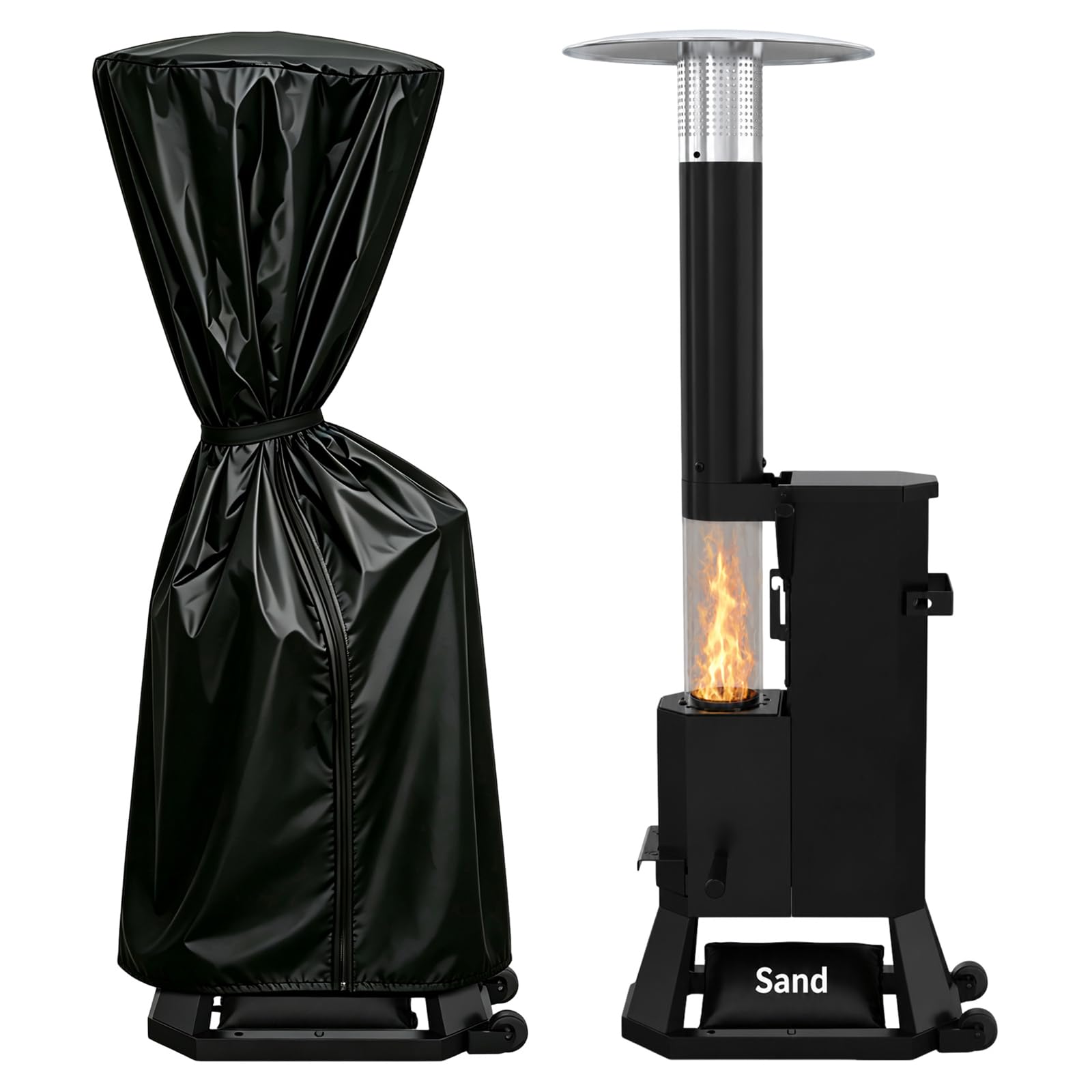
2. NUUK Outdoor Wood Pellet Patio Heater
A 48.97-inch glass tower that turns pellets into a visible flame on your patio.
This is not the same job as the indoor stoves further up the list. The NUUK stands 48.97 inches tall as a freestanding patio piece, burns wood pellets, and shows you the fire through a clear glass tube. It is a centerpiece first and a heater second — the kind of thing that gives a backyard gathering something to face.
The contrast with a house stove is dramatic on both ends. Where the Bay Front weighs 242.5 pounds, this unit weighs 23.2 pounds and rolls on built-in wheels after it cools completely. Coverage is a modest 100 square feet, which tells you it warms the ring of people around it rather than a room.
Read the setup rules carefully before you order. It needs at least 36 inches of clearance from anything combustible and must sit on a hard, smooth, level, non-combustible surface. No wood decks, no overhangs, nothing enclosed. During the first light you may see a brief haze as the fire catches — that settles once the flame reaches a steady burn. Move it only when fully cooled, and the wheels then do the work.
What you are buying: a 23.2 pound outdoor flame feature with a glass viewing tube, wheels for repositioning, and a 100 square foot heating reach for the people sitting nearest it.
Where it will not work: a wooden deck or a covered porch rules it out entirely — the clearance and surface requirements simply do not bend.
Reach for this if: you want visible fire on a hard patio surface and love the idea of rolling it into place for the evening.
Look elsewhere if: your deck is timber or your goal is heating an interior room.
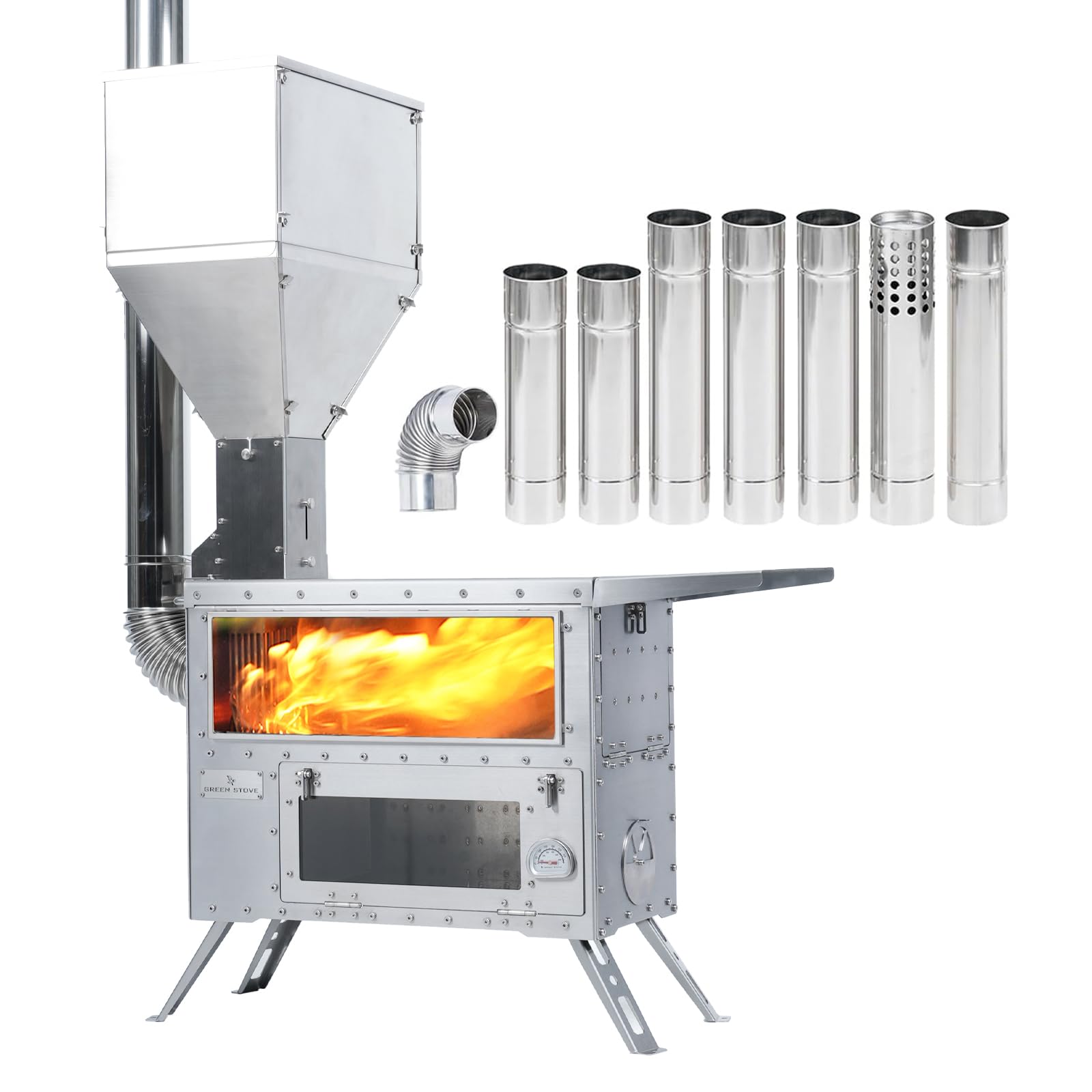
3. Greenstovehori 5 Max Outdoor Pellet Stove
A stainless tent stove with a real oven built in and 4–6 hours of burn on a full load.
For a canvas tent in freezing weather, a full pellet box delivers 4 to 6 hours of burn — enough to get you through a long night if you load it last thing. The stainless steel body weighs 48.5 pounds, which is heavy enough to stay planted but still goes in the included carry bag.
Owners praise the build quality most, and the stainless steel body is the reason. The U-shaped interior is designed to hold heat inside rather than lose it up the chimney, which makes a difference in a space as leaky as a tent. The oven is the detail that changes a trip — you can cook on the fire that is already warming you.
One change to know about: the chimney damper is no longer included in this version. Instead you control the burn with the pellet Sheep Horn Bolt, adjusting how fast fuel feeds to set your power level. The pellet cage is a wear part, and continuous high-temperature use can eventually wear it — replacements sell separately. The kit itself is thorough, with two 2.95 × 12.6 in tubes, two 2.75 × 15.75 in tubes, one 2.95 × 15.75 in tube, a 2.75–2.95 in adapter, a windproof tube, and a 2.75 in 90° elbow.
The overnight case: a full pellet box carries you 4–6 hours, the U-shaped interior holds the heat in, and the enlarged hopper plus bigger oven make it the more capable tent setup for cold-weather trips.
Dampers and wear parts: no chimney damper in this version — you tune the burn with the Sheep Horn Bolt — and the pellet cage is a replaceable item you should expect to buy again.
Made for: cold-weather tent camping and ice fishing where you want heat and a cook surface from one unit.
Not the fit if: you want a set-and-forget house heater with a thermostat.
4. ComfortBilt HP40 Alpine Pellet Stove

A narrow-footprint cabin stove that runs itself on five settings and a thermostat.
The Alpine is built for a small footprint. At 21 inches deep by 17 inches wide by 30 inches tall it slots into a cabin, sunroom, garage, or workshop where a full-size stove would crowd the room. It delivers 26,224 BTU per hour from a 25 lb hopper and claims 1,500 square feet of coverage at 81% efficiency.
Automation is where this one punches. Five power settings, a programmable thermostat, auto ignition, and an included remote mean you set the temperature and walk away. The removable ash pan takes the worst of the cleanup, and a powerful room blower pushes heat out rather than letting it pool above the stove.
Now the trade-offs. The 25 lb hopper is the smallest in this group, and against the Castle’s 40 lb it needs refilling noticeably more often. Buyers report it heats well, but the 25 lb hopper and 1,500 square foot ceiling suit a defined room, not an open-plan house.
Standout wins
- Five power settings with a programmable thermostat and included remote
- Compact 21 × 17 × 30 inch footprint fits tight spaces
- 81% efficiency with a powerful room blower and removable ash pan
- Auto ignition lights the burn for you
Honest limits
- 25 lb hopper means frequent refills compared to bigger models
- Coverage tops out around 1,500 square feet
Pair it with: a defined cabin, garage, or sunroom where the thermostat and remote do the managing for you.
Different route: a large open-plan home wants a bigger hopper and a wider coverage claim.
5. Castle 41278 Serenity Pellet Stove, 1,500 sq ft

Four operating modes and a hopper that holds 40 lb — then an easy-clean interior.
Castle’s Serenity brings 32,000 BTU across a claimed 1,500 square feet from a 40 lb hopper. That hopper sits between the ComfortBilt’s 25 lb and the Cleveland’s 130 lb, which makes it the middle path for a home that wants occasional rather than constant filling.
The smart controller is the real story. Manual, Thermostat, Weekly, and Eco modes cover a range of habits — Eco lets the stove toggle on and off to hold a target room temperature rather than burning steady. Every mode programs from the included remote. The interior is built for cleaning too, with no tubes, corrugations, or hidden chambers to chase ash through, and the operating wattage is a light 77 W at 120 V.
Owners praise reliability most, and the stove runs warm and quiet when it is dialed in. One caveat worth knowing: a report surfaces of the auger (the screw that feeds pellets into the fire) cycling only 3 to 4 times, a feed-rate hiccup to watch during your first burns. Install is easy to schedule but requires a phone number for the truck delivery appointment, so plan a day around it.
The mode question answered: if you want a stove that maintains a set temperature on its own schedule, Eco and Weekly modes plus the remote do that job — no daily fiddling required.
A feed-rate note: the auger cycling short on a unit is a real report to keep in mind; check the feed during the first week and it is easy to catch.
Suits: a household that wants scheduled modes, a 40 lb hopper, and a clean-out that does not fight back.
Reconsider if: you need immense coverage or want to skip the delivery-appointment scheduling.
6. Bay Front Pellet Stove w/Smart Home Technology

Cast iron, WiFi, and 30,173 BTU with a hopper that carries you through a long stretch.
Here is the biggest heat number among the indoor cast iron stoves: 30,173 BTU for a reported 1,800 to 2,500 square feet. Against the ComfortBilt’s 26,224 BTU, that is a higher ceiling, and it matches a larger 66 lb hopper. The smart home build puts a digital control panel and a remote in your hands, and built-in WiFi lets you tweak settings from your phone.
Owners notice the quiet blower most. A performance-first stove that you can sit beside without a roaring blower is a real comfort in a living room. Temperature control is a strength too — the stove comes on automatically when the room drops to a set point, so it stays ahead of the chill instead of chasing it.
Two things to weigh. Installation reports vary; some find it simple, some want better instructions, so budget patience for the first setup. And the flame control aspect is the most-discussed gripe — dialing in a specific burn takes more time than you might expect. Neither is a dealbreaker, but they are the honest limits. It also qualifies for the 30% IRS Biomass Stove Tax Credit, so confirm your eligibility before filing.
Heat and hush together: 30,173 BTU, a 66 lb hopper, and a blower quiet enough to live alongside — the combination that makes a cast iron stove disappear into daily life.
Setup mood: instructions split opinion, and fine flame adjustment takes patience — plan for a learning curve during the first week.
The right pick for: a homeowner who wants the biggest heat number here, WiFi control, and a stove quiet enough for the living room.
Try another route if: instruction clarity and fine flame control matter most to you.
7. Canyon Lodge Large Pellet Stove
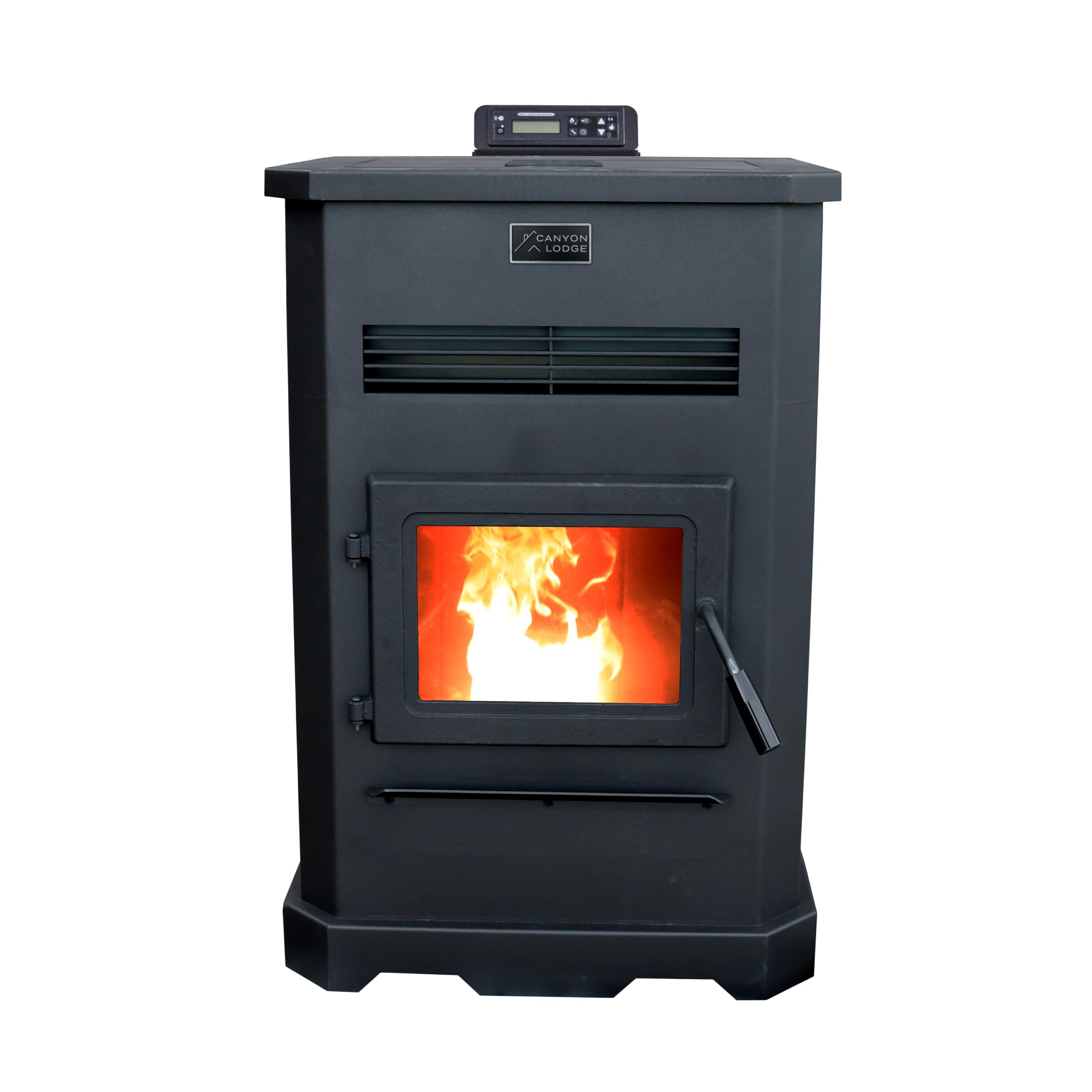
A 130 lb hopper and Whisper Quiet blower for heating 3,000 square feet quietly.
The Canyon Lodge matches the Cleveland on paper for coverage and hopper: up to 2,000–3,000 square feet and a 130 lb hopper. It puts out 29,501 BTU, the same figure, from the same manufacturer, Enerco Group Inc. It is a steel fire pot inside a metal body with EPA approval, and it stands 27.6 × 25.75 × 36.73 inches, essentially a big freestanding stove for a large room.
Where it differentiates is the install features. A fresh air kit is included, and it is mobile home approved — a specific clearance certification that matters if your home is factory-built. The Whisper Quiet Blower Technology and Smart Home Technology give you quiet running and app control, and the large viewing glass has an air wash system to keep the flame visible.
Owners respond to the build quality most, and the air wash glass keeps soot off the window through the first season. Automatic ignition removes the manual-light step. The 209.4 pound weight means it anchors to the floor and stays there — this is a freestanding, floor-mounted unit, not a movable one.
Why it stands out: a fresh air kit in the box, mobile home approval, and an air wash glass that stays clear make this the most install-ready large stove here.
The space it needs: 209.4 pounds and a 27.6-inch depth demand a real hearth pad and a solid floor.
Go with it if: you have a large room, a factory-built home, or both — the fresh air kit and mobile home approval are purpose-built for that situation.
Leave it if: floor loading is a concern or you need to move the heater between seasons.
8. US Stove GW1949 Wiseway Non-Electric Pellet Stove

A pellet stove that runs with no electricity, no blower, and no fan noise at all.
The Wiseway is the outlier on this list. It is a non-electric, gravity-feed pellet stove — the pellets slide down a chute under their own weight, no auger motor involved. EPA certified, it puts out 40,000 BTU for a reported 2,000 square feet from a 60 lb hopper that lasts up to 30 hours on a full load. Standard 3-inch pellet venting keeps install familiar.
Two things make it outstanding in a power cut. It draws no electricity, so the heat keeps coming when the grid goes down. And the operation is silent by design — no blower roaring, no motor cycling. Assembly is straightforward enough that owners find it simple to put together.
Here is the honest part. Heat output splits opinion: for some it warms well, others say it does not truly cover 2,000 square feet. Reliability and value read mixed too, and smoke reports come up. The trade-off with a 40,000 BTU figure and no electrical assist is that you manage the burn yourself — less automation, less forgiveness. It rewards a hands-on owner who understands draft and feed and keeps an eye on it.
The case for going electric-free
- No electricity required — heat continues through an outage
- 60 lb hopper burns for up to 30 hours per fill
- No blower or motor, so operation is silent
- Standard 3-inch venting simplifies the install
Where it demands more
- Heat coverage and reliability read as mixed — the 2,000 square foot claim has doubters
- Smoke reports appear and it wants a careful operator
For the off-grid owner: someone who needs heat with no power and no noise, and is comfortable managing the burn by hand.
Maybe not if: you want set-and-forget coverage of a large, open space.
9. Freedom Stove PS21 Pellet Stove

Runs on batteries for 40+ hours during an outage, with a touchscreen and app too.
The PS21 delivers 34,700 BTU — the highest heat figure among the indoor stoves here — across 800 to 1,800 square feet, using a stacked tube heat exchanger to hold on to warmth. It lights in about four minutes and warms up fast, and the red steel finish with black side panels stands out rather than blending into the wall.
what separates it is the backup system. A 24V DC setup (a low-voltage power system) runs the stove for 40+ hours on two 12V batteries (sold separately), so a storm or an outage does not leave you cold. You still get automation: a full touchscreen, a WiFi app and a remote. The 12×12 ceramic tile side panels let you match the room.
The five-year limited warranty and U.S.-based support from Pellethead suit a do-it-yourselfer who plans to clean and repair it personally. Where it gives back a little: temperature control and WiFi connectivity both read as mixed — the app experience and fine temp-holding are not the smoothest part. Reliability and performance, though, are what owners praise, and lighting in about four minutes puts it among the quicker starters here.
The outage insurance: 40+ hours of heat on two 12V batteries means a winter storm does not stop the warmth — and the five-year warranty plus U.S. support covers the long haul.
App-side friction: WiFi and temperature-holding are the parts that draw mixed feelings, so plan on the touchscreen doing most of the work.
Made for: a storm-prone or off-grid home that wants heat through an outage, a fast light-up around four minutes, and a warranty you can call on.
Not quite the fit if: you need to heat more than 1,800 square feet or demand a polished app experience.
Know the Specs
BTU and Coverage in Square Feet
BTU (British thermal units) measure how much heat a stove produces; the coverage figure tells you the floor area that heat is intended for. A high BTU number with a modest coverage figure can mean the stove runs hard for its size, while a lower BTU with a wide coverage claim leans on an efficient blower. Read both together. The Freedom’s 34,700 BTU and the Wiseway’s 40,000 BTU are heat peaks; the 800–1,800 and 2,000 square-foot figures are what those peaks are aimed at covering.
Hopper Capacity and Burn Time
The hopper is the tank that holds your pellets, measured here in pounds. A larger hopper holds more pellets, which means fewer refills. The Wiseway’s 60 lb hopper runs up to 30 hours per fill; the Cleveland and Canyon Lodge carry 130 lb each; the ComfortBilt’s 25 lb is the smallest. Burn time also depends on the power setting, so a 30-hour claim reflects a low, economical burn rather than a full roaring fire.
Auto Ignition, Thermostats, and Modes
Auto ignition means the stove lights itself on command rather than needing a manual fire starter. A programmable thermostat holds a set room temperature, and Eco mode lets the stove toggle on and off to reach that target rather than burning steady. These features decide how hands-off a stove feels — a unit with five settings and a remote runs itself for an evening, while a gravity-feed stove asks you to manage the fire directly.
Venting and Clearance
Indoor pellet stoves need venting — some use standard 3-inch pellet venting, which is a common, familiar spec for an installer. Clearance rules matter even more for outdoor units: the NUUK requires at least 36 inches from anything combustible and a hard, non-combustible, level surface, with no wood decks or enclosed areas. Always confirm your installation spot against the maker’s own clearance figures before the first burn.
Common Questions
How long does a full hopper of pellets actually last?
Can I use a pellet stove during a power outage?
Do I need electricity for a pellet stove to run at all?
Can I use an outdoor pellet patio heater on a wooden deck?
What does Eco mode do on a pellet stove?
Is a bigger hopper worth it, or does it just waste pellets?
What is the difference between a gravity-feed and an auger-fed stove?
How much square footage can a large pellet stove really heat?
Can I install a pellet stove in a mobile home?
Do pellet stoves need a chimney, or just a vent?
The Bottom Line
For most homes, start with the Cleveland Iron Works Large Pellet Stove. Its 130 lb hopper (the pellet bin) and 2,000 to 3,000 square foot coverage mean you refill now and then, not every day. Want the biggest heat figure among the indoor cast iron stoves, with quiet running and WiFi? The Bay Front fits. And if your home loses power often and the heat has to keep coming, reach for the Freedom PS21 with its 40+ hours of battery backup.
The Cleveland pairs that three-bag hopper with the strongest owner-reported heating record in this set, which is why it tops the list. If your evening is spent on a patio instead of indoors, the NUUK’s 48.97-inch glass flame tower is a different kind of purchase, and worth choosing with the clearance rules in mind.
How we choose
We do not accept paid placement. Every pick is matched to a real buyer and a real use-case; we do not hands-on test units.
Sources
Specifications: manufacturer listings and product documentation. Review insights: verified customer reviews, as of November 2026. Pricing: not shown on this page (it changes often); check the current price via the retailer link.
As an Amazon Associate, Tactical Gear Guy earns from qualifying purchases. This does not affect which products we feature.