Specs are compiled from manufacturer listings and verified buyer reviews and can change over time — please confirm the key details on the product page before buying.
You want to know the moment a car turns into your drive or something crosses your gate — before it reaches the house. That’s the whole job of a yard motion detector, and the picks below do it without wiring, monthly fees, or a phone app you have to babysit. The trick is matching the detection range and the alert style to your property, because a sensor built for a 26-foot chicken coop won’t cover a 400-foot driveway.
This guide is built by comparing the manufacturers’ published specifications and the patterns across verified customer reviews, so you get each pick’s real strengths and trade-offs instead of marketing spin.
Some systems beam a chime into your kitchen from half a mile out, while others blast a siren and strobe right at the fence line. Below you’ll find the range, the power source, and the honest catch for each one, so you can pick the right setup for your best yard motion detectors.
Top Picks


How To Choose The Best Yard Motion Detectors
Two numbers decide most of this purchase, and buyers routinely mix them up. Detection range is how far the sensor’s eye reaches out to spot movement. Transmission range is how far the sensor can send its signal back to the receiver inside your house. Picture a gate at the end of a long lane: a unit with a 30-foot eye and a half-mile transmitter works there, because the sensor only needs to see the last 30 feet while the chime travels all the way to your kitchen.
Match the alert style to your property
A siren-and-strobe unit sits at the fence line and reacts on the spot with a loud noise and flashing light. That suits a farm, orchard, or chicken coop where you want to push deer and intruders away immediately. A receiver-based system stays quiet outside and chimes indoors, which is what most homeowners want for a driveway — you get a heads-up without broadcasting your security setup to the whole road.
Check how many sensors one receiver can hold
If you plan to cover a gate, a back shed, and a side yard, the receiver’s sensor limit matters more than the range. Expansion ceilings in this lineup run from just a handful of sensors up to dozens, so decide how many zones you actually want to watch before you buy. A receiver that tops out early will force you to buy a second system later.
Look hard at the power plan
Solar sensors recharge themselves through a panel and keep a backup battery topped up, which means no ladder work every few months. Battery-only sensors need fresh AA cells on a schedule, and in cold weather those cells fade faster. Whichever you choose, confirm the sensor is weather-sealed for rain and snow — IP65 is the common outdoor rating here, meaning it shrugs off dust and water spray.
Side-by-Side Comparison
| Model | Best For | Max Transmission Range | Detection Range | Power Source | Amazon |
|---|---|---|---|---|---|
| 1/2 Mile Long Range Solar Wireless Driveway Alarm 1R4S★ Best Overall | Whole-property coverage | 0.5 miles | 30 feet | Solar + battery | Amazon |
| SENKEFEI Solar Motion Sensor Alarm 130dBAnimal Deterrent | Scaring off animals | 26 feet | — | Solar + USB | Amazon |
| FULNIX Driveway Alarm with Portable ReceiverCarry-Anywhere Chime | Long lanes, carry-anywhere chime | 3000 feet | 55 feet | Solar + USB-C | Amazon |
| Qualirey 2 Pack Solar Motion Sensor Alarm 129dB | Two-zone farm protection | 8 meters | 5–8 meters | Solar + DC | Amazon |
| HTZSAFE Driveway Alarm 1R2S | Budget-friendly perimeter alert | 0.5 miles | 35–50 feet | 3 AA batteries | Amazon |
| HTZSAFE Solar Driveway Alarm 1R2S | Solar with backup receiver | 1/2 mile (70 ft sensor) | 25–70 feet | Solar + battery | Amazon |
| eMACROS Pro4 Wi-Fi Smart Solar Driveway Alarm | Phone alerts on the go | 2600 feet | — | Solar + rechargeable base | Amazon |
| Hosmart Driveway Alarm 1R2S | Chime variety and swivel mount | 1500 feet | 15–30 feet | AA batteries | Amazon |
| Wuloo Solar Driveway Alarm 1R4S | Multi-zone solar coverage | 30 feet (sensor) | 30 feet | Solar + rechargeable | Amazon |
Detailed Reviews
1. 1/2 Mile Solar Wireless Driveway Alarm 1R4S
Our pick — 4.5+★ from 100+ verified ratings; the strongest balance of quality and price.
Four solar eyes and a half-mile shout back to the house — one box covers the whole property.
This is the pick for someone with a long lane, a gate, or several outbuildings to watch, because it ships with a receiver and four motion sensors instead of the usual one. Each sensor sees movement up to 30 feet away, then beams the alert back up to half a mile in open air. That split — a 30-foot eye paired with a half-mile transmitter — is exactly what a driveway setup needs, since the sensor only has to catch the last few car lengths while the signal crosses the entire property.
The power plan is what makes it livable. Each sensor carries a battery that a solar panel keeps topped up, and you can also top it off with the included USB-C cable if a stretch of gray weather drains it. The housing carries an IP65 weatherproof rating (dust-tight and protected against water spray), and the maker rates the working temperature from -4°F to +140°F, so it stays on through a hard freeze and a summer heat wave.
Day-to-day reliability is where it earns its place. Owners lean on it most for catching vehicles and people at the gate, and they keep praising the battery life and the sun-fed charging as the reason it stays out of the way. It’s honest about its trade-offs too: it’s not a quiet unit. Some find the alert loud, so place the receiver where a sudden chime won’t jolt the whole house. Compared with the SENKEFEI siren alarm in this list, which reaches just 26 feet, this one stretches across a 0.5-mile spread — a different class of coverage.
What earns the top spot
- Ships with four solar sensors plus a receiver — real multi-zone coverage without buying more
- Half-mile transmission in open air handles long lanes and detached garages
- Solar panel plus USB-C backup keeps the battery fed through cloudy stretches
- IP65 housing rated for -4°F to +140°F year-round use
- Receiver expands to 16 sensors for a growing property
What to keep in mind
- The alert is genuinely loud — placement of the receiver matters
- You need decent sun on the panels or you’ll rely on the USB-C top-up
Built for: big properties with a long drive and more than one gate or outbuilding to watch.
Think twice if: your alerts need to stay whisper-quiet indoors — this one likes to be heard.
2. SENKEFEI Solar Outdoor Motion Sensor Alarm 130dB with Remote
A fence-line siren that barks, blasts, and strobes the moment something moves.
If deer keep stripping your fruit trees or raccoons treat the coop as a buffet, this is the shape of alarm that fits. It doesn’t chime indoors — it reacts right where the motion happens, with a 130dB siren plus a light, and you can load your own recorded voice or pick from the default dog-bark and gunshot sounds. Buyers pick it specifically to keep deer and raccoons out of gardens, orchards, and coops. The speaker is adjustable so you can dial the effect to the setting.
Setup leans simple. You get three operating modes — night only, 24-hour, or a timer — so you can keep it silent through the day and armed after dark, or run it around the clock. It’s solar-powered with a USB port as backup, so the sun does the charging and you stay off a ladder. It’s small and light, roughly 0.37 kg, and mounts on a protruding bracket aimed at the zone you want to guard. The maker backs it for two years.
Here’s the honest part, and it matters for this style of alarm. The noise that scares animals also can’t always be heard from inside the house, so don’t buy this expecting an indoor alert — it’s a deterrent at the fence, not a chime in the kitchen. A handful of units have faded within weeks, so treat this as a first line of defense rather than a set-and-ignore system. The 26-foot detection reach also means you’ll aim it at a specific spot — a garden bed, a gate — not a wide perimeter.
The design logic: a loud siren plus strobe at the detection point is the right call for pushing animals and wanderers away, and the 130dB rating gives it real reach on the ears.
The trade-off: it protects a spot, not a spread — 26 feet of detection wired to a fence post, best paired with a receiver-based system if you also want an indoor heads-up.
Reach for this if: you’re guarding a garden, orchard, or coop and want the alarm to sound right there.
Look elsewhere if: you need the alert inside the house — this one shouts outdoors.
3. FULNIX Driveway Alarm with Portable Rechargeable Receiver
The one that follows you around the property — a receiver with 30 days of unplugged runtime.
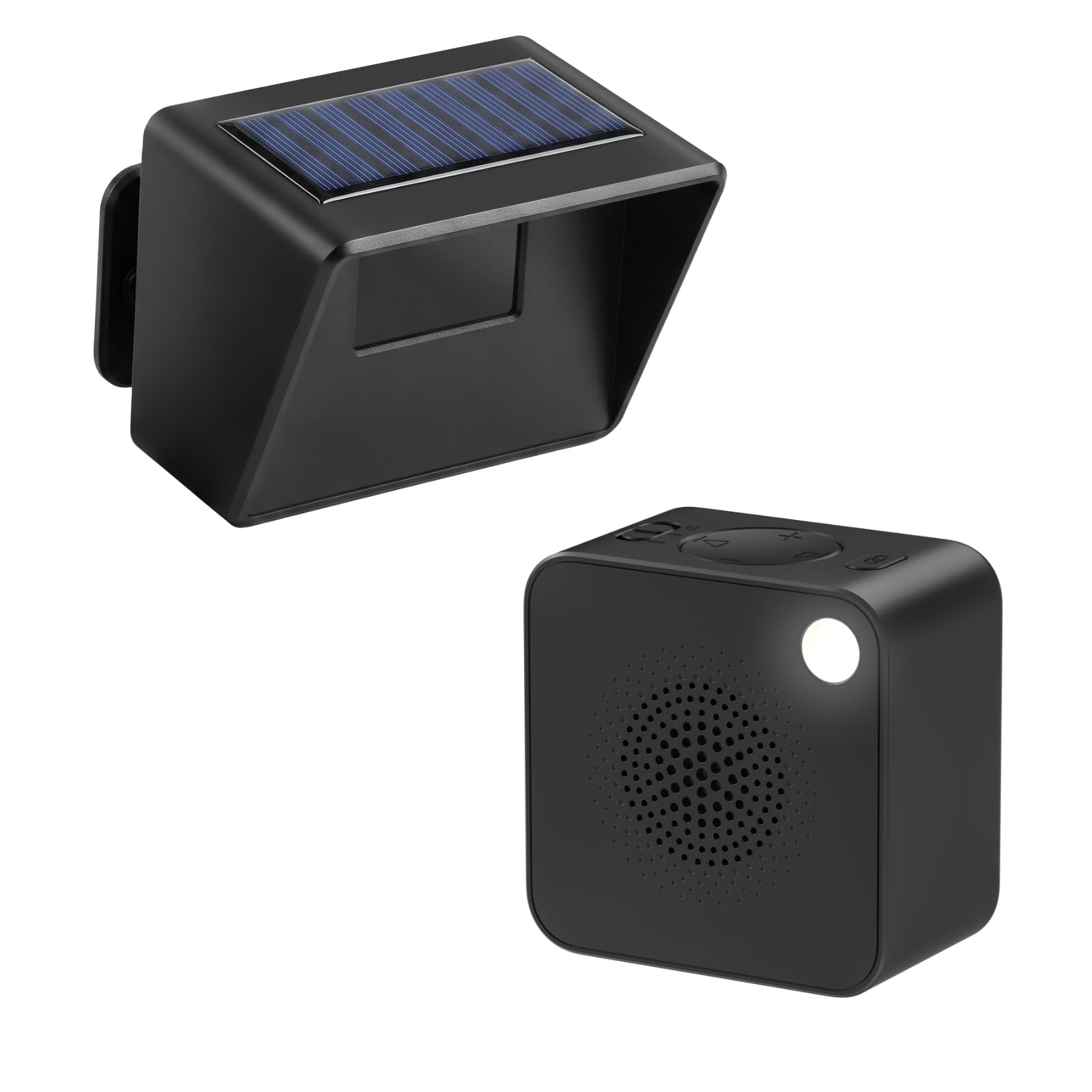
Most receivers are bolted to a wall outlet; this one carries a built-in 5000mAh battery rated for up to 30 days of use at roughly 10 alerts a day. That means you can walk it to the garage, the porch, or the workshop and still hear the driveway. It transmits up to 3000 feet in open, unobstructed conditions — far beyond the SENKEFEI’s 26-foot reach — and it does it without Wi-Fi, an app, a subscription, or wiring.
The sensor side is built to last between charges. Its 2500mAh rechargeable battery (a battery rated in milliamp-hours, a measure of capacity) is rated for up to two years of use on a full charge under typical conditions, and a solar panel keeps feeding it; USB-C is there as a backup. You get 55 feet of detection on high sensitivity, or 32 feet on low for tighter zones like a mailbox or gate, so a small pet can pass without tripping it. Each sensor has its own on/off switch, so you can pause one area without shutting the whole system down. Setup is three steps with voice prompts, and the receiver handles up to 84 sensors.
Day to day, the receiver pairs to each sensor in three voice-prompted steps and the chime fires reliably. What you should know is that the headline 3000-foot range assumes open, unobstructed air — trees, walls, and hills will shorten it, as with any wireless system. And the solar sensor still wants decent sun or a USB-C top-up during a long gray spell. Compared with the Wuloo, which caps its expansion at 8 additional sensors, this one’s 84-sensor ceiling is in another league for large properties.
Why it stands out
- Portable receiver with up to 30 days of unplugged runtime
- 3000-foot open-air transmission and 55-foot detection on high
- Expands to 84 sensors with per-sensor on/off switches
- 37 chimes and 10 volume levels, no app or subscription needed
Before you commit
- 3000 feet is open-air only — terrain and walls cut it down
- Solar sensor needs sun or the USB-C backup through cloudy weeks
Best match for: someone who wants the chime in hand as they move around the yard.
Not ideal for: a fence-line siren — this one alerts indoors, quietly.
4. Qualirey 2 Pack Solar Motion Sensor Alarm
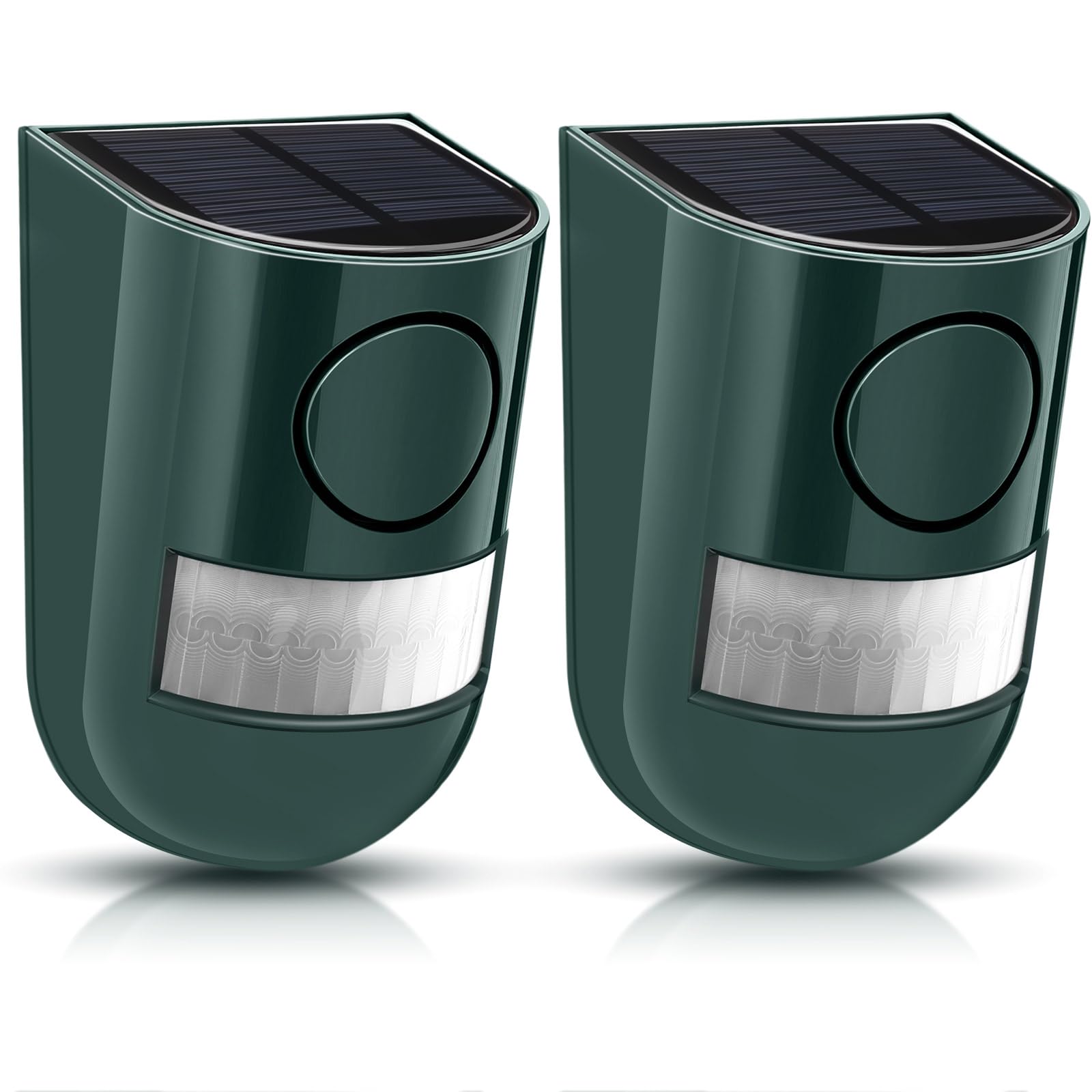
Two strobe-and-siren units for the price of guarding a single spot — built for farms.
Two complete solar alarm units come in the box, which is the whole appeal for anyone covering a farm, orchard, or long fence line. Each one pairs a 129dB siren (a sound-pressure rating; higher numbers mean louder) with a flashing strobe, and the maker says the sound carries far enough to be heard from a distance and the flash can be spotted from far off — so the alarm works on both the ears and the eyes. Detection angle is 125 degrees, catching movement within a 5-to-8 meter zone.
Four modes let you run it your way: 24 hours with flash and alarm, 24 hours with flash only, night-only with flash and alarm, or night-only with flash. The housing is IP65 rated and built from stainless steel bracket and rugged ABS, so it takes harsh weather without complaint. Charge is handled by solar or DC, and a single charge runs it for up to 30 days — the maker notes that a sunny afternoon is often enough to top it up. The alarm itself is sized at 6.3″D x 5.12″W x 3.15″H, a compact unit that mounts with a wall bracket onto a post or fence.
Owners praise the stainless-steel bracket and ABS housing, and report it keeps deer off apple trees and farm animals protected. Two honest notes: a unit occasionally arrives dead from the start, so test both the day they land, and the settings menus are a little fiddly to dial in at first. It’s a deterrent at the perimeter rather than an indoor alert system, which is exactly what a two-pack of fence-line alarms should be.
Where it wins: two units in one box with a 129dB siren plus strobe, IP65 sealing, and 30-day run time means you arm two spots without a second purchase.
The caveat to size: it’s a perimeter deterrent, so test both units on arrival and expect to spend a few minutes learning the mode settings.
Pick it when: two fences, gates, or garden beds need guarding and you want sound plus light at both.
Pass if: you’d rather have one indoor chime than two outdoor alarms.
5. HTZSAFE Driveway Alarm 1/2 Mile 1 Receiver + 2 Sensors

A no-frills half-mile driveway alarm that just keeps telling you someone’s coming.
This is the straightforward pick for anyone who wants an indoor chime and doesn’t need solar or an app. It pairs a plug-in receiver with two motion sensors that see moving people or vehicles from 35 feet to 50 feet in front of them, with two sensitivity settings — Low at 35 feet, High at 50 feet. The signal crosses up to a half mile in open air, and the system uses FSK+FHSS wireless transmission (frequency-hopping tech) to dodge interference from other devices on your street.
The setup is nearly nothing: pop 3 AA batteries into the sensor, plug the receiver into an outlet, and you’re live — the units come pre-programmed, so mounting to a post or tree takes minutes. The receiver offers 4 volume levels and 35 melodies, and you can assign a different tune to each sensor so you know whether it’s the driveway or the back gate. It’s rated to work across -30°F to 150°F, and it expands to 32 sensors for wider coverage later. It’s the crowd favorite here, holding 4.0+ stars across 20,000+ ratings.
The realistic trade-off is batteries. With no solar panel, you’ll be swapping those 3 AA cells periodically, so keep spares handy and don’t mount the sensor somewhere you can’t reach comfortably. It also doesn’t distinguish a car from a large dog — sensitivity is your only filter. But for a simple, reliable driveway alert on a budget, it’s tough to argue with. Unlike the SENKEFEI’s spot-coverage siren, this one gives you an indoor chime with the reach to match a long drive.
Why buyers keep returning
- Half-mile open-air range with interference-fighting wireless tech
- Pre-programmed and plug-in — live in minutes
- 35 melodies and 4 volumes, assignable per sensor
- Expands to 32 sensors; rated for -30°F to 150°F
Worth knowing
- Runs on 3 AA batteries — no solar, so plan for cell swaps
- No pet filter, so sensitivity tuning is your only false-alarm control
Suits you if: you want a simple, proven indoor chime for a driveway on a tight budget.
skip it if: you refuse to climb a ladder for batteries — go solar instead.
6. HTZSAFE Solar Driveway Alarm 1/2 Mile 1 Receiver + 2 Sensors

Solar panels on the sensor and a receiver that keeps working when the power goes out.
Take the battery-swapping out of the job: this version puts a solar panel on the outdoor sensor and a rechargeable cell inside it, so the sun keeps it charged even through rainy and cloudy days. The receiver is the real story, though — it has its own built-in rechargeable battery and keeps chiming even if the AC power drops. On a stormy night when the grid flickers, you still get your driveway alerts, which is a genuine advantage over a purely plug-in receiver.
Detection is the longest in the receiver-based group here: 70 feet of reach with three sensitivity levels (Low 25 feet, Medium 50 feet, High 70 feet), so you can tune out a small cat or catch a car at the end of a long drive. Like its battery brother, it transmits a half mile in open air and expands to 4 motion sensors with unlimited receivers, each sensor assignable its own melody — a bark for the backyard, a spoken tag for the driveway. Setup is plug-and-play, live in minutes.
What this one does well is convenience: no battery swaps, and the backup receiver is a real comfort during outages. It’s not perfect on the reliability front — a fair number of buyers report connection or durability hiccups over time, so it earns a “treat it as one strong layer” framing rather than an only line of defense. But for the combination of 70-foot detection and a receiver that survives a blackout, it holds its own against the plain HTZSAFE, which needs fresh batteries on a schedule.
Its strong suit: solar charging plus a receiver that runs on its own battery — a 70-foot detection range and 3 sensitivity levels give you real control over what trips it.
The fair warning: reliability is the most-discussed theme here and it cuts both ways, so keep it as a dependable primary with a plan B rather than your sole alarm.
Consider this if: you want solar convenience and an alert that keeps working when the power fails.
Look past it if: you need bombproof long-term durability above all.
7. eMACROS Pro4 2.4G Wi-Fi Smart Solar Driveway Alarm

Get a ping on your phone from the end of the drive, wherever you happen to be.
If you want your driveway to talk to your phone, this is the shape of system to look at. It connects over 2.4GHz Wi-Fi (not 5GHz) and, when the solar sensor catches motion, the indoor base sounds an alarm and fires an instant push notification to the app. It uses SST PIR tech — a passive-infrared sensor tuned to read body heat from people, cars, and large animals — to cut false triggers from wind, leaves, and small pets. The sensor reaches the base from up to a half mile (2600 feet) in open areas.
Power is handled on both ends. The indoor base carries a rechargeable battery good for up to 3 days of backup during a power outage, and the outdoor sensor is solar-powered with an IP65 weatherproof housing. One thing to set straight before you buy: this is a motion detector only — there’s no camera, no video recording, and it won’t pair directly with third-party camera systems. You’re buying alerts, not footage.
The push notification lands the moment the PIR sensor trips, and owners mention the signal holding up to around a fifth of a mile through trees and walls. The catches are ordinary for smart gear: it only rides a 2.4GHz network (the older, longer-range Wi-Fi band), so a 5GHz-only router setup won’t do, and the battery life and connectivity get mixed reviews, so keep the sensor in good sun and don’t expect the phone to be infallible. Compared with the FULNIX’s carry-around receiver, this one’s advantage is that the alert follows you anywhere you have a phone signal.
The case for it
- Instant push notifications to your phone via the app
- 2600-foot open-air range from sensor to base
- Base has 3-day backup battery; sensor is solar IP65
- SST PIR reduces false alarms from wind and small pets
Where it asks more
- 2.4GHz Wi-Fi only — no 5GHz support
- No camera or video, and it won’t tie into third-party cams
Fits you if: you want driveway alerts on your phone while you’re away from home.
Not for you if: you need video evidence — this only tells you something moved.
8. Hosmart Driveway Alarm 1 Receiver + 2 Sensors

Rugged PVC housing and 38 ringtones — a driveway chime you can actually enjoy hearing.
Some receivers beep; this one plays from a menu of 38 fun ringtones, and you can match a different chime to each sensor so you instantly know whether it’s the drive or the back gate. The upgraded square receiver even adds a ringtone-selection button and comes with an adapter. Range is rated at half a mile in ideal situations, with the maker noting it hits around 1500 feet in most real conditions — tested through trees, buildings, walls, and weather.
The build is the part that earns trust. The outdoor sensor uses an industrial-grade PVC housing with a rubberized, water-resistant seal and a sunshade, and a swivel mount lets you aim the detection eye precisely. With 4 AA batteries (not included) the sensor runs about a year, and the receiver can run on a cable or AA batteries. Sensitivity is switchable — High at 30 feet, Low at 15 feet — to cut false alarms, and the system expands to 4 sensors with unlimited receivers. It’s backed by a 2-year parts and workmanship warranty.
The honest read is that battery life and range earn mixed feelings — some find the sensor drains sooner than they’d like, and the 15-to-30-foot detection window is on the tighter side for a very long lane. The occasional stray non-programmed tone can pop up too. But for a mid-length drive where you want a dependable indoor chime with a build that feels solid, it’s a sound choice. Where the eMACROS sends a phone alert, this one keeps it simple with an in-home chime and a swivel-aimed eye.
What makes it solid
- Industrial-grade PVC housing with sunshade and swivel mount
- 38 assignable ringtones to tell zones apart
- Roughly a year of sensor life on 4 AA batteries
- Backed by a 2-year parts and workmanship warranty
What to weigh
- Detection window is 15–30 feet — tight for a very long lane
- Battery life and range split opinion among long-term owners
Worth a look if: you want a rugged, swivel-aimed chime with plenty of tone choices.
Think again if: your drive is long enough that a 15–30-foot eye won’t catch the car in time.
9. Wuloo Solar Driveway Alarm 1800ft 1 Receiver + 4 Sensors

Four solar sensors, a receiver that doubles as a clock, and a 30-foot detection zone.
This one leans on multi-zone coverage: four solar sensors plus a receiver, so you can blanket a gate, a side yard, and a back path in one go. Each sensor uses a built-in rechargeable battery that the solar panel keeps topped up, with the maker rating up to 24 months on a full charge. The sensor catches movement within 30 feet of its zone, and you can expand up to 8 additional sensors if you need more reach. The receiver does double duty as a clock and alarm, with adjustable chimes, sounds, and volumes.
Range here is rated at 1/3 of a mile (1760 feet) and tested in real-world settings with trees, buildings, walls, and vehicles, so it’s a realistic figure rather than an open-field best case. Sensitivity is adjustable to help skip leaves and small animals, and the weatherproof sensors are made to work in rain or snow. Setup is described as a few minutes — place the sensors, and the in-home chime fires the second a person, vehicle, or large animal moves within the detection zone.
The catch is accuracy. Some customers note frequent false alarms, so spend time tuning the sensitivity and aim the sensors where passing pets and wind-blown debris won’t trip them. It’s also a motion-only alert with no camera, and the 30-foot detection zone means you get a heads-up as something enters, not as it crosses your whole property. For a homeowner who wants four zones covered on solar without a subscription, the coverage and the building of the system carry it.
Where it earns its keep: four solar sensors and a receiver that also shows the time — solar charging rated for up to 24 months and expansion to 8 extra sensors make this a multi-zone workhorse.
The tune-up needed: false alarms come up enough that you’ll want to dial in sensitivity and placement before trusting it fully.
Go with this if: you want four zones guarded on solar power without a monthly bill.
Hold off if: you can’t spare the time to fine-tune sensitivity against false triggers.
Know the Specs
Detection Range vs. Transmission Range
Detection range is how far the sensor’s eye can spot movement — think of it as the sensor’s reach out into the yard. Transmission range is how far the alarm signal travels back to your receiver or base. A sensor with a 30-foot eye and a half-mile transmitter is ideal for a long drive: it only needs to watch the last few car lengths, but the signal has to cross the whole property. Always match the eye to the zone you’re guarding and the transmitter to the distance from that zone to your house.
PIR Sensors and False Alarms
PIR stands for passive infrared — a sensor that reads the body heat of a moving person, car, or large animal. It’s what keeps a system from tripping on every waving branch. Many units add software or sensitivity levels to filter out small animals, leaves, and wind, and some offer high and low detection distances. The lower the sensitivity, the tighter the zone and the fewer false triggers. Aiming the sensor level and keeping it off swaying branches is half the battle against nuisance alarms.
Solar Power and Battery Backup
A solar sensor recharges its own battery through a panel, so you don’t climb a ladder to swap cells. Many pair that with a USB or DC backup for cloudy stretches. A rechargeable receiver with its own battery keeps chiming even if the wall power drops — useful during an outage. Check the run-time ratings (some claim up to 2 years on a charge, others up to 30 days) and confirm the housing carries an IP65 rating so rain, snow, and dust don’t get inside.
Expansion and Zone Count
The number of sensors one receiver can hold decides how many areas you can watch from a single indoor chime. Some receivers top out at a handful of sensors; others accept dozens for a large property. When you can assign a different chime to each sensor, you can tell a driveway alert from a back-gate alert by sound alone. Plan your zones now — gate, shed, side yard — and pick a receiver whose sensor ceiling leaves room to grow.
Common Questions
How far can a yard motion detector actually detect and transmit?
Do these systems need Wi-Fi or a monthly subscription?
Will my alarm trip on dogs, deer, or blowing leaves?
How long does a solar driveway sensor last between charges?
Can I add more sensors to one receiver later?
Will a yard motion detector survive rain, snow, and freezing cold?
Can this system work as a remote doorbell or gate alert?
What is the difference between a siren alarm and a chime receiver?
How do Ireduce false alarms from a driveway sensor?
Do I need to mount a yard motion detector at a set height?
The Bottom Line
For most homes with a long drive, the yard motion detectors winner is the Betterlink 1/2 Mile Solar Driveway Alarm, because it ships with four solar sensors, reaches a half mile in open air, and needs no app or subscription — a complete multi-zone setup in one box. If you want the alert to follow you around the property, reach for the FULNIX Driveway Alarm with its carry-anywhere receiver and 84-sensor ceiling. And if you’re guarding a garden, orchard, or coop, the Qualirey 2 Pack gives you two 129dB siren-and-strobe units to arm two spots at once.
One last nudge before you click buy: if you want a proven, widely owned driveway chime without fuss, the HTZSAFE has the deepest track record here at 4.0+ stars across 20,000+ ratings. Match the eye to your zone, the transmitter to your distance, and the power source to your ladder tolerance, and you’ll have a yard that tells you someone’s coming before they reach the door.
How we choose
We do not accept paid placement. Every pick is matched to a real buyer and a real use-case; we do not hands-on test units.
Sources
Specifications: manufacturer listings and product documentation. Review insights: verified customer reviews, as of November 2026. Pricing: not shown on this page (it changes often); check the current price via the retailer link.
As an Amazon Associate, Tactical Gear Guy earns from qualifying purchases. This does not affect which products we feature.