Specs are compiled from manufacturer listings and verified buyer reviews and can change over time — please confirm the key details on the product page before buying.
A twelve-hour shift in wet weather depends on three things: dry feet at the bottom, grip on wet concrete, and a boot that slides on without a fight at five in the morning. Most cheap rubber boots fail at exactly one of those three jobs. This list separates the pairs that survive a working week outdoors from the ones that look the part but quit early. If you want the short answer, the MUCK Chore Cool is the best all-round pick for warm-weather outdoor work.
This guide is built by comparing the manufacturers’ published specifications and the patterns across verified customer reviews, so you get each pick’s real strengths and trade-offs instead of marketing spin.
Below you will find nine rubber work boots sorted by what they actually do well, from steel-toe construction pairs to cold-weather liners. Each entry names the toe protection, the shank support, and the fit quirks you will meet on day one, so you can compare toe protection, shank support, and fit quirks before you buy.
Top Picks


How To Choose The Best Work Rain Boots
Buying a work boot meant for wet ground is a different job from buying a fashion wellie. You are picking a tool you will stand in for eight to twelve hours, on surfaces that want to put you on your back. Three things drive that decision: what sits under your sole, what sits around your foot, and how the boot comes off at the end of the day.
Start with the sole, not the shell
The rubber outer keeps water out, but the steel shank under your foot is what keeps your arches from aching by hour nine. Look for a steel shank — a stiff metal strip buried between the insole and the outsole. It spreads your weight across the whole foot instead of letting it pile onto the heel. On soft mud and gravel that difference shows up fast. Puncture resistance sits in the same layer: a steel midsole stops a nail or a shard from coming up through the bottom, which a plain rubber sole will not do for long.
Understand neoprene thickness before you commit
Neoprene is the spongy foam layer bonded inside the rubber — the thicker it is, the warmer the boot runs. A 5mm liner is built for cold mornings and snow, and a 6mm liner goes a step warmer still. That warmth helps in January and hurts in July, because a thick liner traps heat with nowhere to vent. If you dig, load, or walk hard in summer conditions, thick insulation works against you. Breathable mesh linings help move sweat away, but they cannot rescue a boot that is over-insulated for the season.
Toe and calf: the two fit traps
A steel toe is a rigid cap over the front of the foot — it takes a dropped tool or a rolling drum so your toes do not. It does not flex, so the toe box needs room; a cramped steel toe rubs the same spot all shift. Calf width is the second trap. Pull-on rubber boots do not have laces, so the opening either clears your calf or it does not. Adjustable back gussets with buckles and expandable openings are the fix for larger calves and thick work trousers. Where a boot ships with a fixed 10-inch shaft circumference, measure before you buy.
Side-by-Side Comparison
| Model | Best For | Toe / Underfoot Protection | Stated Weight | Insulation | Amazon |
|---|---|---|---|---|---|
| MUCK Chore Cool Steel Toe Tall★ Best Overall | Warm-weather outdoor shifts | Steel toe + steel shank | 4.5 pounds | Neoprene, warm-weather build | Amazon |
| HISEA Steel Shank Adjustable CalfBest For Big Calves | Cold mud, snow, and big calves | Steel shank, no steel toe listed | — | 5mm neoprene | Amazon |
| Trudave Steel Shank Neoprene BootBest All-Season Value | All-season farming and hunting | Reinforced hard-plastic toe + steel shank | — | 5mm neoprene | Amazon |
| Hunthor Steel Toe Puncture-Proof | Construction crews on debris | Steel toe + steel shank, puncture-proof | 4.41 pounds | — | Amazon |
| Trudave Steel Toe Construction Boot | Lightweight daily site wear | Steel toe + steel shank | 3.5 pounds | 4mm SBR + 2mm breathable layer | Amazon |
| TIDEWE Puncture Resistant Work Boot | Mixed terrain, roomy fit | Steel toe + steel shank, puncture proof | — | 6mm neoprene | Amazon |
| MUCK Chore Met Guard | Landscaping and heavy impact risk | Steel toe + steel shank + metatarsal guard | 4.5 pounds | 5mm neoprene | Amazon |
| XTRATUF 15″ Steel Toe Legacy | Wet decks and fish processing | Steel toe | 4.5 pounds | — | Amazon |
| Dunlop Explorer with Vibram Sole | Extreme cold and hazardous sites | Steel toe + steel midsole | — | Purofort build, rated to minus 58°F | Amazon |
Detailed Reviews
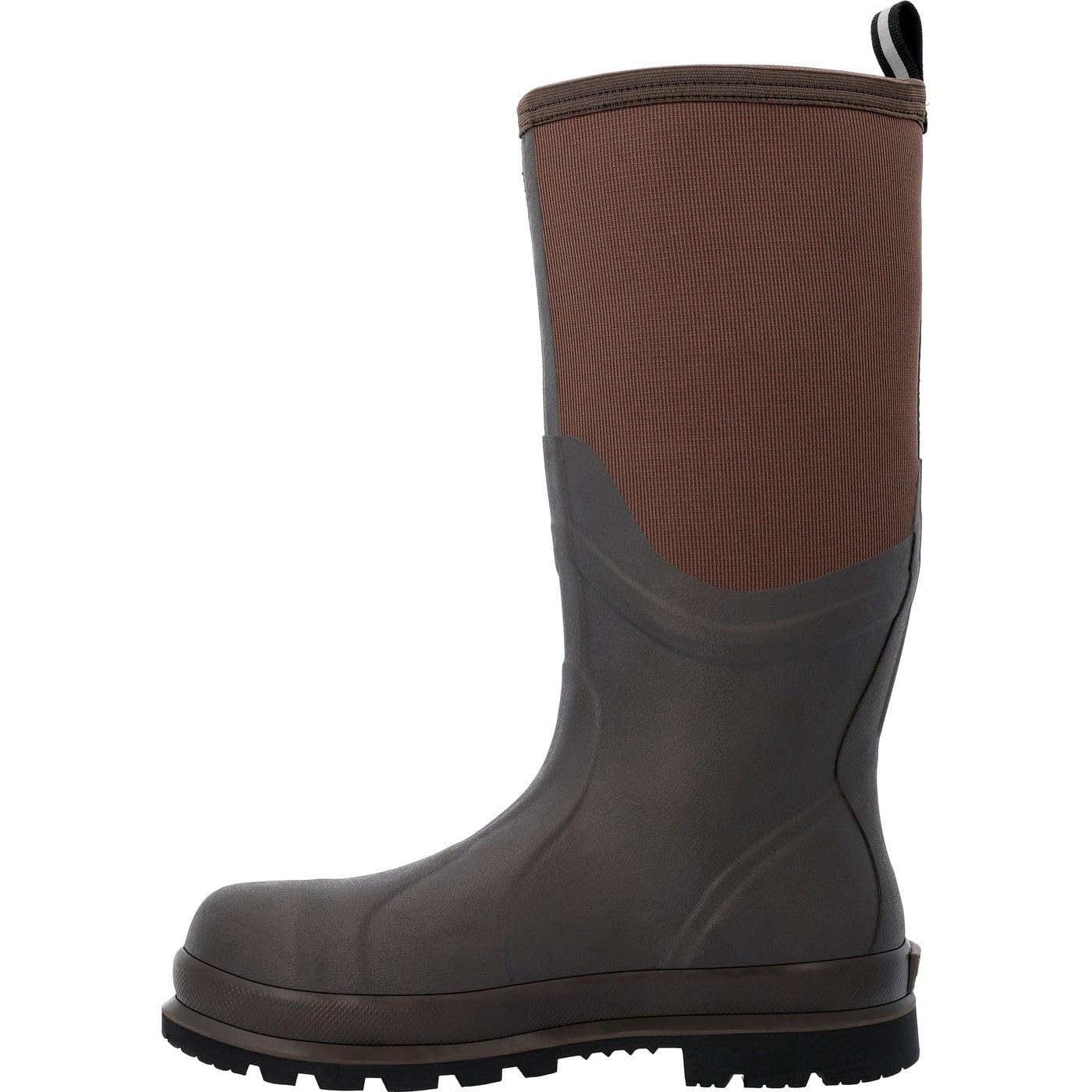
1. MUCK Chore Cool Men’s Steel Toe Tall Boot
Our pick — 4.5+★ from 750+ verified ratings; the strongest balance of quality and price.
The warm-weather chore boot that keeps a long summer shift from turning into a foot sauna.
Muck built this pair for heat, not frost. The “Cool” in the name is the whole point: it is a tall rubber boot with a shock-absorbing neoprene shell (foamed rubber that flexes with your foot instead of fighting it). Two hard parts do the protecting. A steel toe cap takes a falling object so your toes do not. A steel shank (a rigid strip under the arch) spreads your weight so your heel is not carrying everything by mid-afternoon. At 4.5 pounds for the pair, it sits in the same weight band as the other heavy-duty picks here — the trade-off for that much rubber and metal.
Buyers praise the look of this boot more than anything else in its review pages, and the warm-weather lining earns steady credit for keeping feet from cooking. The shaft carries a Spandura treatment (a tough, abrasion-resistant wrap) that holds up where your trousers and the boot mouth rub all day. Reinforcement is heavy where it counts: a triple toe and a quadruple rubber heel, the two spots a work boot wears through first. If you want a tall boot that looks tidy enough to wear off-site, this is the one.
The catch is the fit above the ankle. The shell runs roomy up top, so if your calf is on the slim side the boot can slosh rather than lock on. Most people solve it with one pair of socks. Durability also splits opinions — plenty of pairs run for seasons, and a share of owners have had seams give out early. That is a real risk on a boot this expensive, so treat the rubber properly: rinse the mud, air-dry in shade, and keep it out of a hot truck cab.
Why crews keep buying it
- Steel toe plus steel shank covers both impact on top and support underneath
- Built for warm weather, so it does not trap heat the way a winter liner does
- Triple toe and quadruple heel reinforcement target the wear points
- Spundura-wrapped shaft resists abrasion from trousers and debris
Where it asks for patience
- Roomy above the ankle on slimmer calves — plan on thick socks
- 4.5 pounds is real weight to lift all shift
- Long-term seam durability is the split in owner experience
Reach for this if: you work outside in warm weather and want steel toe protection in a tall boot that looks presentable.
Look elsewhere if: you have a narrow calf and want a locked-in fit straight from the start.
2. HISEA Men’s Rain Boots with Steel Shank and Adjustable Calf
The pair that opens up at the back so a thick calf and thick trousers both fit inside.
Most pull-on rubber boots assume one calf size. This one does not. Expandable back gussets with cinch buckles let you widen the opening to clear a large calf or heavy overalls, then tighten it back down so the topline seals in warmth and keeps cold drafts and grit out. Underfoot, an integrated steel shank takes the pressure of standing and digging and spreads it across the arch — the difference you notice after a few hours with a shovel in your hands.
Your feet stay dry thanks to a smooth natural rubber shell over 5mm insulating neoprene (foamed rubber bonded inside the boot). That liner is rated to keep your feet working in temperatures down to 14°F (-10°C), so this works as a cold-mud and snow boot as much as a wet-day boot. It is not a summer digger — HISEA states plainly that the 5mm thermal layer is not meant for heavy labor above 86°F (30°C). Buyers talk about quality most, paired with a strong sense of value, and the rear kick tab lets you step out hands-free at the end of the day without tearing the heel seam.
Two honest realities. HISEA sizes these to run large so winter socks fit, and the brand says to size down if you land between sizes — ignore that and you will swim. And on hard gravel or asphalt, the deep mud lugs wear faster than you would like; if you are on abrasive ground eight hours a day, alternate pairs. On slick black ice these are not spiked cleats, so watch your step.
The cold-weather angle: 5mm neoprene plus a smooth rubber shell is a genuinely warm combination, built for snow and deep mud rather than a drizzle in July.
Sizing warning worth repeating: this is a generous cut by design. The brand’s own guidance is to go down a size if you sit between two.
Best fit for: anyone whose calf has broken a cheaper boot’s opening, or who works cold, wet ground through winter.
Not the pick for: heavy summer labor, where a 5mm liner becomes a heat trap.
3. Trudave Rubber Boots for Men with Steel Shank
A mid-priced all-rounder that handles flooded ground, mud, and snow without much drama.
Trudave aimed this boot at the person who does a bit of everything — work, hunting, fishing, camping — and does not want a specialist for each. The 5mm neoprene lining wraps your foot the way a wet suit does, which is where the warmth comes from on a cold morning, and a smooth waterproof shell keeps the water on the outside. A steel shank runs under the arch for support through a long day on your feet, while the reinforced hard-plastic toe cap takes knocks in front of your toes.
Quality is the strongest signal in its feedback by a wide margin, with value-for-money close behind — this boot over-delivers on the basics at its tier. Buyers approve of the traction for grip and slip resistance on wet, uneven ground. The pull tabs at the top make it quick to get on and off, which matters when you are changing in and out of a truck cab all day. The breathable fabric lining helps keep the inside from turning swampy.
Two things to plan around. The durability picture is uneven — many pairs run long, and some owners have had a boot rip within a month of hard use, so inspect the seams when they arrive. Sizing also draws a mix of opinions, which is normal for a rubber boot with no laces to fine-tune the fit. Order your normal work-boot size and keep the receipt handy in case you need to swap.
Where the money lands: steel shank support, a reinforced toe, slip-resistant tread, and 5mm warmth — the full working kit rather than a bare rubber shell.
What to check on arrival: seam quality at the toe and heel, since that is where the failures in its feedback show up.
Pick this one for: mixed outdoor work across mud, snow, and flooded ground on a mid-range budget.
Swap it out if: you need the tough construction of a true site boot for daily heavy debris.
4. Hunthor Steel Toe Rubber Work Boots

Built for a site scattered with nails and offcuts, where the ground itself is the hazard.
If your workday involves walking over demolition debris, cutoffs, and loose screws, this boot’s whole case is the layer under your foot. It pairs a steel toe up front with a steel shank and puncture-proof construction beneath, so a sharp edge does not come up through the sole and a dropped beam does not crush your toes. At 4.41 pounds it is the lighter of the two weighed boots on this list — the MUCK Chore Cool runs 4.5 pounds by comparison, so the gap is slight, but every ounce counts when you are lifting your feet hundreds of times a shift.
Comfort is the other surprise. The supportive insole is meant for long construction shifts, and comfort is one of the strongest themes in its feedback, right behind overall quality. Fit earns steady praise, and buyers report it clears above the calf so you are not cinched at the widest point. The back gusset adjusts to different calf sizes, and a kick tab at the heel lets you step out without using your hands. The anti-slip outsole also cleans up easily — caked mud wipes off the tread rather than packing in.
The trade-off is in the long haul. Some of these boots run for seasons; others develop cracks in the rubber over time. A share of owners also call it heavy, which is the natural cost of a steel toe, steel shank, and puncture layer stacked into one boot. That is a fair swap if avoiding a foot injury is the priority.
What the site crew gets
- Puncture-proof underfoot layer plus steel toe for two kinds of impact
- Steel shank holds up the arch through a long shift
- Back gusset and kick tab handle calf fit and hands-free removal
- Anti-slip tread cleans off mud quickly
What you accept
- Rubber can develop cracks over time on some pairs
- Weight draws split opinions — the steel layers are not free
Ideal for: construction and demo work where the ground is studded with sharp debris.
Think twice if: you want a featherweight boot and the ground under you is clean and soft.
5. Trudave Steel Toe Rubber Boots with Steel Shank
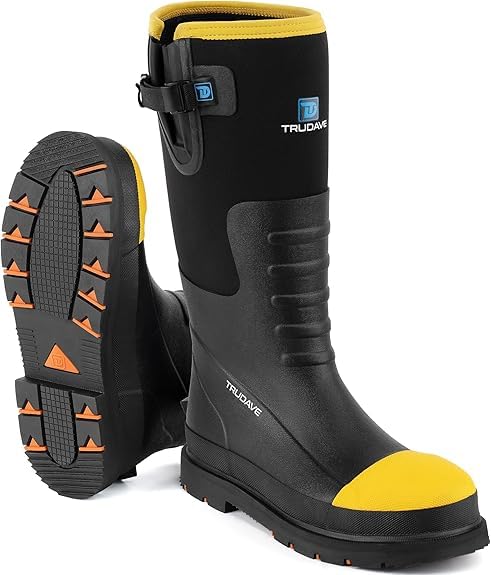
Steel toe protection at 3.5 pounds, the lightest boot with a metal cap on this list.
Weight is normally what you sacrifice for a steel toe. This pair keeps a metal cap over the toes and a steel shank under the arch and still comes in at 3.5 pounds, which is a full pound lighter than the 4.5-pound MUCK Chore Cool. On a shift where you are up and down ladders or crossing a site all day, that difference in the swing of your leg is the thing you feel at hour eight. The lining is a 4mm SBR layer plus a 2mm breathable sandwich, built to circulate air so the inside of the boot does not overheat.
Fit is where this boot shines — it draws more praise on fit than any other single trait in its feedback, and the adjustable buckle strap lets you tune the calf so the boot grips rather than hangs. The ergonomic arch at the top of the boot sits where your foot naturally bends, which is part of why it wears comfortably. Airmes inner lining keeps air moving through the shell, and the deep rubber tread with anti-slip design handles the varied surfaces of a construction, farm, or fishing job.
Now the honest part. Durability and water resistance both split down the middle for this boot — some owners find it heavy-duty and water-tight, others report cracking and water getting through. Value divides the same way. Weigh that risk against the low weight and the lower price of entry. It makes this a smart second pair or a lighter boot for dry-ish, mixed use rather than your only defense on a soaked winter site.
The one number that sells it: 3.5 pounds, which buys you a steel toe and a steel shank without the leg drag of the heavier boots here.
Where it gets divided: reports on cracking and water intrusion mean this is not the boot to bank a whole wet season on.
Suits you when: a light boot and a steel toe both matter more than maximum rubber toughness.
Best left alone if: you work standing water in freezing weather day after day.
6. TIDEWE Rubber Work Boots Steel Toe
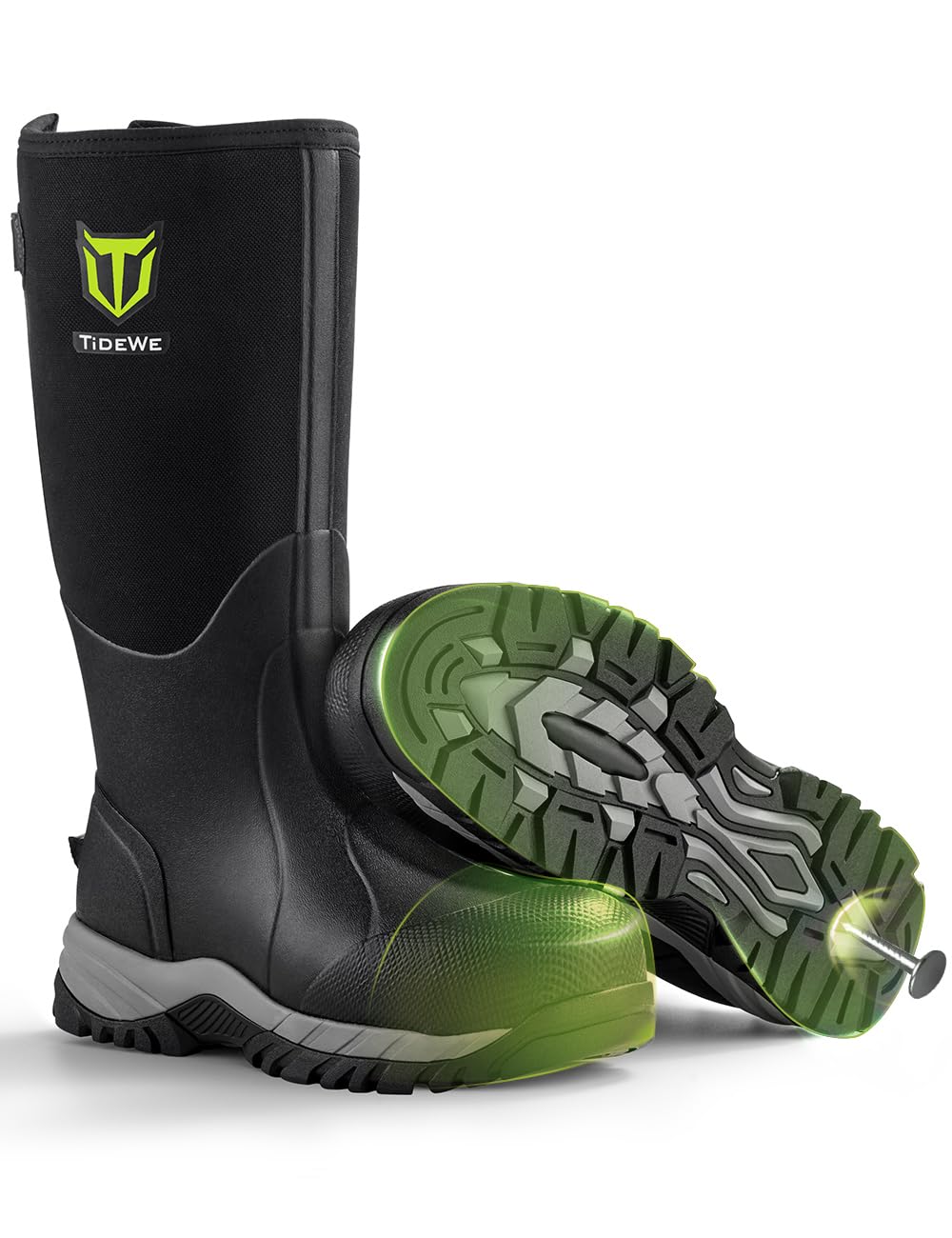
Six millimeters of neoprene warmth wrapped around a steel toe and a full puncture layer.
TIDEWE stacks the safety parts without cutting corners. A puncture-proof layer sits underfoot for secondary protection, a steel shank runs between the insole and outsole to hold your arch and spread pressure, and a steel toe up front handles impact from falling or rolling objects. On top of that it adds 6mm neoprene — the thickest liner in this lineup — so it runs warmer than the 5mm boots here when the temperature drops. Breathable inner lining moves air through the boot so it does not turn stifling in milder weather.
Fit is generous, with plenty of room through the boot, and the shaft measures 10 inches around, so if your calf runs wide, measure first. The brand gives a precise sizing rule worth following: measure your foot and pick a size roughly 0.16 inches longer than your actual measurement. Pull-on and kick tabs get you out the door fast. Quality and value both draw strong praise, and plenty of owners wear them daily without an issue.
The water resistance is the point that divides people. Many find the boot fully waterproof; some report getting wet quickly, which usually points to a seam or a shell that has taken damage. Handle these the way you would any rubber boot — rinse, air-dry in shade, keep away from direct heat — and they hold up far better. On a cold, wet job this is a warm, well-protected boot for the money.
The warmth edge: 6mm neoprene is the heaviest insulation in this group, which shows up on a frosty morning and works against you in high summer.
Fit rule to follow: a 10-inch shaft circumference plus a roomy cut means measuring your foot and ordering to the brand’s 0.16-inch allowance.
Turn to it for: cold, wet outdoor work where you want maximum liner thickness and steel protection.
Skip the fit gamble if: your calf is wide — check that 10-inch shaft before you commit.
7. MUCK Men’s Chore Met Guard Work Boots
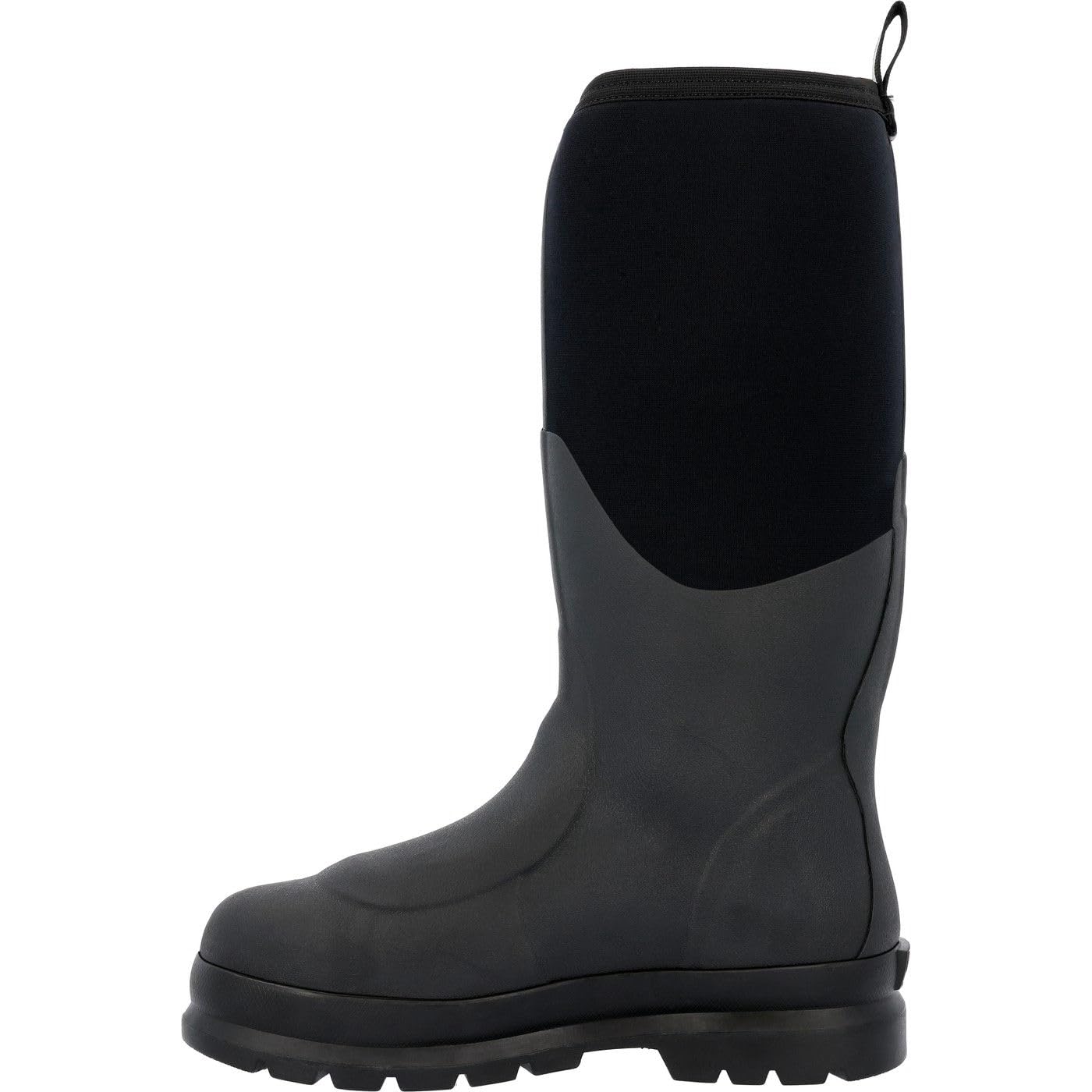
The one boot here with a metatarsal guard — protection for the top of your foot, not just the toes.
A steel toe saves your toes. It does nothing for the long bones behind them, which is exactly where a dropped paver or a rolling beam lands. That is what the metatarsal guard on this Muck Chore is for: a soft, flexible shield over the top of the foot that stays bendable while you walk but hardens the instant something strikes it. Landscaping and construction crews who face that kind of impact risk are the target here. Under it all sits a steel toe for frontal impact and a steel shank for arch support, on a 5mm waterproof, shock-absorbing neoprene shell that also wicks sweat away from the skin.
The comfort side is where it earns its place. Fit is the second-strongest theme in its feedback, with a toe box that gives your toes room instead of pinching them, and warmth that keeps feet comfortable through cold, wet work. Rubber overlays and outsoles wipe clean easily, which keeps mud and grime from building up on the shell. At 4.5 pounds it matches the Chore Cool’s weight, so you know what you are carrying.
Durability is the honest question mark. Some of these boots go about two seasons of hard use, and a portion have come apart at the sole well before that. There are also reports of leakage in a share of pairs, so seal checks matter. For a boot with this much protection built in, that is the risk to weigh, and it is why proper care — clean, shade-dried, stored upright — is not optional.
What sets it above a plain steel toe
- Metatarsal guard shields the top of the foot from heavy impact
- Steel toe, steel shank, and 5mm neoprene cover top, bottom, and warmth
- Toe box gives toes genuine room through a long shift
- Easy-clean rubber overlays and outsoles
The honest cost
- Sole separation and leakage show up in a share of pairs
- 4.5 pounds with the guard and steel layers on board
Choose it when: heavy objects drop near your feet and the top of the foot needs protecting, not just the toes.
Consider a lighter boot if: your hazards are water and mud rather than falling weight.
8. XTRATUF Men’s 15″ Steel Toe Legacy Boot
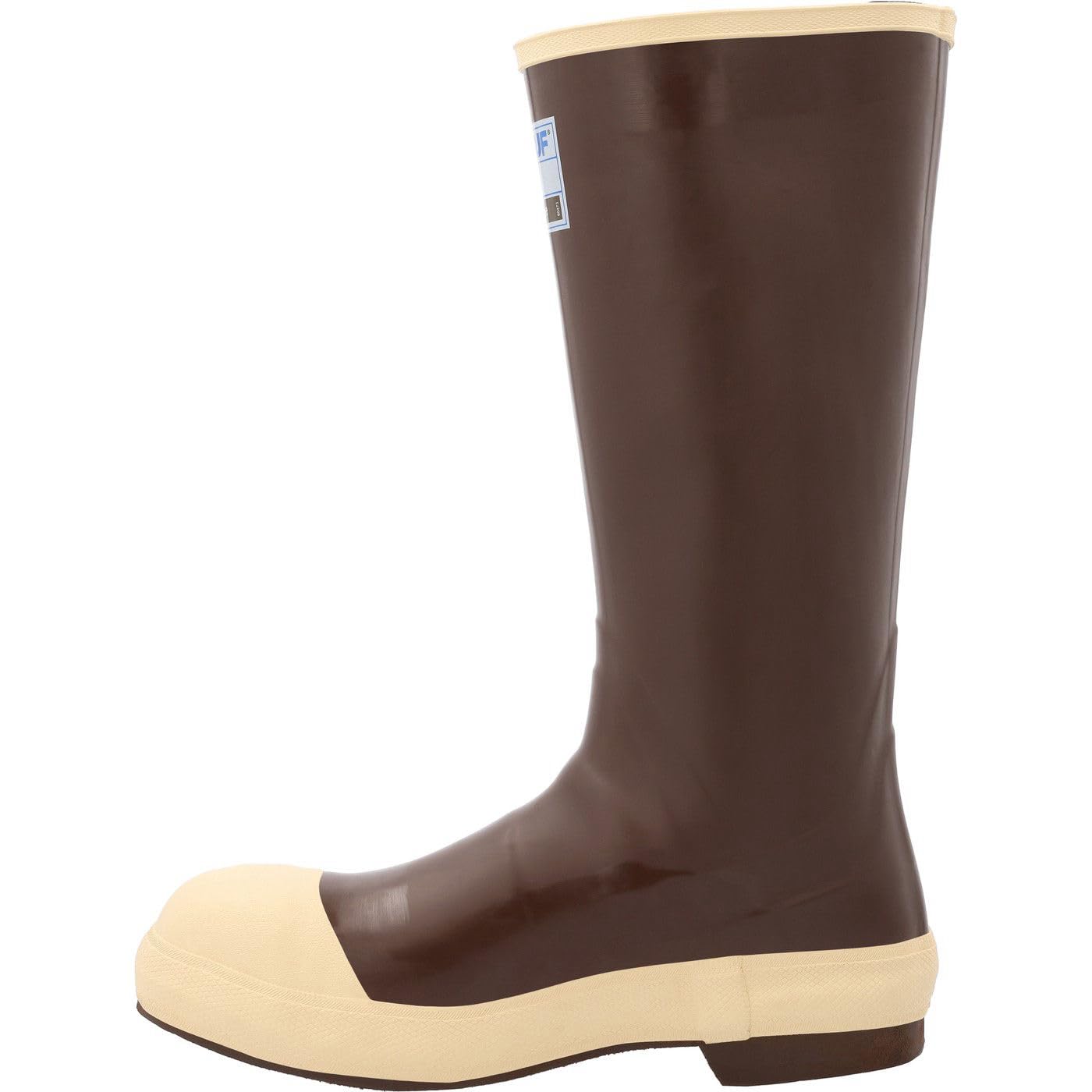
The tall deck boot for wet, oily surfaces where the grip rating is the whole game.
On a fish-processing floor or a wet boat deck, slippery is the hazard you meet first every morning. XTRATUF tests its footwear to ISO slip-resistance standards (an international benchmark for grip), and the rating tiers tell you exactly what you are getting: SRA gives grip on wet floors, SRB adds traction on wet and oily surfaces, and SRC combines both for the highest rating. This 15-inch boot also carries acid and chemical resistance, which matters when the deck is slick with more than water. A steel toe sits up front, and the whole boot is 100% waterproof by design.
This is a working boot first — quality is the strongest theme in its feedback, with durability close behind, and owners find it very much suited to full work days rather than weekend use. It weighs 4.5 pounds, the same as the Muck pairs here. One practical note from the brand: most XTRATUF boots do not come in half sizes, so if you wear a half size, round to the nearest whole and test the fit.
Two things to check before you buy. The calf runs snug, so a wider calf will feel the squeeze at the top of that tall shaft. And there are reports of water getting in — worth inspecting the seams and the boot mouth on arrival, since a 15-inch shaft has more places to leak than a shorter one. For a fishing or wet-deck job where grip underfoot is everything, it remains a strong tool.
The grip case: ISO-tested slip resistance with an SRB tier for wet and oily surfaces, plus acid and chemical resistance — built for a deck, not a pavement.
Fit reality: no half sizes and a snug calf mean you should size deliberately, not by habit.
Right boot for: wet, oily decks and fish houses where slip resistance is the deciding factor.
Wrong boot for: wide calves, or anyone who needs a half-size fit.
9. Dunlop Explorer Full Safety Work Boots with Vibram Sole

Engineered to keep feet warm to minus 58 degrees Fahrenheit in chemical and fuel-oil environments.
This is the boot for the cold that stops other boots. Dunlop builds the Explorer from its Purofort material, and the company rates it to keep feet warm down to minus 58 degrees Fahrenheit while resisting chemicals, fuel oils, and workplace grime. Safety comes in layers: a steel toe for impact, a steel midsole for underfoot puncture protection, and a slip-resistant outsole for icy and uneven ground. It is certified to ASTM and CSA Omega standards, which is the language safety officers look for. Sizes run US 6 to 15.
Comfort carries this boot in its feedback more than any other trait, and Dunlop builds toward that with a fatigue-reducing, classic-fit design meant for long shifts in demanding conditions. Durability is right behind it, with work in hard industrial settings holding up well. It keeps feet warm in genuinely cold weather. Lightweight for a full-safety boot, it still handles construction, utilities, and outdoor work with a steel toe and midsole protecting you from both ends.
Where it asks you to be careful is width. The fit splits between owners who find it a great fit and those who find it too narrow, so if your foot runs wide, that is the risk to weigh. Traction also divides — some find the grip solid on ice, others do not trust it as much as they would like. This is a premium, high-safety boot, and those are the two points to test early if you can.
The cold-and-safety case
- Warmth rated to minus 58°F — the deepest cold rating in this lineup
- Steel toe plus steel midsole covers impact and underfoot puncture
- Purofort shell resists chemicals, fuel oils, and grime
- Certified to ASTM and CSA Omega standards
The fit watch-outs
- Runs narrow for some feet
- Traction on slick ice draws divided feedback
Made for: deep-cold industrial work where chemicals, fuel oils, and sub-zero temperatures come together.
Walk away if: your foot is on the wide side, or you want a boot that grips hard ice without caution.
Know the Specs
Steel Toe vs. Metatarsal Guard
A steel toe is a rigid cap over the front of the boot that takes the force of a dropped or rolling object so your toes do not. It protects the toes only. A metatarsal guard sits over the top of the foot, behind the toes, and shields the long bones there — that is the difference between the MUCK Chore Cool and the MUCK Chore Met Guard. A guard stays flexible while you walk and stiffens on impact. If your hazards fall on the whole top of the foot, you want the guard; if it is mostly frontal knocks, a steel toe alone covers you.
Steel Shank and Puncture Resistance
A steel shank is a stiff strip buried between the insole and the outsole. It does two jobs: it holds up your arch so your feet do not fatigue as fast, and it stops sharp objects from pushing up through the sole. Puncture resistance is that same protective layer doing the nail-stopping work. Rubber on its own flexes and wears; a steel midsole or shank layer does not let a screw or a shard through. On debris-strewn ground, this is the spec that matters more than the rubber shell.
Neoprene Thickness and Warmth
Neoprene is the foamed rubber lining bonded inside the boot — a wet suit for your foot. The thicker it is, the warmer the boot runs. On this list you will find 4mm, 5mm, and 6mm liners. A 6mm liner, as on the TIDEWE, runs warmest; a 5mm liner is the common cold-weather standard; thinner builds breathe better in heat. Match the liner to your season. A 6mm liner that traps sweat on a hot shift is as uncomfortable as a thin unlined boot in the cold.
Slip Ratings and Sole Grip
Slip resistance is graded, and the grade tells you what surface it was built for. SRA means grip on wet floors. SRB adds traction on wet and oily surfaces. SRC combines both for the top rating. On a wet boat deck or an oily floor, an SRB or SRC boot like the XTRATUF is the right choice. Deep mud lugs are a different design — great in soil and snow, but they wear faster on hard asphalt. Match the tread to your ground: deep mud lugs for soil and snow, SRA/SRB/SRC rubber for wet concrete and oily decks.
Common Questions
Will a steel toe work boot fit the same as my normal rubber boots?
Can I wear work rain boots in summer heat?
How does a steel shank help during a long shift?
What is the difference between a steel toe and a metatarsal guard?
Is a slip-resistant sole enough for ice?
How long should a rubber work boot last?
How do I stop the rubber from cracking?
Can a work rain boot handle chemicals and fuel oils?
Should I size up or down in a boot with thick neoprene?
Do I need a steel toe for farm and garden work?
The Bottom Line
The crowd favorite for a reason, the MUCK Chore Cool Steel Toe Tall Boot sits at 4.5+ stars across 700+ ratings, and it is the strongest all-round pick for warm-weather outdoor work — steel toe, steel shank, and a build that keeps a long summer shift from cooking your feet. If your calf has broken a cheaper boot’s opening and you work cold, wet ground, grab the HISEA Adjustable Calf Boot, which opens at the back to clear a thick calf and layers 5mm neoprene against the cold. And for a site studded with nails and cutoffs, the Hunthor Puncture-Proof Boot is the one to reach for, with a puncture-proof layer under the sole to stop a sharp edge coming up through the bottom.
Whichever pair you choose, follow the brand’s sizing rule — HISEA runs large, TIDEWE runs long, and XTRATUF skips half sizes. Rubber work boots run large or snug by design, and the right fit is what keeps you steady through a twelve-hour shift in the rain.
How we choose
We do not accept paid placement. Every pick is matched to a real buyer and a real use-case; we do not hands-on test units.
Sources
Specifications: manufacturer listings and product documentation. Review insights: verified customer reviews, as of November 2026. Pricing: not shown on this page (it changes often); check the current price via the retailer link.
As an Amazon Associate, Tactical Gear Guy earns from qualifying purchases. This does not affect which products we feature.