Specs are compiled from manufacturer listings and verified buyer reviews and can change over time — please confirm the key details on the product page before buying.
You want a real fire inside a small living space, without filling the whole van with smoke or turning the walls into a hot plate. That is the whole job. A wood stove for a motorhome has to be small enough to fit a compact floor plan, sealed tightly enough to keep smoke out of a room you sleep in, and light enough that the build does not sag. The picks below cover that exact job, from a well-proven all-rounder down to specialist kits built for canvas and cold nights.
This guide is built by comparing the manufacturers’ published specifications and the patterns across verified customer reviews, so you get each pick’s real strengths and trade-offs instead of marketing spin.
Below you will find how to size a firebox to your space, why chimney height matters more than raw heat, and which builds hold up when the fire is lit every evening. The list that follows is the short version of all of it — a ranked wood stove for motorhome lineup you can compare side by side before you commit.
Top Picks

How To Choose The Best Wood Stove for Motorhome
Installing a stove in a motorhome is nothing like kitting out a barn. The room is small, the ceiling is low, and the walls are close to the fire. Every choice you make is really a choice about clearance, draw, and how much mess you can live with. Get those three right and the stove becomes the warmest corner of the van.
Start with the firebox, not the footprint
A bigger firebox holds more wood, so you refill less often during a long evening. The trade-off is that a bigger box also needs more floor space and a longer straight piece of firewood. In a van, measure the longest log you can realistically store first, then pick a stove that takes that size. A box that only swallows short splits will have you cutting wood on the roadside.
Look at steel thickness in millimetres
Wall thickness tells you how much heat the body can shrug off before it warps. Thicker steel holds its shape under a long hot burn. A body built from 1.6mm steel sits toward the sturdier end of this group, while 1mm steel is at the lighter end. If you plan to run the stove every night through winter, the thicker body is the one you want supporting that fire.
Chimney height and diameter decide the draw
Smoke rises because the hot pipe pulls air up behind it. That pull only happens if the pipe is tall enough and wide enough to move the burnt gases out. A short, narrow chimney fights the fire and pushes smoke back into the room. Check the pipe diameter on the listing and plan how far the chimney will rise above the stove inside the van. On a low roof, a spark arrestor cap on top also keeps embers off the ceiling.
Sealed joints and a glass window you can trust
Every joint is a place where smoke can escape. Riveted bodies and tight door frames keep the burn sealed inside. A heat-resistant glass window lets you watch the fire and judge the burn without opening the door — which is exactly when smoke tends to slip out. If the glass is rated for very high heat, it survives the swings between a roaring fire and a cold stove.
Side-by-Side Comparison
| Model | Best For | Firebox | Chimney | Stove Weight | Amazon |
|---|---|---|---|---|---|
| Winnerwell Nomad Medium★ Best Overall | All-round van heating and cooking | 800 cubic inch | 5 sections, 2.5-inch diameter | 19.4 pounds | Amazon |
| Gonex Hot Tent StoveBudget Pick | Budget heating with a fire view | 16.9 × 10 × 9.5 in box | 72.8-inch, 2.76-inch diameter | 23.8 pounds | Amazon |
| 1.6mm Stainless Steel Tent StoveThickest Steel | Thick-steel body on a budget | Oversized box with ash drawer | 7 sections, adjustable, 2m | — | Amazon |
| Change Moore Secondary Burning | Cleaner burn, less smoke | 593 cubic inches | Built-in chimney connection | — | Amazon |
| KUNGKA Portable Tent Stove | Low-roof heating with wide glass | 18″ × 11.69″ footprint | 6 sections + rain cap | 20 pounds | Amazon |
| OneTigris Tiger Roar | Flexible pipe layout in tight builds | 10.6″ × 8.5″ × 17.3″ | 7 sections + 45°/90° elbows | 10 kg | Amazon |
| TSG Portable TA1 Titanium | Long burn nights, light carry | 23L (395 cu in more than TSG) | Φ2.48″ × 8.2ft, 8 rings | 8.16 pounds | Amazon |
| POMOLY Dweller Max 3 | Big glass view and stable frame | 14.2″ × 15.35″ footprint | Inverted design + damper | 33.4 pounds | Amazon |
| RBM Outdoors Caminus S | Glass-walled fire and shield safety | 17.71″ × 12.20″ × 16.14″ | 2.76-inch diameter | 23.6 pounds | Amazon |
Detailed Reviews
1. Winnerwell Nomad Medium Tent Stove
Our pick — 4.5+★ from 350+ verified ratings; the strongest balance of quality and price.
The proven all-rounder that warms a whole living space without eating the floor plan.
The number that carries this pick is the 800 cubic inch firebox — the open space inside the stove where the wood burns. That is a genuinely generous box for a small space, and it means fewer trips to feed the fire during a long evening. It also dwarfs the 593 cubic inch box on the Change Moore below, so you load bigger pieces and reload less often.
The body is 304 stainless steel, a grade that resists rust and corrosion in damp conditions. That matters in a van where condensation and wet firewood are everyday facts. It ships as a complete kit too: the stove body, five sections of 2.5-inch diameter chimney pipe, a spark arrestor to catch flying embers, and an ash scraper. At 19.4 pounds it stays easy to shift around, and the nesting legs fold flat under the stove while the pipe sections stow inside the body.
Owners are clear on what the stove does best. Buyers report it warms a 16ft bell tent in about 20 minutes. The thing that wins people over most is plain build quality — the fit and finish rather than any gadget. The honest catch is value: enough owners feel the asking figure is steep that it is worth weighing against the cheaper picks here. Think of it as paying once for a body that will not rust out.
What earns it first place
- 800 cubic inch firebox holds a serious load of wood for its footprint
- 304 stainless steel resists rust in damp van conditions
- Ships complete with 5 chimney sections and a spark arrestor
- 19.4 pounds, with legs that fold flat and pipe that stows inside
Where it asks more of you
- The price sits at the top of the mid-range for this group
- Pipe diameter is 2.5 inches, narrower than some rivals at 2.76 inches
Worth it for: anyone who wants one stove to heat and cook in a compact van and would rather buy once than replace a thin body in a couple of seasons.
Weigh the cost: the value question is the one real hesitation, so compare it against the Gonex and the 1.6mm stove before you decide.
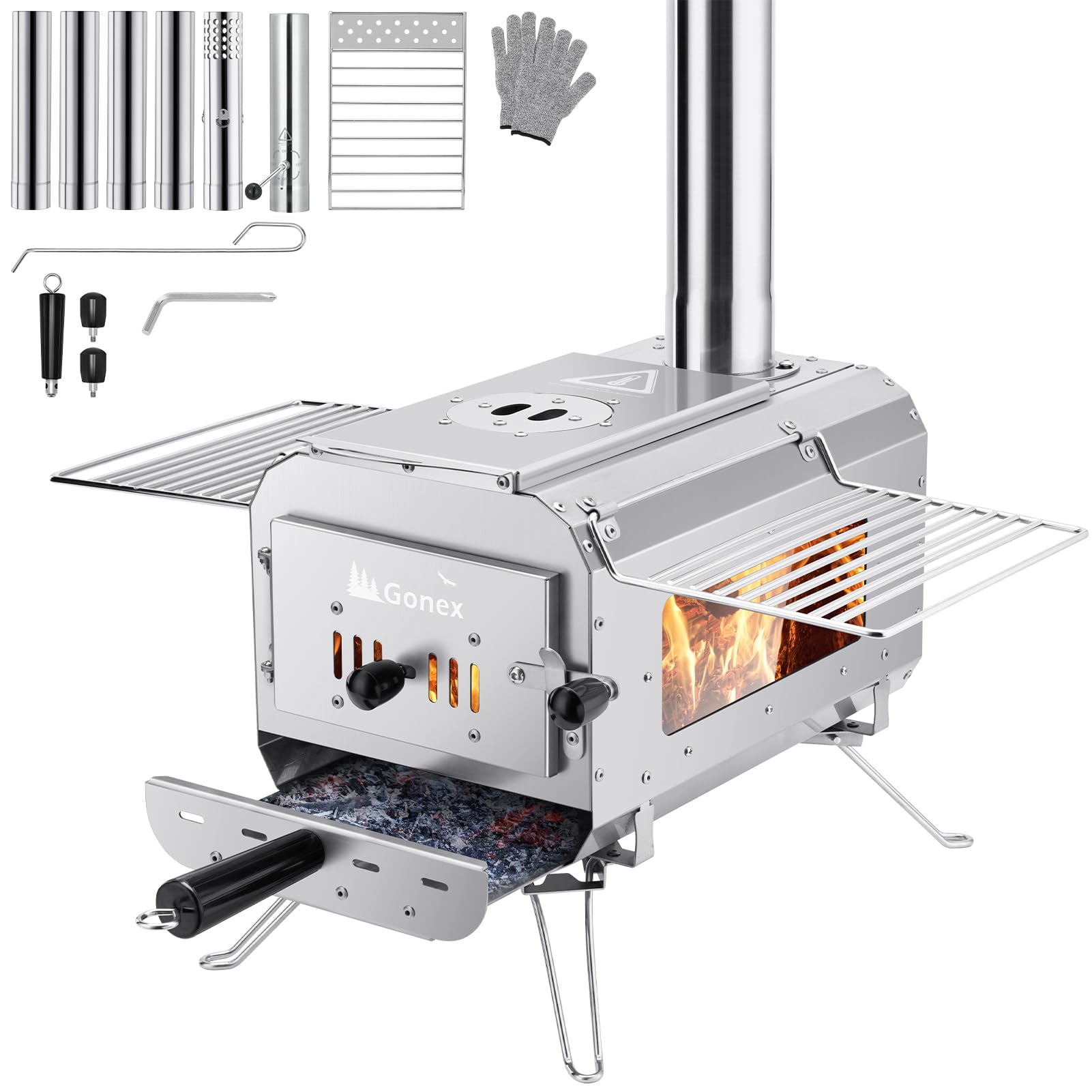
2. Gonex Hot Tent Stove
An entry-level stove with a real glass window and a chimney built to fight backflow.
The first thing you notice in the build is the chimney: 72.8 inches of it, at 2.76 inches in diameter. That wide pipe is a notch up on the Winnerwell’s 2.5-inch diameter, and a wider pipe moves smoke out more freely. The crescent-shaped damper keeps airflow moving even when it is fully closed, which cuts the backflow that sends smoke into a small room.
The body is 1mm stainless steel, rated to withstand 932°F without warping. That is thinner steel than the 1.6mm body on the pickup further down, so treat this as the lighter-duty build. The firebox measures 16.9 × 10 × 9.5 inches and takes standard pre-cut logs. A side-mounted heat-resistant glass window lets you watch the flames without cracking the door, and a removable ash drawer makes cleanup far less gritty. It weighs 23.8 pounds.
Function is what earns the praise here — the damper and venting work as intended, and the stove delivers for the outlay. The one honest caveat is heat control at the top end: the whole stove body can run red hot if you load it heavy and leave the air open. Keep the inlets dialled back and it stays a steady, controlled heater.
What the fire view gives you: a side window and dual air inlets mean you can read the burn and adjust it without opening the door, which keeps smoke in the box where it belongs.
Keep it in mind: the 1mm steel is the thinnest wall in this group, so it rewards a gentler hand on the fuel load than a thick-bodied stove would.
Reach for this if: you want a heat source with a glass window and a tall, wide chimney without stretching the budget.
Look elsewhere if: you plan to run the stove flat out every night and want a thicker wall carrying the heat.
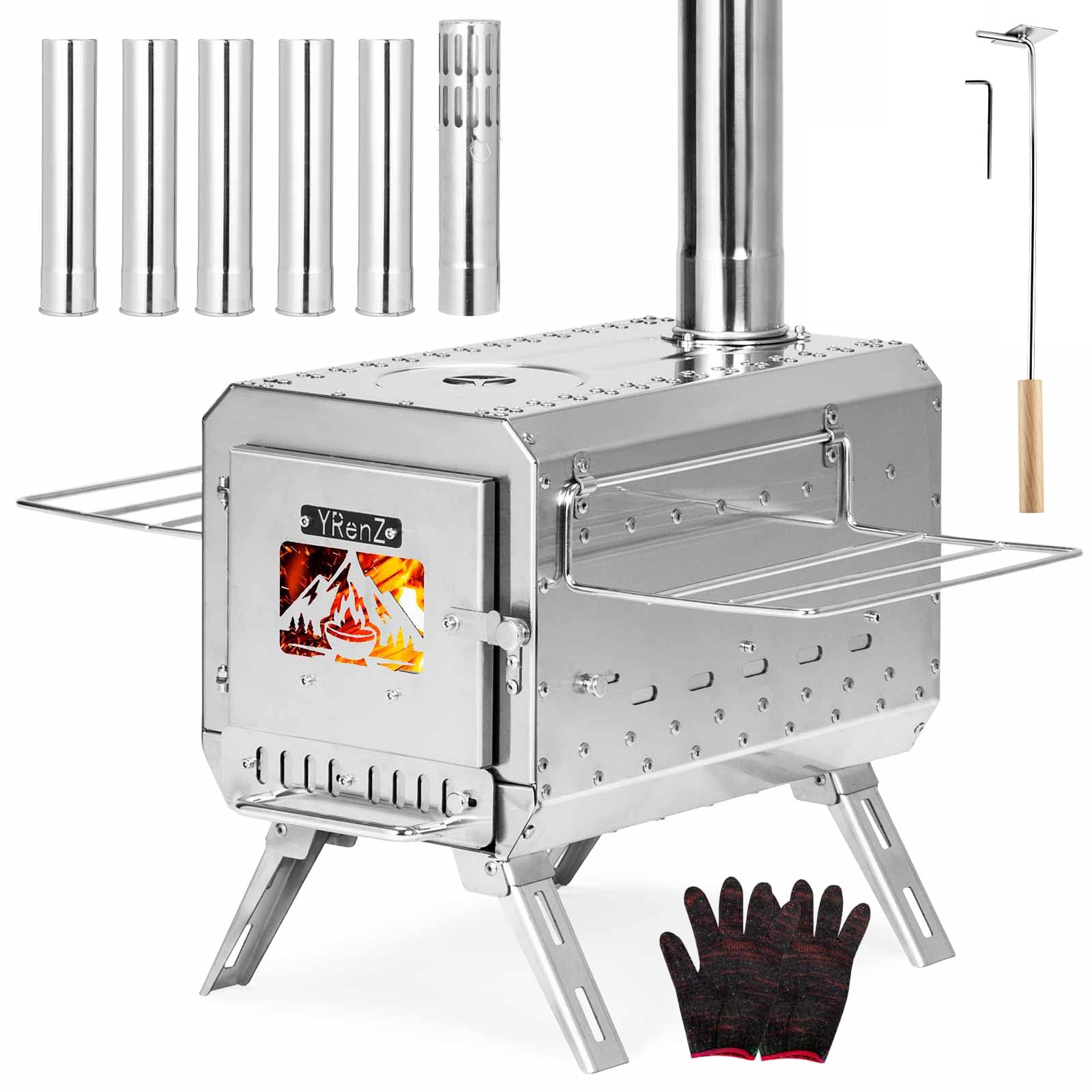
3. 1.6mm Stainless Steel Tent Stove
The thinnest-looking numbers in the listing hide one of the stoutest steel bodies here.
Steel thickness is the spec to read first on this one, and it delivers. The body is built from 1.6mm stainless steel — sixty percent more wall than the 1mm Gonex above. A thicker wall resists bending when the fire is hot for hours, and the dual-layer heat insulation structure under the top reinforcing ribs is there to stop overheating warping the body over a long winter of nightly use.
Inside, three air paths — one primary inlet and two adjustable secondary ones — feed the fire from more than one direction. That three-way combustion gives a steadier heat output than a single inlet. The oversized firebox cuts how often you refill, and a removable ash drawer makes cleaning a two-minute job. The chimney runs to 2m across seven splicable, height-adjustable sections, so you can tune the draw to your roofline.
Riveted joints hold the body sealed against smoke leaks, and the stainless steel avoids the odour and paint peeling you get from painted steel as it heats. Read the install manual carefully, because getting the pipe sections seated right matters for draw.
Pick this one if: you want the thickest body in the guide and an adjustable 2m chimney to fit an awkward roofline.
Be aware: the body is heavier-duty than the price suggests, but the listing has less owner history to lean on.
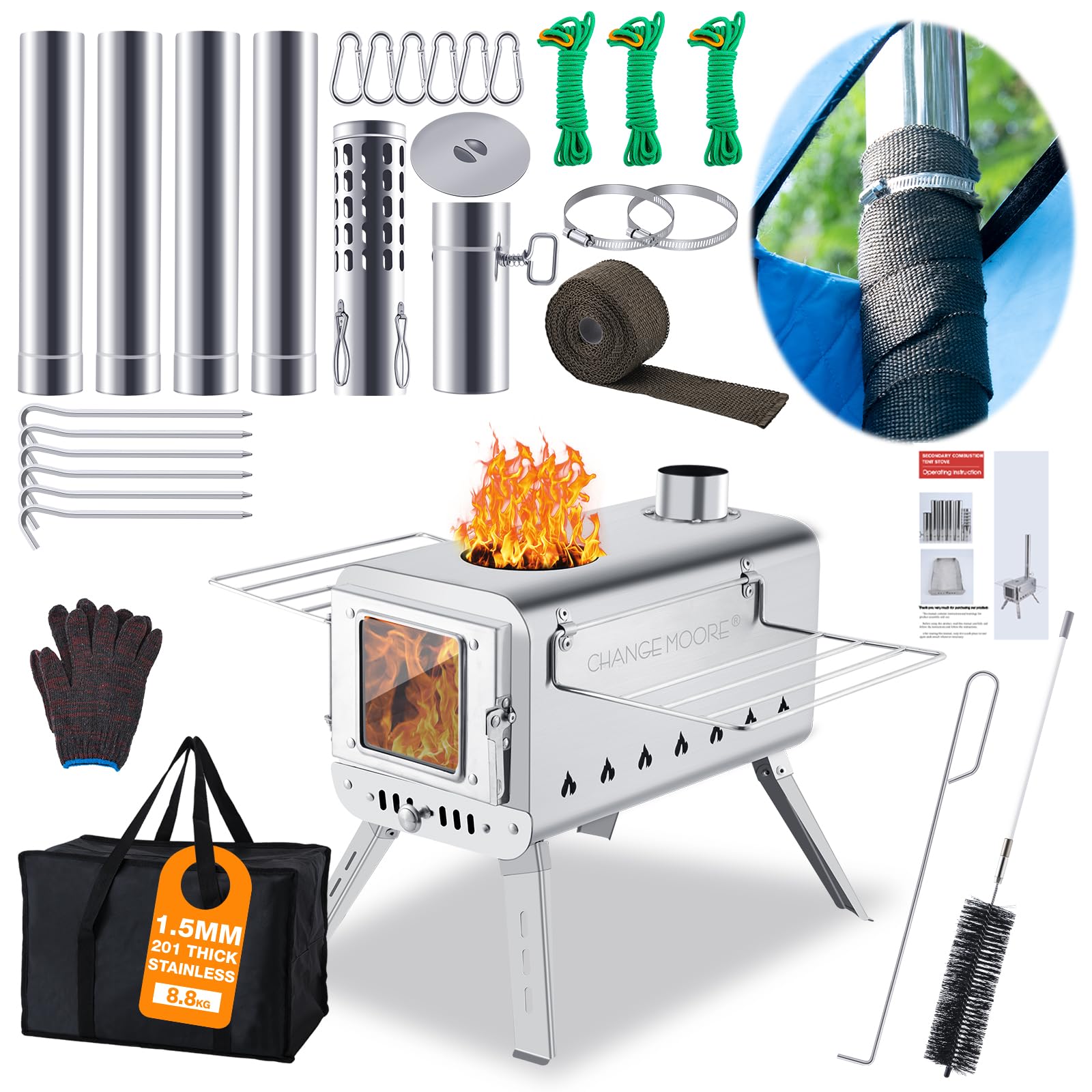
4. Hot Tent Wood Stove Secondary Burning
A secondary burn system that turns smoke into heat and keeps the van smelling clean.
What sets this stove apart is its secondary burn system. Instead of letting unburned gases drift up the pipe, it burns them again at higher temperature. The result is more consistent heat, less smoke, and less carbon and tar building up inside the stove. It also copes better with damp or lower-grade wood than a plain single-burn box would.
The body is 1.5mm 201 stainless steel, and the SCHOTT glass window is rated to 1000°C. That is the same brand of glass used on the OneTigris, and it holds a clear view through the temperature swings. The firebox gives 593 cubic inches of interior space — smaller than the Winnerwell’s 800 cubic inch box, but enough for a larger wood load than the tightest stoves here. A removable burn plate makes cleaning quick.
Functionality is where it shines — owners mention the stove runs clean, with minimal smoke and strong heat retention from the double burn. The safety kit is real, too: a built-in chimney connection, a heat-resistant wrap to stop burns off the hot surfaces, and wind-resistance ropes to steady it. The catch is its stated coverage of areas up to 500 sq ft, which is far more space than a van holds — in a motorhome you will be running it low, so get used to the air control early.
The burn you can trust: less smoke and tar means fewer midwinter clean-outs, and the SCHOTT window keeps the fire visible through the cold snaps.
Installation note: the manufacturer is specific — fit the chimney before lighting, avoid cooling the stove with water right after use, and keep hands off the hot glass.
Suits you if: smoke control and clean burns matter more to you than a huge firebox.
Look past it if: you need the biggest possible wood load and a body with a long, proven track record.
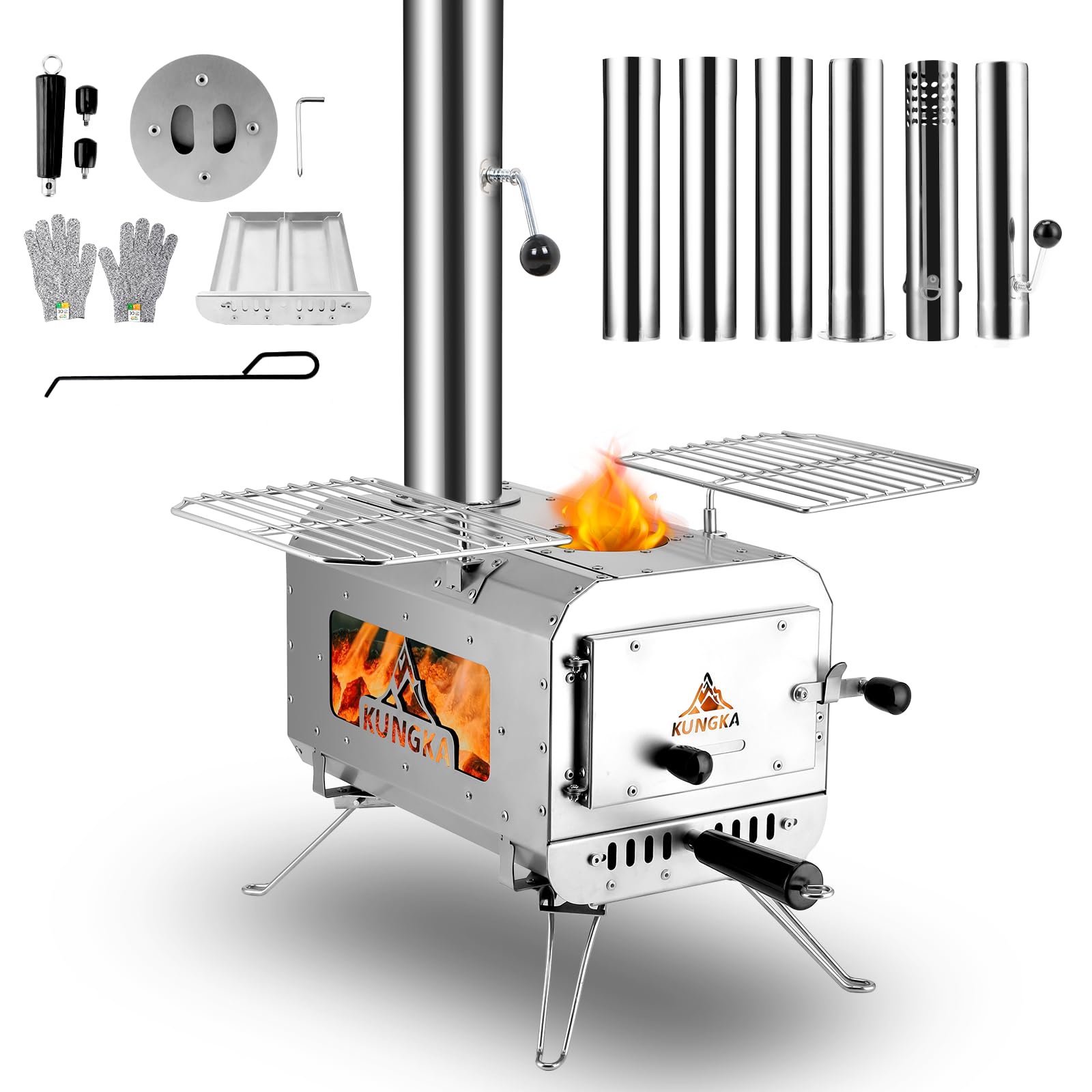
5. KUNGKA Portable Wood Burning Stove
Wide viewing windows and a rain cap built for a stove that lives under a low roof.
Start with the glass. This stove puts a viewing window in the door and large flame-retardant glass panels on the sides, so you can monitor the burn from your seat. Watching the fire through glass instead of opening the door keeps smoke inside the box, which is a real help in a small space. The stainless steel body conducts heat well and resists rust, and the pipe diameter is 2.76 inches across six chimney sections.
That 2.76-inch pipe is noticeably wider than the Winnerwell’s 2.5-inch diameter, which helps smoke travel out of a short chimney on a van roof. The chimney has an adjustable valve and the stove has two air inlets, so you set the flame size rather than guessing. A rain cap on top means a shower does not soak the fire, which matters when the stove is your main heat. At 20 pounds it stays portable, with folding legs and side tables that unfold into a storage rack.
Build quality is what owners talk about most, and the burn performance backs it up. The one honest complaint is heat at the top end — run it hard and the stove gets very hot, so you learn to dial the inlets down. The placement of those large side windows is the standout, letting you see the flames from across the van without touching the hot door.
It fits your build if: you want to see the fire clearly and keep it going through rain without opening the door.
Mind the heat: the upper range runs hot, so pair it with a heat mat and steady hand on the air control.
6. OneTigris Tiger Roar Tent Stove
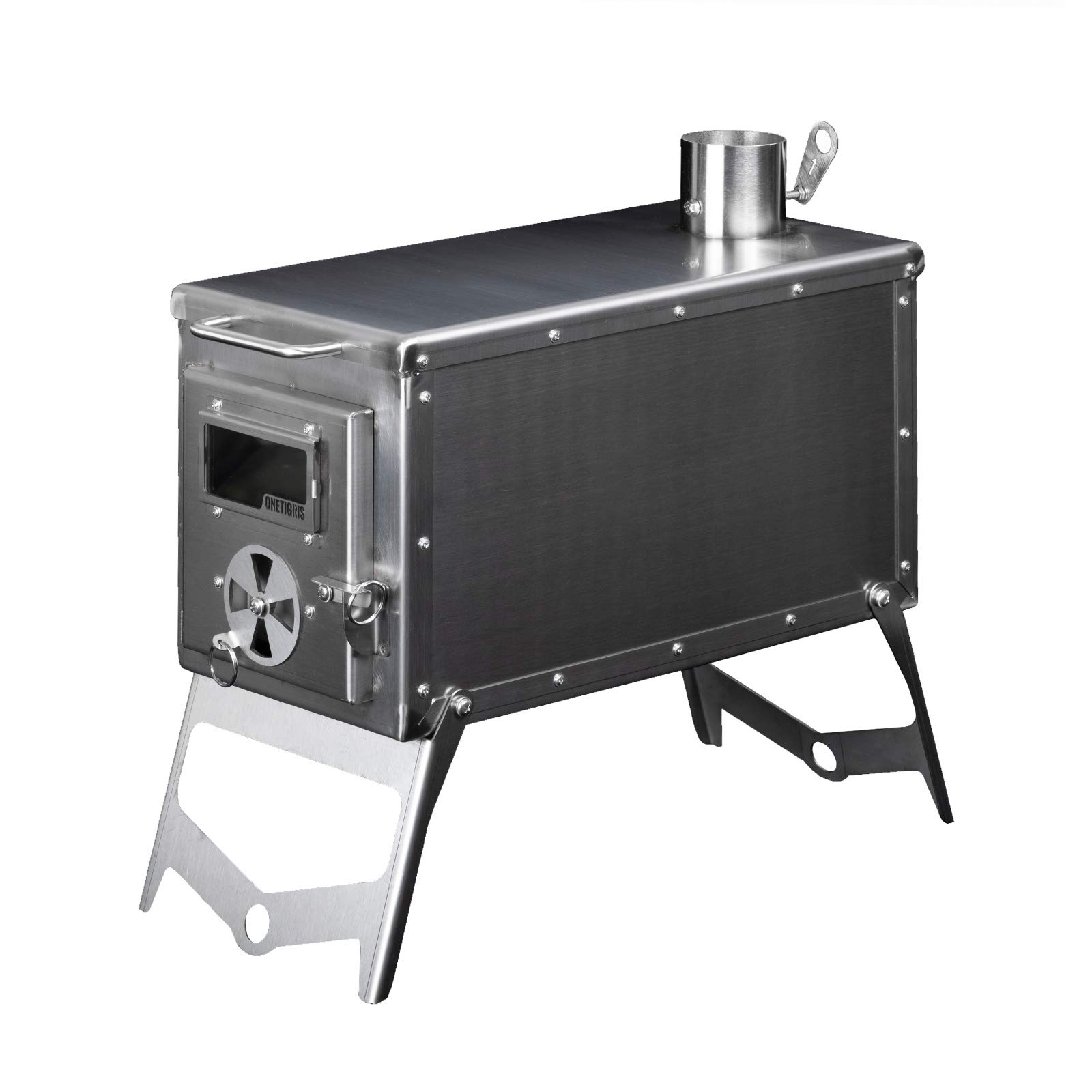
The pipe-layout tinkerer’s stove, with elbows that let you route smoke around a tight roofline.
The standout here is the exhaust kit. You get seven stove pipe sections plus two 45-degree elbows and two 90-degree elbows, so you can turn the pipe around corners a straight chimney cannot. You can also flip the elbow to point rain or snow away from the pipe opening. That flexibility is what makes this stove fit an awkward motorhome roofline where a rigid straight run will not.
The body is 304 stainless steel with a 3mm-thick top that the maker says resists bending under fire. The chimney and elbow pipes are made from 201 stainless steel. The viewing window is German SCHOTT ROBAX glass-ceramic, rated to 760°C and built to survive sudden temperature swings. A special air valve splits airflow up and down, controlling burn speed and stopping smoke from backing into the tent.
The size is what owners praise most — a compact 10.6 × 8.5 × 17.3 inch body that fits tight spaces, with heating performance that holds up in genuinely cold conditions. Portability for car camping gets strong marks too. The trade-offs are real, though: smoke containment and durability draw mixed feedback, so keep the joints seated right and treat the pipe sections with care. It is also heavy at 10 kg, so plan a fixed install rather than moving it often.
Where it earns its spot
- 7 pipe sections plus 45° and 90° elbows for tricky roof routing
- SCHOTT ROBAX glass rated to 760°C
- Air valve splits flow to control the burn and stop backflow
- Compact body fits a tight van footprint
What to watch
- 10 kg makes it a fixed install rather than a carry-around
- Smoke containment and durability are the areas that need care
Turn to this if: your roofline needs an elbow or two to get the pipe out cleanly.
Think twice if: you want something you lift in and out of the van each trip.
7. TSG Portable TA1 Titanium Tent Stove
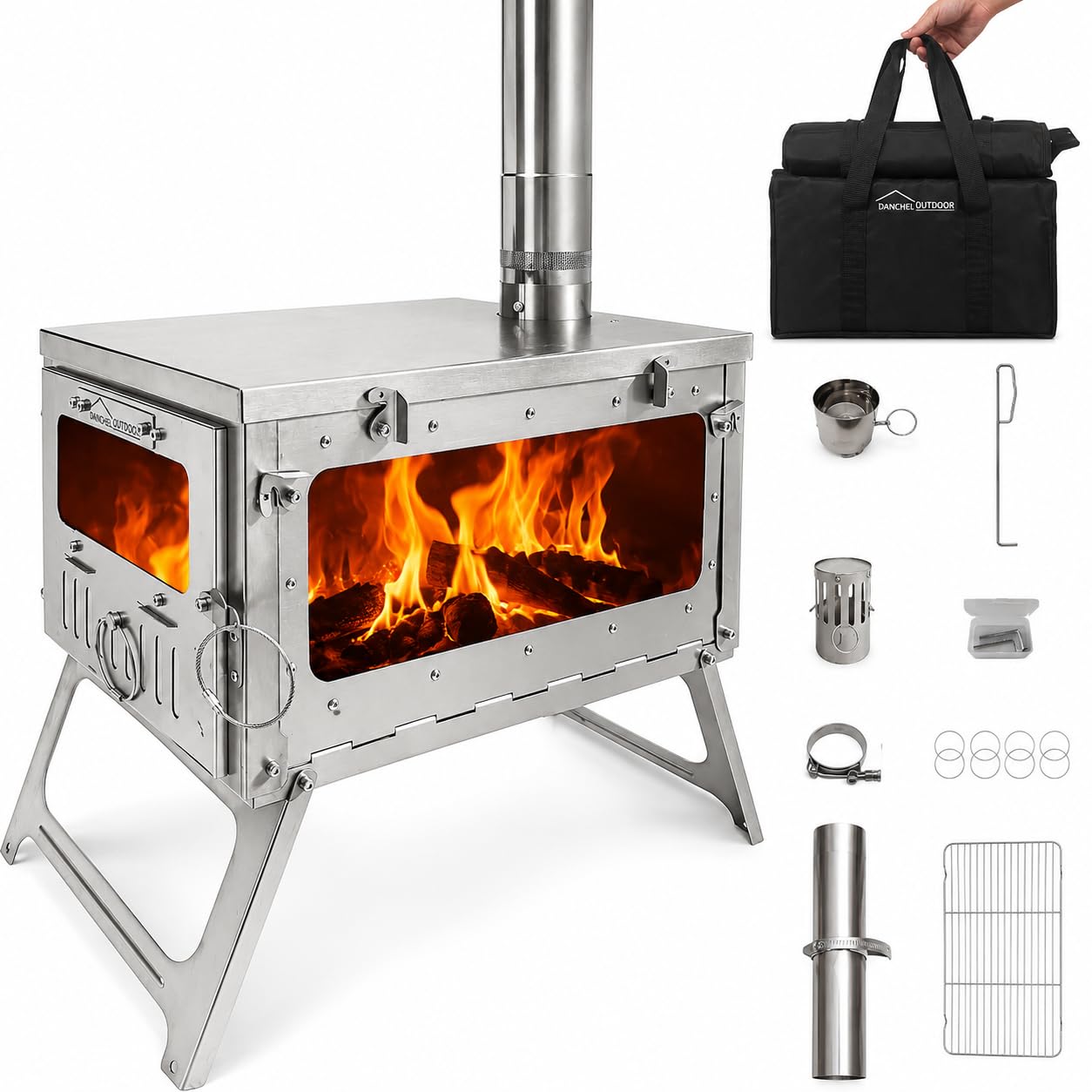
A 23L firebox you can load with long logs, yet it weighs just 8.16 pounds with the bag.
Titanium is the story. The body is TA1 titanium, a rust-resistant metal that shrugs off high heat, and it pays off in the weight figure: 8.16 pounds including the carrying bag. That makes it the lightest stove in this group by a wide margin, which matters whether you are packing it into a far campsite or just want a stove you can lift without help.
The firebox holds 23 litres, enough to take wood pieces up to 16 inches long, and it gives 395 cubic inches more firebox capacity than the standard TSG version. Seven adjustable air intakes plus a damper let you fine-tune airflow, and a built-in cooling rack lifts air under the logs for a cleaner burn. Its two-plate top with a load-bearing bar holds up to 22 lbs, so it cooks as well as heats. A titanium spark arrestor and three wind-rope rings keep embers in check.
Effectiveness is what owners cheer most, and the heat output holds up — one buyer ran it comfortably in 40-degree temperatures. The draft control and damper working together gets a lot of love, and no embers escaping the chimney is the sort of thing that makes it safe inside a van. Durability is a mixed note: titanium is light and rust-resistant but thin, so treat the body gently and do not drop heavy fuel on it.
The weight payoff: 8.16 pounds means you can pick the stove up one-handed, a genuine difference from the 33.4-pound POMOLY below.
The honest catch: titanium is thin metal — it saves weight but rewards careful handling when you load large wood.
Go for it if: you want a large firebox without the weight that normally comes with one.
Steer away if: you need a heavy-duty steel body to take rough handling over many seasons.
8. POMOLY Dweller Max 3 Tent Stove

Three panels of fire-resistant glass turn the stove into an open fireplace for the van.
Ambience is the pitch here, and it is a real one. Three panels of high-temp fire-resistant glass give you a view of the flames from more than one side, so the stove reads like a hearth rather than a metal box. Watching the burn through the glass also means you judge when to refill without opening the door — and opening the door is when smoke escapes.
The body is rugged 304 stainless steel, and the joints are cut to high precision so gaps stay minimal. That tight fit is what keeps smoke from sneaking out where it should not. The inverted chimney design, paired with an integrated damper, is built to stop creosote weeping out through the seams over time. A drawer-style ash box slides out at the base for cleanup without a dust cloud, and the air intake sits low with a simple slide control to open or choke the fire.
Heat is the thing owners notice — it gives off plenty of it. The frame feels solid and stable, which is what you want on a van floor. The honest trade-off is weight and size: at 33.4 lbs without the stovepipe, this is the heaviest stove in the guide, so plan it as a permanent fixture rather than something you move in and out.
Eyes on the fire: the three-panel glass gives you a view from several angles, and the precision joints keep the smoke where it belongs.
Built to stay put: the drawer ash box and inverted chimney keep maintenance low, but 33.4 lbs locks it to a fixed spot.
Made for you if: the look of a real fire burning matters as much as the heat it throws.
Keep looking if: you need a stove you can carry easily or move around the van.
9. RBM Outdoors Caminus S Wood Burning Stove

Glass-walled on both sides, with four metal shields between you and the heat.
The defining feature of the Caminus S is that its side walls are made from heat-resistant ceramic glass. Instead of a single window, the fire glows through the sides, giving that soft golden light the maker talks about — like an open fireplace inside a tent or van. It is a genuine step up in how the stove feels to sit beside, not just how it heats.
Safety is built around those hot glass panels. Four protective metal shields stand between you and the hot surfaces, which matters in a small space where you move around a lot. A coil-type spark arrestor sits in the upper part of the firebox, splitting the chamber into two zones — the lower section where the wood burns and gives off heat, and the upper section where the after-burning happens. The whole unit weighs 23.6 lbs, runs on a 2.76-inch smoke pipe, and comes with gloves, a stove shovel, a mat, replacement plates, and a bag.
This is the premium end of the list, and it earns the spot with real glass, real shields, and a compact 17.71 × 12.20 × 16.14 inch assembled frame. The honest caveat is the same as any premium pick: you are paying for the glass and the finish, and the fold-out setup needs the manual followed carefully so the pipe seals right. Buyers who want a fireplace feeling in a van will find it hard to match anywhere else.
The pick for you if: you want the fire visible from the sides and the hot surfaces guarded.
Pass on it if: you want the simplest, most stripped-back stove and do not value the glass and shield kit.
Know the Specs
Firebox capacity
Firebox size is the space inside the stove where the wood burns, measured in cubic inches or litres. A bigger box holds more fuel and goes longer between refills — the Winnerwell’s 800 cubic inch box against the Change Moore’s 593 cubic inches shows how much that can vary. In a van, size it to the longest log you can store, not just the floor space you can spare.
Steel wall thickness
Thickness, measured in millimetres, tells you how much heat the body can take before it bends. Thicker steel like the 1.6mm body on the YRenZ-style stove holds its shape through a long hot burn, while 1mm steel stays lighter but asks for a gentler hand on the fuel load. If you run the fire every night, the thicker wall pays off over time.
Chimney diameter and height
Smoke rises because the hot pipe pulls air up behind it, and that pull depends on a tall, wide enough pipe. A 2.76-inch pipe moves gases more freely than the Winnerwell’s 2.5-inch diameter, and 72.8 inches of chimney on the Gonex gives strong draw. Too short or too narrow a chimney fights the fire and pushes smoke into the room.
Spark arrestor and damper
A spark arrestor is a mesh cap or coil that catches flying embers before they leave the stove, keeping sparks off a low van ceiling. A damper is a valve in the pipe that controls how fast smoke rises and how hot the fire burns. Together they are what make a wood stove safe and controllable inside a small living space.
Common Questions
Is a wood stove safe inside a motorhome?
How big a firebox do I need for a small van?
What does steel thickness mean for a stove’s life?
Why does chimney height matter more than heat output?
Do I need a glass window on a small wood stove?
What is secondary combustion and does it cut smoke?
Is titanium better than stainless steel for an RV stove?
What is a spark arrestor and do I really need one?
How do I stop smoke blowing back into the van?
Can I cook on a motorhome wood stove?
The Bottom Line
For most motorhome builds, the wood stove for motorhome that is worth the money is the Winnerwell Nomad Medium. Its 800 cubic inch firebox and rust-resistant 304 stainless body handle both heating and cooking, and it packs into a 19.4-pound bundle with the pipe stowed inside. If you want a lighter-duty stove with a glass window and a tall, wide chimney on a tighter budget, the Gonex Hot Tent Stove is the one to reach for. And if the look of a real fire burning through glass walls matters most, the RBM Outdoors Caminus S with its ceramic glass sides and four heat shields earns its premium spot.
How we choose
We do not accept paid placement. Every pick is matched to a real buyer and a real use-case; we do not hands-on test units.
Sources
Specifications: manufacturer listings and product documentation. Review insights: verified customer reviews, as of November 2026. Pricing: not shown on this page (it changes often); check the current price via the retailer link.
As an Amazon Associate, Tactical Gear Guy earns from qualifying purchases. This does not affect which products we feature.