Specs are compiled from manufacturer listings and verified buyer reviews and can change over time — please confirm the key details on the product page before buying.
If you want one running watch that gets pace, distance and recovery right without fiddling with menus mid-run, the Garmin Forerunner 570 is the safest pick here — a 42 mm aluminum case, a bright AMOLED display, and up to 10 days of battery life in smartwatch mode. The rest of this list splits cleanly into two camps. There are ultralight race watches built to disappear on your wrist, and there are rugged all-day GPS watches that just happen to track your splits beautifully. Knowing which camp you belong in is most of the buying decision.
This guide is built by comparing the manufacturers’ published specifications and the patterns across verified customer reviews, so you get each pick’s real strengths and trade-offs instead of marketing spin.
Below you’ll find honest picks sorted by who each one actually suits. We cover what a GPS running watch can and can’t do, which specs genuinely change your training, and how to pick the right wrist watch for running.
Top Picks

How To Choose The Best Wrist Watch for Running
A running watch has one job above all others: tell you your pace and distance accurately, every single run, without a phone in your pocket. Everything else — sleep scores, recovery readiness, mapping — is a bonus on top of that core job. The trick is buying the watch whose bonus features match how you actually train, rather than paying for sensors you’ll never open.
Start with GPS battery hours, not smartwatch days
The “up to 10 days” figure on a spec sheet usually means smartwatch mode — normal wear with notifications, not live satellite tracking. The number that decides whether a watch survives your marathon or ultra is the GPS-mode figure. A watch rated for 18 hours of GPS will comfortably cover a marathon and a long training week; one rated for 43 hours of GPS covers a multi-day trail race. Read both figures before you commit.
Decide how much weight you want on your wrist
Wrist weight compounds over distance. A 32 g nylon-band watch and a 48 g rugged sports watch feel identical for the first mile and completely different at mile twenty. If you race frequently, hunt for the sub-40 g models first. If you wear the watch to work and on hikes as well, a slightly heavier case with proper water sealing is usually the better long-term trade.
Understand single-band versus dual-frequency GPS
Standard GPS locks onto one satellite signal, which can drift between tall buildings or under dense tree cover. Dual-frequency GPS listens on two signals at once, so it holds your line in cities and forests far more reliably. That matters if your routes run through downtown streets or technical trails — less so on open flat roads where basic GPS is usually fine.
Side-by-Side Comparison
| Model | Best For | GPS Tracking | Stated Battery Life | Weight / Size | Amazon |
|---|---|---|---|---|---|
| Garmin Forerunner 570 (42mm)★ Best Overall | All-round training and race day | Built-in GPS, 30+ activity profiles | 10 days smartwatch, 18 hrs GPS | 42 mm, 20 mm band | Amazon |
| CARBINOX Blaze RuggedRugged Runner | Rough terrain and mixed sports | Dual GPS, 7 outdoor modes | 15 days, 480 mAh | 22 mm band | Amazon |
| Amazfit Active 3Map Master | Free mapping and coached plans | Six satellite systems, free offline maps | 12 days, 24 hrs continuous GPS | 1.32″ AMOLED, stainless steel | Amazon |
| Polar Pacer Pro | Structured runner’s training | Built-in GPS, 150+ sports | 35 hrs training mode, 7 days watch mode | 41 g, 22 mm band | Amazon |
| SUUNTO Run | City and trail navigation | Dual-frequency GPS, breadcrumb trail | 12 days, 20 hrs GPS training | 36 g, 46 mm case | Amazon |
| COROS PACE 4 | Ultralight long-distance racing | Built-in GPS, breadcrumb navigation | 19 days daily, 41 hrs continuous GPS | 32 g, 11.8 mm thin | Amazon |
| Garmin Instinct 3 Solar | Backcountry wear-and-forget | Multi-band GPS with SatIQ | 28 days, solar charging | 45 mm, 22 mm band | Amazon |
| Polar Street X | Gym-and-road hybrid training | Built-in GPS, back-to-start navigation | 10 days, 43 hrs GPS | 48 g | Amazon |
| Garmin Forerunner 70 | First-time and beginner runners | Built-in GPS, 80+ activity profiles | 13 days, 23 hrs GPS | 43 mm, 20 mm band | Amazon |
| Samsung Galaxy Watch Ultra | Android users who want one watch for everything | Dual-frequency GPS, Running Coach | 590 mAh battery | 47 mm titanium | Amazon |
| Apple Watch Ultra 4 | Ultramarathon and iPhone users | Precision dual-frequency GPS | Up to 45 hrs Max Extended Workout | 49 mm titanium | Amazon |
Detailed Reviews
1. Garmin Forerunner® 570, 42mm, Aluminum, Bone/Mango
Our pick — 4.5+★ from 600+ verified ratings; the strongest balance of quality and price.
A 42 mm Garmin that handles recovery, readiness and daily suggested workouts so you just run the miles.
Garmin built this one for smaller wrists, and it shows: the 42 mm aluminum case paired with a 20 mm silicone band sits close and stays out of the way. You get a bright AMOLED touchscreen (the vivid color display type) backed by physical buttons, which matters on a rainy run when wet fingers slide off glass. Battery life is up to 10 days in smartwatch mode and up to 18 hours in GPS mode — enough for a marathon with a long training week wrapped around it.
What wins people over is the overall build quality, and the battery follows close behind. Owners describe charging roughly every nine or ten days in normal wear, which lines up with the published 10-day figure. The training side goes deeper than most casual runners will ever need: personalized Garmin Coach plans for running and triathlon, a training readiness score built from sleep quality, recovery, training load and HRV status (heart rate variability, the tiny beat-to-beat timing shifts that hint at how recovered you are), plus daily suggested workouts that adjust to what you actually did yesterday.
The honest catch is the price tier — this sits among the pricier options here, and “value for money” reads mixed in the feedback even though the watch itself is clearly well made. Call quality is a genuinely useful extra too: there’s a built-in microphone and speaker, so paired to your phone you can take calls from your wrist. Here’s the direct comparison that matters — this watch runs up to 10 days in smartwatch mode, while the CARBINOX Blaze stretches to 15 days, but the Garmin’s stronger overall quality read makes 10 days a fair trade for most runners.
Where it earns its keep
- Bright AMOLED display with real buttons underneath for sweaty or rainy runs
- Up to 18 hours of GPS mode covers a marathon without a recharge
- Training readiness and daily suggested workouts adapt to your recovery
- 42 mm aluminum case built to fit smaller wrists properly
- Built-in mic and speaker for wrist calls when paired to your phone
What to weigh first
- Premium tier pricing makes it a bigger commitment than the value picks
- Reliability feedback lands as mixed rather than glowing
- 30+ activity profiles is plenty, but the depth is aimed at data-minded runners
Reach for this if: you want one watch that nails pace, distance, recovery and wrist calls without juggling apps.
Think twice if: you only need basic pace and distance — the beginner-friendly Forerunner 70 covers that for less.
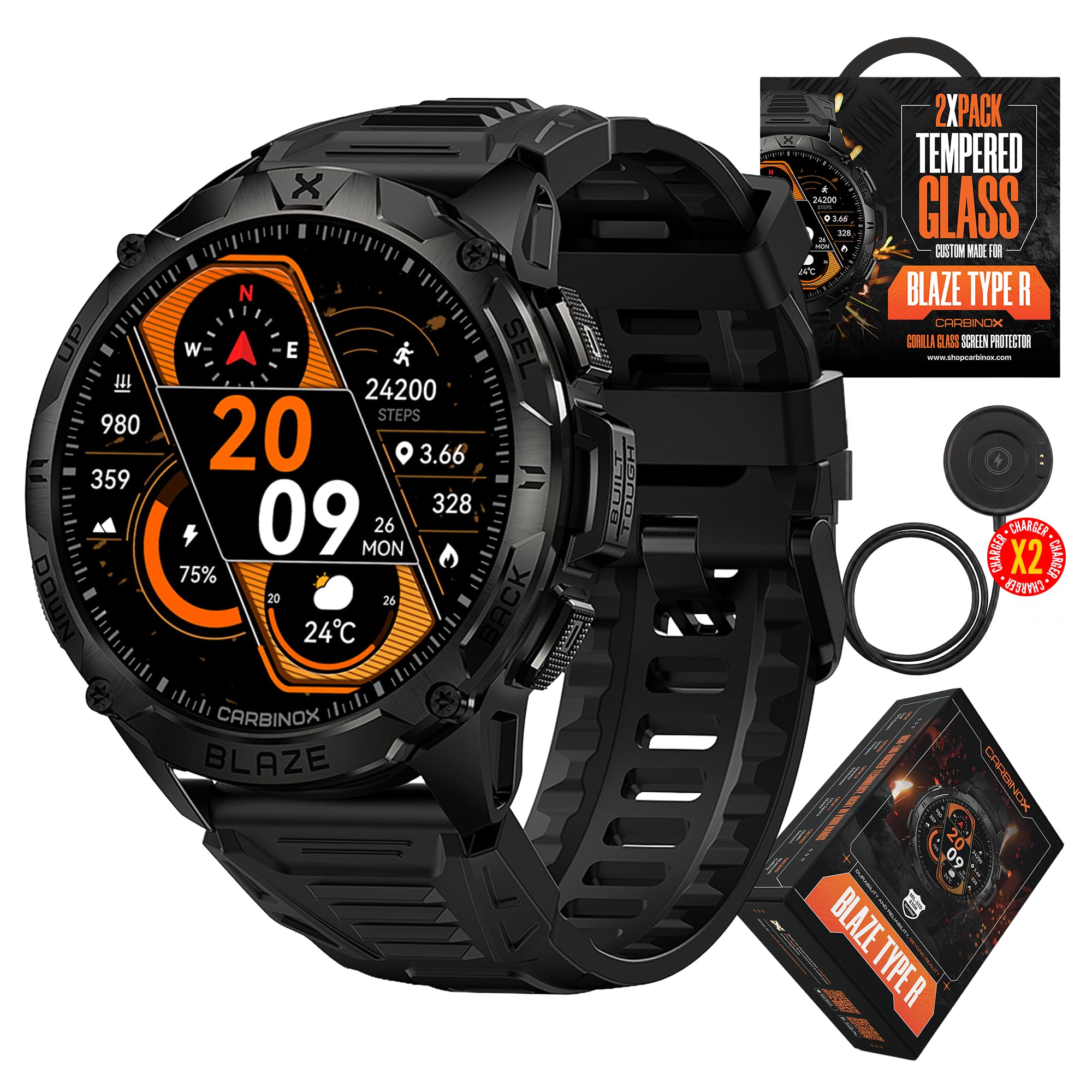
2. CARBINOX Blaze Rugged Smart Watch
A MIL-STD-810H trail watch sealed to IP69K, so mud, rain and rock scrapes are inside its comfort zone.
If your runs happen on gravel, dirt and construction-site shortcuts rather than clean pavement, the CARBINOX Blaze makes a serious case. It’s built to MIL-STD-810H (a military durability standard covering drops, dust and impact) in alloy steel with a Gorilla Glass display, then sealed to IP69K (a rating for high-pressure water and dust ingress). Mud, rain and hard training are all inside its comfort zone. The AMOLED screen stays bright outside, and the 22 mm quick-release strap swaps without tools.
Battery is the standout number: a 480 mAh cell rated for up to 15 days. That’s the biggest stated capacity on this list — compare it to the Polar Pacer Pro’s 265 mAh and you’re looking at roughly 81% more raw battery capacity, which translates to fewer nights tethered to a cable. You also get dual GPS with 7 outdoor modes, plus a compass, altimeter and barometer, so you can navigate trails phone-free. Bluetooth calling from the wrist and 170+ sports modes round out a packed feature list.
The thing everyone raves about is the toughness and the look — it reads as a proper tool watch rather than a fitness band. Reliability, though, is the honest asterisk: some units have stopped working within a week, while plenty of others run fine for the long haul. That’s a real quality-control wobble, not a dealbreaker, but it’s worth buying from a seller with a solid return window. Pairing to both Android and iPhone is straightforward, and setup is quick.
Battery math that matters: 480 mAh and 15 days is the most generous power spec in this lineup, so a weekend of trail runs won’t drain it.
The trade-off: rugged build plus a large alloy case means it wears heavier and bulkier than the 32 g race watches here — great for toughness, less ideal if you want a wrist that forgets the watch exists.
Suits you when: durability and battery endurance outrank featherweight feel on your priority list.
Better elsewhere if: you race often and want the lightest possible wrist — the COROS PACE 4 trims down to 32 g.
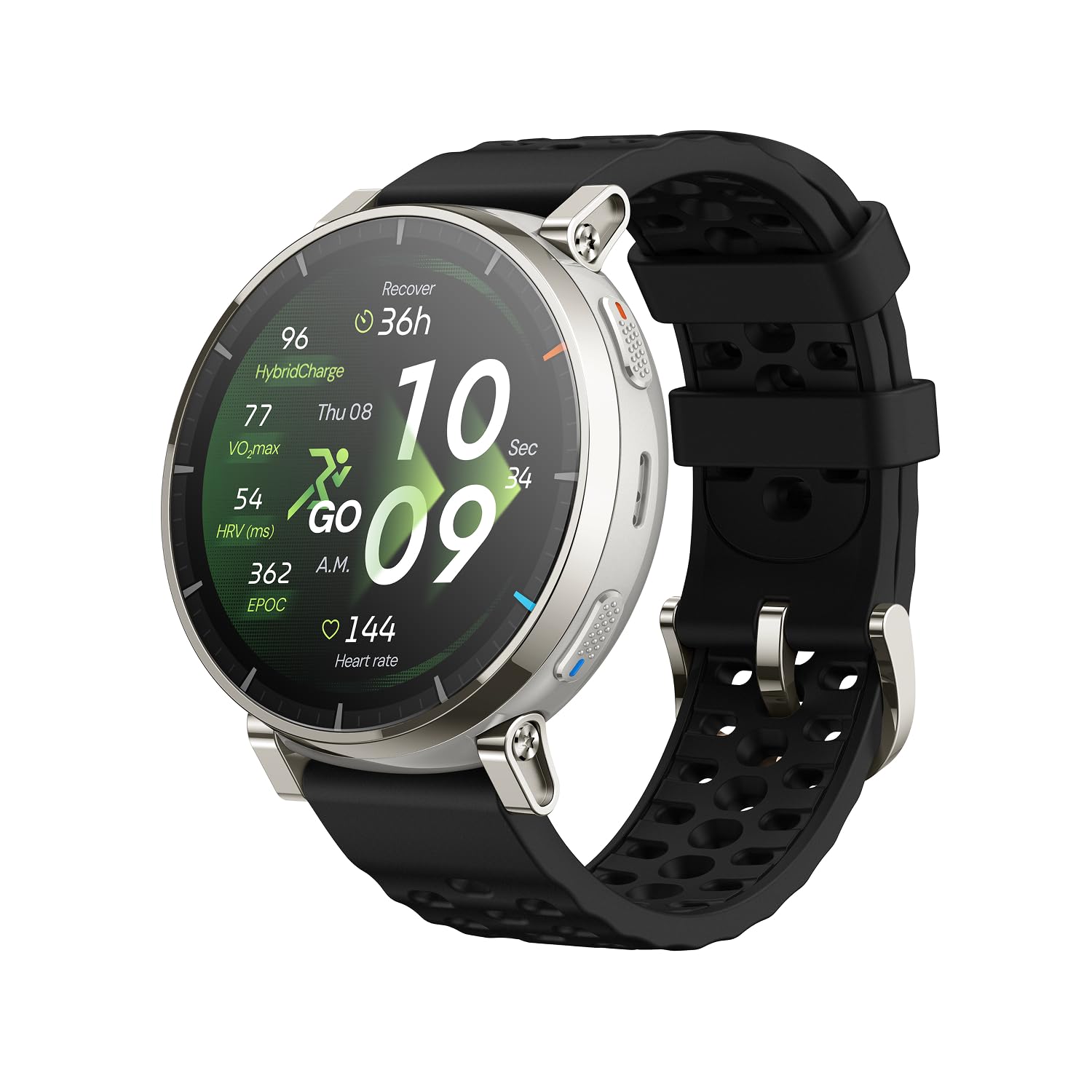
3. Amazfit Active 3 Smart Watch
Free offline maps with turn-by-turn directions and automatic rerouting, no subscription and no phone required.
Most running watches make you pay for mapping or carry your phone for it. The Amazfit Active 3 does neither: you download free maps to use offline, with turn-by-turn directions and automatic rerouting on the watch itself. Six GPS satellite systems (the watch pulls location from several constellations at once for a stronger lock) keep you on course. For anyone who runs unfamiliar routes or explores new cities, that’s the feature that changes the whole experience.
Battery life is 12 days in typical use, 7 days with heavy use, or 24 hours with continuous GPS route tracking. The 1.32″ AMOLED display is bright and easy to read, and the stainless steel frame with sapphire glass keeps the watch light while resisting scratches. The free Zepp app carries the training side: 5K-to-marathon coaching, plus running power, lactate threshold, posture and ground contact metrics to tidy up your form. Over 170 workouts and BioTracker health monitoring (heart rate, blood oxygen, stress and sleep) are included.
Owners gravitate toward the overall quality and the sheer spread of features, and the battery holds up to a week and a few days before charging. The one caveat worth knowing: the charging base uses a magnetic connector rather than a USB Type-C cable, so misplacing it means ordering a replacement. Accuracy feedback splits between praise and criticism, so treat the advanced metrics as guidance rather than gospel. Bluetooth calling and speech-to-text replies are handy extras for Android users.
Best-in-line feature: free offline maps with automatic rerouting are the single biggest reason to pick this watch over the pricier ones.
Worth noting: no USB Type-C cable in the box means the magnetic charging base is your lifeline — keep it somewhere predictable.
Pick this if: you run new routes and want watch-led navigation without a subscription.
Look past it if: you train on the same loop every day and mapping adds nothing for you.
4. POLAR Pacer Pro GPS Smartwatch
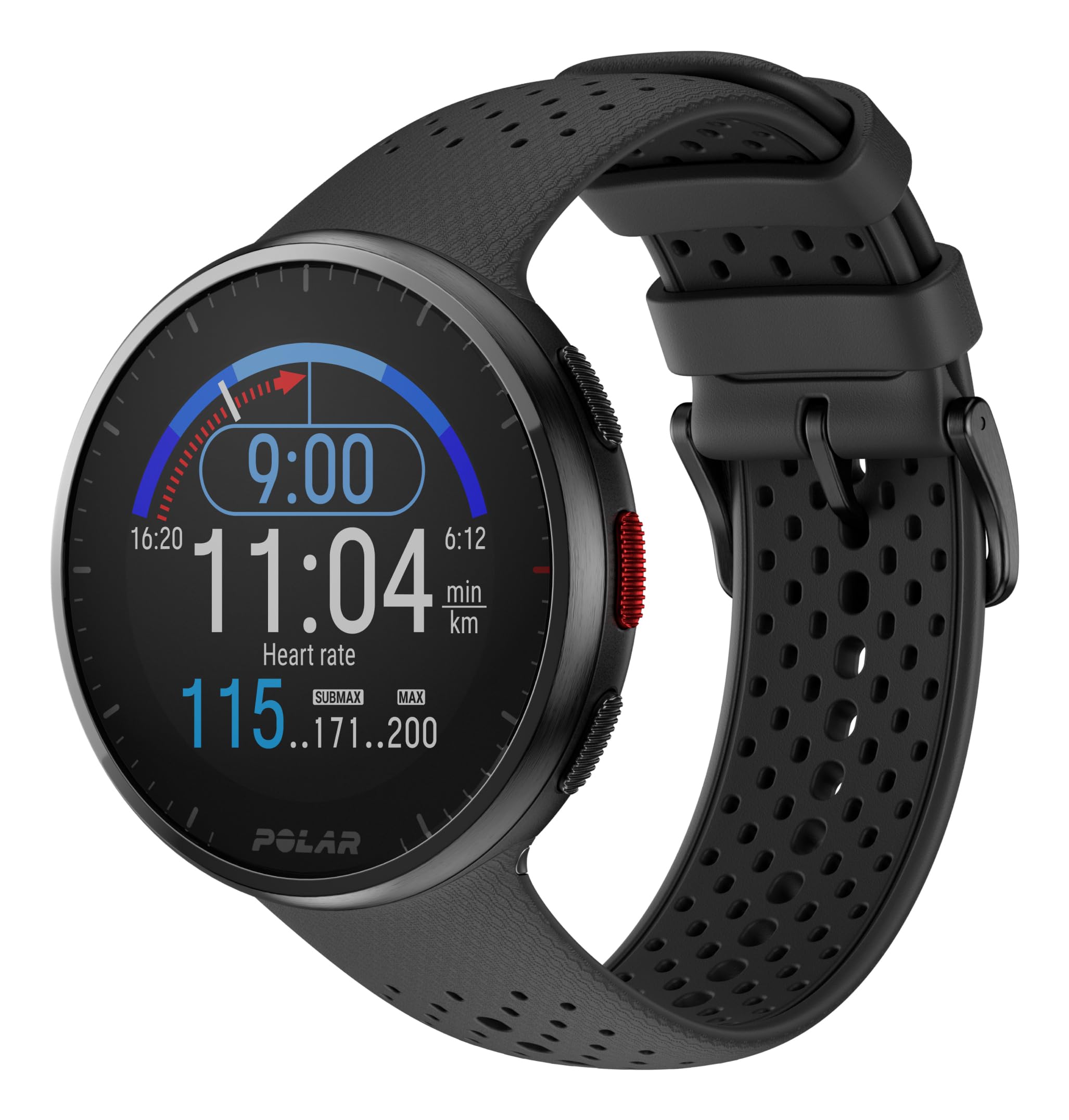
A 41 g training watch with up to 35 hours in training mode, enough for back-to-back long runs.
The Polar Pacer Pro is a runner’s watch built around one idea: give you the data a coached athlete gets, and get out of the way. At 41 g it’s light enough to forget you’re wearing it, yet the high-speed processor keeps time, pace, distance and laps updating live on a clear color display. Polar Precision Prime optical heart rate monitoring joins sleep and recovery tools, and there are specialized training features across 150 plus sports.
Battery is where it separates from the pack. You get up to 35 hours on a single charge in training mode, 100 hours in power save, and 7 days in watch mode. That 22 mm stainless steel band and standard strap setup also makes it one of the more dress-up-friendly options here. The included setup covers both sizes of wristband plus adapters for standard 20 mm bands, so you can swap straps freely.
Two honest notes. First, the 265 mAh cell trails the CARBINOX Blaze’s 480 mAh on raw capacity — Polar gets its endurance from efficiency, not brute size. Second, the heart rate monitor draws mixed feedback while GPS tracking lands as accurate, so a chest strap still earns its place for interval sessions. Syncing is the weakest link in the feedback, so keep the app updated and pair carefully before race day.
Reasons runners keep it
- 41 g build is among the lightest full-featured training watches in this lineup
- 35 hours in training mode covers back-to-back long runs without charging
- 150+ sports profiles and a high-speed processor keep live pace data smooth
- Includes an extra wristband and adapters for standard 20 mm straps
Points to plan around
- Wrist heart rate reads mixed, so serious interval work may want a chest strap
- Sync reliability shows up as the weakest feedback theme
- 265 mAh is the smallest raw battery capacity among the endurance picks
Built for the runner with a plan: structured training, interval work and long efforts where the data drives the session.
Not the first pick if: you want a flashy everyday smartwatch — this one prioritizes function over frills.
5. SUUNTO Run GPS Sport Running Watch
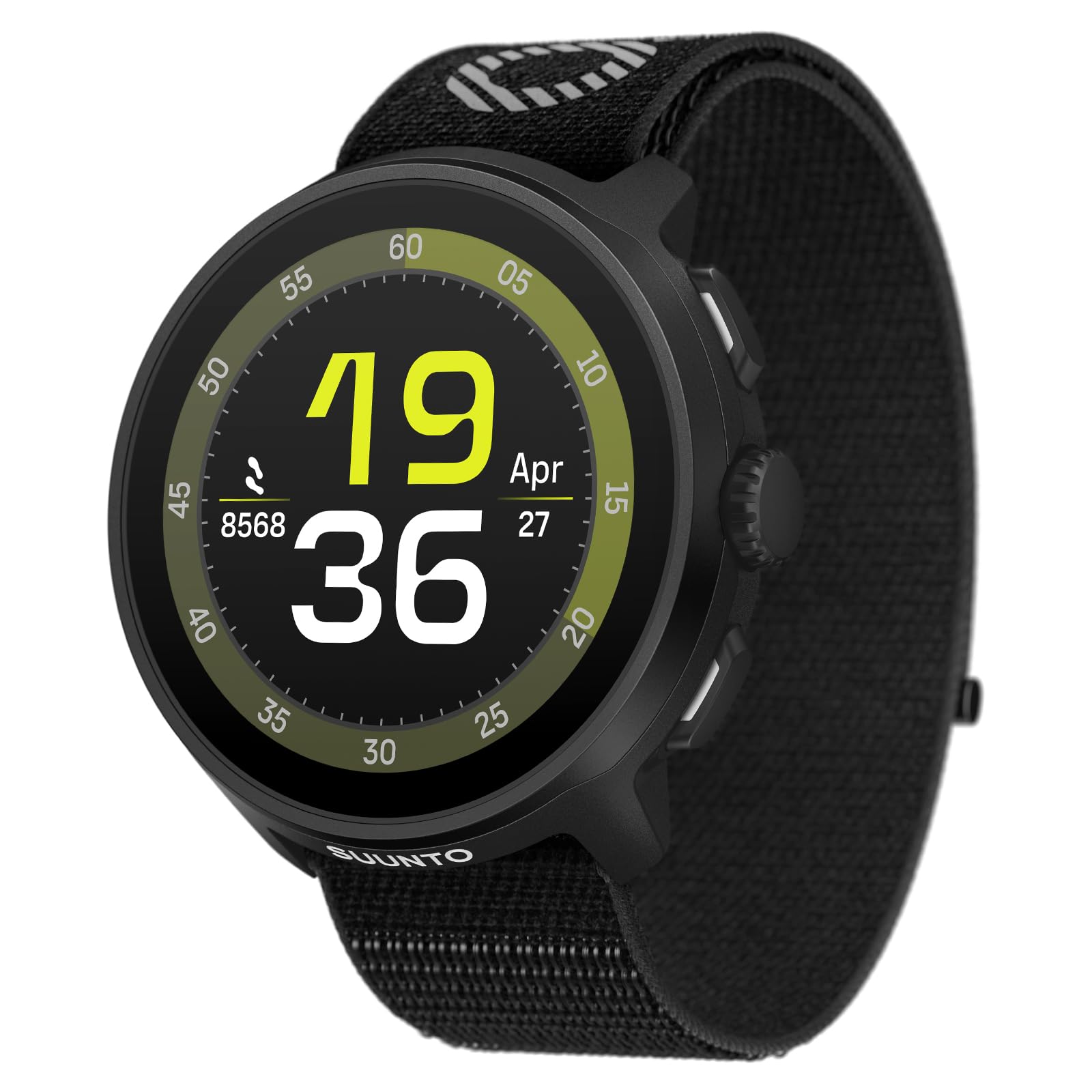
Dual-frequency GPS that holds your line through downtown streets and dense forest canopy.
Your route in downtown or under thick canopy is where standard GPS starts drawing shaky lines. The SUUNTO Run counters with dual-frequency GPS (tuning into two satellite signals at once for precise real-time location), plus a Breadcrumb Trail and navigation features so you can follow your route and key points without getting lost. On a 46 mm case at 11.5 mm thick and 36 g with the textile velcro strap, it stays light enough for daily wear.
Battery runs up to 12 days while tracking daily activity and sleep, and up to 20 hours of training with high-precision GPS. A full recharge takes one hour — the fastest stated recharge on this list — so a quick top-up before a run fits into a coffee break. The 1.32″ AMOLED touchscreen with a crown control is easy to read at a glance, and the watch face customization lets you shuffle widgets around to see what you check most.
Training insights go beyond pace: it tracks training load, monitors post-exercise heart rate, and measures Training Stress Score (a single number estimating how hard a session taxed you). The SUUNTO app digs into that data afterwards. GPS accuracy draws a mixed read — accurate for many, off for some — and customization, connectivity and functionality split opinions too, which is fair to expect from a watch this configurable. The velcro textile strap is comfortable but will soak on a rainy run more than silicone.
Standout spec: dual-frequency GPS plus offline breadcrumb navigation at 36 g makes it the lightest navigator here.
The realistic limit: the 1.32″ AMOLED is bright and readable, but the crown-plus-touch mix takes a run or two to learn.
For navigators: runners who explore cities and trails and want precise location without a heavy case.
Consider the alternative if: you want the longest GPS battery — the COROS PACE 4 pushes to 41 hours of continuous GPS.
6. COROS PACE 4 GPS Watch

32 g on the wrist with 41 hours of continuous GPS, enough for a three-day trail race.
Weight is the whole pitch here, and the number tells the story: 32 g with the nylon band and 11.8 mm thick, lighter than an energy gel and comfortable enough for round-the-clock wear. Compare that to the Polar Street X at 48 g and the difference is plainly a case of physics — a lighter wrist conserves energy across a long effort. The 41 hours of continuous GPS and up to 19 days of daily battery ensure training is never tied to a charger.
The 1.2″ AMOLED touchscreen (auto-adjusting brightness so it stays readable in bright sun or dusk) delivers 164% higher resolution compared to the COROS PACE 3. Control comes from a tactile digital crown, two easy-to-reach buttons and the touchscreen, plus a customizable Action Button for one-tap access to media controls, breadcrumb navigation or Voice Pins. Voice recording lets you log where you were and how you felt, which turns into training notes after the run. Recovery time, sleep stages, HRV and menstrual cycle tracking round out the health side.
What keeps winning people over is straightforward functionality — serious runners find it does exactly what a training watch should without fuss. Value and enjoyment follow close behind. The one mixed signal is accuracy, so pair it with a foot pod or chest strap if precision to the second matters to you. Appearance and performance get steady praise, and GPS reliability holds up across the long stuff.
Race-day logic: 41 hours of continuous GPS plus 32 g means one charge and one minimal wrist for a 100-mile week.
Fair caveat: the nylon band is cozy 24/7 but picks up sweat odor faster than silicone — plan to wash it.
The long-distance choice: ultrarunners and high-mileage athletes who want the lightest possible race watch.
Not for you if: you want a full smartwatch with calls and a big app library — the Amazfit Active 3 leans further that way.
7. Garmin Instinct® 3 Solar, Rugged GPS Smartwatch, 45mm, Black

Solar charging over a 28-day baseline, so the charger stays in the drawer for weeks.
Most watches trade battery for features. The Instinct 3 Solar sidesteps that. A solar charging lens over the 0.9″ display delivers unlimited battery life with solar charging, assuming all-day wear with 3 hours per day outside in 50,000 lux conditions — bright, direct daylight. Even without sun it’s rated for 28 days on a 300 mAh battery. The 45 mm fiber-reinforced polymer case with a metal-reinforced bezel is built to MIL-STD-810 for thermal and shock resistance, and the whole thing is 10 ATM water-rated (a rating for swimming and snorkeling depths).
Navigation is where it pulls ahead of the casual picks. Multi-band GPS with SatIQ technology holds positioning in tight terrain while optimizing battery, and a 3-axis compass and barometric altimeter keep you oriented when your phone has no signal. There’s even a built-in LED flashlight with variable intensities and strobe modes — genuinely useful on a dawn trail run or a night-time walk. Garmin Pay contactless payments and Connect IQ Store watch faces are on board when paired to a phone.
There’s a real cost to all that ruggedness: the 0.9″ display is smaller than the AMOLED screens on the Amazfit and COROS picks, so it reads more like a tool than a showpiece. Health tracking — wrist-based heart rate, advanced sleep monitoring, Pulse Ox — is there, though the manufacturer notes it’s not a medical device and data is an estimation. If you run for fitness and want something that survives a hiking season, this is your watch.
The reason to buy: solar charging with a 28-day baseline means a charge cable issues vanish from your backpacking life.
The trade: a small 0.9″ display and a ruggedized polymer body prioritize survival over style.
Best matched to: trail runners and hikers who go days off-grid and want a watch built like gear.
Pass if: you want a big bright screen for glancing at stats mid-run — the Amazfit Active 3 wins there.
8. Polar Street X GPS Running Sports Watch
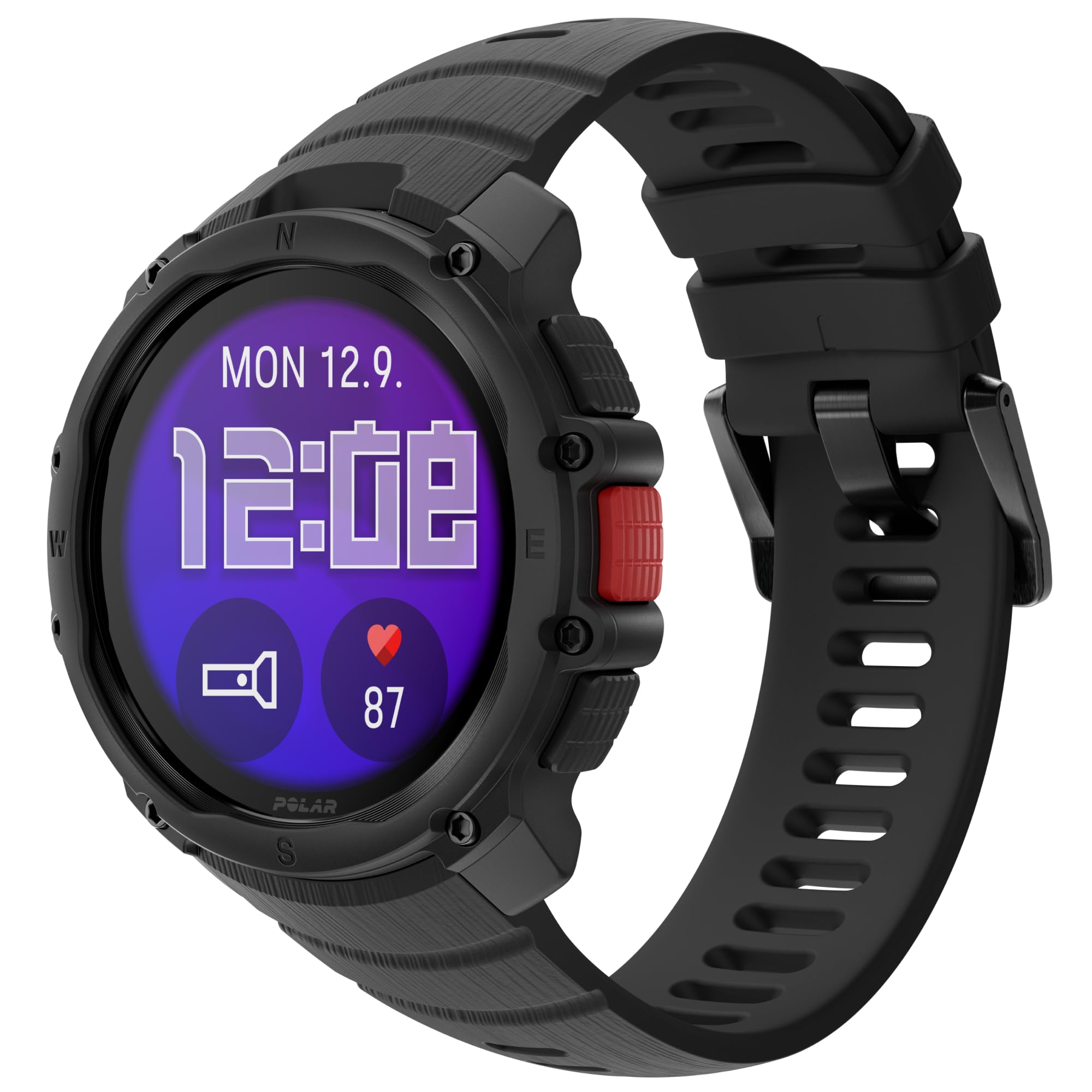
For the runner who lifts on Tuesdays and runs the long route on Sundays.
The Polar Street X is built for hybrid athletes, and the 170+ sport profiles show it: running, strength, HIIT and cycling all live in the same watch. Built-in GPS tracks distance and pace with route guidance and back-to-start navigation (a feature that draws a straight line home when you’re lost), so city runs and outdoor sessions stay on track. Shock-resistant with 50 m water resistance, it handles gym sessions, rain and daily impact. At 48 g it’s the heaviest on this list but still light enough for all-day comfort.
Battery is rated at up to 10 days and up to 43 hours of GPS tracking, which covers a busy active week with long sessions and a built-in flashlight for dusk runs. Wrist-based heart rate tracking gives real-time effort data without a chest strap, and the AMOLED display keeps the numbers readable. Charging uses a USB-C cable included in the box, a practical touch since you can borrow any nearby cable.
One limit worth knowing: the watch has no map data and only 32 MB of storage, so navigation is via route guidance and back-to-start rather than a screen you can pan and zoom. That’s fine for urban loops and trail out-and-backs; less so for exploring new terrain where a mapping watch would help. It’s also note the AMOLED display and heavy feature set earn their place alongside the pricier picks for the runner who wants one watch for the whole gym bag.
Where the Street X delivers
- 170+ sport profiles cover strength, HIIT and running in one wrist piece
- Back-to-start navigation and built-in flashlight are genuinely practical
- Up to 43 hours of GPS tracking on a 10-day battery rating
- USB-C charging cable included, unlike some rivals
- 50 m water resistance and shock-resistant build
Where you’ll notice limits
- No map data and only 32 MB of storage for non-route navigation
- 48 g is the heaviest watch here, so it sits on your wrist more than the 32 g racers
- A newer listing with less owner history behind it
Right for the hybrid athlete: strength days and run days on one wrist, without a separate gym tracker.
Look elsewhere if: trail mapping matters — the Amazfit Active 3 offers free offline maps.
9. Garmin Forerunner® 70, 43mm, Tidal Blue
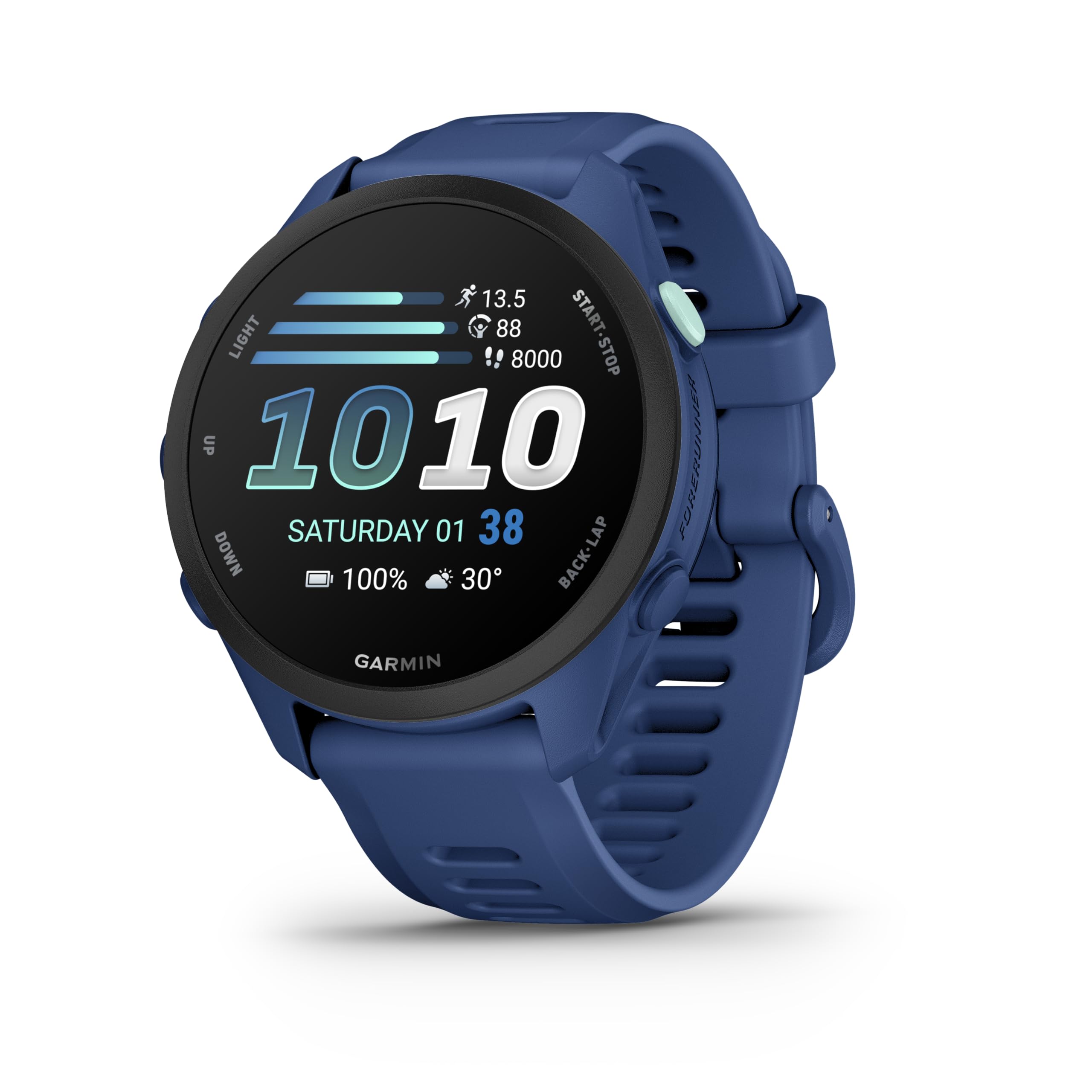
The easy-entry Garmin for the runner who’s just signed up for a first 5K.
Not everyone needs lactate threshold in week one. The Forerunner 70 keeps things simple — a lightweight smartwatch with built-in GPS for accurate pace and distance, wrist-based heart rate, and a bright AMOLED touchscreen with button controls. Up to 13 days of battery in smartwatch mode and up to 23 hours in GPS mode means a full training block on a couple of charges. The 43 mm case with a 20 mm silicone band wears comfortably for daily use.
What earns the beginner-friendliest label here is Garmin Coach: personalized training plans that adapt based on your performance and recovery, with beginner-friendly run/walk workouts all the way up to higher-volume plans for experienced runners. Training readiness, training status and recovery time tell you when to push and when to rest, and personalized daily suggested workouts give you something to do on the days you don’t have a plan. The quick workout feature even lets you build a session on the watch based on desired time and intensity.
The feedback points at quality and accuracy as the big wins, with battery life and functionality close behind. The single surprising gap is that water aerobics isn’t listed as an exercise category — minor unless that’s your main cross-training. Safety and tracking features let you share your live location with chosen contacts when paired to your phone. At 80+ activity profiles, it’s not the widest spread here, but it’s the most forgiving.
Beginner advantage: Garmin Coach run/walk plans start where your fitness starts, no intimidating dashboards required.
Honest limit: 23 hours of GPS is solid for a marathon but trails the endurance monsters on this list.
Pick this if: you want a Garmin experience without the steepest learning curve or feature set.
Upgrade path: if you outgrow the beginner plans, the Forerunner 570 adds deeper recovery and call handling.
10. Samsung Galaxy Watch Ultra 47mm LTE Smartwatch
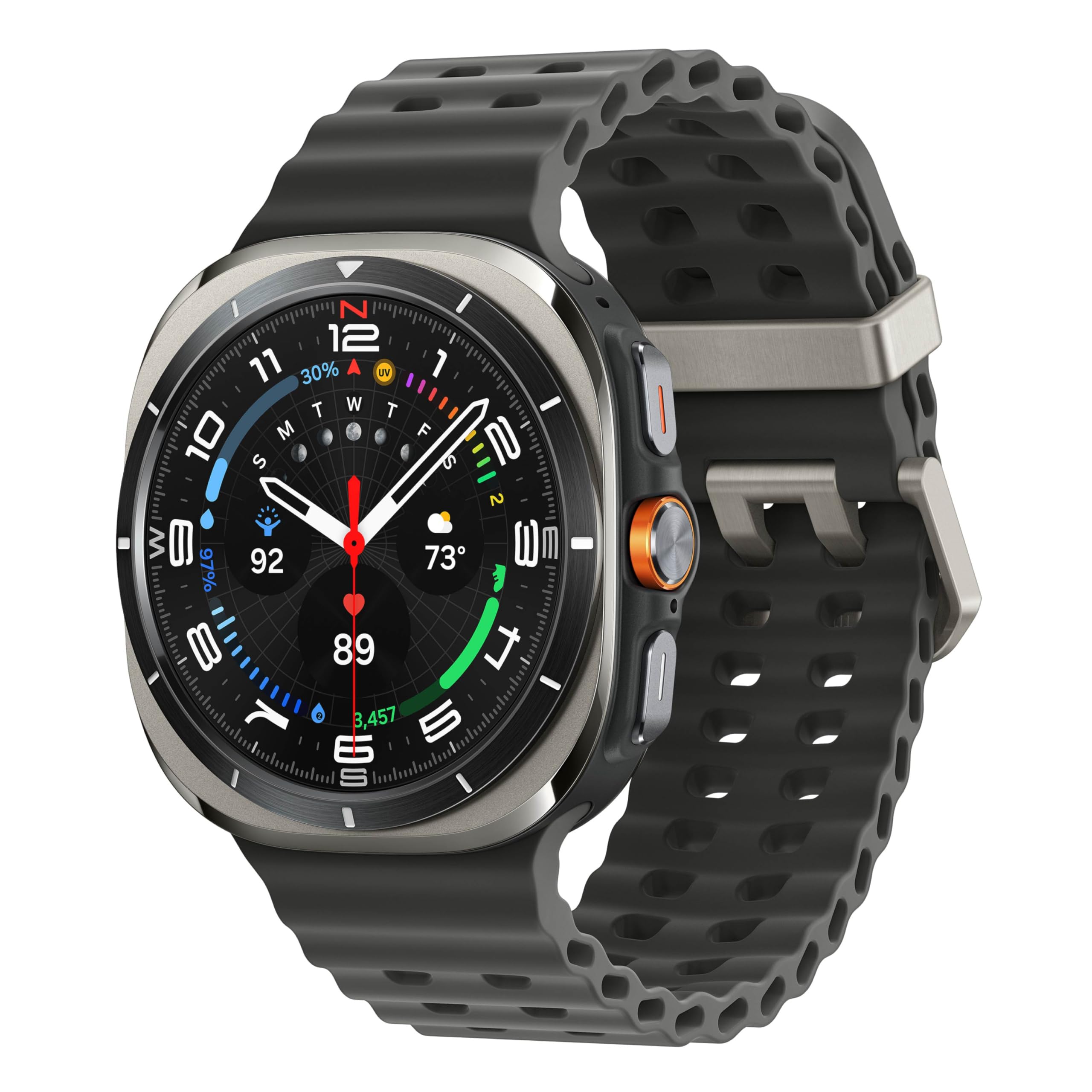
One watch for the track, the trail and the office, with satellite-level GPS accuracy.
If you want a single watch that looks right in a meeting and tracks a serious run on the way home, this is the Android answer. The titanium casing with 10 ATM water resistance and dual-frequency GPS (two satellite signals for a tighter lock) puts it in genuinely rugged territory. A 590 mAh battery — the largest single cell on this list, and 2.25 watt-hours in power terms — fuels the endurance promise. Running Coach analyzes factors like age, weight, oxygen levels and heart rate to guide the session.
The health side is ambitious: Advanced Sleep Coaching, an Energy Score with Galaxy AI that summarizes sleep, activity and heart rate throughout the day, plus a blood pressure feature that requires calibrating against a blood pressure cuff sold separately. There’s a personal AI assistant on board for hands-free help, and the Now Bar keeps weather, timers and directions on your main screen. Compatible with Samsung phones and other Android handsets via the Galaxy Wearable and Samsung Health apps, and it’s an LTE model so you’re not tethered to your phone.
Appearance wins the popularity contest by a wide margin, with accuracy a strong second. Battery feedback is the split vote: incredible for some, needing a charge every two days for others — so consider your use pattern. The large screen and 47 mm size are appreciated, but they do mean this is a big watch on a small wrist. Value feedback ranges from worth it to eye-watering, which is fair for a titanium LTE flagship.
Feature that earns the sticker: LTE plus a 590 mAh cell means music, calls and a two-hour run without the phone.
The catch to weigh: not a marathon runner in the GPS-battery sense — plan for a charge every couple of days under heavy use.
Built for the upgrade crowd: Android users stepping up to a big, durable, connected smartwatch.
Think twice if: you want multi-day GPS endurance — the Instinct 3 Solar stretches far longer.
11. Apple Watch Ultra 4 GPS + Cellular 49mm Smartwatch

A titanium ultra-runner that opens its run with a two-day battery and a satellite line to safety.
The number that changes things for long-distance runners is this: up to 45 hours of Max Extended Workout tracking, with a fast charge of 15 minutes giving up to 18 hours of use. That puts it in the same endurance conversation as the dedicated GPS watches here, while keeping a titanium case and sapphire crystal that are rated water resistant up to 100 m. The 49 mm case makes it a substantial wrist presence, so smaller wrists should try one first.
The running toolkit is deep: precision dual-frequency GPS, Pacer, Heart Rate Zones, Custom Workouts and training load. It also measures HRV as often as every five minutes for stress and recovery insight, with background heart rate readings every five seconds. The readiness experience gives one clear score by analyzing recent activity, vitals and sleep, and the Vitals app shows overnight health metrics with a daily sleep score. For safety, it can detect a hard fall or severe car crash, and built-in satellite communications let you text emergency services without cell service or Wi-Fi.
Its GPS + Cellular build means you can take calls and stream music with the watch alone, no iPhone in the pocket. The recurring split is value — it sits among the priciest picks here, which is honest for the feature set. Siri AI is on board, though the maker notes it is rolling out in English and some audio features arrive in beta. The bottom line: this is the running watch for an Apple user who wants one device for training, safety and daily life.
What makes it an ultra-runner
- Up to 45 hours of Max Extended Workout tracking on one charge
- Fast charge: 15 minutes for up to 18 hours of use
- Precision dual-frequency GPS with Pacer, Heart Rate Zones and custom workouts
- Built-in satellite communications for emergency texting off-grid
- 100 m water resistance with a titanium case and sapphire crystal
Honest considerations
- Premium pricing puts it at the top of this list
- 49 mm titanium case is large; try a demo before committing
- Some Siri AI and audio features are still rolling out
Best fit for the Apple athlete: someone who wants ultramarathon battery, safety comms and one-wrist convenience.
Alternative if: you run on Android — the Samsung Galaxy Watch Ultra is the closest twin.
Know the Specs
GPS battery hours vs. smartwatch days
Two very different numbers live on a running watch. Smartwatch days describe normal wear with notifications and no live tracking. GPS hours describe how long the watch can log a route with satellites active — the number that matters when you race. A watch rated for 18 to 24 GPS hours covers a marathon plus a warm-up; 41 to 43 hours covers multi-day trail efforts. Always check both before buying.
Single vs. dual-frequency GPS
Single-band GPS works off one satellite signal and can drift near tall buildings or dense trees. Dual-frequency GPS picks up two signals and corrects for that drift, so your map shows the road you actually ran. If your routes go through downtown or technical trail, dual-frequency is worth the upgrade. On open country roads, the difference is far smaller.
Wrist weight and case size
A watch at 32 g feels absent for a full marathon; one at 48 g feels progressively heavier. Case size and strap width follow the same logic — a 42 mm case on a 20 mm band suits smaller wrists, while a 47 mm case is a presence on thewrist. Look for a watch that fits snugly without pressure points before you commit to a big case.
Common Questions
How many hours of GPS battery do I need for a marathon?
Is dual-frequency GPS worth it for city running?
Will a running watch track my heart rate accurately without a chest strap?
What is the lightest running watch on this list?
Do running watches work with both iPhone and Android?
How water resistant does a running watch need to be?
Can a running watch navigate me without my phone?
What does training readiness actually measure?
Do I need a subscription to use the training apps?
Can I wear a running watch as my everyday smartwatch too?
The Bottom Line
For most runners, the wrist watch for running that gets the balance right is the Garmin Forerunner 570. It pairs a 42 mm aluminum case that fits smaller wrists with up to 18 hours of GPS mode, up to 10 days of smartwatch battery, and recovery tools that adjust to what you actually did yesterday. If you race ultralongs and want the lightest possible wrist, reach for the COROS PACE 4 at 32 g with 41 hours of continuous GPS. And if exploring new routes without a phone is the goal, the Amazfit Active 3 delivers free offline maps with turn-by-turn rerouting.
One last note for anyone still deciding: the crowd favorite here tops 600+ ratings at 4.5+ stars, a signal that its accuracy, battery and build hold up over months of training, not just the first week. Buy for the run you do most often — everything else is a bonus.
How we choose
We do not accept paid placement. Every pick is matched to a real buyer and a real use-case; we do not hands-on test units.
Sources
Specifications: manufacturer listings and product documentation. Review insights: verified customer reviews, as of November 2026. Pricing: not shown on this page (it changes often); check the current price via the retailer link.
As an Amazon Associate, Tactical Gear Guy earns from qualifying purchases. This does not affect which products we feature.