Specs are compiled from manufacturer listings and verified buyer reviews and can change over time — please confirm the key details on the product page before buying.
The hardest part of shooting Fujifilm isn’t the sensor — it’s picking the glass. You can mount a tiny pancake prime that disappears into a jacket pocket, or a weather-sealed zoom that handles a rainy street shoot without flinching, and both bolt onto the same X-mount body. This guide separates the primes, the zooms, and the value oddballs so you can pick the one lens that actually matches how you shoot. The top-rated pick here holds a 4.5+ star score across 800+ owners, the strongest review record in this lineup.
This guide is built by comparing the manufacturers’ published specifications and the patterns across verified customer reviews, so you get each pick’s real strengths and trade-offs instead of marketing spin.
Below you’ll find the full breakdown of every x mount lens worth putting on your camera. A quick word on the numbers below: a larger maximum aperture — the opening that lets light in — means better low-light shooting and softer background blur, and that single figure drives most of these decisions.
Top Picks


How To Choose The Best X Mount Lens
Any Fujifilm X-mount camera body will mount any lens on this list, so fitting is the easy part. The real choices come down to three things: focal length (how wide or zoomed-in the view is), aperture size (how much light the lens lets in), and if you want one zoom lens that covers a bit of everything or a single prime (a fixed focal length lens) that does one job beautifully. Start with the shot you take most, then work backward from there.
Prime or zoom — and why it changes how you walk
A prime lens is fixed at one focal length, so you move your feet to frame a shot instead of twisting a barrel. A zoom covers a range, which saves you from swapping glass on a dusty trail. Primes tend to be smaller and open wider on aperture; zooms trade some of that brightness for flexibility across focal lengths.
The aperture number that decides your low-light shooting
A maximum aperture of f/1.4 lets in more light than f/2.8, which means you can shoot handheld as the light fades and still get a usable frame. Wider apertures also blur the background more, which is why portrait shooters chase them. The trade-off: wider glass often costs more and can add bulk to the lens.
What weather sealing and image stabilization actually protect
Weather sealing means rubber gaskets that keep dust and moisture out of the barrel — useful on a rainy street or a sandy trail shoot. Image stabilization (OIS) counteracts your hand shake so handheld shots stay sharp at slower shutter speeds. Neither is inside every lens here, so check before you buy if you shoot outdoors a lot.
Side-by-Side Comparison
| Model | Best For | Focal Length | Max Aperture | Weight | Amazon |
|---|---|---|---|---|---|
| Fujifilm Fujinon XF35mmF2 R WR★ Best Overall | Everyday carry | 35mm (53mm equiv.) | f/2 | — | Amazon |
| TTARTISAN 27mm F2.8 PancakeBest Value | Travel and pocket carry | 27mm (41mm equiv.) | f/2.8 | 93 g | Amazon |
| Viltrox 56mm F1.4Best for Portraits | Portraits on a budget | 56mm | f/1.4 | 290 g | Amazon |
| Sigma 18-50mm F2.8 DC DN | One-lens standard zoom | 18-50mm (29-80mm equiv.) | f/2.8 | 285 g | Amazon |
| Fujifilm XF35mmF1.4 R | Low-light character | 35mm | f/1.4 | 187 g | Amazon |
| Sigma 10-18mm F2.8 DC DN | Interiors and vlogging | 10-18mm | f/2.8 | 260 g | Amazon |
| Fujinon XF55-200mm F3.5-4.8 | Long-reach travel | 55-200mm (83-300mm equiv.) | f/3.5-4.8 | 580 g | Amazon |
| Sigma 17-40mm F1.8 DC Art | Fast all-around zoom | 17-40mm | f/1.8 | 1.2 lb | Amazon |
| Fujinon XF50-140mm F2.8 R LM OIS WR | Pro telephoto work | 50-140mm (76-214mm equiv.) | f/2.8 | — | Amazon |
Detailed Reviews
1. Fujifilm Fujinon XF35mmF2 R WR
Our pick — 4.5+★ from 800+ verified ratings; the strongest balance of quality and price.
The one lens that makes a small Fujifilm body feel complete.
Here’s the plain answer for most shooters: start with a 35mm prime, because it lands at 53mm in full-frame terms — close to how your own eye frames a scene. That makes it the natural pick for street shots, candid portraits, and any room where you can’t back up further. The glass weighs almost nothing, so your camera stays the kind you actually carry.
What it does best is stay sharp even wide open at f/2 — the aperture stays bright enough for dim restaurants and evening streets without you cranking the ISO. Autofocus locks in 0.08 seconds, fast enough to catch a walking subject mid-stride. It’s also nearly silent, so shy subjects and quiet venues won’t hear it hunt.
The build earns its keep on a wet day: eight sealing points keep out dust and moisture, and it keeps working down to 14 degrees Fahrenheit. Nine aperture blades make round, smooth background blur rather than the harsh polygon you get from cheaper designs. Nano-GI coating cuts ghosting and flare when the sun sits just outside your frame.
Where does it fall short? The 13-inch minimum working distance means you’re not shooting tight macro with it — a bug or a coin won’t fill the frame. And a lens this good at f/2 invites you to wonder about f/1.4, which lives in the XF35mmF1.4 below. If you want the tighter framing and lower-light ceiling, that model is calling; if you want an every-single-day lens with weather sealing, this one wins outright.
What earns it the top spot
- Sharp wide open at f/2, so low-light shots stay usable without raising ISO
- 0.08-second autofocus that is fast and nearly silent
- Weather sealing to 14°F keeps it working on a wet or dusty day
- 9 rounded blades produce smooth, circular background blur
What to know before you buy
- 13-inch minimum focus distance rules out tight close-ups
- f/2 stops short of the f/1.4 light gathering in the XF35mmF1.4 R
Reach for this if: you want one compact, sealed 35mm that handles street, portraits, and travel without thought.
Look elsewhere if: you shoot in near-darkness and need the extra stop the f/1.4 gives you.
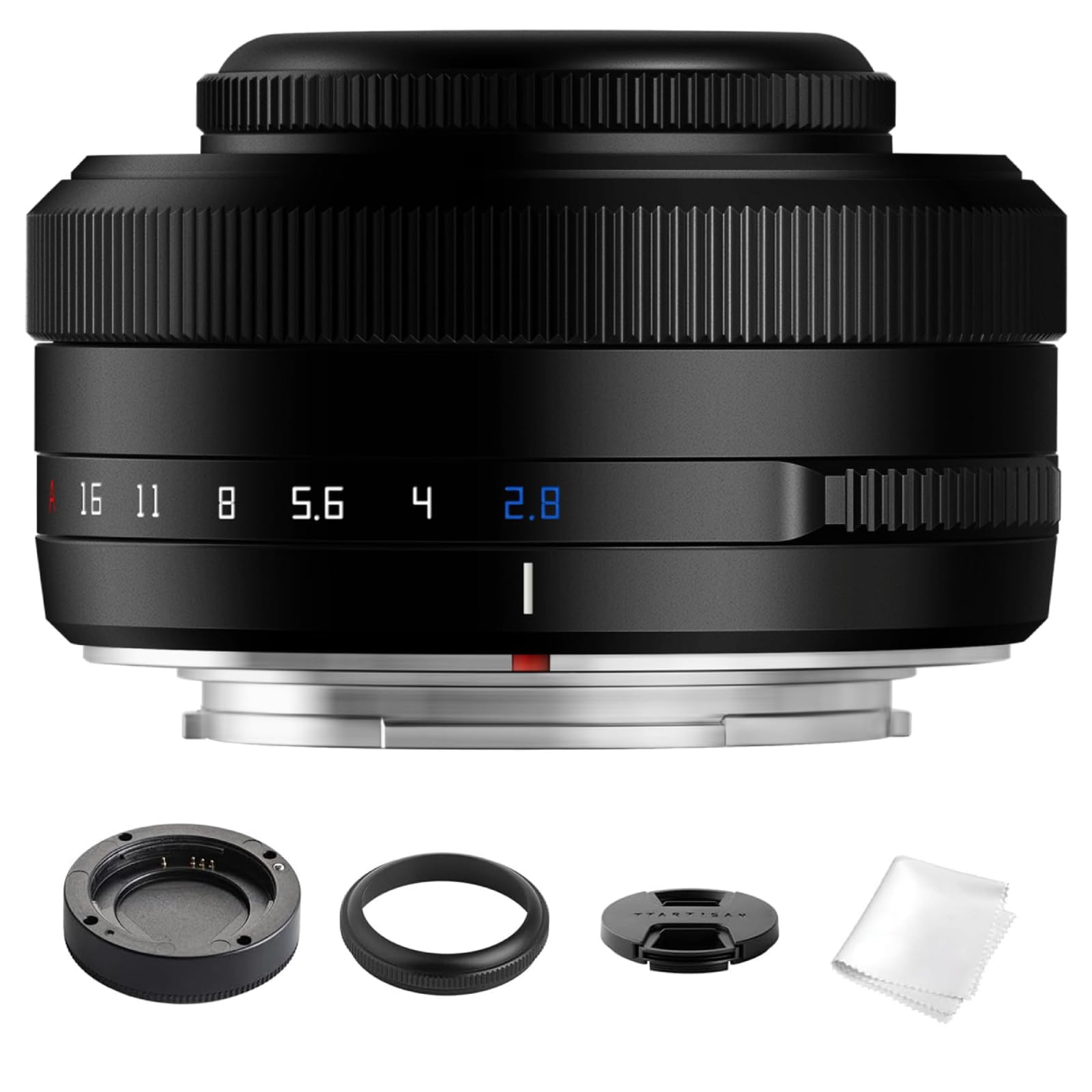
2. TTARTISAN 27mm F2.8 APS-C Pancake Lens
A 93 g flat lens that turns a mirrorless body into a pocket camera.
If your X-mount camera stays home because it feels like a chore to carry, this is the fix. At 93 g it is a fraction of the weight of the Viltrox 56mm F1.4’s 290 g, and the pancake shape sits almost flush with the body. You can slip it into a jacket pocket and forget it’s there.
The 27mm focal length lands at a 41mm equivalent — just wider than the classic 50mm eye-view, which suits street, travel, and tabletop close-ups. The f/2.8 maximum aperture holds its own in dimmer light and gives you control over how much background melts away. The STM stepping motor drives eye and face detection autofocus, so you can shoot people without fiddling with a focus box.
What sells it is the build and the price-to-performance — as an entry-level prime it punches well above its tier. Just keep your expectations in line on the autofocus: the motor is quick by pancake standards, but it can hunt in low contrast, and reports split between smooth and sluggish. Use the USB-C port on the rear cap to update firmware; the maker ships updates that way for a reason.
Best for the minimal packer: anyone who values a camera that travels light — a 41mm view and 93 g make it a natural city walker.
The honest catch: the autofocus is the weak link. It works, but in dim or flat scenes it can take a moment longer than the Fujifilm primes above.
Pick it for: bargain-priced travel glass you can drop in a bag without noticing.
Skip it for: fast-moving subjects where you need instant, unshakeable focus lock.
3. Viltrox 56mm F1.4 Autofocus Lens
A portrait prime that opens wider than almost anything at its tier.
Here’s the number that matters for head-and-shoulders shots: f/1.4, which is twice the light-gathering of the f/2.8 maximum aperture on the Sigma 10-18mm F2.8. That extra stop lets you shoot in indoor light and still get an in-focus face with the background falling away. The 56mm focal length spaces you a comfortable distance from your subject.
The optics use 10 elements in 9 groups — 50% more groups than the Fujifilm XF35mmF1.4 R’s 6, and 25% more elements than that lens’s 8. That array includes 1 ED (extra-low dispersion) element and a high-refractive glass, aiming to hold the line on distortion. You get a smooth transition from sharp focus into soft background blur, which is what makes a portrait look like a portrait.
One feature that stands out: you can flip the aperture ring to A for automatic control, or rotate it by hand for full manual. So the same lens serves the beginner who wants auto and the shooter who wants manual feel. That’s rarer than it sounds at this tier.
At 290 g it’s compact enough to hold steady for a long session, and the 52mm filter thread takes standard filters you probably already own. The trade-off is that near-focus isn’t its job — 60cm minimum focus distance means this is a people lens, not a detail lens. If you want the widest aperture on the list, note the XF35mmF1.4 opens to the same f/1.4 but at a wider angle.
Where it shines
- f/1.4 aperture pulls in double the light of an f/2.8 lens
- Dual aperture control — auto via the A ring setting, manual by hand
- 10 elements in 9 groups with 1 ED element for low distortion
- 52mm filter thread takes standard filters
Limits worth knowing
- 60cm minimum focus distance rules out macro work
- Focus is manual-only in the listed exposure control, so check your body’s AF pairing
Made for: shooting people and events in mixed light without spending premium money.
Not the tool for: close-up detail work, where the 60cm minimum focus gets in your way.
4. Sigma 18-50mm F2.8 DC DN | C

The zoom that replaces a bag of primes without adding weight.
If you’ve been carrying three primes and swapping glass on the street, this lens is the answer. It covers 18-50mm — 29-80mm in full-frame terms — and holds an f/2.8 aperture across the whole range. That’s the same f/2.8 brightness as the wide 10-18mm below, but spread across a more useful everyday spread.
It’s built as the smallest and lightest f/2.8 standard zoom for APS-C mirrorless, and at 285 g it undercuts the Viltrox 56mm’s 290 g while reaching 32mm further at the long end. The clarity and sharpness is what buyers come back to; for video work it holds up well, with smooth transitions across focal lengths.
What’s the honest limit? It doesn’t stabilize your shots — there’s no OIS here, so you rely on your body or your hands in low light. It’s also not built for the rain; there’s no weather sealing in the listing. If a wet hike is on your calendar, the sealed 16-80mm below is the safer companion. For clear-day street, travel, and family shooting, this compact zoom is about as efficient as it gets.
Why it stays in the bag: one lens, 29-80mm equivalent, constant f/2.8, and under 300 g — you stop thinking about focal length and start shooting.
One caveat: no image stabilization and no weather sealing, so pair it with a steady hand and a dry forecast.
Choose this if: you’d rather carry one f/2.8 zoom than juggle a set of smaller primes.
Keep shopping if: you shoot in rain, sand, or dust and need seals around the barrel.
5. Fujifilm XF35mmF1.4 R
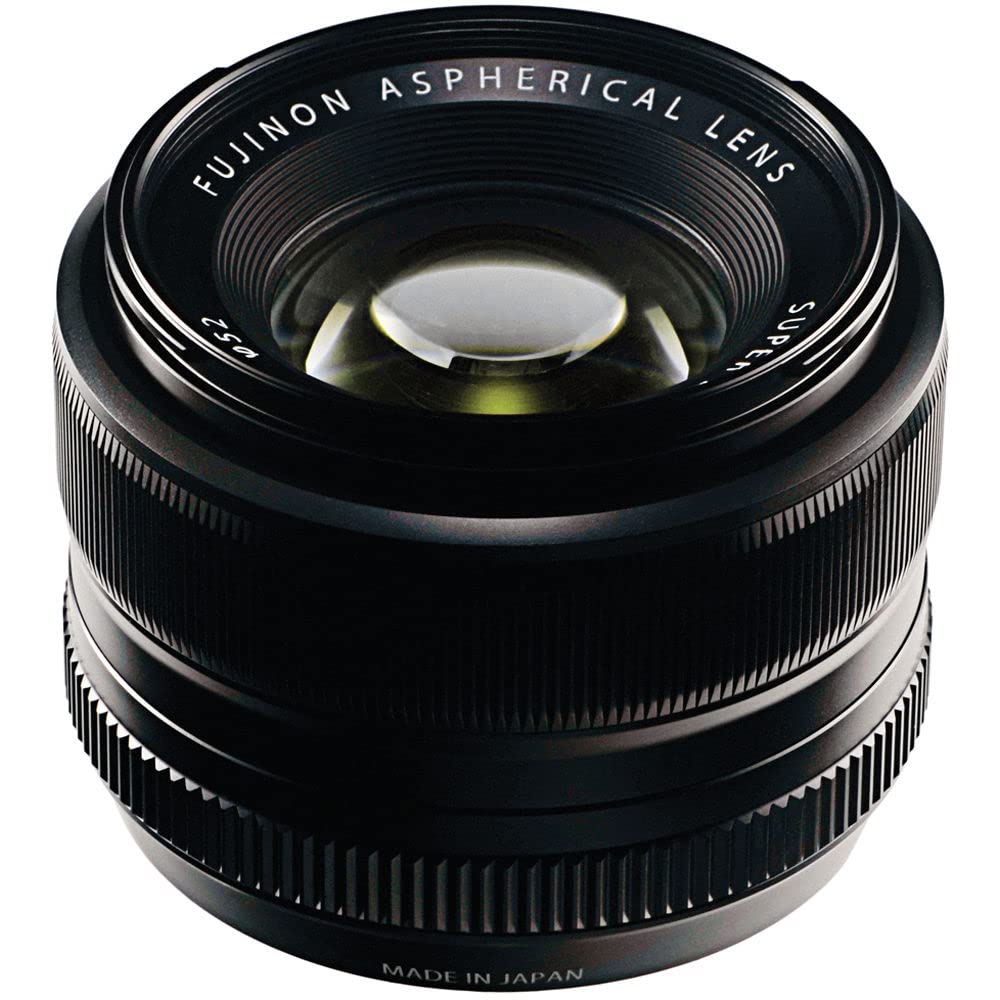
The character prime that turns dim rooms and concert stages into great photos.
There’s a reason generations of Fujifilm shooters cut their teeth on this exact lens: f/1.4 at 35mm, at 187 g. That’s the widest aperture on a normal prime in this lineup, and it is the glass that made the system famous for low-light rendering. In a concert pit or a candlelit room, it keeps working when smaller apertures give up.
The circular bokeh and depth-of-field are the parts owners fall for — backgrounds melt in soft round shapes instead of hard-edged blobs. Center-to-corner sharpness holds at most working apertures. A metal barrel with Fujifilm’s Super EBC coating keeps controlled contrast on street scenes. At 187 g it’s lighter than the Viltrox 56mm F1.4’s 290 g, and the 44.2-degree angle of view matches the XF35mmF2 exactly.
Here’s the trade-off worth naming: the focus is a manual-focus design, and speed reports split between quick and slow. On a slow-moving street subject it’s fine; on a sprinting dog or a fast toddler, you may want the f/2’s quicker 0.08-second AF. There’s also no image stabilization built in — your hand decides the shutter speed.
The optics verdict: 8 elements in 6 groups with one aspherical element deliver the low-light character this lens is known for.
The kitchen-table caution: manual focus means your technique, not the motor, decides the hit rate.
For you if: you shoot in available light and want the signature Fujifilm blur straight out of the camera.
Think again if: you need reliable autofocus on fast-moving subjects.
6. Sigma 10-18mm F2.8 DC DN | C

Squeeze a whole cathedral or a whole street into one frame.
When the shot won’t fit — an interior wide enough that you can’t back up, a landscape, a vlog where you need both arms in frame — the ultra-wide zoom is the answer. It runs 10-18mm at a constant f/2.8 and is positioned as the world’s smallest and lightest ultra-wide zoom for APS-C cameras. At 260 g it’s easy to hold out for a vlog take.
At 10mm it covers a 5.6x wider field than the Viltrox 56mm’s portrait view, with the same f/2.8 maximum aperture as the Sigma 18-50mm zoom but aimed at the opposite end of the range. Low distortion across all focal lengths is the quality buyers call out. The dust-resistant mount adds a measure of durability for outdoor work.
Note what’s missing: no image stabilization, no full weather sealing, and a stepping motor that favors smoothness over raw speed. That makes it a considered choice, not a do-everything lens — it’s for people who shoot wide and value the compactness. If you split your time between wide interiors and tighter portraits, you’ll want the 18-50mm as a resting lens and this as the special one.
The wide-angle case: constant f/2.8 across 10-18mm, 260 g, and low distortion make it a natural interior and vlog tool.
The catch: no OIS and no sealed barrel, so hand steadiness and dry weather are on you.
Your match if: interiors, landscapes, or vlogs are where you live.
Move on if: you rarely shoot below 18mm — you’d be paying for reach you don’t use.
7. Fujinon XF55-200mmF3.5-4.8 R LM OIS

The reach lens for stadium seats, safari trucks, and far-off faces.
55-200mm on an APS-C body works out to 83-300mm full-frame equivalent. That’s the range that lets you fill the frame with a batter or a bird from across the ground. It is the all-rounder of the telephoto group, with sharp results through the range and reported strong performance even indoors.
Optical image stabilization rated at 4.5 stops keeps hand-held long shots steady. A linear motor drives autofocus quietly, so you won’t spook wildlife or draw eyes at a recital. The 1.10m (43.41-inch) minimum focus distance lets you grab a mid-distance frame when the subject gets closer. 62mm filters screw onto the front.
The honest limitation is speed: at f/3.5-4.8 it gathers less light than the constant f/2.8 zooms here. When the venue lights dim, you’ll lean harder on the OIS and a slower shutter. But if your goal is reach, this lens hands you 300mm equivalent in a package you can still carry all day — and it’s the balance point between the light 18-50mm and the pro-grade 50-140mm below.
Why the reach sells
- 83-300mm equivalent covers distant subjects with one lens
- OIS rated at 4.5 stops keeps long shots steady by hand
- Linear motor autofocus runs quiet and smooth
- 43.41-inch minimum focus lets you work closer when you need to
What you accept
- f/3.5-4.8 is dimmer than a constant f/2.8 in low light
- 580 g is heavier than a prime — you feel it after a long walk
Grab this for: sports, wildlife, and events where the action is far from your seat.
Leave it if: most of your work happens in dim rooms where f/2.8 constant matters more than reach.
8. Sigma 17-40mm F1.8 DC | Art

A zoom so bright it can replace three fast primes at once.
Here’s a rare thing: a zoom with a constant f/1.8 aperture from 17-40mm. That’s brighter than f/2.8 and closes in on the f/1.4 primes, which means you get prime-style background blur and night-shooting ability without twisting the barrel. For a hybrid shooter who wants one lens and no swapping, that combination is hard to argue with.
As an Art-series lens it targets premium clarity and color accuracy, and the HLA autofocus motor runs fast and quiet. The 17-40mm range is what makes it stick to a camera — a versatile spread that covers wide street through mid-portrait. Owners describe it as their go-to, which is the highest praise a zoom can get.
It isn’t light — 1.2 pounds means you carry a noticeable lump in the bag. And there’s no image stabilization listed, so nighttime still shots rely on steady hands. But the trade is clear: f/1.8 constant is a spec you feel on every frame, not one you read about. The 17-40mm zoom also covers far more range than the fixed Viltrox 56mm, if you want one lens to do the work of two.
The defining number: constant f/1.8 across a 17-40mm zoom is genuinely unusual — that’s the brightness that draws people in.
The weight reality: at 1.2 pounds it’s the heaviest wide zoom here, so it’s a stay-on-the-camera lens, not a pocket spare.
Suits you if: you want prime brightness plus zoom flexibility in a single Art-series lens.
Not for you if: you pack light for long hours and feel every extra ounce.
9. Fujifilm XF16-80mm F4 R OIS WR
The fast telephoto zoom for paid work, built to shrug off weather.
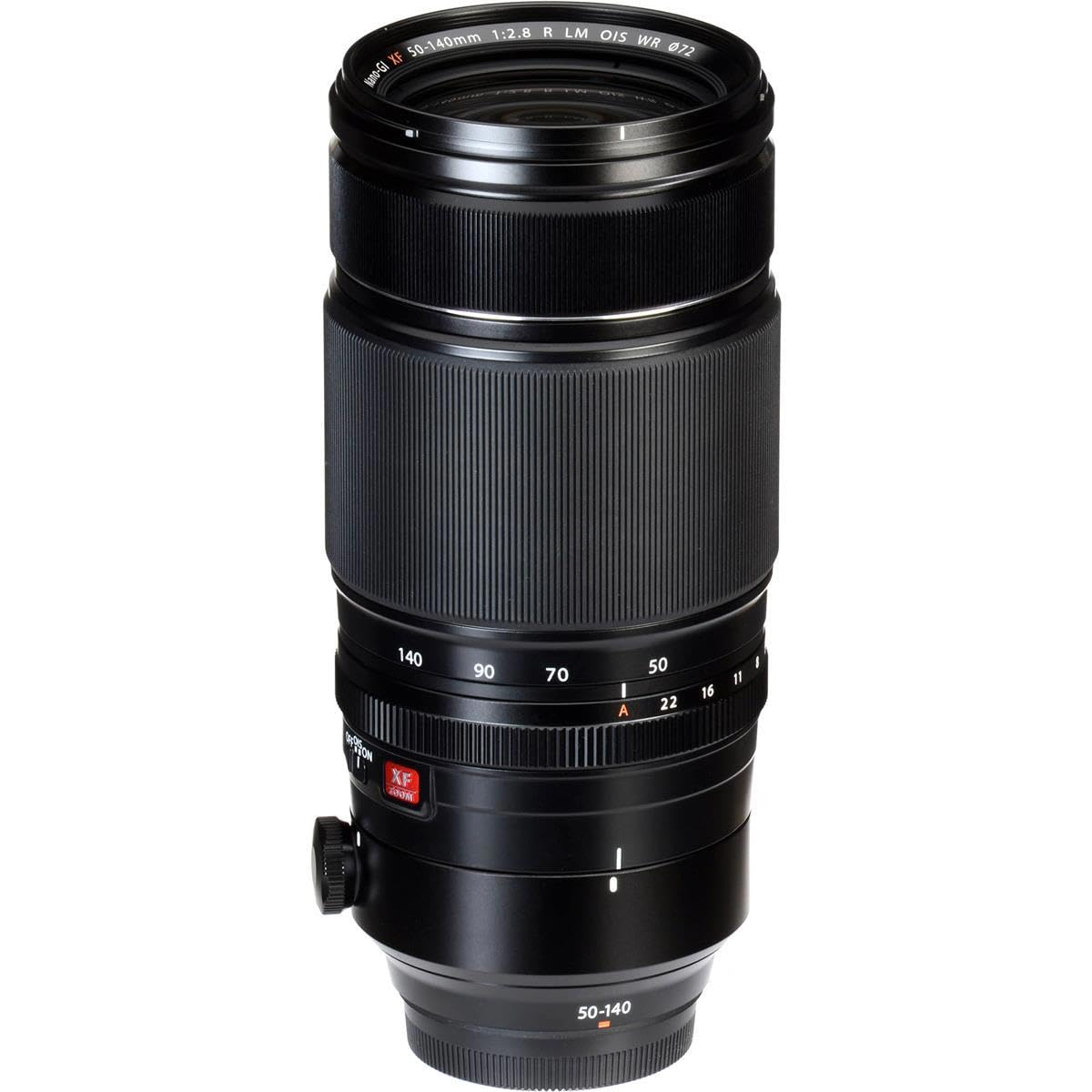
Where the 55-200mm trades some speed for reach, this lens keeps a constant f/2.8 through the whole 50-140mm range — 76mm to 214mm in full-frame terms. That constant aperture is the pro feature: you can isolate a face at 140mm with the same light-gathering you had at 50mm. For events, portraits, and indoor sports, that matters.
The optical stack includes 5 ED and 1 Super ED element, with Nano-GI coating and a triple linear motor driving fast autofocus. It’s built for shallow-depth portrait work with blurred backgrounds. Reports on autofocus speed are positive and paired with a four-stop image stabilization figure. Build is solid, with dust and water and low-temperature resistance for outdoor shoots.
The sticking point is weight: opinion splits here, and at the pro-telephoto end of the range you feel it on a long day of handheld shooting. Noise is the other mixed note, so a quiet room isn’t its native habitat. What you pay for is the constant speed, the stabilization, and the weather sealing. If your work demands reach and brightness at the same time, this is the class of lens the cheap telephoto can’t match.
The pro argument: f/2.8 across 76-214mm equivalent, with 5 ED and 1 Super ED elements and a triple linear motor, is a serious piece of glass.
The weight answer: it is heavy — treat it as a lens you dedicate a shoot to, not one you carry as backup.
Right for: working shooters who need bright, stabilized, weather-ready reach for events and portraits.
Too much if: you shoot casually at the long end and don’t need constant f/2.8 brightness.
Know the Specs
Focal Length and Focal Range
The number on the barrel — 35mm, 56mm, or 10-18mm — is the true focal length, and the “equivalent” figure converts it to full-frame terms for comparison. A lower number means a wider view; a higher number means you can reach further into a scene. Primes hold one number; zooms cover a range and give you flexibility without changing lenses.
Maximum Aperture and How It Changes Your Shooting
The f-number — f/1.4, f/2.8, f/4 — is the widest the lens opening can go. A smaller number lets in more light, which is why f/1.4 primes work in dim rooms and f/4 zooms need more light. The aperture also controls how blurred the background gets: wider openings separate your subject from what’s behind it.
Autofocus Motor and Weather Sealing
Stepping motors and linear motors make autofocus quiet and quick, which matters for video and nervous subjects. Weather sealing means gaskets that keep dust and moisture out — useful if you shoot outdoors through seasons. Image stabilization (OIS) counters hand shake so handheld shots stay sharp; it’s not in every lens, so check before you commit.
Common Questions
Will any of these lenses fit my Fujifilm X-mount camera body?
Is f/1.4 really better than f/2.8 for portrait shooting?
Can I shoot in the rain with a non-weather-sealed lens?
Do I need image stabilization on an X Mount lens?
What does the equivalent focal length figure actually mean?
Which lens is better for travel — a prime or a zoom?
Can I use these lenses for video, or are they photo-only?
How do I update the firmware on the TTARTISAN 27mm pancake?
Will a 56mm lens be too tight for indoor shots?
Is a heavier telephoto zoom harder to hand-hold?
What does the maximum magnification number tell me?
The Bottom Line
The x mount lens that deserves the spot at the top of your bag is the Fujifilm Fujinon XF35mmF2 R WR. Its 53mm equivalent view, 0.08-second autofocus, and eight-point weather sealing make it the one lens that handles street, portraits, and a wet afternoon without asking you to choose. Do keep in mind that the budget pancake has more reviews behind it—the honest trade-off for the top pick’s higher score is its shorter history.
Shoot in dim rooms and want the deepest blur? The Fujifilm XF35mmF1.4 R hands you f/1.4 at 187 g and a look people buy into the system to get. Need one zoom that holds f/2.8 through its whole range on a bright-day stroll? The Sigma 18-50mm F2.8 DC DN covers 29-80mm equivalent at a compact weight.
If reach and weather are non-negotiable, the Fujifilm XF16-80mm F4 R OIS WR seals in ten places and carries 6.0 stops of stabilization for full-day travel. And if you want the lightest possible carry, the TTARTISAN 27mm F2.8 at 93 g makes the camera a pocket object again. Pick the one that matches the shot you take most, and the system does the rest.
How we choose
We do not accept paid placement. Every pick is matched to a real buyer and a real use-case; we do not hands-on test units.
Sources
Specifications: manufacturer listings and product documentation. Review insights: verified customer reviews, as of November 2026. Pricing: not shown on this page (it changes often); check the current price via the retailer link.
As an Amazon Associate, Tactical Gear Guy earns from qualifying purchases. This does not affect which products we feature.