Specs are compiled from manufacturer listings and verified buyer reviews and can change over time — please confirm the key details on the product page before buying.
You do not need a workshop full of tools to cut clean joints — you need a chisel, a plane and a saw that actually hold an edge. Most woodworking disappointment comes from dull chisel steel and a plane sole that will not sit flat, not from a lack of gadgets. This guide sorts the hand tools that earn their place on your bench by how well they cut, how long they stay sharp, and how they feel after an hour of work.
This guide is built by comparing the manufacturers’ published specifications and the patterns across verified customer reviews, so you get each pick’s real strengths and trade-offs instead of marketing spin.
Chisels, planes and pull saws solve different jobs, so the right pick depends on the cut you make most. Below you will find the chisel set, hand plane and saw combinations that suit real benches — every one of these wood work tools is chosen for edge quality and how it feels in the hand.
Top Picks


How To Choose The Best Wood Work Tools
Three questions decide almost every hand-tool purchase: what cut are you making, how hard is the wood, and how much sharpening are you willing to do? Answer those and the shortlist shrinks fast. A chisel set covers chopping and paring, a bench plane flattens and smooths, and a pull saw cuts joinery and trim. Most home woodworkers end up with one of each rather than five of one kind.
Blade steel and hardness
Harder steel holds an edge longer but takes more effort to sharpen. Chisels rated around Rc 59 to Rc 60 (Rockwell hardness, a scale for how hard the steel is) sit in a practical middle — they keep a working edge through a session without turning brittle. Chrome-manganese and chrome-vanadium alloys are the common blends you will see listed, and both take a fine edge when tempered well.
Body material on planes
A plane’s body decides whether the tool stays flat and steady. Cast iron and ductile iron bodies resist twisting and add weight that helps the cutter stay engaged in the cut. Wooden-bodied Japanese planes are lighter and let you feel the grain, but they demand more tuning and care in storage. Neither is wrong — they suit different hands and different jobs.
Pull saw teeth and kerf
Japanese saws cut on the pull stroke, which keeps a thin blade straight and lets you steer with light pressure. Teeth count matters: a rip-cut edge with 9 TPI (teeth per inch) removes wood faster along the grain, while a 15 TPI crosscut edge leaves a cleaner line across it. A narrow kerf (the width of the slot the blade cuts) means less wood removed and less effort per stroke.
Side-by-Side Comparison
| Model | Best For | Tool Type | Blade Steel | Cutting Width / Size | Amazon |
|---|---|---|---|---|---|
| Narex Bevel Edge Chisel Set (4 pcs)★ Best Overall | All-round chisel work | Chisel set | Cr-Mn alloy steel, Rc 59 | 6, 12, 20, 26 mm | Amazon |
| Spec Ops Tools Wood Chisel SetJobsite Tough | Jobsite abuse | Chisel set | High-carbon steel | 1″, 3/4″, 1/2″, 1/4″ | Amazon |
| IRWIN Marples Chisel SetImpressive Value | Carpentry on site | Chisel set | Hardened alloy steel | 1/2″, 3/4″, 1″ | Amazon |
| JORGENSEN No.60-1/2 Block Plane | Trim and detail work | Block plane | O1 tool steel | 1.38 in | Amazon |
| STANLEY No. 4 Bench Plane | Flattening boards | Bench plane | Hardened & tempered steel | 2 in | Amazon |
| KAKURI Japanese Hand Plane 42mm | Fine smoothing passes | Japanese plane | Laminated high carbon steel | 36 mm (1.42 in) | Amazon |
| SUIZAN Ryoba Double Edge Saw | Joinery and trim cuts | Pull saw | Japanese steel | 9.5 in blade, 9 & 15 TPI | Amazon |
| EZARC Wood Chisel Set (6 pcs) | Starter kit range | Chisel set | CR-V steel, HRC60 | 1/4″ to 1″ | Amazon |
| Narex Czech Steel Premium Set | Serious bench work | Chisel set | Chrome-manganese, Rc 59 | 6, 12, 20, 26 mm | Amazon |
Detailed Reviews
1. Narex Bevel Edge Chisel Set
Our pick — 4.5+★ from 950+ verified ratings; the strongest balance of quality and price.
Four chisels in the sizes that actually get used, from 6 mm up to 26 mm.
The steel is the story here. Blades are made from highly alloyed Cr-Mn steel (chrome-manganese, an alloy blend chosen for edge stability) hardened up to Rc 59 on the Rockwell scale. That hardness is what lets you pare end grain and chop mortises without stopping to re-hone every few minutes. Buyers describe edges that hold well and tools that perform as well as pricier brands.
What wins people over is the sharpness — it is the quality owners single out more than any other — followed closely by cutting performance and the feel of the oval handles in hand. The oval cross-section gives your palm a reference point, so the bevel stays flat against the wood instead of rolling. The set covers 6 mm (1/4″), 12 mm (1/2″), 20 mm (13/16″) and 26 mm (1 1/32″), which spans the paring and chopping sizes most benches use.
These are made in the Czech Republic and meet DIN 5139 requirements (a German standard covering wood chisels). At 13.5 inches wide across the roll, the set fits a bench drawer without drama. The honest catch: flatness of the backs is a mixed report, so plan on spending time lapping the back on a stone before you trust a paring cut.
Where the money goes
- Rc 59 hardened Cr-Mn steel keeps a working edge through a session
- Four blade sizes — 6, 12, 20 and 26 mm — cover the common paring and chopping jobs
- Oval wood handles give a consistent grip angle while you pare
- Sharpness is the quality owners praise most
Set your expectations
- Blade backs arrive less than perfectly flat — expect to lap them first
- Wooden handles need occasional oiling to stay sealed
Buy this if: you want a bench-ready chisel set in metric sizes and you are willing to spend an hour flattening the backs.
Reconsider if: you need chisels that survive being hammered on site — the wooden handles are built for controlled mallet work, not impact.
2. Spec Ops Tools Wood Chisel 4-Piece Set
A chisel set built for the guy who leaves his tools on a tailgate.
These are 13 inches long across the set and 2.2 inches wide, and the four chisels run 1-in, 3/4-in, 1/2-in and 1/4-in — the same imperial spread you find on the IRWIN Marples wallet set, just with four blades instead of three. Blades are high-carbon steel, precision-honed for a sharper starting edge, and the hardened metal strike caps take hammer blows without mushrooming.
Quality and sharpness rank as the most-discussed strengths here, and the shock-absorbing MOA grips with a thumb pocket give you a place to plant your off-hand thumb for controlled paring. The beveled sides reduce friction when you are clearing waste out of a pocket or dovetail. Spec Ops also advertises 100-foot drop testing and a limited lifetime warranty for chisels that live in a bag between jobs.
The trade-off is weight. These are heavier and bulkier than the Narex set, and the handle quality gets mixed feedback — a couple of buyers find the grips less refined than wood. At 9.125 inches overall with a 4.25-inch blade and 4.875-inch handle, they are long enough that fine paring takes a lighter touch.
Best on a rough bench: the hard strike caps and shock-absorbing grips make this the set to reach for when a chisel is going to be hit with a hammer, not a mallet.
Second thought: the mixed feedback on handle quality and the extra bulk mean it suits carpentry and site work more than delicate furniture joinery.
The right call for: carpenters who want chisels that shrug off drops and hammer strikes.
Look elsewhere if: you want a light, fine-paring set for furniture work — that belongs to the wooden-handled pick above.
3. IRWIN Marples Chisel Set 3-Piece
Three chisels, a folding wallet and enough steel to handle trim all day.
This is the lightest set on the shortlist at 16 ounces, and that matters when you are carrying tools up a ladder all morning. The three chisels are 1/2″, 3/4″ and 1″, sized for carpentry cuts rather than fine joinery. Compare the 2-inch length and 5.25-inch width spec against the Spec Ops set and this is a much more compact kit — though note the IRWIN spec flags only 1 item in the box, since the set ships as one cased unit.
Blades are high-quality hardened steel with a bevel edge, and the large strike cap withstands repetitive hammer strikes, which is what you want for chopping out hinges or trimming studs. The ProTouch grips are built to handle jobsite abuse. The folding wallet keeps the edges from banging together in a toolbox. Buyers describe these as sharp and well-built, taking a fine edge quickly, and the carrying case draws its own compliments.
The bigger chisels take more effort for fine paring work — 1-inch and 3/4-inch sizes are not the ones you reach for when cleaning a dovetail. That is a sizing note, not a defect, and the 1/2-inch blade covers most trimming chores. Bevel edges make this a natural fit for quick site cuts, but furniture joinery wants the smaller sizes found in the premium picks.
Reach for this if: you want a light, wallet-carried trio for carpentry trimming on site.
skip it if: your work is fine dovetails and small mortises — the size range does not include the narrow blades that call for.
4. JORGENSEN NO.60-1/2 Wood Planer

A low-angle block plane with a 1.38-inch cutter that trims end grain cleanly.
The blade is professional-level O1 tool steel (a high-carbon steel grade known for edge durability), finely sharpened and meant to be re-sharpened and re-adjusted rather than replaced. That matters for anyone who planes regularly — the tool improves as you learn to hone it. The 1.38-inch cutting width is narrower than the STANLEY’s 2 inches, which makes it lighter in the cut but better at trimming into corners.
The body is ductile iron (a tougher, more shock-tolerant form of cast iron than standard cast), drop-tested for ruggedness, with a zinc-alloy lever cap and stainless-steel parts. The mouth width is adjustable as well as the cutting depth, so you can close the throat for fine shavings or open it for heavier passes. Sharpness right from the start and smooth cutting that produces fine shavings are what buyers talk about most.
Adjustability is a mixed report — the mechanism works but takes attention — and flatness gets some mixed notes too, which is typical of block planes in this class. It weighs 1.5 pounds, so it sits in hand easily for one-handed trimming. Pair it with a mallet and you have a compact kit for chamfering, polishing and deburring furniture edges.
Why detail work suits it
- 1.38-inch O1 steel cutter sharpens to a fine edge and stays serviceable
- Adjustable mouth width lets you control shaving thickness
- Ductile iron body survives drops and knocks
- Sharpness and smooth cutting are the qualities owners praise most
Keep in mind
- Adjusting the blade takes patience while you learn the mechanism
- Sole flatness gets some mixed notes — check it against a straight edge when it arrives
Built for: hobbyists and pros who want a small, sharpenable plane for trim, chamfers and end-grain cleanup.
Not the one for: flattening full boards — the narrow cutter and 1.5-pound body are built for detail, not panel work.
5. STANLEY No. 4 Adjustable Bench Plane (12-404)
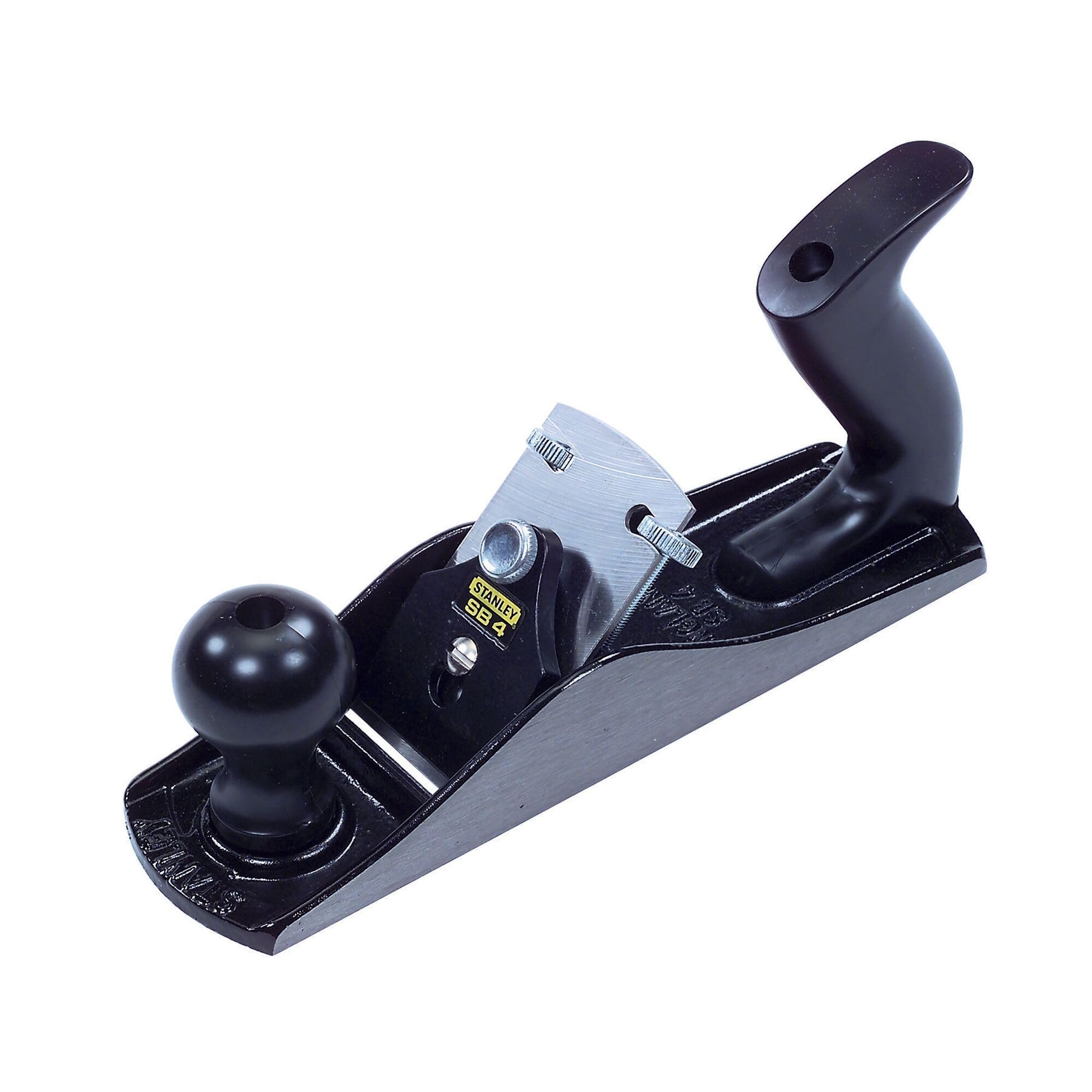
The classic 2-inch bench plane that flattens a board with a steady rhythm.
At 10.7 inches long, 2.8 inches wide and 6 inches tall, this is the biggest plane on the list — and 2.8 pounds of cast iron is what gives it the momentum to ride through a full pass. The cast-iron base has precision-ground sides and bottom, and the hardened and tempered steel cutter adjusts for depth and alignment. Compare the 2-inch cutting width to the KAKURI’s 1.42 inches and the STANLEY takes a wider shaving per stroke.
High-impact polymer handles and knobs are contoured and polished for comfort, and the quick-release cam-lock makes iron removal faster when you change settings or sharpen. Quality is the aspect owners praise most by a wide margin, with value for money running a close second — it is the plane that many people buy first and keep for years.
Setup is the honest sticking point. Buyers report the plane is solid and versatile for light planing jobs, but they disagree on ease of use — some find it easy to work with while others report it takes about an hour and a half to set up. Blade adjustment draws more negative notes than any other feature, and sole flatness gets its own share of complaints, so budget time to tune the sole and cutter before your first real cut.
The trade you make: a wide 2-inch cut and plenty of mass in exchange for a proper setup session when it arrives.
Fit note: buyers who want to work straight from the box may be happier with the JORGENSEN, which arrives sharper; buyers willing to tune a plane get more capacity per pass here.
Best for: woodworkers flattening and smoothing boards who do not mind spending an evening dialing in the sole and blade.
Think twice if: you want zero setup — the time-to-first-cut on this one is longer than most.
6. SUIZAN Ryoba Double Edge Saw 9.5″

Flip the blade to switch between rip and crosscut — no second saw needed.
The blade is 0.02 in (0.5 mm) thick and cuts a narrow 0.03 in (0.8 mm) kerf, which means less wood removed and less force per stroke. One edge carries rip-cut teeth at 9 TPI (teeth per inch, for cutting along the grain) and the other a fine crosscut pattern at 15 TPI. It cuts on the pull stroke, so the thin blade follows your line instead of wandering. The overall length is 23.23 in / 590 mm, with a 9.45 in / 240 mm blade.
The steel is Japanese, hand-sharpened, and set into a wingnut wood handle wrapped in vinyl rattan. Quality and cutting performance are the most-discussed strengths, with teeth described as scary sharp from the box and blades that cut like butter through hardwood. Assembly is a slide-and-tighten-one-screw job, and a zippered storage bag protects the teeth between sessions.
Ease of use splits opinion. Some buyers control the saw easily, others find the handle does not suit them. Read the listing carefully: this is the assembly version, so you fit the blade yourself. It is also 7.04 ounces total, so it feels light in the hand — which is the point of a pull saw, but takes getting used to if you are coming from a Western push saw.
The saw to grab: anyone cutting tenons, dovetails or trim who wants a thin, accurate kerf and a blade that tracks by itself.
Second-guess it if: you prefer a push saw or a pre-assembled handle — this version expects you to fit the blade and adjust your stroke.
7. KAKURI Japanese Hand Plane 42mm

A pull-stroke plane with a laminated steel blade that arrives ready to cut.
You pull this plane toward you rather than pushing away, and that change in direction puts less strain on your shoulder and gives a more consistent cut. The 42 mm (1.65″) blade is Japanese high-carbon steel laminated with soft iron, hand-sharpened by craftsmen, and set into a white oak body. The cutting width comes in at 36 mm (1.42 in) — noticeably narrower than the STANLEY’s 2 inches, which makes it better for chamfering edges than for flattening wide boards.
At 7″ x 2.1″ x 1.6″ and 11.9 ounces, it is light and compact enough to work one-handed on small parts. At 11.9 ounces it is light enough to steer one-handed on small parts. Craftsmanship and ease of use rank as the two most-praised qualities here, and the blade arrives sharp enough to take a shaving from the start. An English instruction manual is included, so a first-time user can pick it up without guessing.
Adjusting the blade is the part that splits opinion — some find the hammer-tap method easy, others report difficulty. That is inherent to a Japanese plane: fine-tuning with a hammer before use is how the blade seats. The chipbreaker over the blade also reduces splitting compared with single-blade planes when planing thin stock.
What stands out: the hand-sharpened laminated blade and the white oak body deliver a fine surface finish, and the pull stroke keeps the cut consistent without pushing hard.
What to expect: the blade needs hammer-tap tuning and the adjustability draws mixed notes, so this is not a plug-and-play tool if you have never used a Japanese plane.
Made for: woodworkers who want a fine finishing pass on edges and small parts and are happy to tune a blade by feel.
Not ideal for: anyone hoping for knob-and-screw adjustments on the first day.
8. EZARC Wood Chisel Set 6PCS

Six beech-handled chisels in a wooden case — the biggest size spread here.
The range is the pitch: 1/4″ (6 mm), 3/8″ (10 mm), 1/2″ (12 mm), 5/8″ (16 mm), 13/16″ (20 mm) and 1″ (25 mm). Nothing else on this list covers that spread. More sizes means you are less likely to make a joint fit with the wrong blade, which is how tear-out happens. Blades are chrome-vanadium steel tempered to HRC60 (hardness on the Rockwell C scale) and bevel-ground at 25 degrees so they cut from the start.
Beech is a hard, dense wood for the handles, and the wooden storage case makes it easy to keep edges separated between uses. Quality and value for money are the most-praised aspects. If you are starting out and want a full range without buying individual chisels, this closes the gap — and the wooden case makes it a reasonable gift for a new woodworker.
Sharpness and durability split opinion. Some owners mention the edges hold for a reasonable time and that the set holds up; others report dull edges on arrival and blades that break under hard use. This is the set to buy for size spread and light work, not for heavy mortising. Expect to hone each edge before you trust it on a finished face.
What you get for the range
- Six blade widths from 1/4″ to 1″ cover nearly every common joint
- HRC60 chrome-vanadium steel, bevel-ground to 25 degrees
- Beech handles resist wear and the wooden case keeps edges apart
- Quality and value for money are the qualities owners praise most
Where to be careful
- Edge sharpness on arrival is a mixed report — hone before the first cut
- Durability gets mixed feedback under heavy striking, so keep the mallet light
Worth it when: you want the widest blade range in one box and you are doing light to moderate work.
Not the pick for: heavy mortising or high-impact chopping — that is the Spec Ops set’s job.
9. Narex Czech Steel Premium 4 pc set with Hornbeam Handles

The premium Narex set adds hornbeam handles and the same Rc 59 steel.
Blades are fine-grained chrome-manganese steel, tempered and hardened to Rc 59, bevel-ground at 25 degrees in the 6 mm, 12 mm, 20 mm and 26 mm sizes. That is the same hardness and size spread as the best-overall Narex set above — what you are paying extra for here is European hornbeam, a very hard wood for the handles, and a more premium fit and finish. The set weighs 1.6 pounds and spans 13.5 inches across the roll.
Quality and sharpness are the qualities buyers praise most, and the chisels take fine end-grain shavings from hard maple — which is the honest test of a bench chisel. They feel good in hand and offer good value for the money at the premium tier. Made by a small toolmaker in the Czech Republic.
Durability is a mixed report — the blades themselves hold up, but some customers note brass collars cracking. That is a hardware detail worth knowing before you start tapping the handles with a mallet. Flatness also draws a few mixed notes, so check the backs before trusting a fine paring cut.
For the finish-line buyer: woodworkers who want European hornbeam handles and the Rc 59 Czech steel that Narex is known for.
Pause before buying if: you plan to use a steel hammer — the brass collar is the weak point to watch.
Know the Specs
Rockwell hardness (Rc)
Rc is a scale for how hard steel is. A chisel at Rc 59 holds a working edge longer than a softer blade but still sharpens on a normal water stone. Higher numbers are not always better — very hard steel chips when you pry with it. Most bench chisels worth buying land in the early Rc 60s, and the two Narex sets here sit at Rc 59.
Teeth per inch (TPI)
TPI counts the teeth on one inch of saw blade. Fewer teeth remove wood faster; more teeth leave a cleaner edge. The SUIZAN Ryoba pairs a 9 TPI rip edge with a 15 TPI crosscut edge so you get both on one saw. That is why flipping the blade between tenon and trim cuts works without swapping tools.
Cutting width
On planes, cutting width is how much wood the blade slices in one pass. The STANLEY bench plane cuts a 2-inch swath; the JORGENSEN block plane covers 1.38 inches; the KAKURI cuts 36 mm (1.42 in). Wider is faster for flattening, narrower is better for edges and corners.
Kerf and blade thickness
The kerf is the width of the slot a saw cuts. A thin blade leaves a narrow kerf, which removes less wood and takes less effort. The SUIZAN blade is 0.02 in (0.5 mm) thick and leaves a 0.03 in (0.8 mm) kerf. That thin blade needs the pull stroke to stay straight — pushing it would bend it.
Common Questions
Are Japanese pull saws harder to use than Western saws?
What do the Rc numbers on chisels actually mean?
Do I need a bench plane and a block plane?
How often will I need to sharpen a chisel?
Will a wooden-handled chisel hold up to hammer strikes?
Why does a plane’s sole flatness matter?
Can I use one chisel set for both carpentry and fine joinery?
Does the SUIZAN saw come assembled?
What is the difference between a rip cut and a crosscut?
Should I buy a plane with an adjustable mouth?
The Bottom Line
For most benches, the strongest all-round pick among these wood work tools is the Narex Bevel Edge Chisel Set — Rc 59 chrome-manganese steel and four metric sizes — 6, 12, 20 and 26 mm — that cover paring and chopping. Lap the backs once and the Rc 59 edges hold through years of paring and chopping. If you want a plane to pair with it, the JORGENSEN No.60-1/2 arrives sharp and trims end grain with its 1.38-inch O1 steel cutter. And for joinery cuts that need to follow a pencil line, the SUIZAN Ryoba saw pairs a 9 TPI rip edge with a 15 TPI crosscut edge on one thin blade. Start with the chisel set — a plane and a saw only cut as cleanly as the edge you pare a joint with.
How we choose
We do not accept paid placement. Every pick is matched to a real buyer and a real use-case; we do not hands-on test units.
Sources
Specifications: manufacturer listings and product documentation. Review insights: verified customer reviews, as of November 2026. Pricing: not shown on this page (it changes often); check the current price via the retailer link.
As an Amazon Associate, Tactical Gear Guy earns from qualifying purchases. This does not affect which products we feature.