Specs are compiled from manufacturer listings and verified buyer reviews and can change over time — please confirm the key details on the product page before buying.
If you have ever unrolled a new mat and got smacked by a chemical smell that lingers through every session, that is the problem this list solves. A genuinely non-toxic yoga mat means one built from natural rubber, TPE (a rubbery plastic that is free of the common vinyl softeners), or cork rather than standard PVC loaded with phthalates. The tricky part is that “non-toxic” and “actually grippy when you sweat” do not always arrive together, and that gap is exactly where most buyers get burned. Below you get nine mats that clear both bars, sorted so you can pick the right one in a few minutes.
This guide is built by comparing the manufacturers’ published specifications and the patterns across verified customer reviews, so you get each pick’s real strengths and trade-offs instead of marketing spin.
You’ll see which mats stay grippy once your hands get damp, which cushion sore knees without turning mushy, and where each material gives up ground.
Top Picks


How To Choose The Best Non-Toxic Yoga Mat
The whole point of going non-toxic is to stop breathing in softener fumes during a practice that is supposed to calm you down. So the first filter is the material itself, and the second is whether that material actually holds your hands and feet in place. Get material and grip right and the rest — thickness, size, weight — is personal fit.
Read the material before the marketing words
Natural tree rubber, TPE and cork are the three materials that carry a real non-toxic story here. A mat labeled “6P free” is declaring it contains none of six common phthalate softeners (DEHP, DBP, BBP, DINP, DIDP and DNOP) — the plasticizers that give cheap vinyl mats their smell. Cork needs no such disclaimer because it is harvested bark.
Here’s the assumption to drop: a mat with no smell is not automatically the safer one, and a mat with a temporary smell is not automatically bad. Natural rubber often carries an earthy scent when first unrolled, and that fades with air. Chemical smell that keeps returning after weeks is the real warning sign.
Match grip to how much you sweat
Dry-hand grip and wet-hand grip are two different skills. Textured rubber and TPE mats hold best on dry skin, while cork actually gets tackier as moisture builds — which is why hot yoga regulars drift toward it. If your palms are dry going in, a sticky textured mat serves you better than cork.
Pick thickness by joint comfort, not maximum padding
A thicker mat protects knees in kneeling postures but softens your base in standing balance poses. Thin mats keep you connected to the floor. Somewhere around 4mm to 6mm suits most people who mix standing and seated work, while a very thick mat suits kneeling-heavy or restorative sessions.
Weigh the carry burden honestly
If you walk or cycle to class, mat weight decides whether you arrive fresh or annoyed. Natural rubber bases are the heavy option, and cork over rubber adds more. If you walk or cycle to class, the difference between a light TPE mat and a heavy rubber one is the difference between arriving fresh and arriving annoyed.
Side-by-Side Comparison
All nine mats here qualify as non-toxic by material. The three columns that actually separate them are thickness (joint comfort versus stability), material (grip behavior and smell), and stated weight (how it carries).
| Model | Best For | Thickness | Material | Weight | Amazon |
|---|---|---|---|---|---|
| Gaiam Premium Yoga Mat, 6mm Print★ Best Overall | Everyday practice on a budget | 6 mm | PVC, 6P free | 1.34 kg | Amazon |
| YOTTOY Extra Thick TPE MatDeepest Cushion | Knees and joints that need padding | 0.5 in (12mm) | TPE | 4 lb | Amazon |
| Hatha Yoga TPE MatRoom To Spread | Tall or broad frames needing room | 1/3 in (0.33 in) | TPE | — | Amazon |
| Gaiam Cork Yoga Exercise Mat | Light travel and hot classes | 4 mm | Cork over TPE | 0.82 kg | Amazon |
| Satori Concept Cork & Rubber Mat | Sweaty flows with extra floor space | 4 mm | Cork over natural rubber | 5.5 lb | Amazon |
| Plyopic All In One Mat | Hot yoga and sweaty hands | 0.14 in | Natural rubber | 2.4 kg | Amazon |
| Manduka eKO Yoga Mat | Strong flows with a natural feel | 5 mm | Natural tree rubber | 6.2 lb | Amazon |
| Body By Yoga Luxury Cork Mat | Long limbs and hot studio classes | 0.25 in | Cork over natural rubber | 9.9 lb | Amazon |
| Liforme Special Yoga Mat | Alignment work and premium grip | 4.2 mm | Eco-polyurethane, rubber | 2.5 kg | Amazon |
Detailed Reviews
1. Gaiam Premium Yoga Mat, 6mm Thick Print Mat
Our pick — 4.5+★ from 22,000+ verified ratings; the strongest balance of quality and price.
Six millimeters of joint cushioning and a label that names every phthalate it leaves out.
This is the mat that wins on the combination most people actually want: a declared non-toxic build and enough padding to kneel on without wincing. The 6mm thickness (six millimeters of cushion between you and the floor) is the number doing that work, and it sits right in the range that protects knees without turning standing poses wobbly. The label spells out its own claim clearly — a PVC mat that is “6P free,” meaning it excludes DEHP, DBP, BBP, DINP, DIDP and DNOP, six plastic-softeners that give cheap mats their chemical reek.
Cushioning is where it earns its reputation. The mat feels soft under sitting bones and forearms, which is why it carries so much affection from people doing long floor sequences and Pilates work. Its print designs pull a lot of the attention — this is a mat people are happy to have visible in a living room, not one they hide in a closet.
Grip is the honest asterisk. Hand traction splits down the middle: some practitioners find it locked in place, others slide when their palms get damp. If you sweat heavily, plan on a towel over the top or look at the cork and rubber options lower down. There is also a short break-in period — Gaiam itself suggests unrolling and airing the mat for two to three days before first use, since a harmless odor can be present out of the wrap.
What earns the top spot
- 6mm thickness cushions knees and elbows without killing your balance
- Explicit 6P-free build excludes six named phthalate softeners
- 68″L x 24″W gives a standard full-body footprint
- Print designs are genuinely good-looking, not an afterthought
- Includes a free downloadable yoga class to start with
Where it asks patience
- Grip is inconsistent once palms get sweaty
- Hand wash only — no machine cycle
- Needs two to three days of airing before the smell settles
- At 1.34 kg it is not the lightest mat in a tote
Worth grabbing if: you want a proven, well-cushioned everyday mat with a declared phthalate-free build and you do not sweat hard through your hands.
Think twice if: hot yoga or heavy palm sweat is your normal — the grip gets unpredictable there.
2. YOTTOY Extra Thick Yoga Mat
Half an inch of foam for anyone whose knees have filed a complaint against the floor.
Knees that ache in kneeling poses get 12mm of cushioning here, because this mat is 0.5 in thick. That is 0.5 in thick versus the Hatha mat below at 0.33 in, so restorative sessions and tender joints feel supported. The material is TPE (a rubbery, recyclable plastic that avoids the vinyl softeners), which keeps it in the non-toxic lane. The maker states the material is SGS and TUV certified free of heavy metals like lead and cadmium plus ten types of phthalate.
Width matters as much as depth here. At 72″L x 32″W it is 32 inches across versus the Gaiam Premium’s 24 inches, which changes what you can do on it. That extra span is why people mention spreading out with a child or a pet beside them. The one-piece foam construction also makes it odorless out of the wrap and easy to wipe down with a damp cloth and mild detergent.
The trade-off is stability. Deep foam gives you a soft landing but a less certain base in standing balance poses, and the surface has drawn split verdicts on whether it stays put or shifts underfoot. If your practice is mostly warrior sequences on one leg, the thinner rubber mats serve you better. If it is floor work, this is the comfort pick.
The foam math: 12mm of TPE genuinely separates this from every other mat on the list in joint protection — it is the thickest here by a wide margin.
The honest limit: that same depth makes standing balances feel less planted, and some users find it slides on smooth floors. A towel or a grippy base helps.
Reach for this if: your practice is floor-centered and your knees want real padding — 12mm is the most cushion on this list.
Look elsewhere if: you need a rock-steady base for one-legged standing poses or a mat that packs small.
3. Hatha Yoga TPE Yoga Mat 72″ x 27″ x 1/3″
Twenty-seven inches wide and a third of an inch deep — built for bodies that need elbow room.
Tall practitioners and broad-shouldered ones keep hitting the same wall: a standard mat runs out of width mid-pose. This one measures 72″L x 27″W at 1/3 inch thick, so you get three extra inches of width and a full-length footprint. It is TPE, the material Hatha states is SGS certified and odor-less, and the maker describes it as a step up from traditional mat material.
The grip design is the interesting part: grain on both sides, so the top holds your hands and the reverse holds the floor. Hatha’s claim is that the grip survives sweat — the mat stays under wet hands and feet rather than turning slick — and that it works on wood, tile, cement, or a gym floor. The green colorway is a small thing that gets noticed favorably, and the included carrying sling saves you buying a strap.
What to know going in: this mat asks for care. Spot clean with a damp cloth and cold water, dry flat, and keep it out of long sun exposure — extended sun breaks the material down. Rolling it up has drawn some grumbling, so if you store it stretched out or rolled loosely, you will be happier than if you cram it tight after every session.
Why it earns the mid slot: Wide-legged standing poses feel roomier because this mat gives you 27 inches of width and a full 72 inches of length. The double-sided grain also tackles both hand slip and floor slip at once.
One thing to plan for: it does not roll up easily. Give it room in the bag and it behaves.
Best fit for: taller or wider-framed practitioners who keep running off the edge of a standard 24-inch mat.
The catch: it wants careful storage and shade — sun exposure and tight rolling both shorten its life.
4. Gaiam Cork Yoga Exercise Mat, 68″ x 24″

Cork on top, TPE underneath, and the lightest weight on this entire list.
When the walk to class is the hard part, this mat is the one to carry because it weighs 0.82 kg. Compare that with the Gaiam Premium’s 1.34 kg and you feel the difference on your shoulder — the cork build here is the lighter of the two by a noticeable margin, and it is the only mat on the list under a kilogram. The construction is cork on top with a non-toxic, lightweight TPE rubber base, so you get a natural surface without a heavy natural-rubber core.
Cork’s whole argument is moisture. The surface grip increases as it gets damp, so heat and sweat make it tackier rather than slicker — which is why heated and hot classes suit it. It also refuses to hold odor: cork does not absorb the funky smell that porous rubber can pick up over months. Four millimeters is the thin end of the range here, keeping you connected to the floor for balance work.
Two honest notes. The mat is 4mm against the Gaiam Premium’s 6mm, so if your knees need padding, this is not your mat. And grip reports split: some find it locked in, others call it too slippery, so cork’s behavior varies with how damp your hands actually get.
Where cork earns its keep
- 0.82 kg — the lightest mat on this list
- Cork surface resists odor buildup entirely
- Grip rises with heat and moisture, suiting hot classes
- Sustainable cork over a non-toxic TPE base
The honest trade-offs
- 4mm is thin — limited joint padding
- Grip is polarizing on dry hands
- Dry flat only, no machine cleaning
- 68-inch length suits most, not all, heights
Grab it if: you carry your mat to class and want a natural cork surface that stays fresh-smelling and grips better as you heat up.
Pass if: your knees need 6mm-class cushioning or your hands stay dry through practice.
5. Satori Concept Cork Yoga Mat with Natural Rubber Base
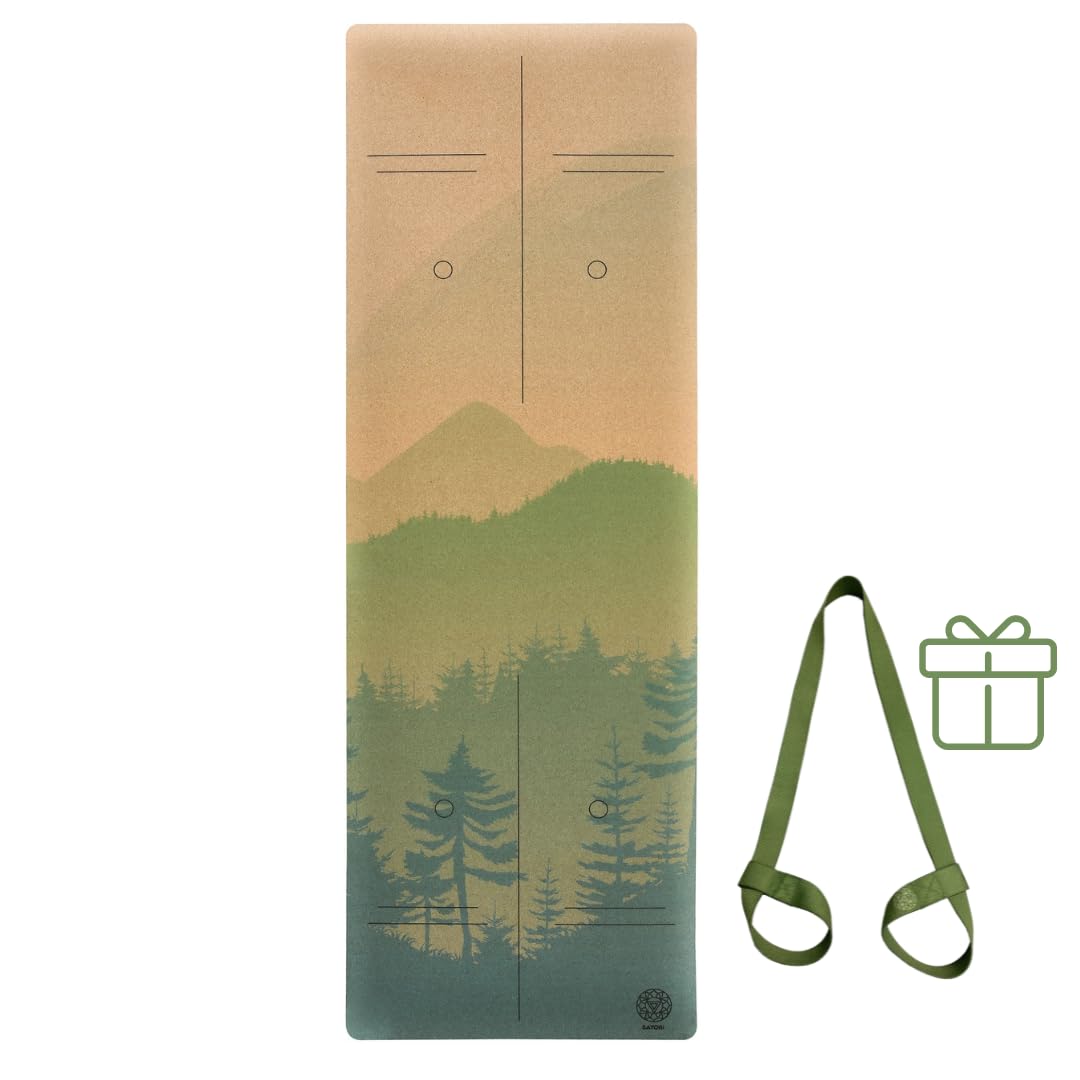
Cork over tree rubber, sized generously, and built to stay put through a sweaty flow.
The material pairing is the story. Where cheaper cork mats back the cork with synthetic TPE, this one uses natural tree rubber underneath — a combination Satori positions as sturdier and free of the chemical smell that synthetic bases can carry. At 72″L x 26″W x 4mm, the footprint is 26 inches wide and 72 inches long, versus the Gaiam Premium’s 24-inch width and 68-inch length.
Lying on this mat feels good and standing poses feel steady at the same time, because the rubber base supplies a firm, stable platform while the cork top stays soft against skin. That pairing is what people respond to most. Grip tracks with cork’s nature: it holds without going sticky, tightening up as sweat arrives, so long holds and hot sessions both work. A free strap is included, and the packaging is recyclable.
Hauling this mat is the recurring grumble, because at 5.5 pounds it is substantial. Opinions split between “not too heavy” and “a bit heavy.” If your mat lives at home, this is a non-issue; if it rides your back to a studio three times a week, you will feel it.
What wins people over: the firm rubber base plus soft cork top gives a luxurious feel that does not sacrifice stability — rare in a cork mat.
Size it honestly: 5.5 pounds is real weight. Home practice loves it; a daily commute may not.
Choose this when: you want cork grip with genuine rubber support and practice mostly at home or drive to class.
Choose something else when: you need a mat that travels light — the 5.5-pound heft is the one thing that wears.
6. Plyopic All In One Yoga Mat

Built on the premise that sticky mats were designed for people who don’t sweat.
Plyopic says the quiet part out loud: standard sticky mats work for dry hands and fail for damp ones. This mat is aimed at the second group. The grip compound is meant to hold through moist palms and hot-yoga sweats, so transitions stay smooth instead of turning into a slide. Underneath, a 3.5mm rubber base is engineered to grip the floor firmly, which is doing the balance work while the top handles your hands and feet.
It is also a two-faced mat by design. Flip it over and the reverse side works with footwear for gym or fitness sessions, which widens its job beyond yoga into general training. Materials are SGS certified, and the surface is soft against skin. At 0.14 inch it runs thin, so this is a mat for people who want ground contact rather than a plush ride.
Thickness is the split verdict. Enough padding for knees and elbows, not enough for someone who wants deep cushioning — that is precisely the trade for stability. The limited-edition prints are a genuine draw and rotate out, so if a specific design matters to you, that is a reason not to sit on the decision.
The core argument: a mat tuned for sweat beats a mat tuned for dry skin if you run hot — and the flip side adds gym use on top.
Who it is not for: if you want thick foam under your knees, 0.14 inch will feel sparse.
Suits you if: sweat is your enemy and you want one mat that covers hot yoga and gym sessions with a flip.
Not your pick if: you need plush cushioning for sensitive joints — this one is deliberately thin.
7. Manduka eKO Yoga Mat
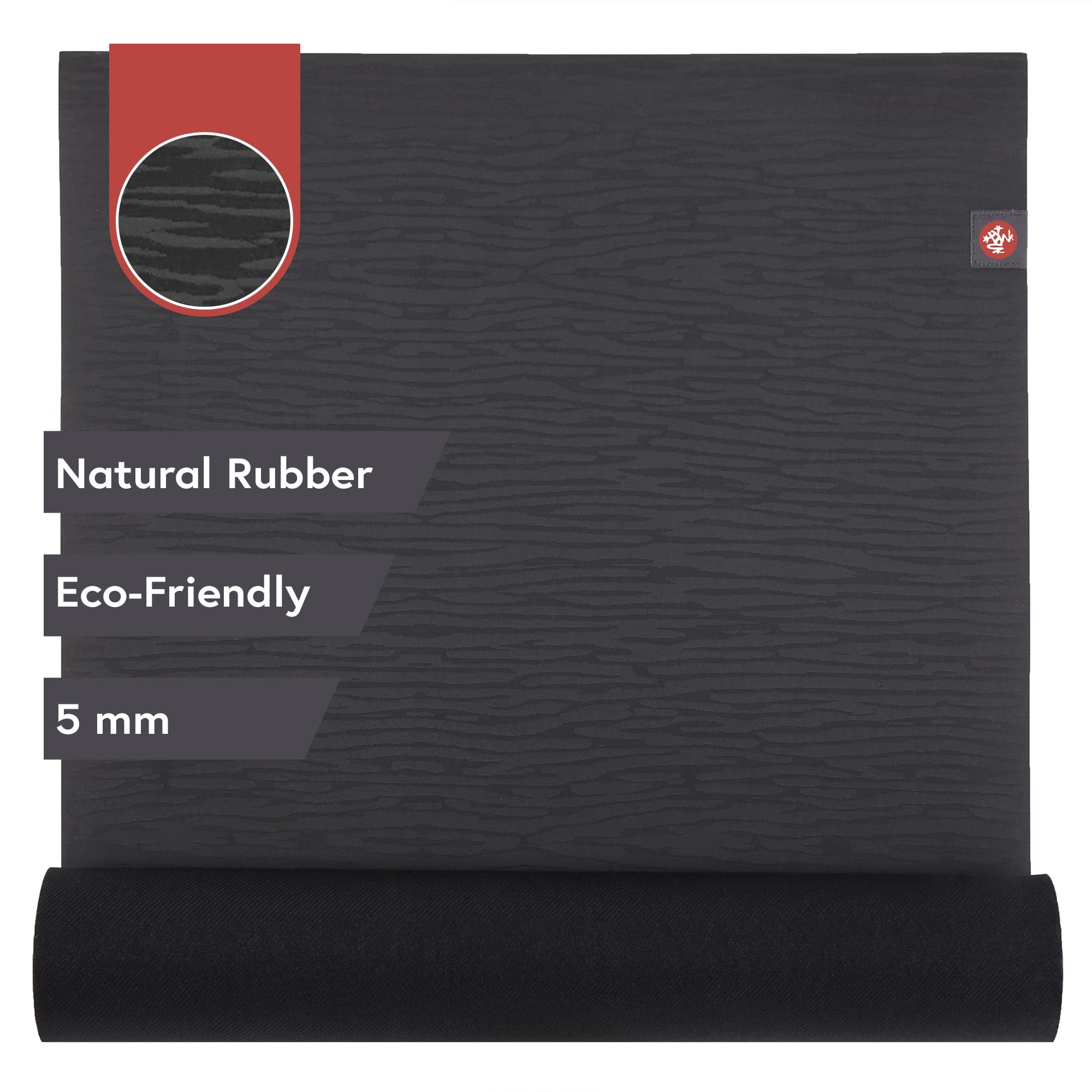
Biodegradable tree rubber with a rippled surface that feels like nothing else here.
The eKO is made from biodegradable, 100% natural tree rubber, and it is 99% latex-free (the tiny remaining fraction matters if you are latex-sensitive). At 5mm thick with a “Rippled Catch-Grip” texture, the surface is meant to give you purchase in dry conditions and across different styles. The closed-cell design keeps moisture and buildup on the outside, where you can wipe it away, and Manduka states the mat resists tearing and scratching.
Grip and natural feel are its reputation. The textured surface gives grounded traction, and what people respond to is the next-to-skin quality — it does not feel like a synthetic sheet. If you practice strong flows where you need to plant a hand and trust it, this mat delivers in the dry conditions it was built for.
Two real caveats. Natural rubber carries a characteristic scent that can be strongest when first unrolled, and it fades with air and regular use but does not vanish on day one. And durability is genuinely divisive — some mats hold up beautifully, others report wear. The care rules are strict for a reason: spray the maker’s natural-rubber restore, let it sit five minutes, wipe dry, and avoid soap, soaking, sun, a garden hose, a vacuum, or a washing machine.
Where the eKO delivers
- 100% natural tree rubber, biodegradable and non-toxic
- 99% latex-free for sensitive skin
- 5mm with a rippled texture for dry-condition grip
- Closed-cell surface resists moisture and buildup
What you accept in return
- Natural rubber scent lingers through early use
- Longevity reports are genuinely mixed
- 6.2 pounds is heavy to carry
- Strict care — no soap, sun, or machine washing
The match: you want a natural, grounded surface with real dry-condition grip and you do not mind a rubber scent for the first stretch.
The mismatch: you sweat through your palms heavily or expect a mat to shrug off years of hard use without care.
8. Body By Yoga Luxury Cork Yoga Mat
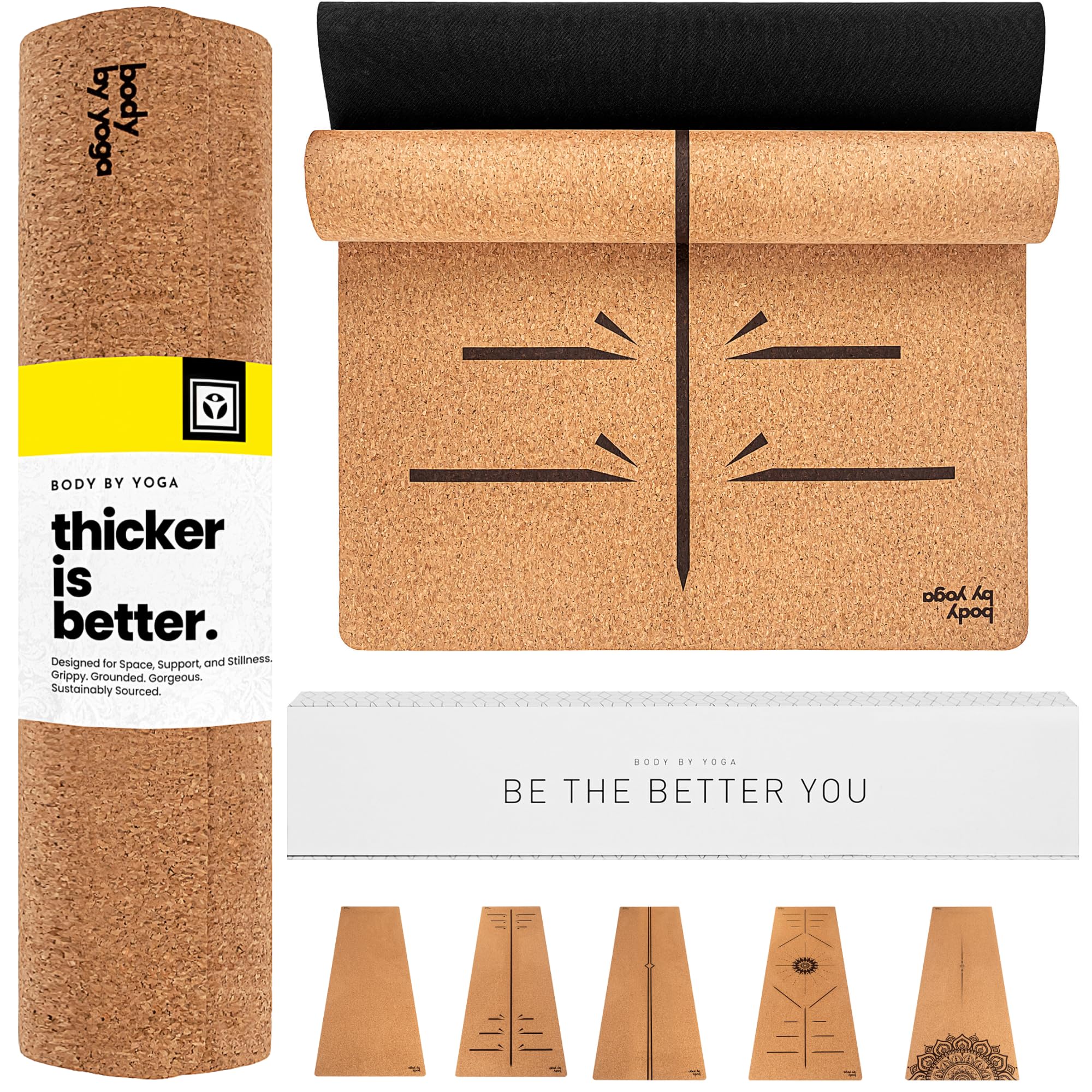
Eighty inches long, so the top of your head and your heels both stay on the mat.
Length is the fix here. At 80″L x 26″W this is the longest mat on the list, versus the Plyopic’s 71 inches and the Gaiam Premium’s 68 inches. For tall practitioners whose heels hang off a standard mat, that changes everything. The 0.25-inch thickness cushions knees while keeping the mat firm enough that standing and balance poses stay stable — Body By Yoga explicitly avoids an overly soft foam.
The cork layer is deliberately thicker than most cork mats, which the maker ties to better grip, more durability, and a softer surface. That cork gets tackier with moisture, so hot classes and studio sessions work well, and it wipes clean with water since it does not absorb sweat the way porous rubber does. The maker states the mat was created by yoga instructors, and the firm, smooth cork is easy on skin.
Then there is the weight, and it is the one thing everyone notices: approximately 9.9 pounds. That heft is on purpose — it keeps the mat planted on any surface and gives the cushioning its substance — but carrying it to class is a workout in itself. Home practice and studio sessions where you drive are where this mat belongs.
The length payoff: Anyone over standard height gets a mat that actually fits, because 80 inches is class-leading on this list — it is the difference between a mat that fits and one that doesn’t.
The weight cost: roughly 9.9 pounds is a deliberate trade for stability. Treat it as a home mat and it makes sense.
Made for you: tall practitioners who want a long, firm cork surface that stays glued to the floor through hot sessions.
Wrong for you: if you commute on foot or bike, the 9.9-pound carry will wear thin fast.
9. Liforme Special Yoga Mat

The patented alignment system that puts your hands and feet exactly where they belong.
Hot-yoga practitioners keep coming back because the grip holds through hot sessions. Liforme claims its “GripForMe” material makes this the grippiest mat on the market and stays grippy even when “sweaty-wet.” Superlative aside, the grip holds through hot sessions. The build uses eco-polyurethane and rubber, is PVC free, and is made from non-toxic materials by the maker’s account.
The alignment design is the feature nothing else on this list offers. Patented markers across the surface guide hand and foot placement, which genuinely helps when you are learning where your body should land in a pose and cannot check a mirror mid-flow. At 4.2mm and described as long and wide, the mat is comfortable for extended practice, and a free yoga bag comes with it.
Thickness opinions split — some find it nicely thick, others call it a little on the thinner side — so if you want deep knee padding, know that 4.2mm is the honest figure. It is also the top-tier option here, so this is a mat you buy once and look after.
The standout: alignment markers are a genuine teaching tool, and the wet-grip hold backs up the hot-yoga reputation.
The one caveat: 4.2mm is a middle-of-the-road thickness — fine for most poses, thin for anyone who wants plush cushioning under knees.
Buy it when: alignment guidance and reliable wet grip matter more to you than maximum cushion, and you want a mat built to last.
Skip it when: you specifically need thick joint padding — this one is deliberately moderate at 4.2mm.
Know the Specs
Material: what “non-toxic” actually means on a label
Three material families carry the non-toxic claim in this category. Natural tree rubber is harvested, biodegradable, and grippy but heavy and earthy-smelling. TPE is a rubbery plastic that skips vinyl softeners and tends to be lighter and odor-free. Cork is bark, needs no plasticizer, and gains grip as it dampens. The “6P free” phrase on a PVC mat means it excludes six named phthalate softeners — DEHP, DBP, BBP, DINP, DIDP and DNOP — the chemicals behind that new-mat reek. A “SGS certified” or “TUV certified” line means an outside lab tested the material for things like heavy metals. None of these labels make a mat grippy; they only tell you what it is made of.
Thickness: the comfort-versus-balance dial
Thickness is measured in millimeters, and it decides how much your knees and elbows are protected versus how planted your standing poses feel. Thin mats — around 0.14 inch to 4mm — keep you close to the floor, which helps balance and proprioception (your sense of where your body is in space). Mid-range mats around 5mm to 6mm suit most mixed practice. Very thick mats, like a 12mm option, are for kneeling-heavy and restorative work, but they soften your base and can make one-legged poses feel less sure. Choose thickness by the poses you actually do, not the biggest number on the page.
Common Questions
Is a TPE yoga mat actually non-toxic?
Why does my new non-toxic mat still smell?
Does a cork yoga mat grip better when you sweat?
How thick should a yoga mat be for knee and joint support?
Can I wash a natural rubber or cork yoga mat in a machine?
Is a cork mat better than a rubber mat for hot yoga?
How long is a standard yoga mat and when should I go longer?
Will an alignment-marked mat help my practice?
Does a heavier yoga mat stay in place better?
What does “6P free” mean on a yoga mat label?
The Bottom Line
For most people, the non-toxic yoga mat that gets it right is the Gaiam Premium Yoga Mat — it gives you 6mm of joint cushioning on a clearly labeled 6P-free build, from a brand that has been making mats long enough to have ironed out the basics. If your knees are the loudest voice in the room, the YOTTOY doubles that depth at 12mm. And if you sweat hard or practice hot, the Plyopic was purpose-built for damp hands, while the Body By Yoga handles tall frames at 80 inches. One nudge: the Gaiam Premium carries a 4.5+ star rating across tens of thousands of owners, a track record that makes it an easy first mat.
How we choose
We do not accept paid placement. Every pick is matched to a real buyer and a real use-case; we do not hands-on test units.
Sources
Specifications: manufacturer listings and product documentation. Review insights: verified customer reviews, as of November 2026. Pricing: not shown on this page (it changes often); check the current price via the retailer link.
As an Amazon Associate, Tactical Gear Guy earns from qualifying purchases. This does not affect which products we feature.