Specs are compiled from manufacturer listings and verified buyer reviews and can change over time — please confirm the key details on the product page before buying.
An X-ray marker is not decoration — it is the photographic proof that a radiologist is reading the right side, from the right view, taken by the right person. A marker with a blank or worn-off L or R does two things: it fails the QC review, and it can send a patient back for a repeat exam. This list covers the markers that hold their letters, survive daily dropping on a cassette, and fit inside a tight collimation field without covering the anatomy.
This guide is built by comparing the manufacturers’ published specifications and the patterns across verified customer reviews, so you get each pick’s real strengths and trade-offs instead of marketing spin.
The markers below stay legible on the image and keep L and R obvious at a glance. Below you get the full breakdown on the best x-ray markers.
Top Picks

How to Choose the Best X-Ray Markers
Three things decide whether a marker works in daily imaging: the size of the lead letter you will actually see on the image, what surrounds and protects that letter, and whether the shape fits inside the field you shoot. Get those three right and the branding, color, and initials are just personal taste.
The Lead Letter Is the Whole Point
A 1/2″ lead character is big enough to stay legible on a film or digital receptor even when the technique runs bright. Small lead characters are the number one reason a marker fails QC — a tiny L or R can fade into the anatomy behind it. Solid lead stays visible because lead blocks the beam; the letter has to be thick enough to block it well. Every marker on this list uses lead letters set inside clear epoxy so the character cannot scratch off the surface.
Backing Material: Plastic vs Aluminum
The backing is the density plate that holds the lead letter in place. A tough polycarbonate backing adds density and improves the image on the film. An aluminum casing does the same job in a harder shell you can toss on a cassette tray. Plastic tends to be lighter and quieter; aluminum takes more abuse over a career. Neither is wrong — pick based on whether you drop your markers on the floor during a shift or keep them in a case between patients.
Shape, Size, and Collimation
Tight collimation means the beam is narrowed to the anatomy — which leaves very little room around the body edge for a marker. A wide rectangular tag can get clipped off the field entirely. A skinny, vertically oriented marker fits into a narrow margin where a wide one would land outside the shot. If you shoot a lot of small anatomy, choose the narrower tag even if you like the look of a bigger one.
Initials and Color Coding
Initials tie an image to the tech who took it, so the marker doubles as identification. Blue Left / Red Right is the industry-standard color code, and it saves you a half-second of thinking every single shot. When you have multiple techs in a department, mixed colors or custom shapes help everyone visually confirm whose marker is whose without reading the letter each time.
Side-by-Side Comparison
| Model | Best For | Lead Letter Size | Marker Material | Initials Customizable | Amazon |
|---|---|---|---|---|---|
| X-Ray Plastic Markers (Red/Blue Set)★ Best Overall | All-around daily imaging | 1/2″ lead character | Polycarbonate backing | 1-3 characters | Amazon |
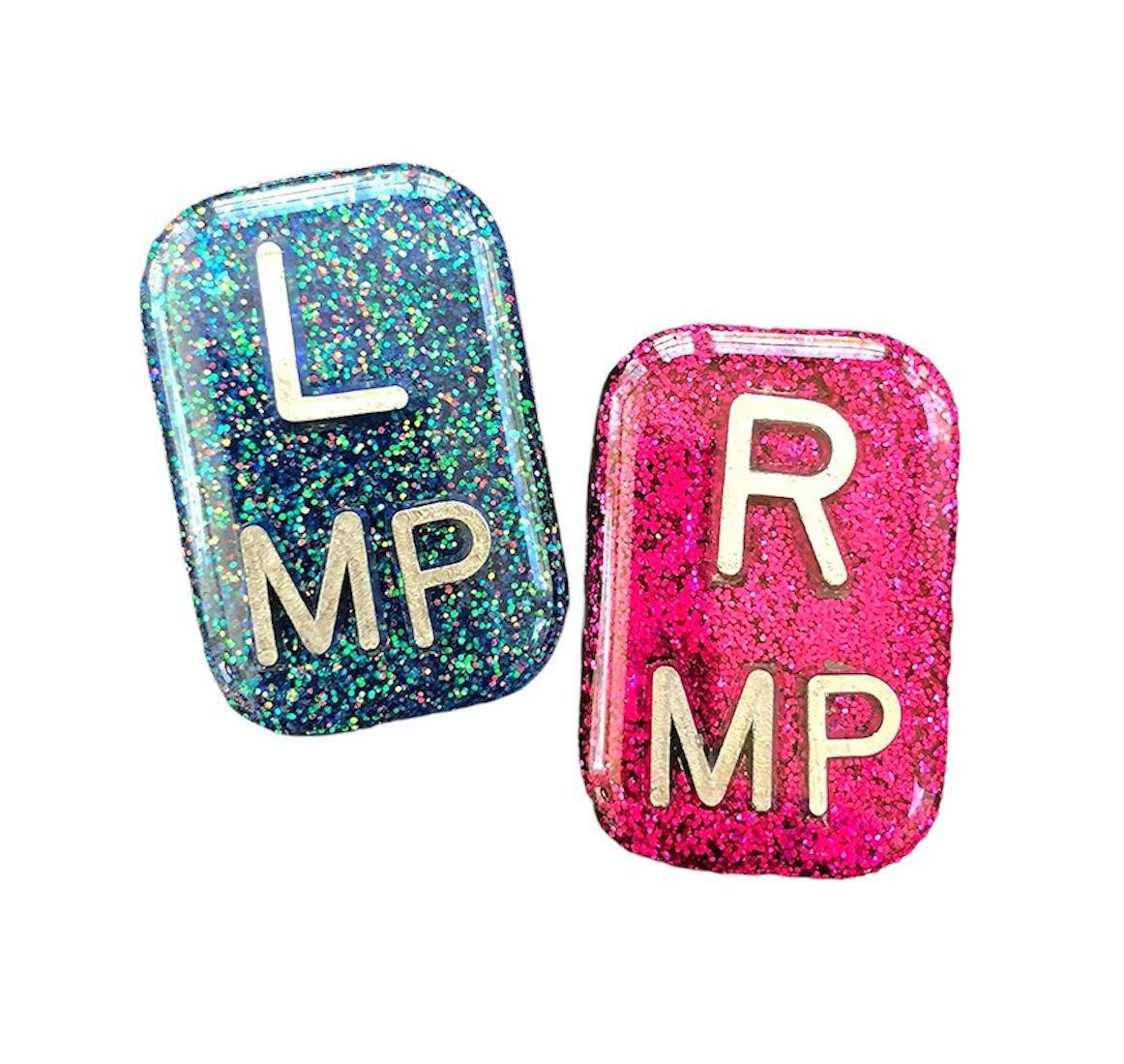
| Rectangle Glitter Xray MarkersBest Appearance | Color and glitter finishes | Lead letters | Lead letters | 2 or 3 initials | Amazon |
| Blue/Red Rectangle Solid Colors | Color variety | Lead letters | Lead letters | 2 or 3 initials | Amazon |
| Skinny Bone Xray Markers | Tight collimation | Lead letters | Lead letters | 2 or 3 initials or numbers | Amazon |
| 4 Sets of Xray Markers (8 total) | Multiple techs or spares | Lead letters | Lead letters | Initials or numbers | Amazon |
| X-Ray Aluminum Skull Set | Statement style | 1/2″ lead character | Aluminum backing | 1-3 characters | Amazon |
Detailed Reviews
1. X-Ray Plastic Markers — Red/Blue Set, 1/2″ Lead Letters
Our pick — 4.5+★ from 200+ verified ratings; the strongest balance of quality and price.
The 1/2″ lead letter does the heavy lifting here — big enough to survive a bright technique.
If you take one marker out of this article and put it in your apron pocket, make it this one. The lead character measures a full 1/2″, which is the size that stays readable on the image instead of fading into the anatomy behind it. Each set ships as a Red Right and a Blue Left pair, so the color tells you the side before you even read the letter. The tag itself runs 1-5/8″ long, 7/8″ wide, and 1/8″ thick — a firm slab that sits flat on a cassette without curling.
What keeps this pair at the top is confidence over time. Bulk of the feedback centers on solid build that arrives exactly as described and keeps working as intended through daily shifts. The polycarbonate backing is doing quiet work there: it adds density so the edge of the marker reads cleaner on the image. You can also personalize with 1-3 capital letters or numbers, which is the practical way to add your stamp to the tag without walking around trying to identify whose marker is on the cassette. It’s designed for x-ray techs, rad techs, radiologists, general imaging staff, laboratory staff, and medical students — basically the whole imaging floor.
The one thing to know before ordering is the return rule: customized markers are not eligible for return unless there is a manufacturing defect. So double-check your initials and your color choice before you commit. They are made in the USA by a veteran-owned small business, which is a detail a lot of buyers weigh in this category. At 4.5+ stars across 200+ owners, it’s one of the highest-rated sets here.
What earns it first place
- 1/2″ lead character stays legible where smaller letters wash out.
- Red Right / Blue Left backgrounds make side confirmation instant.
- Polycarbonate backing adds density and sharpens the image edge.
- 1-3 capital letters or numbers personalize it to the tech.
- 1-5/8″L x 7/8″W x 1/8″ thick body sits flat on a cassette.
The catches worth knowing
- Customized markers cannot be returned unless there’s a manufacturing defect.
- Personalization adds a step — you have to message the seller with choices.
Go with this one if: you want one dependable marker set with the biggest lead letter on the list and initials that tie images back to you.
Pass if: you need to return and try a second color — the custom rules lock you in.
2. Rectangle Glitter Xray Markers with Initials
A marker that turns the QC basic into a small personal accessory.
You spend a shift staring at these things, so a bit of glitter and a color you picked yourself is worth something. Alisha Goes Crafty builds these with lead letters and a glitter finish, and you choose from blue, pink, and a range of glitter options from the photo reference. Initials go one of two ways: a 2-initial set sits horizontally underneath the L/R, and a 3-initial set sits next to the L/R in a vertical direction. That is the detail to read twice, because it changes how much room the tag takes up.
The size is the one split opinion. Some buyers find it very small, others find it just right — and neither is wrong, it depends on what you’re used to. If you’re moving from a wider rectangle, order with the photo as your reference and know that the rectangle feels smaller in hand. The rest of the story is the part that carries the rating: these arrive well-made, look exactly as pictured, and the colors are the kind of personalized thing buyers genuinely enjoy choosing. With 4.5+ stars across 440+ ratings, this shop has a long custom-order track record.
Buy this for the joy of a marker that matches your scrub color and shows your initials. It still does the QC job — lead letters, clear differentiation, visible identification — but it’s the aesthetics you’re paying for in this tier.
Where it shines: the look. Owners speak highly of the colors and the finish, and the whole thing arrives matching the photos.
Order it carefully: the size feedback splits — some find it very small — so check the reference photo against what you already carry.
Pick this if: you want your initials on a glitter marker that looks as good in your hand as it does in a photo.
Slow down if: you’re used to a large rectangular tag — the compact size may surprise you.
3. Blue and Red Rectangle Xray Markers, Solid Colors

Nine solid colors, two sizes, one maker who takes bespoke orders seriously.
If glitter is not your thing but color is, this is the set to look at. It comes in solid red, blue, green, yellow, orange, purple, pink, white, and black — enough to color-code by view, by department, or by tech without repeating a color. Initials work the same way as the glitter version from this maker: 2 initials underneath the L/R horizontally, 3 initials next to it vertically. Measurements are approximately 1 inch by 1.25 inch, and there is also a smaller rectangle in 20mm x 30mm if you ask for it.
That size flexibility is the quiet standout. The seller invites a message if you want the 20mm x 30mm version, and says these colors can be applied to most of their other shapes too. For a tech who has seen every generic marker on the market, that’s the point where you can actually build a marker to fit your cassette. At 4.0+ stars across 20+ ratings it’s the lowest score here, but a review base that small on a newer listing swings easily.
Treat this as the “spec it your way” pick rather than a mass-market standard. The trade-off is that the finish is solid color rather than a set L/R background pair, so you should confirm the left/right color scheme you want in the message before ordering.
Reach for this if: you want nine solid color choices and the ability to request a smaller 20mm x 30mm rectangle.
Skip this if: you need a fixed standard L/R color scheme from the start — confirm your scheme with the seller first.
4. Skinny Bone Xray Markers, Vertical

Built for the narrow strip of field left when you collimate right down to the bone.
The spec sheet is short and decisive: about 2 inches long, and under 0.75 inches wide at the thickest point — which is the ends. When you need the beam tightened to a small anatomy, that vertical, tapered profile is what keeps the marker inside the field instead of clipped off the edge. A wide rectangle simply does not fit that space. This is the marker you buy the moment you realize your last one kept landing outside the shot.
You also get 2 or 3 initials or numbers on these, and a color choice from the reference photo — the range is wide, from glitter and silver and gold through to blue, pink, orange, black, red, and white. The bone shape is the visual signature, and it stays readable because the lead letters sit visible inside. What wins people over in this one is the build: solid quality tags that hold up in a real imaging routine, plus the kind of shape and sparkle that makes them easy to find in an apron pocket.
The main thing to size before you order is the length. Two inches is taller than a standard rectangle, so on a crowded cassette it takes a vertical space; if you are already fighting for space, check that the standard bounding box on your protocol works with the taller marker. At 4.5+ stars across 97+ ratings, it’s among the highest-scored markers here.
What the shape buys you: it slips into the thin margin a tight-collimated shot leaves around the anatomy, which a wide tag cannot do.
Space to plan for: the 2″ length is tall — measure against your current marker if your cassette layout is already busy.
It’s the right marker for: small-field, tight-collimation work where a wide tag would not make the image.
Measure first: the taller 2″ body needs more vertical room than a standard rectangle.
5. 4 Sets of Xray Markers (4 R and 4 L) with Initials

Eight markers, four color pairs, and initials on every single one.
One set of markers gets lost. Two sets get borrowed. Eight covers the whole department. This listing gives you 4 Right markers and 4 Left markers — 8 items in total — each one carrying your initials or numbers. That is the practical answer for a shared imaging floor where everyone wants their own set but nobody wants to buy four separate pairs. Colors span red, blue, green, pink, yellow, teal, orange, and purple, so each tech can stake out a pair and keep it straight.
The appearance is what makes this set easy to keep separate in a drawer. Owners talk about the cute look and the perfect size, and the color coding gives you a quick visual scan instead of squinting at a tiny L in low light. The set also arrives with extra accessories, including a badge reel — a small inclusion, but one that saves you a trip to the supply cabinet. Consistent build across all eight markers is what matters in a set this size, and 4.5+ stars across 73+ ratings backs it up.
Here is the honest limit. This is a newer listing, so the long-term durability track record is shorter than the established name-brand options above. What makes that a small risk rather than a big one: each marker is still lead letters, and the price-tier math works out well when you’re covering a full drawer. If you’re a solo tech buying one personal pair, you’re overbuying; if you run a department, this is the cleanest way to kit everyone out at once.
Why it works for a department
- 8 markers total — 4 Right and 4 Left, each with initials or numbers.
- Eight color options let each tech claim a pair.
- Arrives with extra accessories including a badge reel.
- 4.5+ stars across 73+ ratings on a consistent build.
Where to hesitate
- Newer listing, so there is less of a multi-year track record to judge.
- Overkill for a single tech who only needs one pair.
It’s built for: department buying, where eight personalized markers cover four techs or give you backups in a shared drawer.
One person only: buy a single pair instead — this pack is more than a solo tech needs.
6. X-Ray Aluminum Markers — Skull Set, 1/2″ Lead Letters

The same 1/2″ lead letter as the top pick, dressed up in a skull pair.
The first thing to notice is what you don’t lose by going for the fun design. This set carries the same 1/2″ solid lead letters as the Best Overall pair, embedded in clear epoxy so they stay visible on the image. It also uses a durable aluminum backing instead of polycarbonate, which adds density and improves the image edge in a harder shell. The overall marker measures 1-1/2″L x 3/4″W x 7/64″ thick — slightly shorter and narrower than the plastic set, which can help on a tighter cassette.
The skull pair is the whole pitch: a left and right X-ray marker that actually looks like a left and right, with a design that stands out in a drawer full of grey rectangles. It does the same daily QC job as any of these — lead letters visible, colored backgrounds separating views or departments, personalization with 1-3 capital letters or numbers. It’s aimed at the same crowd: x-ray techs, rad techs, radiologists, general imaging staff, laboratory staff, and medical students.
What it isn’t is a budget option. You pay for the aluminum build and the custom design, but the same customization rule applies: these are not eligible for return unless there’s a manufacturing defect, so lock in your initials and colors before ordering. Made in the USA and distributed by a veteran-owned small business, like the Best Overall set. If you want a marker that makes an impression in an otherwise utilitarian drawer, this is the one that does it without sacrificing lead size.
The design win: skull-shaped left and right, still with the full 1/2″ lead letter inside — style without a spec compromise.
Return rule caution: customization is final unless there’s a defect, so verify your initials match before you click buy.
Buy it when: you want the same 1/2″ lead quality as the top pick in a design that stands out on the cassette.
Think again if: you need a return-friendly order — the custom skull pair is a commitment.
Know the Specs
Lead Letter Size (1/2″ and Small)
The lead character is the size of the L or R that actually blocks the X-ray beam and shows up on the image. A 1/2″ lead character is the larger option and stays readable even when the technique runs bright. A “small” line size — used on the ATTENUTECH aluminum pair — takes up less space but can wash out under heavy technique. Bigger is not automatically better: a big letter on a wide tag may not fit a tight-collimated field. Match the letter size to how much room your shot actually leaves.
Marker Material: Polycarbonate vs Aluminum
The backing is the density plate that holds the lead letter in place. A tough polycarbonate backing adds density and improves the image in a lighter, plastic shell. A durable aluminum casing does the same job in a harder, heavier shell that takes more abuse. Both hold the lead letters embedded in clear epoxy, so the characters cannot scratch off in a pocket. Polycarbonate suits the daily carry; aluminum suits the drawer that gets dropped on a tray between patients.
Marker Dimensions and Collimation Fit
Overall marker size is different from the letter size. A marker measuring 1-5/8″L x 7/8″W x 1/8″ thick takes more cassette room than a skull marker at 1-1/2″L x 3/4″W x 7/64″ thick, and both take more than a skinny bone marker that runs about 2″ long and under 0.75″ wide. When you collimate down, the beam is narrowed to the anatomy and leaves little margin — so a narrower tag can make the shot where a wide rectangle falls outside the field.
Initials, Colors, and L/R Coding
Initials attach an image to the tech who took it, so a marker with your letters doubles as identification. The standard color code is Red Right / Blue Left, and both Colortrieve sets and the ATTENUTECH aluminum pair use it. Custom makers let you choose from an extended palette — glitter, silver, gold, pink, teal, and more — which helps a department color-code by tech or by view. The one thing to confirm: customized markers are usually not returnable unless there is a manufacturing defect, so double-check spelling and color before you order.
Common Questions
What size lead letter is most readable on an X-ray image?
Can I put my initials on X-ray markers?
What is the difference between plastic and aluminum X-ray markers?
Are custom X-ray markers returnable if I don’t like them?
What is tight collimation and why does it matter for marker choice?
How long do lead markers last with daily use?
What do the red and blue colors on X-ray markers mean?
Is one X-ray marker enough, or should I buy more than a pair?
Will a rectangular marker fit if I already shoot tight fields?
The Bottom Line
The x-ray markers winner is the X-Ray Plastic Markers Red/Blue Set because it holds the biggest practical spec — a 1/2″ lead character inside a clear epoxy and polycarbonate build — plus 1-3 personalized initials. It’s the 4.5+ star, 200+ owner favorite, and it just works shift after shift. For tight-collimated small-field imaging, reach for the Skinny Bone Xray Markers — the under-0.75″ width is what keeps the tag inside the beam. And if you’re kitting out a department, the 4 Sets of 8 Xray Markers covers everyone with initials and color pairs in one go.
How we choose
We do not accept paid placement. Every pick is matched to a real buyer and a real use-case; we do not hands-on test units.
Sources
Specifications: manufacturer listings and product documentation. Review insights: verified customer reviews, as of November 2026. Pricing: not shown on this page (it changes often); check the current price via the retailer link.
As an Amazon Associate, Tactical Gear Guy earns from qualifying purchases. This does not affect which products we feature.