Specs are compiled from manufacturer listings and verified buyer reviews and can change over time — please confirm the key details on the product page before buying.
For most people, the short PVC Chelsea is the safest bet: it pulls on fast, keeps socks dry on a wet commute, and its textured sole grips slick pavement. The catch is that yellow rubber boots look almost identical in photos, so the real differences hide in sole grip, ankle fit, and how the material behaves after repeated wet-dry cycles. This guide separates the pairs that hold up from the ones that only look good in the listing photo.
This guide is built by comparing the manufacturers’ published specifications and the patterns across verified customer reviews, so you get each pick’s real strengths and trade-offs instead of marketing spin.
Yellow boots get judged fast: by the second muddy walk you know whether the sole grips or slides. Below you’ll find the pairs that pass that test, chosen from real owner feedback and listed specs so you can pick the right yellow rain boots in one pass.
Top Picks

How To Choose The Best Yellow Rain Boots
Most people buying yellow rain boots are solving one problem: wet feet on a wet day, without wrecking a decent outfit or slipping on a slick walkway. The hard part is judging whether a boot still fits on the tenth wear, once the novelty is gone and the mud isn’t.
Match the shaft height to your actual day
Ankle and short boots slip on fast and work well for errands, dog walks, and quick garden jobs. Mid-calf boots cover more of your leg and handle deeper puddles and heavier mud. Knee-high boots give the most coverage but take more effort to pull on, so consider whether you’re stepping into a flooded path or just crossing a wet parking lot.
Look hard at the sole, not the shine
A concave and convex texture on the outsole — meaning raised and recessed patterns that bite into the surface — is what keeps you upright on wet concrete. A smooth, glossy sole looks fine in the box but slides on a wet ramp. Grip is the single spec that most changes how safe a yellow rain boot feels in real use.
Decide on the upper material and what it means for your feet
PVC uppers are fully waterproof and easy to rinse clean, and they’re what most budget-friendly yellow boots use. Rubber uppers flex more naturally with your stride. Either way, a breathable lining or moisture-wicking fabric is what stops that swampy feeling after an hour of wear, so check that the listing mentions one.
Size for socks, and know your calf
Rain boots don’t stretch, so if you plan to wear thick socks or you have wider feet, going up a size is the safer call. If you have a fuller calf, check whether the boot is described as slim-fit or tailored — a narrow shaft can be genuinely uncomfortable even in the right shoe size, and it’s the most common fit complaint in this category.
Side-by-Side Comparison
| Model | Best For | Shaft Height | Upper Material | Weight | Amazon |
|---|---|---|---|---|---|
| Women’s Short Rain Boots Waterproof Chelsea★ Best Overall | Everyday wet-weather wear | Short (Chelsea) | PVC | — | Amazon |
| Hehainom Toddler Kids Rain BootsBest for Kids | Kids and puddle play | Chelsea | — | — | Amazon |
| Women’s Rain Boots Waterproof Mid Calf Rubber Garden Shoes | Garden and farm work | Mid-calf | PVC | 1.5 pounds | Amazon |
| Asgard Women’s Mid Calf Rain Boots | Gardening, car washing, fishing | Mid-calf | — | — | Amazon |
| HISEA Women’s Slim Fit Chelsea Boots | City commuting in style | Ankle (Chelsea) | Rubber | — | Amazon |
| HISEA Women’s Tall Rain Boots | Deep puddles and heavy mud | Knee-high | PVC | 1 pounds | Amazon |
| Crocs Women’s Handle It Rain Boots | All-day comfort and easy on/off | Mid-height | Ethylene vinyl acetate | — | Amazon |
Detailed Reviews
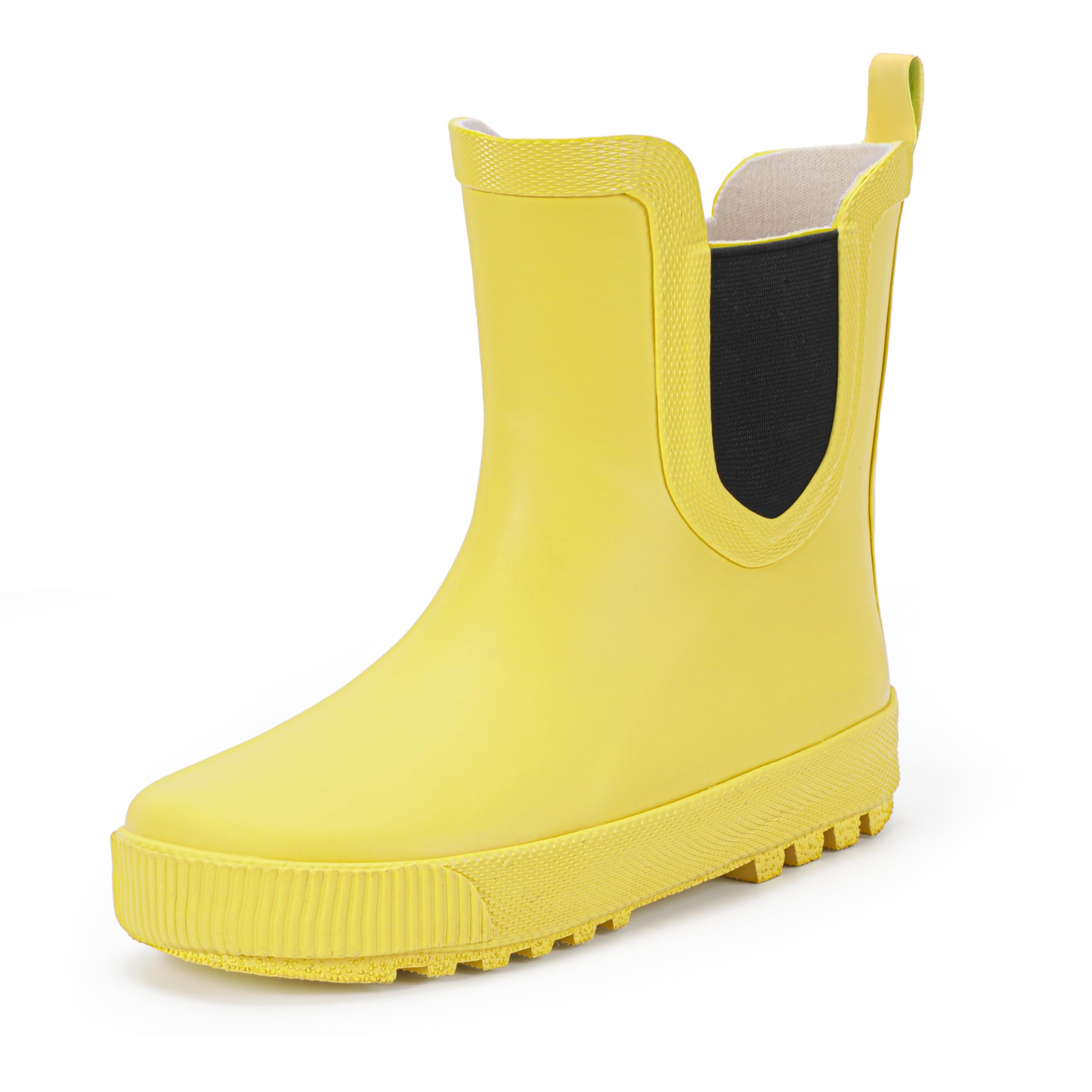
1. Women’s Short Rain Boots
Our pick — 4.5+★ from 950+ verified ratings; the strongest balance of quality and price.
The short yellow Chelsea that gets the fundamentals right and doesn’t fight you at the door.
What makes this pair the one to beat is how little it asks of you. The elastic band on the side means you step in and out without bending, wrestling, or a shoehorn. The upper is PVC, a fully waterproof plastic that rinses clean under a hose, and the round toe gives your feet room instead of pinching them into a fashion shape. For a rainy-season boot you’ll wear three times a week, that low-friction design matters more than any logo.
The sole is where it earns its keep. A concave and convex texture — raised ridges and recessed grooves — gives the outsole something to bite with on wet pavement, so you’re not sliding down a slick ramp with a grocery bag in each hand. These are built for yard work, garden beds, and casual rainy-day errands, and the PVC handles all three without complaint. The short shaft also means they slip into a tote or under a car seat without eating space.
They’re the crowd favorite here too, holding 4.5+ stars across 900+ ratings, and appearance is what wins people over most. That matters: a yellow boot you actually want to wear is one you’ll reach for on every wet morning. The honest limit is coverage — a short shaft won’t keep splash out of deep puddles the way a knee-high will, so if you’re wading rather than walking, look at the tall HISEA below.
What works in its favor
- Elastic side panels let you pull them on and kick them off hands-free
- Concave and convex sole texture gives real grip on wet ground
- PVC upper is fully waterproof and wipes clean in seconds
- Round toe design leaves room for your foot instead of squeezing it
Where it stops short
- Short shaft leaves your ankle exposed to deep splashes and mud
- No stated breathable lining, so long summer wears can feel warm
Reach for this if: you want a yellow boot for errands, garden beds, and wet commutes that goes on in two seconds flat.
Look elsewhere if: your route involves standing water past the ankle — this one covers the foot, not the leg.
2. Toddler Kids Rain Boots for Girls Boys Rain Shoes
The puddle-boot answer for a toddler who wants to do it themselves.
Anyone who has wrestled a three-year-old into footwear knows the real spec isn’t waterproofing — it’s whether the kid can get them on without a meltdown. This Hehainom pair is a Chelsea-style pull-on, so there are no laces to tie and no buckles to fumble. Small hands can manage it, which is exactly the trait that keeps them in the rotation rather than at the back of the closet.
They’re built for the job kids actually do with them: stomping through puddles and coming home dry. The water resistance keeps feet dry in shallow standing water, and the lightweight design means a small child isn’t dragging weight around the park. That combination is why they get used for outdoor play rather than saved for special occasions.
The sensible caution is sizing. Kids’ feet grow in jumps, and a pull-on boot that’s too big will flop and slip at the heel. Measure their foot before ordering rather than guessing from their last pair of sneakers. In kids’ rain boots, fit comes first and everything else second.
What parents get: A no-fuss pull-on boot for kids who want independence — no laces, light enough for small legs, and water-resistant enough for the puddle circuit. Fit is the one thing worth measuring carefully before you buy.
The right call for: parents of toddlers and younger kids who need boots that go on without help.
Think twice if: your child is between sizes — pull-on boots have no adjustment, so a half-size off shows up fast.
3. Women’s Rain Boots Mid Calf

A mid-calf workhorse that keeps mud off your shins while you’re on your knees in the beds.
Gardening is the use case this boot was clearly built around, and it shows in the material choices. The PVC upper is 100% waterproof, so wet soil and hose spray stay outside where they belong. The outsole is non-slip, which matters when you’re stepping across wet stone edging with a trowel in one hand. And there’s a removable insole — pull it out to dry after a soggy day and the boot doesn’t sit damp overnight.
At 1.5 pounds, it’s noticeably heavier than the HISEA knee-high at 1 pound, a 50% weight difference that you’ll feel by the end of a long planting session. That extra heft buys you a mid-calf shaft that shields your shins from mud splash, which is the trade most gardeners will happily make. Quality is what buyers praise most here, and the boots are described as durable and easy to slip on and off.
Two honest notes. Fit splits opinion — some find it true to size while others say it isn’t wide enough through the calf, so if you have a fuller leg, measure before ordering. And a smell has been reported on arrival; airing the boots outside for a day before first wear is the practical fix. Neither is a reason to walk away from a boot this well made for the price tier.
Why gardeners keep them by the door
- 100% waterproof PVC upper handles wet soil and hose spray
- Removable insole pulls out so the boot can dry fully
- Non-slip outsole keeps you steady on wet stone and mud
- Mid-calf shaft blocks splash from reaching your shins
Worth knowing before you order
- Calf fit is the sticking point — some find it too narrow
- A smell has been reported from the start; air them first
Pick these for: garden beds, farm chores, and any job where mud flies above the ankle.
Skip the guesswork: measure your calf as well as your foot — this is the pick most likely to pinch if you have a fuller leg.
4. Asgard Women’s Mid Calf Rain Boots

One boot for the garden, the car wash, the fishing bank, and the beach walk.
The Asgard is the pick for the person who owns one pair of boots and expects it to cover everything. The manufacturer lists it for gardening, washing the car, fishing, and a breezy beach walk — four jobs that don’t normally share footwear. A mid-calf shaft is the reason it can stretch that far: tall enough to handle splash and shallow standing water, short enough that you’re not committing to a knee-high pull-on every time you step outside.
The slip-on design is the other half of the appeal: there’s nothing to fasten, so it’s a two-second job at the back door. The waterproof build keeps feet dry, and the mid-calf shaft clears puddles and shallow flood water without soaking your socks.
Where it sits against the others: it’s rated lower than the short Chelsea at the top of this list, so it’s the value play rather than the crowd favorite. If you want one pair that does garden, errands, and the occasional wet walk without specializing, this is a sensible middle ground. If maximum grip on slick pavement is your priority, the concave-textured Chelsea above is the stronger pick.
The case for one pair: A mid-calf slip-on that covers garden work, car washing, fishing, and beach walks — the do-everything option if you don’t want a boot collection.
The honest comparison: It trails the top pick on grip. The Chelsea’s concave and convex sole texture is built specifically for wet pavement; this boot’s strength is coverage and convenience, not outsole bite.
Best matched to: someone who wants a single yellow boot for outdoorsy odds and ends.
Pass if: you walk slick city pavement daily — the top pick’s textured sole is the safer footing.
5. HISEA Women’s Chelsea Boots
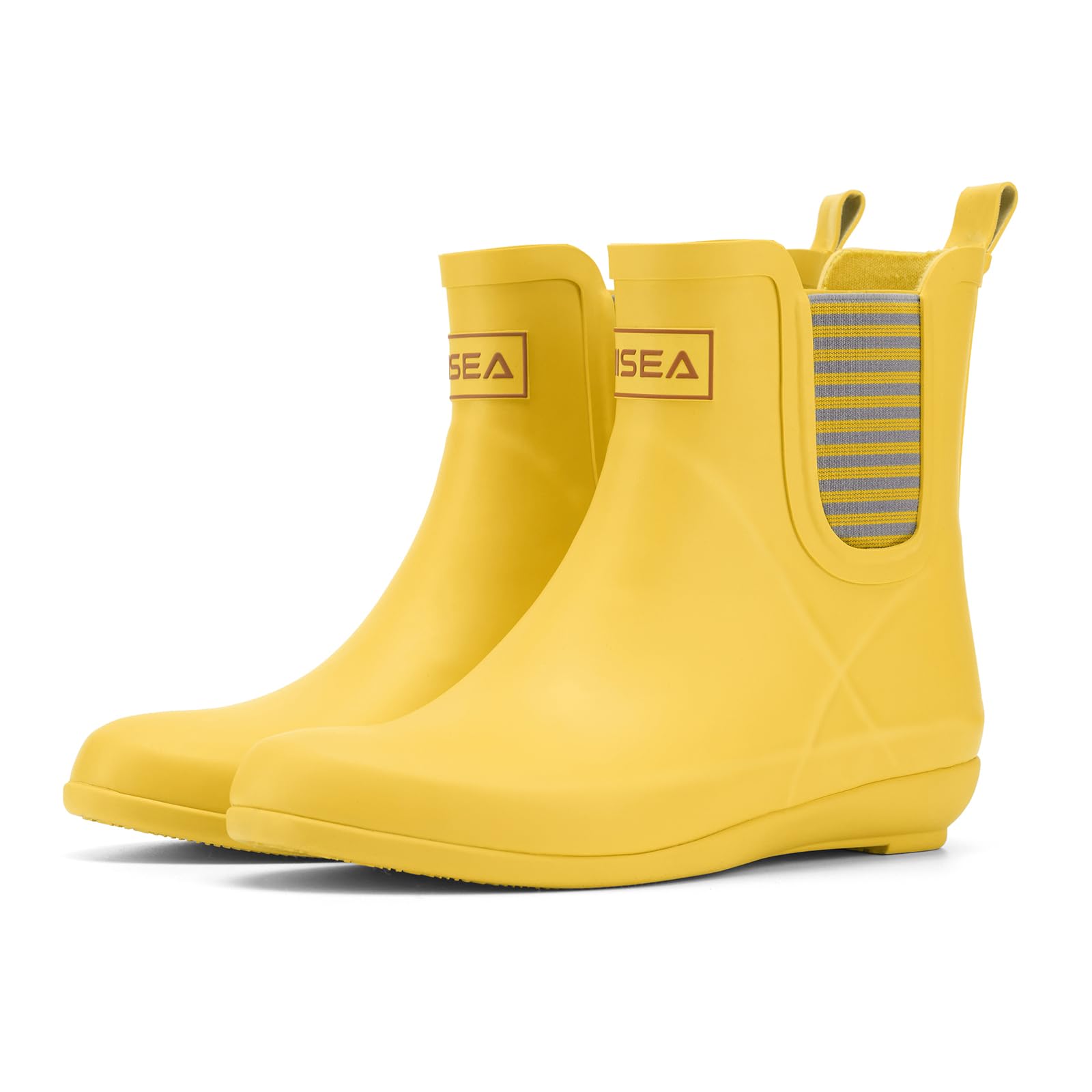
The rain boot that behaves like a shoe — as long as you size it right.
HISEA’s whole pitch here is the silhouette. Their “Beauty Last” design is a contoured, slim-fit shape that hugs the foot and ankle rather than swallowing it, so the boot reads as footwear instead of farm equipment. If you commute through a city downpour and want to walk into an office without changing shoes, that’s a genuinely different proposition from a bulky PVC wellie.
The upper is high-quality rubber, which flexes with your stride more naturally than stiff PVC, and the smooth one-piece construction means there’s no seam to leak through. Inside, a high-density breathable fabric lining wicks away moisture, and the removable EVA insole plus integrated arch support make these comfortable enough to keep on for a full day. A heavy-duty outsole adds traction on wet pavement, mud, and grass.
The catch is real and worth stating plainly: durability is this boot’s weak point, with reports of holes developing in the heels after about 10 wears. Fit is the other split — some find them true to size, others find them super tight across the whole foot, which is why HISEA itself advises sizing up if you have wider feet or plan to wear thick socks. Treat these as a stylish light-use Chelsea rather than a heavy-duty work boot and they’ll serve you well.
Where it shines
- Slim, contoured silhouette that pairs with jeans and dresses
- smooth one-piece rubber build with no seam to leak
- Breathable lining plus removable EVA insole and arch support
- Heavy-duty outsole grips wet pavement, mud, and grass
What to watch
- Heel durability is a genuine concern — reports of holes after about 10 wears
- Runs tight; HISEA recommends sizing up for wider feet or thick socks
It’s for you if: you want a yellow rain boot that looks like a fashion shoe and you’ll wear it for commutes, not demolition.
Not for you if: you need a boot to survive daily farm or construction abuse — the slim build trades toughness for looks.
6. HISEA Women’s Tall Rain Boots Waterproof Knee-High Booties
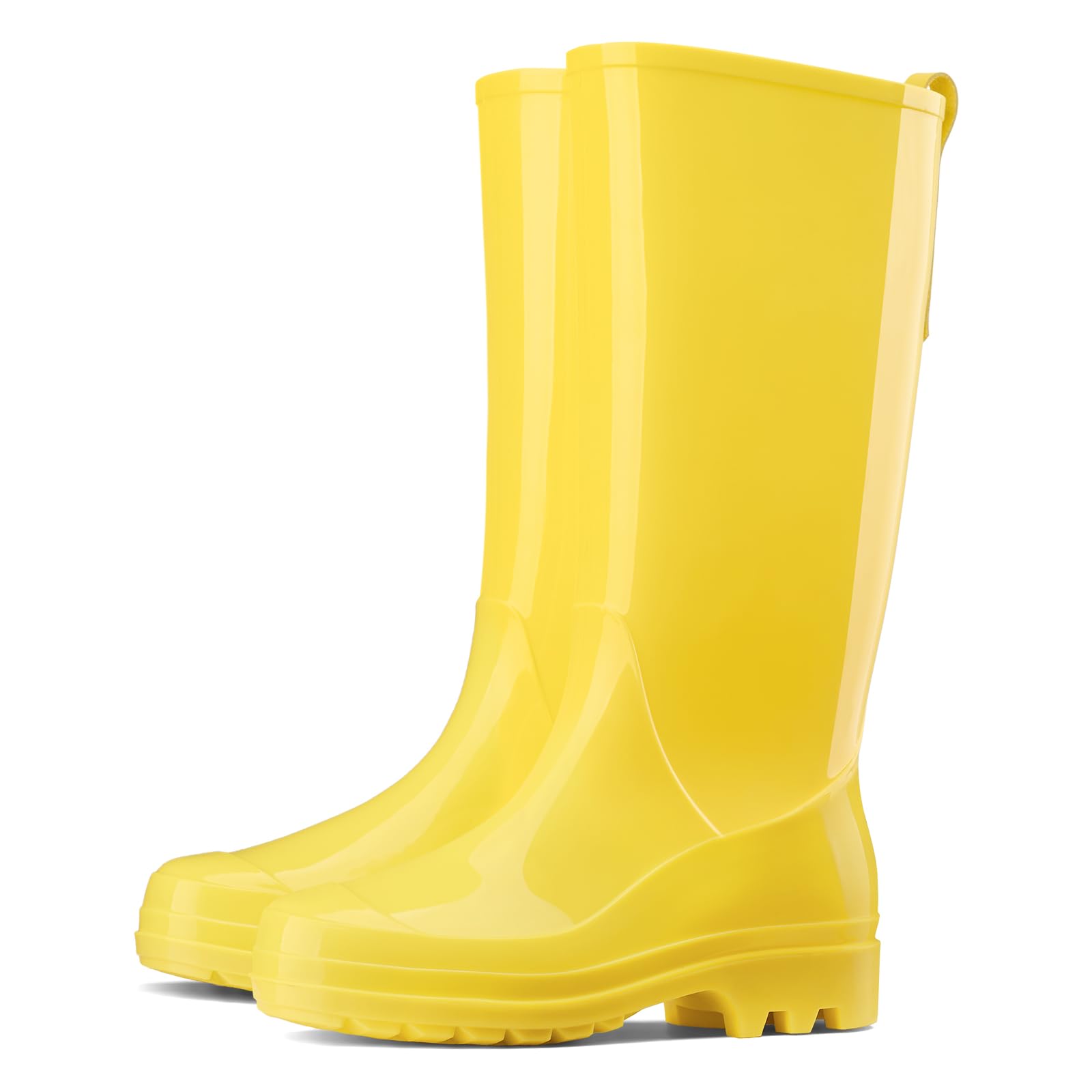
Knee-high coverage for the days when the puddles are deeper than your ankles.
When the water is genuinely deep, shaft height is the only spec that matters, and this HISEA reaches the knee. The PVC upper is fully waterproof, the lining is a soft synthetic that sits comfortably against your leg, and the non-slip outsole keeps you upright on slick ground. A back pull loop gives you something to grab so you can haul the shaft on without contorting.
At 1 pound it’s the lightest boot in this lineup — the Asgard and the mid-calf garden boot both carry more weight, with the garden boot at 1.5 pounds. That lightness is a real advantage for a tall boot, because knee-highs can otherwise feel like dragging a bucket on each foot. Buyers describe these boots as handling the deepest puddles and keeping mud and water from getting into socks, which is the entire job description.
The knee-high shaft is also the boot’s main constraint. It’s more effort to pull on than a short Chelsea, and it can feel warm on a humid summer day since the PVC doesn’t breathe. If you’re mostly crossing wet parking lots, the short Chelsea at the top of this list is easier to live with. If your walks run through flooded paths and deep mud, this is the coverage you want.
Why the height earns it: A knee-high PVC boot that’s waterproof to the top and light enough to walk in — the pick for standing water, heavy mud, and anyone tired of soaked socks.
Go tall if: your route crosses real standing water and you need the leg covered, not just the foot.
Stay short if: quick errands are your main use — a knee-high is more boot than that job needs.
7. Crocs Women’s Handle It Rain Boots
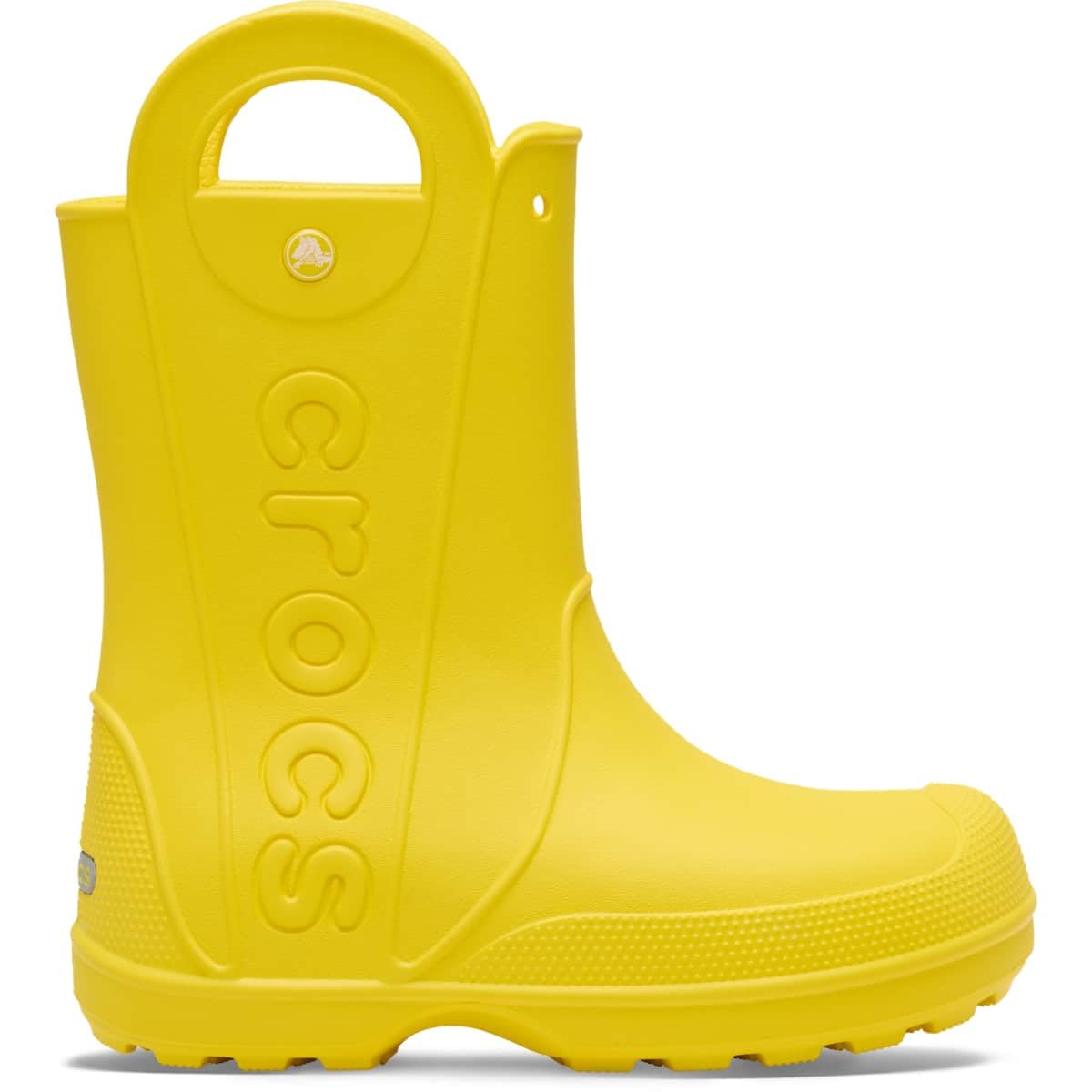
The rain boot built around getting it on and off without a struggle.
Crocs took the one thing they’re known for — a shoe you can slip into — and put it on a rain boot. The oversized handles on either side of the shaft are the defining feature: you grab and go, no bending, no heel-wiggling, no sitting on the floor to pry them off at the end of the day. If rain boots have ever left you hopping on one foot by the door, the oversized side handles let you pull these on and kick them off standing up.
The upper, insole, and outsole are all ethylene vinyl acetate, a lightweight foam-like material that stays soft and doesn’t stiffen the way rubber can. The build is waterproof, so puddles and wet streets stay on the outside. Style is what wins people over most here, and the vibrant yellow is a big part of that — these are meant to be seen, not hidden under trousers. They’re comfortable enough to wear through a full errand run.
Two things to plan around. Crocs recommends sizing up — if you’re a 7.5, go to an 8 — and the fit runs big particularly in the toe box, so there’s room for thick socks, which is exactly what makes them workable in mud, rain, or snow. The handle design also means the shaft is fairly open, so these are better for wet surfaces than for wading through deep water. That’s the fair trade for the easiest on/off in the lineup.
The Crocs advantage
- Oversized handles make them the easiest boot here to get on and off
- EVA upper, insole, and outsole stay soft and lightweight
- Waterproof build handles puddles, wet streets, and mud
- Roomy toe box leaves space for thicker socks
The trade-offs
- Fit runs big, especially in the toe — size down if you want a snug feel
- Open handle shaft isn’t built for wading through deep water
The pick for you if: comfort and quick on/off matter more than a close-fitting silhouette.
Look elsewhere if: you want a slim ankle-hugging fit — this one is deliberately roomy.
Know the Specs
Shaft height: what it actually covers
Shaft height is how far up your leg the boot reaches — short or ankle, mid-calf, or knee-high. A short Chelsea covers the foot and slips on fastest, which suits errands and quick garden jobs. A mid-calf boot shields your shins from mud splash. A knee-high covers the most leg and is the only sensible option for standing water, but it takes more effort to pull on. Pick the height by the depth of water you actually walk through, not by what looks best in a photo.
Upper material: PVC, rubber, or EVA
PVC is a rigid waterproof plastic — fully waterproof, easy to rinse, and common on budget-friendly yellow boots. Rubber flexes more naturally with your foot and tends to feel less stiff over a long day. EVA is a lightweight foam-like material used in Crocs’ boots that stays soft and springy. All three keep water out; the difference shows up in how they flex, how they feel after an hour, and how they hold up over a season of wear.
Sole grip and outsole texture
The outsole is the bottom of the boot, and its texture is what keeps you upright. A concave and convex pattern — raised ridges alongside recessed grooves — gives the sole edges to bite into wet concrete and mud. A smooth sole slides. Since rain boots are worn on the exact surfaces that cause slips, grip is the spec worth checking before anything else.
Weight and how it feels by hour three
Boot weight is listed per pair in pounds, and it matters more than it sounds. A lighter boot tires your legs less on a long walk, while a heavier one often buys you a taller shaft or a thicker sole. The lightest picks here sit around 1 pound, with the mid-calf garden boot at 1.5 pounds. If your wear is short bursts, weight is minor. If you’re on your feet for hours, it decides whether you reach for the boot or avoid it.
Common Questions
How should yellow rain boots fit compared to my normal shoes?
Will these yellow rain boots keep my feet dry in deep puddles?
Is PVC or rubber better for a yellow rain boot?
How do I stop my feet from sweating inside rain boots?
Do yellow rain boots stain or discolor over time?
How long should a pair of rain boots last?
Can I wear yellow rain boots in snow and cold weather?
Are yellow rain boots slippery on wet concrete?
How do I clean and store yellow rain boots?
What is the difference between a short Chelsea and a knee-high rain boot?
The Bottom Line
For most people, the yellow rain boots winner is the Women’s Short Rain Boots Waterproof Chelsea — it pairs elastic side panels and a concave-textured grip sole with a PVC upper that wipes clean, and its 4.5+ star standing makes it the safest match for everyday wet weather. If you garden or work outside and need mud off your shins, the mid-calf garden boot delivers a 100% waterproof PVC build with a removable insole. And for genuinely deep water, the HISEA Tall knee-high covers the leg at just 1 pound. Buy the short Chelsea first — the sheer volume of positive owner feedback on it is the honest signal that it’s the one most people end up happy with.
How we choose
We do not accept paid placement. Every pick is matched to a real buyer and a real use-case; we do not hands-on test units.
Sources
Specifications: manufacturer listings and product documentation. Review insights: verified customer reviews, as of November 2026. Pricing: not shown on this page (it changes often); check the current price via the retailer link.
As an Amazon Associate, Tactical Gear Guy earns from qualifying purchases. This does not affect which products we feature.