Specs are compiled from manufacturer listings and verified buyer reviews and can change over time — please confirm the key details on the product page before buying.
Your Zigbee smart light only works once it has a hub to join, so pick the hub first. A Zigbee bulb (a bulb that talks to a small hub box instead of your Wi-Fi router) needs a hub like SmartThings, Hubitat, an Echo with a built-in hub, or a Hue Bridge. Match the bulb to the hub you already own or plan to buy, and the rest of the shopping gets simple.
This guide is built by comparing the manufacturers’ published specifications and the patterns across verified customer reviews, so you get each pick’s real strengths and trade-offs instead of marketing spin.
Below you’ll find six bulbs ranked by what they actually do in a room, from colour range and dimming to how reliably they stay paired. Every pick runs on the Zigbee protocol, so the shortlist for Zigbee Smart Lights is built on hub compatibility, kelvin range, and brightness you can count on.
Top Picks


How To Choose The Best Zigbee Smart Lights
The wrong assumption most beginners carry is that any smart bulb works with any smart speaker. It does not. A Zigbee bulb will not pair straight to an Echo Dot or a plain Google Home speaker — it needs a Zigbee hub in the chain first, then the speaker controls the hub.
Start with the hub you already have
Look at what’s on your shelf before you look at bulbs. A Hue Bridge means you want Hue-compatible Zigbee bulbs. A SmartThings or Hubitat hub opens up most of the bulbs here. And an Echo with a built-in hub — like an Echo Plus or Echo Show 10 — can act as the hub itself, which removes one box from your setup.
Then look at Kelvin, not just colour
Colour temperature is measured in Kelvin (K), where a lower number is warmer and candle-like and a higher number is cooler and daylight-white. A bulb that runs 2700K to 6500K covers everything from a cosy bedside lamp to a crisp work surface. A bulb locked at 2700K only ever gives you the warm end.
Check the fit, not just the feature list
Base type is the physical screw or pin fitting. Most of this list is E26, the standard screw base for table and ceiling lamps in the US. If you’re replacing recessed spotlights, you may need a GU10 pin base instead, which is a completely different fitting and won’t go into an E26 socket.
Side-by-Side Comparison
| Model | Best For | Base | Colour Temperature | Colour Rendering Index | Amazon |
|---|---|---|---|---|---|
| Philips Hue White Ambiance A19 2-Pack★ Best Overall | Reliable everyday white lighting | E26 | 2700 Kelvin | 80 | Amazon |
| Sengled Zigbee Smart Bulbs 4-PackBest Value | Filling a whole room on a budget | E26 | 2700K–6500K | 90 | Amazon |
| Aqara Thread/Zigbee Smart LED Bulb T2 | Colour range and Matter flexibility | E26 | 2000K–9000K | 90 | Amazon |
| Sylvania SMART+ ZigBee Bulb | Colour on a tight budget | E26 | 6500 Kelvin | 80 | Amazon |
| THIRDREALITY Zigbee Smart Color Bulb ZL1 4-Pack | Home Assistant users and mesh range | E26 | 2700K–6500K | 80 | Amazon |
| LEDEPLY Zigbee GU10 LED Smart Bulbs | Recessed and spot fixtures | GU10 | 2700K–6500K | 85 | Amazon |
Detailed Reviews
1. Philips Hue White Ambiance A19 2-Pack
Our pick — 4.5+★ from 750+ verified ratings; the strongest balance of quality and price.
Two white-only Hue bulbs that just work — once you own the bridge.
The pitch here is narrow and honest: 2700 Kelvin white light only, no colour, and 800 lumens of it in a standard E26 screw base that drops into a table lamp like any ordinary bulb. Where it earns the top spot is smartness, not rainbow effects. It’s part of the Hue system, so app schedules, remote control while you’re away, and scenes come almost for free. Its colour temperature of 2700 Kelvin is warm on purpose — this is a lamp glow, not a kitchen worktop white.
It plays with the widest set of controllers on this list: Amazon Alexa, Apple HomeKit, Google Assistant, Nest, and SmartThings all sit on its compatibility list, and the brightness control is genuinely smooth. It also expands cleanly: add a Hue Dimmer Switch, Hue Tap, or Hue Motion Sensor later for wall control without the phone. Where it differs from the Sylvania above on paper is colour range: Sylvania’s bulb reaches 6500 Kelvin versus this bulb’s 2700 Kelvin, so Hue gives you warmth and little else in the white spectrum.
You need the Philips Hue Hub (model 458471, sold separately) to get the full experience — pairing the bulbs straight to other systems gives you only a sliver of what they can do. Value is the other honest note: buyers argue in reviews about whether two white bulbs justify the price plus a hub.
Why it takes the crown
- Works with Alexa, Apple HomeKit, Google Assistant, Nest and SmartThings
- 2700 Kelvin warm white with genuinely smooth dimming
- Expands with Hue Dimmer Switch, Hue Tap or Hue Motion Sensor
- Backed by a three-year Philips Hue warranty
Where it pinches
- Needs the Hue Hub (model 458471) sold separately for full features
- No colour — white only at 2700 Kelvin
- You pay a system premium for two bulbs
Buy it if: you want warm white lamps you can schedule and dim from anywhere, and you’re fine owning the Hue Hub.
Think twice if: you need cool daylight white or colour — 2700 Kelvin is the ceiling here.
2. Sengled Zigbee Smart Bulbs 4 Pack
Four tunable-white bulbs for the price of one-and-a-bit premium ones.
If you’re lighting a whole room rather than one lamp, this is the pack that makes the math work. You get four A19 E26 bulbs covering 2700K to 6500K — from warm evening light right through to crisp daylight — and each one pulls 9 watts where an old 60W incandescent would. The colour rendering index of 90 is the hidden spec worth knowing: it’s a 0–100 score for how faithfully colours show up under the bulb, and 90 means your sofa and your paint look the right shade.
What owners praise most is build quality, and the dimming follows close behind — the tunable white sweep and the brightness adjustment are the two things that get called out. Setup splits the room, though. On SmartThings and Echo speakers with a built-in hub it goes quickly; pairing with a bare hub sometimes fights back. Sengled’s own hub (model B0828KXVGQ) is sold separately, and Echo Plus, Echo Show 10 and Echo 4th Gen don’t need a separate hub at all.
One spec to read carefully: this is a Zigbee bulb, not a Wi-Fi bulb, and it’s not for sale in California. The hub requirement is real — SmartThings Hub, Wink Hub, Hubitat Hub, or Sengled’s own — and app remote control only works once that hub is wired to your router by Ethernet. At 9 watts per bulb it matches a 60W incandescent, and a few owners find the light throws harsher shadows than they’d like.
Room-to-room value: four bulbs with 90 CRI and a full 2700K–6500K sweep — this is how you fix a whole floor without buying twice.
The honest snag: expect a clean run on SmartThings or an Echo Plus; on other hubs, budget a little patience at pairing time.
Worth grabbing if: you’re kitting out several fixtures and want warm-to-daylight control on each one.
Pass for: a single lamp — four bulbs is overkill and the hub hunt is unnecessary.
3. Aqara Thread/Zigbee Smart LED Light Bulb T2 E26, 1 Pack
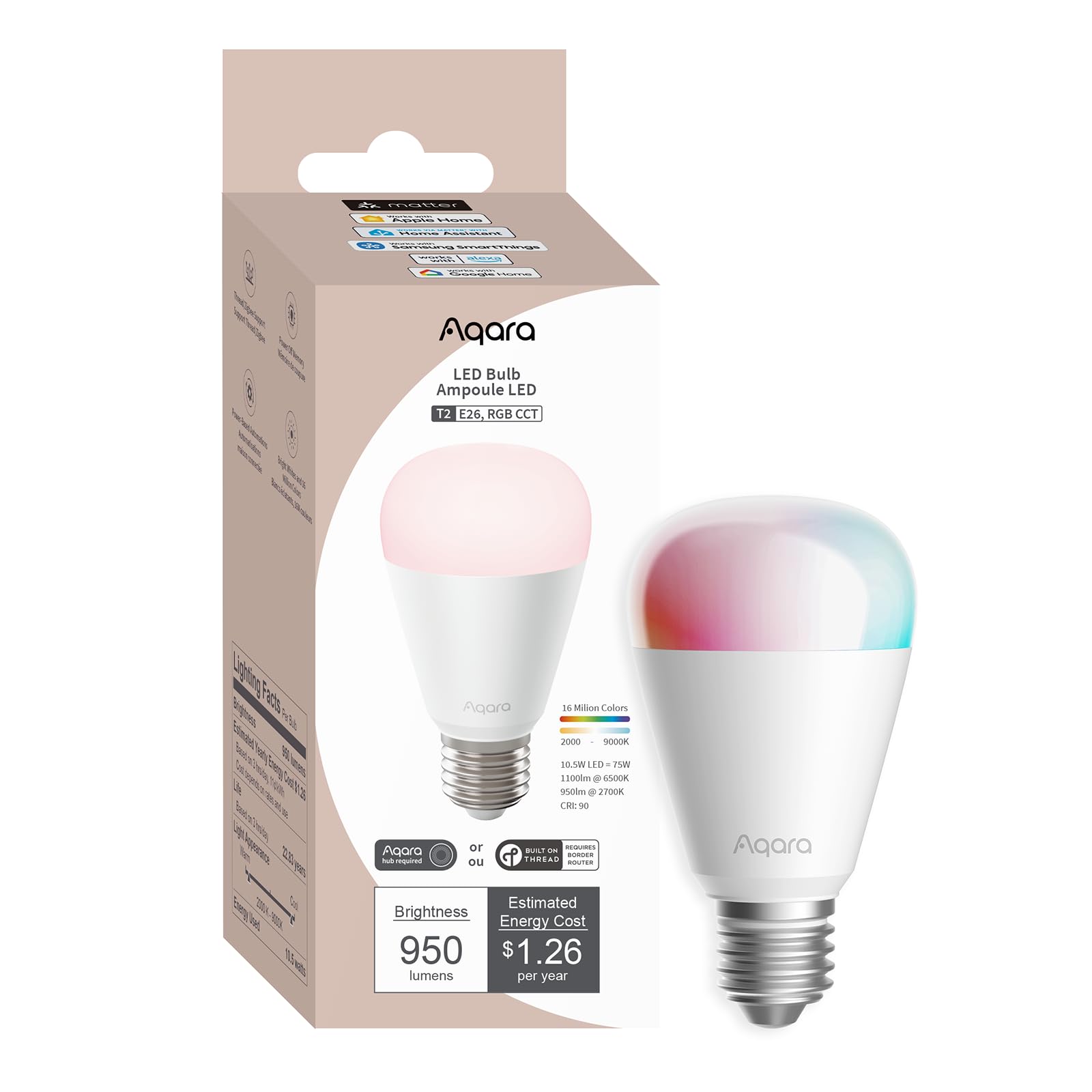
A 2000K-to-9000K swing that’s wider than anything else here.
This bulb gives you the widest colour temperature range here: 2000 Kelvin at the candle-warm end all the way to 9000 Kelvin at the icy end, with 16 million colours in between and 1100 lumens of output. For comparison, the Hue bulb above tops out at 2700 Kelvin and the Sylvania at 6500 Kelvin — the Aqara simply gives you more of the spectrum to work with. CRI (colour rendering index, a score for how true colours look) is 90 here, versus 80 on the Hue pick, so colours render truer.
It’s also the only bulb on the list with two radios: Zigbee and Thread. In Zigbee mode you get Aqara’s own features and Matter compatibility through an Aqara hub. In Thread mode it joins Matter ecosystems like Apple Home, Google Home and Alexa directly — though each of those needs a Matter Controller and a Thread Border Router in the house. A 200-degree beam angle spreads the light wide, which suits a table lamp or a ceiling fixture better than a tight spot.
You also get thoughtful extras: a power-off memory setting so you choose whether the light comes back on after an outage, and circadian lighting that adjusts colour temperature through the day — that one is Zigbee-mode only and needs an Aqara hub. The honest limit is the wiring. If you don’t already own an Aqara hub or a Thread Border Router (a small box that connects Thread smart devices to your network), the setup cost lands on top of the bulb, and the Matter and circadian features stay locked until it does.
Why colour buffs lean here: 2000K–9000K and CRI 90 is the deepest palette in this group, so warm scenes and sharp daylight both look right.
What to plan for: an Aqara hub or a Thread Border Router — without one, the clever extras sit idle.
Reach for this if: you need true colour control and already run an Aqara or Matter setup.
Look elsewhere if: you want zero extra hardware — this one rewards people who own the hub already.
4. Sylvania SMART+ ZigBee Bulb

Sixteen million colours for a party room — with a colour-accuracy caveat.
The Sylvania is a bargain colour bulb on paper: RGBW LED (red, green, blue and a separate white channel, which is why it can do proper white as well as coloured light), 16 million colour options, and an adjustable white range of 2700K–6500K at 10 watts replacing a 60W bulb. The box holds two A19 bulbs. Its colour temperature peaks at 6500 Kelvin — unlike the Hue at 2700 Kelvin, this one will give you a bright daylight white for the kitchen.
Setup is the part owners agree works well: it pairs with SmartThings and Alexa without drama, and scheduling from the phone is straightforward — leave the lights on a timer so you never walk into a dark house. It needs a compatible Zigbee hub, though. SmartThings, Wink, or an Echo Plus will do it; an Echo Dot or a plain Google Home speaker will not, because those lack the Zigbee radio.
Here’s the trade-off, stated plainly: colour accuracy wobbles above roughly 40% brightness, and a few people notice abrupt dimming. Treat it as mood lighting and a daylight-white workhorse rather than a colour-accurate design tool. One more practical note — it doesn’t ship to California.
What you actually get: two RGBW bulbs with a 2700K–6500K white range, on SmartThings or Wink, without fuss.
Set expectations: rich, useful colour, but push past mid-brightness and shades start to drift.
Fits you if: you want colour bulbs for fun scenes without paying premium system prices.
Skip if: you need precise colour matching at full brightness.
5. THIRDREALITY Zigbee Smart Color Bulb ZL1 4-Pack

Four Zigbee 3.0 bulbs that double as signal repeaters.
For anyone running Home Assistant, Hubitat, or an Echo with a Zigbee hub built in, this four-pack is the practical choice. Each bulb is Zigbee 3.0, tunes from 2700K warm to 6500K daylight, and dims from 1% to 100% at 800 lumens. The spec that does real work here is the repeater function — every bulb passes the Zigbee signal along, so four of them spread light and also fill dead spots in a larger home’s network.
What wins people over is connectivity and reliability, and the pair is the whole story: ZHA, Z2M, SmartThings 2015/2018, Aeotec, Hubitat and the Third Reality Hub Gen2 Plus all appear on its compatibility list. Because it’s Zigbee, it talks to its hub instead of crowding your Wi-Fi network — which is exactly the point of going Zigbee in a busy house. An Amazon Smart Bridge MZ1 (sold separately) opens up Apple Home, Google Home and Alexa voice, and firmware updates arrive over the air.
Colour is where this four-pack splits opinion. Vivid scenes look good; skin tones and pastels in some reviews come out less convincing — mix that with 800 lumens and it’s a lamp-and-accent bulb, not the thing to read fine print by. Two limits worth knowing: the 40W-equivalent rating sits below the 60W-equivalent brightness of the Sengled and Hue bulbs above, and full Alexa/Google/Apple control needs that separately sold Smart Bridge MZ1 if your hub isn’t already doing it.
Why Home Assistant folks rate it
- Zigbee 3.0 with ZHA and Z2M support from the start
- Each bulb repeats the Zigbee signal to cover dead spots
- Doesn’t clog your Wi-Fi network
- 2700K–6500K tunable with 1%–100% dimming
What to weigh first
- Colour accuracy is the most argued-over point
- 40W equivalent — dimmer than the 60W-equivalent picks
- Smart Bridge MZ1 sold separately for Apple/Google/Alexa voice
Right call for: a Home Assistant or Hubitat home that wants a stronger mesh and four bulbs in one box.
Not the one for: a room that lives on rich, true colour — brightness tops out at 800 lumens here.
6. LEDEPLY Zigbee GU10 LED Smart Bulbs, 2 Pack

The pin-base pair for recessed and spot fittings — a different socket entirely.
This is the odd one out for a good reason: it’s a GU10 pin-base bulb in an MR16 shape, not the E26 screw base everything else on this list uses. If your ceiling has recessed spotlights or a track fixture, this is the fitting that actually goes in the hole — an E26 bulb simply won’t. Each bulb outputs 400 lumens at 5 watts where a 50W halogen used to sit, with 16 million colours and a 2700K–6500K white range.
Brightness and vivid colour are the strengths that carry it; owners describe an easy setup and a smooth fit into an existing lighting system. Zigbee 3.0 keeps the connection stable, and pairing is best done close to the bridge first, then moving the bulb to its final spot. CRI is 85, so colour and fabric tones read reasonably true under it.
The one to read twice: with a Philips Hue Bridge it currently supports white light and warm-to-cool dimming, but colour mode can show inaccurate colours, and it won’t work with Apple HomeKit or Hue Entertainment mode. There’s also a firm warning in the listing — never put these on a dimmer switch or in a refrigerator. Reliability and connection get mixed marks, so it’s a fit-and-finish chip shot rather than the safest bulb for a whole house.
The fit matters most: GU10 pin base and 400 lumens — pick this because your fixture demands it, not because of the colour count.
Honest hiccup: colour drifts on a Hue Bridge, and the bulb is pickier about its hub than the brighter E26 picks above.
Choose this when: your spotlights take GU10 pins and you want colour and tunable white in that socket.
Leave it if: you have standard screw-base lamps or rely on Apple HomeKit.
Know the Specs
Zigbee vs Wi-Fi
Zigbee is a low-power wireless protocol that talks to a hub rather than your router. That means it doesn’t load your Wi-Fi and often uses less power per bulb. The cost is the hub — SmartThings, Hubitat, a Hue Bridge, or an Echo with a built-in Zigbee radio. A Wi-Fi bulb skips the hub but eats router bandwidth. For a house full of lights, Zigbee’s mesh keeps more bulbs connected without straining the router.
Colour Temperature (K)
Kelvin measures how warm or cool the light looks. Around 2700K is a warm, lamp-style glow; around 6500K is cool daylight white. A tunable bulb shifts across that range on demand, while a fixed bulb stays put. That’s why a 2700K-only bulb suits bedside lamps and a 2700K–6500K bulb can handle both a cosy evening and a bright workspace.
Common Questions
Do Zigbee smart bulbs need a hub to work at all?
Will these bulbs pair directly to an Echo Dot or Google Home speaker?
What’s the difference between 2700K and 6500K in a smart bulb?
Will a GU10 bulb fit a normal screw-in lamp?
How do I know which hub a Zigbee bulb will pair with?
Can I use a Zigbee smart bulb in an old dimmer switch?
Do Zigbee bulbs help the range of my other smart devices?
Why do some Zigbee bulbs say “does not ship to California”?
Is higher CRI worth caring about in a smart bulb?
The Bottom Line
The zigbee smart lights winner is the Philips Hue White Ambiance A19 2-Pack because it pairs with the widest set of controllers and dims warmly without fuss. If you want a whole room lit with tunable white at 90 CRI, grab the Sengled Zigbee 4-Pack. And for recessed spot fixtures that take GU10 pins, the LEDEPLY GU10 pair is the one to reach for.
How we choose
We do not accept paid placement. Every pick is matched to a real buyer and a real use-case; we do not hands-on test units.
Sources
Specifications: manufacturer listings and product documentation. Review insights: verified customer reviews, as of November 2026. Pricing: not shown on this page (it changes often); check the current price via the retailer link.
As an Amazon Associate, Tactical Gear Guy earns from qualifying purchases. This does not affect which products we feature.