Specs are compiled from manufacturer listings and verified buyer reviews and can change over time — please confirm the key details on the product page before buying.
You want one rack that lets you squat and bench without a spotter, and that fits the space you actually have. Three specs decide it: the steel the frame carries, the in-cage depth, and whether the safety catches sit where your bar fails. Below you get all eleven picks that are worth your floor space, sorted by what each one genuinely does best.
This guide is built by comparing the manufacturers’ published specifications and the patterns across verified customer reviews, so you get each pick’s real strengths and trade-offs instead of marketing spin.
Home racks fail buyers in two ways: a frame that walks across the floor under a heavy squat, and a cage so tall it will not clear a basement joist. This breakdown covers footprint, steel size, and rated capacity for all eleven picks. The picks below answer the search for the best workout racks for home by what each frame actually does.
Top Picks

How To Choose The Best Workout Racks for Home
The first number a home lifter should check is not the capacity rating — it is ceiling clearance. A rack standing 86 inches tall needs that much room plus the height of your head and hands above the pull-up bar. Measure the lowest point of your joists or garage door track before you order anything, because a rack that does not fit is a rack you return.
Steel size versus the big capacity sticker
Uprights come in 2″ x 2″, 2″ x 3″, and thicker, and that steel tubing does more for stability than any number printed on the box. A 2,500-pound rating means little on a frame that shifts when you rack a heavy squat. A 2″ x 3″ 14-gauge upright paired with a dual-triangle base spreads load into the floor, and that base is what stops the rack walking.
In-cage depth and your bench
In-cage work is the reason to buy a full cage instead of a half rack: the safeties sit in front of you, so a failed rep lands on steel, not on you. That only works if your bench fits inside. One cage here gives 41″ x 60″ of internal space, which swallows nearly any adjustable bench. Check the internal depth and width of any cage against your bench length before you commit.
Pulley ratio, in plain terms
Cable systems run at 2:1 or 1:1. A 2:1 ratio halves the load you feel at the handle, so the pull feels lighter but moves twice the cable — good for high-rep sets. A 1:1 ratio gives you the full stack on the handle, which is what you want for heavy lat work. Some racks switch between both; most are fixed at one.
Side-by-Side Comparison
| Model | Best For | Rated Capacity | Footprint (L x W x H) | Frame / Weight | Amazon |
|---|---|---|---|---|---|
| Mikolo K6 Power Cage★ Best Overall | Full home gym in one frame | 1500 lbs | 67.5″D x 56.5″W x 86.4″H | Alloy steel / 220 lbs | Amazon |
| FLYBIRD SR1 Squat RackSmallest Footprint | Tight rooms on a budget | 950 lbs | 42 x 51 x 83 inches | Steel / 68 lbs | Amazon |
| SunHome Power CageBest Storage Layout | Plate storage built in | 1500 lbs | 46.9″D x 42.4″W x 84.9″H | Alloy steel / 115 lbs | Amazon |
| Mikolo Folding Wall Rack | Garages that double as parking | 1000 lbs | 86 x 22 x 47 inches | Alloy steel / 80 lbs | Amazon |
| JELENS S11 Power Cage | High capacity in a compact cage | 2000 lbs | 57.48″D x 44.49″W x 82.6″H | Alloy steel / — | Amazon |
| Sportsroyals Power Rack | Accessory load-out on day one | 1200 lbs | 56″D x 61.6″W x 82.6″H | Alloy steel / 200 lbs | Amazon |
| REP Fitness PR-1100 | Standard-height ceiling garages | 700 lbs | 48″D x 48″W x 84″H | Alloy steel / 135 lbs | Amazon |
| Titan Fitness T-2 Short Rack | Low basements and crawl spaces | 850 lbs rackable / 2,200 lbs total | 82 x 11 x 10 inches | Alloy steel / 130 lbs | Amazon |
| MAJOR FITNESS Drone3 | Switchable pulley ratios | 2500 lbs | 69.5″W x 45.9″D x 85″H | Alloy steel / 232.2 lbs | Amazon |
| JELENS M21 Smith Machine | Two lifters training at once | 2000 lbs | 59.84″D x 46.85″W x 84.65″H | Alloy steel / — | Amazon |
| MAJOR FITNESS F22 | Heavy lifters sharing one rack | 1600 lbs static | 68.9″D x 55.5″W x 82.5″H | Alloy steel / 243 lbs | Amazon |
Detailed Reviews
1. Mikolo Power Cage Cable Crossover
Our pick — 4.5+★ from 200+ verified ratings; the strongest balance of quality and price.
Eight stations bolted into one steel frame, so you stop buying machines one at a time.
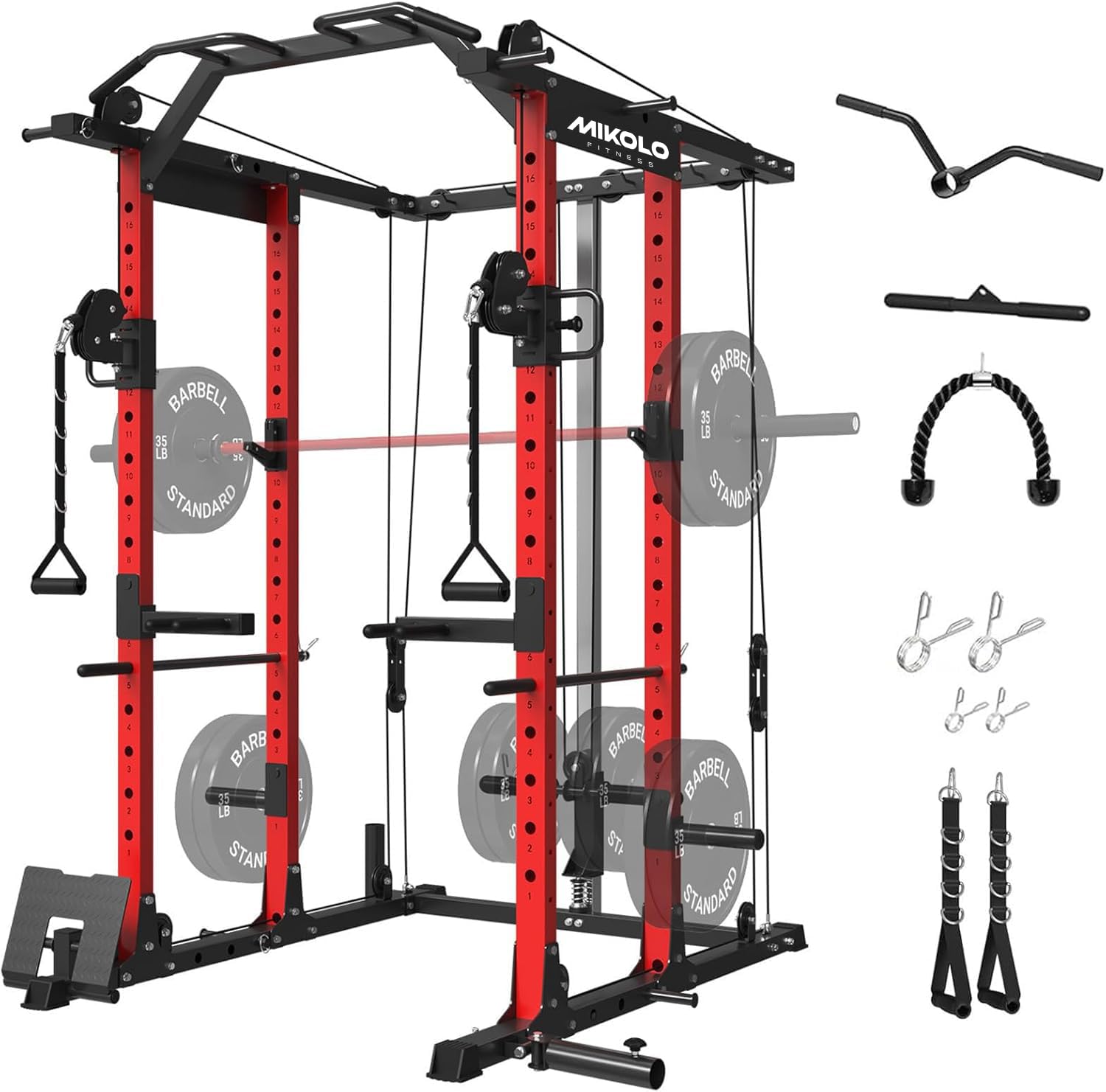
The K6 answers the question every home lifter eventually asks: do I buy a cage or a cable machine? This one is both. You get a power rack, cable crossover, lat pulldown, a 2:1 ratio low row with footplate, chin-up station, dip station, core trainer, and a resistance station in a single frame rated to 1500 pounds. That 1500-pound rating is why it sits up top: it takes a heavy squat and still pulls smooth cables for accessory work.
Stability comes from the cage shape itself, not just the steel. The internal space measures 41″ x 60″, deep enough to fit almost any weight bench inside the frame, and the unit weighs 220 pounds with eight reinforcing tabs. In-cage squats and bench presses mean the safeties sit in front of you. That is the difference between training alone and training alone with steel safeties catching the bar. The frame is 67.5″D x 56.5″W x 86.4″H, though, so measure your ceiling before you order — this is the tallest and deepest footprint on the list.
Owners praise the build quality first and the manageable assembly second for a 220-pound frame this size. The trade-off shows up around weight capacity and mobility: a 220-pound cage is not something you slide around the garage, and the pulley system works best left where you set it. The accessories arrive complete — T-bar, lat bar, tricep rope, cable bar, handles, J-hooks, dip bars, landmine, footboard, and spring clamps — so there is no second shopping trip.
What earns its place up top
- Cage and cable crossover in one 1500-pound frame, replacing several machines
- 41″ x 60″ internal space takes a full bench for in-cage pressing
- Complete attachment set included, so nothing else to buy
- Assembly is straightforward for a unit this size
The part to weigh up
- 220 pounds plus an 86.4″ height means it stays put once built
- Deepest footprint here at 67.5″D — measure the room first
- Moving it to a new spot is a two-person job
Worth the floor space if: you want a cage, crossover, and lat station without buying three separate units.
Think twice if: your ceiling is short or your room is narrow — the 86.4″ height and 67.5″ depth need real clearance.
2. FLYBIRD SR1 Squat Rack
A half rack you can carry up the stairs alone, built for a corner of a spare room.
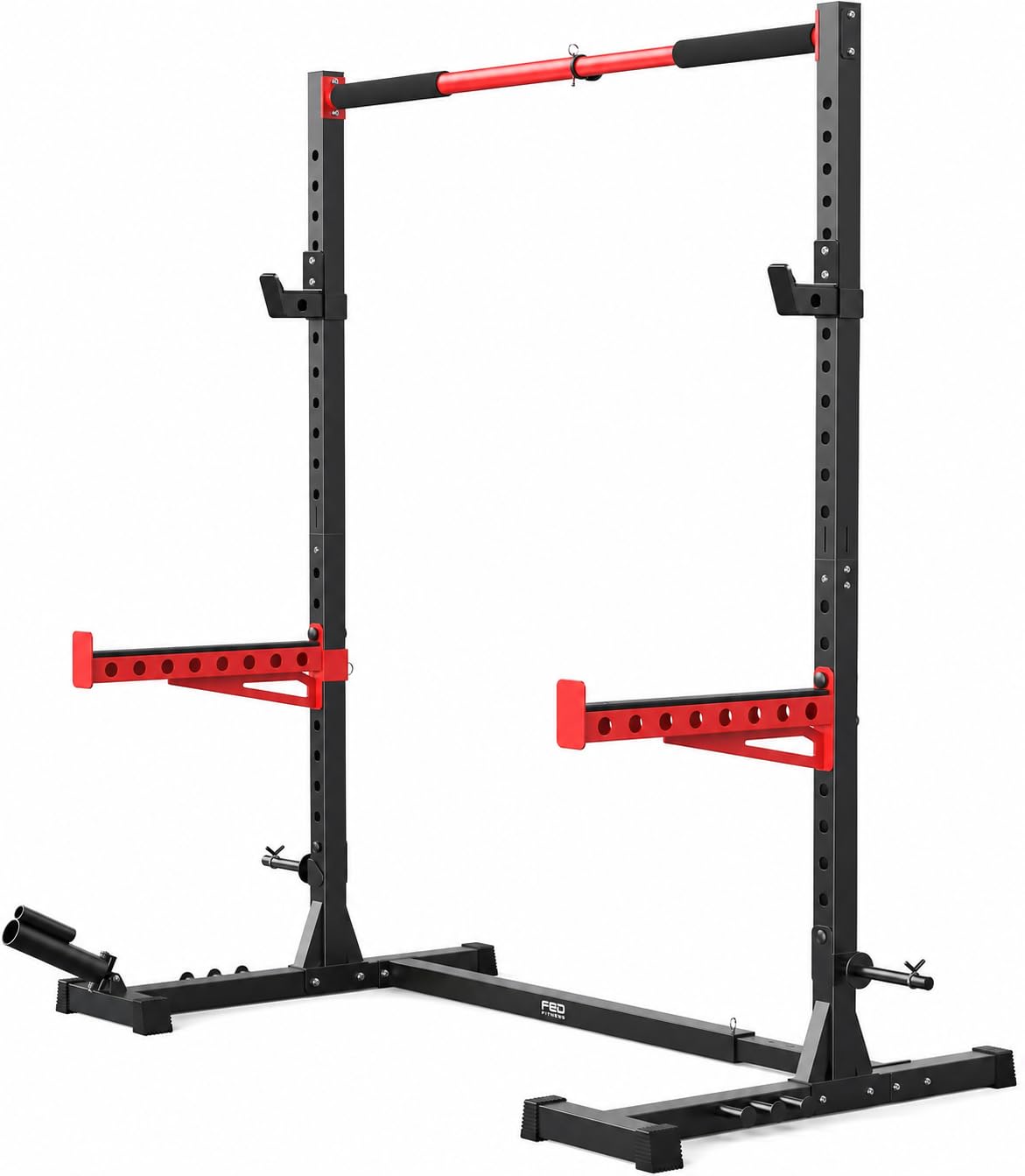
If your gym is a spare bedroom rather than a garage bay, this is the frame that fits. It occupies roughly one square meter of floor — the compact footprint of 39″ L x 41.3″ W x 83″ H — and it weighs 68 pounds, against the Mikolo K6’s 220 pounds. You can build it solo, shift it solo, and still get 950 pounds of capacity on 2″ x 2″ commercial-grade steel.
Adjustability is where a half rack earns its keep. Twenty-two height settings on 1″ standard holes let you line the J-hooks and safety arms up with your exact squat depth and bench position. The width adjusts to accept most 6 ft and 7 ft barbells, and the 16.7″ extended safety arms give you catch room for solo training. Those arms are built from 1.2″ x 1.2″ solid steel with protective liners that take the impact off your bar.
Owners praise sturdiness most and value second — a 950-pound rack that assembles in a tight room is why it sells. The honest limit is that 950 pounds is a home-gym rating, not a competition rating, and the landmine and six resistance band pegs handle accessory work rather than heavy cable pulling. If you want a lat pulldown, this is not the frame for it.
Where it beats the big cages: setup speed and floor space. A 68-pound frame with a one-square-meter footprint goes where a 220-pound cage simply will not.
What you give up: no cable system and no lat pulldown, so accessory work runs through the landmine, band pegs, and pull-up bar instead.
Reach for this if: you train in a small room, a basement corner, or any space where a full cage would crowd you out.
Look elsewhere if: your program leans on cable crossovers — this frame has no pulley system at all.
3. SunHome Power Cage Squat Rack
Twenty-eight catch positions and four plate posts, in a cage that keeps your floor clear.
Plate storage is the feature that separates a tidy gym from a trip hazard, and this cage bakes it in. Four weight plate storage posts and two barbell storage hooks hold your plates and bar off the floor. That does not sound like much until you have stepped over a 45-pound plate for the tenth time in one session.
You get 28 positions for the J-hooks (the hooks that hold your bar) and spotter arms (the safety catches), so you can set up for squats and then swing the catches down to bench height in seconds. The rack holds up to 1500 pounds on 2″ x 2″ steel tubes, and the bench that pairs with it holds 660 pounds. At 115 pounds with a 46.9″D x 42.4″W x 84.9″H frame, it sits in the middle of the physical scale — a bit shorter and much narrower than the Mikolo K6’s 56.5″ width, so it tucks into a bay more easily.
Owners consistently describe this frame as well built and stable, with nothing shaking loose and no visible bending under load. The one-year warranty is the shortest coverage on this list, so factor that in. It is a sound pick if you want a mid-size cage with genuine storage and you do not need two people training at once.
The storage payoff: four plate posts and two bar hooks mean your plates live on the rack, not across the floor between sets.
Size it before you buy: at 42.4″ wide it is the narrowest full cage here, so check that your bar and stance fit comfortably between the uprights.
Built for: a single lifter who wants a proper cage with plate storage and a wide adjustment range.
skip it if: you want a second lifter on the cables at the same time — this runs one pulley system, not two.
4. Mikolo Folding Wall Mounted Squat Rack
Your car parks where your squat rack was, fifteen seconds after you rack the bar.
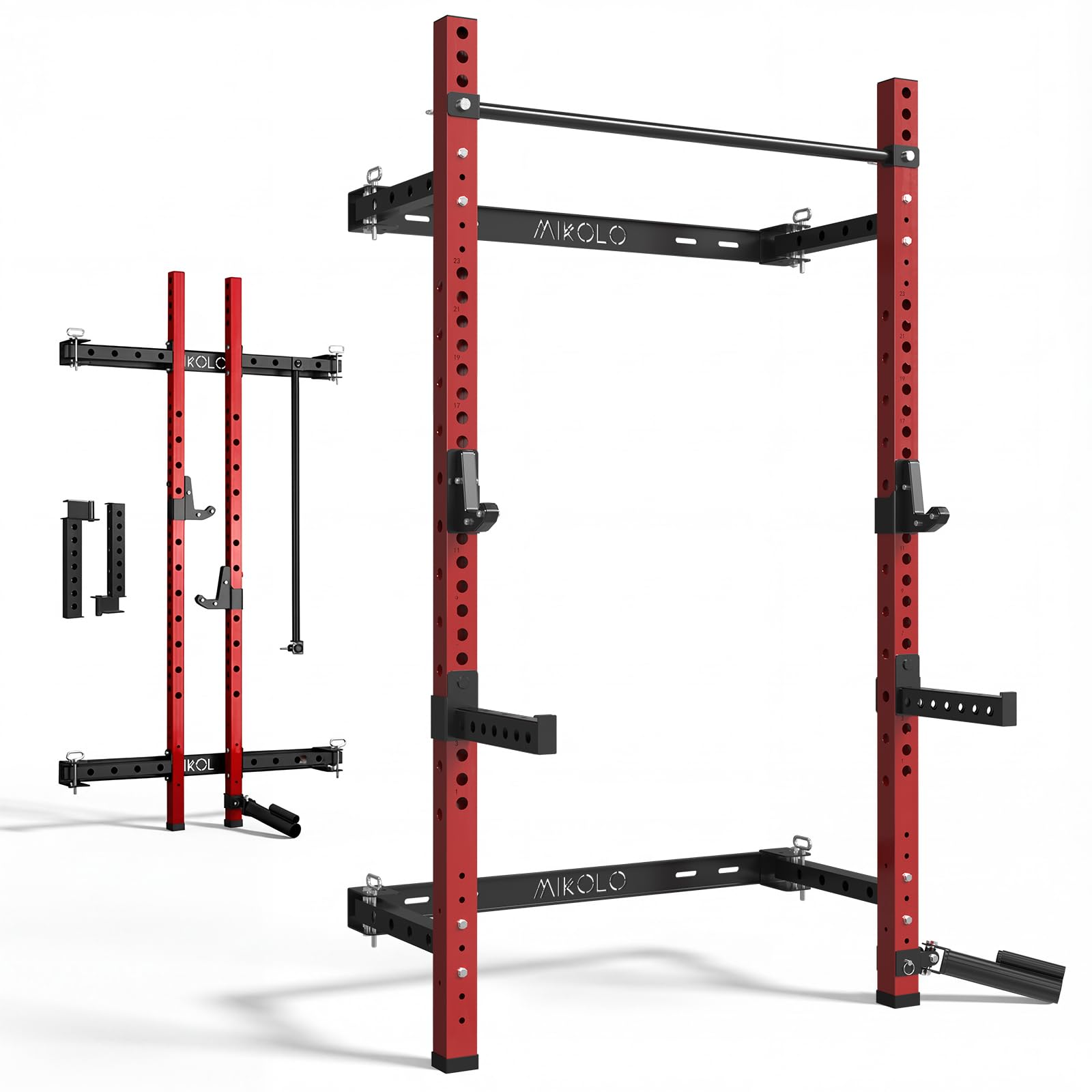
Fold-flat depth is the entire argument here. Folded, this rack measures 47″ x 2″ x 85.8″ — two inches off the wall. Open, it extends to 19.7″ deep. That fifteen-second switch between storage and use is what lets a garage serve as a gym and a garage in the same day. The Mikolo K6 takes up 67.5 inches of depth permanently; this one gives most of that back.
The build holds up to the folding mechanism. It uses 2″ x 2″ 13-gauge steel uprights with textured powder coat for grip and carries up to 1000 pounds. The quick-attach pull-up bar reaches 89″ off the ground, which gives you a longer stretch at the top of the rep. J-cups with UHMW plastic inserts protect your bar’s knurling, and a 360° dual-size T-bar row attachment takes both Olympic and standard bars.
Installation takes 15 to 30 minutes with the included stringer and metal studs, and there is a one-year parts replacement service behind it. Mounting is the one thing to plan for carefully — wall-mounted racks live or die by what is behind the drywall. Every frame on this list that stands free does not care what your wall is made of; this one does. Check for studs or block before you drill.
The space math: 2 inches folded versus 19.7 inches open is the difference between a garage you can park in and one you cannot.
The catch to plan for: it is a wall mount, so the wall has to be right — this is the only pick here that cannot simply stand on the floor.
The right call for: anyone whose gym shares a wall with a car, a workbench, or a laundry setup.
Not for you if: you rent and cannot put holes in the wall, or your studs will not line up with the stringer.
5. JELENS S11 Power Cage
Two thousand pounds of rated capacity squeezed into 12.5 square feet of floor.
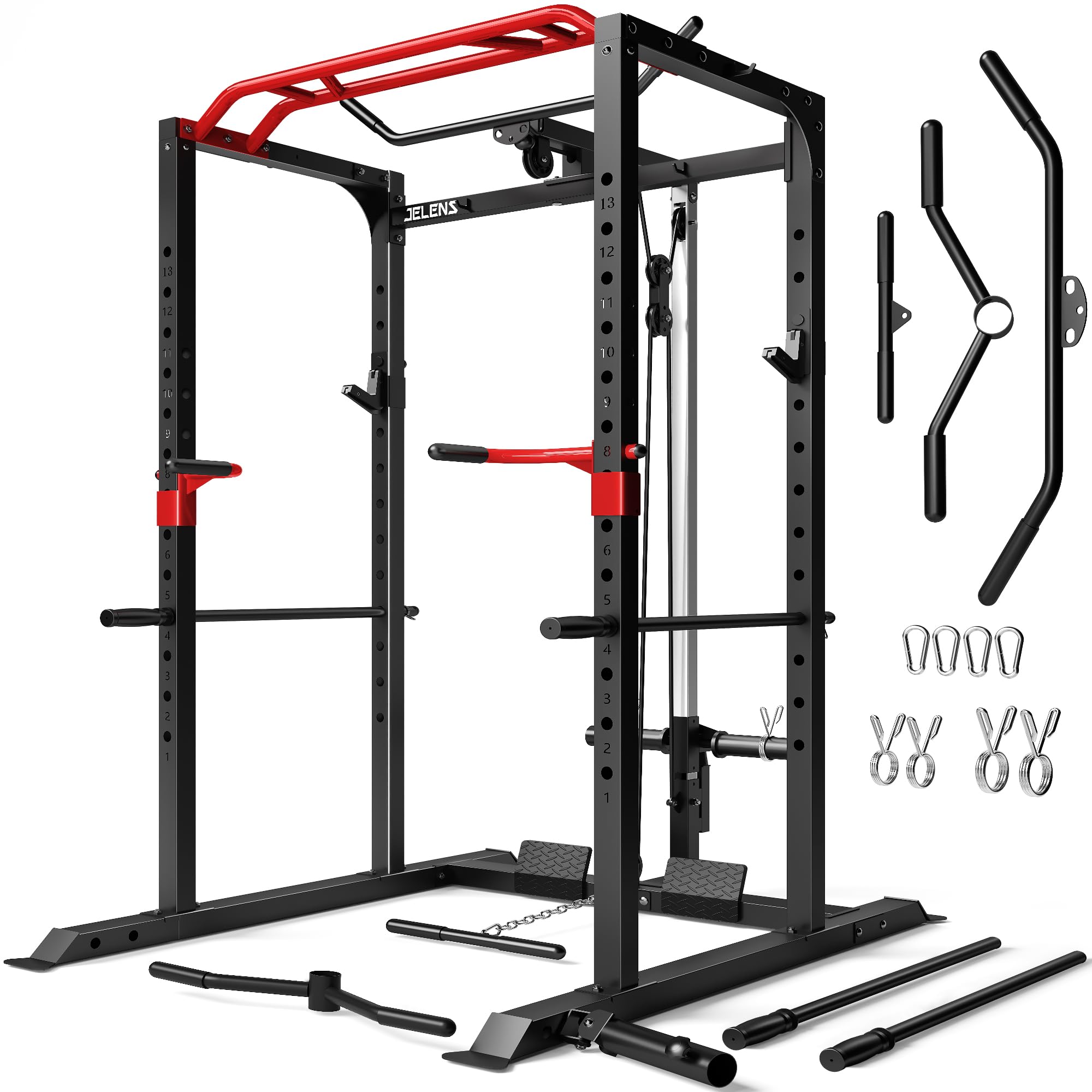
Most cages trade capacity for compactness. This one refuses. It stands on a 12.5-square-foot patch with a cage size of 57.5″ L x 44.5″ W x 79.7″ H, yet carries a 2000-pound rating on 50mm x 50mm heavy-duty steel pipes. For comparison, the FLYBIRD SR1 carries 950 pounds. If you want headroom above your heaviest lift without giving up a narrow room, this frame delivers it.
You can find your J-hook setting by sight instead of counting holes, thanks to 13 height positions marked with laser-cut numbers. The pulley system runs an upper and lower pull-down on a precision steel shaft pulley with a polished solid steel cable, and that hardware is there for quiet, smooth travel — no jerking at the top of a lat pull. The steel surfaces get a high-speed sandblasting finish that resists rust.
Build quality dominates the feedback on this rack, with assembly close behind, and the durability story holds up — a full year of use leaves it looking the way it did on day one. The limit worth knowing is adjustability and mobility: the pulley setup moves best when you leave it where you put it, and one set of settings covers the whole frame rather than each station adjusting independently. The attachment kit is complete: lat bar, cable bar, T-bar, pull-down bar, J-hooks, safety rods, a 360° landmine, and four counterweight racks with clamps.
Why lifters pick this one
- 2000-pound rating on 50mm x 50mm steel — the highest capacity in a compact cage here
- 12.5 square feet of floor covers a cage, lat pulldown, and landmine station
- Laser-cut numbered heights make setup fast between lifts
- Sandblasted finish resists rust over years of garage humidity
Where it holds you back
- Fixed pulley positioning takes the adjustability out of cable work
- Shipped in two boxes, so assembly is a session, not an afternoon
- Not a frame you move around after setup
Built for: heavier lifters working a narrow bay who still want a full cable station.
Look elsewhere if: you need to reconfigure cable height between exercises on the fly.
6. SPORTSROYALS Power Rack

Fourteen height pillars, six band pegs, and enough attachments to keep the floor clear.
You get a full accessory set in the box with nothing left to order: a lat pull-down bar, cable bar, two cable handles, two J-hooks, two safety frames, two safety rods, a wide-and-narrow pull-up frame, two dip bars, a 360° landmine (a pivoting bar holder for arc lifts), a footboard, six band pegs, and six 1″ and 2″ barbell clamps. Owners praise value for money most about this frame, with sturdiness right behind it.
The frame itself is 50 x 50mm commercial steel square tubing at 1.5mm thickness, rated to 1200 pounds, and it weighs 200 pounds with two reinforcing tabs. The pulley system runs precision bearing pulleys on fully electroplated telescopic poles, and the steel pulley rope is rated to hold 500 pounds. Fourteen adjustable pillars cover your squat, bench, and press setups. The cage measures 61.6″ L x 56.0″ W x 82.6″ H, wide enough that more than one family member can work at the same time.
The recurring gripe is the one you would expect from a lighter-rated frame: a slight wiggle once it is in place. It is a 1200-pound rack, not a 2000-pound one, and it behaves like it under very heavy loads. Loading the storage racks with plates helps settle it. Buy this if accessories and value matter more to you than a competition-level capacity rating.
What you actually get: a complete training kit out of one box — dip bars, landmine, band pegs, and bar clamps included, with six plate racks and a bar holder to park it all.
The honest trade-off: the frame wobbles slightly once assembled. Set it in place with care and add plates to the storage pins before your first heavy squat.
Best fit for: a family starting a home gym who want every attachment in one purchase.
Look past it if: you plan to push loads near the top of a 1200-pound rating.
7. REP Fitness PR-1100 Power Rack

Eighty-four inches to the top of the pull-up bar — a number a lot of basements can live with.
Ceiling clearance rules more home gyms than any other spec, and this rack was designed around it. Its full height is 84 inches to the top of the pull-up bar, and 82 inches to the top of the uprights if you flip the bar. It does not need anchoring either — the double rear stability bars hold it in place as a freestanding cage, which matters if you are working on a floor you cannot drill.
Inside, you get 44″ wide by 45.5″ deep of working space, with full-length safety bars and two J-cups included. The frame is 14-gauge steel rated to 700 pounds, and the pull-up arch is rated to 400 pounds. Laser-cut numbered uprights let you reset the hooks by eye, and the black powdercoat takes garage abuse. The lat pull-down attachment adds a 250-pound capacity if you buy it separately, though it is not part of this model’s included kit.
What people value most about this frame is how compact and manageable it feels in a home or garage setting. The stability and rust resistance are the two things to weigh: the frame is solid for most home lifters, but it is a freestanding cage at 700 pounds, and a few units have arrived with surface rust. If your gym runs damp, inspect it on delivery and treat any spots early.
The clearance win: 84″ overall height and no floor anchoring means it drops straight into most home spaces.
What to check on arrival: rust resistance is uneven — inspect the uprights when the box lands and catch any spots while they are still cosmetic.
Pick this when: your ceiling sits under 90 inches and you still want a real cage with full safety bars.
Go bigger if: you regularly squat past a 700-pound rating or lift in a damp garage year-round.
8. Titan Fitness T-2 Series Short Power Rack
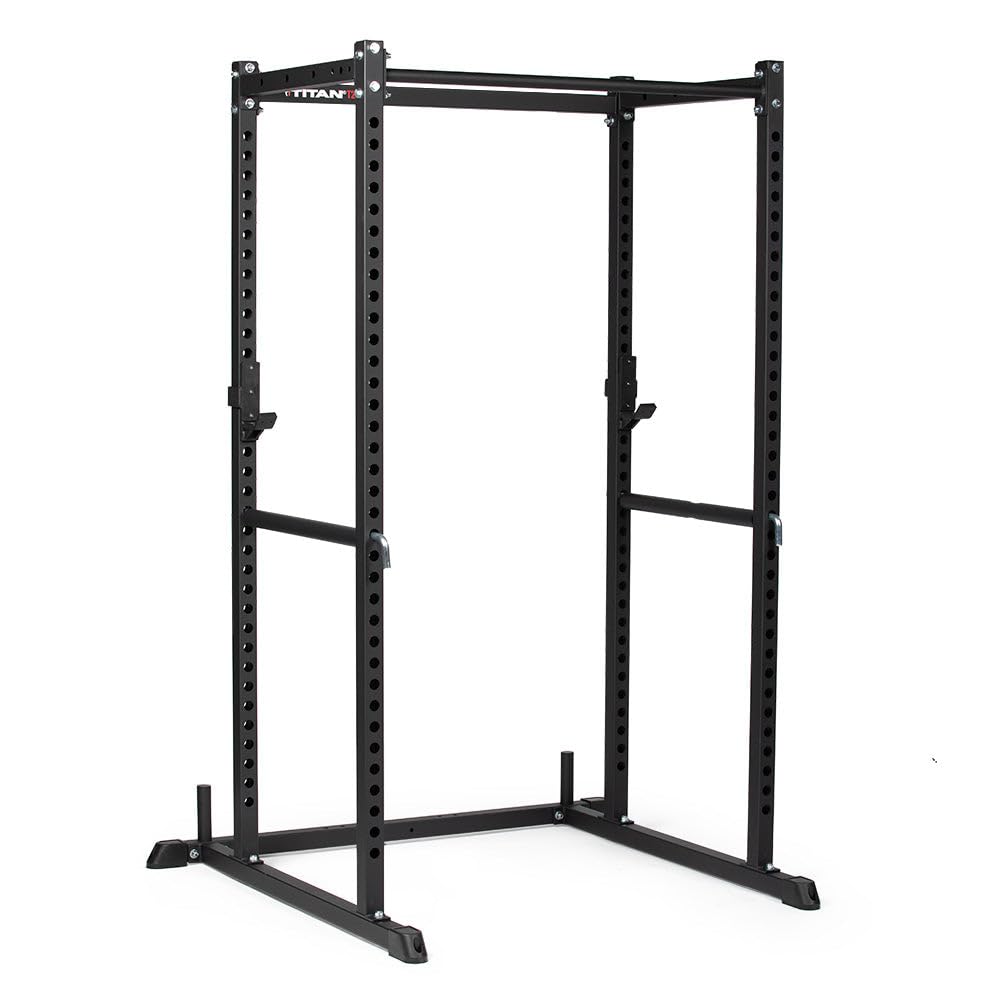
The rack that goes into a basement with a low ceiling and comes back out with your squat intact.
Two height options make this the most forgiving frame on the list for tight overhead space. Pick 71 inches or 83 inches depending on what is above you. It is built with heavy-duty 14-gauge square 2″ x 2″ laser-cut uprights and side bracings, and it holds a rackable capacity of 850 pounds with a total rack capacity up to 2,200 pounds. That gap between the two numbers is worth understanding — the 2,200 figure is total structural capacity, not the load your bar sees.
The front crossmember doubles as a single pull-up bar at 1.25″ diameter with a powder coat finish that resists wear from repeated use. Pin and Pipe Safeties catch a failed bar and let you train without a spotter. That design is simple and it works: the pins set the height, the pipes catch the bar. At 130 pounds it stays put under load without being immovable.
Quality is what owners praise most here, with sturdiness right behind, and it earns its keep in basement setups where a low ceiling is the constraint. The one mismatch to know about is length — several lifters find it shorter than expected for their needs, which is the same trait that makes it fit a low room. Measure your own squat depth and where the bar sits on your back before choosing the 71-inch version.
Why it suits a basement
- 71″ or 83″ height choice clears ceilings a standard 86″ cage cannot
- 2,200-pound total rack capacity and 850 pounds rackable
- Pin and Pipe Safeties make solo heavy sets realistic
- 14-gauge 2″ x 2″ laser-cut uprights with side bracing
The measurement to take first
- The short version is genuinely short — check your bar height and squat depth before ordering
- Single pull-up bar rather than a multi-grip setup
- No cable system on this frame
Made for: basement and garage lifters working under a joist or a low door track.
Check before you order: the 71-inch version leaves limited headroom above the bar — pick 83 inches if your ceiling allows it.
9. MAJOR FITNESS Drone3 Power Rack
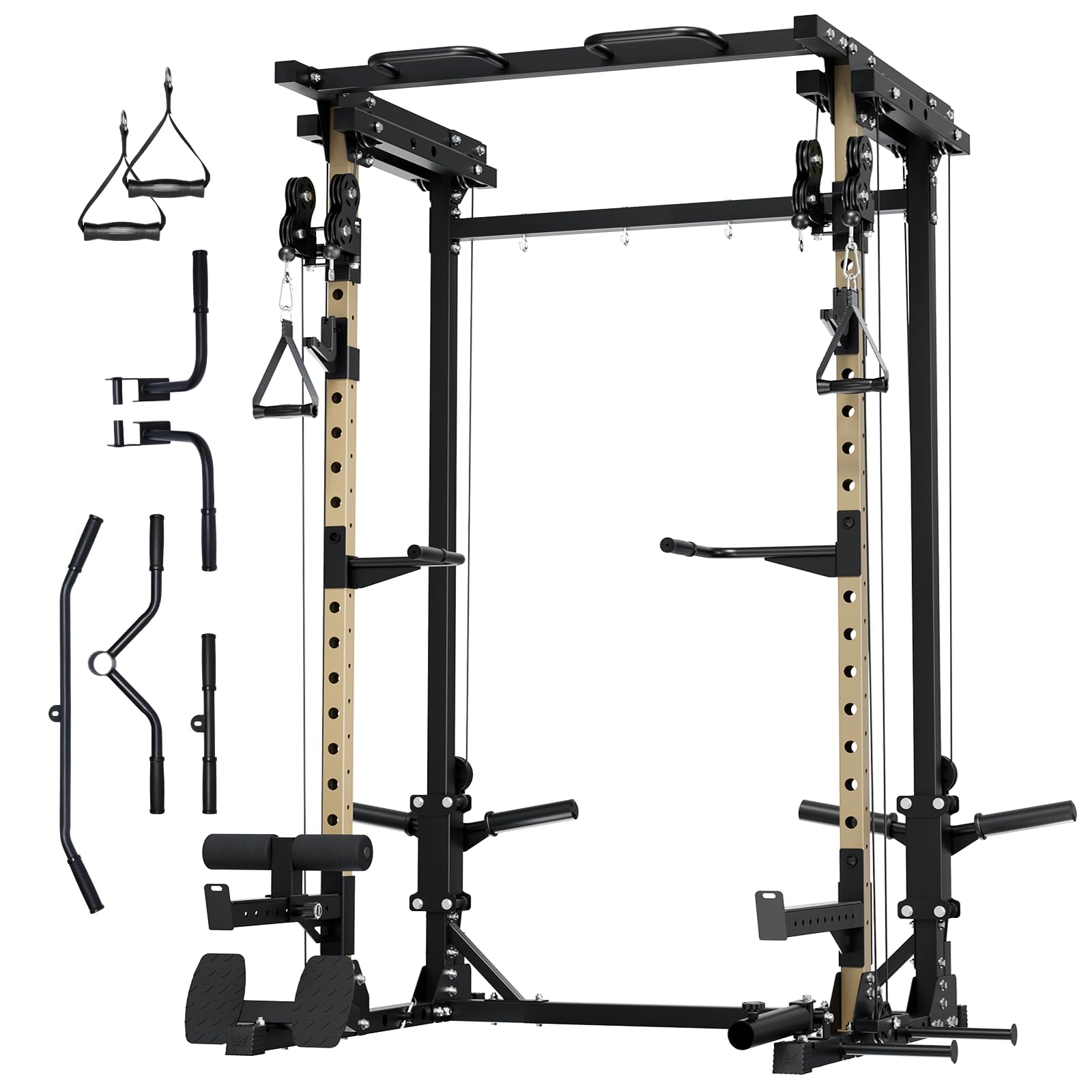
One cable system, two ratios, so high-rep burnout and heavy strength work come from the same frame.
Being able to change the pulley ratio is the feature you will not find on most racks here. Run the 2:1 ratio for high-rep sets where smooth travel matters more than load at the handle, then switch to 1:1 for heavy work where you want the full resistance. That flexibility is why this frame earns a premium spot despite a compact 69.5″ W x 45.9″ D x 85″ footprint.
The capacity number is the biggest on the list at 2,500 pounds, on 2″ x 2″ commercial-grade steel. A linear bearing system keeps the bar moving with zero friction, and a professional spring system adds a safety layer for heavy sets. Nineteen height settings let you dial the rack in to your frame. The build weighs 232.2 pounds, and there is a high pull-up bar, T-bar, and chest pull-up bar in the box. A one-year replacement warranty covers any component that needs swapping.
What people appreciate most is how well made the frame feels, with assembly close behind and the quiet operation getting its own share of praise. The T-bar, chest pull-up bar, and high pull-up bar mean you can hit every muscle group without a second machine. The trade-off is simple: this is a single-pulley system, not a dual independent one — if two people train at once, the second lifter is working free weights, not cables.
Where it pulls ahead: the 2:1 and 1:1 ratio switch is a rare feature, and combined with the 2,500-pound capacity it covers both endurance and strength work.
The limit worth knowing: one cable path, not two independent ones, so simultaneous cable training by two people is not the design here.
Right for: a lifter who mixes high-rep cable work with heavy barbell sessions in the same week.
pass on it if: you need two people pulling cables side by side.
10. M21 Smith Machine Power Cage

Two independent cables mean you and a training partner pull at the same time without fighting the rope.
Independent pulley systems on both sides is the feature that sets this frame apart. The front and rear partitions split the cage into separate cable zones, so you can lift with someone else and neither of you waits for the other’s set. That same split gives you a Smith machine, a power cage, and a cable system in one footprint of 59.84″ D x 46.85″ W x 84.65″ H.
It combines linear bearings with a bottom spring shock absorption system, and the nine adjustable columns are welded with screws rather than set with pins. The frame supports a 2000-pound rating on 50mm x 50mm heavy-duty steel pipes, with 20 laser-marked height positions for accessories. A 2-year free replacement warranty covers the accessories.
Sturdy construction and value are what come through strongest in how owners describe it, and the machine does the job it was built for. The two areas to expect some variation are smooth operation and assembly — the pulley feel and the instruction clarity both get mixed reads. It ships in three boxes, so block out real time for the build. The accessory set is thorough: lat bar, T-bar, pull-down bar, tricep rope, two J-hooks, two cable handles, four weight storage pins, a 360° landmine, a footboard, and six counterweight racks with clamps.
The differentiator: independent left and right pulleys plus the front-and-rear partition, which is the whole reason to pick this frame over a single-cable cage.
Budget your build day: three boxes and instructions that some find clearer than others mean assembly is not a quick evening job.
Choose this if: two people share the gym and both want cable access in the same session.
Think again if: you train solo and would rather spend the frame budget on a simpler, faster-to-build cage.
11. MAJOR FITNESS F22 Power Rack
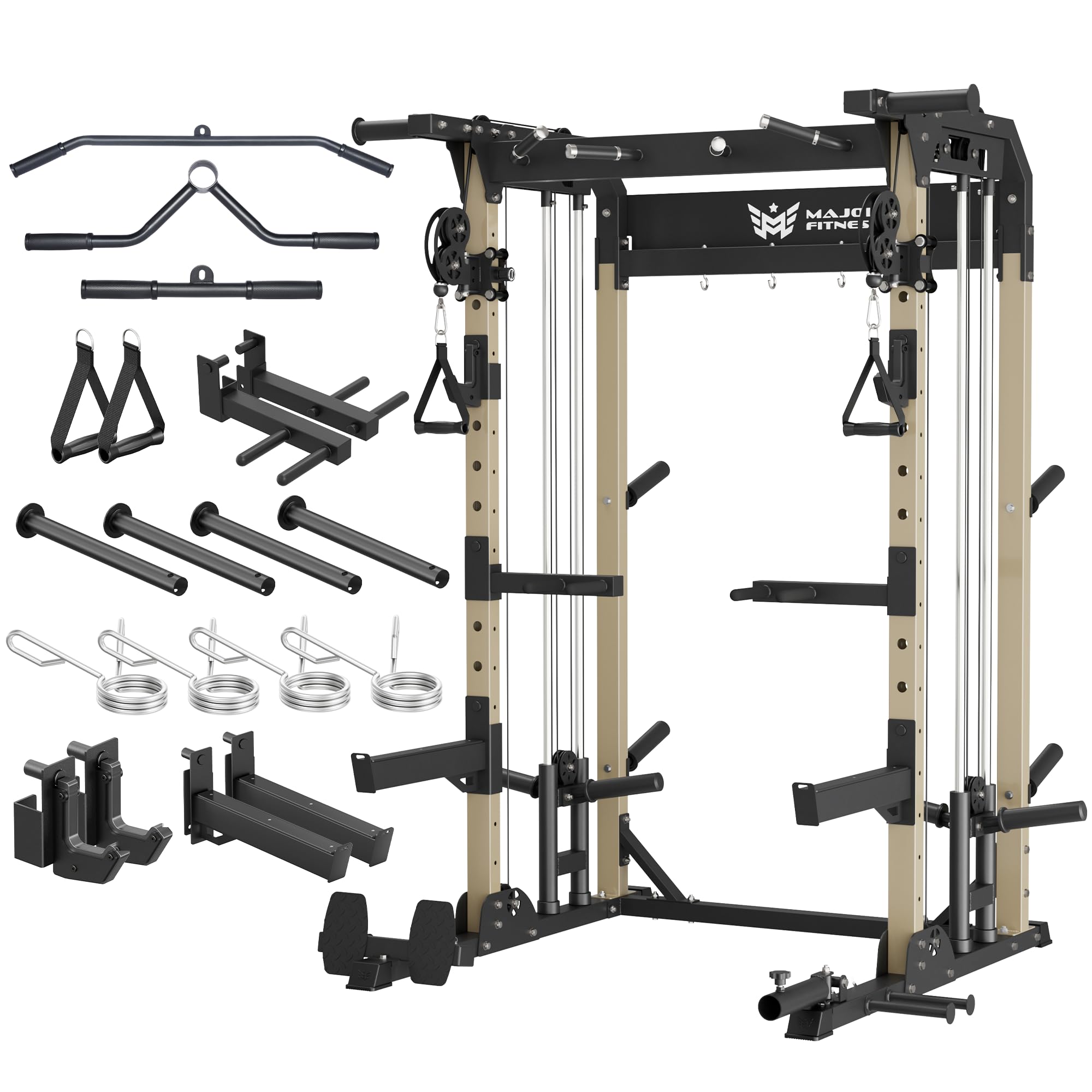
Thicker uprights than anything else here, and a base built to stop the frame walking.
This frame uses 2″ x 3″ commercial-grade 14-gauge steel at 0.08″ thick, against the 2″ x 2″ tubing on most of this list, and that extra inch of width is what keeps the frame from warping under max-load squats, deadlifts, and heavy rack pulls. The static capacity is 1600 pounds and the unit weighs 243 pounds — the heaviest frame here, and the one least likely to shift.
The dual-triangle base is the answer to floor sway. It increases the contact area with your floor, which gives a grounded feel during weighted pull-ups and aggressive cable crossovers. No bolting to the floor is required for standard stability. The independent dual-pulley runs a 2:1 ratio for smoother cable travel and finer resistance control, and two people can train at once without cable interference. It replaces a weight cage, squat rack, and dual-cable crossover in one footprint of 68.9″ D x 55.5″ W x 82.5″ H.
Build quality leads the feedback by a clear margin, and the pulley system earns specific praise for how smooth it runs. Assembly is described as straightforward, with the build running a few hours. The recurring negative is shipping damage — some units arrive with bent components. That is a delivery problem, not a design one, but inspect the boxes before you sign and start a claim immediately if a tube is out of true.
Where this frame leads
- 2″ x 3″ 14-gauge steel at 0.08″ thick — the beefiest uprights on the list
- Dual-triangle base spreads load and resists sway without floor bolts
- Independent dual pulleys let two lifters work at once
- Complete attachment suite: J-hooks, safety arms, foot pedals, landmine, T-bar, dip bars, and band pegs
What to prepare for
- 243 pounds means it arrives in heavy sections and stays where you build it
- Some units show up with bent parts — check the boxes on delivery
- The deepest frame here at 68.9″, so plan the room around it
The pick for: a serious lifter who wants a frame that will not flex under heavy rack pulls and shares the space with a partner.
Only go elsewhere if: your room is tight on depth or you cannot lift heavy boxes on delivery day.
Know the Specs
Rackable capacity versus total capacity
Some racks list two numbers, and they mean different things. The rackable capacity is the load your bar puts on the J-hooks and safeties — the number that matters for your squat. The total capacity includes the frame’s fullstructural strength. The Titan T-2 lists both: 850 pounds rackable and up to 2,200 pounds total. Read the rackable figure when sizing a rack to your lifts, since that is the weight the safety catches actually have to catch.
Steel gauge and tube size
Upright size and wall thickness do more for a rack’s feel than any capacity sticker. A 2″ x 3″ 14-gauge upright is thicker in profile than a 2″ x 2″ tube, and that extra material is what keeps a frame from flexing when you rack a heavy squat. The Mikolo folding rack uses 13-gauge uprights, while the MAJOR FITNESS F22 uses 2″ x 3″ 14-gauge steel at 0.08″ thick. Thicker, wider steel tends to mean less wobble under load.
In-cage depth and bench clearance
The inside of the cage is where you actually train, so measure it against your bench. The Mikolo K6 offers 41″ x 60″ of internal space, and the REP PR-1100 gives 44″ wide by 45.5″ deep. If your bench is longer than the internal depth, you cannot press inside the frame. Check the internal figures, not the outside footprint, before you commit.
Pulley ratios and what you feel
A 2:1 pulley halves the resistance at the handle and doubles the cable travel, which suits high-rep work. A 1:1 ratio gives you the full load on the handle, which suits heavy lat work. Most racks here are fixed at one ratio — the MAJOR FITNESS Drone3 lets you switch between 2:1 and 1:1, which is why it carries a premium label.
Safety systems: J-hooks, straps, pins, and pipes
Every rack here catches a failed rep somehow, but the hardware differs. Pin and Pipe Safeties on the Titan T-2 use pins to set height and pipes to catch the bar. Full-length safety bars on the REP PR-1100 and extended safety arms on the FLYBIRD SR1 do the same job with different geometry. Whichever style, set the catches just below your bottom position so the bar never touches them on a good rep.
Height, clearance, and where the rack lives
The tallest cage on this list stands 86.4″ and the shortest option runs 71″, so ceiling height decides more than anything else. A wall-mounted folding rack needs solid studs or block behind the drywall, while a freestanding cage with rear stability bars does not need anchoring at all. Measure the lowest point of your ceiling, then match the rack height plus your standing reach above the pull-up bar.
Common Questions
Will a power cage fit under a standard garage ceiling?
What weight capacity do I actually need for a home squat rack?
Is a folding wall-mounted rack as strong as a freestanding cage?
Do I need to bolt a power rack to the floor?
What is the difference between a 2:1 and a 1:1 pulley ratio?
Can two people train on the same power cage at once?
How much floor space does a home power cage take up?
Should I pick a cage with a built-in lat pulldown or buy one separately?
What does 14-gauge steel mean on a power rack?
How long does it take to assemble a home power cage?
The Bottom Line
For most home lifters, the workout racks for home winner is the Mikolo K6 Power Cage because it folds a cage, cable crossover, lat pulldown, and low row into one 1500-pound frame, so you stop buying machines one at a time. If ceiling height is your limit, the Titan Fitness T-2 Short Rack gives you a 71-inch option with Pin and Pipe Safeties (safety bars that catch the barbell) that let you train heavy alone. And if you share the gym with a partner, the JELENS M21 Smith Machine runs independent pulleys on both sides so neither of you waits for a cable.
The nudge: the Mikolo K6 holds 4.5+ stars across 200+ ratings, and that consensus is your best signal that the frame, pulleys, and build hold up in real garages.
How we choose
We do not accept paid placement. Every pick is matched to a real buyer and a real use-case; we do not hands-on test units.
Sources
Specifications: manufacturer listings and product documentation. Review insights: verified customer reviews, as of November 2026. Pricing: not shown on this page (it changes often); check the current price via the retailer link.
As an Amazon Associate, Tactical Gear Guy earns from qualifying purchases. This does not affect which products we feature.