Specs are compiled from manufacturer listings and verified buyer reviews and can change over time — please confirm the key details on the product page before buying.
Your XH-A1 still shoots beautiful HD footage — the problem is the microphone situation. The camcorder’s built-in mic sits far from your subject, picks up the tape transport and the zoom motor, and delivers thin, hissy dialogue you cannot fix in editing. Swapping on a proper shotgun mic is the single cheapest upgrade you can make to that camera’s sound. This guide covers nine mics that all mount on a cold shoe and plug into a 3.5 mm jack, so you are not chasing adapters.
This guide is built by comparing the manufacturers’ published specifications and the patterns across verified customer reviews, so you get each pick’s real strengths and trade-offs instead of marketing spin.
Not every mic in this list fits every camera the same way, and a couple need a quick settings check before they behave. Below you get the real differences — polar pattern, power source, output type, and the switches that actually change your audio — all in plain terms so you can pick in one pass, not three shopping carts. This is everything that matters in a practical xh-a1 mic replacement.
Top Picks


How To Choose A Replacement Mic For Your XH-A1
Three things decide whether a mic works on your camera: the polar pattern, how it gets power, and which cable its output expects. Get those right and almost any on-camera shotgun will do the job. Get one wrong and you spend a shoot chasing hum or silence.
Start with the polar pattern
A polar pattern is the shape of the area a mic listens to. Cardioid means “wide front, some sides” — forgiving if your subject moves. Super-cardioid is narrower and more focused, which helps when you shoot in a noisy room but punishes sloppy aim. For interviews and events on a camcorder, super-cardioid tends to serve you better.
Decide how the mic gets power
Plug-in power means the camera feeds the mic through the same 3.5 mm cable — no battery to forget. A built-in rechargeable battery means the mic runs on its own and usually adds a display or gain controls, but you have to remember to charge it. Passive mics exist too: they need only a small voltage from the camera and nothing else.
Match the cable to the jack
Camcorders and DSLRs use a TRS cable (three contact bands on the plug). Phones use TRRS (four bands). Plug a TRRS cable into a camera and the audio can land on the wrong channel or drop out. Every mic here ships with at least one of each, so check the box contents before your first shoot.
Decide if you need gain control on the mic
Some mics give you a sensitivity switch or a stepless gain knob. That is useful when your camcorder’s own audio menu is limited — you can raise or lower the level at the mic instead of fighting the camera. If you always shoot the same setup, a fixed-gain mic is simpler and one less thing to bump.
Side-by-Side Comparison
| Model | Best For | Polar Pattern | Power Source | Connector | Amazon |
|---|---|---|---|---|---|
| RØDE VideoMic Pro+★ Best Overall | Run-and-gun shooters who want on-mic control | — | LB-1 rechargeable, 2 x AA, or Micro USB | 3.5 mm Jack | Amazon |
| Deity V-Mic D4 DuoDual-Capsule Standout | Filming yourself and your subject at once | Dual cardioid | Plug-in power | 3.5 mm Jack | Amazon |
| Deity V-Mic D4 MiniFeatherweight Outdoor Pick | Long outdoor days with a light rig | Super-cardioid | Passive, 1–5V plug-in power | 3.5 mm Jack | Amazon |
| Movo X1-Mini | Mixing analog and USB-C recording | Super-cardioid | Battery-free | 3.5 mm Jack / USB-C | Amazon |
| RØDE VideoMic GO II | Simple, set-and-shoot camera audio | Shotgun | No battery required | 3.5mm TRS / USB-C | Amazon |
| Sennheiser MKE 400 | Monitoring audio while you record | Super-cardioid | — | 3.5 mm TRS and TRRS | Amazon |
| COMICA VM20 | Long shoots where you can’t stop to charge | Super-cardioid | 300mAh rechargeable, USB-C | 3.5 mm Jack | Amazon |
| COMICA CVM-VM10II | First-time buyers adding a mic at all | Cardioid | — | 3.5 mm Jack | Amazon |
Detailed Reviews
1. RØDE VideoMic Pro+ Premium On-camera Shotgun Microphone
Our pick — 4.5+★ from 800+ verified ratings; the strongest balance of quality and price.
The on-camera shotgun that powers itself down when you unplug it, so the LB-1 battery isn’t drained by the time you roll.
If your XH-A1 ride-along kit is one bag and you shoot whatever the day hands you, this is the mic built for that. The automatic power function uses plug-in power to sense the camera connection and turns the mic off when you unplug. On a long day of stop-and-start filming, that is the difference between a fresh battery and a dead one.
Power is the real story here. You can run it from the included RØDE LB-1 rechargeable pack, from 2 x AA batteries, or continuously over Micro USB. Three routes to power means you are never stranded — a spare pair of AAs lives at the bottom of your bag. The built-in battery door is designed so the cover stays attached, which sounds small until you drop one in a car park.
Your recordings keep both the deep body of a voice and its fine detail, because RØDE rates the frequency range at 40Hz – 20kHz (the span of low to high sounds the mic captures). The metal enclosure shrugs off knocks on set. The Rycote Lyre suspension and windshield (a shock mount and a foam cover that soak up handling noise) do the quiet work of keeping bumps out of your track. It is the most-reviewed mic here — 4.5+ stars across 800+ ratings — and owners keep it on the rig. The catch is the footprint: this is a full-size on-camera shotgun (a long directional mic), so it adds noticeable bulk and front weight to a camcorder that is already not light.
Where this one pulls ahead
- Three power routes — LB-1 rechargeable, 2 x AA, or Micro USB
- Auto power off on unplug saves the battery you forgot about
- Rycote Lyre suspension tames knocks and handling noise
- Metal body survives being thrown in a camera bag
The trade-off you should plan for
- Full-size body adds real length and front weight to the XH-A1
- More controls and switches than a no-battery mic to learn
Reach for this if: you shoot unpredictable days and want the mic to look after its own battery.
Think twice if: your rig is already front-heavy — a smaller mic like the VideoMic GO II keeps the balance.
2. Deity V-Mic D4 Duo Mic
Two capsules in one barrel — the only mic here that records what’s in front of the lens and behind it.
Most shotgun mics are deaf behind your shoulder. The D4 Duo is not. It carries two cardioid capsules, and a switch on top lets you choose between a stereo track from the front capsule alone or two mono tracks split between front and back. For anyone filming themselves — a solo operator who talks to the lens and needs their own voice captured — that rear pickup is the whole point.
At 40 g (about 1.4 oz) it barely registers on a cold shoe, and the metal enclosure plus Rycote Lyre shockmount keep handling noise down without a battery inside. It draws plug-in power straight from the camera through the 3.5 mm jack. There is also a 3.5 mm AUX input that bypasses the rear capsule’s audio and sends it to the right channel, so you can drop in a lavalier or a wireless receiver without a second mounting point.
Owners rate the metal build and the front capsule’s clean pickup for a mic this small; the rear capsule is the bonus, not the reason they keep it. The honest limitation is the dual-cardioid pattern itself: cardioid is wider than super-cardioid, so in a genuinely loud room it collects more of the room than a tighter mic would. Aim it deliberately and keep your subject close.
The rear-capsule payoff: the AUX 3.5 mm input turns this into a two-source rig — rear capsule on one channel, your lav or wireless on the other.
Set it before you roll: the dual mono / stereo switch is easy to leave in the wrong position, so confirm your channel layout before every shoot.
Built for: solo shooters who need their own voice as well as the subject’s.
Not the pick if: you work in crowded, echoing rooms where a narrower super-cardioid wins.
3. Deity V-Mic D4 Mini Supercardioid On-Camera Mic
A 0.15 kg mic with a stated 20mph wind rating — built for the day the forecast turns on you.
For wedding and event work outdoors, wind is the enemy that ruins a take. Deity publishes a 20mph wind rating for the D4 Mini, and it ships with a faux fur windshield to back that up. Pair that with the super-cardioid pattern pulling focus onto the person in front of the lens and you have a mic that behaves when the venue is an open field.
It runs passive off 1–5V from cameras, phones, and audio recorders — no battery, nothing to charge, nothing to forget. The automatic extra track assignment kicks in when you plug a secondary source, so your phone or second mic lands on its own channel without menu-diving. At 30 db sensitivity and 74 db audible noise, it keeps the self-noise floor low enough for quiet dialogue.
Here is the contrast worth knowing: the COMICA CVM-VM10II lists 90 db sensitivity and 100 db audible noise against this mic’s 30 db and 74 db. Lower audible noise means less hiss sitting under your dialogue. The thing to watch is the long game — durability is the recurring gripe on this mic, with reports of units failing after a couple of months. Treat the cable joint gently and it serves you well; yank on it every shoot and you shorten its life.
Why it earns a spot
- 20mph wind rating plus included faux fur windshield
- Passive 1–5V power from camera, phone, or recorder
- Automatic second-track assignment for a plugged-in extra source
- 0.15 kg — barely felt on a small mirrorless or camcorder
Where it asks for care
- Durability is the most-discussed weak point — handle the cable joint gently
- Passive power means no on-mic gain control
Suits you if: your shoots happen outdoors and you want zero charging routine.
Pass if: you need on-mic level control or you’re rough on cables.
4. Movo X1-Mini Video Shotgun Mic

One mic that speaks both analog and digital — 3.5 mm into the camcorder, USB-C into a laptop.
The X1-Mini is the pick for anyone whose kit spans two eras. It outputs over 3.5 mm TRS for your XH-A1 and over USB-C for a computer or phone, and in digital mode it captures up to 24-bit resolution. That means the same mic can record your camcorder audio and a clean digital take for a podcast or a Zoom call without buying a second piece of gear.
Construction is aluminum with a battery-free design, so there is no charging ritual and no battery door to lose. The integrated shock mount and the included Rycote shockmount, foam windscreen, furry windscreen, and hard-sided case mean the box already covers the accessories you would otherwise buy separately. It mounts to a cold shoe for run-and-gun work or to a boom pole when you want it closer to the speaker.
The supercardioid pattern keeps the sides and rear out of the recording, which suits a camcorder rig pointed at one subject. The honest caveat sits in the spec sheet: 2200 ohm impedance and 80 db audible noise. That impedance is high for a mic, so check levels on your camera rather than assuming a set-and-forget gain. It works, but it may want a nudge up in the XH-A1’s audio menu.
Two connectors, one mic: the USB-C output at up to 24-bit is what separates this from every other pick here that only offers 3.5 mm.
Check your levels first: the 2200 ohm impedance is unusually high, so do a test recording before your real one.
Your match if: you want one mic to cover camcorder footage and digital recording.
Look elsewhere if: you want a fixed, plug-in-and-forget level with no test run.
5. RØDE VideoMic GO II Microphone

Fifty-seven grams, no battery, no switches — the least fussy way to get better sound on the XH-A1.
Some shooters do not want a menu of options. They want to clip a mic on, plug in a cable, and roll. That is exactly what the GO II delivers: no battery, no complicated switches or controls, and a 3.5 mm TRS output that runs into the camcorder. At 57 g it adds almost nothing to the front of your rig, which matters if your shoulder already knows the XH-A1’s weight.
The HELIX isolation mount does the quiet work — it is designed to shield your audio from knocks, bumps, handling noise, wind noise, and plosives. A deluxe windshield is included. The frequency range runs 20Hz – 20kHz, so the full voice band is captured. Owners praise it for plain, dependable audio rather than any one feature — no battery, no switches, nothing to set wrong.
There is a second life in this mic beyond the camera. The USB-C output works with smartphones, tablets, and computers, and it is compatible with RØDE Connect and RØDE Central, which open up a high-pass filter, a high-frequency boost, and a pad. So you get a camcorder mic today and a podcast mic tomorrow. The catch is that those advanced controls only exist in the RØDE apps over USB — over 3.5 mm into your XH-A1, it is a plain, fixed-gain mic.
What makes it easy to recommend
- No battery and no switches — plug in and shoot
- 57 g keeps the XH-A1’s front end light
- HELIX mount plus deluxe windshield cut handling and wind noise
- USB-C opens RØDE Connect features like high-pass and pad
What it does not do
- Over 3.5 mm you get no filter, boost, or pad — those need the apps
- No on-mic gain or level display
The right buy if: you want the shortest possible line from unboxing to good dialogue.
Skip if: you need filters and pads to work on camera, not just over USB.
6. SENNHEISER MKE 400 Microphone

The one mic here with a headphone jack — so you can hear the problem before you shoot it.
Flying blind on audio is the oldest mistake in camcorder work. The MKE 400 fixes that at the source: it has an integrated headphone output with volume adjustment, so you can monitor what the camera is actually receiving, not what you hope it is. If you have ever finished a shoot only to find the mic was pointed at a wall, this solves it in the field.
The pickup is a super-cardioid pattern, deliberately narrow to isolate and enhance in-camera audio. There is a built-in low-cut filter for wind and rumble and a 3-step sensitivity switch, so you can dial the level without leaving the mic. It ships with interchangeable 3.5 mm TRS and TRRS connectors — one for the XH-A1, one for a phone — and the metal body with internal suspension mount reduces handling noise.
The audio is detailed and the build is solid, but the noise floor is the thing buyers mention most about the less glowing side of this mic. Several buyers report poor noise-floor performance, and audio quality draws a divided response overall. In a quiet interview room it is fine; in a hissy environment you may want the low-cut filter working and a careful gain setting. Not a deal-breaker, but do not expect it to hide a noisy room.
Hear it as you roll: the headphone output with its own volume adjustment is the standout feature, and no other mic here offers it.
Plan for the noise floor: the low-cut filter and sensitivity switch give you tools, but a noisy room will show through.
Worth it when: you refuse to shoot audio you cannot hear live.
Less ideal if: you often record in echoey or electrically noisy spaces.
7. COMICA VM20 Shotgun Microphone with OLED Power Display
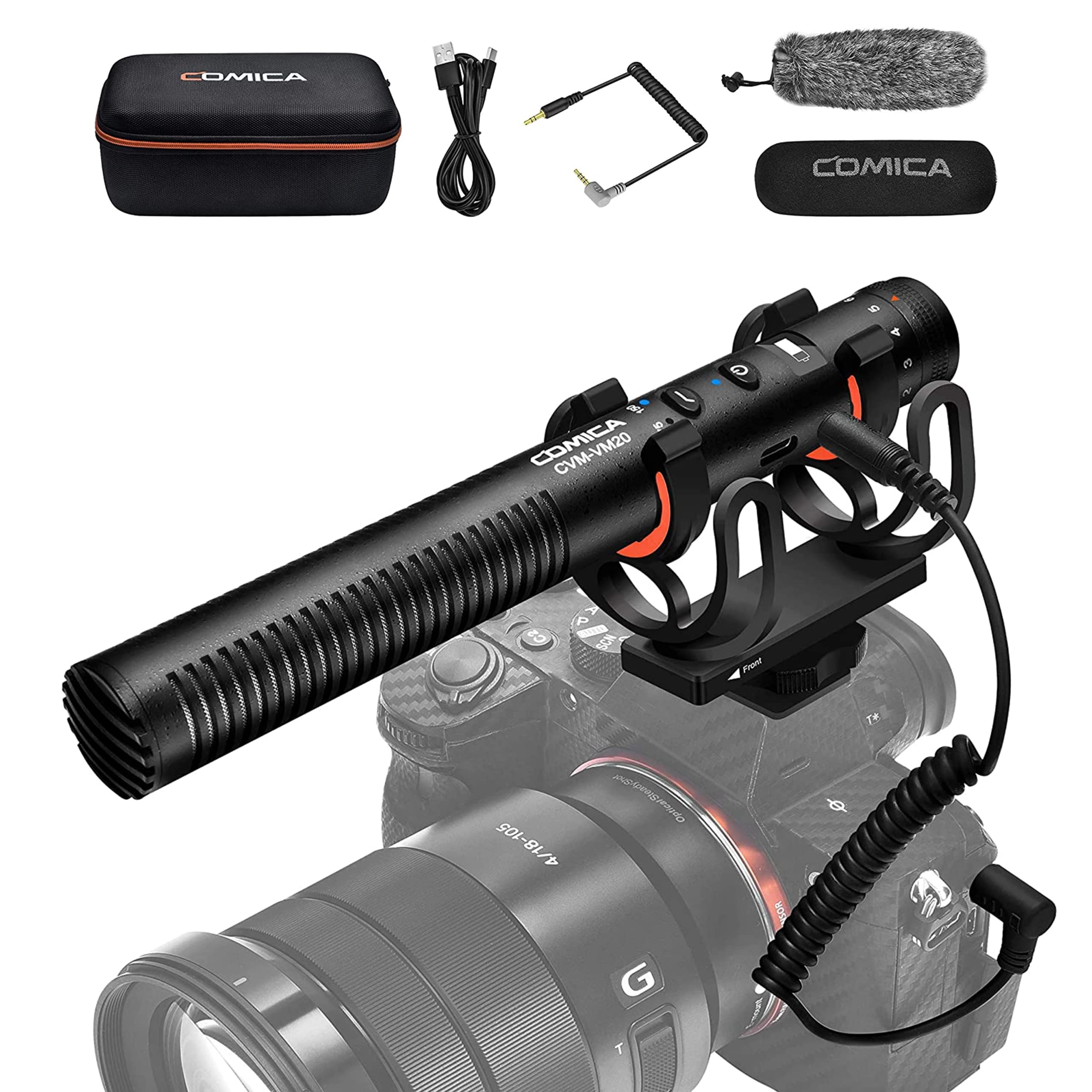
A 300mAh cell rated for up to 60 hours, and it charges while it records over USB-C.
Most battery mics ask you to stop and charge. The VM20 does not. Its built-in 300mAh rechargeable lithium battery is rated for up to 60 hours of standby, and the USB-C port lets you charge while using it — so a power bank in your pocket extends a long shoot indefinitely. The OLED screen shows battery level in real time, which means no guessing whether you have an hour or an afternoon left.
The controls are unusually deep for the money. A stepless gain knob offers ten levels with a sensitivity range of -43dB to -23dB, so you can trim the signal at the mic rather than fighting the camera menu. Two low-cut settings — 75Hz and 150Hz — let you choose how much rumble to strip, which helps on a windy day. At 23 db audible noise it is one of the quieter mics in this list by its own spec.
The full metal body shields the signal and the whole thing weighs only 84 g. Buyers praise the sound first, and the box already includes the TRS camera cable and TRRS phone cable. The thing to know is the reliability split: a small number of units arrive dead from the start. Test yours the day it lands, and if it powers up and records, the 60-hour battery and gain control make it a genuinely capable on-camera mic.
The case for the VM20
- Rated up to 60 hours of standby on the 300mAh cell
- Charges over USB-C while you record
- OLED display shows real-time battery level
- Ten-level gain knob and 75Hz/150Hz low-cut filter
What to watch
- Occasional units arrive dead — test on arrival
- More controls than a passive mic, so more to learn
Choose this if: your shoots run long and you want a battery readout you can trust.
Consider the alternative if: you would rather have zero charging routine than a power display.
8. COMICA CVM-VM10II Universal Shotgun Microphone

The entry into on-camera audio that arrives with a case, a windscreen, and both cables.
If this is your first step up from the XH-A1’s built-in mic, the VM10II is the low-risk way in. The box carries the microphone, a carrying case, a windscreen, a windmuff, a 3.5 mm TRS camera cable, a 3.5 mm TRRS phone cable, and a shock mount — everything you need to shoot on day one. No add-on shopping.
It uses a cardioid directional pattern with off-axis rejection, so it cuts down on the room around your subject. The professional shock-absorption stand is designed to minimize vibrational, handling, and cable-borne noise, and the body is built from aluminum with the manufacturer stating it strengthens anti-interference to reduce noise from vibrations. It reaches cameras, camcorders, audio recorders, phones, tablets, and laptops via the two included cables.
Buyers rate it sturdier and more capable than its price suggests, and many use it as a stepping stone before a pricier shotgun. The real limit is the audio ceiling. The spec lists 90 db sensitivity and 100 db audible noise, against the Deity D4 Mini’s 30 db sensitivity and 74 db audible noise — that higher noise figure means you may hear more hiss in quiet rooms. Cardioid is also wider than super-cardioid, so it collects more of the space you are standing in.
The starter-kit logic: case, windscreen, windmuff, shock mount, and both cables in one box mean you are not patching a kit together.
The ceiling to know: 100 db audible noise will show in very quiet rooms, and the wide cardioid pattern hears more of the room than a super-cardioid.
Money well spent if: you are adding a mic to the XH-A1 for the first time and want a complete kit.
Step up instead if: you record dialogue in near-silent rooms and want a lower noise floor.
Know the Specs
Audible Noise (db)
This is the electrical self-noise the mic generates with no sound to record — think of it as the floor of hiss under your dialogue. A lower figure is better, because there is less to hear in quiet rooms. The Deity D4 Mini lists 74 db against the COMICA VM10II’s 100 db, which is why the Deity suits close dialogue better. Match this number to your shooting space: loud streets forgive a higher floor, silent interviews do not.
Polar Pattern
A polar pattern is the shape of the listening area. Cardioid is wider and more forgiving of a moving subject but picks up more room; super-cardioid is tighter, rejects more off-axis noise, and rewards accurate aim. For a camcorder pointed at one speaker, super-cardioid usually wins. For a subject who cannot sit still, cardioid keeps you covered.
Plug-In Power vs. Battery
Plug-in power means the camera supplies the small voltage the mic needs over the 3.5 mm cable — no battery, nothing to charge. A built-in rechargeable battery lets the mic run on its own and often adds gain controls or a display, but you must remember to top it up. Passive mics like the D4 Mini take only 1–5V from the camera and need nothing else.
Low-Cut Filter
A low-cut filter removes low-frequency sound below a set point — the rumble of wind, the thrum of traffic, the hum of a fridge. On a windy outdoor shoot it is the single most useful switch on the mic. The catch is that it also removes some of the body from a deep voice, so use it only when the ambient noise justifies it.
Common Questions
Will these mics plug straight into the XH-A1’s mic jack?
Do I need a battery for a shotgun mic on a camcorder?
Super-cardioid or cardioid for interview work?
How much does handling noise matter on a camcorder rig?
What does a windy-day mic need that a calm-room mic does not?
Can I hear the audio while recording with these mics?
Is a wider frequency range better for dialogue?
Will a mic that works on my phone also work on the camcorder?
How should I care for a mic that hangs off the front of a camcorder?
The Bottom Line
For most XH-A1 owners, the best xh-a1 mic replacement is the RØDE VideoMic Pro+, because it looks after itself on a long day. It gives you three power routes — an LB-1 rechargeable battery, 2 x AA batteries, or Micro USB — and it switches off automatically when you unplug it. If you need to hear your audio live, the Sennheiser MKE 400 is the only pick with a headphone output (a jack so you can monitor sound as it records). And for the lightest possible rig, the RØDE VideoMic GO II weighs 57 g with no battery and no switches, so you get recording in seconds. Whichever you pick, mount it, aim it at your subject, and do one test recording before the shoot that matters.
How we choose
We do not accept paid placement. Every pick is matched to a real buyer and a real use-case; we do not hands-on test units.
Sources
Specifications: manufacturer listings and product documentation. Review insights: verified customer reviews, as of November 2026. Pricing: not shown on this page (it changes often); check the current price via the retailer link.
As an Amazon Associate, Tactical Gear Guy earns from qualifying purchases. This does not affect which products we feature.