Specs are compiled from manufacturer listings and verified buyer reviews and can change over time — please confirm the key details on the product page before buying.
Your TV’s built-in speakers flatten every explosion into a thin buzz, and quiet dialogue vanishes under the soundtrack. A soundbar with a center channel and a game mode fixes both. For an Xbox setup, three things matter most. First, a center channel (the speaker that carries voices) pulls dialogue forward. Second, a game mode keeps audio in sync with your controller. Third, an input that accepts your console without fighting your TV for the HDMI port.
This guide is built by comparing the manufacturers’ published specifications and the patterns across verified customer reviews, so you get each pick’s real strengths and trade-offs instead of marketing spin.
Below you’ll find the models that handle late-night campaign sessions and split-screen matches without tripping over their own cables. Every pick here was checked against its own spec sheet and owner feedback to earn a spot on this list of the xbox soundbar options worth your desk or living room shelf.
Top Picks


How To Choose The Best Xbox Soundbar
The mistake most people make is buying the loudest bar on the shelf. For gaming, raw volume is the easy part. The hard part is keeping a whispered radio call intelligible under a roaring helicopter while the audio stays locked to your console’s frame rate. Nail both and the bar feels like an upgrade; miss either and it feels like a nuisance.
Start with the connection, not the wattage
HDMI eARC is the port that lets your TV pass uncompressed audio down to the bar over a single cable. Without it, you’re often stuck with optical, which caps what formats can travel. If your TV has an eARC port, buy a bar that uses it — the difference shows up the moment a game switches from quiet exploration to a full firefight.
The alternative is plugging the console straight into the bar’s HDMI input, then the bar into the TV. That works, but check the bar’s passthrough refresh rate before you commit. A bar rated for 120Hz passthrough keeps a high-frame-rate game looking smooth; one that isn’t can force your console down to a lower refresh.
The center channel is your dialogue lifeline
In a 3.1 or 5.1 setup, the center channel is a dedicated speaker aimed at voices. That’s the channel doing the heavy lifting when a character murmurs a plot point under swelling music. A 2.0 bar has to fake that separation with processing, and it usually shows.
Look for features named things like Clear Voice, PureVoice, or Active Voice Analyzer — each brand has its own label for the same idea: pull speech out of the mix. These matter more in a game with layered audio than a spec-sheet wattage number does.
Where the subwoofer goes changes everything
A wireless subwoofer needs a power outlet near where you place it, plus a little breathing room. In an apartment, a down-firing sub against a shared wall turns every explosion into a noise complaint. A bar with a built-in subwoofer trades some of that chest-thump for a footprint you can tuck under the TV.
Side-by-Side Comparison
| Model | Best For | Channels | Output Power | Wireless Sub | Amazon |
|---|---|---|---|---|---|
| Sonos Arc Ultra★ Best Overall | Whole-room spatial audio | 9.1.4 | — | Sold separately | Amazon |
| TCL S45HBest Value | Budget gaming corner | 2.0 | 100 W | No | Amazon |
| Hisense A620Built-In Bass | Built-in bass, no extra box | 2.1 | 240 W | Built-in | Amazon |
| LG S60T | LG TV owners on a budget | 3.1 | — | Yes | Amazon |
| Samsung S60D | Samsung TV pairing, all-in-one | 5.0 | — | Built-in | Amazon |
| LG S70TY | QNED owners, 120Hz passthrough | 3.1.1 | — | Yes | Amazon |
| Yamaha SR-B40A | Stereo-to-Surround upgrade | — | — | Yes | Amazon |
| JBL Bar 500 | Big-room bass emphasis | 5.1 | 590 W | Yes | Amazon |
| Samsung Q800F | Premium Atmos with Q-Symphony | 5.1.2 | — | Yes | Amazon |
Detailed Reviews
1. Sonos Arc Ultra Soundbar with Dolby Atmos – Black
Our pick — 4.5+★ from 750+ verified ratings; the strongest balance of quality and price.
A nine-and-a-bit-channel bar that places every helicopter above your head
The Arc Ultra packs a 9.1.4 channel layout into a single metal enclosure — that first number counts ear-level channels, the middle.1 counts the bass, and the final.4 counts height channels aimed at the ceiling. That’s the highest channel count here, and it’s why voices and effects land in separate spots instead of smearing together.
Raw sound quality wins people over by a wide margin over everything else buyers talk about. Speech Enhancement, which the maker says is AI-driven, actively hunts for the human voice and lifts it clear of the mix. That is what you want when a teammate’s callout gets buried under an explosion. Setup is the second-biggest thing buyers bring up, and it depends on one HDMI eARC cable (the audio-return connection that carries sound from TV to bar) plus the Sonos app walking you through the rest.
Here’s the honest catch: you’re paying for the bar alone. There’s no subwoofer in the box, and the Sonos Sub and Era 300 rear speakers that open up true surround are separate purchases. A real slice of owner feedback questions whether the finished sound justifies the outlay, so go in knowing the upgrade path is incremental. Connectivity and performance also drew mixed notes, which is worth weighing if you’re expecting plug-and-forget.
Where it runs ahead
- 9.1.4 channels give you height and side placement no 2.0 or 3.1 bar on this list can match.
- Speech Enhancement targets dialogue directly — big for story-heavy games at low volume.
- Single HDMI eARC cable plus app-guided setup keeps the cable nest minimal.
- Trueplay room tuning adjusts the output to your actual wall and furniture layout.
- Metal enclosure, Wi-Fi and Bluetooth, AirPlay 2, and Sonos Voice Control plus Amazon Alexa.
What to weigh first
- No subwoofer included — the low end and the rear channels cost extra.
- Some owners question the value once the full surround kit is priced in.
- Connectivity and performance feedback is mixed rather than unanimous.
Reach for this if: you want the widest, most precisely placed soundstage on this page and you’re willing to build it up in stages.
Look elsewhere if: a single-box setup with bass already inside is what you’re after.
2. TCL S45H 2.0 Sound Bar for Smart TV
A slim 2.0 bar that trades a subwoofer box for a cleaner shelf
Two channels and 100 watts of output is the whole story here — no dedicated subwoofer driver, no third box to find an outlet for. In a bedroom or under a desk monitor, that missing box is a feature. You get Atmos and DTS Virtual:X processing that simulates height and surround from a single bar, so the effects still move around even without speakers behind you.
Owners consistently describe clear voices and clean music reproduction, and setup is genuinely quick — buyers report it’s a one-to-two-minute download-and-install affair that connects easily to LG Smart TVs. The 31.89-inch width and 2.36-inch height mean it slips under most TV stands without blocking the screen edge. HDMI eARC/ARC, optical, Bluetooth, and AUX cover nearly any console-and-TV combination you’d throw at it.
Compared with the Hisense A620 sitting third on this list, the gap is real: the TCL’s 100W total output sits well under the Hisense’s 240W, so don’t expect the same room-shaking low end from a single slim bar. Volume control also drew mixed comments. But the auto room calibration via the TCL app — AI Sonic, in their naming — does a fair job of levelling the sound to where you’re actually sitting.
What the room gets: Atmos and DTS Virtual:X from a 2.0 enclosure, plus HDMI eARC/ARC, optical, Bluetooth, and AUX for flexible hookups.
What you give up: no wireless subwoofer means the deepest bass stays handled by the bar’s own drivers.
Worth it for: a second gaming setup in a bedroom or a first soundbar where the TV’s speakers were the previous ceiling.
Not the one for: anyone chasing chest-thumping bass in a large living room.
3. Hisense A620 2.1ch All-in-one Sound Bar
240 watts with the subwoofer built right into the bar’s own body
The number that defines this bar is 240W of output — the equivalent TCL S45H runs 100W, so this is where the bass weight lives. Better still, that power feeds a 75 by 160 mm subwoofer driver mounted inside the bar itself and sealed behind transparent acrylic, so you can watch the cone move as it works. No second box, no extra outlet, no cable run across the floor.
Bass isn’t the only thing inside — Dolby Digital Plus and DTS Virtual:X handle the surround processing. There’s a clever TV mode, too: the bar borrows the decoding power of a compatible Hisense TV over HDMI ARC/eARC so it can play Dolby Atmos material even though the bar itself can’t decode it alone. EzPlay lets one TV remote control both units and pushes the bar’s settings menu onto your TV screen.
Owners find the sound a clear step up from TV speakers and the minimal footprint easy to live with. The recurring gripe is the remote — it takes criticism in a fair share of feedback, so plan on leaning on the TV remote or the app instead. HDMI eARC, Bluetooth, AUX and USB cover the inputs, with HDMI ARC as the one to use for console audio.
The strong side of the ledger
- 240W feeds a visible built-in subwoofer, so the bass arrives without a second box.
- TV mode pulls Atmos decoding from a compatible set over eARC.
- Dolby Digital Plus and DTS Virtual:X processing built in.
- Bluetooth, HDMI ARC, AUX, and USB give you several ways to wire a console.
The fine print
- The bundled remote draws consistent lukewarm notes.
- TV mode’s Atmos trick depends on owning a compatible Hisense set.
- Some units reportedly stick in Bluetooth mode and need coaxing back.
Grab it for: a one-box setup where you want real bass without giving up the floor space.
Skip it for: a full surround build — this stays a 2.1.
4. LG S60T 3.1 ch. Soundbar with Wireless Subwoofer

Three channels and a separate sub, tuned to keep voices out of the effects
Three channels is the dividing line for gaming dialogue — left, right, and a dedicated center, plus a wireless subwoofer for the low end. That center speaker handles voices as its own job, so a taunt from an enemy in a cutscene doesn’t have to fight the same drivers producing the explosion. Owners find the audio clarity lands especially well in movies and music.
The center channel plus AI Sound Pro is the pairing that matters. AI Sound Pro actively separates content types — clear vocals during live sports, fuller bass during music, dynamic response in action scenes. WOW Interface means a single LG TV remote drives both the bar and the TV, and WOW Orchestra brings the TV’s own speakers into the mix alongside the bar if you’re pairing with an LG set.
If you own an LG OLED, this is a natural fit — owners mention it pairs well. The honest trade-off is compatibility: customers note that while it works well with LG TVs, some find the subwoofer stops working within six months, and it works best with its own special remote. Set your expectations to a closed ecosystem rather than a universal box, and pair it with the TV the maker designed it for.
Who it clicks with: an LG TV owner who wants dialogue clarity and real bass without a separate speaker pair.
One thing worth knowing: the ecosystem is LG-centric — the value shows best when the TV is LG too.
Best matched to: an LG living room where one remote should control the whole picture.
Think twice if: your TV isn’t an LG and you want the smartest pairing.
5. SAMSUNG S60D 5.0ch Soundbar

A five-channel bar with the subwoofers hidden inside and Atmos sent wirelessly
This Samsung spreads effects around the room instead of firing them straight at you, and the channel count explains why. It runs five channels versus the Hisense A620’s 2.1 layout (two main channels plus a subwoofer). Wireless Dolby Atmos (Atmos is the surround format that places sound overhead and around you) means the signal travels from TV to bar with no HDMI cable at all. That gives you the cleanest wire run on this page.
Built-in subwoofers mean the deep end lives inside the bar, so the all-in-one design keeps the shelf tidy. Q-Symphony pairs with a Samsung TV to run the TV’s speakers and the bar’s speakers as one combined system, and SpaceFit Sound Pro analyzes the room and adjusts the output to fit. Adaptive Sound watches the content in real time and pulls dialogue forward, while Game Mode Pro auto-activates alongside a Samsung TV and uses up-firing speakers and an acoustic beam to push height into shot.
The clear strength here is the speaker count in a compact body, and it suits smaller rooms — living rooms, studies, and bedrooms all get mentioned as good fits. Alexa is built in, along with Chromecast and AirPlay 2, so voice control and casting come without a separate smart speaker. It’s a strong choice if your TV is a Samsung; outside that ecosystem you’ll still get good output, just not the synergy tricks.
Standout strengths
- 5.0 channels with built-in subwoofers keep the bass inside the bar itself.
- Wireless Dolby Atmos skips the HDMI cable entirely.
- Game Mode Pro auto-tunes for gaming on a paired Samsung TV.
- Alexa, Chromecast, and AirPlay 2 built in.
Where it asks more of you
- Q-Symphony only shines with a Samsung TV on the other end.
- There’s no separate sub box, so the bass is bounded by the bar’s cabinet.
Ideal for: a smaller room, a Samsung TV, and a buyer who wants zero visible extra speakers.
Choose other: if you want a dedicated sub box thumping on the floor.
6. LG S70TY 3.1.1 ch QNED TV Matching Soundbar
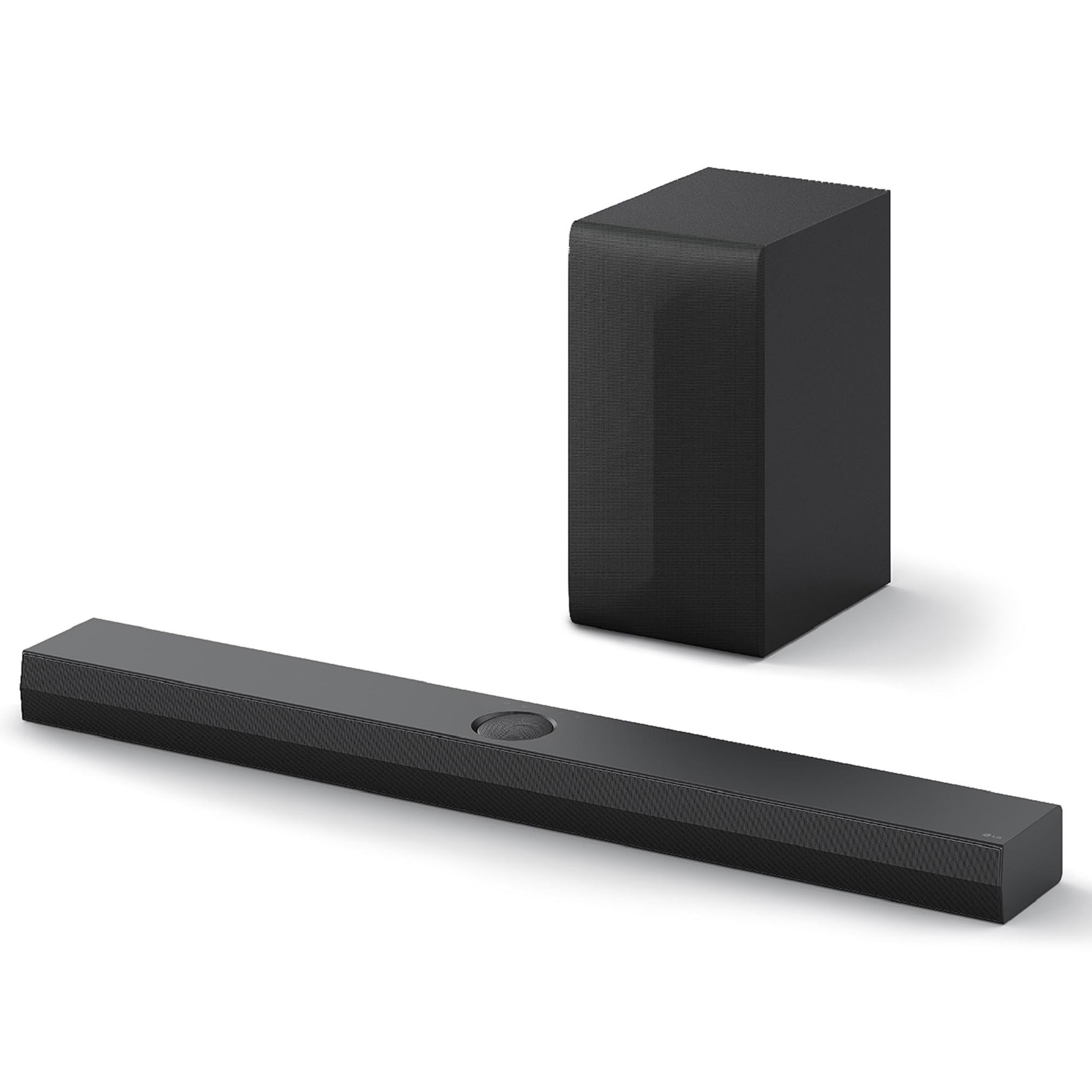
The 120Hz passthrough number that keeps your game frames intact
For a console, the 120Hz passthrough rating is the spec to circle. It means a high refresh signal passes through the bar without being knocked down, so a fast, twitchy shooter still feels like one. Owners find the audio separates speech from background noise well, and the up-firing center channel is purpose-built to focus on dialogue clarity while still giving you the full effects spread.
The 3.1.1 layout adds a height channel to the standard 3.1 arrangement, and that’s what Dolby Atmos uses to place sound above you. Owners note that the setup is remarkably easy and pairs flawlessly with LG TVs — not surprising, since this bar is sized in width and depth to nest under a QNED on a stand. It’ll also mount on the wall if you’d rather lift it.
Surround expansion is available with 2.0 rear speakers that connect wirelessly — no separate receiver needed. Game mode trims the audio response time down to keep the action lag-free. The one wobble: sound settings feedback is mixed, so budget a little time in the app to dial in the EQ to your taste rather than accepting the preset.
The gaming angle: 120Hz passthrough plus a low-latency game mode means less input-to-ear delay during fast play.
Room-fit strength: slimmer width and depth than a QNED, so it tucks beneath the panel without obscuring it.
Buy it if: you own an LG QNED or another LG panel and want a bar shaped to sit under it with gaming features ready.
Pass if: you want the tuning to sound finished without touching the app.
7. YAMAHA SR-B40A Dolby Atmos Sound Bar with Wireless Subwoofer
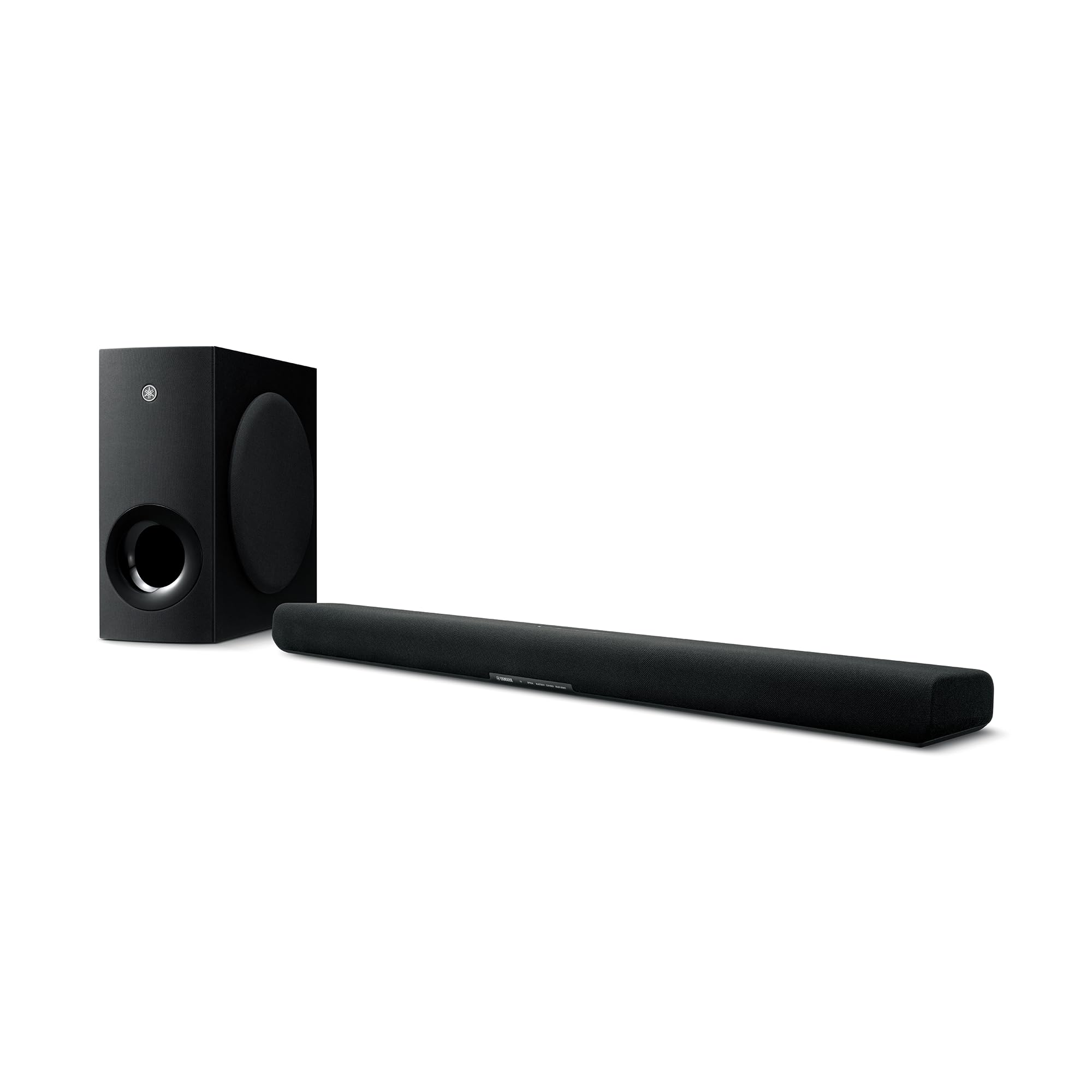
An audio-first bar built by a company that has spent decades in sound
The 6.5-inch wireless subwoofer is the anchor here — a genuinely separate box delivered in the package, so you get the low-end thump without buying anything extra. Dolby Atmos pairs with Yamaha True Sound, and the HDMI eARC/ARC connection carries uncompressed, high-bitrate audio straight from your TV. That last part matters when you’re streaming a game’s orchestral score and want the full detail.
Clear Voice is the dialogue feature, designed to lift speech out of background music and effects — and owners consistently praise how well it works, with several reporting they can finally hear voices clearly while streaming. Bluetooth Multipoint lets two devices stay connected at once, so your phone and console can share the bar without constant re-pairing. Movie, Stereo, Standard, and Game modes handle the same content switches in one button press each.
Owners describe it as delivering great sound quality, with particular praise for how well the subwoofer complements the bar, and the price-to-performance ratio is one of the strongest things buyers talk about. Connectivity feedback runs mixed, so be sure the eARC port on your TV is properly enabled before you blame the bar. It mounts to the wall with built-in keyholes, keeping the install clean.
Why it earns its spot
- 6.5-inch wireless subwoofer included — no separate purchase needed.
- HDMI eARC/ARC carries uncompressed high-bitrate audio.
- Clear Voice dialogue enhancement is a recurring owner highlight.
- Bluetooth Multipoint keeps two devices connected at once.
Honest limits
- Connectivity drawn from mixed reports, so eARC setup needs care.
- No rear surrounds in the box, only the bar-plus-sub pairing.
Pick it for: the buyer who values honest bass and clear dialogue over flashy smart features.
Leave it if: you want an app ecosystem and multi-room audio.
8. JBL Bar 500 Soundbar

590 watts feeding a ten-inch subwoofer that can shake the whole room
590W of total system output is the largest power figure on this entire page, and a full 10-inch wireless subwoofer doing the low end. Owners describe it as shaking the house, and several note the bass is powerful enough to fill an 11×12 living room. That’s the bar for a big room where you want explosions you feel in your chest.
MultiBeam surround processing fires sound around the room without extra speakers, so Atmos effects spread sideways and above without a rear speaker pair. Built-in Wi-Fi with AirPlay, Alexa Multi-Room Music, and Chromecast opens up streaming, and it also handles automatic software updates so new features arrive without a manual step. PureVoice dialogue enhancement keeps voices ahead of the effects even at peak volume.
The trade-off in a wooden building is real — that 10-inch sub pushes a lot of low-frequency energy, so keep it off the shared wall. Dialogue quality feedback runs mixed, meaning PureVoice helps but doesn’t entirely solve the mud when the mix is dense. Audio latency is listed at 200 milliseconds, which is fine for streaming but worth knowing if you’re sensitive to lip-sync drift.
The headline: 590W total output and a 10-inch wireless sub — the biggest bass rig on the list.
Worth noting: 200-millisecond audio latency on the spec sheet, and dialogue gets mixed reviews.
Made for: a roomy living room with a wood floor and no shared wall on the sub side.
Maybe not for: an apartment where your neighbor hears every footstep already.
9. Samsung Q800F 5.1.2ch Q Series Soundbar

Five channels and a height pair — Dolby Atmos aimed above your head
That 5.1.2 layout is the spec that separates this from the S60D’s 5.0 — the final .2 is two up-firing height channels that bounce sound off the ceiling, so helicopters genuinely read as overhead. Dolby Atmos travels wirelessly from a compatible TV, no HDMI cable required, and the same trick keeps the shelf looking clean.
Bass comes from a compact subwoofer with a 6.5-inch active driver paired to an 8-inch passive radiator, so it moves real air without a tower-sized cabinet. SpaceFit Sound uses a microphone inside the bar to analyze the room and automatically calibrate the output to where the soundbar, sub, and rear speakers actually sit. That’s a genuinely helpful feature if your couch isn’t centered or your room isn’t a rectangle.
Owners point to how well the high, mid, and center voice speakers fill the room, and to the subwoofer’s power. Q-Symphony pairing with a Samsung QLED TV gets called out as smooth. Samsung TV speakers and the bar run together as one combined system, splitting voices from background sound and remastering the audio objects. The value question gets mixed reviews, though. Buy this one if you’re already inside the Samsung family, where that synergy pays out; if you own another brand’s TV, you lose the Q-Symphony benefit.
Gaming upside: Game Mode Pro and Active Voice Analyzer keep dialogue ahead of room noise.
Room-specific: SpaceFit Sound calibrates to your layout, which matters more than most spec sheets admit.
Where it stings: the premium to buy in means value-for-money is a fair question.
Worth the step up: a Samsung TV owner with a 5.1.2 layout in mind and the budget to get there.
Think twice if: your TV isn’t a Samsung — you’d be paying for synergy features you can’t use.
Know the Specs
Channels (2.0, 3.1, 5.1.2 — what the math means)
Each number in a channel count describes a different speaker group. The first counts ear-level speakers, the middle counts subwoofer drivers, and the final counts height or up-firing speakers. So a 2.0 bar has two ear-level drivers and no sub, a 3.1 has three ear-level and one sub, and a 5.1.2 has five ear-level, one sub, and two height. More channels give you more separated sound placement, which for gaming means directional audio cues land in the right spot and voices get their own speaker. A center channel is the single most valuable one for dialogue clarity.
HDMI eARC, optical, and 120Hz passthrough
HDMI eARC is the port that lets your TV send uncompressed sound down to the bar over one cable. Optical is the older standard and caps what formats can travel. If your TV supports eARC, use it. Passthrough refresh rate is a different measure — it’s the refresh signal the bar will carry through to your TV from a console plugged into the bar. A bar rated up to 120Hz won’t knock a high-frame-rate game down to a lower refresh. Check that number before you route the console through the bar.
Common Questions
Will an Xbox Soundbar work with my Xbox Series X or Series S?
Do I need a subwoofer to feel the bass in games?
Does a soundbar add input lag when I’m gaming?
Is Dolby Atmos worth having for gaming specifically?
How do I set up a soundbar with an Xbox and a TV at the same time?
Can I mount a soundbar above or below my TV on the wall?
Do I need a Samsung TV to get the most out of a Samsung soundbar?
How much room does a wireless subwoofer need?
Will a soundbar improve dialogue in games with dense background audio?
What’s the difference between Dolby Atmos and DTS Virtual:X?
The Bottom Line
For the widest, most detailed sound placement, build around the Sonos Arc Ultra — if you’re willing to add sub and rear speakers over time. Its 9.1.4 channel layout (nine ear-level channels, one bass channel, four height channels) is the most ambitious on this list. Its Speech Enhancement actively hunts dialogue in a crowd of effects. The honest nudge: this is a bar you grow into rather than one that arrives complete, so budget for the extra speakers.
Want bass without a second box? The Hisense A620 packs a 240W built-in subwoofer (the woofer is built into the bar itself) and a clever TV mode that borrows Atmos decoding from a compatible Hisense set. If your living room is large and your neighbors are tolerant, reach for the JBL Bar 500. Its 590W output and 10-inch wireless subwoofer are the ones to pick when you want the room to move.
How we choose
We do not accept paid placement. Every pick is matched to a real buyer and a real use-case; we do not hands-on test units.
Sources
Specifications: manufacturer listings and product documentation. Review insights: verified customer reviews, as of November 2026. Pricing: not shown on this page (it changes often); check the current price via the retailer link.
As an Amazon Associate, Tactical Gear Guy earns from qualifying purchases. This does not affect which products we feature.