Specs are compiled from manufacturer listings and verified buyer reviews and can change over time — please confirm the key details on the product page before buying.
If you want distant detail from your Android phone without buying a dedicated camera, a clip-on telephoto lens is the cheapest way in — and the honest answer is that magnification alone tells you almost nothing. A 60X lens at the bottom of your bag can produce mush while a 6X lens in your pocket produces the sharpest frame of the day. The number that matters is how the optics are built, not how big the multiplier looks on the box.
This guide is built by comparing the manufacturers’ published specifications and the patterns across verified customer reviews, so you get each pick’s real strengths and trade-offs instead of marketing spin.
Below you will find how the clip mount works, what the power number really means, and which focal lengths fit your shooting. Choosing the right zoom lens for android phone starts with matching the power to the subject, not the spec sheet.
Top Picks

How To Choose The Best Zoom Lens for Android Phone
You are buying a small telescope and a clamp. That is the whole product. Everything about your results comes from how good the glass is and how steadily the clamp holds it against your phone’s main camera. Get those two right and a cheap lens outshoots an expensive one. Get them wrong and no price tier saves you.
The multiplier is marketing, the focal length is physics
A “60X” label is usually a magnification multiplier the maker chose to print. A “144mm equivalent” or “400mm” label describes the actual focal length — how tight the field of view will be. Focal length is the number you can compare across brands. A 6X lens rated at 144mm equivalent and a 400mm fixed lens are not in the same class at all, and you should read the millimetre figure before the X figure.
Work out your subject distance first
Portraits and pets across a room are a short-distance job. A concert stage, a bird on a branch, or a moon shot is a long-distance job. Some lenses are built for the first and clearly disclaim the second. Match the distance to the lens’s stated use, because a lens designed for daily distance will not fill the frame with the moon no matter how you focus it.
The mount: thread or spring clip
A 17mm thread mount means the lens screws into a matching case or rig, so it stays perfectly centred on the camera. A spring clip squeezes the phone body and holds the lens in a slider. The clip works on almost any phone but can shift. The thread is rock solid but ties you to a case or cage. Know which one your phone and case can accept before you buy.
Stability decides sharpness
Magnification magnifies shake. At high power, a handheld frame will smear. A lens that ships with a tripod, or at least a tripod thread, is doing you a real favour — especially for long-distance and low-light shooting. If your kit has no tripod, plan to brace the phone on something solid.
Turn off macro mode and enable the in-camera zoom
Every clip-on lens needs your phone to stop fighting it. Switch off macro mode before you shoot, and on many phones you will need to nudge the in-camera zoom up to around 2x or more so the lens’s black circle disappears and fills the screen. This is normal, not a defect.
Side-by-Side Comparison
| Model | Best For | Magnification / Focal Length | Mount Type | Weight | Amazon |
|---|---|---|---|---|---|
| 32X Telephoto Phone Lens★ Best Overall | Budget dual-use telephoto | 32X | Phone clip | 0.3 lb | Amazon |
| 60mm Telephoto Lens (Veedzoens)Best Value | Portrait and everyday distance | 60mm, 2X | 17mm thread clip | 3.7 oz | Amazon |
| APEXEL 6X Upgraded TelephotoTop Performer | Sharp everyday reach | 144mm equivalent, 6X | 17mm universal clip | 4.28 oz | Amazon |
| 400mm Telephoto Lens (COSULAN) | Long-range wildlife and sport | 400mm fixed | Universal clip | 5.6 oz | Amazon |
| 36X Telephoto Lens (Evil Eye) | Tripod-supported outdoor use | 36X | Phone clip | — | Amazon |
| Freewell 6X Telephoto | Composed tripod shots | 6X, 15.7° field | 17mm mount | — | Amazon |
| 20-60X Zoom Telephoto (MIAO LAB) | Variable power with tripod | 20-60X zoom | Universal phone clip | 3.8 lb | Amazon |
| APEXEL 60X Telephoto Kit | Moon and long-distance subjects | 60X, 24.0-95.0mm | F001 adjustable clip | — | Amazon |
Detailed Reviews
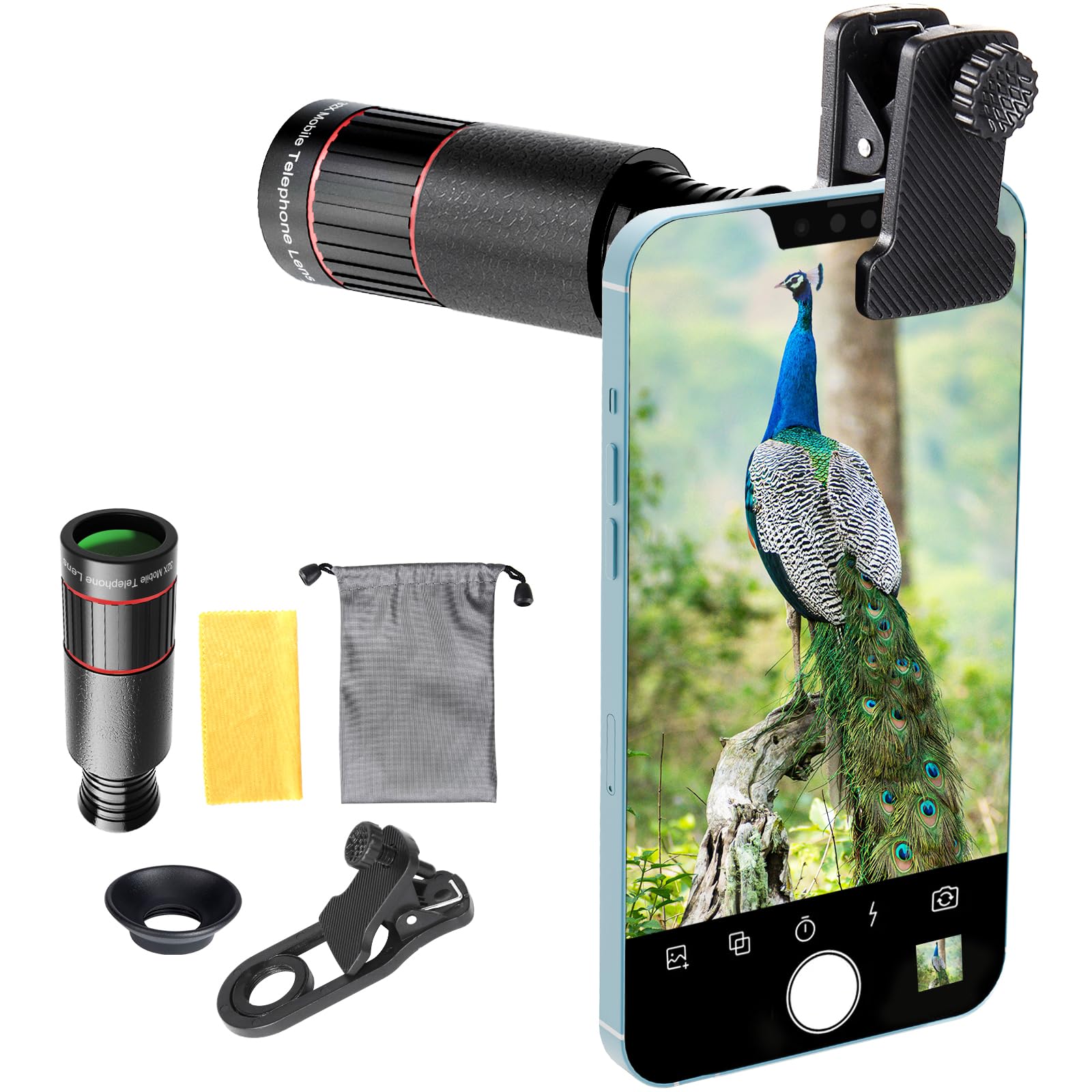
1. 32X Telephoto Phone Lens for iPhone & Android
Two devices in one barrel — a phone lens by day, a handheld telescope when you lift it away.
The 32X multiplier is the eye-catcher, but the second use is what separates it. Clip it to your phone and it works as a telephoto lens. Pull it off and hold it up, and it becomes a small portable telescope for spotting distant objects with your own eye. That dual personality is what you are actually paying for.
It measures 3.7 inches long and 0.3 lb, so it drops in a jacket pocket and comes back out when you need it. FMC coating (a multi-layer film on the glass that helps cut flare and keep colour natural) is the technical support behind clearer long-distance frames. A 60-day satisfaction money-back guarantee backs it, which tells you the maker expects you to test it and be sure.
The honest trade-off: a 32X lens on a friction clip magnifies every wobble in your hand. There is no image stabilization inside. For brighter, steadier reach across a concert crowd or a distant building, brace it on a rail or a table and you will see the real payoff. Handheld works, but the sharpest frames come with a steady rest.
Where it earns its keep
- 32X reach in a 3.7-inch, 0.3 lb barrel that slips into a jacket pocket.
- The telescope mode gives you a second way to observe without draining your phone.
- FMC coating keeps colour and contrast natural at long distance.
- 60-day satisfaction guarantee takes the risk off your purchase.
The trade-offs to weigh
- No image stabilization, so handheld 32X frames take a steady hand.
- The phone clip is a friction-style grip, not a threaded mount.
Reach for this if: you want one pocket-sized lens that doubles as a spotting telescope for hikes, stadiums, and city views.
Look elsewhere if: you need rock-sure alignment on a tripod or a threaded mount that will not budge.
2. 60mm Telephoto Lens for iPhone Android Smartphone
The portrait specialist — 60mm of natural blur instead of a 60X wall of wobble.
This is the shortest zoom on the list, and that is the point. A 60mm focal length pulls in a subject without dragging a whole skyline into frame — think portraits, wildlife at moderate distance, and sports from the stands. The manufacturer says it produces a natural blurring effect, which is the look you get when a long focal length separates your subject from the background.
It ships with a 17mm thread clip, a cleaning cloth, a manual, and a portable bag, so the kit is complete on day one. At 3.7 oz it adds almost nothing to the weight of your phone and disappears into the bag between shots.
The catch is modest: main camera only, macro mode off, and the phone does the focusing. The manufacturer tells you to use it on your phone’s main camera and to switch off macro mode first — a fixed-focus lens gives you no manual ring to lean on, so your phone does the focusing. Get that setup right and the 60mm frames come out clean; skip it and you will chase soft frames.
The focal length call: 60mm is a deliberate answer to the fact that a huge multiplier is often unusable handheld. If your subjects are five metres away rather than five hundred, the shorter glass is the more useful choice.
What to plan for: fixed focus means you point and trust the phone. It rewards shooters who set up carefully more than those who panic-zoom.
Choose it when: portraits and mid-distance details are your main job, and you want a light lens that vanishes in a bag.
Pass it over if: you need variable focus you twist by hand for very tight long-distance work.
3. APEXEL 6X Upgraded Telephoto Lens
The one that wins on build quality and daily usefulness, not on the loudest number.
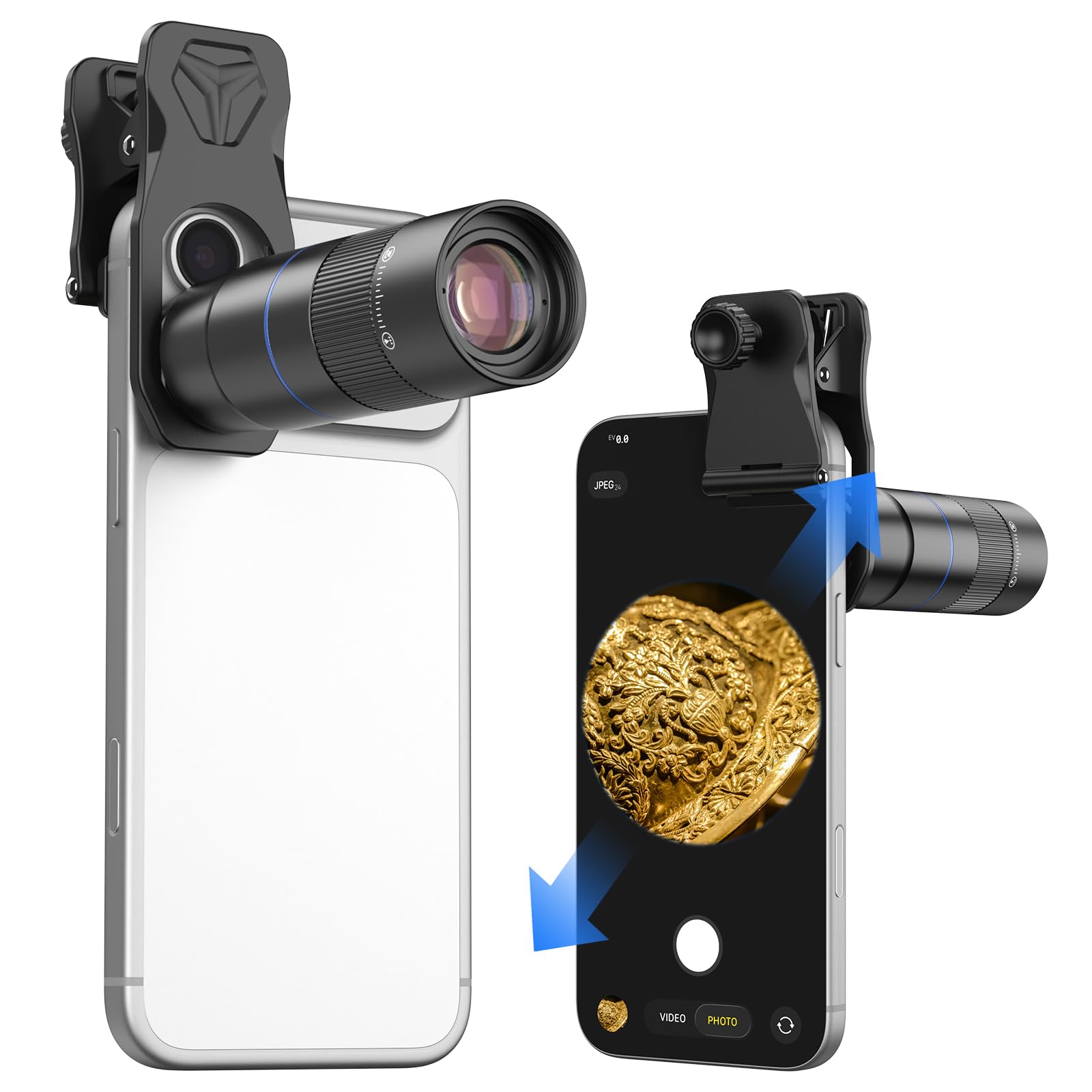
Ten glass elements in seven groups, each with a multi-layer coating, sit inside an aluminium housing that weighs only 4.28 oz (121g). That component count is the reason this lens competes with far showier options: more glass elements correct more of the optical mess that single-element phone lenses leave in the frame. The 144mm equivalent focal length is a tight but real reach, right for street scenes, travel, and everyday creative shooting.
Unlike the 400mm COSULAN fixed lens, which chases the far horizon at a fixed 400mm, this one is built for the distance you actually shoot. The manufacturer is refreshingly direct about the limit too — it is the best daily-distance lens here and is not meant for the moon or extreme long-range work. Buy it for street, travel, and everyday distance, not the moon, and it will not disappoint you.
Build quality is the thing owners rave about most, and the second most-praised trait is compatibility across iPhone, Samsung, Pixel, and OnePlus phones. A clip attaches it to the main camera, and it also works as a standalone monocular when you add the eyecup. Two recurring caveats worth planning around: it wants neither a huge phone nor a thick case, and the spring clip can cross part of the screen edge on wider phones. Align the clip carefully and those two fusses disappear.
Why it takes the top spot
- 10 glass elements in 7 groups with multi-layer coatings — the most optically stuffed build here.
- Aluminium housing at only 4.28 oz (121g) — pocketable without feeling cheap.
- The 144mm equivalent focal length is a genuinely useful everyday reach.
- Dual-use monocular mode via the included eyecup.
What you should know going in
- Absolutely not built for the moon or extreme long-range subjects.
- The clip can block part of the screen on larger phones, and thick cases can interfere with the fit.
The verdict: this is the lens most Android shooters should buy first — excellent optics, honest limits, and a weight you will actually carry.
The one caveat: if you want lunar or 400mm-class reach, this is not that lens.
4. 400mm Telephoto Lens for iPhone & Android (COSULAN)
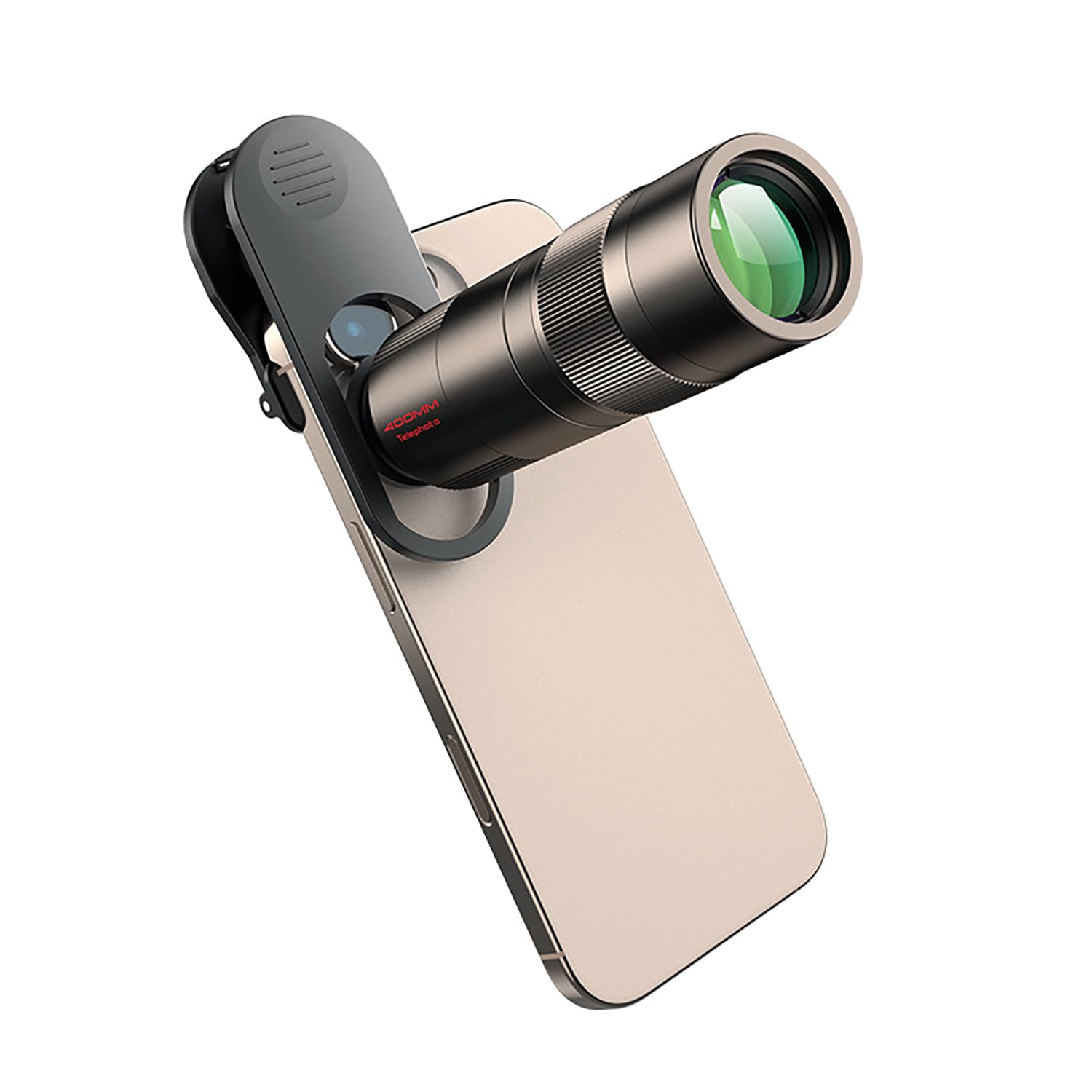
400mm of pull, seven coats of glass, and a kit bag that thinks of everything.
For wildlife on a ridge or a striker at the far end of the pitch, this is the lens that pushes past the everyday-distance pack. Where the Veedzoens 60mm above tops out at 60mm, this one fixes at 400mm, a very different class of reach. A larger aperture helps it gather more light, so dawn and dusk shots hold brightness that shorter lenses lose.
The FMC 7-layer optical coating (seven thin films on the glass that cut colour fringing and push more light through) is the spec that backs the clean long-distance look. The kit arrives complete — universal clip, eyepiece, storage pouch, cleaning cloth, and two lens caps — so nothing crucial is missing on arrival. It is also one of the lighter long-throw options at 5.6 oz, far below the 3.8 lb MIAO LAB kit.
The part that deserves your attention is focus. This is a fixed-focus 400mm lens, so you cannot twist a ring to pull a subject into sharpness — you lean on your phone’s autofocus and the narrow-angle or full-screen mode you choose. Expect to spend a little time on setup before the first keeper. Once you are dialled in, the reach is the reward.
The reach argument: 400mm is the focal length that turns a distant building or bird into a filled frame. If that is your subject, the extra pull justifies the fiddlier setup.
The setup cost: no focus ring means your phone does the work. Narrow-angle mode for precise portraits, full-screen for hands-free wide views — the switch is there, you just have to learn it.
It suits: wildlife watchers and sports shooters who accept a patient setup in return for serious 400mm reach.
skip it if: you want to point and shoot fast — this lens asks you to set up first.
5. 36X Telephoto Lens with Tripod (Evil Eye)
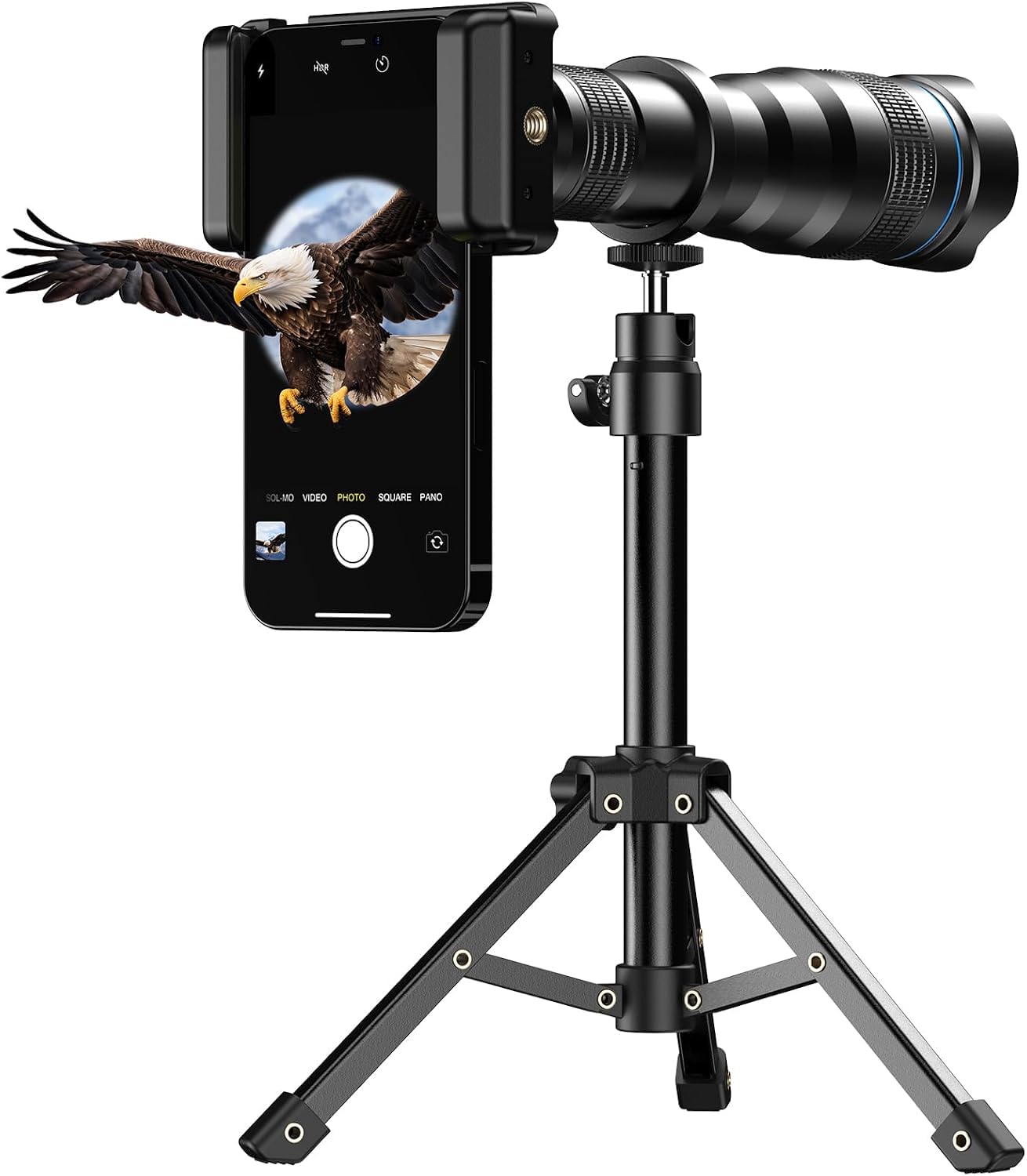
The kit that hands you back both hands — 36X, a tripod, and a focus ring you twist.
Aircraft-grade aluminium and quality optical glass house the 36X lens, and a rotating focus ring lets you dial the sharpness by hand — the kind of tactile control that makes long-distance framing feel like real photography rather than hoping the phone’s autofocus cooperates. It also converts into a simple monocular for landscape scanning when you want to rest your eyes on the scene itself.
The tripod is the part worth getting excited about. It assembles with a fixed ring and does exactly what you need at high magnification: kills the shake that turns a distant bird into a smear. The phone clip is claimed to fit most smartphones on the market, including iPhone, Google, Samsung, OnePlus, Sony, LG, and Huawei models. A storage bag and hook let you sling the whole lens off a backpack so it takes up a bag-lining’s worth of space at most.
The limitation is honest: no image stabilization, and 36X is still a job for the tripod most of the time. Hand-held use works best at the lower end of the zoom and in bright light. Treat the included tripod as part of the kit rather than an extra, and the 36X optics deliver.
Why the tripod changes everything: at 36X, a millimetre of hand movement becomes a visible smear. Mount it and the lens competes with anything here; hold it loose and you waste the optics.
The honest catch: you will not hand-hold 36X for long. Plan for a flat surface or accept softer frames.
Pick this one when: you shoot long-distance subjects for long stretches — camping, birding, moon-watching, or stadium work.
Think twice if: your shooting is mostly quick grab-and-go and a tripod will stay in the bag.
6. Freewell 6X Telephoto Lens for Smartphones

A 15.7° field of view — the lens that frames rather than catalogs.
The defining number here is the narrow 15.7° field of view. That tight frame isolates a single subject and pushes the background into soft separation, which is the compositional look serious photographers chase. It does that at 6X optical magnification in an aluminium alloy body, with a dual-sided multi-layer anti-reflective coating that cuts glare on bright, tricky days.
Unlike the threaded-into-a-case approach of some rigs, this one twists clockwise into a 17mm thread mount on a smartphone case or rig and locks onto the 1x main camera. That is a stable, repeatable alignment — the sort you want when your whole kit is sitting on a tripod for a wildlife or landscape sequence. It ships with a cleaning cloth and a storage bag.
Freewell’s own note is the one to take seriously: high magnification demands stability, so pair it with a tripod for blur-free shots, especially in low light. No image stabilization is built in, and manual focus is a deliberate act rather than an afterthought. This is a lens for someone who already has a case with a 17mm mount or is willing to build that setup.
The compositional edge: 15.7° is a genuinely tight frame. If your shots have felt cluttered, this focal length will clean them up.
What it demands: a 17mm thread case and a tripod. Without both, you are fighting the lens rather than shooting with it.
Worth it for: shooters who already run a 17mm-mount case and want a tight, tripod-stable 6X frame.
Not the one if: your phone lives in a plain clip-only setup and you shoot handheld.
7. 20-60X Zoom Telephoto Lens (MIAO LAB)

The only true variable-zoom kit here — 20X to 60X on one twist of the ring.
Every other lens on this list fixes its magnification. This one dials it: a 20-60X range you adjust by rotating the focus ring, moving from a wide field of view right down to detailed close-ups of distant subjects. That flexibility is the reason to look here. Wildlife and stadium work fit the lower end; moon and long-range detail sit at the top.
The 45mm large-diameter objective lens gathers good light and holds a wide field, which helps keep dawn and dusk shots bright. There is a standard 58mm filter thread too, so you can add UV, VND, CPL, or star filters for creative control. The kit ships with an aluminium tripod — 4-section legs, a 360° pan-tilt head, and a universal 1/4″-20 thread — plus a cell-phone stretching clip, eyecup, covers, and an EVA spacer.
What wins people over is how well it functions, and the optics quality holds up as the second most-praised trait. The mounting is where buyers split — the spring mount is fussy to set and adjust securely, so treat the tripod and the adjustable slider as part of the same job. Its 3.8 lb weight also makes this a stay-put kit rather than a pocketable one.
What makes it stand out
- 20-60X variable magnification in a single lens — the widest power range here.
- 45mm objective lens and 58mm filter thread for low-light reach and creative filters.
- Aluminium 4-section tripod with a 360° pan-tilt head included.
- Monocular mode via the included eyecup.
Where it asks patience
- The spring mount takes care and practice to sit securely.
- At 3.8 lb it is a stationary kit, not a take-everywhere lens.
Best match for: campers, birders, and stargazers who want one kit covering both wide observation and tight moon shots.
Consider a lighter pick if: you want something pocketable that travels in a jacket, not a bag.
8. APEXEL 60X Telephoto Lens Kit
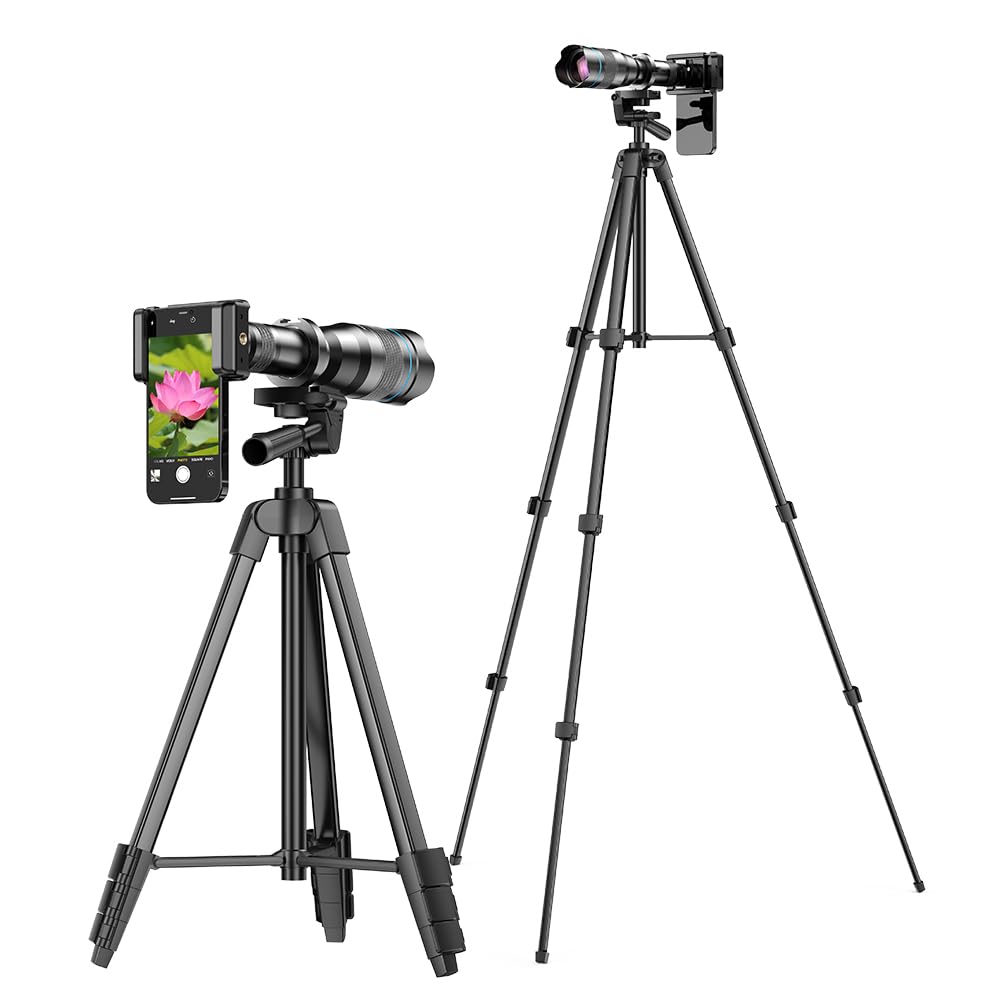
Built for the far horizon — 60X pull, a tripod, and a shutter remote that removes shake.
The 60X telephoto design fills more of your phone screen with distant subjects than lower-power lenses manage, so the moon, a lighthouse, a shooting-range target, or a perched bird actually fills the frame. The 50mm objective lens and 10-element, six-group optical system with multi-layer coatings push brightness and contrast at those distances. Start with subjects around 66 ft/20 m out, per the manufacturer, with the most consistent results between 98 and 492 ft/30-150 m.
The kit is the argument for choosing this over a bare lens. A 4-section aluminium tripod with a 1/4-inch mount, 360-degree horizontal rotation, 180-degree tilt, and up to 6.6 lb/3 kg carry weight keeps the setup still. The Bluetooth remote fires the shutter from up to 30 ft/10 m away, so you are not touching the phone when it matters. Small movements get magnified at 60X, which is why every extra piece here is doing real work.
The honest limit is baked into the design: this is not for close-range portraits or fast-moving action, and picture quality splits across buyers — sharp shots in good light, softer ones when conditions or setup are off. It is at its best with large, mostly stationary subjects in daylight. Get the 66 ft/20 m-plus distance and the tripod right, and the 60X kit earns its keep.
The remote changes the shot: a 60X frame cannot tolerate a finger on the shutter. The 30 ft/10 m Bluetooth remote solves that, and that is why this kit includes it rather than treating it as an extra.
The recurring trade-off: this is a far-subject lens, not a general-purpose one. Portraits and action at close range are where it wobbles.
Buy it for: moon photography, distant buildings, and long-range wildlife from a stationary setup.
Don’t reach for it when: your main subjects are people up close or things that move fast.
Know the Specs
Magnification vs. focal length
A “60X” or “6X” label is a multiplier the maker prints — it says little about optical quality. A focal length like 144mm equivalent or 400mm fixed describes the actual field of view and is the apples-to-apples figure you can compare. Always read the millimetres before the X.
Optical coating and glass element count
Multi-layer coatings (sometimes called FMC) reduce flare and colour fringing, and more glass elements in more groups tend to correct more distortion. A lens built with 10 elements in 7 groups corrects more of the optical mess than a bare single element — which is why element count is a quieter quality signal than the headline zoom.
17mm thread mount vs. spring clip
A 17mm thread mount screws the lens into a matching case or rig for fixed, centred alignment. A spring clip squeezes the phone and holds a slider — more compatible but easier to shift. Before buying, check whether the lens needs a 17mm case or works with the clip your phone already accepts.
Tripod, thread, and image stabilization
Most phone telephoto lenses have no built-in image stabilization. High magnification magnifies hand-shake, so a tripod or a 1/4″-20 thread mount makes the difference between a sharp frame and a smear — especially for long-distance and low-light shots.
Common Questions
Will a clip-on telephoto lens work on my Android phone?
Should I zoom in on my phone after attaching the lens?
Does a higher magnification like 60X always mean better image quality?
Can I use these lenses for moon photography?
Do I need a tripod to get sharp shots?
Will a clip-on lens block part of my screen?
What is the difference between fixed focus and manual focus on these lenses?
Are these lenses usable as a standalone telescope?
Which lens should I pick for fast-moving action like sports?
Does the lens work if my phone case is thick?
The Bottom Line
For most Android shooters, the zoom lens for android phone winner is the APEXEL 6X Upgraded Telephoto Lens — 10 glass elements in 7 groups, a 144mm equivalent reach, and 4.28 oz of aluminium build make it the sharpest everyday pick. If long-range subjects and the moon are your mission, the APEXEL 60X with its tripod and Bluetooth remote is the one to reach for. And for budget flexibility with a tripod included, the Evil Eye 36X earns its place. Whichever you choose, the APEXEL 6X is the pick that best matches how most of us actually shoot — and that is the honest nudge.
How we choose
We do not accept paid placement. Every pick is matched to a real buyer and a real use-case; we do not hands-on test units.
Sources
Specifications: manufacturer listings and product documentation. Review insights: verified customer reviews, as of November 2026. Pricing: not shown on this page (it changes often); check the current price via the retailer link.
As an Amazon Associate, Tactical Gear Guy earns from qualifying purchases. This does not affect which products we feature.