Specs are compiled from manufacturer listings and verified buyer reviews and can change over time — please confirm the key details on the product page before buying.
Your water bill is the real reason to pick one sprinkler controller over another. A basic dial unit waters on a fixed clock no matter what the sky is doing. A smart box watches the local forecast and skips a cycle when rain is coming. The right pick for you depends on three things: how many zones your yard runs, if you want app control, and whether the unit lives indoors or on an outdoor wall.
This guide is built by comparing the manufacturers’ published specifications and the patterns across verified customer reviews, so you get each pick’s real strengths and trade-offs instead of marketing spin.
Below you’ll find station counts, wiring requirements, and weather features laid out plainly, so you can match a controller to your own valve box instead of guessing. This breakdown of the best yard sprinkler controller covers all nine picks.
Top Picks


How To Choose The Best Yard Sprinkler Controller
The biggest mistake first-time buyers make is buying more zones than their yard actually uses. Walk to your valve box and count the valves first — that number is your ceiling. An 8-zone unit wired to a 5-zone yard still works fine, but you paid for capacity you’ll never switch on.
Count your valves, not your lawn
Each valve in your box feeds one watering area, and each valve needs one station on the controller. A front lawn, a back lawn, a flower bed, and a drip line is four valves. Most suburban homes land between four and eight, which is why the 6-zone and 8-zone models dominate this list. Leave one spare station if you plan to add a garden bed later.
Decide if you want an app at all
A dial or button controller requires you to walk outside and stand in front of it to change anything. An app-connected unit lets you adjust a schedule from the couch or from a hotel room. That convenience is real, but it depends on a decent WiFi signal reaching wherever the box is mounted — and a garage or shed wall is often the worst spot in the house for signal. Wired Ethernet or a controller that still runs its saved schedule without WiFi solves that.
Indoor, outdoor, or both
Some units are built for indoor mounting only, usually in a garage or utility closet near the valve wiring. Others carry a weatherproof housing and can bolt straight to an exterior wall. If your current controller already sits outside, buy an indoor/outdoor model or plan on an enclosure — an indoor-only unit mounted in the rain is asking for trouble.
Weather skipping is where the water savings live
The feature that actually moves your bill is weather-based skipping: the controller pulls a local forecast and cancels a cycle when rain, wind, or freeze is coming. Pair that with a cycle-and-soak setting, which waters in short bursts so clay soil absorbs it instead of running it down the driveway. Both features appear across several picks below.
Side-by-Side Comparison
| Model | Best For | Zones | App / WiFi | Mounting | Amazon |
|---|---|---|---|---|---|
| Rain Bird ESP-TM2 8 Station (TM2-8)★ Best Overall | Best Overall | 8 | WiFi ready (LNK module sold separately) | Indoor/Outdoor | Amazon |
| Orbit B-hyve 6-Zone (57946)Best App Experience | Best App Experience | 6 | Built-in app, Alexa compatible | Indoor/Outdoor | Amazon |
| Netro Spark 8 ZoneTouchscreen Fans | Touchscreen Fans | 8 | Built-in WiFi app | Indoor use | Amazon |
| Hunter X-Core XC800i | No-App Simplicity | 8 | None (dial control) | Indoor | Amazon |
| Rain Bird TM2-6 | Straightforward Replacement | 6 | WiFi ready (module separate) | Indoor/Outdoor | Amazon |
| ImoLaza 8 Zone ET Master | Water Conservation | 8 | Built-in WiFi, Alexa and Google | Indoor (case sold separately for outdoors) | Amazon |
| Hunter X2 8 Zone | Upgrade Path | 8 | Optional Hydrawise via WAND module | Indoor/Outdoor | Amazon |
| Yardian Pro 8-Zone | Apple HomeKit Homes | 8 | Built-in WiFi plus RJ45 Ethernet | Indoor (IP56 enclosure sold separately) | Amazon |
| Rachio 3 8-Zone | Premium Pick | 8 | Built-in WiFi app, Works With Alexa | Indoor | Amazon |
Detailed Reviews
1. Rain Bird ESP-TM2 TM2-8
Our pick — 4.5+★ from 950+ verified ratings; the strongest balance of quality and price.
Eight stations, a three-step schedule, and a housing that tolerates the weather.
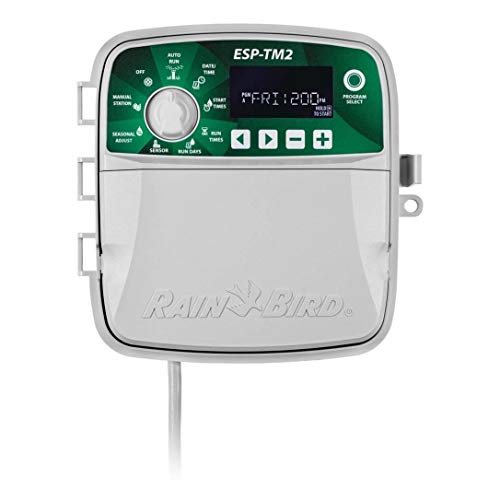
The TM2-8 is the pick that fits the widest spread of yards because it does the basics without fuss. You get eight stations for lawns, beds, and drip lines, and a schedule goes in through three programming steps on a large back-lit LCD. That screen is bright enough to read in direct sun and in low light, which matters when you’re standing in a garage squinting at a dial.
Rain Bird built in a couple of details that save you repeat trips. Contractor Default stores your custom schedule so you can restore it after someone fiddles with the buttons. Delay Watering pauses the whole system for up to 14 days and then resumes automatically once the delay runs out — useful when you reseed or when a neighbor’s crew is digging. The factory-installed 6′ outdoor-rated power cord also means you don’t have to splice your own.
What wins people over is how quickly it goes in. Owners consistently describe a straightforward install, and the fact that so many single out ease of installation tells you the wiring and setup steps are genuinely friendly. The one honest catch is WiFi. This is a WiFi-ready unit, not a WiFi unit — you need the Rain Bird LNK module sold separately to get app control and internet-based weather adjustments.
What It Gets Right
- Eight stations cover front lawn, back lawn, beds, and drip in one box
- Three-step programming plus a large back-lit LCD readable in sun or shade
- Factory-installed 6′ outdoor-rated power cord, so no custom wiring
- Delay Watering up to 14 days then auto-resume — no reprogramming after a pause
Where It Asks More Of You
- App control and weather skips require the LNK WiFi module, sold separately
- At 3.52 pounds it is the heaviest unit on this list, so plan the mount
- A few buyers report the WiFi module link is the fussy part, not the controller
Reach for this if: you want a proven eight-station controller that runs perfectly on its own buttons, with app control as an add-on when you’re ready.
Think twice if: built-in WiFi from the start is a must — the Orbit or Rachio has it without buying a module.
2. Orbit B-hyve Smart Sprinkler Controller, 6-Zone – 57946
Six zones, app control from anywhere, and a weatherproof case that goes indoors or out.
If you want to run your sprinklers from your phone without buying an extra module, the B-hyve is the clearest path. Six zones handle a standard front-and-back yard with a couple of beds, and the waterproof housing lets you mount it on a garage wall, in a shed, or on an outdoor wall. At 16 ounces it is light enough that mounting is a one-hand job.
The app is the whole point here. You build schedules on your phone or tablet, adjust programs, and check on each zone remotely. It also works with Alexa, so a voice command can start or stop a run. Owners tend to describe the phone setup as the easy part, especially compared to the older dial timers they replaced.
Here’s the trade-off to weigh. This is a 6-zone controller, while the Hunter X-Core XC800i gives you eight stations — 8 versus 6 zones — so if your valve box has seven or eight valves, you’d be leaving stations unused. It is also a comparatively wide unit, sized at 3″L x 9″W x 8″H. For a tidy six-zone yard, though, the app control plus the weatherproof case is a lot of controller for the money.
Where the value sits: a weatherproof six-zone box with phone scheduling and Alexa voice control, no add-on module needed — the setup most first-time smart-controller buyers actually want.
Suits you if: your yard runs six zones or fewer and you’d rather build the schedule on a phone than kneel at a dial.
Look elsewhere if: you need eight stations or a pure offline controller.
3. Netro Spark 8 Zone
Simple on-device touch icons for when you don’t want to open the app.
The Spark puts eight zones behind a small touch surface, so you can water without reaching for your phone. A grass icon picks the zone, a clock icon sets the run time, and a kettle icon gives you an immediate manual start — the remaining time shows above as it runs. That on-panel control is the reason this one separates from the app-only crowd.
In the app you get more. Each zone can be named and given a photo, which turns a row of “Station 1, 2, 3” labels into “Front Lawn” and “Vegetable Garden.” Scheduling supports daily intervals, weekly patterns, odd/even days, and date ranges you choose. Netro pulls a location-based forecast for precipitation, temperature, humidity, and wind speed, then logs up to 60 days of irrigation history with start time and duration for each run.
Setup is where you’ll want your eyes open. A good chunk of buyers get it running exactly as promised, but a share of buyers were unable to get it working — the honest read is that this unit rewards a patient setup session and a solid WiFi signal near the box. It also has no battery backup and must stay plugged in. Build quality draws the most goodwill of anything on this unit, which is reassuring for a device that lives on a wall for years.
Why people warm to it: the touch panel gives you instant manual watering without the app, and the 60-day irrigation log tells you exactly what ran and for how long.
Best for: someone who wants both a physical touch panel and a rich app with named, photo-tagged zones.
Worth knowing: this is an indoor-use unit with no battery backup, so it needs a dry spot and a steady outlet.
4. Hunter X-Core XC800i

A dial-and-done timer that keeps watering through a power cut or a dead router.
Not every yard needs an app, and the XC800i is the pick for anyone who would rather turn a knob than manage a login. It runs eight zones, each with its own schedule, across three programs with four start times each — up to 12 total start times if you use them all. That’s enough to give the front, the back, the garden, and a high-traffic strip their own morning slot.
The dial approach is the feature, not a compromise. There’s no signal to drop, no app to update, and no server to go quiet. Seasonal adjustment lets you trim or stretch run times in one step when the weather shifts, so you’re not reprogramming zone by zone when summer breaks. Quick Check diagnostics flag wiring problems, and built-in surge protection guards the board. If you want remote control later, the Smart Port accepts optional Hunter remotes.
At 1.2 pounds it is the lightest controller here — far lighter than the 3.52-pound Rain Bird TM2-8 — so wall mounting is trivial. Owners describe setup as quick, with station times entered in about half an hour and wiring finished in under 20 minutes. The math on this one also leans toward value: you get eight stations where the Orbit B-hyve gives you six. The limitation to accept is that it’s indoor-only and app-free by design.
What You Gain
- Eight zones across three programs and up to 12 start times
- No WiFi, no app, no login — works during outages and offline
- Seasonal adjustment trims run times in one step
- Quick Check diagnostics and built-in surge protection
What You Give Up
- No app control unless you add an optional Smart Port remote
- Indoor mounting only — it cannot live on an exterior wall
- Every schedule change means walking to the unit
Choose it for: a set-and-trust timer for an eight-zone yard, especially where WiFi never reaches the box.
skip it if: you want forecast-based skips and phone control.
5. Rain Bird TM2-6 Station Indoor/Outdoor Controller

The no-drama replacement for a tired six-zone box, indoors or on the wall.
This is the TM2 platform in its six-station form, and the whole pitch is familiarity. The interface is laid out like the controller you’re taking off the wall, so the swap is mostly matching wires and copying your old run times. A rain sensor input with bypass lets you add a physical rain sensor and still override it when you want a run, and there’s a master valve or pump start circuit for systems that use one.
Ease of use is the thing that carries this controller. Owners describe a setup that goes quickly, and the functionality is what you’d expect from a mainstream brand — solid, predictable, and easy to hand off to a landscaper. It mounts indoors or outdoors, so if your old box sat on an exterior wall, you’re not forced to move it.
Size is the comparison worth making. This unit measures 7.92″L x 3.51″W x 7.86″H, while the Orbit B-hyve runs 3″L x 9″W x 8″H — a 2.6x gap in length — so if your old controller sat in a tight cabinet, the Rain Bird’s narrower profile can be the difference between fitting and not. Weigh that against the station count: six here, eight on the TM2-8 above. Owners who went WiFi-ready on this model note the module link is where a few people hit friction, so treat app control as a bonus rather than the main event.
The honest read: a dependable, familiar six-station unit with rain sensor input and master valve support — but the app side needs the add-on module and isn’t always smooth.
Made for: swapping out an aging six-zone controller with minimal relearning.
Not for: seven- or eight-zone yards, or anyone who needs weather-based skips from the start.
6. ImoLaza 8 Zone
Real-time ET data skips the cycle before your grass ever gets wet.
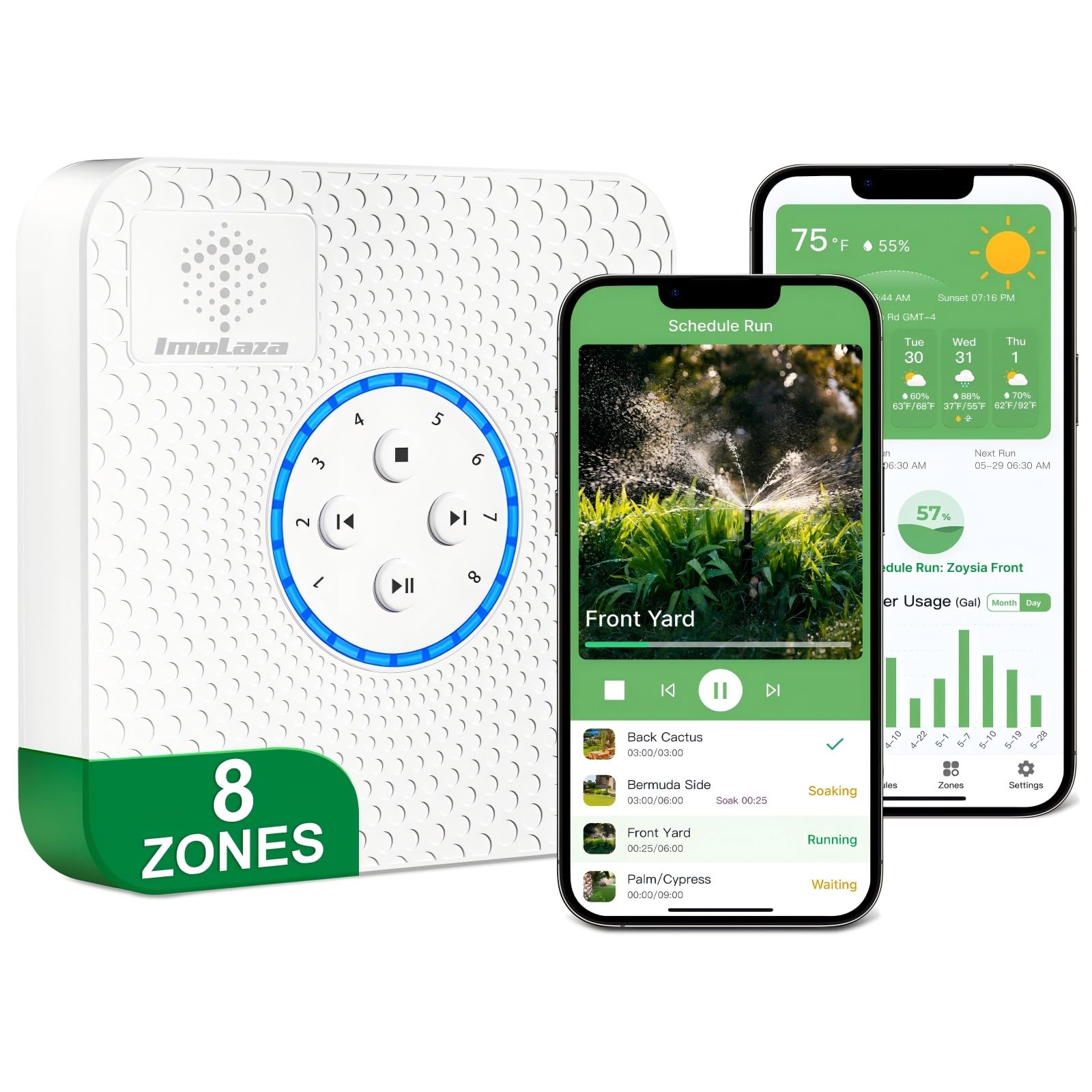
The ImoLaza runs on evapotranspiration — the rate at which your lawn loses water to sun and wind — paired with hyperlocal weather. When rain, wind, freeze, or saturated soil shows up, it skips the run. ImoLaza claims up to 60% water savings, and owners mention the ET skips actually cutting run time. Cycle and Soak is built in, so water goes in short bursts and soaks instead of sheeting off a slope.
What earns it a spot is the flexibility for odd jobs. Beyond standard Smart ET and fixed schedules, there’s a New Grass schedule with up to 24 start times per day for light, frequent watering — the kind of thing you need after seeding or laying sod. Each of the eight zones handles a different area, from lawn to orchard. The app runs on iOS and Android, works with Alexa and Google Assistant, and requires no subscription.
Functionality is the heartbeat here — it’s the aspect owners bring up more than anything else, and it shows in how many separate jobs people describe running through it. Customizability ranks high too, as you’d expect from a controller that lets you tune every zone. The caveats are worth knowing: it’s built for indoor mounting (a waterproof case is sold separately for an outdoor wall), and connectivity is a mixed bag, so a strong signal near the mount helps. Fault alerts for open circuits, controller offline, and flow-meter leaks are a genuinely useful safety net if you’re away from home.
What It Brings
- Real-time ET plus hyperlocal weather skips runs on rain, wind, freeze, or saturated soil
- New Grass schedule with up to 24 start times per day
- Fault detection for open/short circuits and flow-meter leaks
- No monthly subscription, with OTA updates for new features
What To Plan Around
- Indoor-mount design — outdoor walls need the waterproof case, sold separately
- Connectivity is the weak link for some owners
- Sensor pairing for flow monitoring is optional but adds setup steps
The pick for: a water-restriction area or a homeowner who wants the app to do the watering math and warn about leaks.
Bear in mind: budget for the waterproof case if the mount point is outside.
7. Hunter X2 8 Zone

Start with buttons, add smart watering later by plugging in a module.
Eight stations come with the X2, along with three programs and four start times each, plus delay between stations so pump-driven systems don’t pressure-spike. It runs as a capable standalone controller from the start, and the upgrade path is deliberate: add the WAND module, sold separately, and it open up Hunter’s Hydrawise software for remote scheduling, smartphone access, weather-based automation, and water-use monitoring.
Built-in water-savers don’t wait for the module. Weather-based programming and seasonal adjustment are already there, and Cycle and Soak prevents runoff on clay soil and slopes. QuickCheck spots wiring faults instantly, Easy Retrieve saves your full schedule against an outage, and you can run any zone manually for spot watering or a quick test. The cabinet is weather-resistant with a backlit display you can read in any light, so it can live outdoors year-round.
Owners describe the app as easy once Hydrawise is on, with installation finished inside an hour, and three separate schedules are a commonly noted plus. One honest caveat: the battery that backs up the schedule is not a long-term part — there’s a note of it lasting around five years, so plan to swap it. At 2.8 pounds it’s a mid-weight unit, lighter than the 3.52-pound Rain Bird TM2-8 but heavier than the 1.2-pound Hunter X-Core.
Why it earns a place: eight zones, weather-aware scheduling, and Cycle and Soak now, with a genuine path to a full Hydrawise smart system when you want app control.
Pick it if: you want real eight-zone control today with the option to go smart later without replacing the box.
Only if you accept: the WAND module costs extra, and the schedule battery is a maintenance item.
8. Yardian Pro 8-Zone

A wired Ethernet jack for garages where WiFi never quite reaches.
The Yardian Pro solves the one problem that hobbles most smart controllers: a weak signal at the mount point. It has a built-in RJ45 Ethernet port for a stable wired link, plus enhanced WiFi as a fallback. If your controller sits in a detached garage or a metal-clad shed, that jack is the feature that makes the whole thing work.
For Apple households it’s the only unit on this list with native Apple HomeKit support, and it also ties into Amazon Alexa, Google Home, and Home Assistant. Physical buttons on the device let you run zones or test sprinklers with no phone and no internet — handy during install or when the network is down. ET-based watering pulls hyperlocal weather to automate runs, and Yardian claims up to 50% savings on water bills. Flow-monitoring support for both wireless and wired sensors sends leak or burst-pipe alerts before damage spreads.
Reliability is the headline owners come back to, and HomeKit compatibility runs right alongside it. Yardian says a replacement takes under 15 minutes, and a universal 100V–240V adapter means it travels. Two practical notes: it’s built for indoor mounting unless you add the custom IP56 weatherproof enclosure, sold separately, and at 16 ounces it’s a light wall-mount. If your priorities are Apple integration and a rock-solid wired connection, this is the one built for you.
Go here if: you live in the Apple ecosystem or your controller location can take an Ethernet cable.
Just plan for: the outdoor enclosure if you’re mounting on an exterior wall.
9. Rachio 3 8-Zone

The app-driven original, still the one people compare every other controller to.
The Rachio 3 is the benchmark for a reason. Eight zones, a free app for iOS and Android, and patented Weather Intelligence that skips a run for rain, wind, freeze, and more. The app lets you create your own schedule or let Weather Intelligence adjust automatically, run zones on demand, and track estimated water usage. Rachio says it’s compatible with 99% of existing sprinkler systems and installs in 30 minutes or less.
Adaptive scheduling is the core of the Rachio experience. The system learns from the weather and your yard’s conditions and adjusts rather than running a fixed clock, with grow-in options for new plantings. Owners describe the wiring as simple and the phone control as intuitive, and how it uses forecast data to cancel an upcoming run is the feature people point to again and again. Functionality and installation are the two aspects owners bring up most by a wide margin.
The genuine trade-off is the app dependency. The Rachio runs its smart scheduling through the app and the cloud, so if you’d rather not depend on a network link, a dial controller is a better fit. Reliability comes up as a recurring theme in the negatives, so the honest read is that this is a controller most buyers love but comes with occasional service hiccups. At 16 ounces and sized 9.1″L x 1.4″W x 5.6″H, it stays slim against an indoor wall and pairs with Works With Alexa.
What buyers settle on: the app and weather intelligence are the reason it earns its premium spot — flexible scheduling that adapts to your yard rather than a clock on repeat.
The fit for: a phone-first homeowner who wants adaptive weather-driven watering and is fine with the app being central.
The catch: it leans on the app and a network, so a pure offline install isn’t what this is.
Know the Specs
Zones and Stations
A station is a single wire terminal on the controller, and each one drives one valve. Zones and stations are usually the same number in this category — an “8-zone” controller has eight terminals, so look for the higher count if your yard runs more valves. Wiring an 8-station unit to a 5-valve yard is fine, but a 6-station unit can never water a 7th area. Count the valves in your box before you check the label.
WiFi Built-In vs WiFi Ready
“WiFi ready” means the controller has a port for an add-on module you buy separately to open up app control and internet weather. “Built-in WiFi” means the radio is already inside. Both approaches work, but WiFi-ready models add a cost and a setup step later. If app control from day one matters, filter for built-in WiFi — otherwise the module is one more thing to remember at installation.
Weather-Based Skipping and ET
Weather skipping pulls a local forecast and cancels a cycle when rain, wind, or freeze is coming. ET stands for evapotranspiration — the rate your lawn loses moisture to sun and wind — and a controller that reads it adjusts run times to match actual conditions. Some brands claim specific savings percentages on their listings; treat those as maker claims and look at the features behind them, like rain skips and cycle-and-soak.
Cycle and Soak
This setting splits a long watering run into short bursts with a pause in between so water soaks in instead of running off. On clay soil, a slope, or a packed bed, it’s the difference between water reaching the roots and water heading for the curb. If you buy a controller with this, use it on the zones that pool fastest — it’s among the most effective water-saving settings on the list.
Common Questions
How do I know how many zones my sprinkler controller needs?
What does WiFi ready mean on a sprinkler controller?
Can a smart sprinkler controller save water compared to an old timer?
Do I need an electrical outlet near my sprinkler controller?
Can I still water my lawn if the WiFi goes down?
Is a dial controller or a smart controller easier to install?
Can I mount a sprinkler controller on an outside wall?
Does a sprinkler controller work with my existing sprinkler system?
The Bottom Line
For most yards, the best yard sprinkler controller is the Rain Bird ESP-TM2 8 Station — eight stations, a three-step schedule, indoor/outdoor housing, and a Delay Watering feature that pauses up to 14 days and resumes on its own. It’s the crowd favorite here at 4.5+ stars, and most owner feedback centers on how fast it installs. If you want phone control without buying a module, the Orbit B-hyve 6-Zone has built-in app and Alexa control in a weatherproof case. And for an Apple HomeKit home or a garage with weak WiFi, the Yardian Pro earns the spot with its native HomeKit support and wired Ethernet jack.
If water savings top your list, the ImoLaza’s ET-based skips and leak alerts are the reason to look its way. And if app-driven weather intelligence is what you’ve been waiting for, the Rachio 3 remains the standard others get measured against — the honest nudge is simply to buy the one whose app and zone count match how you actually water.
How we choose
We do not accept paid placement. Every pick is matched to a real buyer and a real use-case; we do not hands-on test units.
Sources
Specifications: manufacturer listings and product documentation. Review insights: verified customer reviews, as of November 2026. Pricing: not shown on this page (it changes often); check the current price via the retailer link.
As an Amazon Associate, Tactical Gear Guy earns from qualifying purchases. This does not affect which products we feature.