Specs are compiled from manufacturer listings and verified buyer reviews and can change over time — please confirm the key details on the product page before buying.
If you want the safest buy for an Xbox One S, get a wired headset that plugs straight into the controller — no dongle, no pairing, no dead battery mid-match. That single rule eliminates most of the frustration in this category, and it is why the HyperX CloudX takes the top spot here. Below you get nine headsets that genuinely connect to an Xbox One or Xbox One S, sorted so the reliable wired picks come first and the pricier wireless options follow with their real caveats stated plainly.
This guide is built by comparing the manufacturers’ published specifications and the patterns across verified customer reviews, so you get each pick’s real strengths and trade-offs instead of marketing spin.
A headset lives or dies on three things: whether the mic carries your voice cleanly, whether the cups stay comfortable past the two-hour mark, and whether the connection holds. You will see all three judged honestly for every pick in this xbox one s headsets roundup so you can choose with confidence.
Top Picks

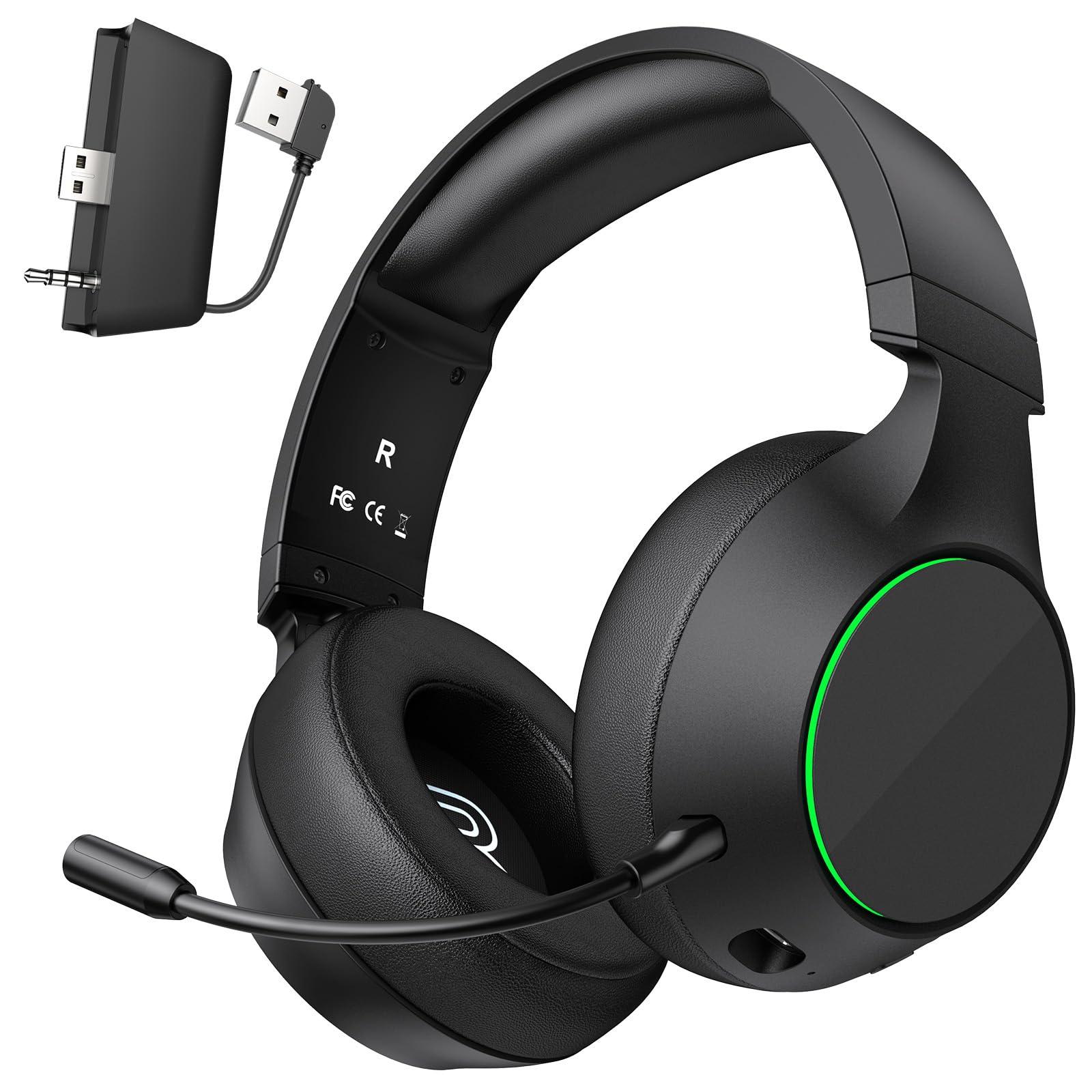

How To Choose The Best Xbox One S Headsets
The Xbox One S controller has a single 3.5mm round jack on the bottom edge, and that jack is the whole reason wired headsets are the low-risk choice for this console. Anything that plugs into it just works — no pairing screen, no USB adapter, no charging. Wireless models are fine too, but they depend on a dongle or Bluetooth, and that is where most setup complaints start. Decide the connection type first, then everything else gets easier.
Connection type decides your first ten minutes
A 3.5mm wired headset is the plug-and-play path. You push the plug into the controller and audio is there. A 2.4GHz wireless headset (a radio link that uses a small USB dongle instead of a cable) gives you freedom to walk around, but the dongle has to sit firmly in the controller or console port or the sound drops. Bluetooth is the loosest option and the one most likely to introduce a delay between the on-screen action and what you hear.
Driver size and what it does for you
Drivers are the small speaker cones inside each cup, measured across in millimeters. Bigger drivers — 50mm versus 40mm — generally move more air, which tends to give fuller bass and a wider sense of where a sound came from. That matters in shooters where a footstep behind your left shoulder should sound like it is behind your left shoulder. It is not the only factor, but it is the one buyers check first.
The microphone matters more than the spec sheet admits
Look for a mic you can mute fast without opening a menu. Flip-to-mute and swivel-to-mute designs let you kill the mic by folding the boom up, which is far quicker than digging into console settings mid-match. A detachable mic is the better pick if you also want to use the headset for music or a quiet single-player session. Noise cancellation on the mic is about blocking background noise from your room, not about blocking game audio from your ears.
Comfort over long sessions
Memory foam cushions mold to your ears and spread the pressure, while leatherette surfaces seal better but trap heat. Clamping force — how tightly the band squeezes — is what makes a headset feel heavy after two hours. If you wear glasses, look for deeper, softer cushions so the arms are not pressed into your head.
Side-by-Side Comparison
| Model | Best For | Connection | Driver Size | Battery / Cable | Amazon |
|---|---|---|---|---|---|
| HyperX CloudX★ Best Overall | Plug-and-play reliability | Wired 3.5mm | 5.3 cm | 3 ft cable | Amazon |
| X4 70H WirelessBest Battery Life | Long-battery wireless play | 2.4GHz + Bluetooth 5.3 | 50 mm | 70 hours | Amazon |
| HyperX CloudX Stinger 2 CoreBudget Wired Pick | Budget wired simplicity | Wired 3.5mm | 40 mm | Wired | Amazon |
| Turtle Beach Recon 70 | Cross-platform versatility | Wired 3.5mm | 40 mm | 4 ft cable | Amazon |
| EKSA Fenrir S | Glasses-friendly fit | Wired 3.5mm | 50 mm | Retractable cable | Amazon |
| Razer BlackShark V3 X HyperSpeed | Light multi-mode wireless | 2.4GHz / Bluetooth 5.3 / USB-C | 50 mm | Wireless | Amazon |
| Razer BlackShark V3 Pro | Tournament-grade audio | 2.4GHz / Bluetooth 5.3 / USB / 3.5mm | 50 mm | Wireless | Amazon |
| JBL Quantum 910X | Head-tracked spatial audio | 2.4GHz / Bluetooth 5.2 | — | 37 hours | Amazon |
Detailed Reviews
1. HyperX CloudX, Official Xbox Licensed Gaming Headset
Our pick — 4.5+★ from 7,000+ verified ratings; the strongest balance of quality and price.
Officially licensed by Microsoft, it plugs straight into the Xbox One S controller’s 3.5mm jack with no dongle and no battery to charge.
The CloudX is the calmest purchase in this lineup. It carries official Xbox licensing, meaning Microsoft tested it and confirmed it works with controllers that have a 3.5mm headset jack — which is exactly what the Xbox One S controller has. No dongle to lose, no pairing screen, no battery to watch. You plug the 3-foot cable in and you are talking to your squad.
Comfort is where this one earns its keep. The memory foam ear cushions mold around your ears and the aluminum frame holds its shape instead of flexing loose over months of use. Sound comes from a dynamic driver measuring 5.3 centimeters, with enhanced bass reproduction that gives explosions weight while keeping lows, mids and highs distinct enough to separate a distant reload from a nearby one.
The detachable noise-cancelling mic is the smart detail. Position the flexible boom where your voice sits best, then pull it off entirely when you are playing solo or listening to music. In-line audio controls on the cable let you change volume and mute without leaving the game. The honest catch is the 3-foot cable — noticeably shorter than the 4-foot run on the Turtle Beach Recon 70, so you will want to sit reasonably close to the console if you route it that way.
What earns it the top spot
- Official Xbox licensing confirmed by Microsoft for 3.5mm-jack controllers
- Detachable noise-cancelling mic pulls off cleanly for music and solo play
- Aluminum frame holds its shape where plastic bands loosen
- In-line volume and mute controls save a trip into console menus
Where it asks you to compromise
- The 3-foot cable is shorter than the 4-foot Recon 70 run
- Wired only — no wireless freedom to walk around the room
- Some players notice echo on their own voice through the mic
Settle here if: you want the headset that just works the moment you open the box on an Xbox One S.
Think twice if: you need to move around the room — the 3-foot cable keeps you tethered.
2. X4 70H Wireless Gaming Headset with Mic
Up to 70 hours per charge, refilled in 2.5 hours, with 50mm drivers that are 10mm wider than the 40mm cones on the Stinger 2 Core.
If charging cables annoy you, the X4 is the pick that makes it a weekly errand instead of a daily one. A single charge claims up to 70 hours of continuous play, refilled in 2.5 hours — so a Sunday evening charge covers most of a week of evenings. That is the number to hold onto here, because the big 50mm dynamic drivers are 10mm wider than the 40mm cones on the CloudX Stinger 2 Core, which tends to translate into a fuller low end and a wider picture of where sounds originate.
Connection is where you need to pay attention. The 2.4GHz dongle works with official Xbox controllers only, and older Xbox One controller models need an extra Microsoft Adapter that is not in the box. Bluetooth 5.3 covers Mac and Switch, and PC, PS5 and PS4 run off the 2.4GHz receiver. Audio latency is listed at 20 milliseconds — roughly a fiftieth of a second — so lip-sync stays tight enough for competitive play.
The build leans comfortable rather than premium: air protein over-ear pads with leatherette surfaces and an adjustable headband that fits a range of head shapes. What wins people over most is the overall quality and the value — it feels like more headset than the outlay suggests. The recurring gripe is setup: echo through the mic usually traces back to monitoring mode switched on in the Xbox console settings, and connectivity takes a little patience the first time you pair it.
Setup patience required: the dongle must be fully seated, console volume set to maximum (it defaults to 80% on first use), and monitoring mode switched off to kill echo — do those three things and it behaves.
Reach for this if: you want to stop thinking about charging and you are comfortable with a one-time settings check.
Look elsewhere if: you run a third-party controller — the dongle only supports official ones.
3. HyperX CloudX Stinger 2 Core Wired Gaming Headset
The swivel-to-mute boom flips up and kills the mic instantly — no button hunt, no menu dive.
Teams lose rounds to open mics. This headset solves that with the simplest mechanism in the lineup: the swivel-to-mute boom flips up and out of the way, and the mic is definitively off. No button hunt, no menu dive. It is tested and approved by Microsoft and connects directly to Xbox One and Xbox Series X|S controllers through the 3.5mm port, so the setup is a single plug.
The 40mm directional drivers are tuned for console gaming with enhanced bass, and onboard audio controls sit on the headset itself so you can ride the volume without pausing. Soft ear cushions and a flexible mic boom round out a design that is built to be simple. Owners consistently flag the value, the connectivity and the volume control as the strong points — this is a headset that does its job without drama.
Where it shows its budget roots is sound and durability. The treble can feel harsh to ears used to richer audio, and the plastic build will not survive being tossed in a backpack without care. Treat it as a desk-side headset that lives near the console and it will serve you well for a long stretch.
Why the mute design wins: flipping the boom up is faster than any button and impossible to forget — you can see the mic is off.
The fair caveat: this is a plastic build at a budget tier, so long-term toughness is the trade-off you accept for the simplicity.
Best for: players who share a room and need a guaranteed-silent mic between callouts.
Not for: anyone who expects premium materials or audiophile-grade treble.
4. Turtle Beach Recon 70 Wired Multiplatform Gaming Headset
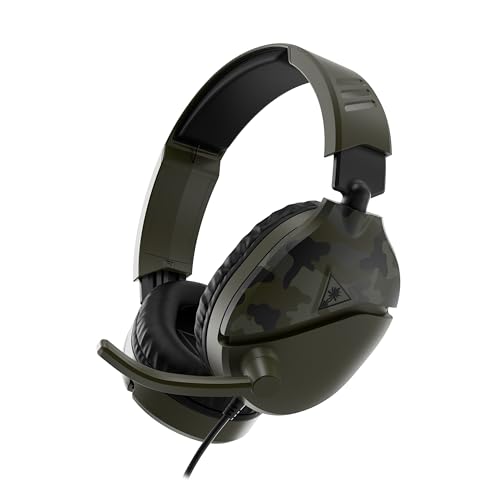
One 3.5mm plug covers Xbox, PS5, Switch, PC and mobile, on a 4-foot cable that runs a foot longer than the CloudX’s 3-foot lead.
Most headsets lock you to one console family. This one lists Xbox Series X|S, Xbox One, PS5, PS4, Nintendo Switch, PC and mobile devices as compatible, which makes it the pick if your setup changes or you share a living room across platforms. The cable runs 4 feet — a full foot longer than the 3-foot run on the HyperX CloudX — so you have more slack between the controller and wherever you sit.
Sound is the strongest part of the story. The 40mm speakers handle voices and effects cleanly, and enough players describe it as very clear that sound quality is the thing this headset is known for. The flip-to-mute mic works the same way as the Stinger 2 Core’s swivel mute — fold it up and you are off-air. Premium noise-isolating ear cushions help keep game audio in and room noise out, and the whole thing is built to be comfortable and light on your head.
It also supports spatial audio technologies, which is worth knowing if you run a console that outputs positional sound. The mixed part of the record is long-term build — this is a widely owned headset with a huge base of experience behind it, and bulky plastic housing is the recurring note. Handled with reasonable care it holds up fine.
Cross-platform reach: Xbox, PlayStation, Switch, PC and mobile from one 3.5mm plug means this is the headset you can move between rooms and consoles.
House the caveat honestly: the plastic housing is the part to treat gently; it is a comfort-first build rather than an armored one.
Pick it when: you play across more than one console and want a single headset to cover them all.
Skip it when: you want a metal frame — the aluminum CloudX is the tougher build.
5. EKSA Fenrir S Gaming Headset

Extra-large, deeper cushions built for glasses wearers, backed by a two-year warranty that most headsets in this group don’t offer.
Glasses arms plus tight earcups equals a headache by hour two. The Fenrir S attacks that directly with extra-large, deeper, softer cushions described as glasses-friendly, designed to house your ears rather than press on the frames. The 50mm drivers are the same size class as the Razer and X4 picks and 10mm wider than the 40mm cones on the Stinger 2 Core and Recon 70, which brings superior clarity and deep, punchy bass to footsteps and explosions alike.
The mic is a 120-degree rotatable boom — you can swing it to the spot that suits your face and leave it there. The unidirectional pickup cuts surrounding noise so teammates hear your voice rather than the room. The aesthetic is a werewolf-themed design with monochrome lighting, a specific look that leans into a certain style rather than a plain black shell. The cable is retractable, which keeps the mess down when it is not in use.
The two-year warranty stands out at this tier — most headsets in this group ask you to trust the brand with nothing written down. Sound quality is the mixed note: a chunk of players love it, while echo through the mic shows up in some setups, usually traced to console settings. Worth knowing before you buy if you are sensitive to that.
The fit story: deeper, softer, glasses-friendly cushions pair with a retractable cable and a swiveling boom for a setup that adapts to your face and desk.
The echo caveat: some users hear their own voice bounce back — the standard console-settings fixes help, but it is worth understanding going in.
Suits you if: you wear glasses during long sessions and want bigger cups plus a warranty behind them.
Probably not if: you want a plain, understated look — the werewolf styling is very much the point.
6. Razer BlackShark V3 X HyperSpeed
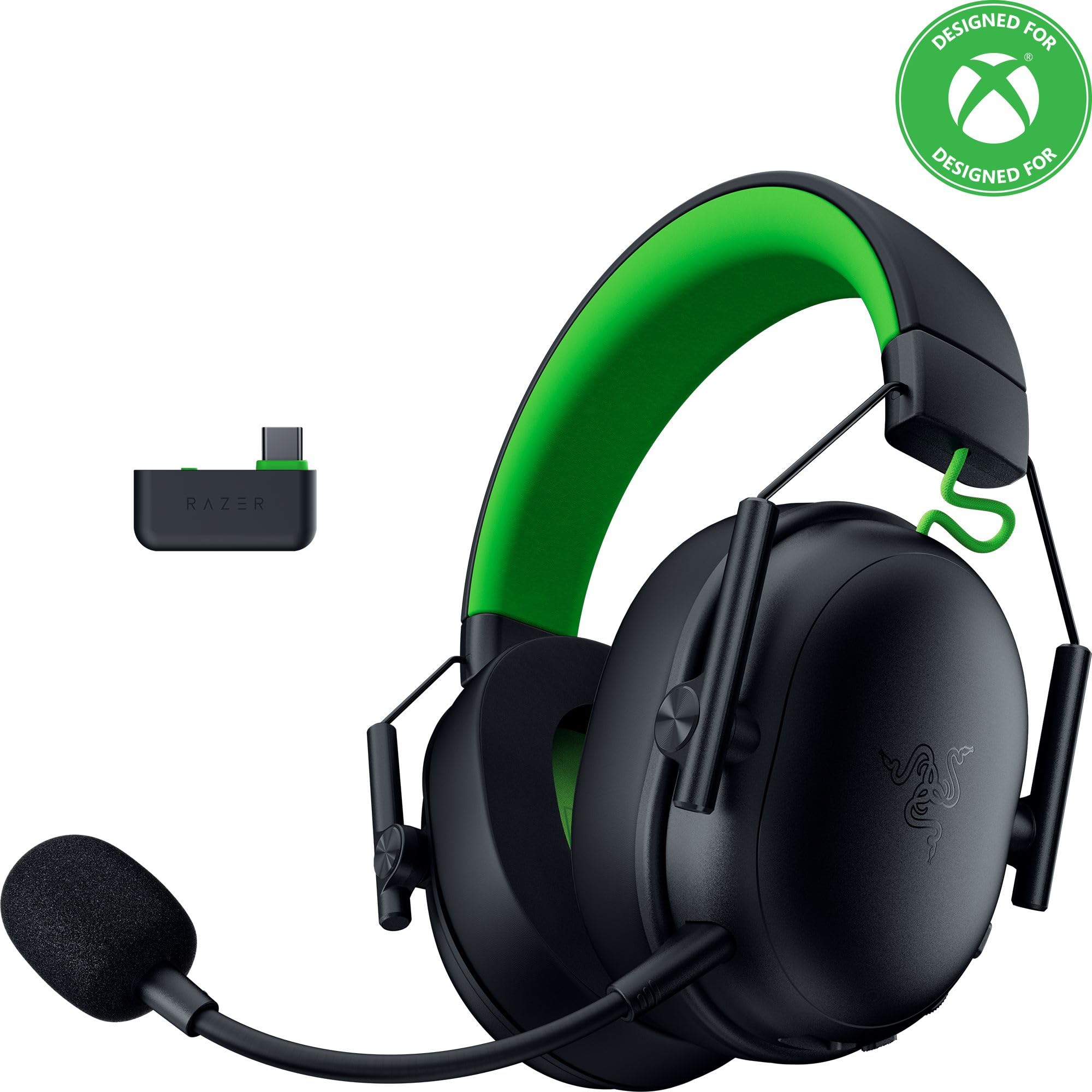
A 270-gram shell with 2.4GHz, Bluetooth 5.3 and USB-C wired paths, plus a detachable HyperClear cardioid mic.
Weight is the underrated spec in this category. Razer lists the BlackShark V3 X at 270 grams, which you feel most at the end of a four-hour session — the top of your head stays fresher than with heavier builds. The TriForce 50mm Gen-2 drivers are tuned for clarity and positional accuracy, and Razer claims an improved soundstage so footsteps and audio cues land where you expect them. On Xbox that means directional audio designed for competitive play rather than a flat stereo wash.
The connection story is unusually flexible. You get an ultra-fast 2.4GHz wireless link for low-latency play, Bluetooth so you can take a call mid-session, and USB-C wired for when you are out of power and still want to game. SmartSwitch moves you between 2.4GHz and Bluetooth without digging in menus. A detachable HyperClear cardioid 9.9mm mic handles voice — its unidirectional pattern aims at your mouth and rejects what is around it, and you can pull it off entirely when not in use.
What wins people over is the package — the sound, the comfort of the plush earcups and the sense that it punches above its tier. The recurring gripe is Xbox pairing: some units take patience to connect, and there are the usual scattered notes on long-term durability in a plastic-and-foam shell. Detach the mic carefully and treat the dongle well, and this one earns its keep.
The case for it
- At 270 grams it is one of the lightest wireless builds here
- Three connection paths — 2.4GHz, Bluetooth 5.3 and USB-C
- Detachable cardioid mic pulls off for solo play
- SmartSwitch hops between 2.4GHz and Bluetooth without menus
The honest trade
- Setup takes patience — some units resist pairing with Xbox on the first try
- Plastic-and-foam shell asks you to handle the mic and dongle with care
Made for: competitive players who feel headset weight after a few hours and want to switch devices fast.
Be ready for: a ten-minute pairing session on first connect before it settles in.
7. Razer BlackShark V3 Pro Wireless ANC Gaming Headset for Xbox
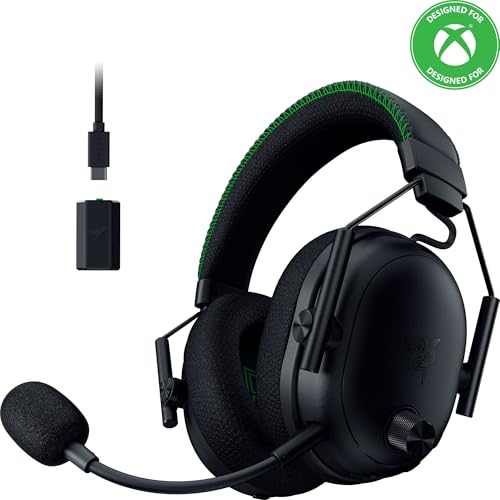
10ms HyperSpeed Gen-2 wireless latency and hybrid ANC — the most competition-oriented build in this lineup.
Latency is the invisible spec that separates a pro-grade headset from a good one. Razer HyperSpeed Wireless Gen-2 delivers as low as 10 milliseconds here — roughly a hundredth of a second — and Razer positions it as industry-leading wireless performance for FPS and battle-royale play. In practice, that is the gap between reacting to a sound and reacting slightly late. The TriForce Bio-Cellulose 50mm Drivers Gen-2 aim at positional accuracy so enemy movement reads from the direction it should.
The mic is a detachable HyperClear Full Band 12mm capsule — a wider mic than the 9.9mm cardioid on the BlackShark V3 X — with a unidirectional pattern for detailed voice capture and background rejection. Hybrid Active Noise Cancellation (a mix of methods that block steady surrounding sound) pairs with swiveling earcups and dual-layered memory foam to seal off the room. That seal is what keeps your focus locked during a ranked session with a TV going in the corner.
Comfort and connection are both flexible. The pads come in for praise for that never-getting-hot quality during long stints, and swapping between Xbox, PC and mobile over simultaneous 2.4GHz and Bluetooth is a genuine convenience, with USB and 3.5mm wired as fallbacks. The mixed part of the record is reliability and value — a premium outlay asks a lot, and some scattered reports of units acting up suggest checking the return window rather than assuming a lifetime purchase.
Pro-grade internals: 10ms wireless latency, a 12mm detachable mic and hybrid ANC make this the most competition-oriented headset here.
The considered trade: a premium price plus scattered reliability notes — buy it as a competitive tool, not as a lifetime heirloom.
Built for: ranked and tournament play where a sealed ear and a 10ms link change outcomes.
Harder to justify if: you play casually in a quiet room — the ANC premium is wasted on silence.
8. JBL Quantum 910X Wireless Over-Ear Gaming Headset

The only headset here that moves the soundstage when you turn your head.
Head tracking is the differentiator nobody else in this lineup offers. JBL QuantumSPATIAL 360 on Xbox runs over the USB-A dongle with integrated head-tracking technology, so the audio field shifts as you move your head — the extra acoustic presence JBL says competitive players need. The Hi-Res certified 50mm neodymium drivers carry JBL’s QuantumSOUND Signature tuning, and the 2.4GHz wireless link keeps the audio synced with zero lag.
Battery is listed at up to 37 hours over the dongle, or up to 42 hours over Bluetooth 5.2, and you can charge while playing via the included USB cable so a session never has to stop. Active Noise Cancelling tuned for gaming environments blocks the room out. Over 100 Xbox Game Pass titles are cited as the playground for the spatial audio, and JBL QuantumSPHERE 360 on PC adds pro-level 3D positioning through the Windows app.
Comfort lands well, with players describing long sessions that stay comfortable. The recurring mixed notes are fit and reliability: some headsets slip on certain head shapes, and reports of the mic stopping after a year and three months suggest keeping an eye on the warranty window. It is the heaviest commitment on this list in both build complexity and outlay, so buy it for the spatial audio specifically.
Why it stands apart
- Head-tracked QuantumSPATIAL 360 audio over the USB-A dongle
- Up to 37 hours over 2.4GHz, up to 42 hours over Bluetooth 5.2
- Charge-and-play over USB so a session never dies
- Active Noise Cancelling tuned for game environments
Worth knowing first
- Fit is divisive — some head shapes find the headset slips
- Mic reliability is the weakest point over long ownership
Choose it for: the one-of-a-kind head-tracked soundstage and charge-while-you-play battery.
Think hard if: you have a head shape that slips under heavy cups — a wired, clampier pick may suit better.
Know the Specs
Driver size in millimeters
The driver is the speaker cone inside each cup, and its diameter decides how much air it moves. A bigger cone, like the 50mm units on the X4, Fenrir S, Razer trio and JBL, tends to deliver deeper bass and a wider sense of where sounds sit. A 40mm cone, as on the Stinger 2 Core and Recon 70, is common on lighter, simpler builds. Size is not the whole story because tuning matters too — a well-tuned 40mm can image better than a sloppy 50mm — but bigger is the safer assumption when you want fuller sound.
Battery life and charge time in hours
This only applies to wireless headsets, and the two numbers tell different stories. Battery life is how long you can play between charges — 70 hours on the X4, up to 30 on the Kaira HyperSpeed, up to 37 on the JBL over the dongle. Charge time is how long it takes to refill, and it is the number buyers forget: the X4 refills in 2.5 hours, while the Kaira HyperSpeed lists 30 hours to charge. A headset with a short charge time is easier to live with than one you have to plan a night around.
Latency in milliseconds
Latency is the delay between the game producing a sound and you hearing it. Wireless headsets chase this down: the X4 lists ≤20ms and the BlackShark V3 Pro lists as low as 10ms. A 10ms delay is roughly a hundredth of a second — effectively imperceptible. 20ms is still tight enough that lip movements stay synced. A headset with no published latency figure is a small unknown, not automatically a problem, but the number is worth checking on anything you buy for competitive shooters.
Connection type: wired, 2.4GHz or Bluetooth
Wired 3.5mm is the simplest and the one you plug into an Xbox One S controller — nothing to pair, nothing to charge. 2.4GHz wireless uses a small USB dongle and gives you cable-free play with lower latency than Bluetooth. Bluetooth is the most portable but tends to carry a delay unless a low-latency mode is offered. Many headsets here offer more than one of these, which is the real hedge against getting caught by a dead battery.
Common Questions
Will a wired 3.5mm headset work with the Xbox One S controller from the start?
Does the X4 wireless dongle work with third-party Xbox controllers?
Why does my headset mic echo back through my ears?
Is 50mm better than 40mm for hearing footsteps in shooters?
How long does the battery last on these wireless headsets?
What does flip-to-mute mean and why does it matter?
Can I use these headsets on PC and PlayStation too?
Do I need a special adapter for the Xbox One S console?
Is active noise cancellation actually useful for gaming?
How fragile are the plastic-shell headsets in this group?
The Bottom Line
For most owners of an Xbox One S, the HyperX CloudX is the confident bet — Microsoft tested it, the aluminum frame holds its shape, and the detachable noise-cancelling mic handles both chat and solo listening without a hitch. If you want to cut the cable and stop charging nightly, the X4 70H Wireless answers that with 70 hours and a setup that rewards five minutes of console-tweaking. And if you play multiple consoles in one room, the Turtle Beach Recon 70 covers Xbox, PlayStation and Switch from a single 3.5mm plug — a small, honest nudge for the wired route as the least disappointing path in this whole lineup.
How we choose
We do not accept paid placement. Every pick is matched to a real buyer and a real use-case; we do not hands-on test units.
Sources
Specifications: manufacturer listings and product documentation. Review insights: verified customer reviews, as of November 2026. Pricing: not shown on this page (it changes often); check the current price via the retailer link.
As an Amazon Associate, Tactical Gear Guy earns from qualifying purchases. This does not affect which products we feature.