Specs are compiled from manufacturer listings and verified buyer reviews and can change over time — please confirm the key details on the product page before buying.
You are chasing one helmet and there are two very different things wearing that name. Some are leather Pickelhauben with a brass spike on top — the parade-ground icon. Others are steel Stahlhelme, the bowl-shaped trench helmet that replaced it. If you get that split wrong, you end up with a showpiece where you wanted a steel shell, or a heavy steel shell where you wanted something to display. This guide separates them clearly, then walks you through seven replicas that each solve the problem differently.
This guide is built by comparing the manufacturers’ published specifications and the patterns across verified customer reviews, so you get each pick’s real strengths and trade-offs instead of marketing spin.
The crowd favourite here is a leather spiked officer helmet with a 4.0+ rating from 200+ owners, and it earns that spot on brass-and-leather craftsmanship rather than size. Below you get seven replicas compared on shell material, head fit, and what they are genuinely built for — a straight read on the best WW1 German Helmet for your shelf, your reenactment, or your costume.
Top Picks


How To Choose The Best WW1 German Helmet Replica
The first decision is not brand or budget — it is shape. A Pickelhaube (the spiked leather helmet carried into the early war years) and a Stahlhelm (the steel shell introduced once trench warfare made head protection urgent) serve completely different purposes today. One is a display and costume piece. The other is a steel shell you can wear and knock about.
Spiked leather or steel shell
Go leather-and-brass if you want the silhouette people recognise instantly, the one with the spike rising off the crown. Go steel if you want the smooth dome with the flared neck guard. Neither is more accurate than the other for the 1914–1918 window — both were worn — but only one of them matches the photograph in your head.
Measure your head before anything else
Replica helmets list an inner circumference in centimetres, and that is the number that decides fit. A 58 cm shell suits a smaller adult head; 67 cm is a generous fit that swallows most heads with room to spare. If your measurement lands under the listed circumference, the helmet will sit low and wobble. Adjustable liners help, but they only stretch so far.
Check what the fittings are made of
Brass accents are the detail that separates a replica from a toy. Solid brass plate, chinstrap clutches, and a removable spike all point to a piece built to be looked at closely. Painted steel fittings look right from across a room and less convincing in your hands.
Decide whether you will wear it or display it
A leather liner and chinstrap mean the helmet is meant to go on a head — reenactment, theatre, Halloween. A heavy steel shell with a leather band is often better on a stand. Be honest about which one you are buying, because a 5.2-pound steel shell wears and stores very differently from a 1.17-pound leather one.
Side-by-Side Comparison
| Model | Best For | Shell Material | Inner Circumference | Weight | Amazon |
|---|---|---|---|---|---|
| Medieval Replicas Imperial German Spiked Pickelhaube★ Best Overall | Overall display-and-wear Pickelhaube | Genuine leather with brass hardware | Fits US 7 (56 cm) to 7 1/2 (62 cm) | 1.17 pounds | Amazon |
| German WWI M18 Steel Helmet with Leather LinerMost Authentic Steel | Rare ear-cutout steel shell | Steel shell | Adjustable 7 (56 cm) to 7 1/2 (60 cm) | — | Amazon |
| German WWI M16 Stahlhelm Steel Helmet | Most authentic steel trench helmet | Steel with leather liner | — | 5.2 pounds | Amazon |
| AnNafi German Pickelhaube Military Helmet | Steel-bodied officer spike | 20-gauge steel with brass | 25.12 inches | 1.16 kg | Amazon |
| Medieval Replicas FR Badge Prussian Pickelhaube | Compact leather spike on a budget | Leather with brass fittings | 58 cm | 0.66 kg | Amazon |
| Red German Pickelhaube Leather Prussian Helmet | Red leather collector display piece | Real leather with solid brass | 67 cm | 1.95 pounds | Amazon |
Detailed Reviews
1. Imperial German Spiked Pickelhaube Officer Helmet
Our pick — 4.0+★ from 200+ verified ratings; the strongest balance of quality and price.
The spiked officer helmet that most people picture when they hear the words German helmet, done properly in leather and brass.
This is the helmet you buy when you want the shape, not the armour. The body is handcrafted from genuine leather and the hardware is brass throughout — the Prussian eagle helmet plate, the chinstrap clutches, the peakmount, and a spike you can lift off the crown. That removable spike is a small detail with a real payoff: you can store it flat in a box instead of a wide crate.
Weight matters more than you would think on a helmet you plan to wear for a full day of reenactment or a long Halloween event. At 1.17 pounds this one is a world away from the steel shells here — the M16 Stahlhelm on this list tips the scale at 5.2 pounds, a genuine 4.4x gap that your neck will notice within an hour. The leather liner adjusts, and the maker lists the fit as one size covering US 7 (56 cm) up through US 7 1/2 (62 cm), so most adult heads will sit inside that range.
Craftsmanship wins people over first, with the brass eagle plate catching light and reading convincingly on a shelf. The honest catch is sizing: the one-size liner draws mixed fit reports, and it is not a helmet for young children. Value splits opinion too, with some owners calling it worth the spend and others feeling it runs high for a leather replica. Neither gripe changes what the piece is.
What it gets right
- Genuine leather shell with brass eagle plate, peakmount, and chinstrap clutches
- 1.17 pounds — light enough to wear for hours without neck strain
- Removable spike makes storage and transport far simpler
- Adjustable liner covers US 7 (56 cm) to US 7 1/2 (62 cm)
Where it asks something of you
- One-size liner rewards a head measurement taken before you order
- Not sized for children
- Leather needs a dry, dust-free spot to keep its shape
Buy this if: you want the iconic spiked silhouette in leather and brass, and you will actually wear it at events.
Look elsewhere if: you need a steel trench shell — this is a Pickelhaube, and no amount of brass makes it armour.
2. German WWI M18 Steel Helmet with Leather Liner
A steel shell with the ear cutouts that made the M18 the rare one — and the reason collectors notice it.
Most steel helmets in this space are smooth-sided domes. This one is the M-1918 pattern with cutouts above the ears, a feature the maker describes as likely added so soldiers could use trench telephones or hear better. That detail is why the model carries the Cavalry Helmet nickname, and it is the single thing that makes this shell stand out on a shelf next to a standard M16.
Where it lands for a buyer is straightforward: full leather liner, a chinstrap, and a drawstring liner that adjusts from 7 (56 cm) to 7 1/2 (60 cm). One size fits most, and the drawstring does the work of dialling in the fit rather than a fixed band. The shell is new-made, not an original, which is exactly what you want if you intend to wear it outdoors without worrying about damaging a century-old artefact.
The trade-off is the one every rare-pattern replica carries: fewer people own one, so there is less of a track record to lean on. If you want the safety of a huge review base, a mainstream steel dome is the easier call. If you want the cutout ear profile that most reproductions skip entirely, this is the shell that has it.
The case for it: the M18 ear-cutout silhouette is a specific, checkable detail that separates this from the smooth-domed steel helmets around it.
What to weigh: the fit tops out at 7 1/2 (60 cm), so a larger head has to look elsewhere no matter how much you like the cutouts.
Reach for this if: the ear cutouts are the reason you are shopping, and your head measures inside the 56 to 60 cm liner range.
Pass if: you want the reassurance of thousands of owner opinions behind your purchase.
3. German WWI M16 Stahlhelm Steel Helmet

Copied from an original in a military collection — this is the steel dome that actually went to the trenches.
If your mental picture of a WW1 German helmet is a smooth grey bowl with a flared neck guard, this is that helmet. It is reproduced from an original Stahlhelm M1916 held in the IMA collection, which is the kind of provenance that matters to a collector more than any marketing line. The shell is steel, the liner is genuinely supple leather, and the chinstrap comes with it.
The liner is where the historical accuracy shows up in the details: three tongues, a leather band, and removable pads. That is not a decorative arrangement — it is the correct M1916 setup, and it is the part a reenactor will notice first when they lift it off your head. Grey finish, large size, adjustable liner.
Here is the number you have to plan around. This shell weighs 5.2 pounds. That is genuine steel, and it is the heaviest thing on this list by a wide margin — the leather Pickelhaube above comes in at 1.17 pounds, a 4.4x difference. Expect to feel it after a few hours. The other honest note is the finish: paint durability is the recurring gripe, with the coating scuffing and flaking more readily than owners expected on something this solid. Treat it as a display-and-event piece and you will not be disappointed.
Pick it if: a correct three-tongue liner and real steel weight are the whole point of owning a Stahlhelm for you.
Think twice if: you want a helmet to wear all day — 5.2 pounds is a lot of steel, and the paint wants gentle handling.
4. AnNafi German Pickelhaube Military Helmet
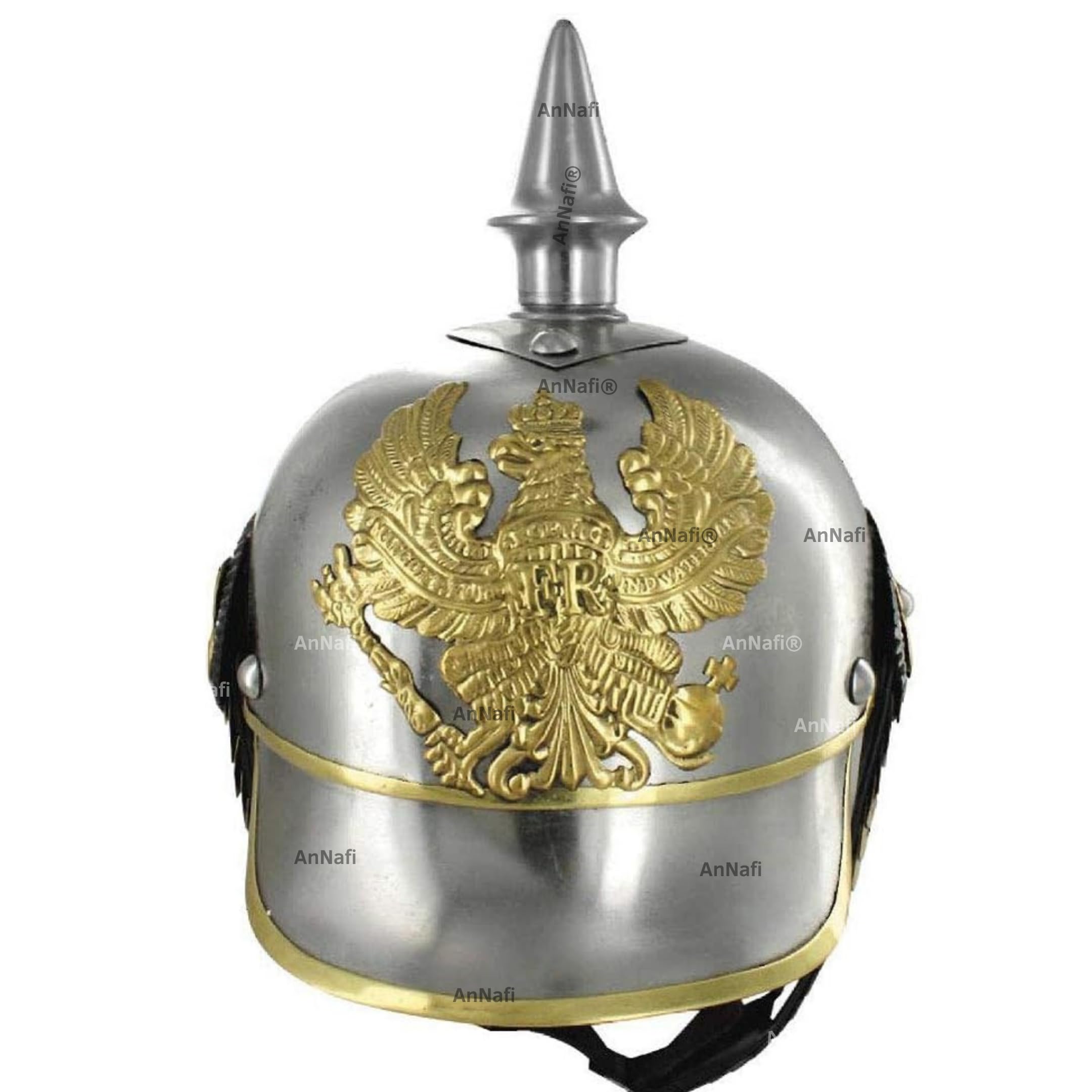
The spiked officer helmet built from 20-gauge steel instead of leather — a hybrid for people who want the silhouette but not the fragility.
Leather and steel meet in an unusual place here. The body is 20-gauge steel (a thin sheet metal, light enough to keep the whole helmet at 1.16 kg) and the accents are handtooled solid brass. You get the spike, the Prussian officer profile, and the brass shine, but on a shell that will not crease if it gets knocked around a display shelf. It weighs 1.16 kg against the 0.66 kg of the compact leather Pickelhaube further down this list — noticeably more substantial in the hand.
The fit is stated plainly: an internal circumference of 25.12 inches, an internal diameter of 8 inches side to side and 12.50 inches front to back. In practice that is built for a normal adult head with room to spare, and the listing is clear that it is not a child’s helmet. There is an adjustable strap to tighten things up, and it is meant to be worn, not just looked at.
The maker backs it with a 30-day full refund against manufacturing defects, which is a useful safety net on a hand-finished steel-and-brass piece. Where it may not suit you is if your head leans small — a generous steel shell with an adjustable strap still needs a head near its intended size, and the maker has sized this for a normal adult. It is equally at home on a costume table or in a collection cabinet.
Why it earns its place: 20-gauge steel gives you a shell that holds its shape through years of display, while the handtooled brass keeps the officer look sharp.
The honest limit: sized for a normal adult head and explicitly not for kids, so a smaller wearer will find it roomy no matter how tight the strap goes.
Best matched to: a buyer who wants the spike silhouette in something sturdier than leather, on a display shelf or a reenactment field.
Not your helmet if: you are shopping for a child or a distinctly small head.
5. Medieval Replicas FR Badge German Prussian Helmet
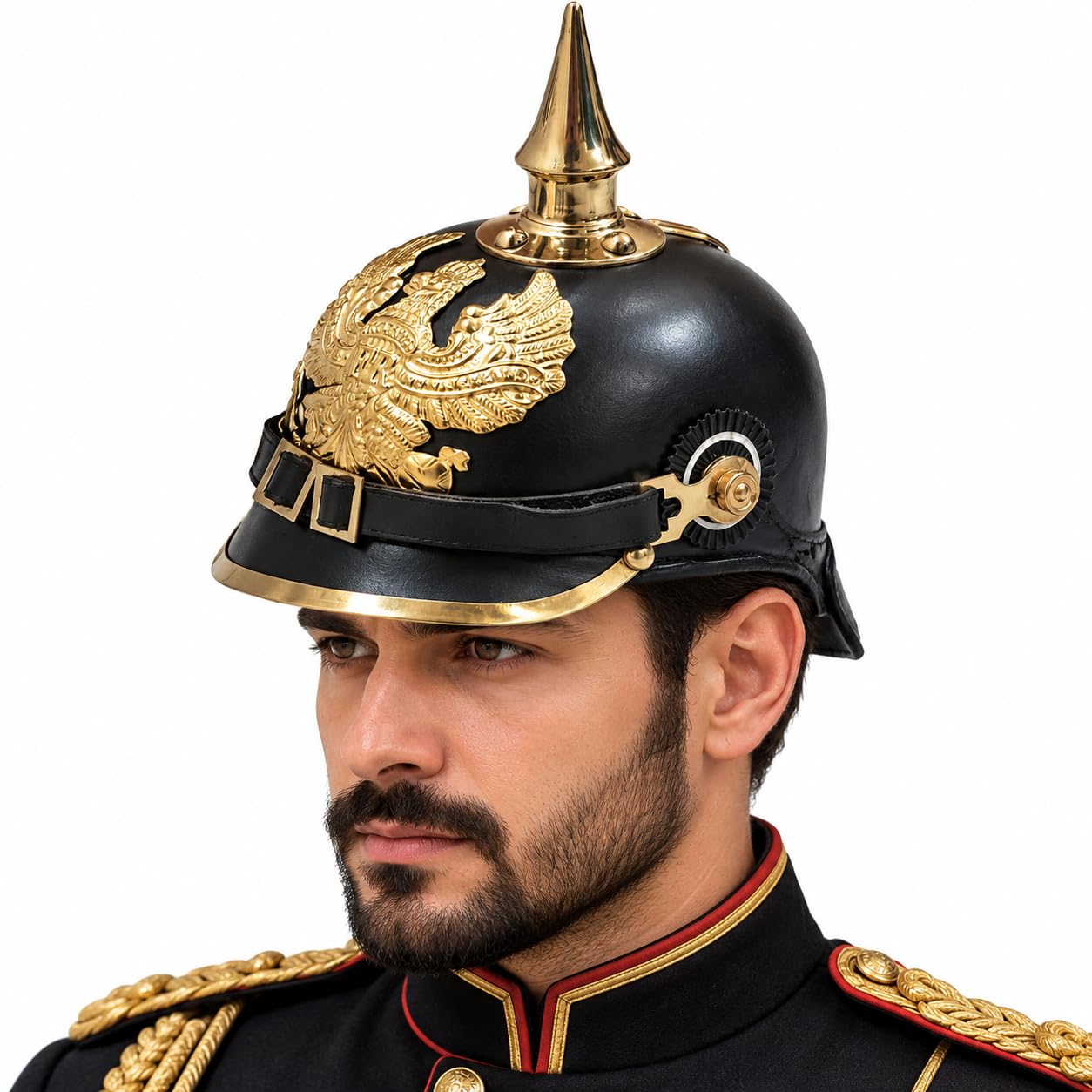
The lightest leather spike here, and the one that fits the smallest head — 0.66 kg and a 58 cm liner.
Two numbers tell you everything about this one. The inner circumference is 58 cm, the tightest listed fit on this page — compare it to the 67 cm of the two AnNafi-style shells higher up and you can see the gap: 58 cm versus 67 cm is a meaningfully smaller head size. The weight is 0.66 kg, against 1.16 kg for the steel-bodied AnNafi officer helmet, so it feels feathery by comparison and will not pull on your head during a long event.
The build is leather with brass throughout, an inner liner fitted for comfort, and a spike on top. It is listed as a historical style piece with ventilation and it can be customised, which is the sort of detail that matters if you plan to add a chinstrap or adjust the interior fit. Finish is brass on a black leather body, so it photographs well against a dark display.
What it does well is the basics: a decent leather Pickelhaube replica whose appearance and detail draw praise. The honest catch is simply size — a 58 cm circumference is a real fit for a smaller adult head, and if you measure bigger than that, this helmet will perch rather than sit. It is also the least substantial leather build here, so treat it as a piece for wear and display rather than a rough-and-tumble costume.
Choose this when: you have a smaller head, and you want a light leather Pickelhaube you can wear all afternoon without noticing it.
Move on if: you measure past 58 cm — the fit ceiling is the deciding number here.
6. Red German Pickelhaube Helmet
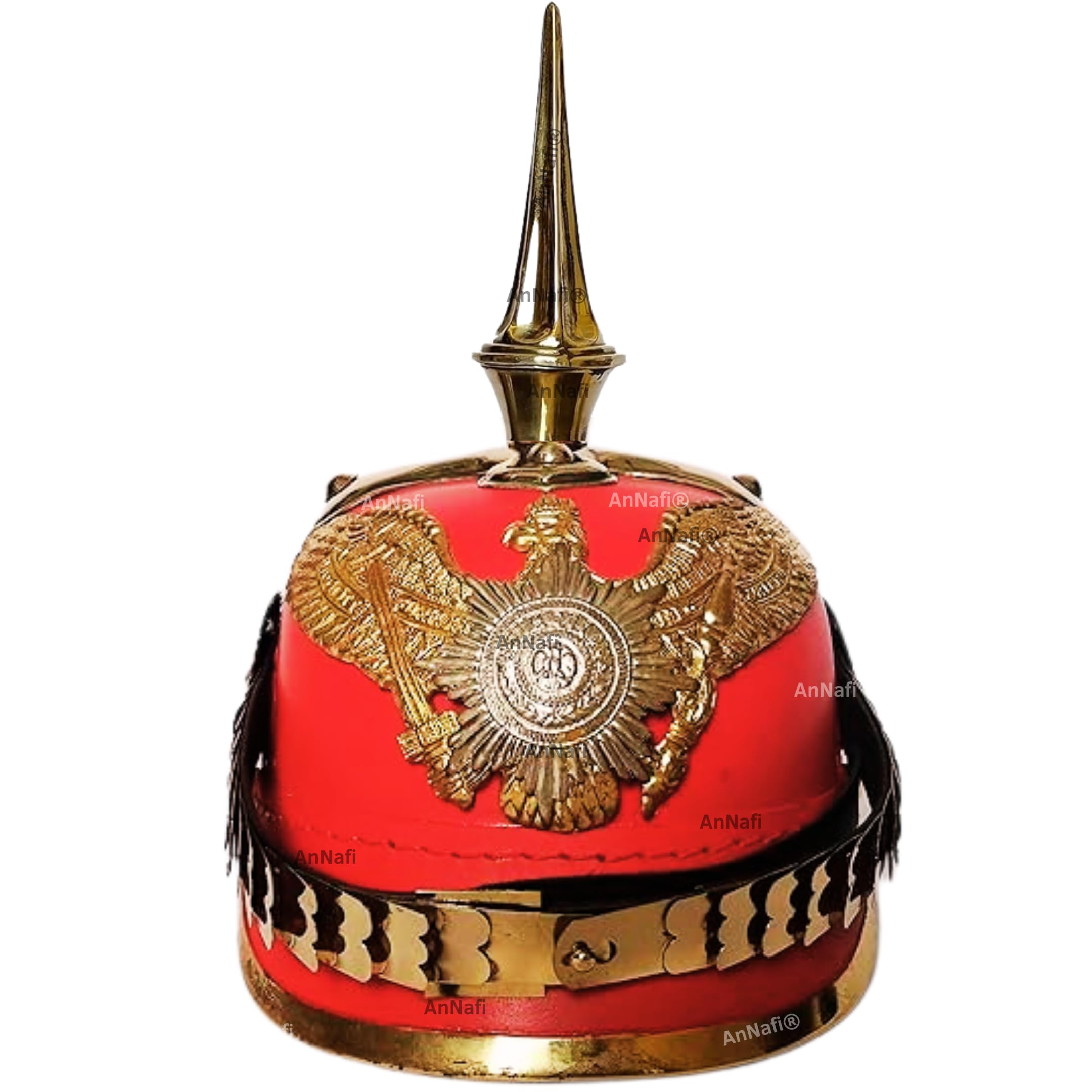
A red leather Pickelhaube with a long brass spike — the loudest, most decorative piece on this page.
Nobody blends in wearing this. The body is real leather in red, finished with solid brass fittings throughout and a long spike on top. It is the same generous size as the steel-bodied officer helmet above — a 67 cm inner circumference against that helmet’s 25 inches internal, with matching 20 cm ear to ear and 24 cm front to back measurements. Compared with the compact leather shell at 58 cm, it is the roomy end of the fit range, made for a normal adult head.
Where it separates itself is in the finish. Real leather with fully handtooled brass reads richer up close than painted steel, and the red body makes it a display statement rather than a subtle shelf filler. The maker lists it for cosplay, reenactment, Renaissance-style events, and costume work, and there is a care regime worth noting: wipe it with a clean cloth, store it covered to keep dust off, and keep it dry and away from direct sunlight so the leather holds its colour.
The honest note is the thin owner track record behind it. That is not a knock on the helmet itself — the spec sheet is complete and the materials are the real thing — it is simply a reminder to measure your head against that 67 cm before you commit.
What stands out: real leather in red with solid handtooled brass, at a 67 cm fit that suits most adult heads.
What to keep in mind: leather this finished wants dry, shaded storage, and the listing is new enough that owner experience is still building.
Point it at: collectors and cosplayers who want a Pickelhaube that makes a statement on the shelf rather than a subtle one.
Leave it for someone else if: you want decades of owner track record to lean on before you buy.
Know the Specs
Inner circumference
This is the measurement of the inside of the helmet all the way around, listed in centimetres or inches. It is the single most useful number on a replica listing, because it tells you whether the helmet will sit on your head or perch above it. Measure your own head with a soft tape just above the ears, then match it to the listed circumference. A 58 cm shell is a smaller adult fit; 67 cm is generous.
Shell material
Leather is the Pickelhaube material, lighter and softer, and the right choice for a wearable costume or display piece. Steel is the Stahlhelm material, heavier and rigid, and the right choice if you want the trench helmet weight and shape. Mild steel and 20-gauge steel sit as thinner sheet-metal options that give you stiffness without the heft of a full armour steel shell.
Brass fittings
Brass is the metal that makes a replica look right up close — the eagle plate, the chinstrap clutches, the peakmount, and the spike. Solid brass keeps its shine and ages with character. It also tells you the maker put real material where you will look first, rather than casting a plastic lookalike and painting it gold.
Liner and chinstrap
The liner is the leather inner headband that sits between your head and the shell. An adjustable drawstring liner lets you pull the fit in or let it out, which is why a one-size helmet can still suit a range of heads. A three-tongue liner with a leather band and removable pads is the historically correct setup on an M1916 Stahlhelm.
Common Questions
Is a Pickelhaube the same as a WW1 German helmet?
How do I work out which size Pickelhaube will fit me?
Can I actually wear a steel Stahlhelm replica or is it display only?
Will a leather Pickelhaube survive being worn outdoors?
What is the difference between the M16 and M18 steel helmets?
Are brass fittings better than painted steel fittings on a replica?
Is a spiked Pickelhaube appropriate for a child’s costume?
How should I store a Pickelhaube between events?
Do these replicas come with a display stand?
What does 20-gauge steel mean on a replica helmet?
The Bottom Line
For most buyers, the ww1 german helmet to start with is the Medieval Replicas Imperial German Spiked Pickelhaube. It gives you the shape everyone recognises, real leather and brass in the places you will look, and a 1.17-pound build you can wear all day — a combination nothing else here matches so cleanly. If you want the steel trench shell instead, the German WWI M16 Stahlhelm is the honest answer, with a correct three-tongue liner and the real 5.2-pound weight of steel. And if you simply want a helmet on a shelf tonight, the THOR INSTRUMENTS Pickelhaube arrives with its wooden stand already in the box. Whichever you pick, measure your head first — a 58 cm shell and a 67 cm shell are different helmets for different people.
How we choose
We do not accept paid placement. Every pick is matched to a real buyer and a real use-case; we do not hands-on test units.
Sources
Specifications: manufacturer listings and product documentation. Review insights: verified customer reviews, as of November 2026. Pricing: not shown on this page (it changes often); check the current price via the retailer link.
As an Amazon Associate, Tactical Gear Guy earns from qualifying purchases. This does not affect which products we feature.