Specs are compiled from manufacturer listings and verified buyer reviews and can change over time — please confirm the key details on the product page before buying.
The zoom you want is the one whose focal range matches how you actually shoot — and for most Sony E-mount owners, that means a standard zoom that covers everyday scenes without swapping glass. Get the range wrong and you end up with a bag full of lenses you leave at home. Get it right and one zoom handles the school play, the street corner, and the tight indoor room.
This guide is built by comparing the manufacturers’ published specifications and the patterns across verified customer reviews, so you get each pick’s real strengths and trade-offs instead of marketing spin.
Below you will find wide-angle options that squeeze a whole room into frame, fast primes-in-disguise zooms that keep shooting when the light drops, and long telephotos that pull a distant subject right up to your sensor. Every pick mounts straight onto Sony E, so you can start reading this breakdown of the zoom lens for sony e mount.
Top Picks


How To Choose The Best Zoom Lens for Sony E Mount
Start with the room you shoot in most, not the spec sheet. A zoom lens is a tube of glass that slides between a wide angle and a long one. The two numbers on the box — like 24-105mm — tell you the widest and tightest view it can frame. So a 24-105mm lens covers a whole room and a tight portrait without swapping glass. Everything else about the lens is there to support those two numbers.
Match the focal range to your subject distance
A wide focal length like 11mm or 24mm pulls a whole room, a skyline, or a group of people into one frame. A long focal length like 200mm or 350mm compresses the background and fills the frame with something far away. If you mostly chase kids, dogs, and travel moments at arm’s length to across the street, a range that starts around 24mm to 28mm is the natural home base.
Understand what the aperture number controls
The F-number measures how much light the glass lets in and how blurry the background can go. A constant F2.8 keeps that wide opening at every zoom position, so your shutter speed and background blur do not jump when you zoom. A variable aperture like F4.5-6.3 saves size and cost by narrowing as you zoom toward the long end.
Weigh stabilization and size honestly
Optical stabilization (a floating glass group that counteracts hand shake) matters most on long telephoto zooms, where tiny movements get magnified. On shorter zooms your camera body may already compensate. Every ounce of stabilization hardware and fast glass adds weight — a 41.1 oz zoom and a 1.2 pound zoom feel very different after three hours on your feet.
Side-by-Side Comparison
| Model | Best For | Focal Range | Max Aperture | Weight | Amazon |
|---|---|---|---|---|---|
| Sony FE 24-105mm F4 G OSS | Everyday walk-around | 24-105mm | F4 constant | 1.5 pounds | Amazon |
| Tamron 28-75mm F2.8 Di III RXD | Full-frame all-rounder | 28-75mm | F2.8 constant | 1.2 pounds | Amazon |
| Tamron 28-200mm F2.8-5.6 Di III RXD | Travel with one lens | 28-200mm | F2.8-5.6 variable | 1.3 pounds | Amazon |
| Sony E 70-350mm F4.5-6.3 G OSS | APS-C super-telephoto | 70-350mm | F4.5-6.3 variable | 1.4 pounds | Amazon |
| Sigma 100-400mm F5-6.3 DG DN OS | Full-frame reach outdoors | 100-400mm | F5-6.3 variable | 1.1 kg | Amazon |
| Sigma 24-70mm F2.8 DG DN II | High-resolution bodies | 24-70mm | F2.8 constant | 745 g | Amazon |
Detailed Reviews
1. Sony FE 24-105mm F4 G OSS Standard Zoom Lens
One lens that starts wide enough for a small room and finishes long enough to isolate a face.
The 24-105mm focal range is the reason this sits at the top: it starts at a genuinely wide 24mm and reaches 105mm of reach without you touching another lens. The F4 maximum aperture stays constant through the whole zoom, so your exposure and depth of field hold steady as you frame tighter. Sony built in a 9-blade circular aperture, and that round opening is what keeps out-of-focus backgrounds soft rather than angular.
Optical stabilization is built into the glass, which is a real help when you shoot at the long end in fading light and want to keep your shutter speed hand-holdable. The internal focusing runs on Sony’s DDSM motor (a direct-drive system that moves focus quietly and quickly), and you get a minimum focusing distance of 1.25 feet so you can push in close for detail shots. Glass-wise there are 4 aspherical and 3 ED (extra-low dispersion) elements doing the work of keeping edges and corners crisp across the full range.
What wins people over is the glass itself — the lens quality and the image quality are what dominate the conversation. It earns a 4.5+ star reputation, and honesty about the one trade-off: this is the heaviest everyday zoom on this list at 1.5 pounds. That is 25% more weight than the Tamron 28-75mm at 1.2 pounds, and you will feel the difference on a long day of walking. Stabilization and range are what you are paying that weight for.
Where it pulls ahead
- 24-105mm covers wide interiors through tight portraits in one twist
- Constant F4 holds exposure and blur steady across the whole zoom
- Built-in optical stabilization steadies the long end in low light
- 1.25-foot close focus gets genuine detail shots
What to know before you commit
- At 1.5 pounds it is the heaviest everyday zoom here
- F4 max means it lets in less light than an F2.8 for night work
Reach for this if: you want one lens for travel, events, and family work and can live with a little heft.
Look elsewhere if: you shoot dim interiors and need the wider F2.8 opening that a faster zoom provides.
2. TAMRON 11-20mm F/2.8 Di III-A RXD
The architectural squeeze: a whole hallway in frame without stepping backward through a wall.
This is the widest option here by a huge margin. Its 11-20mm range against the Sigma 100-400mm’s 100-400mm is a 9.1x spread on the focal scale, which is the difference between fitting a room in the frame and pulling a distant subject close. It is built for APS-C bodies, where the 11mm end renders as roughly 16.5-30mm in full-frame terms — the classic wide-angle look that flattens a sweeping interior.
What surprises people is the F2.8 aperture held constant across a wide zoom, compared wance at 28mm lets you get near a subject and still blur the background, and it stretches to 15.3 inches at the telephoto end. The RXD stepping motor (a quiet focus drive) is designed for smooth video, and moisture-resistant construction with a fluorine coating adds weather protection.
Autofocus performance and build quality draw mixed feelings, so treat this as an optically strong lens for stills and easy video rather than a hardened workhorse. It holds a 4.5+ star reputation and a six-year Tamron limited USA warranty for confidence. If F2.8 across a useful portrait-to-wide range is the goal, this delivers it at a lighter weight than the Sony. Buyers report the autofocus can hunt in low light, so it suits casual shooters more than fast-action pros.
The value read: a constant F2.8 full-frame zoom in a 1.2-pound body is the balance point most shooters settle on.
Where it gives ground: autofocus and build feel are the two areas reviewers split on, so do not expect G-Master ruggedness.
Made for: full-frame Sony shooters who want a fast standard zoom without paying flagship weight or money.
Pass if: you need the extra reach beyond 75mm or a tougher weather-sealed build.
3. Tamron 28-200mm F/2.8-5.6 Di III RXD All-in-One
Seven focal lengths’ worth of reach in one barrel you can leave on the camera all trip.
Here is the case for one lens replacing three. The 28-200mm span covers wide street scenes through distant subjects, and at 20.3 ounces and 4.6 inches long it packs small enough to be your only lens on a trip. Versatility, zoom range, and travel-friendly handling are what people mention most, which fits a zoom built to do everything without a swap.
The trade-off lives in the aperture: it opens to F2.8 at the wide end but narrows to F5.6 as you reach 200mm, which is the price of that range in a compact body. Close focus stays strong regardless — 7.5 inches at wide with a 1:3.1 magnification, and 31.5 inches at the long end with 1:3.8. The RXD motor runs quietly, and a zoom lock switch stops the barrel creeping open in your bag, backed by moisture-resistant construction and a fluorine coating.
Sharpness holds up well across the range, so you are not sacrificing image quality for reach. Autofocus draws mixed feedback, so it is best seen as a travel and snapshooter’s dream rather than a fast-action specialist. With a 4.5+ star reputation, it is the lens for the photographer who hates missing a shot while changing glass.
One-lens travel kit: 28-200mm in a 20.3-ounce body is why people report it doing the work of several lenses.
The aperture tax: F5.6 at the long end limits low-light reach when you zoom in, so keep that in mind for evening shooting.
Built for: travelers and everyday shooters who value range and one-lens simplicity over a fast constant aperture.
Skip if: your shooting happens mostly at the long end after dark, where the narrower aperture costs you.
4. Sony E 70-350mm F4.5-6.3 G OSS Telephoto Lens

Reach that renders a distant subject huge while the whole lens stays under a pound and a half.
For APS-C shooters who need to pull the far world closer, this delivers 70-350mm of reach — the equivalent of 105-525mm in full-frame terms on an APS-C body. That super-telephoto range gets you tight on birds, sports, and wildlife from a safe distance. The XD linear motor (a fast, quiet focus drive) tracks moving subjects, and optical SteadyShot stabilization steadies the long end in your hands.
Resolution holds corner-to-corner, kept up by 19 elements in 13 groups of G-lens glass, so the edges of the frame stay sharp even fully zoomed. At 22 ounces, this is what makes a 5x super-telephoto easy to handle — far lighter than the 41.1 oz Tamron 35-150mm, and the kind of weight you can carry on a full hike. Crisp, clear results and reliable stabilization are the recurring themes.
The variable F4.5-6.3 aperture narrows as you zoom, so low-light reach at the far end takes a hit, and the APS-C-only coverage rules it out on a full-frame body. With a 4.5+ star reputation, though, it is the reach-first answer for crop-sensor Sony owners who want long focal lengths without a monster lens.
Reach per ounce: 70-350mm in a 22-ounce body is a lot of telephoto for the weight.
APS-C only: it is built for crop-sensor Sony bodies, so it is not the pick for a full-frame camera.
For you if: you shoot a Sony APS-C body and want serious telephoto reach you can carry comfortably.
Not for: full-frame bodies or fast action in dim light at the far end.
5. Sigma 100-400mm F5-6.3 DG DN OS for Sony E Mount

A full-frame telephoto that keeps its edge wide open, built for subjects you cannot walk toward.
Built only for full-frame mirrorless bodies, this brings 100-400mm of reach to E-mount full-frame cameras. The standout is sharpness at the widest aperture — the lens holds detail even when you shoot it wide open, which is exactly when you need it for distant, fast-moving subjects. Quick autofocus keeps that subject in focus, and optical stabilization counters the shake a long lens amplifies.
Where opinion splits is weight. It is a 1.1 kg lens, and while some find that manageable in hand others feel it on a long carry. The stabilization and value are both bright spots in the verdict, so the value story is reach plus steadiness in one unit. For wildlife, field sports, and any subject too far to approach, this range does the pulling.
This is the practical long-reach choice for full-frame Sony owners who do not need the fastest aperture but do need distance. Sharpness when wide open and solid autofocus are the reasons to pick it over a variable-aperture zoom that goes soft when pushed. Weigh your own tolerance for 1.1 kg before you commit, because that is the main sticking point in the feedback.
The reach play: 100-400mm of full-frame telephoto that stays sharp at its widest opening is the core of the appeal.
The weight question: at 1.1 kg it earns its keep on a tripod or a strap, but some find the heft noticeable on a long hike.
Go with this if: you shoot a full-frame Sony and need long reach with sharpness at the wide-open aperture.
Look elsewhere if: low weight is your top priority or you mainly shoot closer subjects.
6. Tamron 70-180mm F/2.8 Di III VXD
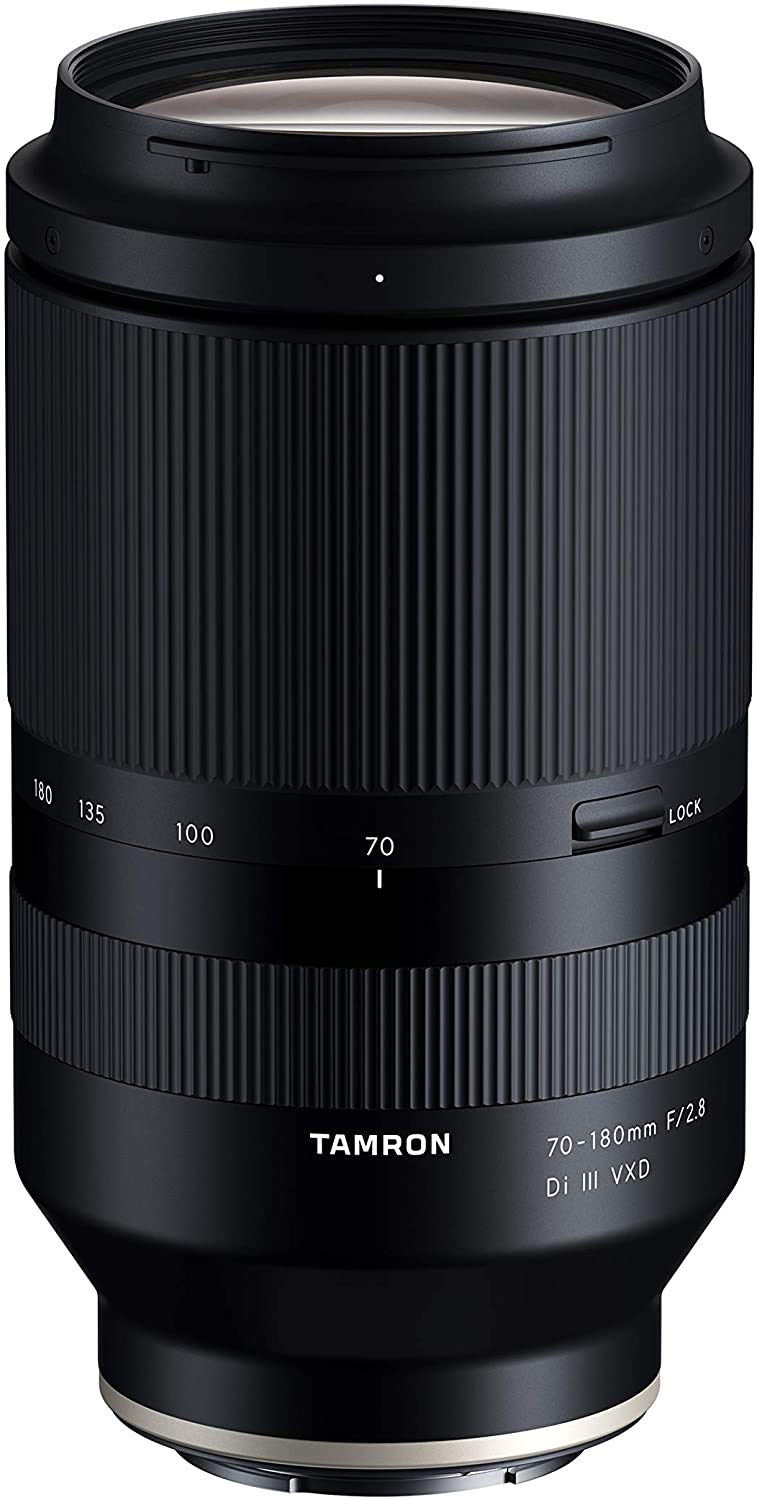
A portrait-and-event telephoto with a fast F2.8 held steady through the whole zoom.
A 1.8-pound fast tele zoom for full-frame Sony mirrorless that keeps a constant F2.8 across 70-180mm. Compared with the Sony E 70-350mm that closes down to F4.5which amplify any softness at the edges — this is built to bring out the best in them. A 24-70mm constant F2.8 range covers wide groups through tight portraits, and the optical design includes 6 FLD glass elements (special low-dispersion glass that cuts color fringing).
Fast autofocus and sharpness through the zoom are the recurring themes, and versatility ranks high — weddings and portraits are named as strong fits. It weighs 745 g, which is lighter than the 1.5-pound Sony FE 24-105mm, though there is no stabilization built into the lens. That is a fair trade for the smaller, sharper standard zoom if your body handles the steadying.
Weight draws mixed reactions, so lighter does not automatically mean featherweight in the hand. The lens quality is what carries the consensus, and the verdict for a sharp, fast 24-70mm on a demanding sensor is a clear yes. It lands as a premium standard zoom for photographers who care about edge-to-edge sharpness first.
Sharpness-first build: high sharpness across the whole image is the reason it suits high-resolution Sony bodies.
No built-in stabilization: you lean on your camera body for steadiness, and weight feels a touch on the heavier side to some.
Pick this when: you shoot a high-resolution Sony and want a fast standard zoom that stays sharp corner to corner.
Hold off if: you need in-lens stabilization or the widest reach beyond 70mm.
7. Tamron 35-150mm F/2-2.8 Di III VXD

Stabilization and focus motors
Optical stabilization is a glass group that shifts to cancel hand shake, most useful on long telephotos where tiny movements get magnified. Some lenses here carry it built in; others rely on your camera body’s IBIS. Focus motors matter too: faster linear motors like XD or VXD drive quick, quiet autofocus for video and moving subjects, while standard stepping motors favor quiet over raw speed.
Weight and close-focus distance
Weight decides whether the lens comes out of the bag. A 1.2 pound standard zoom travels easily, while a 41.1 oz event lens is a deliberate choice you plan around. Minimum focusing distance tells you how close the glass can get to a subject and still lock focus — a 5.9-inch or 7.5-inch figure opens up close detail work, while a longer figure limits how near you can push in. So a 5.9-inch minimum focus lets you fill the frame with a coffee cup, but a 15-inch figure means you step back.
Common Questions
Will a full-frame E-mount zoom work on my APS-C Sony camera?
What is the difference between a constant F2.8 and a variable F2.8-5.6 zoom?
Do I need optical stabilization in a zoom lens for handheld shooting?
Is an F4 constant zoom bright enough for indoor events?
How close can these zooms focus for detail and macro-style shots?
Can I use a Sony teleconverter with these lenses?
Which zoom range is best for portraits?
Will a heavier zoom be a problem for travel?
Does zooming change my exposure on a variable-aperture lens?
Is a wide zoom or a long telephoto better as a first lens?
The Bottom Line
For most people chasing a zoom lens for sony e mount, the winner is the Sony FE 24-105mm F4 G OSS because its 24-105mm range covers wide rooms through tight portraits in one twist, with constant F4 and built-in optical stabilization. That means you can shoot a group shot and then a headshot without changing lenses. If a fast F2.8 in a lighter body is what you want, the Tamron 28-75mm F2.8 is the value play at 1.2 pounds. And for APS-C shooters who need serious reach you can carry, the Sony E 70-350mm delivers 70-350mm at 22 ounces.
Before you buy, weigh the one trade-off that matters most for your shooting: the everyday zoom that covers the most distance also carries the most weight, while the lightest standard zooms give up reach or ruggedness. Match the focal range to your subject, the aperture to your light, and the weight to how far you will carry it — that is the whole decision.
How we choose
We do not accept paid placement. Every pick is matched to a real buyer and a real use-case; we do not hands-on test units.
Sources
Specifications: manufacturer listings and product documentation. Review insights: verified customer reviews, as of November 2026. Pricing: not shown on this page (it changes often); check the current price via the retailer link.
As an Amazon Associate, Tactical Gear Guy earns from qualifying purchases. This does not affect which products we feature.