Specs are compiled from manufacturer listings and verified buyer reviews and can change over time — please confirm the key details on the product page before buying.
Buying a step-up box sounds simple until you are standing over three boxes in a gym and realize the wrong height or a wobbling top turns every rep into a gamble on your ankles. The short answer: an adjustable platform with a wide, grippy top and a locked-in base beats a taller box you cannot trust. The nine boxes and platforms below cover every budget and training style, and each one is here for a real reason — height range, stability, surface grip, or all three.
This guide is built by comparing the manufacturers’ published specifications and the patterns across verified customer reviews, so you get each pick’s real strengths and trade-offs instead of marketing spin.
You will see exactly how each box adjusts, how much weight it takes, and where the honest trade-offs sit. From adjustable aerobic platforms to steel-and-plywood jump boxes, this is the shortlist worth your attention if you want to buy a workout step-up box once and train on it for years.
Top Picks


How To Choose The Best Workout Step-Up Box
Your knee and hip do the real work when you drive out of a step, so that is what to check first — not the brand. A good box holds that push steady; a bad one shifts under you. Four things decide which you get: height range, surface grip, base stability, and how much room you have to store it. Get those four right and almost any box here will serve you for years.
Height range decides your progress curve
A fixed box locks you into one height. A three-in-one box or a riser platform lets you rotate the same unit through low, medium, and high settings, so the same equipment keeps challenging you as your legs and balance improve. For step-ups specifically, a lower height lets you settle your hip position before you load the movement. If you are coming back from an injury or following a home routine, low-to-high adjustment is the single most useful feature you can buy.
Surface grip and edge finish matter more than you think
A missed foot lands on the edge, not the centre. Textured tops, rounded or sanded edges, and padded surfaces all reduce how badly a near-miss hurts. Foam boxes give you the most forgiving contact; wood and steel give you the firmest, most predictable platform. Neither is wrong — pick based on whether you train fast and careless or slow and controlled.
Stability, weight capacity, and floor protection
Look at how the base sits on the floor. Rubber feet and wide bases keep the box from skating on hard flooring. Weight capacity tells you the load the box is rated for, and that number should sit comfortably above your own body weight plus any dumbbells you hold. Finally, check storage: full-size platforms are long, three-in-one boxes are compact but chunky, and folding decks earn their place in a small apartment.
Side-by-Side Comparison
Every row below uses the same three dimensions so you can scan height range, weight limit, and footprint side by side.
| Model | Best For | Height Levels | Weight Capacity | Footprint (L x W) | Amazon |
|---|---|---|---|---|---|
| The Step Original Aerobic Platform★ Best Overall | Full-size platform for step-ups and follow-along routines | 3 (4″ to 8″) | 350 lbs | 43″ x 16″ | Amazon |
| CAP Barbell 3-in-1 Plyometric BoxBest Value | Budget wood box for home gyms | 3 (16″, 14″, 12″) | 300 lbs | 14″ x 12″ | Amazon |
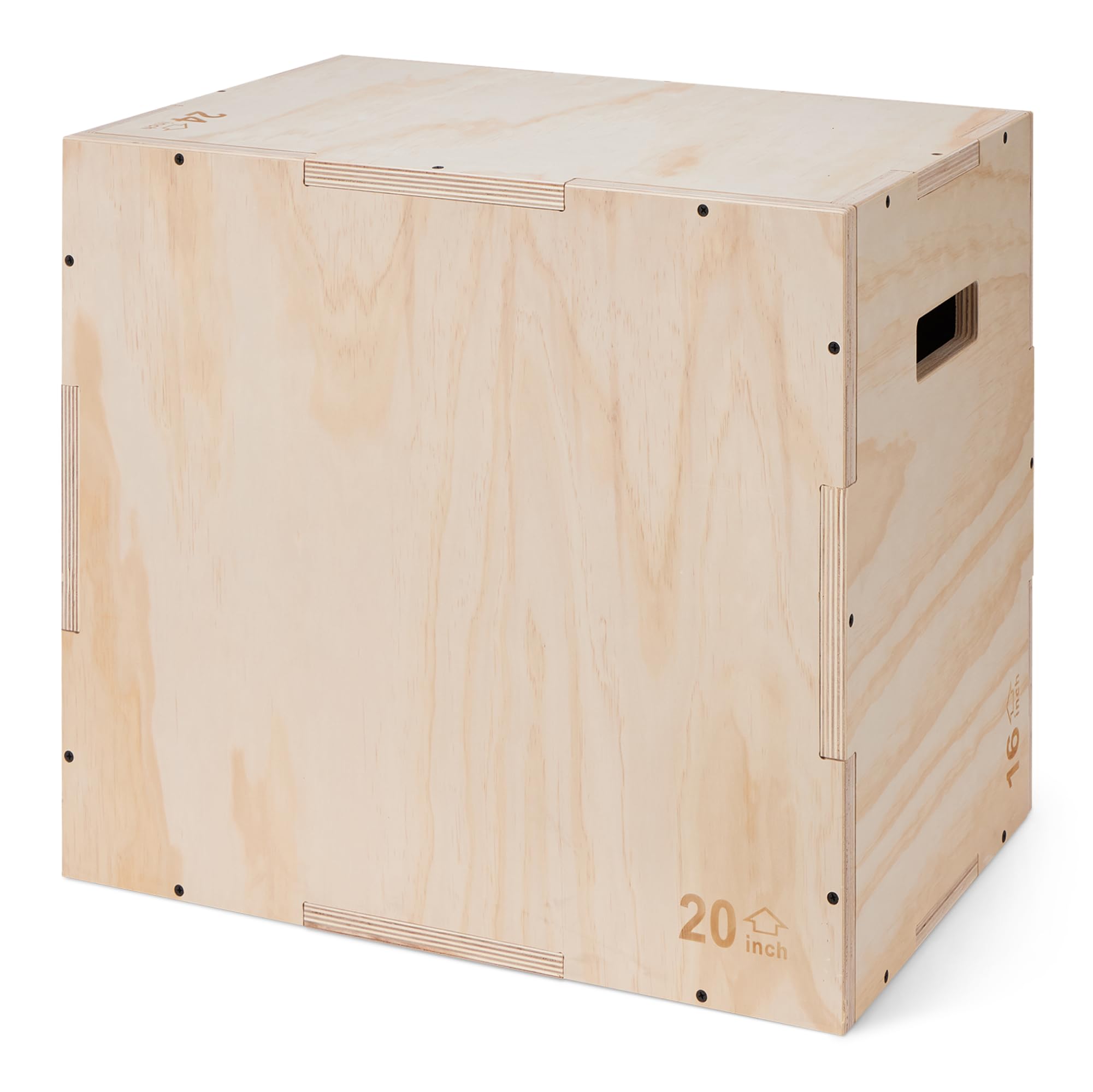
| Amazon Basics 3-in-1 Wooden Plyo BoxTop Performer | Tall-jump training with high load rating | 3 (24″, 20″, 16″) | 450 lbs | 24″ x 20″ | Amazon |
| Aerobic Step Platform Health Club Size | Long durability and high quality construction | 3 (4″ to 8″) | 300 lbs | 42.5″ x 16″ | Amazon |
| Retrospec Leap Plyo Box | No-assembly steel box for jump training | 1 (18″) | 350 lbs | 18″ x 18″ | Amazon |
| Titan Fitness 3-in-1 Foam Plyo Box | Shin-friendly foam for lighter athletes | 3 (12″, 14″, 16″) | 120 lbs | 14″ x 12″ | Amazon |
| Synergee 3-in-1 Plyometric Box | Heavy-duty plywood for strong lifters | 3 (20″, 18″, 16″) | 450 lbs | 20″ x 18″ | Amazon |
| Epic Fitness 3-in-1 Foam Plyometric Box | High-height foam box for HIIT and MMA | 3 (20″, 24″, 30″) | — | 24″ x 20″ | Amazon |
| leikefitness Exercise Step Platform | Multifunctional folding deck for small spaces | 2 levels + 3 angles | 330 lbs | 44.09″ x 9.05″ | Amazon |
Detailed Reviews
1. The Step Original Aerobic Platform Health Club Size
Our pick — 4.5+★ from 900+ verified ratings; the strongest balance of quality and price.
The 43-inch platform that gives your whole foot somewhere to land and a rail of risers to grow with.
If you have ever half-planted a foot on a narrow step and felt your ankle roll, the length here is the fix. This is a full-size 43″L x 16″W platform, so a step-up lands your entire foot with room to spare. It arrives with four original risers, and you stack them to move the surface through three heights — 4″, 6″, and 8″. That is the same range a gym step class uses, which is why the people most drawn to it are following along with step routines and DVDs at home. What wins people over is how many jobs it covers: it handles step-ups, cardio stepping, and low-impact work without you buying a second piece of equipment.
The top is a nonslip, comfort-cushion surface, which matters on the down-stroke of a step-up — your foot stays planted instead of sliding. Underneath, four nonskid feet on each riser and on the platform keep it from skating across a hard floor and protect the floor from scratches. It is built from high-density polyethylene and rated for up to 350 lbs. It also weighs in at 9.93 kg, which is heavy enough to feel planted but light enough to shove against a wall when you are done.
The catch is that it is long. At 43 inches, it wants a clear stretch of floor and a spot to lean against — this is not a box you tuck into a closet shelf. Adjusting height means pulling the platform off the risers and re-setting it, so it is not a quick mid-set switch like a three-in-one box you simply roll onto another face. It is made in the USA from high-density polyethylene, the same dense plastic that gives it its durability. For a step-up box you will keep set up and step onto every day, this is a hard one to beat.
What earns it the top spot
- 43″ x 16″ platform gives your full foot a landing zone on every step-up
- Three heights (4″, 6″, 8″) from the included four risers
- Nonslip comfort-cushion top with nonskid feet on each riser
- Rated to 350 lbs and made in the USA from recyclable high-density polyethylene
Where it asks something of you
- 43-inch length needs real floor space and a wall to lean on
- Changing height means resetting the platform on the risers, not a quick flip
The right buy for: anyone following along with step routines, doing high-volume step-ups, or training at home where a wide, stable surface matters most.
Reconsider if: your training space is tight or you want to swap heights between sets without breaking rhythm.
2. CAP Barbell 3-in-1 Plyometric Box
Three heights in one compact wood box, with a footprint small enough to live beside the couch.
If a full-size aerobic platform is too much furniture, this is the trimmer answer. At 14″L x 12″W, it takes up roughly a third of the floor space the 43-inch Step occupies. Roll it onto a different face and you get 16, 14, or 12 inches of height — enough to run step-ups, box jumps, agility drills, and progressive plyometric work off one unit. It is built from engineered wood with interlocking panels and countersunk screws, and it is rated up to 300 lbs.
Sturdiness is what sells this box. Interlocking panels and countersunk screws keep the box solid through repeated step-ups and jumps, and buyers report it does not tip during workouts. The textured surface adds grip for confident foot placement, and the rounded, smooth-finished edges cut down on snag points. Wide integrated handles let you drag it between exercises without fighting it. Assembly is part of the deal — you screw the panels together — though the box comes with the wrench you need.
Here is the honest limit: 300 lbs is the lowest rating among the wood boxes here, so heavier lifters should look at the 450-lb options. And size is the one point where buyer opinions split — some find the 12-to-16-inch range perfect for their training, others wish there were a taller face. If you mostly need mid-height step-ups for conditioning, that range is all you need. If you are chasing maximum jump height, look at the taller wooden box below.
What it is built to do: it gives you three height faces, countersunk screws (screws set flush so nothing snags your shoe), and a textured top. That turns a compact budget box into a step-up and jump platform that stays planted while you use it.
Grab this one if: you want three heights, real stability, and small-floorprint storage at the entry-level end of the range.
Hold off if: you plan to hold heavy dumbbells — 300 lbs is the ceiling — or you need a face taller than 16 inches.
3. Amazon Basics 3-in-1 Wooden Plyo Box
The tallest wood box here — 24 inches of jump height on a base rated for 450 lbs.
Height is the whole story with this one. The 24″ face tops out at three times the 8-inch peak of The Step platform, so if your training goal is real box-jump height rather than aerobic stepping, this is the wooden box that gets you there. It rotates through 24″, 20″, and 16″ with clear indicators showing which face is which. That 450-lb maximum weight capacity also beats the CAP Barbell’s 300 lbs by a wide margin — a big difference if you are a heavier lifter or you hold weights during step-ups.
It is solid wood and FSC-certified — the materials come from well-managed forests, recycled sources, or other controlled wood, under certificate FSC N004130. Sanded edges reduce the nicks and scratches you get from a rougher wooden box, and wide built-in handles let you flip and reposition it between moves. Assembly goes quickly, because the box arrives with clear instructions, pre-drilled holes, and pilot holes.
The thing to be honest about is size. Some people love how the 24-inch face stretches them; others find the box smaller in person than they pictured. That is a fit question, not a defect — if you already know you want a high jump face, this delivers it. One more practical note: it is still wood, so it is the box that will punish a clipped shin. If forgiveness matters more than height, the foam options further down this list are worth a look.
The case for it
- Three heights (24″, 20″, 16″) — the tallest wooden face in this lineup
- 450-lb weight capacity, the highest here alongside the Synergee
- FSC-certified wood with sanded edges and wide carry handles
- Pre-drilled and pilot holes make assembly quick
Where it asks something of you
- Wood is unforgiving on a missed foot — shins will know
- Size is divisive: the 24-inch face is either just right or bigger than expected
Make this your pick if: you want genuine jump height and a high load rating from a wooden box you assemble once.
Pass it over if: you train fast and unscripted and want a padded surface to absorb near-misses.
4. Aerobic Step Platform Health Club Size – Gray Black

A 42.5-inch anti-slip deck built to shrug off daily abuse in a home or club setting.
For people who step up more for volume and durability than for plyometric height, this platform is the workhorse of the group. The 42.5″L x 16″W anti-slip surface gives you the same wide footing as The Step, and it ships with four removable risers measuring 16″ x 16″ x 2″ each. Stack them and you move through 4″, 6″, and 8″ of height, so you can dial the effort up as your conditioning improves. It is made of high-density polyethylene and rated for up to 300 lbs.
what separates it is durability under daily foot traffic. This platform is built for repeated stepping — cardio, low-impact work, and high-impact intervals — and its 42.5-inch deck doubles as a low bench. Rubber feet keep it from sliding, and the risers lift out so it stores flatter. It works indoors and outdoors, which is rare for a plastic platform.
The one thing to set your expectations on is how the risers behave. They do not click or lock into place; they fit under the platform rather than clipping to it. For straight step-ups that is a non-issue, because your weight holds everything down. But if you are jumping onto the edge or shifting your weight hard from side to side, it can rock. Treat it as a stepped platform, not a plyo box that has to swallow landings, and it will do exactly what it promises.
Why it stays in the shortlist: 42.5 inches of anti-slip deck, three riser heights, and a 300-lb rating make it the most durable-feeling plastic platform for steady step-up volume.
Best for: steady step-ups, cardio stepping, and anyone who wants a platform that survives years of foot traffic.
Look elsewhere if: you need a box that will not shift under hard lateral force — the risers sit loose rather than locking.
5. Retrospec Leap Plyo Box Jump Platform

A steel-framed 18-inch cube that shows up ready to jump on — no screws, no assembly, no patience required.
Some buyers want to sign for a box, set it down, and start jumping. This is that box. It arrives as a single 18″L x 18″W x 18″H unit with a steel frame and a PU leather top. Its 18-inch height lands at 2.2 times the 8-inch peak of The Step, so you get real jump height without building anything. The tapered design widens toward a large, stable base, and that is the geometry that keeps a steel box from feeling tippy when you land.
Stability is why people keep this one. Owners mention it stays planted and never tips during use, and the welded steel frame feels solid at the joints. The top combines stable rubber stoppers with a non-slip surface for a confident landing, and it stacks for storage. Rated to 350 lbs, it handles step-ups, box jumps, and conditioning circuits.
The trade-off is that it is fixed at 18 inches. There is no second face to roll onto, so your progression tops out at the height you buy. There is also no cushioning — a metal box with a leather top is firm on the shins if you clip it. If you want the widest height range, a three-in-one box will serve you better. If you want one height you can trust, with nothing to assemble and nothing to wobble, this steel cube is the simple answer.
Why people keep it
- No assembly — it is ready the moment it lands
- Steel frame with a tapered base and rubber stoppers for confident landings
- PU leather non-slip top rated to 350 lbs
- 18″ x 18″ footprint stacks for storage
What to weigh first
- Fixed at 18 inches with no second height face
- Firm steel and leather give no cushion on a clipped shin
Reach for this if: you want a stable, no-build jump box right now and you are happy training at one height.
skip it if: you want a progression ladder of heights or a forgiving surface.
6. Titan Fitness 3-in-1 Heavy Foam Plyometric Jump Box

The box that forgives a clipped jump — high-density EPE foam instead of wood or steel.
If you have ever caught your shin on a wooden box, you already understand why this one earns its place. The core is high-density EPE foam, a firm but forgiving material that gives on contact instead of bruising you. It rotates through 12, 14, and 16 inches — three levels, the same count as the foam-friendly Amazon Basics box but on a shorter top height — so young or lighter athletes can build intensity step by step. The textured vinyl cover keeps the box planted so you can focus on form.
The rating here is the number to check before you buy: this box supports up to 120 lbs. That is far below the 300-to-450 lb limits of the wood boxes in this list, so it is built for younger athletes and lighter users, exactly as the maker describes it. In exchange you get a no-assembly box that handles step-ups, box jumps, dips, foot switches, lateral movement, push-up variations, and single-leg step-downs. The smooth edges and soft contact point make dynamic moves more forgiving.
The one thing to know is that this foam box can wobble when you stand on the long side — its stability holds up under weight but not in every orientation. Titan also advises against using it on slippery floors, and centred landings are recommended. Stay square on the box, keep it on a grippy surface, and it does its job cleanly. Just be realistic about the weight ceiling: this is a training and conditioning tool, not a heavy-lifting platform.
The honest read: the EPE foam core turns a hard landing into a far gentler one, and the three-step height range suits newer athletes — as long as your body weight stays well under the 120-lb rating.
Made for: lighter athletes, younger trainees, and anyone whose main worry is a bruised shin rather than max load.
Think twice if: you weigh more than the 120-lb rating allows or you need a box that stays planted in every standing position.
7. Synergee 3 in 1 Plyometric Box

Three-quarter-inch plywood, 450 lbs, and a 20-inch top face — this is the lifter’s wooden box.
For serious strength training, the material is the deciding factor. This box is made from ¾-inch high-quality plywood with inner supports, which is the kind of build you want under a loaded lift or a hard landing. It rotates through 20″, 18″, and 16 inches, so you get a taller top face than the CAP Barbell’s 16-inch peak. The 450-lb capacity matches the Amazon Basics box at the top of this group. It also supports the widest spread of exercises: decline push-ups, split squats, around-the-box planks, and step-ups all work off one unit.
Stability is the selling point: the ¾-inch plywood box sits planted enough that tipping is not a concern during fast jump work. It does require assembly, and the process is straightforward: the box ships with inner supports, screws, and pre-drilled holes. At 26.8 pounds it is the heaviest unit in the lineup, which is part of why it feels so planted underfoot.
Two honest notes. The first is weight — 26.8 pounds is a real object to move, so you will want a permanent spot for it. The second is the screws. They are the recurring weak point in an otherwise strong box, and a few buyers have needed to replace them or reinforce the assembly. Handle that once, tighten after a few sessions, and the plywood body does the rest. For a lifter who wants a firm wooden platform to step and jump on, the trade-off is worth knowing before you start.
What backs the premium label
- ¾-inch plywood with inner supports, rated to 450 lbs
- 20″, 18″, and 16″ faces for a higher wooden step
- Solid enough that tipping is a non-issue during fast training
- Works for step-ups, split squats, planks, and decline push-ups
The fair caveats
- 26.8 lbs makes it a permanent floor resident
- Assembly is required, and the included screws are the weak link
Suits this buyer: the lifter who wants a firm, high-capacity plywood box and does not mind a one-time assembly.
Not for you if: you want a no-assembly box or a light unit you can carry between rooms.
8. Epic Fitness 3-in-1 Foam Plyometric Jump Box
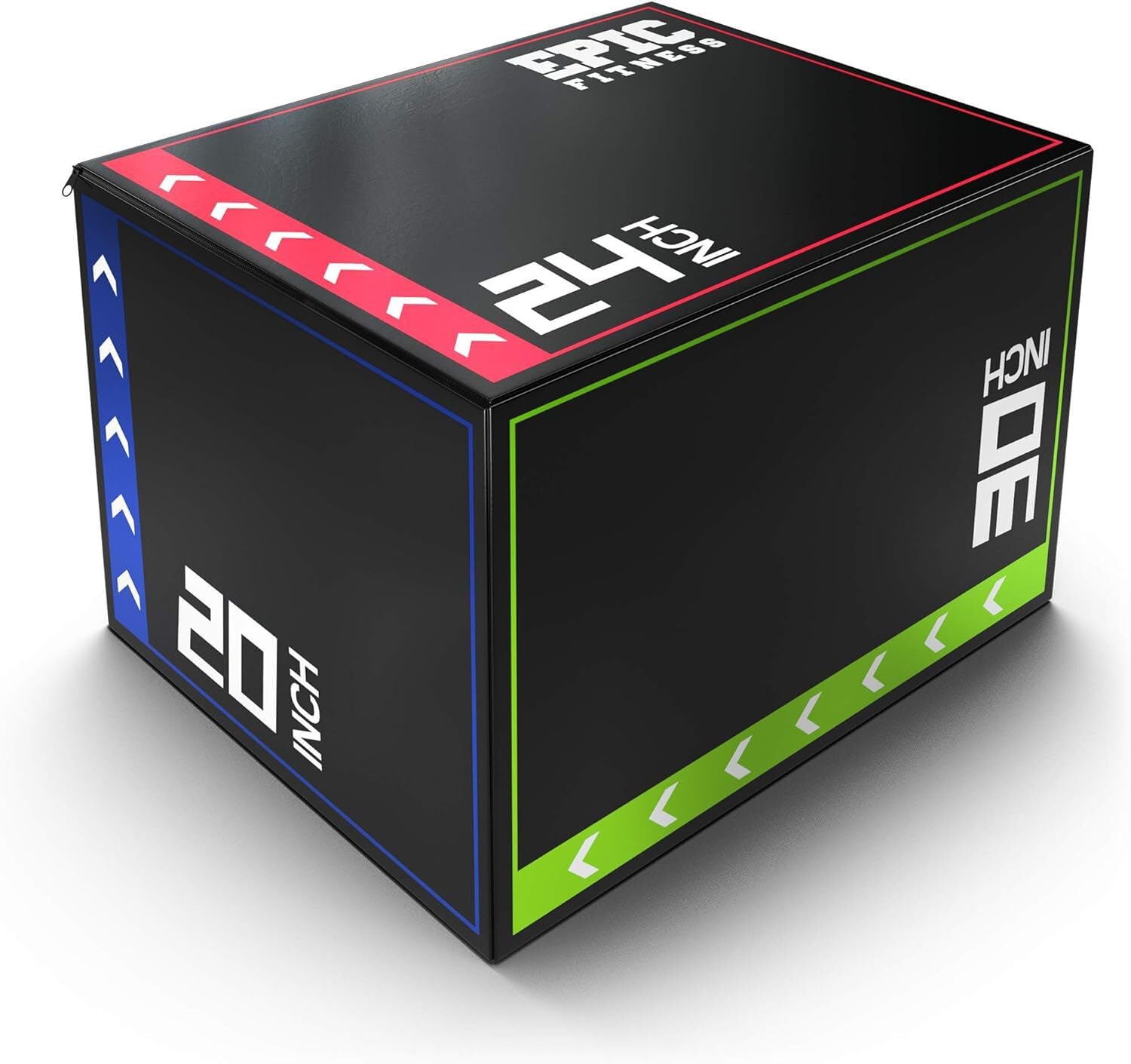
A foam box that climbs all the way to 30 inches — the tallest face in this entire lineup.
If you want high box jumps without the shin tax of a wooden box, this is the one. It rotates through 20″, 24″, and 30 inches, putting its 30-inch top above every other box here, and it does it in foam. The high-density EPE core is the reason it feels less intimidating than wood or steel — a missed foot hits a firm but softened surface instead of a hard corner. Three difficulty stages let men and women at different fitness levels all find a usable height off the same unit.
It is not only for legs. The foam box doubles as a base for improve push-ups and knee touches, so arm and core work fit in too. The PVC leather cover wipes clean, which matters if you train hard and sweat on it. At 16 pounds it is the lightest box in this list, so it is easy to reposition and easy to tuck away. The maker positions it for both home and commercial gyms, which tells you the build is meant to hold up to steady use.
The catch is that foam has a ceiling. This box is sold with no published weight capacity, so I will not put a load figure on it — treat it as a jump and conditioning tool, and check the listing if you plan to load it heavily. The 30-inch face is a genuine jump, not a gentle step-up, so start on the 20-inch side and build up. The cover is hand-wash only, so plan for that upkeep.
What makes it different: three height faces topping out at 30 inches, a wipe-clean PVC leather cover, and a 16-pound build that is easy to move — all on a padded rather than hard landing surface.
Pick it for: high-jump training, HIIT, MMA-style conditioning, and anyone who wants height without hitting a hard box.
Look on if: you need a published weight capacity or you plan to load the step with heavy weight.
9. leikefitness Exercise Step Platform

A folding deck that works as a step, a weight bench, a plyo surface, and a ramp.
Small-space training is where this one pulls ahead. It folds and stores inside a small footprint — the compact design slots under things or against a wall, and there is a small storage space inside for bands and tubes. For step-ups, it gives you a sturdy surface rated to 330 lbs. But the deck does far more: it works as a weight bench, a step, a plyometric surface, and a ramp, and it ships with one resistance band. Two levels of height adjustment and three angle locations — flat, inclination, and decline — let you reshape the surface to the movement.
The bracket angles go further: 0°, 25°, 50°, and 65°, so you can match the incline to whatever drill you are running. An anti-slip textured surface and rubber grip feet keep it steady while you work. It is built from dense, durable plastic on an alloy steel frame at 21 pounds, so it holds its shape without being a chore to move. As a home gym add-on, it earns its place because it stands in for several pieces of equipment at once.
What you give up is the dead-simple steadiness of a solid block. This is a folding multi-tool, so the surface is not one thick slab underfoot the way the wood boxes are, and the height range is two levels rather than three. If your goal is pure box jumps or heavy loaded step-ups, a dedicated box is the better tool. If you want a step-up platform that also becomes a decline bench and packs away when the session ends, this is the most flexible deck on the list.
Where it works hardest
- Folding design with built-in storage for bands and tubes
- Two height levels plus flat, incline, and decline angles
- Four bracket angles (0°, 25°, 50°, 65°) for varied drills
- 330-lb capacity on an alloy steel frame with rubber grip feet
Where to be realistic
- Folding deck is not as rock-solid as a one-piece wooden box
- Two height levels, not three, so the progression ladder is shorter
Worth it if: you train in a shared room, you fold up after each session, and you want one deck that does step-ups, bench work, and incline drills.
Not the one if: your only goal is a fixed, immovable surface for heavy jumping.
Know the Specs
Height levels and how they change your training
A three-level box rolls onto different faces to give you three heights, while a riser platform stacks removable blocks under a deck. More levels mean a smoother progression — you can start low, master the movement, then move up. A single-height box is simpler and often sturdier, but it locks your training at one step height. For daily step-ups, three levels is the useful minimum.
Weight capacity and what it really means
This is the load the box is rated to hold, and it should sit comfortably above your body weight plus anything you carry. Wood boxes here run from 300 to 450 lbs; foam options vary widely, with some builders publishing a limit and others not. When a capacity is not listed, be cautious about loading the box heavily — a step-up box is a support surface, not a lifting platform.
Material: foam, wood, steel, or plastic
Foam boxes soften a missed landing but have the lowest load ceilings. Wood boxes give you a firm, predictable platform for jumps and loaded step-ups. Steel frames feel most solid underfoot and often need no assembly. Plastic platforms are the lightest to store and the easiest to clean, but their risers may not lock, so they suit stepped work rather than hard lateral landings.
Surface grip and footing
A textured top, rubber feet, or a padded cover all affect how much your foot trusts the step. Grip matters most on the down-stroke of a step-up, when your weight is pushing through one foot. Wide footprints also help, because they give your whole foot a landing zone. A narrow box demands more precision from every rep.
Common Questions
Is a foam plyo box or a wooden box better for step-ups?
How do I know what height to start at on a step-up box?
Can a step-up box hold my weight plus dumbbells?
Do I need to assemble a plyometric box?
Will a step-up box slide or scratch my floor?
How much floor space does a step-up box take up?
Is a fixed-height box worse than an adjustable one?
Can I use a step-up box for anything other than step-ups?
Should I worry about the screws on a wooden plyo box?
The Bottom Line
For most people buying a workout step-up box, the winner is The Step Original Aerobic Platform. A 43-inch nonslip surface, three riser heights, and a 350-lb rating cover step-ups, cardio, and follow-along routines without asking you to adapt. If you want real jump height from a wooden box, grab the Amazon Basics 3-in-1 Wooden Plyo Box and its 24-inch face. For a small space that has to double as a living room, reach for the folding leikefitness Exercise Step Platform. One last nudge before you commit: Both the full-size Step and the Amazon Basics box hold 4.5-plus star ratings across hundreds of owners, so choose between them on height range and storage, not build quality.
How we choose
We do not accept paid placement. Every pick is matched to a real buyer and a real use-case; we do not hands-on test units.
Sources
Specifications: manufacturer listings and product documentation. Review insights: verified customer reviews, as of November 2026. Pricing: not shown on this page (it changes often); check the current price via the retailer link.
As an Amazon Associate, Tactical Gear Guy earns from qualifying purchases. This does not affect which products we feature.