Specs are compiled from manufacturer listings and verified buyer reviews and can change over time — please confirm the key details on the product page before buying.
Your garage floor is concrete, and concrete wins every argument with your knees, your joints and your barbell. A proper mat fixes that — but only if it is thick enough, heavy enough to stay put, and tough enough that dropped dumbbells don’t shred it. This guide sorts the rollable mats, the interlocking tile systems and the solid rubber slabs by what actually holds up under a garage workout.
This guide is built by comparing the manufacturers’ published specifications and the patterns across verified customer reviews, so you get each pick’s real strengths and trade-offs instead of marketing spin.
Some picks here are roll-up mats you can stash against a wall, others are interlocking tiles that stay put as permanent flooring. Either way, thickness, weight and grip are what separate a mat that survives a year of garage training from one that curls at the edges. The picks below cover the whole range of workout mats for garage setups.
Top Picks


How To Choose The Best Workout Mats for Garage
Bare concrete in a garage is cold, hard and unforgiving. A mat does two jobs there: it cushions your joints and it stops your equipment from chewing up the slab. Your choice depends on one question: do you want flooring that stays down permanently, or a surface you roll away after training?
Roll-up mat or interlocking tiles
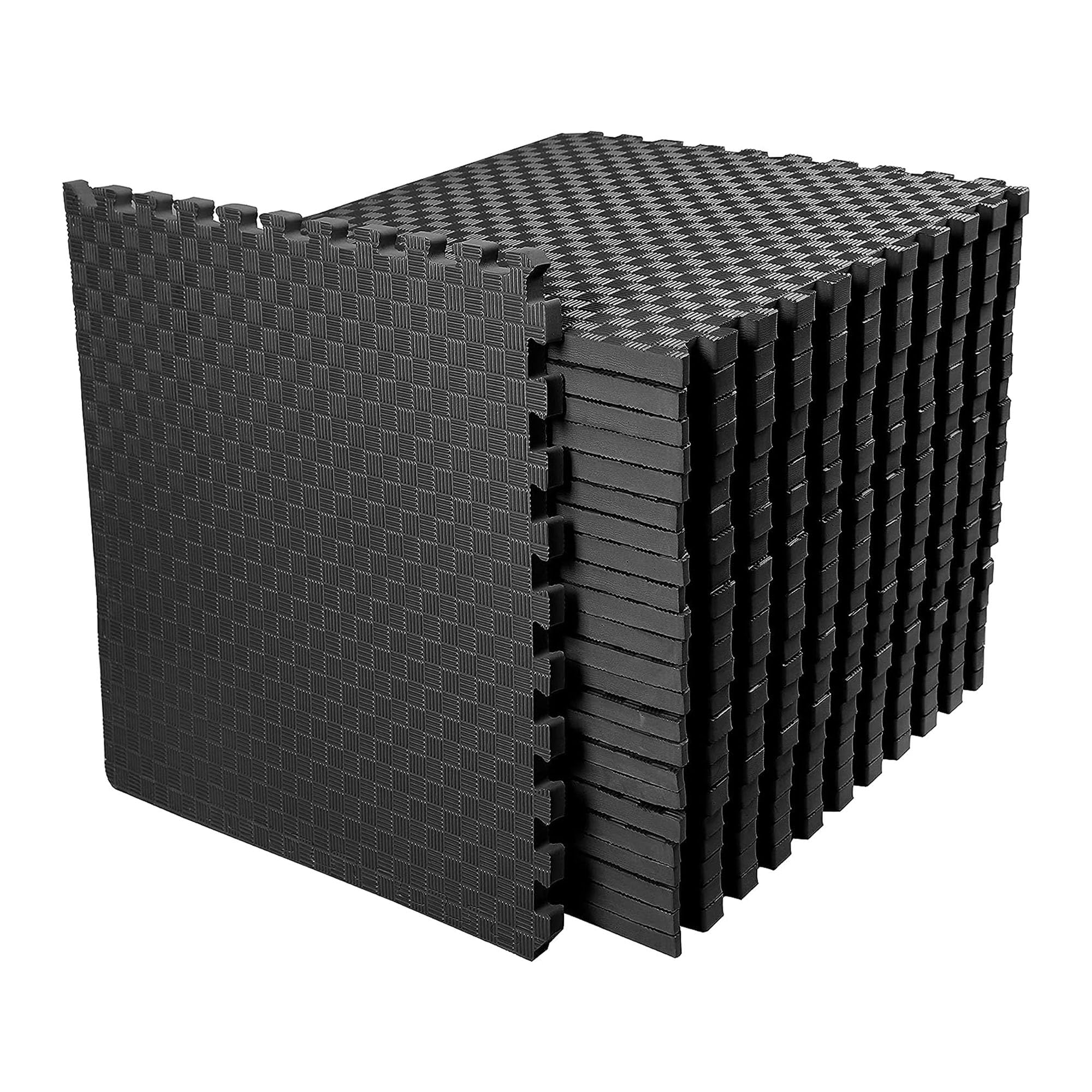
A large roll-up mat is one continuous sheet, so nothing can shift apart mid-set. The GymCope 8’x6′ rolls to 96″L x 72″W with a bag and straps, which suits a garage bay you also park in. Interlocking tiles are the opposite approach — they cover odd-shaped footprints and let you extend the floor later. The AIRHOP set covers 48 sq ft across 12 tiles at 24″L x 24″W each, so you can build an 8 x 6 ft pad and add on from there.
Thickness: cushioning versus stability
Thicker is not automatically better under a loaded barbell. A 1-inch tile like the BalanceFrom gives your knees plenty of give, but a heavy squat stand can sink into soft foam. Thin PVC in the 7mm range (about 0.27 inch) like the GymCope keeps the bar level and still takes the edge off impact. Match the thickness to your training: heavy lifting wants a firmer, thinner sheet, bodyweight and floor work can use the softer tile.
Weight and grip on smooth concrete
A mat that slides is worse than no mat at all. Weight is the simplest proxy for staying put — the GymCope weighs 28 pounds versus 15.6 pounds for the HAPBEAR, so it resists creeping during jump rope and lateral drills. Look for a textured or rubber top layer for traction, and a grooved or suction-cup underside to bite the slab. Rubber-topped tile systems add that grip but tend to carry a rubber smell when new.
Side-by-Side Comparison
| Model | Best For | Form | Thickness | Coverage | Amazon |
|---|---|---|---|---|---|
| GymCope Large Exercise Mat★ Best Overall | All-round garage training | Roll-up PVC sheet | 7mm / 0.27″ | 8′ x 6′ | Amazon |
| HAPBEAR Large Exercise MatBest Cushioning | HIIT and cardio cushioning | Roll-up PVC sheet | 0.32″ | 7′ x 5′ | Amazon |
| BalanceFrom Puzzle Exercise MatBest For Big Areas | Thick padding on a budget | EVA interlocking tiles | 1″ | 72 sq ft (18 tiles) | Amazon |
| AIRHOP Rubber Top Tiles | Heavy equipment protection | Rubber-top EVA tiles | 0.79″ | 48 sq ft (12 tiles) | Amazon |
| ProsourceFit Puzzle Mat | Covering a large floor area | EVA interlocking tiles | 0.5″ | 144 sq ft (36 tiles) | Amazon |
| GXMMAT Large Exercise Mat | Shoe-on cardio and weights | Roll-up PVC sheet | 7mm / 0.28″ | 6′ x 6′ | Amazon |
| SUPERJARE Rubber Top Tiles | Modular gym flooring | Rubber-top EVA tiles | 0.4″ | 96 sq ft (24 tiles) | Amazon |
| IncStores Vulcanized Rubber Mat | Under a squat rack or bench | Solid vulcanized rubber | 0.38″ / 10mm | 4′ x 6′ | Amazon |
| American Floor Mats Rubber Roll | Long-run permanent flooring | Solid rubber roll | 0.31″ | 4′ x 16′ | Amazon |
Detailed Reviews
1. GymCope Large Exercise Mat
Our pick — 4.5+★ from 800+ verified ratings; the strongest balance of quality and price.
One continuous sheet of high-density PVC that refuses to crawl across smooth concrete.
The GymCope is a single 96″L x 72″W roll that lays flat across a garage bay and doesn’t creep when you jump rope or shift your stance. Its high-density PVC takes abrasion and scratches from high-intensity work without gouging, and you can wear shoes on it. That combination — one unbroken surface, 28 pounds of it, and a 7mm thickness — is why it holds the top spot here. It also holds 4.5+ stars across 800+ ratings.
What wins people over is the build quality, and the stability follows right behind: it stays planted on tile, carpet, concrete and hardwood instead of sliding out from under a burpee. The cushioning lands in a firm middle ground, enough to take the slam out of squats without turning mushy under a loaded bar. Because it rolls rather than interlocks, there are no seams to catch a foot or drift apart mid-set.
The catch is thickness. At 7mm it is a lot firmer than a 1-inch foam tile, so if your garage sessions are mostly kneeling mobility work you may want more give. The mixed notes on thickness point the same way — this mat is built to stay stiff and stable, not to feel like a pillow. It ships with a carrying bag, three hook and loop straps and a 27″x16″ microfiber towel.
Takes The Hammering
- High-density PVC shrugs off abrasion and scratches from shoe-on training
- 28 pounds of mat resists creeping during jump rope and lateral work
- Double-sided anti-slip grip bites tile, carpet, concrete and hardwood
- Rolls up with bag and three straps for wall storage between sessions
Know Before You Unroll
- 7mm is firm — lighter cushioning than a 1-inch foam tile
- A full 8′ x 6′ sheet may be more footprint than a single user needs
Best matched to: garage athletes doing cardio, weights and floor work on the same slab, shoes on.
Worth a second thought: if your training is mostly floor-based mobility, the firmer 7mm feel is a real trade-off.
2. HAPBEAR Large Exercise Mat
Softer landing for knees and wrists, and 12 pounds lighter to haul than the GymCope.
The HAPBEAR leans on comfort. Its high-density foam runs up to 8mm thick — over a third of an inch — so knees, wrists and elbows get real give during aerobic work. Where the GymCope is built stiff for barbell stability, this one cushions. It weighs 15.6 pounds against the GymCope’s 28, which makes it noticeably easier to unroll, reposition and hang up.
Grip is the trait people talk about most, helped by a corrugated top and a suction-cup underside that grab the floor and keep it steady through vigorous movement. The mat is waterproof and sweat-proof, so a damp cloth handles cleanup, and it resists curling in a way ordinary thin yoga mats don’t. It comes with HAPBEAR resistance bands and a storage bag.
Where it falls short of the top pick is longevity under shoes and weights — durability draws the weakest feedback here, so this is a mat for cardio, HIIT, bodyweight and yoga rather than dropping dumbbells on it. The 7′ x 5′ footprint is also smaller than the GymCope’s 8′ x 6′.
Where it earns its place: soft, grippy and easy to roll, it turns a hard garage slab into a comfortable HIIT and stretching surface.
Fair warning: treat it as a cardio and bodyweight mat, since durability under heavy iron is its weak point.
Reach for this if: you want maximum padding and easy storage for cardio-first garage sessions.
Look elsewhere if: you plan to drop loaded weights on it regularly.
3. BalanceFrom Puzzle Exercise Mat
A full inch of foam that turns a whole garage floor into a padded room.
If cushioning is your priority, one number tells the story: this mat is 1 inch thick, laid out across 144″L x 72″W of floor from 18 tiles. That is roughly four times the thickness of the 0.27-inch GymCope — and the difference under your knees is immediate. The high-density EVA foam supports and cushions in equal measure, and it is thick enough to kneel on comfortably.
Assembly is genuinely simple — the tiles press together and come apart just as fast, so you can cover an entire garage bay, break it down, or reconfigure it around equipment. It works well as a base under a stationary bike and as general floor padding for a home gym. The design is water-resistant and slip-resistant, and the material is free of rubber, plastic and metal.
The honest trade-off is that a 1-inch foam tile is soft, and soft means movement under a heavy rack. It is a floor-padding and bodyweight surface, not a platform for loaded barbell work. A 2-year warranty covers a floor pad meant to stay down year-round.
The value read: for sheer square footage of thick foam, this is hard to match — a full-pad garage floor for the price of a single roll-up mat.
Honest limit: foam this thick is soft underfoot, so heavy lifting equipment belongs on something firmer.
Best for: covering a whole garage bay in comfortable, joint-friendly padding for bodyweight and cardio work.
Think twice if: you need a rock-solid base for a loaded squat or deadlift setup.
4. AIRHOP Rubber Top Exercise Mats
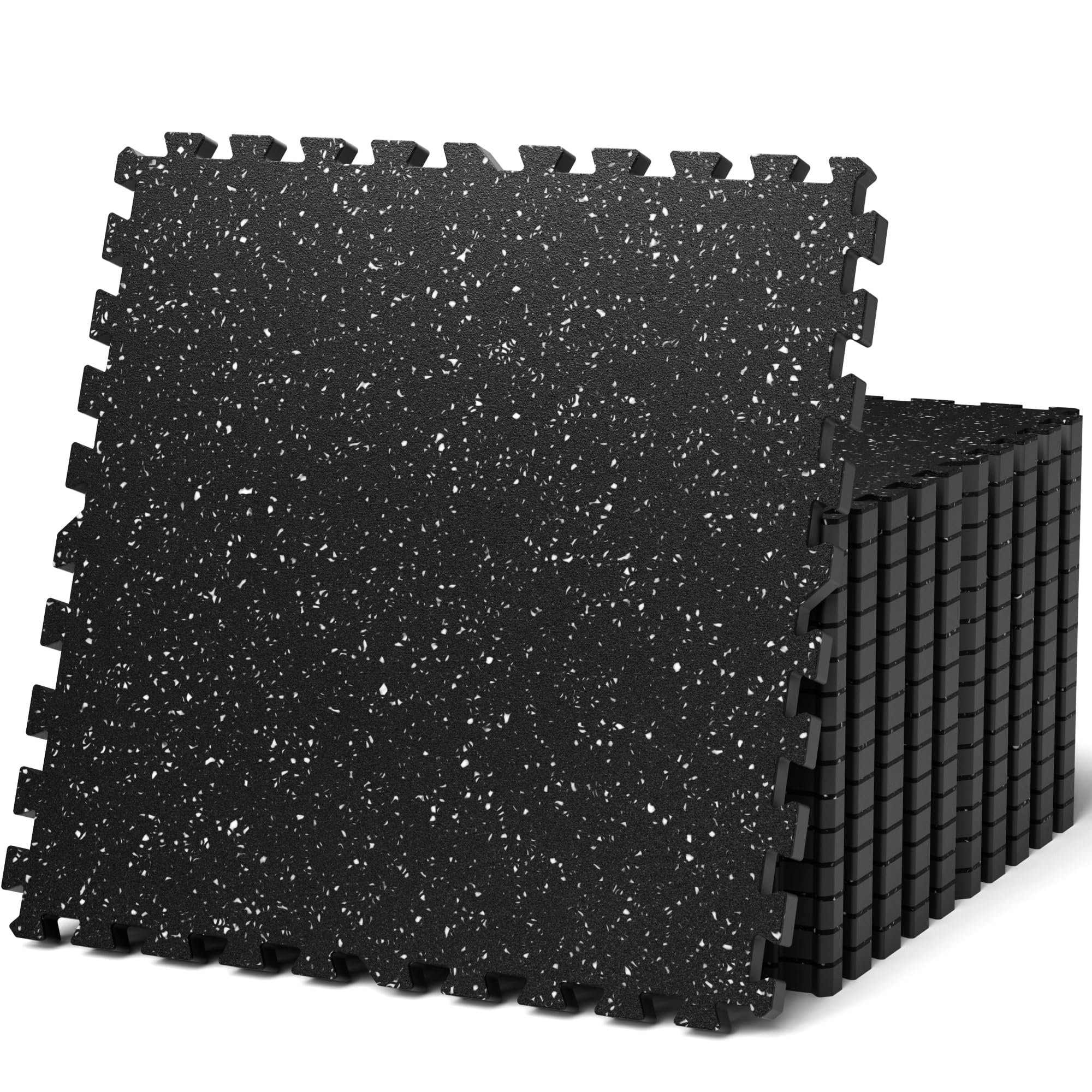
Rubber over foam — the combination that takes dropped weights without letting your equipment gouge the slab.
This is the pick for anyone who found that plain foam tile couldn’t handle real iron. The AIRHOP is a two-layer system: a textured recycled rubber top bonded to a high-density EVA foam base. The rubber surface is tough enough to hold up to free weights being dropped on it, while the foam underneath absorbs the shock. It covers 48 sq ft from 12 tiles, each 24″L x 24″W x 0.79″ thick, which builds an 8 x 6 ft pad.
Build quality is the star here, with durability close behind — the mat is made to support heavy machinery and shrug off scratches, scuffs and dents from dumbbells, medicine balls and kettlebells. The locking teeth are larger than average and hold a secure fit so the tiles stay together mid-workout. Because the pieces detach and re-link, you can extend the floor as your setup grows.
The one thing to expect is a bit of rubber smell when the tiles first come from the start — the material is mixed on odor. Air them out for a day before laying the full pad and it settles.
Built For Iron
- Textured recycled rubber top resists scratches, scuffs and dents from weights
- High-density EVA base absorbs shock and mutes noise and vibration
- Larger interlocking locks keep tiles from separating during use
- Waterproof surface wipes clean with a damp cloth
The Fine Print
- Fresh rubber can carry a noticeable smell at first
- 48 sq ft may need a second set to cover a large bay
The right call when: your garage holds free weights, kettlebells and medicine balls that need a floor that won’t dent.
Pass if: you want zero rubber scent — this one needs airing out first.
5. ProsourceFit Puzzle Mat
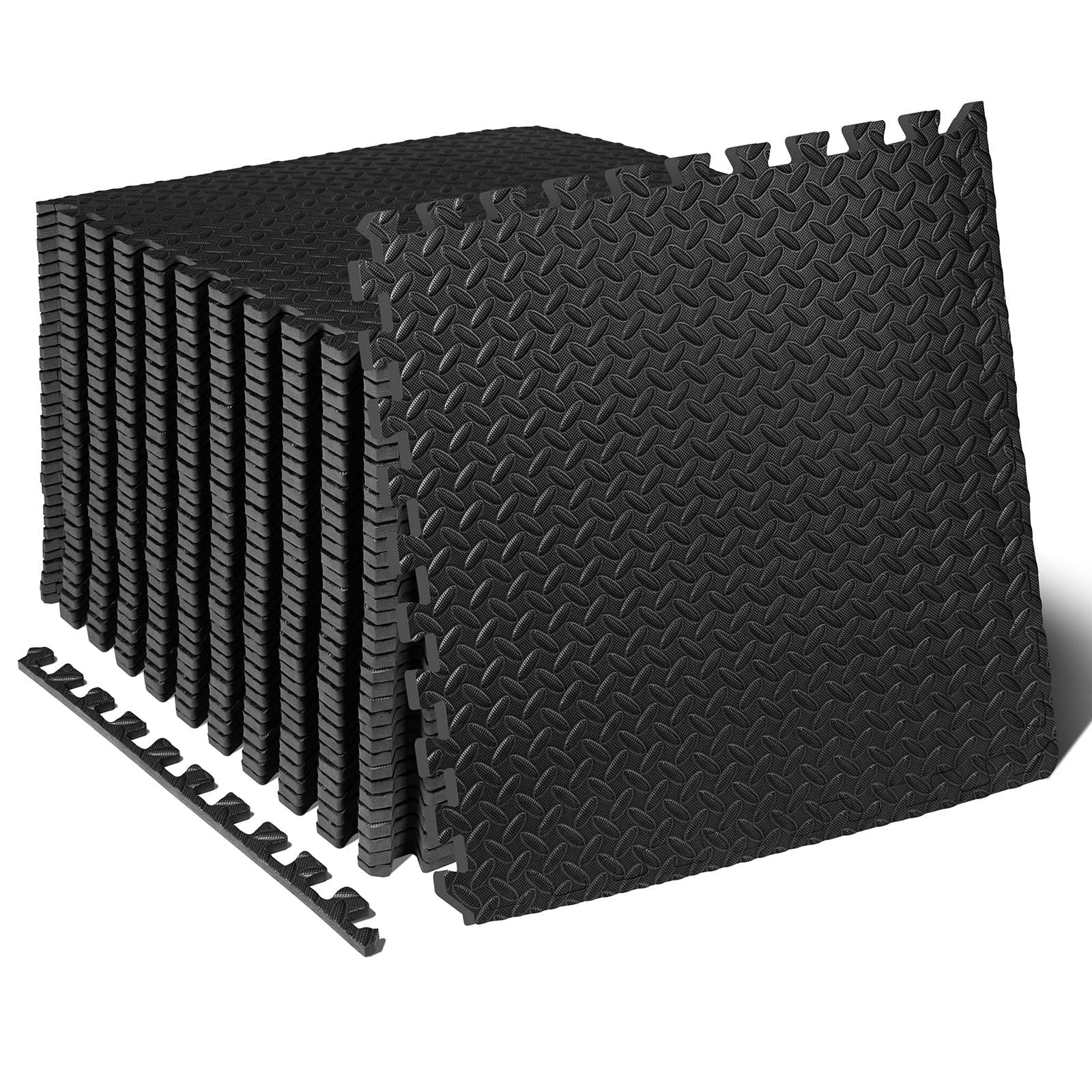
Thirty-six tiles that cover 144 square feet — enough to floor an entire double garage.
When the job is covering a lot of floor, this is the volume answer. Each tile measures 24″L x 24″W x 1/2″ thick and you get 36 of them plus end borders for a finished edge, giving 144 sq ft of coverage. That is the largest area in this lineup — three times the 48 sq ft of the AIRHOP set. The high-density EVA foam is non-skid, water-resistant and noise-reducing, and the interlocking pieces assemble and break down quickly for storage.
The quality and value of the foam are what land best, and assembly is fast enough that setting up a room and pulling it back apart is not a chore. It is a good fit for a garage floor mat, a carpet protector, or a fitness room, and it is free of toxic phthalates as an alternative to rubber mats. Lightweight tiles keep the whole pad easy to move.
Two honest notes: this is 1/2-inch foam, so it is thinner than a full 1-inch tile and compresses slightly under heavy equipment. Tile fit and grip get more mixed feedback than the quality, with some separation reported over time — lay it on a flat hard surface, as the maker advises, and it behaves best.
The standout: 144 sq ft of interlocking foam is a lot of floor, and the end borders give it a clean, finished look.
The reality check: at 1/2 inch it is a light-duty surface — expect some give and occasional tile separation under heavy use.
Ideal when: you want to floor a large area affordably for lighter workouts and equipment protection.
Not the one for: heavy barbell sessions, where a firmer or thicker tile holds up better.
6. GXMMAT Large Exercise Mat

A 6′ x 6′ training square built for shoes-on cardio, from P90X to jump rope.
The GXMMAT is 72″L x 72″W of 7mm high-density memory foam, and it is happy under shoes. That makes it a natural fit for garage cardio and weights, from P90X and Insanity to T25, Zumba and kettlebells. The double-sided no-skid surfaces are the engineering story: a grooved, matrix-circle underside stops the mat sliding on the floor, while the textured top keeps hands and feet from slipping out of position.
Quality leads the feedback on this mat, with stability and value close behind, and it works well in garage settings specifically. The memory foam balances stability against cushioning for aerobics, and it resists abrasion, scratches, tears and impact while muting noise and vibration. You get a pair of gloves, three Velcro storage straps and a carry bag in the box.
At 9 kg it is heavier to move than you might expect for a 6′ x 6′ mat, though that weight is exactly why it stays planted. It is also non-toxic, with no latex, phthalate, silicone or added toxins.
What stands out: the grooved underside and textured top turn a smooth garage slab into a grippy, stable training square.
Worth knowing: a 6′ x 6′ square is generous for one person but tighter than a full 8′ x 6′ sheet for partner drills.
Suits you if: you train in shoes and want a grippy, stable square for cardio, jumping and weights.
Consider the size: one person fits easily, but a couple may want the wider GymCope footprint.
7. SUPERJARE Rubber Top Exercise Mats
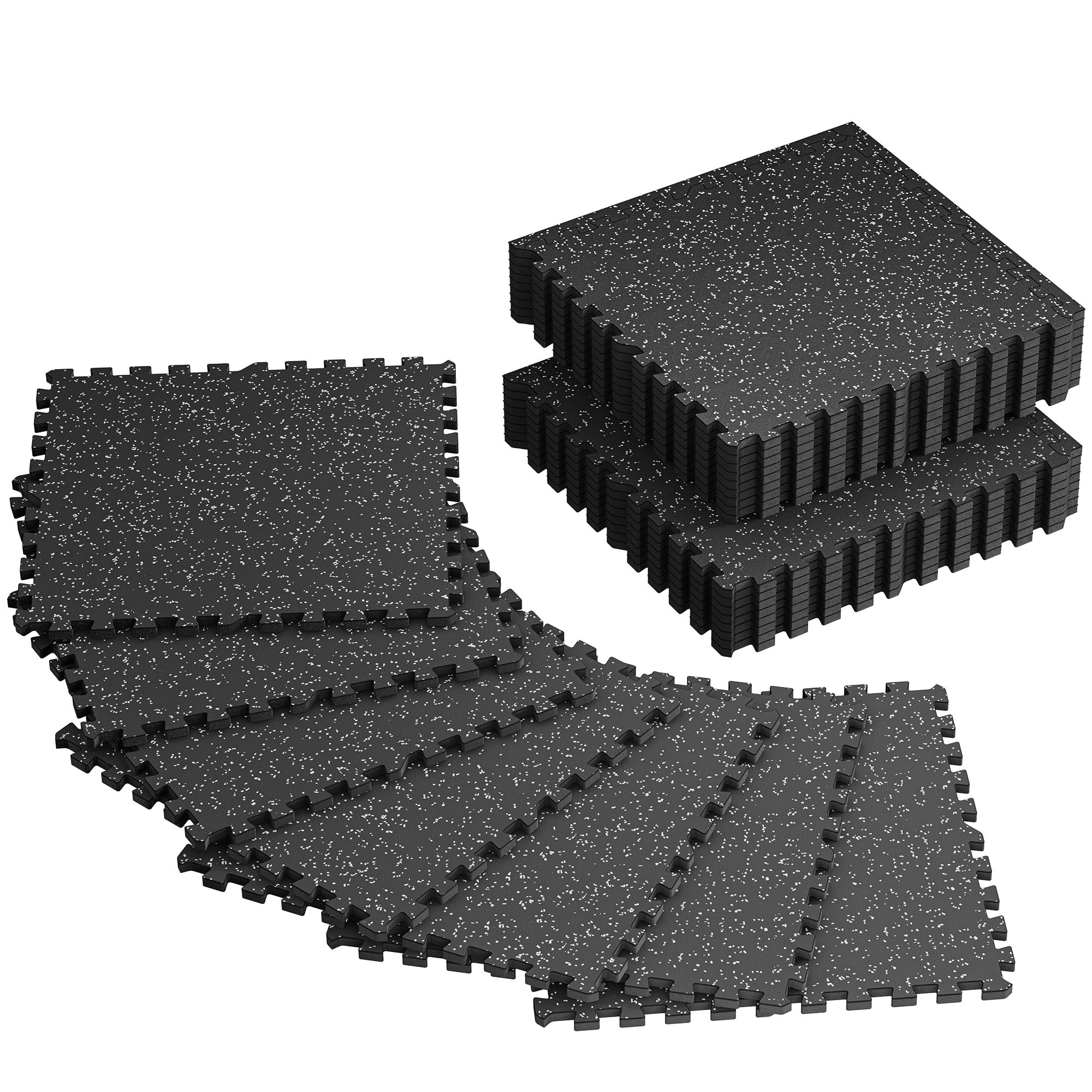
Snap-together tiles you can reshape around your equipment as the garage changes.
These 24 tiles each measure 24″L x 24″W x 0.4″ thick, covering 96 sq ft total — twice the coverage of the AIRHOP set. The build pairs a high-density EVA foam base with a sturdy EPDM rubber top, and the 0.4-inch thickness is there to support heavy equipment without tearing under weight or vigorous movement. Each piece has two detachable borders, so you can snap, extend or reshape the floor into a neat square or rectangle to fit the room.
Durability is the property that earns the most praise, with ease of installation next, and the rubber top provides solid floor traction for landmine presses while staying cushioned enough for deadlifts. The foam layer soaks up shock and cuts noise and vibration, so a late session doesn’t travel through the walls. Assembly and cutting are both manageable if you need to trim around posts.
A couple of honest notes: stability and thickness get more mixed feedback than the durability, and some new-tile odor comes up. It is a modular system, so a stray tile can work loose if the floor beneath isn’t flat — seat every piece fully as you lay it.
Why It Holds Up
- EPDM rubber top with EVA foam base resists tearing under heavy equipment
- 96 sq ft of coverage from 24 tiles — easy to extend later
- Two detachable borders per tile let you reshape around the room
- Cushioned foam mutes noise and protects the floor from impact
Where It Trades Off
- Fresh tiles can carry an odor that needs airing out
- Modular locks can shift if the sub-floor isn’t flat
A strong match for: garages where the layout isn’t fixed and you want flooring you can grow or reshape.
Worth noting: you’ll want a flat base and a day to air the rubber out before full assembly.
8. IncStores Vulcanized Rubber Mat

One solid slab of vulcanized rubber, built for deadlifts and a loaded weight bench.
This isn’t Foam-in-a-tile — it’s a 72″L x 48″W x 0.38″ thick slab of vulcanized rubber, made from premium rubber and recycled tire rubber. The point is resilience: it takes unbelievable punishment, handles treadmill workouts, spin classes and deadlifts, and stays steadily in place with good grip. It is moisture-resistant, liquid-proof and odor-resistant, and it works as a stable base over industrial concrete, in a workshop, or under a horse stall as readily as a home gym.
Durability is the headline, and value is right behind it — this is a mat that repels impact from weightlifting gear and cardio equipment rather than slowly compressing. It measures 10 millimeters thick, so it isolates the floor from dropped load better than a foam tile of similar depth, and a 5-year warranty covers the slab.
The catch is that it is genuine rubber, and rubber has a smell — some report it more strongly than others, along with the occasional headache. If you’re sensitive to rubber odor, this is the one to think hardest about. You also only get 24 sq ft per mat, so covering a full bay means several.
The core strength: a solid 10mm rubber slab that takes deadlift drops and treadmill weight without compressing away.
Real-world caveat: a 4′ x 6′ single mat covers one lifting station — a full garage needs a few — and the rubber scent is more pronounced than on foam systems.
Pick this for: a dedicated lifting station where you drop weight and need a slab that won’t budge.
Hesitate if: strong rubber odor bothers you, or you need to cover a large floor in one purchase.
9. American Floor Mats Heavy Duty Rubber Roll
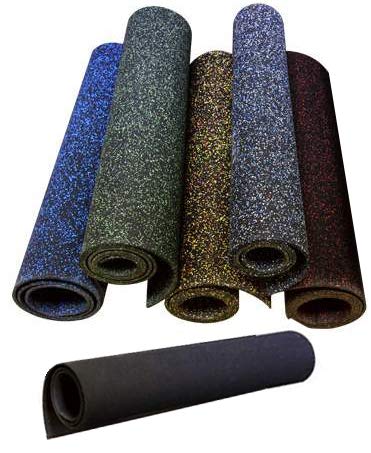
A 16-foot rubber run that turns a whole garage wall into permanent flooring.
This is the longest single piece in the lineup — a 4′ x 16′ roll at 0.31″ thick in 10% grey, sold as protective home-gym flooring. It’s the pick when you want one continuous strip along a wall or under a row of equipment rather than a patchwork of tiles. The rubber is non-slip and heavy duty, and it wipes clean with a damp cloth while avoiding harsh chemicals. It’s built for stability: it stays in place with no problems under use.
Quality is the property people rate highest, with durability close behind — the rubber resists wear in a home gym and still cushions underfoot. It cuts cleanly if you need to trim for posts or a doorway, and its weight helps it lay flat and stay down.
The honest trade-offs: rubber rolls carry a noticeable smell, and cut quality divides opinion — some report uneven edges when trimming, so measure twice and use a sharp blade. At 16 feet it’s also a commitment; you’ll want to plan the layout before you unroll it.
The reason to buy: a single 16-foot run covers a long wall in one continuous piece, with the weight and grip to stay flat.
The honest caveat: rubber odor and trimming are the two friction points, so plan your cuts and give it air.
Right for: a long garage wall or equipment row that needs one continuous, stable rubber surface.
Reconsider if: you want tile-by-tile flexibility — this is a permanent-run product.
Know the Specs
Thickness (mm and inches)
Thickness decides how much shock the mat absorbs. A 7mm PVC sheet, about 0.27 inch, keeps a barbell stable while softening impact. A 1-inch EVA tile gives far more give under knees and joints but compresses under heavy equipment. Go thin and firm (7mm PVC) for loaded lifts, thick and soft (1-inch EVA) for bodyweight and floor work.
Material: PVC, EVA foam or rubber
PVC roll-up mats are tough and shoe-friendly, and they resist abrasion. EVA foam tiles are light and cushioned, though soft and prone to compressing. Rubber — whether a rubber-topped foam tile or a solid vulcanized slab — is the most durable against dropped weights, but it often carries a smell when new. Pick the material by your heaviest drop: rubber for iron, EVA foam for bodyweight work.
Grip and anti-slip surfaces
A mat that slides is a hazard. Double-sided surfaces use a textured top for your hands and feet plus a grooved or suction-cup underside to bite the floor. On smooth concrete, both layers matter. Heavier mats add grip through sheer weight, so a 28-pound sheet resists creeping more than a light foam tile.
Coverage and form
Roll-up mats come as one continuous sheet — nothing shifts apart. Interlocking tiles cover odd footprints and extend over time. Coverage is measured in square feet, from a single 24 sq ft slab up to 144 sq ft of tiles. Measure your garage bay and plan your layout before you buy.
Common Questions
Can I put a rubber gym mat directly on a concrete garage floor?
Is a 1-inch foam mat too soft for lifting weights?
How do I stop my garage mat from sliding?
Will a rubber gym mat smell bad in a garage?
How many tiles do I need to cover a garage bay?
Can I use a workout mat over carpet in the garage?
What is the difference between a roll-up mat and interlocking tiles?
Can I leave a garage workout mat down all the time?
How do I clean a garage gym mat?
Will heavy weights damage my mat or the floor under it?
The Bottom Line
For the widest range of garage training, the workout mats for garage winner is the GymCope Large Exercise Mat. Its 8′ x 6′ sheet is one continuous piece, so no tile seams open up under a squat stance. The 7mm of high-density PVC (a dense plastic foam that resists squashing) is thick enough to soften floor work, and the mat carries enough weight to stay planted through shoes-on cardio and weights. If your knees want maximum padding, the 1-inch BalanceFrom tiles cover 72 sq ft of soft foam — enough to line a small garage corner for floor stretches. And if you drop loaded weights, the IncStores vulcanized rubber slab is the one that takes the punishment.
How we choose
We do not accept paid placement. Every pick is matched to a real buyer and a real use-case; we do not hands-on test units.
Sources
Specifications: manufacturer listings and product documentation. Review insights: verified customer reviews, as of November 2026. Pricing: not shown on this page (it changes often); check the current price via the retailer link.
As an Amazon Associate, Tactical Gear Guy earns from qualifying purchases. This does not affect which products we feature.