Specs are compiled from manufacturer listings and verified buyer reviews and can change over time — please confirm the key details on the product page before buying.
If your kid is dribbling a ball that keeps running away from them, the ball is usually the problem, not the kid. A genuine youth size 5 basketball measures 27.5 inches around — the circumference that actually fits a child’s hand, and the difference between learning to control a dribble and chasing the ball across the driveway. Below are nine size 5 options worth your attention, sorted by what they do best.
This guide is built by comparing the manufacturers’ published specifications and the patterns across verified customer reviews, so you get each pick’s real strengths and trade-offs instead of marketing spin.
Every pick here is verified as a true 27.5-inch youth ball, not a size 6 or 7 relabeled. The list starts with the one worth grabbing first: the youth basketball size 5 from Spalding, a 4.5+ star ball across 900+ ratings that ships inflated and ready to play.
Top Picks


How To Choose The Best Youth Basketball Size 5
Your kid gets a ball that behaves when you get three things right: the ball’s diameter, its weight, and what surface it will live on. Everything else — color, logo, whether a pump is in the box — is a bonus.
Start with the diameter, not the label
A true youth ball is 27.5 inches around — that is the printed “Size 5” standard. A size 6 ball is bigger and a size 7 is a full adult ball, and either one will feel like a boulder to a seven-year-old. Every pick on this list is confirmed at 27.5 inches, which is the number to check on any listing before you buy. If a listing only says “youth” with no diameter, treat that as a warning sign.
Weight is what changes the shooting form
A lighter ball lets a smaller player get the ball up to the rim without flinging their whole body into it. The Spalding Rookie Gear is built 15% lighter for exactly that reason, while several other picks here sit in the 1.1 pound to 1.5 pound range. Heavier balls are fine for older kids and outdoor abuse; lighter ones suit beginners building a repeatable shot.
Rubber, composite, or PU — match the cover to the court
Deep-channel rubber covers grab concrete and asphalt without shredding, which is why so many youth balls use them. Composite and PU covers feel softer in the hands and are gentler on indoor hardwood, but they scuff faster outside. If your kid plays in a driveway, lean rubber. If they play in a gym, lean soft.
Side-by-Side Comparison
| Model | Best For | Diameter | Weight | Cover | Amazon |
|---|---|---|---|---|---|
| Spalding Rookie Gear 27.5″★ Best Overall | First real ball for a young beginner | 27.5 inches | 1.5 lb | Composite | Amazon |
| Wilson NBA DRV OutdoorOutdoor Grinder | Rough outdoor courts | 27.5 inches | 0.68 kg | All Surface | Amazon |
| Franklin Sports Grip-Rite 1000Budget Champion | Small hands, tight budget | 27.5 inches | 1.5 lb | Rubber | Amazon |
| Wilson NCAA Era | Deep-channel control | 27.5 inches | 0.72 kg | All Surface | Amazon |
| Senston Premium Grip | Ball plus pump in one box | 27.5 inches | 0.57 kg | Rubber | Amazon |
| AND1 Fantom Graffiti | Street style that survives asphalt | 27.5 inches | — | Rubber | Amazon |
| Champhox Size 5 for Girls | A gift a girl will actually want | 27.5 inches | 1.1 lb | PU composite | Amazon |
| DECLIR Kids Basketball | Backyard all-rounder | 27.5 inches | 16 oz | PU / faux leather | Amazon |
| KUYOTQ Street Size 5 | Soft-touch street ball | 27.5 inches | 16 oz | Faux leather | Amazon |
Detailed Reviews
1. Spalding Rookie Gear 27.5″ Basketball
Our pick — 4.5+★ from 950+ verified ratings; the strongest balance of quality and price.
The ball that takes weight off a small player’s shot so the form comes first.
The number that earns this spot: 15% lighter than a standard ball of the same size. That 15% is the whole reason a seven-year-old can push a shot toward a ten-foot rim without heaving their shoulders. Pair that with the 27.5-inch diameter and you have a ball sized and weighted for the kid who is still learning what a follow-through feels like.
What wins people over is how it handles for young dribblers — the composite cover grips well enough that the ball comes back up predictably, which is exactly what a beginner needs to build rhythm. It arrives inflated and game-ready, so there is no pump hunt on a birthday morning. It is rated for both indoor and outdoor play, and the 1.5 pound listed weight keeps it manageable in small hands.
The honest catch: the quality read on this ball splits down the middle, and the composite cover is the reason. Some owners get a ball that wears beautifully; a few report it losing its feel faster than expected on hot concrete. Treat it as a driveway-and-gym ball rather than a permanent street beater. It also holds 4.5+ stars across 900+ ratings, so the happy camp is clearly the larger one.
What makes it click
- 15% lighter build encourages proper shooting mechanics instead of arm strength
- Composite cover holds a usable grip for beginner dribbling
- Ships already inflated, so it plays the day it arrives
- True 27.5-inch size that fits smaller hands
Where it runs out of road
- Cover wear draws mixed reports, so heavy concrete use will shorten its life
- Not the ball for a kid ready to graduate to a heavier, standard-weight rock
Buy this if: your player is young, still building a shot, and you want the technique to come before the muscle.
Think twice if: the ball will live on asphalt every single day and you need it to look new for years.
2. Wilson NBA DRV Outdoor Basketball
A 27.5-inch ball built to take a beating on concrete without going slick.
Most youth balls pretend the driveway does not exist. This one is engineered for it: the cover is a designated outdoor surface made to hold grip on rough ground, so your kid keeps control on concrete. The channel layout uses what Wilson calls NBA Pro Seams — a seam shape tuned to how players actually wrap their fingers around the ball. It carries official NBA branding and the Wilson script, which matters to a kid who wants the ball to look like the ones on TV.
At 0.68 kg, it is heavier than the Senston ball on this list (0.57 kg), so it feels more like a real ball in the hand while still sitting at the 27.5-inch youth diameter. The specialized inflation retention lining is the other quiet win: it holds air longer, so fewer trips to the pump between sessions. If your kid plays outdoors more than once a week, that lining is worth more than any print on the panels.
Consider the audience here: the listing carries an adult age range, but the 27.5-inch diameter is a true size 5, so it suits a youth player who has outgrown featherweight balls. It trades a little beginner lightness for a sturdier outdoor build.
The outdoor case: a purpose-built rough-surface cover plus a seam design tuned for hand placement, at a genuine youth diameter — that is a rare combination in this tier.
Fair warning: if your player is brand new to the game, the heavier 0.68 kg body is a step up from the lighter beginner balls here.
Reach for this if: the ball’s home court is a concrete slab or a park blacktop.
Look elsewhere if: your kid is under six and still needs the lightest ball available.
3. Franklin Sports Grip-Rite 1000 Youth Basketball
The entry-level ball that fits a four-year-old’s hands and a family’s budget.
For the youngest players, this is the practical answer. Top-grade rubber and a durable polyester winding give it a build that shrugs off garage-floor abuse, and the 27.5-inch diameter keeps it in the “actually catchable” range for a small kid. The deep-channel construction — deeper grooves between the panels — is what lets tiny fingers find purchase for a first dribble.
What it does best is get out of the way. It plays indoors and outdoors, so a garage, a basement, or a schoolyard all work, and the range of colors includes red-black, green, blue, and brown, so a kid can pick the one they like. At 1.5 pounds it is no featherweight, but for a first ball the weight is manageable.
Two honest notes before you buy. First, the ball often wants air before it is playable, and it can go soft between sessions — budget for a pump you keep handy. Second, durability reads mixed, with some balls starting to wear while others keep going, so this is a first ball, not a hand-me-down-to-the-next-kid ball.
Bottom line: a beginner-friendly 27.5-inch rubber ball with the color options and price to make it a low-risk first purchase.
Best paired with: a four-to-six-year-old and a pump within reach.
Pass on it if: you want a ball that holds air reliably without regular topping up.
4. Wilson NCAA Era Basketball (Size 5)
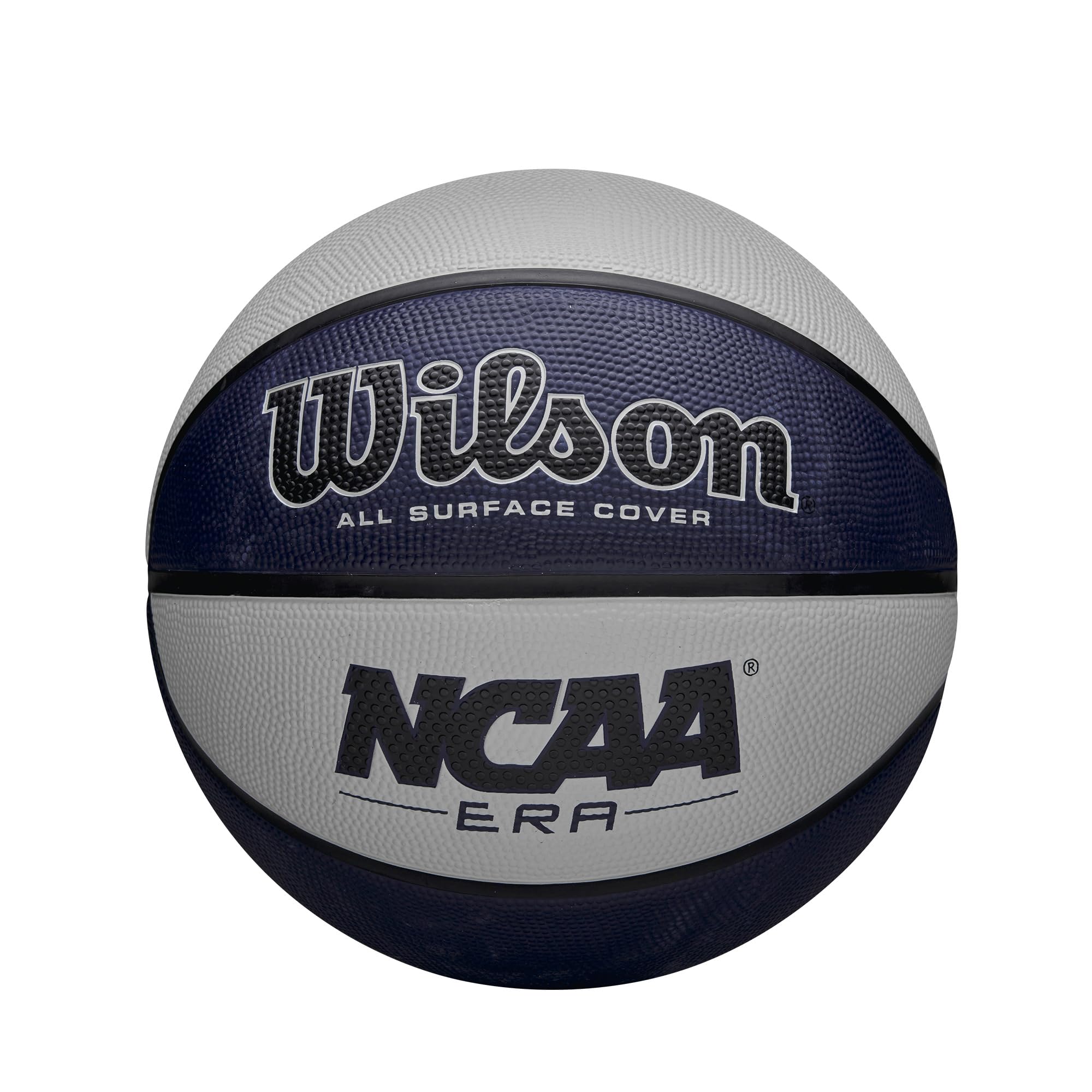
Deeper grooves between the panels give young fingers more places to catch the ball.
The design idea here is simple and smart: deepen the channels between the panels and you create more grip points for a hand that cannot yet palm a ball. That is the whole pitch, and it is the right one for a player learning to control a crossover. The navy and white colorway also makes it easy to spot in a gym bag full of gear.
Weight lands at 0.72 kg, which makes it the heaviest ball on this list — you will feel the difference next to the Senston ball at 0.57 kg. For an older youth player ready for a more substantial rock, that heft is a feature rather than a flaw. There is a specialized inflation retention lining too, built to keep pressure up between uses.
The trade-off is air. Some balls reportedly do not hold pressure properly, so check the valve seating and keep a pump around. Set that aside and the all-surface cover and deep-channel control make this a solid choice for a kid who plays both gym and street.
Solid fit for: a youth player ready for more weight and better control.
Skip the hassle if: you would rather not deal with topping it up.
5. Senston Outdoor Basketball with Pump

The lightest ball here, sold with the pump you will need anyway.
At 0.57 kg, this is the lightest ball on the list — noticeably easier for a young player to lift into a shot than the Wilson NCAA Era at 0.72 kg. That lightness comes from a wear-resistant rubber cover over 80% nylon windings for shape retention and a 100% butyl bladder for air retention. Those are the numbers that decide whether a ball stays round and stays inflated.
The practical bonus is in the box: this ships with a pump, so the “ball arrived flat” problem solves itself on day one. Grip is designed for dribbling, throwing, and passing, and the bright color options are a genuine draw for kids who want a ball that stands out.
The honest read: durability and value both split down the middle, and some balls reportedly lose air over time. It is a good first ball and a great value package, just not the ball you buy expecting a decade of hard outdoor use.
Smart package: light body, butyl bladder, and a pump included — a beginner’s kit in one purchase.
The variance: air retention is not guaranteed ball to ball, so keep that pump.
Go for it if: you want a light, bright ball and a pump in a single order.
Hold off if: you need proven long-haul durability on concrete.
6. AND1 Fantom Classic Graffiti Basketball

A graffiti-print street ball that treats the blacktop as home turf.
AND1 built this ball for kids who want to look the part. The black and white graffiti pattern is the first thing anyone notices, and it is the rare youth ball that does not look like every other brown ball on the rack. Under the paint, an aggressive deep-channel design gives a locked-in grip for handling, and the rubber build is meant to withstand asphalt rather than baby it.
It plays both indoors and outdoors, measures 27.5 inches, and arrives deflated with a hand pump included — so you inflate it yourself and skip the “shipped flat” surprise. The streetball attitude is real, and it gives a kid something to feel proud of carrying to the court.
Set expectations on durability: peeling shows up in some reports and air retention is a recurring issue for a few balls. It is a style-first pick that plays fine, not a buy-it-once-forever ball.
Made for: the kid who cares how the ball looks and plays outdoors.
Not for: the family that wants a quiet, plain-looking ball built for a decade.
7. Champhox Size 5 Basketball for Girls

A butterfly-print size 5 built to be the gift a girl actually opens with a grin.
Most youth balls are plain. This one leans into design with a butterfly pattern and a sparkle finish on pink, aimed squarely at girls, teens, and kids who want their ball to feel like theirs. The practical side is just as real: a genuine 27.5-inch circumference at a 1.1 pound listed weight, and a PU composite cover that feels softer in the hand than hard rubber.
The build details are worth the mention. A rubber bladder wrapped in flexible nylon wire keeps the ball round and its bounce consistent, and the deep-channel construction gives young hands an easier grip for basic practice. The PU cover is rated for indoor wooden floors, rubber courts, and cement, so it travels. A storage bag and pump are in the box too, which makes it a complete gift rather than a ball plus a shopping trip.
The catch is air. Some balls reportedly do not hold pressure well, so check the valve and plan on occasional inflating. The ball ships deflated, which is normal for this category.
The appeal: soft-touch PU composite and a design kids gravitate to, in a true 27.5-inch youth size.
The upkeep: watch the air pressure; it is not set-and-forget.
Ideal for: a birthday or holiday gift where the look matters as much as the play.
Choose another if: the ball will be heavily used on concrete daily.
8. DECLIR Kids Basketball Size 5

The backyard ball that covers every surface and every age from child to teen.
This one is built to be the family ball — the one that goes from the driveway to the park to the beach without anyone worrying about it. It is listed for both children and teens at 27.5 inches and 16 ounces. The cover is non-slip, wear-resistant PU rubber leather, which is the material that makes the ball easy to palm, dribble, and shoot for young players.
It ships with a pump, so it is playable the day it lands. Bright graphics make it stand out, and the listing pitches it as a gift for birthdays, holidays, and parties — the sort of ball a kid is happy to unwrap. Owners overwhelmingly report good quality for the price.
The one recurring gripe is inflation — some balls reportedly will not stay inflated. That is the check to make on arrival: seat the valve well, and keep the included pump handy for the first few weeks.
Go with it if: you want one affordable ball that handles every surface and every kid in the house.
Consider another if: reliable air retention is your top priority.
9. KUYOTQ Street Basketball Size 5

A faux-leather street ball with the softest hand-feel on the list.
This one is for the kid who complains that rubber balls feel hard. The cover is thickened faux leather, which is the reason it feels softer and grips more gently than the rubber builds here. The deep-channel design adds the control points, and the listing pitches it for boys and girls ages 4-12 who want to practice skills or just have fun.
It is a true 27.5-inch size 5, rated for concrete, plastic, and wooden courts, and it weighs 16 ounces. It arrives deflated, and there is a warranty offer and customer service support behind it — a nice touch when you are buying a ball for a kid.
Air retention sits in the middle: some balls hold pressure well, so this is not a consistent weak point, just a coin-flip to watch. The soft cover is also the trade-off — it is gentle in the hand and less suited to constant hard-court abuse.
Best hand-feel: thickened faux leather that feels softer than rubber, in a real youth size.
The caveat: soft covers wear faster on rough concrete.
Pick it for: a kid who wants a soft-touch ball for skill practice and games.
Leave it if: the ball will be dragged across rough asphalt every day.
Know the Specs
Diameter (27.5 inches)
This is the number that defines a size 5 youth ball. Twenty-seven and a half inches around is the standard youth circumference, and it is the size that lets a smaller hand actually wrap around the ball. Anything bigger is a size 6 or 7 and will feel oversized. Check the diameter on the listing before you buy — if it is not 27.5 inches, it is the wrong ball for a kid.
Weight (0.57 kg to 1.5 lb)
A lighter ball lets a young player get a shot up without muscling it. The balls here range from 0.57 kg up to 1.5 pounds, and that difference changes how the ball feels in a kid’s hands. Light balls suit beginners building technique; heavier ones suit older players and outdoor abuse. Match the weight to the player, not just the size.
Common Questions
What age is a size 5 basketball for?
Is a size 5 the same as a size 7?
How can I tell if a listing is really a size 5?
Do these balls come inflated or deflated?
Can a youth basketball be used outdoors?
Why does my new basketball keep losing air?
Is a lighter youth ball better for beginners?
How much should a size 5 basketball weigh?
Can I use a size 5 basketball indoors and outdoors?
What kind of pump do I need for a size 5 basketball?
The Bottom Line
For most kids starting out, the youth basketball size 5 winner is the Spalding Rookie Gear because its 15% lighter build lets a young player learn a proper shot before worrying about strength. If the ball is headed for concrete, grab the Wilson NBA DRV for its rough-surface cover. And for a light ball with a pump in the box, the Senston is the one to reach for. Any of the nine will fit a small hand — the trick is matching weight and cover to where your kid plays.
How we choose
We do not accept paid placement. Every pick is matched to a real buyer and a real use-case; we do not hands-on test units.
Sources
Specifications: manufacturer listings and product documentation. Review insights: verified customer reviews, as of November 2026. Pricing: not shown on this page (it changes often); check the current price via the retailer link.
As an Amazon Associate, Tactical Gear Guy earns from qualifying purchases. This does not affect which products we feature.