Specs are compiled from manufacturer listings and verified buyer reviews and can change over time — please confirm the key details on the product page before buying.
Salt water, heat, and a motor that sits all winter are what actually kill outboard engines — not one dramatic failure. The right Yamaha outboard motor parts keep corrosion, fuel contamination, and cooling problems from turning a fun weekend into a repair bill. Below are nine parts that fit specific Yamaha engines, each with the exact part numbers it replaces, so you can check your own motor before you order instead of guessing.
This guide is built by comparing the manufacturers’ published specifications and the patterns across verified customer reviews, so you get each pick’s real strengths and trade-offs instead of marketing spin.
Match the part number on your engine’s nameplate, not just the horsepower badge, because Yamaha swaps components between years. That single habit is why this list of yamaha outboard motor parts starts with fitment over everything else.
Top Picks


How To Choose The Best Yamaha Outboard Motor Parts
The single most common mistake buyers make is ordering by horsepower alone. Yamaha built the same horsepower rating across many years, and the internals changed underneath it. A part that fits a 2009 15 HP may not fit a 2024 15 HP. Read the nameplate on your engine, write down the model code, then cross-check the replacement numbers listed on the part page before you buy.
Read the OEM Number, Not the Badge
Every genuine Yamaha part carries a number in a format like 63V-W0078-01-00 or 6P3-WS24A-02-00. Aftermarket makers list the numbers they replace, often several, because one part covers a range of models. If your number is not on that list, do not assume it fits — that is the fastest way to waste a weekend on a return.
Know Which System the Part Serves
Fuel parts (filters and water separators) keep contamination out of the engine. Cooling parts (water pump impellers) move raw water through the powerhead. Corrosion parts (zinc anodes) sacrifice themselves so the aluminum does not. Lubricant kits (engine oil, gear lube) handle wear inside. Trim and tilt components (relays, motors) raise and lower the leg. Buy for the system that is actually failing, not the one that sounds most urgent.
Expect Wear Parts to Wear
An impeller is rubber and a zinc anode is designed to dissolve. Neither is a sign of poor quality when it fails — that is the job. What matters is that you catch it before it takes something expensive with it. A fuel filter element, an impeller, and a set of anodes are the three cheapest insurance items on any outboard.
Side-by-Side Comparison
| Model | Best For | Part Numbers Replaced | Engine Fitment | Key Material or Rating | Amazon |
|---|---|---|---|---|---|
| Yamaha Yamalube F30-F70 10W-30 Oil Change Kit★ Best Overall | Routine engine oil service | LUB-MRNSM-KT-10 | Yamaha F30 to F70 four-strokes | 10W-30, 3 quarts | Amazon |
| S3213 Fuel Water Separator KitBest Filtration | Cleaning contaminated fuel | S3213, 35-60494-1, 18-7932-1 | Yamaha and Mercury outboards | 10-micron, 3/8-inch NPT | Amazon |
| A.A Zinc Transom Bracket AnodeCorrosion Guard | Corrosion protection on the transom | 6G5-45251-01, 6G5-45251-02, 18-6090 | Yamaha 115-300 HP outboards | Zinc, transom mount | Amazon |
| Fuel Filter Kit with Wrench, Replaces 6P3-WS24A-02-00 | Primary fuel filter servicing | 6P3-WS24A-00-00, 6P3-24563-00-00 | F150 to F350, VZ150 to VZ300 | Resin-treated paper, 2 elements | Amazon |
| 63V-W0078-01-00 Water Pump Impeller Kit | Cooling system refresh on small engines | 63V-W0078-00-00, 63V-44301-00-00 | Yamaha 9.9 and 15 HP | Rubber impeller | Amazon |
| Seachoice Anode Kit, Yamaha 150-200hp | Saltwater corrosion on larger engines | 50-95211 | Yamaha 150-200 HP, many models | Aluminum, cadmium-free | Amazon |
| Tilt Trim Relay, 63P-81950-00-00 | Replacing a failed trim relay | 63P-81950-00-00, TRM6003 | Yamaha 40 to 250 HP four-strokes | 12V, normally open | Amazon |
| Yamalube Gear Lube Kit with Pump | Lower unit oil changes | ACC-GEARL-UB-QT, 90430-08003-00 | Yamaha F15 through F250, 2 or 4 stroke | 1 quart, includes pump | Amazon |
| DB Electrical Tilt/Trim Motor | Failed trim motor replacement | 6D8-43880-01-00, 430-22118 | Yamaha F75LA, F75TLR, F90JA, F90LA | 12V, metal housing | Amazon |
Detailed Reviews
1. Yamaha Yamalube F30-F70 10W-30 Oil Change Kit
Our pick — 4.5+★ from 750+ verified ratings; the strongest balance of quality and price.
Three quarts of genuine Yamalube and the filter in one box — the annual service, solved.
The mistake most owners make on oil is buying the wrong viscosity off a shelf and hoping. This kit removes the decision entirely. It carries 3 quarts of 10W-30 — the multi-grade oil grade Yamaha specifies for these four-strokes — and it is packaged by Yamaha itself under part number LUB-MRNSM-KT-10. The viscosity grade is printed as a SAE J300 10W-30, which is the standard system that grades how thick oil is when cold and hot.
What it covers is the whole job. The kit is a complete oil change in one order, and buyers report the full oil change typically runs 30-45 minutes in the yard. Owners consistently flag value as the reason they keep buying it, with the completeness of the kit close behind. The OEM filter and genuine fluid mean you are not gambling on a cross-reference. It is listed as vehicle-specific fit, so confirm your model sits in the F30-F70 four-stroke family before ordering.
The honest catch: some buyers have raised questions about the accuracy of the claims on the listing, so double-check that the kit contents match what your engine manual asks for. The physical size listed is 9 x 6 x 10 inches, which is a box you can carry one-handed to the dock. For an engine serviced once a year, this is the lowest-drama way to do it.
Where this kit earns its keep
- 3 quarts of Yamalube 10W-30 in the exact grade the engine calls for
- Genuine Yamaha OEM parts, no cross-reference guesswork
- Complete kit means one order instead of three
- Owners point to value and completeness as the two reasons it wins
The fine print to check
- Vehicle-specific fit — F30 to F70 four-strokes only
- Some questions raised about the accuracy of listing claims
- One kit equals one service, so annual buyers reorder each year
The annual-service buyer: If you own a Yamaha four-stroke between F30 and F70 and change oil once a season, this kit does the whole job in one box.
Verify first: Check the LUB-MRNSM-KT-10 number against your engine manual before you order, because the kit is vehicle-specific.
2. S3213 Fuel Water Separator Kit
Ten-micron filtration in an aluminum bowl that pulls water out before the carburetor ever tastes it.
Ethanol fuel and a boat that sits are a bad combination, and water in the fuel is the classic cause of a rough-running outboard. This separator kit addresses that directly. The 10-micron filter media catches particles at 10 microns — a micron being one millionth of a meter, so small you need a microscope to see a single one — and it separates water from the fuel stream. As owners mention, it does a great job separating water from the fuel.
The 3/8-inch NPT ports are sized to keep fuel flowing smoothly with minimal pressure drop. NPT is the tapered pipe-thread standard, meaning it seals as it tightens rather than needing a gasket. The housing is high-grade aluminum, reinforced with multi-layer filter media, and the kit includes 3/8-inch barb to 1/4-inch NPT brass fittings for hooking up your fuel line. Thread tape on the fittings is recommended to prevent leaks. Installation is described by buyers as simple and straightforward, and functionality is the thing that wins people over here.
Cross-brand fit is unusual and worth noting: the listing names Yamaha, Mercury, Racor, Sierra, and Suzuki compatibility, with replacement numbers including Mercury 35-60494-1 and Yamaha MAR-24563-03-00. The catch is weight — at 0.94 kg this is a substantial piece compared with the filter-only kit further down this list at 0.18 kg. That extra heft is the aluminum housing doing its job, but it is not a part you swap at speed. Check the collection bowl regularly, per the maker, and replace the filter annually. One year of warranty backs it.
Where it earns the spot: The aluminum body, 10-micron media, and 3/8-inch NPT ports make this a real water separator rather than a filter element in a plastic cup — and the cross-brand replacement list covers a lot of engines.
Size it into your plan: At 0.94 kg it is a fixed installation you service rather than a part you carry as a spare filter, so budget the room on your fuel line.
Reach for this if: Your fuel system is showing water or debris and you want a separator with a metal housing that handles annual servicing.
Look elsewhere if: You only need the replaceable element and already have the housing mounted.
3. A.A Zinc Transom Bracket Anode
A single zinc block that quietly sacrifices itself so your transom bracket does not dissolve.
Here is the part owners forget until the corrosion is visible. A zinc anode is a sacrificial metal — it is deliberately the least noble metal on the assembly, so electrolysis eats it before it eats your aluminum bracket. This one is solid zinc, mounts on the transom, and replaces Yamaha parts 6G5-45251-01, 6G5-45251-02, 12885, and 18-6090. It is rated up to a maximum horsepower of 300 hp, which covers the 115-300 HP range named in the title.
Fit is exactly what this part is judged on, and it is the thing that wins people over here. It bolts up where the original came off, no fabrication, no shimming. Quality runs a close second in owner sentiment. At 0.41 kg it is a chunky block of metal, which is the point — more zinc means more material to give up before your housing does.
What buyers should expect: this part is meant to wear. If you pull it off a season later and it looks eaten, that is a working anode, not a defective one. The listing specifies replacement part numbers but not a service interval, so check it visually each season and replace when roughly half has gone. If your boat lives in salt water or brackish water, this is not optional maintenance — it is the cheapest protection on the whole engine. The one thing to watch: order it against your specific bracket, not just the horsepower class.
Why it’s the right zinc
- Solid zinc, the material that gives up electrons first
- Fits where the original came off — no modification
- Replaces four separate part numbers, so cross-checking is easy
- Rated to 300 hp, covering the whole 115-300 range
What to plan around
- It is a wear item — expect to replace it, not resell it
- One anode per order, so a twin-engine boat needs two
- Visual inspection each season is on you
Who this suits: Any 115-300 HP Yamaha kept in salt or brackish water, where the transom bracket is the first thing to pit.
The trade-off: It is a single part designed to be consumed, so treat the replacement cost as a yearly line item.
4. Fuel Filter Kit with Wrench

Two filter elements, two O-rings, and the cup wrench — the servicing kit for the 6P3 housing.
If your engine already has the 6P3 primary filter housing mounted, this is the refill order, not a new install. You get 2 primary fuel filter elements and 2 nitrile-rubber O-rings, plus the filter cup wrench. The elements are resin-treated paper media that traps fuel contaminants before they reach the injection system. The O-rings replace Yamaha 6P3-24564-00-00 for matching filter cups.
The wrench is the piece that makes this practical. It references YB-ACC04 and Sierra 18-79815, and it is built from coated carbon steel, shaped to engage the matching filter-cup ribs. Compare cup shape and dimensions before ordering, because a wrench that does not seat on the ribs is a doorstop. The filter elements replace 6P3-WS24A-00-00, 6P3-WS24A-01-00, 6P3-24563-00-00, and 6P3-24563-01-00. The engine family is broad: VZ150 through VZ300, Z200 and Z300, F150 up through F350, plus the 4.2L VF200, VF225, and VF250 models.
On the scale the difference is stark: this kit weighs 0.18 kg against 0.94 kg for the S3213 separator above, because there is no aluminum housing in the box — just the consumables. Quality and fit are what buyers respond to, and the kit means you have a spare element on hand for the next service. The catch is in the fit table itself: several models carry a 04/2006 production-date note, and 2006 engines specifically need their production date checked. Confirm the number on your old filter matches before you order.
What’s in the box matters: Two elements and two O-rings mean one order covers this service and the next, and the included cup wrench removes the need to improvise with a strap wrench on a cramped fuel cup.
Check the date stamp: The 04/2006 production cutoff listed for several models and the special note on 2006 engines make a nameplate check mandatory here.
Best for the return customer: Owners of F150-to-F350 or VZ150-to-VZ300 Yamahas who service the 6P3 housing themselves each season.
Not for new installs: Without the housing already mounted, this is the wrong order — you need the complete separator, not the elements.
5. 63V-W0078-01-00 Water Pump Impeller Kit for Yamaha 9.9 15 HP
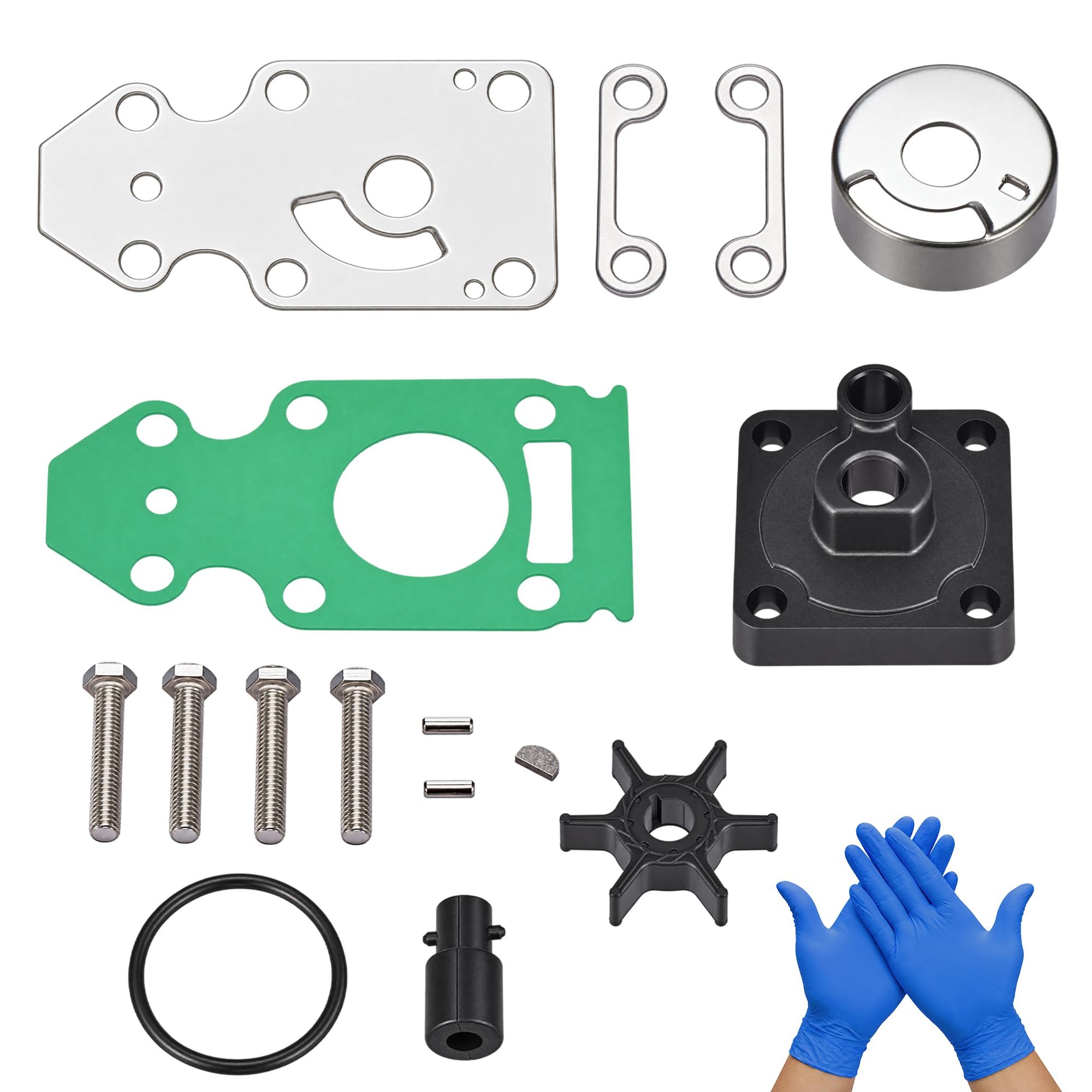
A rubber impeller is the cheapest part that stops an engine from cooking itself.
No water flow means no cooling, and no cooling means a seized powerhead. This kit replaces the impeller that drives raw water through the engine on Yamaha 9.9 and 15 HP outboards — 2 and 4 stroke, 2 cylinders, spanning 1996 to 2024. The replacement list covers 63V-W0078-00-00, 63V-W0078-01-00, 63V-44301-00-00, Sierra 18-3410 and 18-3412, and Mallory 9-48609 and 9-48617. It weighs 0.21 kg.
The impeller is molded from high-quality rubber that, per the maker, resists damage after long immersion in salt water. Performance is what earns this one its place — customers note it performs well, with one noting it works perfectly with a 2009 Yamaha 15hp engine — and quality runs a close second. Cost is the third reason people keep it in rotation.
Now the part that needs saying plainly: fit is the most-discussed topic on this item, and it is genuinely mixed. Some owners find it drops in perfectly; others get a mismatch. That is a fitment question, not a build quality one, and it comes back to knowing your engine. The listing itself says to determine suitability from the information on the engine nameplate, which is the right instruction. Cross-check your model year and the OEM number on the old impeller before you order. If the numbers line up, this is an inexpensive fix for a part you should replace on a schedule anyway.
The case for it
- Rubber rated to survive long immersion in salt water
- Broad replacement list of Yamaha, Sierra, and Mallory numbers
- Covers 9.9 and 15 HP across 1996-2024
- Light at 0.21 kg, easy to keep as a spares-box item
Where buyers get stuck
- Fitment feedback is split — nameplate check is essential
- The listing is 9.9 HP specific while the kit covers 15 HP too
- No gasket set listed separately, so inspect what comes with it
Right for you if: You run a 1996-or-later Yamaha 9.9 or 15 HP and have the exact OEM number confirmed from your engine.
Think twice if: You are ordering by horsepower alone — the split feedback on fit makes a nameplate match non-negotiable here.
6. Seachoice Anode Kit, Yamaha 150-200hp

Two anodes in one box — one for the gimbal housing, one skeg for the ventilation plate.
This one is built for the larger Yamaha legs. The kit includes 1 block anode for the gimbal housing and 1 skeg for the ventilation plate, so you cover two sacrificial points in a single order. The components are cadmium-free and, per the manufacturer, environmentally friendly, and they conform to Mil-Spec A-24779(SH), a military material standard for anodes.
The fitment list is specific, and it should be read carefully. It covers F150 and VF150 four-strokes in all models, F175 four-strokes in all models, the F200LB, F200XB, and F200XCA, plus 150 HP two-strokes from 1988 and newer, 175 HP two-strokes from 1990 and newer, 200 HP two-strokes from 1988 and newer, and the 225ETLD, 225TLR, and 225TXR. It is designed for salt water and brackish water use, and the manufacturer part number is 50-95211. Quality is what owners praise most, with fit right behind it.
The recurring gripe is bolt length. Several reviewers point out the small bolts are too short for their liking, so weigh that against your bracket before bolting up. It is a minor complaint relative to how well the anodes themselves seat and protect, but it is worth knowing if you are installing on a bracket that has seen previous hardware swapped. The package weighs 0.77 kg. For a boat kept in salt water, the gimbal housing is exactly where you do not want corrosion to start.
Where the value sits: Two anode positions for the price of a single-block kit, in a cadmium-free aluminum build that conforms to Mil-Spec A-24779(SH).
Bolt it thoughtfully: The included small bolts run short for some brackets, so have your original hardware on hand in case you reuse it.
Reach for this if: Your Yamaha is in the 150-200 HP band and spends the season in salt or brackish water.
Look elsewhere if: You run a smaller engine or need only a transom-bracket block.
7. Tilt Trim Relay for Yamaha, 63P-81950-00-00, TRM6003

No relay, no trim — this is the switch that lets your outboard raise when the trailer dips.
A trim relay is a relay that passes current to the trim motor when you tap the switch — a normally open contact means the circuit stays off until you command it. This one is a 12V unit that replaces Yamaha 63P-81950-00-00, along with 240-58022, TRM6003, 63P819500000, and 63P-81950. The mounting holes are 6.6mm OD and the studs are M6 x 1.0, so it bolts to the standard mounting points rather than needing adapters.
The fitment reaches across a wide band of four-strokes: 50HP T50 and F50, 60HP T60 and F60, 70HP F70, 75HP F75, 90HP F90, 115HP VF115, LF115 and F115, 150HP VF150, LF150 and F150, 175HP VF175 and F175, 200HP F200 and LF200, 225HP F225XA, and 250HP LF250 and F250. Installation is a strong suit here, with buyers finding it straightforward to swap in, and fit following close behind.
Here is what a buyer deserves to know before ordering: durability is the concern that comes up repeatedly on this part, with multiple buyers reporting the relay burning up. Quality and value are likewise mixed — some find it solid and fairly priced, others less convinced. That pattern means treating this as a service part rather than a permanent fix: check your wiring and connections for the underlying cause, not just the relay. It replaces the OEM number correctly and installs easily, which is exactly what you want from a part that lets you get back to the ramp.
What it does well
- Replaces Yamaha 63P-81950-00-00 and TRM6003 directly
- 12V normally open contact matches the OEM design
- M6 x 1.0 studs and 6.6mm mounting holes bolt to factory points
- Covers a wide four-stroke range from 40HP to 250HP
The honesty note
- Durability feedback is the recurring weak point on this listing
- Some units reportedly fail again, so check the trim circuit
- Value sentiment splits between fair and overpriced
Best suited to: A 40-250 HP Yamaha whose trim has stopped responding and whose relay is the confirmed fault.
Go in with eyes open: Because burning out is a repeated complaint, verify the wiring harness before you install a replacement.
8. YAMAHA Yamalube OEM Outboard Gear Lube Kit

Gear lube without the pump is a mess — this kit puts the pump in the box.
Lower unit oil is a different job from engine oil, and getting the wrong fluid in the gearcase is expensive. This kit is built to do it right: one quart of Yamalube ACC-GEARL-UB-QT marine gearcase lubricant, two genuine OEM 90430-08003-00 gaskets, and a pump with the adapter to fit Yamaha engines. The gaskets in the box are the detail most kits leave out — a fresh gasket on the drain and fill screws is what stops water from weeping in over the season.
The engine coverage runs wide across Yamaha’s lineup, both 2 stroke and 4 stroke: F15, F20, F25, F40, F50, F60, F70, F75, F90, F115, F150, F175, F200, F225, and F250, plus the 150 and 175. The container is a 1-quart bottle, which is the right quantity for a standard lower unit service. The full kit weighs in at 2.1 pounds, boxed and ready to carry to the boat.
Quality is what owners praise most here, with performance right behind — it works as expected, and the pump makes a messy job manageable, particularly for lower unit oil changes. Ease of use and quantity both get steady mention, and the kit is put together so that everything needed for any Yamaha outboard is in one order. The one thing to keep in mind is that this is a lower unit kit, not an engine oil kit — if you are servicing the powerhead instead, the Yamalube 10W-30 kit at the top of this list is the right box. Sized correctly and paired with the gaskets, this kit turns a dreaded job into a half-hour yard task.
Why the pump changes things: Gear lube goes in through a small fill hole with the bottle inverted, and the included pump with adapter does that cleanly instead of by drip and hope.
Don’t confuse the two fluids: This is gearcase lubricant for the lower unit, not 10W-30 engine oil — ordering the wrong one is the mistake to avoid.
Made for you if: You service the lower unit yourself and want the lube, the gaskets, and the pump in one order.
Check what you need first: If the job is an engine oil change rather than the gearcase, this is the wrong kit.
9. DB Electrical Tilt/Trim Motor
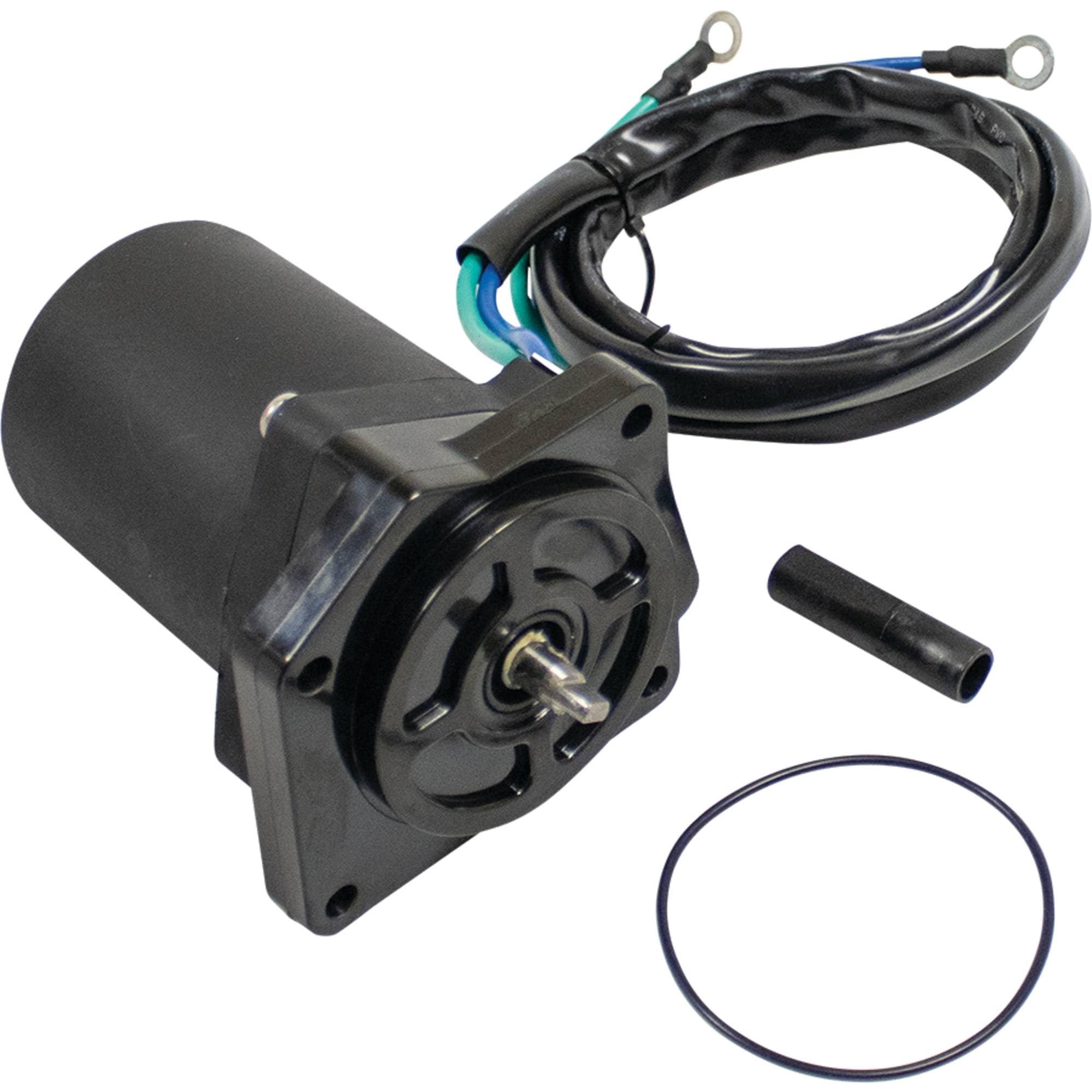
When the trim stops lifting entirely, the motor is the part that has to come off.
This is the biggest job on the list, and the most expensive component. It is a 100% new aftermarket tilt and trim motor built to meet OEM specifications, rated at 12V, and it replaces Yamaha 6D8-43880-01-00 and 6D8-43880-09-00 as well as HSIU CHIANG ST-0340. The manufacturer part number is 430-22118, and the motor is rated to a maximum horsepower of 90 hp, fitting the F75LA, F75TLR, F90JA, and F90LA models named in the listing. It also references API MARINE PT626NM and PT627NM.
Inside, it uses high-quality brushes, bushings, and armatures for longer service life, and the metal housing weighs 3.3 pounds. Where applicable the kit includes a harness, relays, and heavy-duty valves. A 1-year warranty covers it after purchase. Replacement quality is the aspect owners respond to best, with value close behind — buyers point out it runs a fraction of the price of the alternative — and fit and installation both land positively.
The one caveat owners raise is the o-ring: several report the included o-ring is too thin for their liking. Inspect it before assembly and reuse the original if it seats better. Otherwise this is a drop-in replacement that saves real money on a repair that can otherwise stall a season.
The strong points
- 100% new, built to OEM specs, with a 1-year warranty
- Replaces 6D8-43880-01-00 and 6D8-43880-09-00 directly
- Harness, relays, and heavy-duty valves included where applicable
- 3.3-pound metal body with quality brushes, bushings, and armatures
Before you bolt it on
- The included o-ring runs thin — reuse the original if it seats better
- Covers the 90 hp-class models, not the whole Yamaha lineup
- A bigger installation than a filter or anode, so plan for the downtime
Where it earns its place: F75 and F90 owners facing a dead trim motor who want OEM-spec replacement quality and a warranty without a dealer-sized bill.
The one gotcha: Have the original o-ring on hand in case the included one does not seal to your liking.
Know the Specs
Micron Ratings and Fuel Flow
A micron rating tells you the size of particle a filter will catch — a micron is one millionth of a meter. The S3213 kit is rated at 10 microns, which is fine enough to catch debris that would otherwise reach the injection system. Port size matters as much: 3/8-inch NPT ports on that kit are sized to keep fuel flowing with minimal pressure drop, so the engine gets steady fuel rather than a starved stream. If your engine runs rough under load, filtration and flow are the first two things to check.
Zinc Anodes: Built to Give Up
An anode works by being the least noble metal in the assembly — in salt water it corrodes first, sparing the aluminum housing. That is why an anode that looks eaten is doing its job, and an anode that stays shiny is a warning sign. Zinc is the traditional material, while the Seachoice kit uses cadmium-free aluminum components that conform to Mil-Spec A-24779(SH). Match the anode to the metal and the water you run in, and inspect it each season.
Impellers and Raw Water Cooling
A water pump impeller is a rubber wheel with flexible vanes that push raw water through the engine. Because it is rubber and runs in salt water, it ages — and a worn impeller means less cooling and more heat. The 63V-W0078 impeller is molded from high-quality rubber that, per the maker, resists damage after long immersion in salt water. Replacement numbers like 63V-W0078-00-00 and Sierra 18-3410 let you cross-check against your old part.
Viscosity Grades for Two Different Fluids
10W-30 is a multi-grade engine oil rating under SAE J300, the standard that grades oil thickness at cold and hot temperatures. Gear lube is a separate fluid entirely for the lower unit gearcase, and mixing them up is a costly error. The Yamalube engine kit carries 3 quarts of 10W-30 for F30-F70 four-strokes, while the gear lube kit carries 1 quart of ACC-GEARL-UB-QT for the lower unit. Read which system you are servicing before you pour.
Common Questions
How do I know a part actually fits my Yamaha outboard?
Are aftermarket Yamaha outboard parts as good as OEM?
How often should I replace the water pump impeller on a Yamaha?
Why do my zinc anodes disappear so fast?
What is the difference between engine oil and gear lube for an outboard?
Why does my trim relay keep burning out?
Do I need a fuel water separator if I already have a fuel filter?
Why are the two Yamalube kits different prices if both are OEM?
What is the 10-micron rating on the S3213 actually filtering?
Can I fit a tilt trim motor myself or does it need a dealer?
Which anode do I need for a saltwater Yamaha at 150 HP?
The Bottom Line
For most owners, the yamaha outboard motor parts winner is the Yamaha Yamalube F30-F70 10W-30 Oil Change Kit because it packs 3 quarts of genuine Yamalube 10W-30 and the OEM filter into one box, and it holds a 4.5+ star rating across 700+ owners. If keeping water and debris out of your fuel is the job at hand, grab the S3213 Fuel Water Separator Kit with its 10-micron media and aluminum housing. And for the lower unit service that most owners put off, the Yamalube Gear Lube Kit with Pump puts the lube, the 90430-08003-00 gaskets, and the adapter in a single order.
How we choose
We do not accept paid placement. Every pick is matched to a real buyer and a real use-case; we do not hands-on test units.
Sources
Specifications: manufacturer listings and product documentation. Review insights: verified customer reviews, as of November 2026. Pricing: not shown on this page (it changes often); check the current price via the retailer link.
As an Amazon Associate, Tactical Gear Guy earns from qualifying purchases. This does not affect which products we feature.