Specs are compiled from manufacturer listings and verified buyer reviews and can change over time — please confirm the key details on the product page before buying.
If your fantasy map looks great but your towns have no economy, no laws, and no reason to exist, the fix is a reference book — not another blank notebook. The short answer: Cultures and Beyond is the pick worth starting with, because it walks you through cultures, religions, militaries, and money systems in 465 pages of worked examples. Everything below is a real printed book you can hold open beside your laptop, sorted by what each one actually covers.
Every pick here is judged on its published page count, trim size, weight, and template count, so you can see each book’s real trade-offs before you buy.
Each entry is judged on page count, template count, and which layer of the setting it actually builds — cultures, religions, species, or technology. These are the volumes doing the heavy lifting for world generator work.
Top Picks

How To Choose The Best World Generator
The most common mistake is buying a workbook when you needed a reference, or the reverse. A reference book explains how to build a culture, a pantheon, or a legal system. A workbook hands you a page with blanks and expects you to fill them in.
Reference text or fill-in journal
Reference volumes carry long explanatory chapters, so they reward reading cover to cover. Journals carry prompts and template pages, so they reward short bursts of writing. Count the templates listed for a book — that number tells you how much fill-in structure you are actually getting before you commit.
Does the scope match your genre
A fantasy setting leans on one planet explored in depth, with magic systems and sovereign powers. A sci-fi setting spreads across more worlds and heavier on technology, AI, and space travel, with each planet getting a bit less detail per world. Match the book’s scope to your genre: one deep fantasy planet, or many sci-fi worlds.
Trim size and desk weight
A full-size workbook page gives you room to write, and a heavier volume tends to stay flat while you work. A trim-size paperback slips into a bag for drafting on the move. Pick the trim that matches where you write: full-size for a desk, 5 x 8 for a bag.
Where it sits in a series
Multi-volume series number each book, and the numbering tells you the reading order before you buy. A book listed as volume three assumes volume one exists. If you only want the prompts, the same author often sells a separate short prompt book drawn from the main volumes.
Side-by-Side Comparison
| Model | Best For | Print Length | Trim Size | Item Weight | Amazon |
|---|---|---|---|---|---|
| Cultures and Beyond (The Art of World Building)★ Best Overall | Building societies, faiths and laws | 465 pages | 5 x 1.17 x 8 inches | 1.11 pounds | Amazon |
| The Art of World Building Workbook: Sci-Fi Edition | Writing down a sci-fi setting | 338 pages | 8.5 x 0.77 x 11 inches | 1.86 pounds | Amazon |
| The Complete World Building Workbook | Juggling several worlds at once | 202 pages | 8.5 x 0.46 x 11 inches | 1.32 pounds | Amazon |
| Creating Life (The Art of World Building) | Starting a world from zero | 251 pages | 5 x 0.63 x 8 inches | 8.6 ounces | Amazon |
Detailed Reviews
1. Cultures and Beyond (The Art of World Building)
Our pick — 4.5+★ from 150+ verified ratings; the strongest balance of quality and price.
The volume that finally explains who lives in your world and why they fight.
Here is the book for the writer whose map is finished but whose capital city is a blank wall. This is volume three of a twelve-part series, and it turns to the human layer — cultures, organizations, militaries, religions, the supernatural, magic systems, items, names, and legal, health, educational, IT, and monetary systems. Those are the exact systems that make a town feel lived in rather than sketched.
You get a book made for looking things up, not just skimming. It measures 5 x 1.17 x 8 inches and weighs 1.11 pounds, so it is a compact paperback that slides into a bag. The 465 pages give you room for real explanation instead of shorthand. Set it beside the The Art of World Building Workbook: Sci-Fi Edition and the difference is clear: that one runs 338 pages at 8.5 x 0.77 x 11 inches. This book is lighter and smaller, yet it holds a longer read inside it.
Where this book pulls ahead of the journals is depth against the alternative. The Complete World Building Workbook covers multiple worlds in 202 pages, so a single world gets a fraction of the attention — 465 pages versus 202 is more than double the room for the same subject. If you are the sort of writer who wants to understand a monetary system before you invent one, that extra spread is where the value sits.
What earns it first place
- 465 pages covering cultures, militaries, religions and monetary systems in one volume
- 12 fill-in templates to work from, versus the 5 in the Sci-Fi workbook
- Compact 5 x 1.17 x 8 inch trim that travels well
- Illustrated edition, part of a numbered 12-book series
What to know before you buy
- It is volume three, so it reads best after the earlier two
- A reference text, not a prompt journal — it wants reading time, not a quick fill-in
Reach for this if: you have a setting and need the societies inside it to hold up under scrutiny.
Pass it by if: you wanted blank pages to scribble into — this one gives you explanations first.
2. The Art of World Building Workbook: Sci-Fi Edition
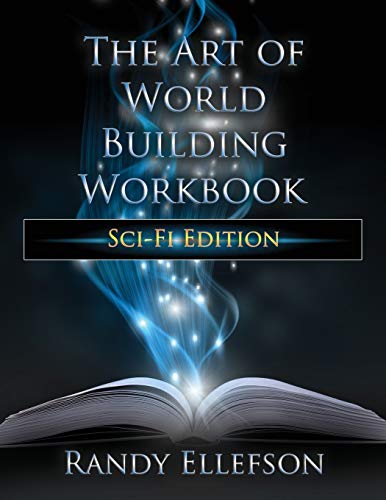
A desk-sized workbook built for AI, technology, space travel and a sky full of planets.
Space opera writers get their own tool here, and the scope is narrow on purpose. This workbook pushes across more planets and heavenly bodies, folds in AI and technology and space travel, and spreads each world a bit less thick than a fantasy volume would. That trade is the right one when your draft already spans several star systems.
The physical size is the giveaway that this is a write-in product. At 8.5 x 0.77 x 11 inches and 1.86 pounds, it is a full-size book that stays flat on a desk with a pen beside it. Weigh that against the Cultures and Beyond paperback at 5 x 1.17 x 8 inches and 1.11 pounds, and you can feel the split: one is a reading book, one is a working book.
The honest trade-off: it is listed as book ten of twelve in the series, and it carries 5 templates against the 12 packed into the Cultures volume. Fewer blank sheets means less hand-holding on the fill-in side.
Where it still delivers: 338 pages of sci-fi-specific prompts is a lot of scaffolding for tech, planets and travel, which generic fantasy-oriented journals rarely touch at all.
The right shelf: beside a laptop for a writer drafting a multi-planet science fiction story.
The mismatch: if you are building one fantasy continent in detail, this spreads your effort too wide.
3. The Complete World Building Workbook
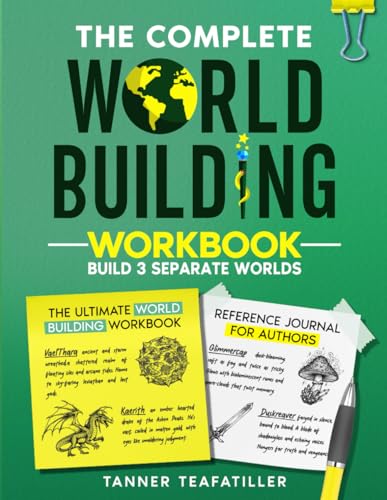
One journal that splits neatly between multiple worlds instead of one deep dive.
If you keep three projects alive at once, a single-world reference book will fight you. This workbook is explicitly built around multiple worlds, with reference material folded in alongside the journal pages, and that combination is what makes it worth a spot on the desk of a writer who jumps between drafts.
Its 202 pages are the shortest run in this group, and that is the point — it is compact by design. The 8.5 x 0.46 x 11 inch full-size page keeps writing room generous, and at 1.32 pounds it is lighter than the 1.86-pound Sci-Fi workbook to haul between sessions. The trade is straightforward when you compare it to Cultures and Beyond: 202 pages versus 465 means each individual world gets a lighter pass.
It sits in The Complete Writer’s Workbook Series next to companion volumes on character development and character creation, so you can build a matching set if you want the whole writing toolkit in one consistent format.
balance: you juggle two or three setting ideas at once and want one place to hold all of them.
Think again if: a single richly detailed world is the goal — the page count is simply too short for that depth.
4. Creating Life (The Art of World Building)

The front door to the series — gods, species, monsters and undead before anything else.
Start at the beginning and the rest of the series makes sense. This first volume builds gods, species and races, plants, animals, monsters, world figures, and undead — the living population of a setting rather than its politics. It is 251 pages and 8.6 ounces, the lightest and shortest of the four books here, which makes it the easiest one to carry and the least intimidating one to open first.
Where it leads is worth knowing before you begin. The next two volumes are Creating Places and then Cultures and Beyond, so this book deliberately stops short of governments, faiths and money. If you want a pantheon and a bestiary, this is the whole answer. If you want currency systems and military structures, you need volume three.
The one thing to size correctly is how the content reads. The worldbuilding material is there and detailed, but the actual act of building can start to feel like bookkeeping when you work through it in long sittings. Treat it as a reference you return to chapter by chapter, not a novel to power through in a weekend.
Why beginners like it here
- 251 pages focused entirely on gods, species, monsters and characters
- 8.6 ounces — the lightest book in the group
- Clear first step in a numbered 12-book series
Where it stops short
- No cultures, money or legal systems — those live in the later volumes
- Detailed enough that long working sessions start to drag
Pick it up when: your world needs believable gods and creatures before it needs a parliament.
Leave it for later: once your species are settled and the politics are what is actually blocking the draft.
Know the Specs
Print length in pages
A page count tells you how much explanation or template space you are getting before you buy. A longer reference book like the 465-page Cultures volume has room to walk through a monetary system step by step. A shorter 202-page journal gives each topic a lighter pass, which suits a writer who needs prompts rather than lectures.
Template count
Templates are the pre-built fill-in pages — the sheets where you write your species, your pantheon, your map notes. The number varies wildly between books in the same series, from 5 in the Sci-Fi workbook up to 12 in the Cultures volume. If you plan to work with a pen, this number is more useful than page count.
Trim size
Trim size is the physical footprint of a closed book. A full-size 8.5 x 11 inch page gives writing room for a workbook but takes up desk space, and stays open flat more easily at that bulk. A 5 x 8 inch paperback slips into a bag for drafting on the move and reads more like a normal book.
Item weight
Weight matters the moment you carry it. An 8.6-ounce paperback rides in a tote without complaint, while a 1.86-pound full-size workbook is a desk resident. Match the weight to where you work: 8.6 ounces travels, 1.86 pounds stays on the desk.
Common Questions
Is a world building workbook or a reference book better for a first world?
Can I start The Art of World Building series at volume three?
Which book covers AI and technology for a science fiction setting?
Do these books include fill-in templates or just text?
What size are these books in real terms?
Is Creating Life enough on its own or do I need the later volumes?
Can one workbook serve several different worlds at once?
Do the Sci-Fi and Fantasy editions of the workbook overlap?
Is the illustrated edition worth choosing over a plain one?
The Bottom Line
For most writers, the world generator winner is the Cultures and Beyond, because 465 pages of worked-through cultures, militaries and monetary systems is what turns a map into a place people argue about. If your setting is science fiction with several planets and a technology stack, the Sci-Fi Edition workbook is the better match. And when you simply need one journal to hold several worlds at once, the Complete World Building Workbook earns its desk space.
One practical note before you close the tab: the Sci-Fi workbook gives you the least fill-in structure of the set. Pair it with a matching journal rather than expecting it to be your only page to write on.
How we choose
We do not accept paid placement. Every pick is matched to a real buyer and a real use-case; we do not hands-on test units.
Sources
Specifications: manufacturer listings and product documentation. Review insights: verified customer reviews, as of November 2026. Pricing: not shown on this page (it changes often); check the current price via the retailer link.
As an Amazon Associate, Tactical Gear Guy earns from qualifying purchases. This does not affect which products we feature.