Specs are compiled from manufacturer listings and verified buyer reviews and can change over time — please confirm the key details on the product page before buying.
If you want to cut real wood parts instead of fighting a machine that flexes and skips, buy the largest rigid work envelope you can afford and skip the belt-driven toys. The TTC6050 is the strongest all-round pick here, but the right mill for you depends on one thing: how big and how hard your projects are. This guide compares work area, spindle wattage, and frame stiffness so you can match a mill to the stock you actually cut.
This guide is built by comparing the manufacturers’ published specifications and the patterns across verified customer reviews, so you get each pick’s real strengths and trade-offs instead of marketing spin.
You will see how work area, spindle watts, and lead-screw or ball-screw drives change what a machine can cut. The picks below cover everything from a hobby desk to a small production bench for a wood cnc mill.
Top Picks

How To Choose The Best Wood CNC Mill
The wrong first machine is the one that flexes before the bit finishes a cut. A wood CNC mill holds a spinning cutter in a moving frame, and every part of that frame either absorbs vibration or passes it into your wood. Choose the frame, drive type, and spindle wattage before you compare software bundles.
Work area and pass height
Work area is the flat space the cutter can reach, and pass height is how tall a piece of stock can stand under the spindle. Larger numbers mean you can cut bigger signs and thicker boards in one setup. A machine listed at 600×500×100mm gives you a broad table and enough clearance for tall relief work, while a smaller unit around 400×400×60mm suits trinkets, plaques, and small joinery.
Ball screws and linear rails versus belts
Ball screws are threaded rods that turn rotary motion into exact straight travel, and linear rails are steel tracks that carry the gantry without slop. Together they hold the cutter steady when it bites into hardwood, so cuts stay dimensionally accurate. Belt-driven units are cheaper and lighter, but the belt can stretch under load, which shows up as chatter and uneven depth.
Spindle power and RPM range
The spindle is the motor that turns the bit. Higher wattage lets it maintain speed through dense wood and thicker cuts. The RPM range tells you how fast it spins, with lower RPM useful for larger bits and higher RPM for fine carving. A spindle that runs from 7,000 up to 30,000 rpm gives you a full spread from hogging out material to detailed work.
Side-by-Side Comparison
| Model | Best For | Work Area | Spindle | Frame / Drive | Amazon |
|---|---|---|---|---|---|
| Twotrees TTC6050★ Best Overall | Large projects and small-batch work | 600×500×100mm | 500W spindle, up to 30,000 rpm | Aluminum, C7 ball screws and linear rails | Amazon |
| Twotrees TTC450 ProBest Upgrade Path | Makers upgrading to a 4th axis | 460×460×80mm | 775 brushed spindle | Aluminum and stainless steel, NEMA 57 stepper | Amazon |
| FoxAlien Masuter ProEasiest First Build | First-time hobbyists learning the basics | 400×400×60mm | 60W, accepts 300W spindles | All-aluminum, linear rail Z-axis | Amazon |
| Genmitsu 4040-PRO | Fast setup and quiet operation | 435×400×80mm | — | 16mm HSS steel tubes, lead-screw drive | Amazon |
| LUNYEE 3020 Nova | Metal cutting on a compact bench | 3020 format | 800W, 6,000–30,000 rpm | Ball screws and HG-15 linear guides | Amazon |
| SainSmart Genmitsu 4040-PRO | Adding a 4th-axis rotary module | 4040 format | — | 16mm Steel HSS linear tubes, lead screw | Amazon |
| SainSmart 4040-PRO MAX | Higher pass height for tall stock | 410×405×77mm | 710W digital display router | X and Z linear guideways | Amazon |
| Genmitsu 4040-PRO MAX | Wireless control and upgrade headroom | 410×405×77mm | 710W digital display router | SBR16 X linear rails, lead screw | Amazon |
| AnoleX 4030-Evo Ultra 2 | Precision metal and hardwood work | 4030 format | 800W, 8,000–24,000 rpm, 6 speeds | Dual HGH-15 linear rails and 1204 ball screws | Amazon |
| FoxAlien XE-PRO | Quiet, fast movement with closed-loop motors | — | 400W, up to 12,000 rpm | 1204 ball screws, dual Z linear rails | Amazon |
| NBS-6040 | Production-level rigidity | 610×410×120mm | 710W, 7,000–30,000 rpm | Linear rails and ball screws on all axes | Amazon |
Detailed Reviews
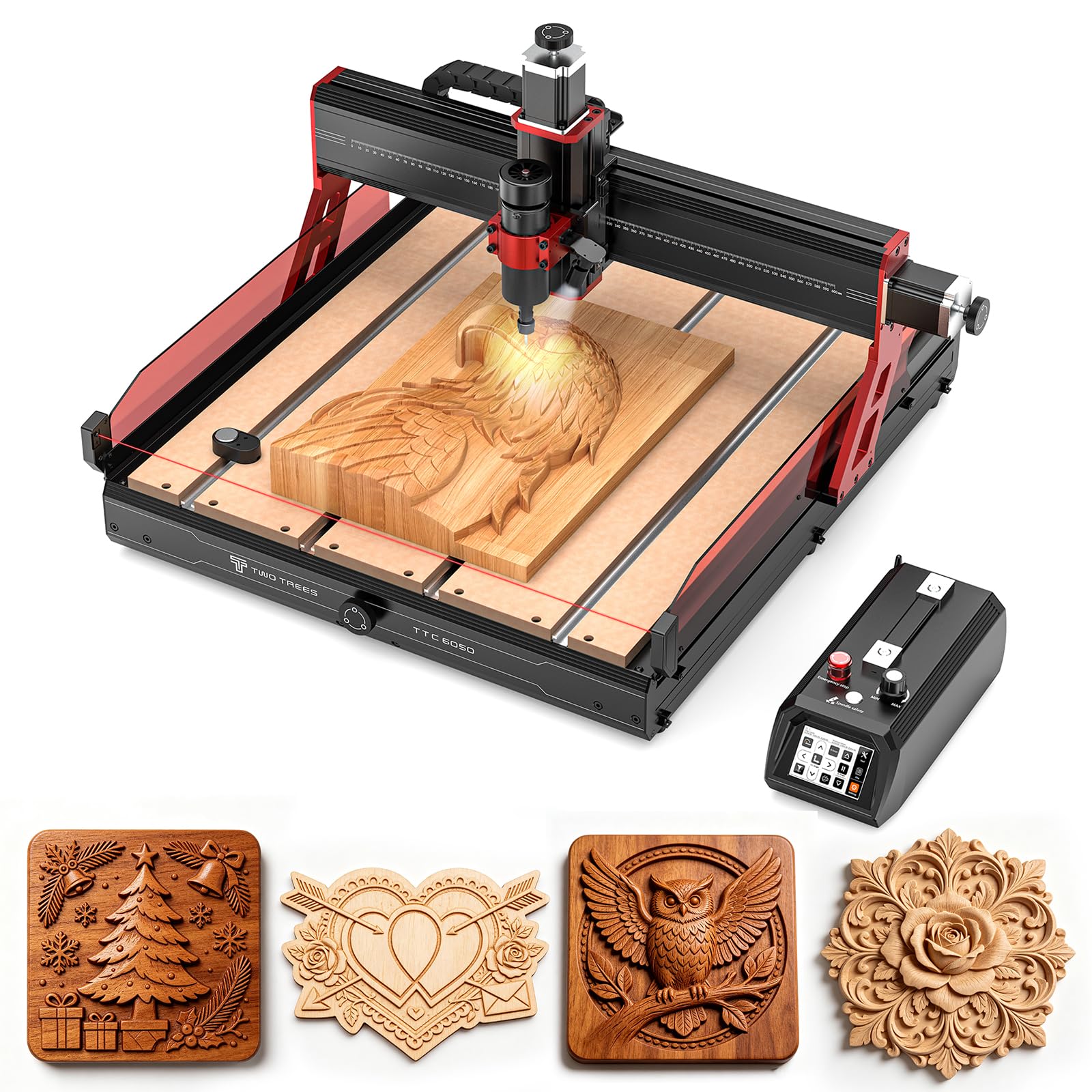
1. TTC6050 CNC Router Machine
Our pick — 4.5+★ from 60+ verified ratings; the strongest balance of quality and price.
A big aluminum bench mill with the travel and stiffness to cut real furniture parts, not just coasters.
Start with the travel numbers, because they set your whole project list. The TTC6050 gives you 600×500×100mm of work travel, which means a wide table for signage and enough height clearance for tall stacked glue-ups. The 100mm is the number that matters here — most desktop mills leave you squeezing thick stock under the gantry, and this one does not.
Rigidity is where this machine earns the top spot. The frame is aluminum alloy with a net weight of 35.9KG, and it runs C7 ball screws with linear rails on all three axes, so the cutter resists deflection on hardwood. Accuracy is listed at 0.1mm with a max engraving speed of 5000mm/min, and 57-series stepper motors keep travel consistent through long carving sessions. Compare that to the Masuter Pro’s 13 kg frame — the TTC6050 at 35.9KG versus the Masuter Pro at 13 kg means noticeably less chatter.
The spindle spins up to 30000 rpm and the ER11 collet takes 0.5–7mm bits, so you have room from fine detail carving to bulk material removal. There is a 3.5-inch resistive touch screen for standalone runs, plus TF-card, USB, and 2.4G WiFi connection for jobs without a tethered laptop. An infrared object sensor cuts power if something enters the work zone, and the hidden transmission structure shields the screws from wood chips.
Where this machine pulls ahead
- 600×500×100mm travel handles large panels and thick stock
- C7 ball screws plus linear rails on all three axes hold tight tolerances
- 35.9KG aluminum frame damps vibration on dense hardwood
- Runs Fusion360, EASEL, and Carveco Maker via open-source GRBL firmware
- Optional air-cooled or water-cooled spindle and laser module expand it later
The honest caveats
- Heavy and needs a solid bench and help to move
- The resistive touch screen is functional rather than slick
- Windows 11 needs the CH341 driver, not the CH340
Reach for this if: you want one mill that will cut big signs, furniture parts, and prototypes without outgrowing it in a season.
Think twice if: your bench is a folding table — at 35.9KG this machine wants a permanent, solid home.
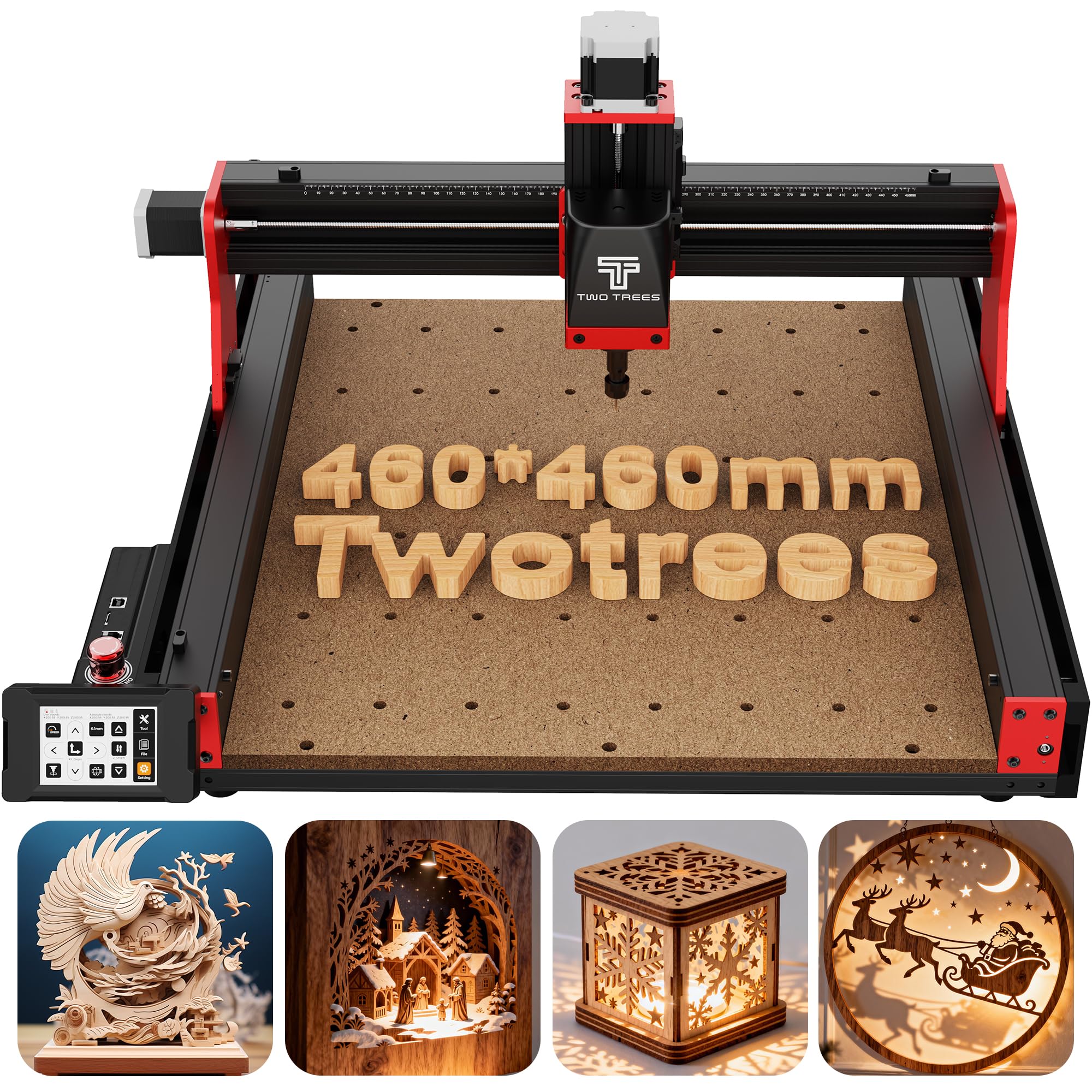
2. Twotrees TTC450 Pro CNC Router Machine
The desktop mill that already has the ports for a 4th axis and a laser, so growing never means replacing.
Quality control is the thing that wins people over on this machine. The build feels tight and the pancake stepper motors track with real precision, and setup is straightforward enough that newcomers get to cutting without a fight. It sits at 4.0+ stars across 600+ ratings, and that consistency is why it lands this high.
The control box is the standout. A 3.5-inch IPS capacitive touch screen runs the machine, and the box carries a 4th-axis rotation port, a laser module port, and a 500W spindle speed control port. So you can add rotary work or laser engraving later without buying a second machine. The working area is 460×460×80mm with a 57 stepper on the Z-axis listed at 0.0025 mm positioning accuracy — fine enough for multi-layer relief carving.
It runs open-source GRBL and works with ArtCam, Fusion 360, Easel, and Carveco Maker across Windows, macOS, and Linux. The 10-piece tool set includes pointed carving bits, flat end mills, chamfer cutters, plus 6 clamping plates and test material, so day one is productive. Aluminium and stainless steel construction with dual limit switches on XYZ keeps the frame safe from over-travel. Note that the buyer feedback is split on functionality and value — most machines do exactly what they promise, but a minority hit basic-test failures, so buy from a seller with a clear return policy.
What the frame is really doing: the aluminium and stainless body with TM-1618D micro limit switches keeps long, high-load carves stable — the 20.5 kg mass is doing the vibration damping for you.
The trade-off to weigh: heat and motor durability come up as mixed in the feedback, so plan to let the spindle cool on very long runs rather than pushing marathon sessions.
Built for the upgrader: the hobbyist who knows they will want a rotary axis and a laser within a year, and wants the ports already onboard.
Hold off if: you want a larger stock spindle from the start — the 775 brushed motor here is a starting point, not the finish line.
3. FoxAlien Masuter Pro 3-Axis CNC Router Machine
The starter machine that is almost assembled when it lands, so your first cut comes the same afternoon.
Build quality is what carries this one: the all-metal framework with a linear rail Z-axis makes the gantry feel far sturdier than the 60W spindle suggests, and it cuts wood, acrylic, MDF, and nylon cleanly. What most wins people over is how it feels bolted together — the precision and stability show up in the actual cuts, not just the spec sheet.
The setup story is the real draw. Main parts arrive pre-assembled and pre-wired to the dust-resistant controller box, and assembly runs 10-15 minutes by the manual. The box keeps dust off the electronics and puts the emergency stop and home buttons within reach. On the bench it measures 13 kg, versus the TTC450 Pro’s 20.5 kg, so one person can lift it onto a workbench without a helper.
You get two spindle clamps, 52mm and 65mm, so a 60W or 300W spindle swaps in, and a 65mm router or 1.5KW spindle opens up heavier carving. The 400×400×60mm engraving surface takes signs and small joinery, and an optional Y-axis extension kit grows the table when you need it. A 1/8-inch collet, 10 engraving bits, and a Z probe ship in the box. The honest catch is the software learning curve — the 10-15 minute build is easy, but CAM setup takes real practice before your first clean cut.
What clicks for new owners
- 10-15 minute assembly with pre-wired parts
- Dust-resistant controller box with emergency stop and home buttons
- Two spindle clamps (52mm and 65mm) for easy spindle swaps
- 1 year manufacturer warranty
Where it will feel tight
- 60W spindle is light for dense hardwood
- 400×400×60mm table limits big panels until you add the Y extension
- Software learning curve is steeper than the hardware build
Best first buy: a newcomer who wants to learn CNC on a stout little frame and upgrade the spindle as skills grow.
Skip the entry point if: you already know you need to hog out hardwood all day — step up to a machine with a larger spindle from the start.
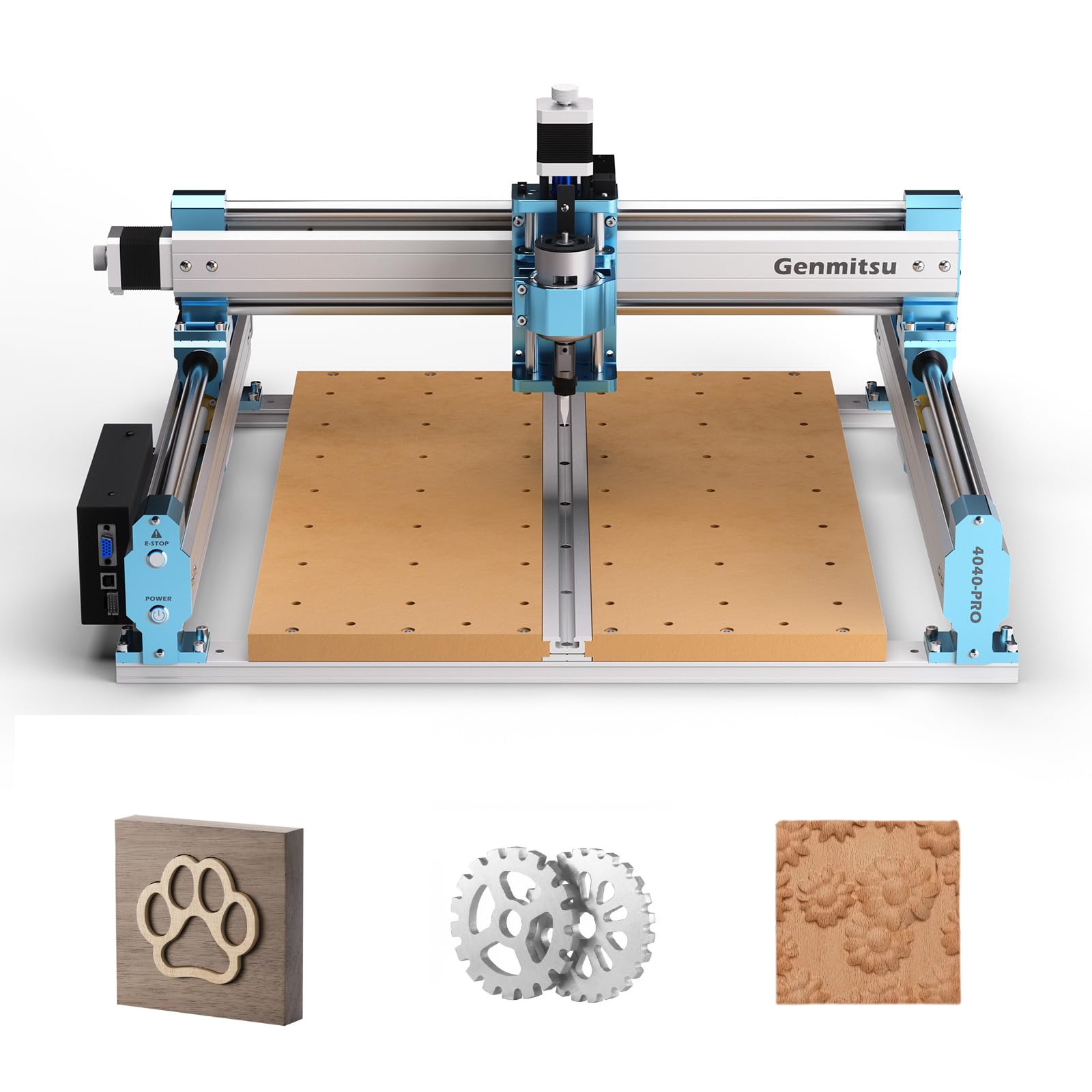
4. Genmitsu 4040-PRO CNC Router Machine
A rigid, quiet little workhorse whose reinforced bed holds flat across bigger projects.
Assembly here is the fastest part of the day — pre-assembled modules get the 4040-PRO running in about 15 minutes, and the relocated Z-probe port makes setup less fiddly. The build feels rigid in the hand from the first moment, and that quality is what owners talk about most. It sits at 4.0+ stars across 600+ ratings, so a majority are satisfied with what arrives.
The frame uses dual 16mm HSS steel tubes on each axis with lead-screw drives, giving smooth, accurate movement. The 32-bit controller with silent Toshiba drivers keeps the noise down for detailed carving in a home shop — you can run it in a garage without a headache. Working area is 435×400×80mm, big enough for signs, reliefs, and prototypes in wood, acrylic, MDF, nylon, and carbon fiber composites. Machine weight is 20.84 kg, so it stays planted while cutting.
Where it suits careful buyers is the spoiled-bed design. A central aluminum support bar reinforces the MDF to stop it sagging under load, which keeps cutting depth consistent across larger jobs. The redesigned Z-axis carriage accepts 65mm or 69mm spindle mounts with an extra mount, and dedicated 3-pin ports take air assistance and MPG controllers. The trade-off to know: reliability feedback is mixed, and axis performance draws notice in the negatives — a small share of owners had trouble getting theirs to run right, so test it thoroughly in the return window.
Why the bed matters: sag in the spoilboard shows up as uneven depth halfway across a board, and the central support bar is the fix that keeps every pass the same.
The honest note: axis performance is the recurring weak spot in the feedback, so factor in some setup patience or a return path if things go sideways.
Great for the patient builder: someone who wants a quiet, rigid mill and does not mind fine-tuning axis settings to get the best from it.
Look elsewhere if: you want a turnkey machine that runs perfectly on the first power-up with no tuning.
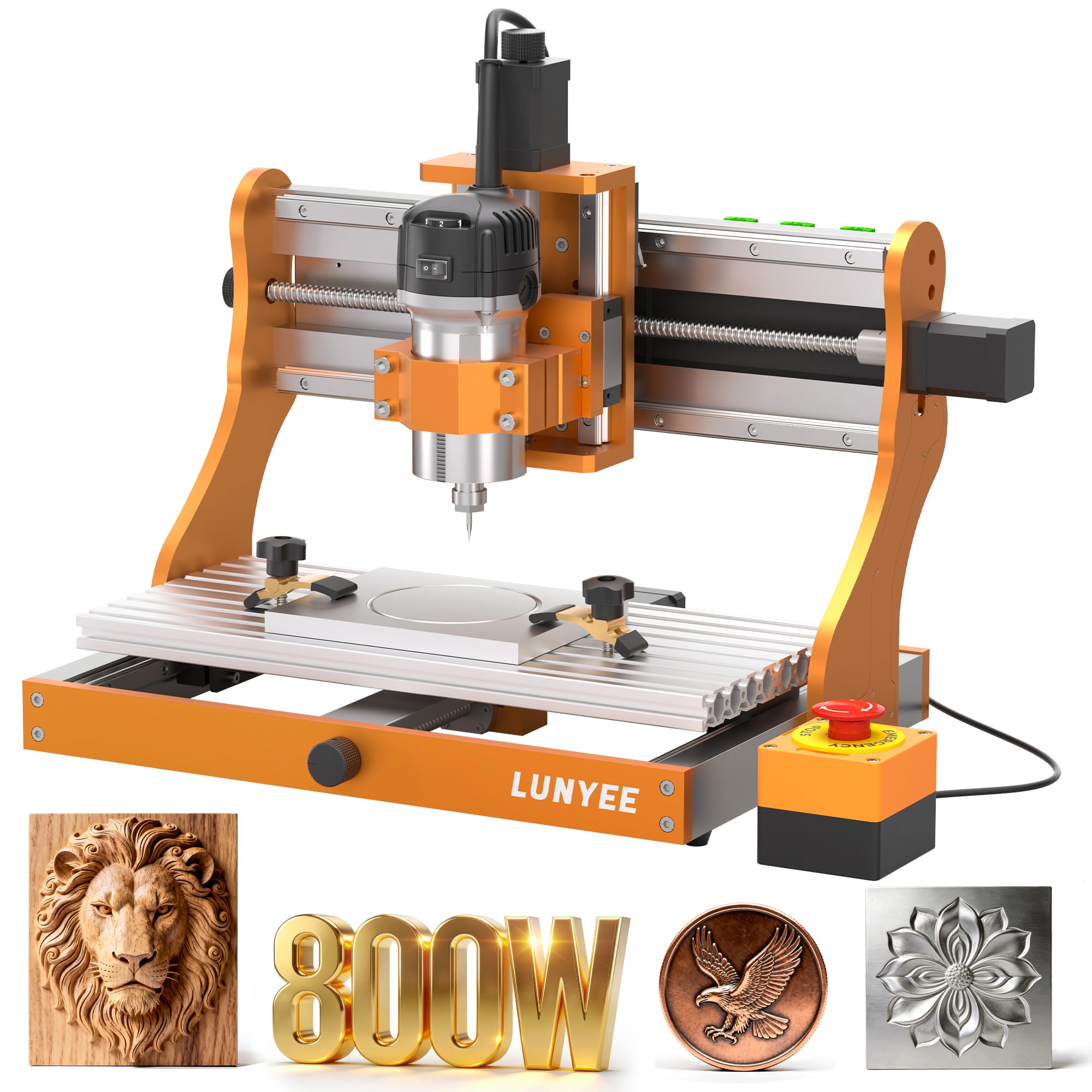
5. LUNYEE 3020 Nova CNC Router Machine
A small-footprint mill with a big 800W spindle that punches well above its desk space.
The first thing to know: this one arrives almost fully assembled with all wiring pre-connected. You install the Z-axis module, plug in the power, and start cutting — no all-day build. That ready-to-run design is a big part of why the build quality lands so well with owners, and it explains the 4.0+ star standing across 30+ ratings.
The frame is all-metal with 1204 ball screws and HG-15 linear guides on each axis to eliminate backlash. Accuracy is listed at ±0.05mm with max movement speed reaching 5000mm/min, so detailed engraving stays sharp. The 800W spindle runs 6,000–30,000 rpm across six speed settings with constant torque control, which is what lets a machine this size take on solid wood, metal, acrylic, plastics, and leather.
You get plenty of software choices: it runs GRBL firmware tools (open-source control software that drives the machine) like UGS, Fusion 360, Easel, and Candle. It also takes engraving modules and pairs with a 20×10 cm CNC vise (a clamp that holds your workpiece) for desktop work. The honest limit: this is a compact machine, so big panels are out. Reliability feedback is mixed — one report of a router stopping after a month of use means you should register the warranty and keep the receipt. For metal and detail-heavy work where space is tight, it packs a serious spindle into a small package.
Pick this one if: your projects lean toward metal, brass, and detailed work, and your bench space is limited.
Bypass it if: you cut large wood panels — the compact 3020 footprint will frustrate you fast.
6. SainSmart Genmitsu 4040-PRO CNC Milling Machine
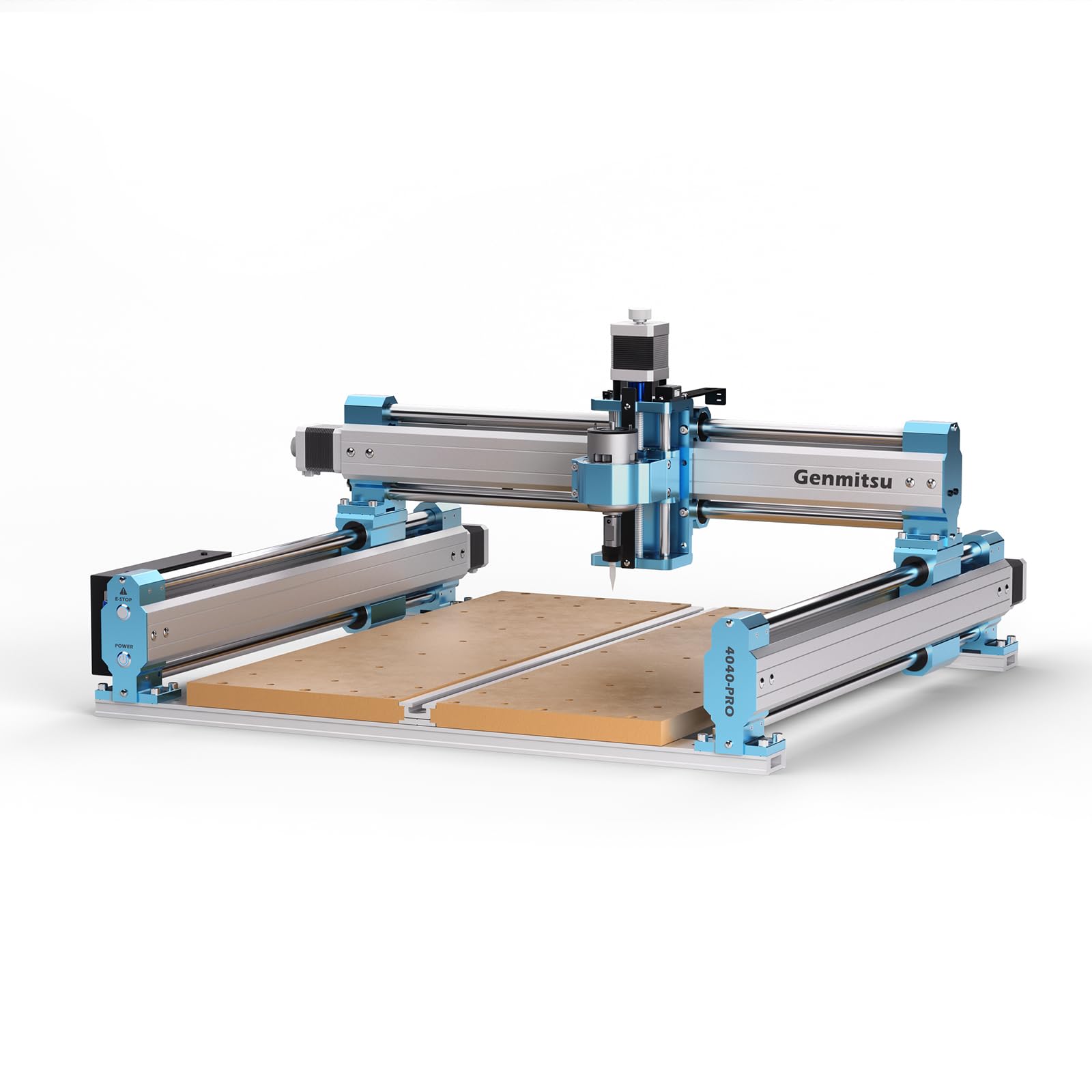
The 4040 that was built from the start to spin a cylinder, not just flatten a board.
Add the matching 4-axis rotation module (a add-on that turns the workpiece as it cuts) and this machine carves from different angles or does complete 3D rotary work with the right software. That is the feature that separates it from the flat-bed-only machines in this list. It sits at 4.0+ stars across a couple dozen ratings, and the ready-for-upgrades design is why it earns a slot.
The frame is a high-rigidity steel HSS structure with 16mm linear tubes, a lead-screw motion drive, dual Y-axis rails, and a full metal frame. That combination keeps precision steady through milling. Electronics run open-source Grbl v1.1 with silent Toshiba TB6S109 drivers on 32-bit chips, so operation stays smoother and quieter than the older generation. Air Assistance Pump and MPG ports add versatility as you grow.
The reinforced spoilboard has a central aluminum support bar that stiffens the MDF against sagging and doubles as a T-slot for clamping. It ships with 42mm and 52mm spindle mounts, with optional 65mm and 69mm mounts available. A 1-year warranty backs the machine. Because this is a newer listing, verified owner feedback is still thin — treat the 4.0+ stars as early signal and lean on the spec sheet and warranty while the review base fills out.
The upgrade angle: 4th-axis support, air-assist, and MPG ports inside one frame — you build the machine out instead of replacing it.
Ideal for the rotary carver: someone planning to turn spindles, legs, and 3D shapes alongside flat boards.
Wait if: you want a deep track record of owner feedback before you commit — this is a newer model with a small review base.
7. SainSmart Genmitsu 4040-PRO MAX CNC Router with 710W Trimmer

Built to slip tall stock under the gantry without skimping on cutting power.
The number that matters here is the 100mm pass height. That clearance lets you engrave thicker materials and taller glue-ups without hitting the gantry. For anyone working thick signage or stacked boards, that clearance alone justifies the upgrade step.
Under the gantry sits a 710W digital display compact router, and the X and Z axes use linear guideway structures for steady motion at speed. A reduced-vibration design keeps precision stable during fast, high-power cutting. A 0.95 hp rating and a 30000 rpm top speed put it well above the lighter starter machines. The work area is 410×405×77mm.
The reinforced spoilboard uses a central aluminum support bar to resist sagging and doubles as a T-slot for more clamping options. Owners describe it as an easy build with impressive accuracy, and the power handles common wood types with good precision. The catch is that the higher pass height and heavier router leave a narrower margin on very fast, high-power passes, so keep your feeds conservative on deep cuts. A 1-year warranty covers it.
The headline spec: 100mm of clearance, aimed squarely at thick-stock jobs.
Right for thick-stock work: sign makers and furniture builders who need clearance for tall material.
Not the pick if: all your work is thin flat stock — you will pay for clearance you never use.
8. Genmitsu 4040-PRO MAX CNC Router Machine with 710W Spindle
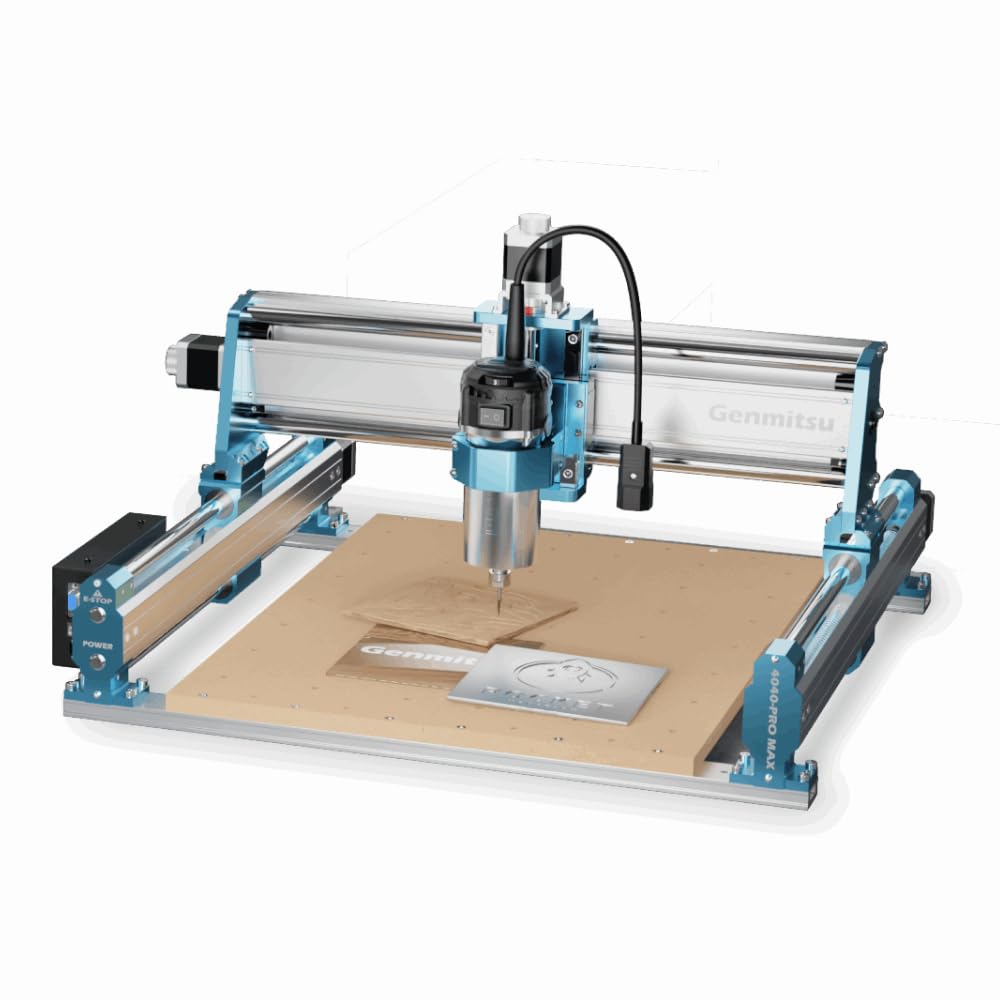
The highest-scoring mill in this roundup, and it hides its muscle in the X-axis rails.
The X-axis is where the engineering lives: modified SBR16 linear rails paired with a lead screw cut machine vibration, and that is what holds precision steady through fast, high-power wood and metal work. It tops this list on owner satisfaction, so the design clearly delivers on the bench.
The work area is 16.1″ x 15.9″ x 3.0″, and a 710W digital display compact router supplies the cutting muscle. An integrated dust plate keeps the rails cleaner, cutting maintenance and extending service life. The reinforced spoilboard carries the same central aluminum support and T-slot as the rest of the 4040 line — worth knowing if you already own PRO accessories.
An upgraded mainboard supports wireless control through an optional Wi-Fi module and the official app, so you can send jobs without a cable tether. It also takes the 4040-PRO Y-axis extension kit, 4th-axis rotary module, and dust shoe, so the machine grows with you. A 1-year warranty backs the build. The one honest note: the wireless module is sold separately, so factor that cost if a cable-free setup matters to you.
What the rails buy you: vibration control is the whole game in fast carving, and the SBR16 X rails are the reason this model leads on owner satisfaction.
The pick for the perfectionist: a buyer who wants the most-loved 4040 frame and a clear upgrade roadmap for 4th axis and dust control.
Know before you buy: Wi-Fi is an add-on module, not standard, so a cable-free workflow is an extra purchase.
9. 4030-Evo Ultra 2 CNC Router Machine
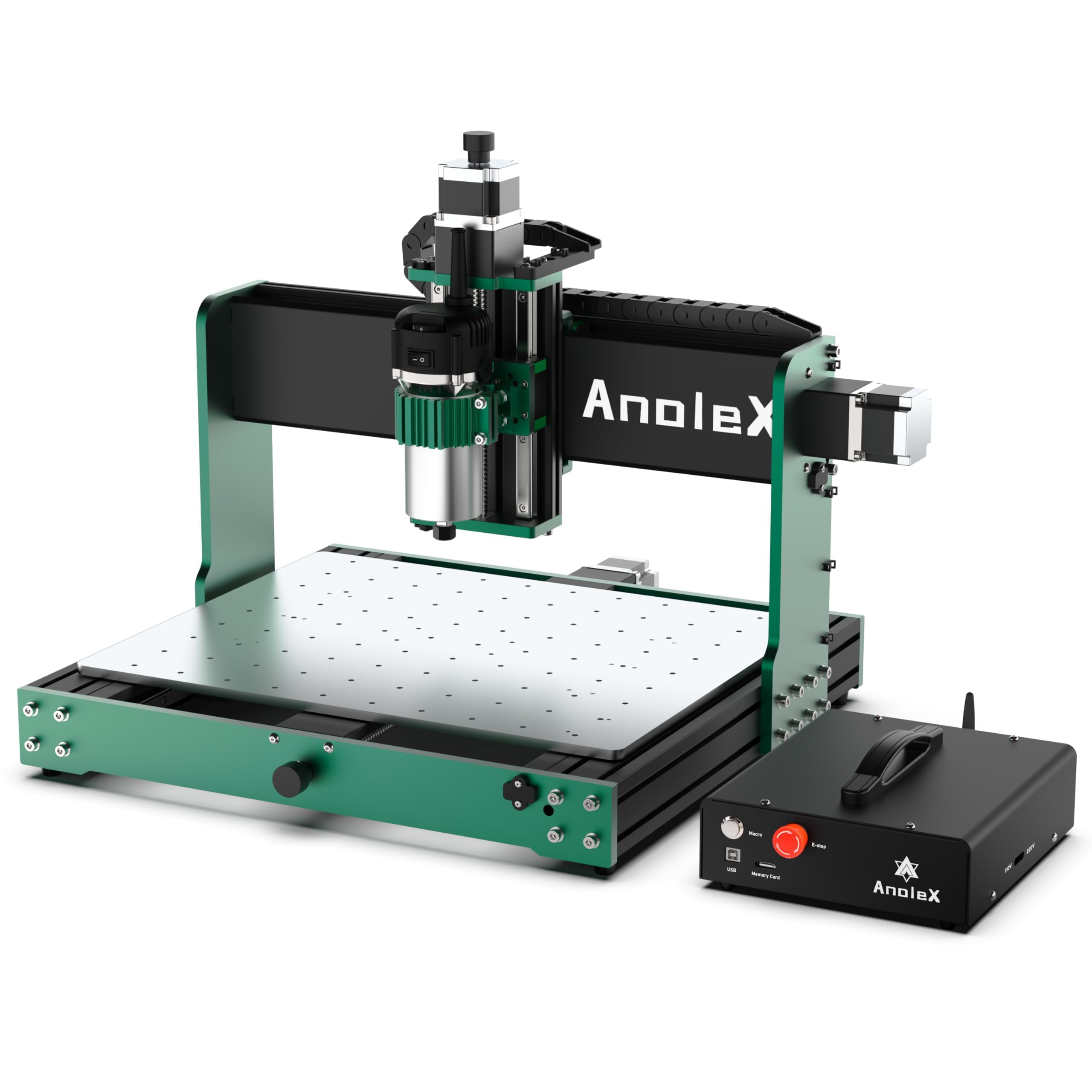
A metal-hungry precision mill with repeatability tight enough to trust on real machine parts.
Repeatability is the number to look at: ±0.005mm on the frame, with cutting accuracy in 6061 aluminum reaching ±0.02mm. That is the sort of consistency you want when a part has to fit on the second cut, not just look good on the first. Build quality and overall quality are what owners praise most, and the 4.0+ star standing reflects it.
Every axis runs HGH-15 dual linear rails plus 1204 ball screws, and the ball screws carry a dual-bearing design at both ends to hold precision, cut high-frequency vibration, and extend stepper motor life. The upgraded Φ65mm trim router is 800W with six speeds from 8,000 to 24,000 rpm, and an ER11 collet takes 1/8-inch tooling. Nema 23 stepper motors (2.8A, 1.2N/m torque) drive the XYZ axes with closed-loop interfaces for plug-and-play upgrades.
Control is modern: the board runs GRBL 1.3a on ESP32 and supports laser engraving, a 4th axis, coolant control, closed-loop steppers, and a 3-pin touch probe. A 32-bit MCU with ESP3D Web UI lets you control it from a PC, phone, or tablet over Wi-Fi with no USB cable, and macro buttons can be reprogrammed for pause, stop, or G-code from an SD card. Compatibility draws mixed feedback — one note about the 3-pin probe port means you should verify your probe wiring. Otherwise the pre-assembled components and clear cable management make setup quick.
Why precision buyers love it
- ±0.005mm repeatability with metal cutting accuracy to ±0.02mm
- Dual HGH-15 linear rails and 1204 ball screws on all axes
- GRBL 1.3a on ESP32 with Wi-Fi control via Web UI
- Nema 23 motors with closed-loop upgrade interfaces
- Reprogrammable macro buttons and SD-card G-code runs
Small print worth reading
- Probe port compatibility drew a mixed reaction
- Manual dial for speed adjustment, not fully software-controlled
- Anodized aluminum frame wants a sturdy bench
The maker’s machine: for fabricators who measure their parts and want repeatability to match.
Consider the trade: on a tight budget, the same money stretches to a bigger work area elsewhere — this one spends it on rigidity instead.
10. FoxAlien XE-PRO CNC Router Machine
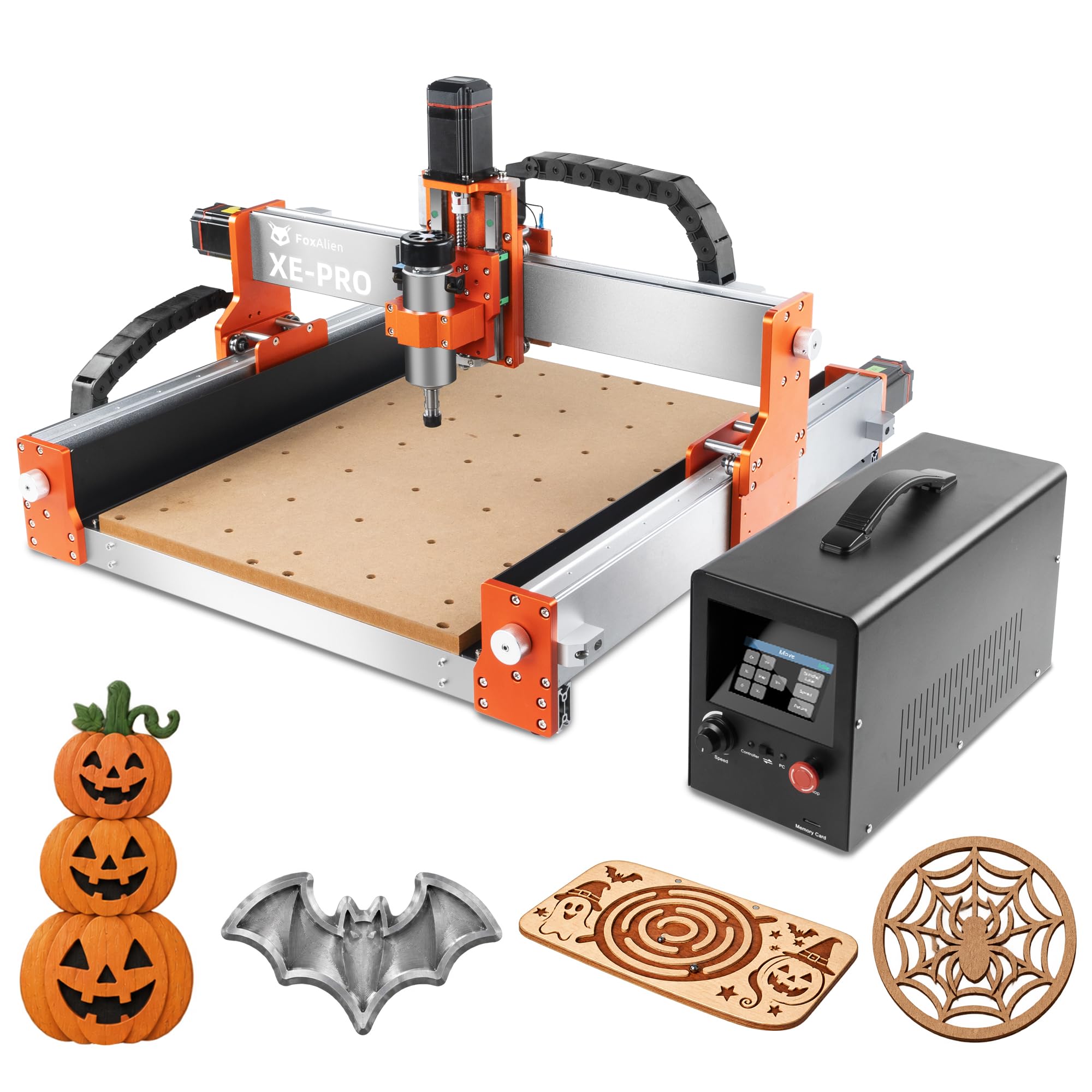
Four closed-loop motors make this the quiet, quick mover of the FoxAlien line.
The performance angle is what buyers talk about first: closed-loop stepper motors let this machine run faster and smoother while keeping noise down, with a max moving speed of 5000mm/min — 2.5 times faster than open-loop steppers. That speed matters when you are running repeated identical parts and the clock starts to add up.
The XE-PRO uses 1204 ball screws on the XYZ axes for precise cutting, plus dual linear rails on the Z axis to stiffen the cutting action. Three spindle clamps at 52mm, 65mm, and 69mm let you swap between 400W, larger spindles, or trim routers for different projects. It also accepts FoxAlien engraving power modules and the NEMA23 4th-axis rotary module for cylindrical work. Main parts come pre-assembled and assembly runs 25-30 minutes, then you are into your first job.
The upgrade path is unusual: an exclusive design lets you convert the X and Y axes to linear rails later, turning a home machine into something closer to industrial grade. The offline controller simplifies the workflow so you can carve without a laptop tethered. The honest note is that reliability feedback is mixed, with a few owners reporting motor or durability issues, so test yours inside the return window. It weighs 38.46 kg, so plan a permanent spot on a solid bench.
Speed with control: the closed-loop NEMA23 motors hold position under load, which is what lets the machine travel at 5000mm/min without losing accuracy.
For the productivity-minded: someone who wants fast travel, quiet running, and a clear path to a linear-rail upgrade.
The cost of the upgrade dream: the 400W spindle is modest for heavy hardwood, so plan a spindle swap if you cut dense stock all day.
11. NBS-6040 CNC Router Machine

A big-table mill that runs like shop equipment and shows it in every cut.
This one is built for people who make parts for a living. Linear rails and ball screws run on every axis, which is a build spec usually reserved for much larger and heavier machines, so rapid movement comes with serious rigidity. Craft and build quality are what owners praise most, and the 4.5+ star rating is among the highest in this group.
The working area is 610×410×120mm — a wide, tall envelope that handles large panels and thick stock. The 710W custom router spins 7,000–30,000 rpm with soft start and constant current drive, so the spindle ramps up smoothly without stalling. GRBL v1.1 runs on 32-bit chips with pulse frequency up to 80 KHZ, and the 2.8-inch TFT touchscreen offline controller lets you run jobs without a computer.
Expansion ports are already there for a 4th axis, MPG, Z probe, air pump, lighting, air blowing, and a dust boot. The modular design gets you running in about 20 minutes. The honest catch is footprint: at 30 inches wide it needs a dedicated bench, and the ER11 collet takes 1–8mm, 1/4″, and 1/8″ bits, so budget for a starter set in your material. For the buyer who wants production-grade rigidity without a floor-standing machine, this is the top of the scale.
The spec that carries it: linear rails and ball screws on every axis is the difference between a hobby mill and one that holds precision at speed.
Made for the shop: the buyer producing repeatable parts who needs a large, stiff work envelope in a benchtop footprint.
Measure your bench first: at 30 inches wide this machine needs dedicated space, so check it fits before you commit.
Know the Specs
Work Area and Pass Height
Work area is the flat space the cutter reaches in X and Y, and pass height is how tall stock can sit under the gantry in Z. A 600×500×100mm envelope gives you a broad table and 100mm of clearance for tall glue-ups. Compare that to a 400×400×60mm surface, which suits plaques and small joinery but not big furniture panels. Size the envelope to the largest panel or thickest board you plan to cut, not to the smallest.
Spindle Wattage and RPM
The spindle is the cutting motor. Higher wattage holds speed through dense hardwood, while the RPM range tells you how fast it spins. A spindle running 7,000–30,000 rpm covers everything from slow hogging with large bits to high-speed detail carving. Lower-wattage starters around 400W or 60W are fine for soft wood and learning the craft, but you feel the difference on thick hardwood passes.
Ball Screws vs Lead Screws
Both are threaded rods that convert rotary motion to straight travel. Ball screws use rolling balls for smooth, low-friction movement with tight tolerances, which is why precision mills favor them. Lead screws are simpler and still accurate for most hobby work. The key difference shows up on big heavy machines that need speed and rigidity at once — that is where linear rails plus ball screws keep the cutter steady.
GRBL Control and Software
GRBL is open-source control firmware that runs the machine’s movement commands. It is the software layer that turns a design file into cutter motion. Because GRBL is widely supported, machines running it work with tools like Fusion 360, EASEL, Carveco Maker, UGS, and Candle, and connect to Windows, macOS, and Linux. Before buying, confirm your design software posts G-code the controller accepts without a paid plugin.
Common Questions
Can a desktop CNC router cut solid hardwood or only softwood?
What work area do I need for cutting cabinet doors or signs?
How long does it take to assemble a wood CNC mill?
Do I need a computer to run a desktop CNC router?
What is the difference between a ball screw and a lead screw on a CNC mill?
Can I add a 4th axis rotary module to these machines?
Will a wood CNC mill also cut aluminum and acrylic?
How loud is a desktop CNC router in a home workshop?
What spindle wattage do I need for thick hardwood passes?
Do these CNC mills come with cutting bits and accessories?
The Bottom Line
For most buyers, the wood cnc mill winner is the Twotrees TTC6050 because its 600×500×100mm travel and 35.9KG aluminum frame give you the size and stiffness to cut furniture parts and signage without fighting vibration. If you want a machine already wired for a 4th axis and a laser, grab the Twotrees TTC450 Pro. And for production-level rigidity on a big table, the NBS-6040 with linear rails and ball screws on every axis is the one to reach for. Whatever you pick, spend your budget on the frame and spindle first — those are the parts you cannot cheaply upgrade later.
How we choose
We do not accept paid placement. Every pick is matched to a real buyer and a real use-case; we do not hands-on test units.
Sources
Specifications: manufacturer listings and product documentation. Review insights: verified customer reviews, as of November 2026. Pricing: not shown on this page (it changes often); check the current price via the retailer link.
As an Amazon Associate, Tactical Gear Guy earns from qualifying purchases. This does not affect which products we feature.