Specs are compiled from manufacturer listings and verified buyer reviews and can change over time — please confirm the key details on the product page before buying.
Buying a wood miter saw is not about finding the biggest motor — it is about which saw cuts square the first time, so you are not shimming trim or re-cutting baseboard after you have already nailed it up. The eleven saws below span garage hobbyist to full-time trim carpenter. Each one earns its spot on a specific job, and each has a trade-off worth knowing before you buy.
This guide is built by comparing the manufacturers’ published specifications and the patterns across verified customer reviews, so you get each pick’s real strengths and trade-offs instead of marketing spin.
You will see what each motor delivers, how the bevel and miter stops actually hold, and which cuts each saw handles in a real workshop. The picks below are organized so you can compare the best wood miter saw by capacity and accuracy in one place without guessing.
Top Picks
How To Choose The Best Wood Miter Saw
A miter saw’s job is simple to describe and hard to do well: drop a spinning blade through a board at an exact angle, over and over, with the cut staying square. The right saw matches your board sizes and bench depth, not the biggest amperage number on the housing.
Start With The Material You Actually Cut
Think about the widest board you will ever lay on the table. A 12-inch horizontal capacity can crosscut a wide shelf board in one pass. A smaller-capacity saw forces you to flip the board and hope the two cuts line up. If you install crown molding, look for nested crown capacity — that is the depth of molding the saw can hold at an angle against its fence.
Single-Bevel Or Dual-Bevel
A single-bevel saw tips its blade head to one side only. A dual-bevel saw tilts both left and right, so you do not have to flip the board or work around the machine to cut the opposite angle. If you run baseboard through a whole house, a dual-bevel head saves real handling time. If you cut a few boards a month, a single-bevel saw handles the same joints with a board flip or two.
Slide Rails Versus Articulated Arms
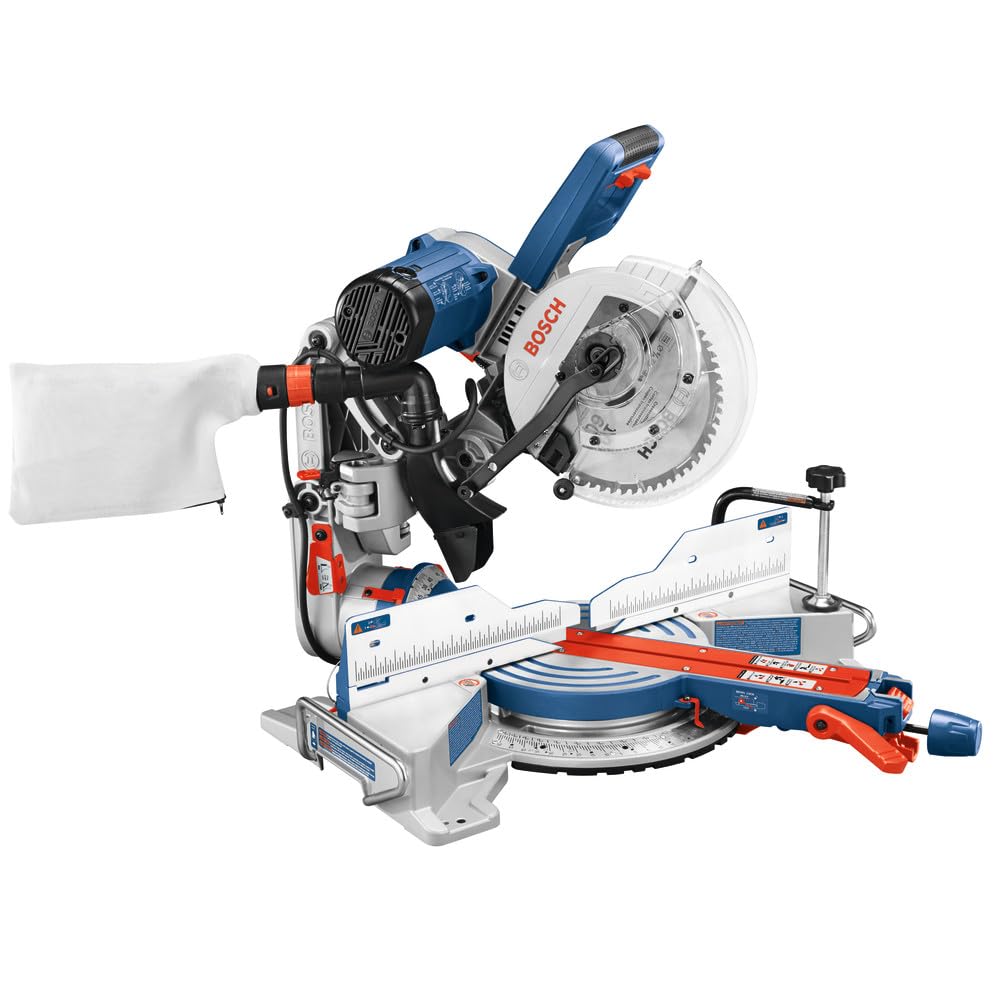
Sliding saws use rails that let the head travel forward and back, which adds cutting width but also adds depth behind the machine. Articulated hinge-arm designs replace those rails with pivoting arms, and the Bosch CM10GD trims its front-to-back footprint by up to 10 inches compared with slide saws of similar capacity. In a narrow garage, those 10 inches often decide whether the saw fits on the bench at all.
Check The Stops, Not The Angles
Every saw advertises a miter range. What matters more is where the stops lock. Positive detents (the preset notches that click into common angles) are what keep your 45s repeatable across a whole day of cuts. Nine positive stops at 15, 22.5, 30 and 45 degrees set up faster and hold those angles better than dialing in by eye.
Side-by-Side Comparison
| Model | Best For | Blade Size | Amperage | Weight | Amazon |
|---|---|---|---|---|---|
| BOSCH CM10GD★ Best Overall | Shop-based precision cutting | 10 in. | 15 A | 64 lb | Amazon |
| Metabo HPT C10FCG2Jobsite Ready | Jobsite portability on a budget | 10 in. | 15 A | 24.2 lb | Amazon |
| DEKOPRO 10-InchBudget Starter | Beginner garage projects | 10 in. | 13 A | 20.5 lb | Amazon |
| Genesis GMS1015LC | Laser-guided trim work | 10 in. | 15 A | — | Amazon |
| DOVAMAN DMS01A | Multi-material cutting | 10 in. | 15 A | 17 kg | Amazon |
| Delta S26-263L | Room-to-room home use | 10 in. | 15 A | 30 lb | Amazon |
| Makita LS1040 | Simple, durable crosscuts | 10 in. | 15 A | — | Amazon |
| DEWALT DWS716 | Baseboard and crown runs | 12 in. | 15 A | 48.3 lb | Amazon |
| Metabo HPT C12RSH3 | Dual-bevel sliding capacity | 12 in. | — | 53.6 lb | Amazon |
| Makita LS1019L | Wall-flush shop setup | 10 in. | — | 72.8 lb | Amazon |
| Festool KAPEX KS 120 | Finish carpentry precision | — | 13 A | 57.3 lb | Amazon |
Detailed Reviews
1. Bosch CM10GD 10-Inch Dual-Bevel Glide Miter Saw
Our pick — 4.5+★ from 650+ verified ratings; the strongest balance of quality and price.
The saw that slides without rails — and still keeps a bench-sized footprint
The Bosch CM10GD is the one to buy if your miter saw lives in a permanent spot and you want the cut to land square the moment you drop the head. Its 15-amp motor spins the 10-inch carbide blade at 4,800 no-load RPM, which is the working speed that keeps a wet pressure-treated board from bogging the motor down. What buyers keep coming back to is build quality above all — that is the single thing the review pages mention most, and it lines up with a 47-degree left and 47-degree right bevel range with detents at 0, 33.9 and 45 on both sides.
Where this saw separates itself from the pack is the Axial-Glide system. Instead of two long rails poking out the back, articulated hinge arms carry the head forward and back. Bosch rates the design to cut front-to-back footprint by up to 10 inches versus a slide saw of similar capacity. The trade you are making is weight: at 64 pounds it is a bench saw, not a truck saw. The 24.2-pound Metabo HPT C10FCG2 is a completely different animal to carry up a ladder.
Capacity is the reason trim carpenters gravitate here. The tall sliding fences measure 4-1/4 inches, and the saw cuts 12 inches horizontally, 5-1/2 inches of baseboard vertically against the fence, and 6 inches of crown nested at a 45 spring. Those are real cabinet-and-trim numbers, so a whole-room baseboard run is a single setup rather than a compromise. The bevel lock and range selector sit up front where your hand already is, so you are not reaching behind the saw to change angles mid-job.
What Earns It The Top Slot
- 15-amp motor at 4,800 RPM holds speed through thick stock without a stutter
- Axial-Glide arms cut front-to-back footprint by up to 10 inches versus rail saws
- 47° bevel both directions with repeatable detents at the common angles
- 12-inch horizontal, 5-1/2-inch vertical base and 6-inch nested crown capacity
Where It Costs You
- At 64 pounds it wants a fixed bench, not a truck bed
- Owners treat it as a long-term shop tool rather than a first saw
Built for the bench: Buy this if the saw has a home in your shop and you cut trim, crown and baseboard that has to line up on the first pass.
Pass if you carry it daily: The 64-pound frame is the honest reason to look at a lighter 10-inch saw instead.
2. Metabo HPT C10FCG2 10-Inch Compound Miter Saw
Twenty-four pounds, fifteen amps, and a five-year warranty — the truck-bed compromise
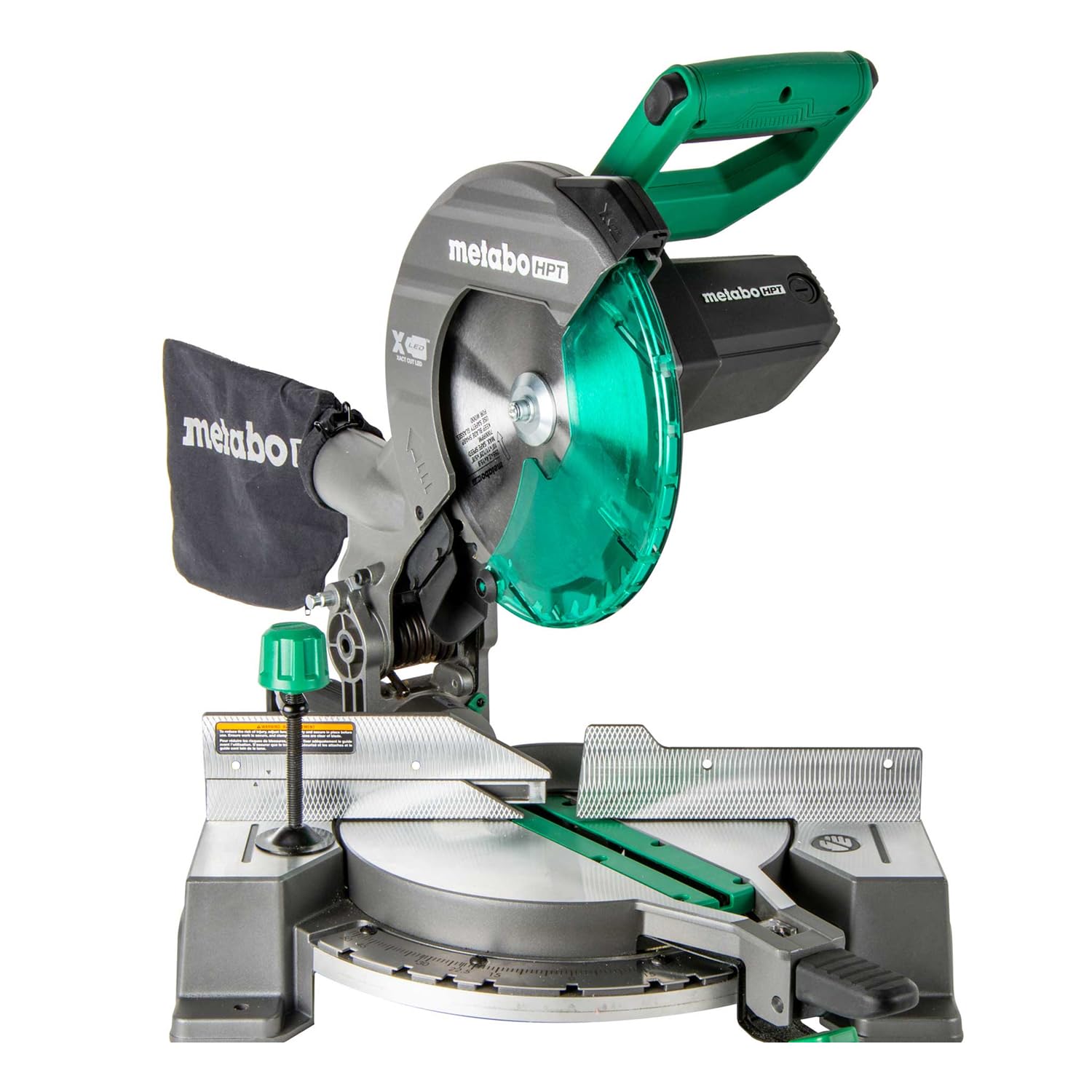
If you carry the saw to the work instead of the work to the saw, the Metabo HPT C10FCG2 is the value pick to beat. The 15-amp motor hits 5,000 no-load RPM and it weighs 24.2 pounds — light enough to lift onto a tailgate with one hand and heavy enough not to walk across the bench mid-cut. Its 0–52-degree miter range swivels left and right, and the bevel range runs 0–45 degrees to the left with adjustable stops so you can dial in a repeating angle instead of hunting for it each time.
What wins people over is quality for the tier. This is a saw that gets used on 4x4s and 2x6s and holds up, which is not a small claim for a saw this light. The large table supports longer stock better than the compact footprint suggests, and the vice clamp locks the workpiece down tight so your hand stays clear of the blade path. Metabo HPT backs it with a 5-year warranty, which matters more on a jobsite saw that gets thrown in and out of a truck bed all week.
Here is the honest limit: this is a single-bevel saw. You can tilt the head one way only, so any opposite-bevel cut means flipping the board or working around the machine. For straight crosscuts and 45-degree miters on trim it does the job cleanly. For repeated compound bevels on a finish job, the dual-bevel Bosch above is the better tool. That is a fit question, not a defect.
The carryability math: At 24.2 pounds against the Bosch’s 64, this is the saw you can actually own if every job starts with a flight of stairs.
The trade: Single-bevel head means opposite-side bevels require a board flip or a different setup.
Reach for this if: You need one saw that cuts trim on the jobsite and hangs on a garage wall when the job is done.
Look elsewhere if: Your day is full of compound bevels that need a tilt in both directions.
3. DEKOPRO 10-Inch Compound Miter Saw
The featherweight entry saw that makes a first 45-degree cut feel doable
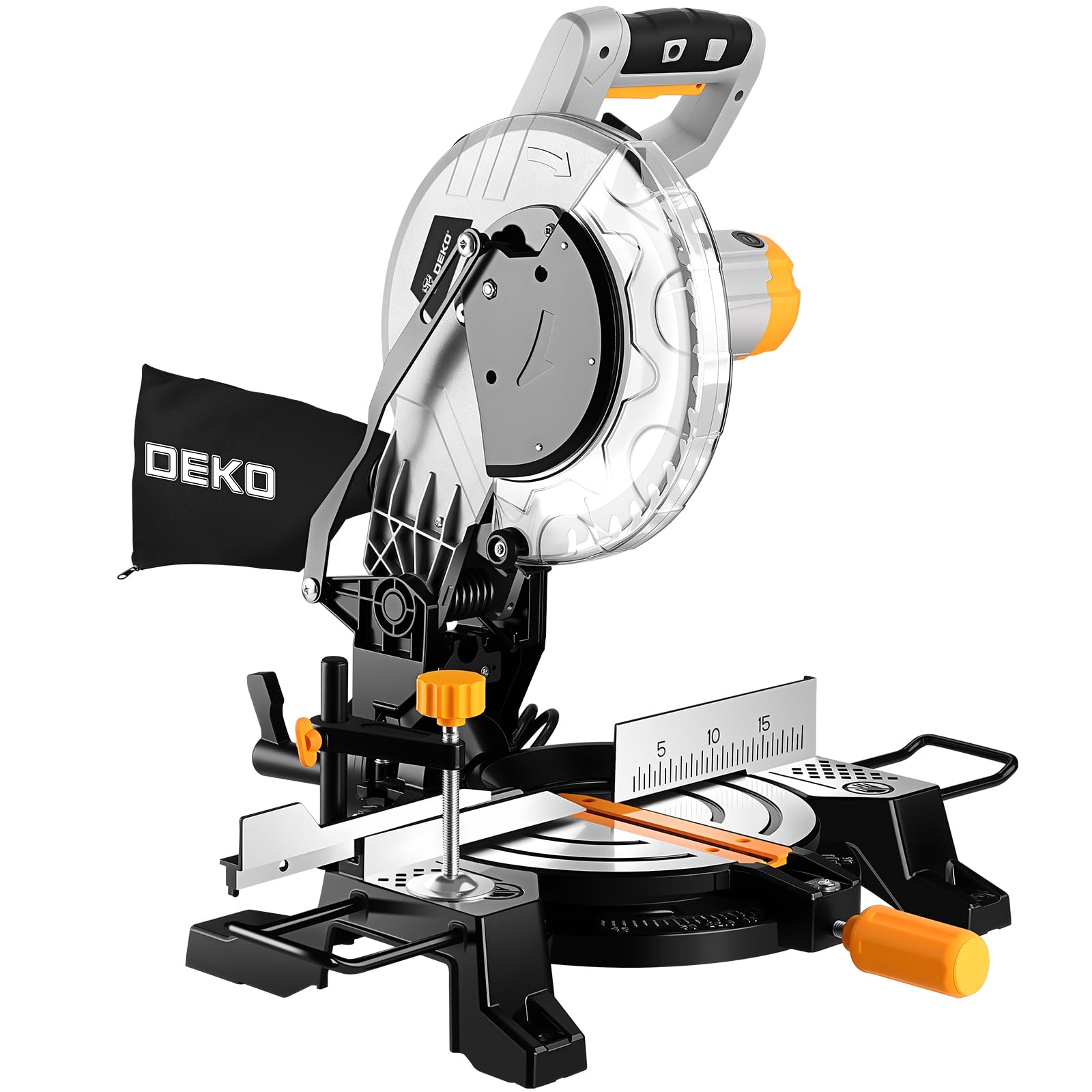
The DEKOPRO is a first saw, plain and simple, and it is built like one. A 13-amp motor at 5,000 RPM is the lightest motor in this group — the DOVAMAN runs a 15-amp motor in comparison — but for pine shelving, picture frames and laminate, 13 amps does the work. It weighs 20.5 pounds, the lightest saw in this guide, so storage and carrying are not a chore.
The cutting setup covers what a beginner actually needs. Bevel adjusts 0 to 45 degrees, the miter goes 45 degrees left and right, and the 40-tooth blade leaves a finer finish than a coarser blade would on trim. The large work table supports stock while the clamp holds it, and a transparent blade guard shows the cut line through the cut. The head locks down for storage, which matters if your saw lives in a garage corner rather than on a stand.
The trade-off is a smaller motor and a single-bevel head. Thick hardwood will slow it where more powerful saws keep speed, and you cannot tilt the head both ways. Go in expecting that and it is a sensible first power tool for pine, trim and laminate. Expect to spend a little time dialing in the angle stops before your first precision cut, because this class of saw rewards a patient setup.
What fits: A 13-amp motor, 40-tooth blade and 20.5-pound frame, sized for a garage workshop and weekend projects.
The honest limit: Single bevel only, and thick hardwood asks for more motor than this.
Right for a first saw: A reader who cuts trim, frames and laminates a few weekends a month and wants a light tool that stores easily.
Not for heavy stock: If you are regularly cutting thick hardwood, step up to a 15-amp saw.
4. Genesis GMS1015LC 15-Amp 10-Inch Compound Miter Saw

A laser on the cut line and a 60-tooth blade, aimed at trim and picture frames
Genesis takes a different angle on the entry saw: give buyers a fine blade and a visible cut line from the start. The 60-tooth carbide blade is the finest in this group — the DEKOPRO ships with a 40-tooth blade — so the cut left behind is smoother on molding and laminate. The 15-amp motor and 9 positive miter stops at the common angles cover the angles you actually use, and it bevels 45 degrees to the left for compound work.
The laser guide is the headline. It shows where the blade will land before you drop the head, which shortens setup on crown molding and shadow boxes where the line is hard to see. There is also an electric brake that stops the blade in seconds instead of letting it coast, and an arbor lock for quicker blade changes. For a home project saw, those are genuine conveniences that save real handling time on a run of cuts.
Be honest with yourself on the laser: several buyers report trouble getting it aligned exactly where they want it, and it will not sharpen for you if it drifts. Check the alignment against a square cut before you trust it on a finished face. A die-cast aluminum base keeps it portable at a manageable size — the saw measures 19.5 by 16.25 by 15 inches, noticeably more compact than the DOVAMAN’s 34 by 20 by 15. If the laser drifts, a pencil line and a test cut on scrap get you just as square.
Points In Its Favor
- 60-tooth carbide blade is the finest included blade in the group
- 9 positive miter stops lock in at the common angles
- Electric brake stops the blade in seconds and arbor lock speeds blade changes
Where It Asks For Attention
- Laser alignment takes patience before it matches the blade path
- Single-bevel head only, 45 degrees to the left
Worth a look if: Trim and picture-frame work is your focus and you want a fine blade and visible cut line right from the start.
Consider skipping if: A laser you have to re-check often would irritate you more than it helps.
5. DOVAMAN 10-Inch Sliding Miter Saw

Three blades, two speeds, and 13 inches of slide for the shop that cuts more than wood
Most miter saws are wood saws. The DOVAMAN is a sliding saw that lets you cut wood, PVC and soft metals, and it ships with three blades to make that possible — two 40-tooth and one 48-tooth tungsten-carbide blade. Its 15-amp motor gives you two cutting speeds: 5,000 RPM for wood and 3,200 RPM for PVC and soft metals. For a shop that installs fascia, trim and plastic, that is a real range of work in one frame.
The slide goes further than most here. A 13-inch sliding rail and extendable side tables open up to 4 by 13 inches of cut, which is enough for wide shelving boards and fence stock. It is ambidextrous, so left-handed and right-handed operators both work comfortably, and the laser guide marks the cut line for compound work. The quality is what owners come back to, and the multi-material versatility is the reason people pick it over a pure wood saw.
The recurring gripe is spin-up time — the motor takes a moment to reach full speed before you can cut. That is a real thing to know if you are churning through cuts on a deadline. It also weighs 17 kg, and its footprint of 34 by 20 by 15 inches is larger than a compact 10-inch saw. If your bench is tight, check the measurements against your space before you set it up.
The differentiator: A three-blade kit and a 5,000/3,200 RPM two-speed motor that covers wood, PVC and soft metals in one saw.
What to expect: Spin-up takes a beat, and it wants more bench depth than a compact 10-inch saw.
Best for mixed materials: Handy for the carpenter who also cuts PVC trim and light metal and does not want three separate saws.
Skip if speed is everything: If every second counts in your workflow, the slower spin-up will be noticeable.
6. Delta 10-Inch Compound Sliding Miter Saw

High RPM, a slide rail, and a weight light enough to work in a spare room
The Delta 10-inch sliding saw lands in the middle of this group with the fastest blade speed of any saw here: 5,500 RPM from its 15-amp motor. That speed translates to a cleaner cut on trim without the blade dragging. It weighs 29-1/2 pounds, so moving it between rooms or loading it into a car is a one-person job. The cord exits out the rear of the slide bar where the blade cannot reach it, which is the kind of small design detail you only notice when it is missing.
A sliding head means it cuts wider boards than a fixed 10-inch saw, and the bevel tilts 0 to 45 degrees to the left with a full-bevel cut capacity of a nominal 2 by 12. The spindle lock holds the arbor while you loosen the blade nut, which makes blade swaps straightforward. Those are solid specs for a home shop or a rental maintenance saw working through a room of baseboard.
The honest picture is a mixed one. Some owners mention it cuts dead straight while others find it wants more setup to stay accurate, so plan to check your square before a finished run. Reports of a plastic throat plate breaking on a first use point at the one part to treat carefully. None of that changes the fact that this is a reliable, easy-moving saw for home projects — it just asks for a careful first setup rather than a plug-and-go.
The speed edge: 5,500 RPM is the fastest blade speed in this comparison, and the 15-amp motor has reserve for trim stock.
The setup note: Accuracy depends on a careful initial square-check, and the throat plate deserves gentle handling.
Suits the home fixer: A homeowner who slides the saw between rooms and wants a wide sliding cut without a bench-mounted saw.
Not for a finish crew: If a whole house of crown depends on dead-on repeatability, a heavier dual-bevel saw is the safer call.
7. Makita LS1040 10-Inch Compound Miter Saw

The direct-drive crosscutter that trades features for years of repeatable cuts
The Makita LS1040 is a saw with a long service record, and it earns its place without a slide rail or a laser. Its 15-amp direct-drive motor runs at 4,600 RPM, and the dual-post compound pivoting arm is the structure that keeps the head stable through a cut. What sells it is cutting performance — the top praise on the review pages — with the included 40-tooth blade cutting clean and smooth right from the box. Nine positive miter stops at 15, 22.5, 30 and 45 degrees left and right, plus the 0-degree 90 cut, lock in the angles you repeat most.
This is a simple machine by design: fixed-head crosscuts and miters up to 45 degrees left and 52 degrees right, bevel 45 degrees to the left, and nothing more complicated than that. No slide rails, no dual bevel, no laser. What you get instead is a saw owners describe as taking abuse and keeping on cutting. For framing, decking, and trim where the same angle repeats all day, fewer moving parts is a real benefit rather than a missing feature.
The limit is capacity and finish. It has no slide, so wide boards beyond the fixed crosscut are out. It is single-bevel, so opposite-side tilts need a board flip. If you need to cut wide crown or a full 12-inch board in one pass, a sliding saw is the answer. If your work is standard stock and straight cuts, this is a durable tool that will outlast the job.
Where it shines: Direct-drive 15-amp motor and nine positive stops at the common angles, in a saw built for repeated cuts.
Where it ends: No slide, single bevel, so wide boards and opposite tilts are off the table.
Simple and steady wins here: Choose it if your work is standard-width stock, repeated angles and a saw that keeps running year after year.
Move on if: Wide crown and full-width boards in one pass are part of your day.
8. DEWALT DWS716 12-Inch Double-Bevel Compound Miter Saw

A 12-inch double-bevel built around baseboard runs, not around your garage shelf
The DEWALT DWS716 is the saw you buy when baseboard and crown molding are the main event. It runs a 12-inch carbide-tipped blade on a 15-amp motor, and the head bevels 0 to 48 degrees both left and right with positive stops at 0, 22.5, 33.9 and 45 — so you can make an opposite-side bevel cut without flipping the board. The stainless steel miter detent plate carries 14 positive stops, which is the repeatability that matters when every cut on a wall has to line up.
Capacity is the reason it is here. Tall sliding fences support crown molding up to 6-5/8 inches nested and base molding up to 6-1/2 inches vertically against the fence. The miter capacity runs 0 to 50 degrees left and right, and the cam-lock miter handle with detent override lets you swing to an angle fast and lock it. Owners who have trimmed whole rooms report cutting an entire room of baseboard on a first use, which is the kind of confidence you want from a trim saw.
The catch is setup feel. The adjustability draws mixed reactions, and some buyers find the angle handle and detents take more attention than they would like before they repeat exactly. At 48.3 pounds it is a bench saw rather than a grab-and-go tool, and the blade is 12-inch, so it wants a stand with real footprint. If your job is a whole house of trim, the capacity and double bevel justify the weight. For a few crosscuts a weekend, it is more saw than you need.
Why Trim Carpenters Like It
- 12-inch blade with 0–48° bevel in both directions
- 14-stop detent plate for repeatable angle settings
- Crown nests up to 6-5/8 inches and base sits 6-1/2 inches against the fence
What To Weigh First
- 48.3 pounds means it lives on a stand or bench
- Adjustability takes some attention before repeated angles settle in
Trim crew material: Built for a whole-room crown and baseboard job where both bevel directions get used in a single day.
Overkill for a hobbyist: If your saw rarely leaves the bench and cuts few boards, this much capacity and weight goes unused.
9. Metabo HPT C12RSH3 12-Inch Dual Bevel Sliding Miter Saw
A sliding 12-inch dual bevel that draws a shadow line where the blade will land
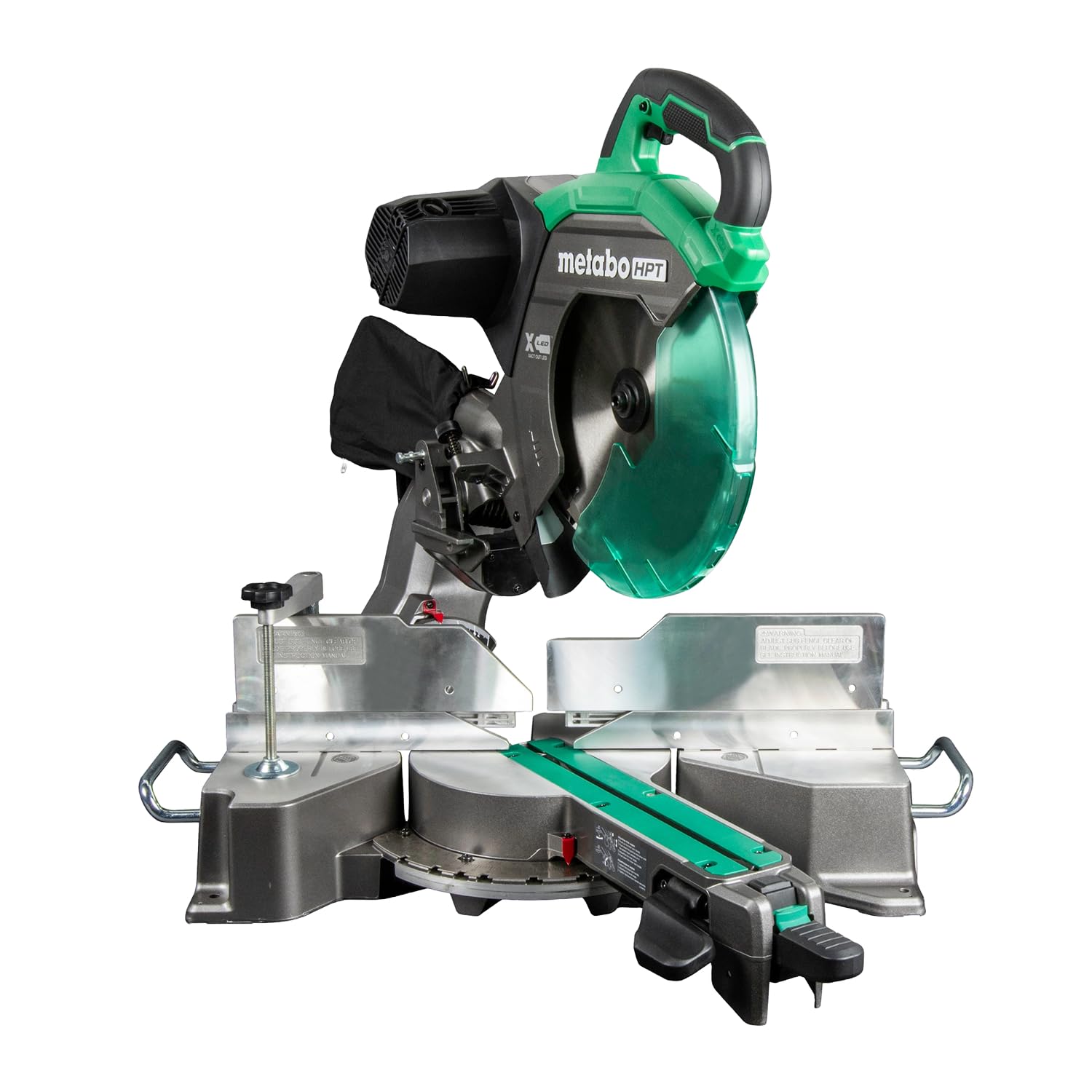
Metabo’s C12RSH3 pairs a 12-inch dual-bevel head with a sliding rail and a cut-line system that throws a shadow instead of a laser dot. That Xact Cut Shadow Line shows the exact width of material the blade will remove, which is clearer under any light than a thin laser line and does not need batteries or alignment. The head bevels 45 degrees both left and right with 9 miter detent stops, and the miter range runs 0–45 degrees left and 0–57 degrees right — the widest right-side range in this group.
The motor runs at 4,000 no-load RPM, and the one-touch bevel and miter locks let you swing to an angle and set it in a single motion. The construction feels solid, and owners liken the quality to high-grade tools at a more accessible tier. Sliding capacity means the 12-inch blade can crosscut wider stock than a fixed-head 12-inch saw, which is the reason to buy a slider in the first place.
The sliding mechanism is the honest caveat. Some buyers find the rail easy to move, others report it feeling stiff, so expect to check the slide travel and lube the rails on a new saw. It weighs 53.6 pounds, so it is not a carry-every-day tool. For a shop that wants a 12-inch dual-bevel slider with a clear, light-independent cut line, this is a solid, well-built machine that earns its keep.
Why the shadow wins: The Xact Cut Shadow Line shows the kerf width, so you see the whole cut under any light without a laser to align.
The rail question: Slide feel varies between units; check travel and keep the rails clean.
Good fit for: A shop that wants a 12-inch dual-bevel slider and prefers a shadow line to a laser.
Think twice if: You need to carry the saw single-handed — 53.6 pounds wants a stand.
10. Makita LS1019L 10-Inch Dual-Bevel Sliding Compound Miter Saw

A 10-inch slider that cuts crown like a 12-inch and parks flush against the wall
The Makita LS1019L is built around a single idea: get 12-inch cutting capacity out of a 10-inch blade without taking up a 12-inch saw’s space. It cuts crown molding up to 6-5/8 inches nested, the same capacity a 12-inch saw advertises, and its direct-drive gearbox and guard system push vertical cut capacity to 5-1/4 inches. The linear ball bearing slide system is engineered for dead-on accuracy, so the head travels on ball bearings rather than sliding on plain rails. The two-steel-rail design lets the saw sit flush against a wall, so you can work in a tighter shop than a rail-back slider allows.
The 10-inch blade with a 60-tooth count in the box is a finish blade, so trim and crown come off the saw clean. Performance is the thing that gets the most attention in the reviews — smooth operation, accuracy and dust collection all draw praise. A dust bag is included, and the saw’s structure is stable enough that a 12-inch-capacity crown cut does not walk. For finish carpentry in a compact shop, it is a strong answer.
The trade is weight and price tier. At 72.8 pounds it is the heaviest saw in this comparison, heavier than the 64-pound Bosch and the 48.3-pound DEWALT. It is also premium-priced, and owners split on whether the finish quality justifies the cost. Some find 45-degree bevel cuts need extra attention to dial in. If your bench is tight and your work is crown and trim, the wall-flush design and 6-5/8-inch crown capacity are the reasons to choose it. If you rarely cut wide crown, the capacity goes unused.
The Case For The LS1019L
- 6-5/8-inch nested crown capacity from a 10-inch blade
- Ball-bearing rail system built for dead-on accuracy
- Two-steel-rail design lets it park flush against a wall
- 60-tooth blade in the box for cleaner trim cuts
What You Pay For It
- 72.8 pounds — heaviest saw here
- Some 45-degree bevel cuts need extra alignment attention
The compact-shop specialist: Buy it if your bench is against a wall and crown molding up to 6-5/8 inches is part of your work.
Look past it if: You rarely cut wide crown, in which case a lighter 10-inch saw gives you more for the same bench.
11. Festool KAPEX KS 120 REB Sliding Compound Miter Saw

Dual lasers that show exactly what the blade will remove, in a rail-forward frame
The KAPEX KS 120 REB is the finish saw that does the small things right, and those small things add up on a cabinet or furniture job. Its rail-forward design carries the head on rails in front of the blade, which strengthens precision and keeps the footprint compact while preventing head play — the head wobble that throws off a fine cut. Two lasers, one on each side of the blade, clearly mark exactly the material the cut will remove, so you align on both edges of the kerf at once instead of one thin line.
The bevel adjusts with a micro-adjust up-front rotary knob, and the large bevel scale with fine pointers makes it easy to set a precise angle by sight rather than guesswork. That is a detail that matters on repeated compound cuts where a fraction of a degree compounds across a run. The dust hood behind the cut and a pivoting 36 mm hose pull dust extraction up to 91%, which keeps the cut line visible and the shop air cleaner while you work.
This is a premium tier saw, and the honest caveat is that many buyers find the cost hard to justify if a lesser saw does the same rough work. Its 13-amp motor is rated lower than the 15-amp saws here, so it is built for accuracy and finish rather than brute speed. It weighs 57.3 pounds and ships with a 3-year wear-and-tear warranty and a 1-month satisfaction guarantee. For cabinet and furniture work where the cut face is what people see, the precision and dust control are what you are buying.
The precision story: A rail-forward frame that prevents head play, dual lasers that frame both kerf edges, and dust extraction up to 91%.
The honest math: A 13-amp motor and a premium tier, so you are paying for finish quality, not raw cutting speed.
Finish work only, mostly: Choose it if cabinets and furniture are the job and a cut line you can trust at a glance is worth it.
Not for framing: For rough framing and speed-first work, a 15-amp saw delivers more motor for less.
Know the Specs
Amperage And RPM
Amperage measures how much current the motor draws — a rough proxy for how much cutting force it can sustain without bogging down in thick stock. A 15-amp motor generally holds its speed better in hard wood than a 13-amp motor. RPM is how fast the blade spins unloaded; more speed tends to leave a cleaner edge on trim, while lower speed suits PVC and soft metals that melt or smear at high heat. Think of amperage as the muscle and RPM as the blade’s pace — one handles a hard board, the other decides the finish.
Bevel Capacity And Miter Stops
Bevel is the side tilt of the blade head, and dualbevel means it tilts left and right; single bevel means one side only, so an opposite angle needs a board flip. Miter is the swivel of the head across the table, and a positive stop is a preset notch that locks the head at a common angle. More stops equal faster, more repeatable setups — a saw with nine or fourteen stops sets to 22.5, 33.9 or 45 degrees without dialing by eye. Buyers should count the stops before buying, because a stop that clicks firmly is a stop that keeps a whole trim run square.
Cut Capacity
Cut capacity is the size of board the saw can actually take. Horizontal capacity is how wide a board it crosscuts; vertical capacity is how tall a piece sits against the fence, which is exactly what baseboard and crown need. Nested crown capacity tells you how deep a molding the saw holds at an angle against the fence, so if you install crown, that figure is the number to shop by. A bigger blade or a sliding head widens those figures, but it also adds weight and bench depth, so match capacity to the boards you genuinely cut.
Slide Mechanism And Footprint
Sliding saws use rails that travel the head forward and back, which adds width to the cut but also depth behind the machine. Rail-forward and articulated-hinge designs keep that depth in front of or inside the saw so it can sit flush against a wall and fit a smaller bench. The Bosch’s Axial-Glide, for example, trims front-to-back footprint by up to 10 inches compared with rail saws of similar capacity. In a garage or a spare room, that saved depth is often the deciding factor between a saw that fits and one that does not.
Common Questions
What size miter saw do I need for baseboard and crown molding?
Is a dual bevel miter saw worth it over a single bevel?
Does a sliding miter saw cut wider boards than a fixed one?
How many amps do I need for cutting hardwood?
What does RPM mean on a miter saw and does higher RPM matter?
Can I cut PVC or soft metal with a wood miter saw?
Is a laser guide on a miter saw accurate enough to trust?
How much does a miter saw weigh and does weight matter?
What is nested crown capacity and why does it matter?
Do I need a work stand for a heavy miter saw?
The Bottom Line
For most buyers, the wood miter saw that gets it right is the Bosch CM10GD — a 15-amp motor at 4,800 RPM, dual bevel in both directions, and an Axial-Glide system that cuts bench depth by up to 10 inches versus rail saws of similar capacity. If trim travels with you, grab the Metabo HPT C10FCG2 at 24.2 pounds with a 5-year warranty. And if you cut PVC and soft metal alongside wood, the DOVAMAN with its three blades and two speeds is the one to reach for. If crown molding defines your work, the DEWALT DWS716 is the tool that takes the whole room.
How we choose
We do not accept paid placement. Every pick is matched to a real buyer and a real use-case; we do not hands-on test units.
Sources
Specifications: manufacturer listings and product documentation. Review insights: verified customer reviews, as of November 2026. Pricing: not shown on this page (it changes often); check the current price via the retailer link.
As an Amazon Associate, Tactical Gear Guy earns from qualifying purchases. This does not affect which products we feature.