Specs are compiled from manufacturer listings and verified buyer reviews and can change over time — please confirm the key details on the product page before buying.
The hard part of buying a yard tractor attachment is not picking a tool — it’s confirming the thing actually bolts onto your machine. A ripper with the wrong pin hole alignment, or a snow blade for a tractor series you don’t own, will sit in the shed all season. This guide sorts the nine most useful tractor-mounted attachments by what they genuinely do well, what they cost you in effort, and which machines they truly fit. The Titan hitch-mounted ripper sets the bar here at 4.5+ stars across 600+ ratings.
This guide is built by comparing the manufacturers’ published specifications and the patterns across verified customer reviews, so you get each pick’s real strengths and trade-offs instead of marketing spin.
Some implements loosen soil, some lift thatch, and some just move snow — and knowing which job you actually need done is half the decision. That’s why every pick below names the exact task it handles and the hitch setup it requires. If you want the short version, this breakdown of the Best Yard Tractor Attachments puts fitment first and marketing claims last.
Top Picks


How To Choose The Right Yard Tractor Attachment
Check your machine’s hitch before you shop for an implement. A three-point hitch (a Cat 0 or Cat 1 mount) works nothing like a simple 2-inch receiver or a pin-style tow bar, so the attachment you buy must match the hitch you own. Get that wrong and nothing else in this guide matters.
Confirm your hitch style before you buy anything
A Cat 0 or Cat 1 hitch is a three-point mounting system that lifts and holds an implement off the ground. A 2-inch receiver is the square sleeve on the back of an ATV or UTV, and a pin-style tow hitch is the simple clevis-and-pin setup most riding mowers use. Check which one your tractor carries before you fall for a tool.
Match the implement to the job you actually repeat
Dethatching, aerating, spreading, sweeping, and plowing are five different jobs, and each wants a different head. A spike aerator punches holes with solid tines, while a plug aerator pulls cores of soil out — the plug type is the one that removes material. Buy for the job you repeat every season, not the biggest head on the page.
Check working width against your lawn size
A wider pass means fewer trips up and down the yard. A 40-inch dethatcher and a 46-inch snow blade cover very different amounts of ground, and a wide spreader hopper means fewer refills on a large property. A 40-inch dethatcher suits a small suburban lot; on an acre, a 46-inch blade or 12-foot spread saves you hours.
Budget for ballast and assembly time
Several of these implements bite harder when you add weight — a weight tray rated for 140 or 150 pounds is a real spec, not a suggestion. And plan for assembly: some units go together in an hour, while others arrive as a full afternoon job that wants a second pair of hands and a clear patch of driveway.
Side-by-Side Comparison
| Model | Best For | Hitch / Mount | Working Width | Item Weight | Amazon |
|---|---|---|---|---|---|
| Titan Attachments Hitch-Mounted Ripper★ Best Overall | Digging trenches and ripping roots | 2″ receiver, Cat 0 & Cat 1 | Single tine | 21 lb | Amazon |
| Suchtale 40 Inch Tow Behind DethatcherBest Value | Lifting thatch from large lawns | Pin-style tow hitch | 40 in | 32.8 lb | Amazon |
| KUAFU 39.75″ Box ScraperMost Versatile | Leveling and moving gravel or snow | Hitch mount | 39.75 in | — | Amazon |
| Brinly SAT2-40BH-P Spike Aerator | Loosening compacted soil with weight | Tow behind | 40 in | — | Amazon |
| Agri-Fab Broadcast Spreader | Seed, fertilizer, and ice melt over big areas | Universal tow hitch | 10–12 ft spread | 29.4 lb | Amazon |
| Craftsman 42 in Snow Blade | Clearing driveways from the tractor seat | T1 / T2 / T3 series mount | 42 in | 79 lb | Amazon |
| Craftsman 40 Inch Plug Aerator | Pulling soil cores for deep aeration | Tow behind | 40 in | 78.8 lb | Amazon |
| Agri-Fab 44 In Lawn Sweeper | Hauling leaves and clippings off the lawn | Adjustable tow hitch | 44 in | 82 lb | Amazon |
| Arnold 46-Inch Snow Blade | Wide snow plowing on MTD-family tractors | MTD / Cub Cadet mount | 46 in | 30.7 lb | Amazon |
Detailed Reviews
1. Titan Attachments Hitch-Mounted Ripper
Our pick — 4.5+★ from 650+ verified ratings; the strongest balance of quality and price.
One steel tooth that turns a small tractor into a trenching machine.
This is the simplest tool on the list and the one that solves the most frustrating job: laying water lines, wires, or hoses without a shovel. The single tine cuts a narrow channel through compact soil, and at 21 pounds it is light enough to wrestle onto a receiver by yourself. It hangs off a standard 2-inch hitch and also mounts to Cat 0 and Cat 1 three-point setups, so it follows you across an ATV, a UTV, or a compact tractor.
The digging depth is set by two positions — 14.25 inches or 16.25 inches measured from the center of the hitch to the tip of the ripper. That is the difference between a shallow cable run and a proper line trench, and you pick it before you start. The working end is a reversible carbon steel tooth on a replaceable shank (the replacement part number is 191419), so a worn tip doesn’t retire the whole tool. A shear bolt is the safety valve here: hit a hidden rock and the bolt gives before your machine does.
What wins people over is the build — the powder-coated steel and quality welding, plus 3 inches of steel past the pin hole so the mount seats without wobbling. The honest catch is the pin hole. On some hitches the hole simply doesn’t line up without persuasion, and that alignment gripe is the most common complaint in the reviews. It’s a fit issue, not a strength issue, and a few minutes with a file usually settles it.
Where it earns its keep
- Works on 2-inch receivers plus Cat 0 and Cat 1 three-point hitches
- Reversible carbon steel tooth is replaceable instead of throwaway
- Shear bolt protects the attachment and the machine on hidden rocks
- 21 lb — light enough for one person to mount
What to plan around
- Pin hole alignment can fight you on some receivers
- Single tine means one narrow pass at a time
- Best in soft-to-moderate soil; rock-heavy ground will trip the shear bolt
Reach for this if: you need trenches for lines, hoses, or wiring and already have a receiver or three-point hitch.
Look elsewhere if: your ground is packed with buried rock — you’ll be swapping shear bolts more than digging.
2. Suchtale 40 Inch Tow Behind Lawn Dethatcher
Twenty flexing tines that drag dead thatch out of a lawn in a single afternoon.
If your grass feels spongy underfoot and refuses to green up, thatch is usually the culprit — a matted layer of dead stems sitting between the soil and the sun. This dethatcher drags 20 heat-treated spring steel tines across the lawn to lift that mat so air, water, and fertilizer can reach the roots again. The tines flex as they go, which is what keeps them from digging in and stalling.
Two numbers make it a serious tool. The 40-inch working width means one pass covers a wide swath, so a big yard takes far fewer trips. And the 70-pound ballast platform lets you stack weight on top to force better tine contact in thick, springy turf. Compare that to the Titan ripper’s 21 pounds — this thing is a different class of load at 32.8 pounds, and you feel that when you lift it onto the hitch. The pin-style hitch connects to compatible riding mowers and ATVs, and a transport handle raises the tines for moving and for hanging it up.
The rust-resistant tines are replaceable, which matters because tines are the wear part on any dethatcher. Buyers report the 20 spring tines pull up dead grass and thatch in a single pass. Just budget for the drag: with weight on the platform, wet thatch, and a long pass, your mower knows it’s back there.
The one honest test: a dethatcher only works if its tines (the metal teeth that rake the lawn) actually reach the soil. That is why the 70 lb platform exists: on thin turf you need extra weight, and on thick turf you need a slower pass.
Own it if: your lawn has built up thatch and you want a tow-behind pass rather than a weekend with a rake.
Think twice if: your mower is a light-duty model — 32.8 lb plus ballast is a real load to pull.
3. KUAFU 39.75″ Box Scraper
A box blade that levels gravel one day and pushes snow the next.
This is the implement for people who move material rather than dig holes. The 39.75-inch working width means each pass shifts more gravel, mud, or snow, so a driveway grade or a backfill job takes fewer trips. The pan design collects material and drags it level instead of just skimming the surface.
The flexibility is the selling point. Pull the side panels off and it becomes a straight blade; the scarifier rod also comes out, so you can loosen hard ground before smoothing it. The scraper locks at 30 degrees in either direction, which lets you cast material to one side as you work. It mounts to most UTV and ATV setups and to lawn tractor attachments that accept a box blade, and assembly is straightforward — screw, pin shaft, and a manual to follow.
The frame is powder-coated heavy-duty steel, built for construction and landscaping abuse. But this is a lighter-duty unit, and owners say so: it handles light, straight-line work well, and a few find the teeth bend quickly under hard use. That’s a signal to match the tool to the job — grading and backfilling, yes; ripping virgin hardpan, no.
Fit note worth reading twice: the mixed feedback on durability isn’t a reason to skip it — it’s a reason to keep it in leveling and light grading duty instead of treating it like a full-size box blade.
The right call for: gravel driveways, backfill, and snow pushing where a leveling pan does the work.
Wrong call for: breaking new ground in rock-hard soil — the teeth and the light build are the weak link there.
4. Brinly SAT2-40BH-P Tow Behind Spike Aerator

Eleven spiked stars that punch holes in hard ground and roll over pavement when you need them to.
Compacted soil sheds water instead of drinking it, and this aerator is the fix. It runs 11 tine stars, each 8 inches in diameter, with 12 spike tips per star. Those tips push up to 2 inches into the soil so water, seed, and nutrients can get down to the roots. The math is simple: more spikes rolling across the ground means more openings per pass.
What makes it work on tough lawns is the weight tray — a rigid platform that takes up to 150 pounds of extra ballast for deeper penetration in hard soil. The tines themselves are Brinly’s 3-D galvanized steel design, which resists bending and rust even in compacted ground. Underneath, a 5/8-inch solid steel axle and nylon spacers between each star carry the load, and the double tow bar stiffens the whole frame.
The single-lever transport wheels are the touch that saves your back — flip them down and you roll across the driveway and sidewalk instead of dragging spikes over concrete. The catch is assembly. Some owners put it together easily, others find the steps confusing, so give yourself space and read the diagram twice. Prices and hardware aside, the tines are the sharpest part; keep kids and bare feet clear of the tray.
Why the tray matters: a spike aerator without weight barely scratches the surface, and 150 lb of ballast is what turns this from a lawn ornament into a soil-loosening tool.
Get this one if: your soil is compacted and you want aeration without pulling cores out of the lawn.
Skip the tray at your peril: run it dry and the spikes just tickle the turf.
5. Agri-Fab Pull Behind Broadcast Spreader
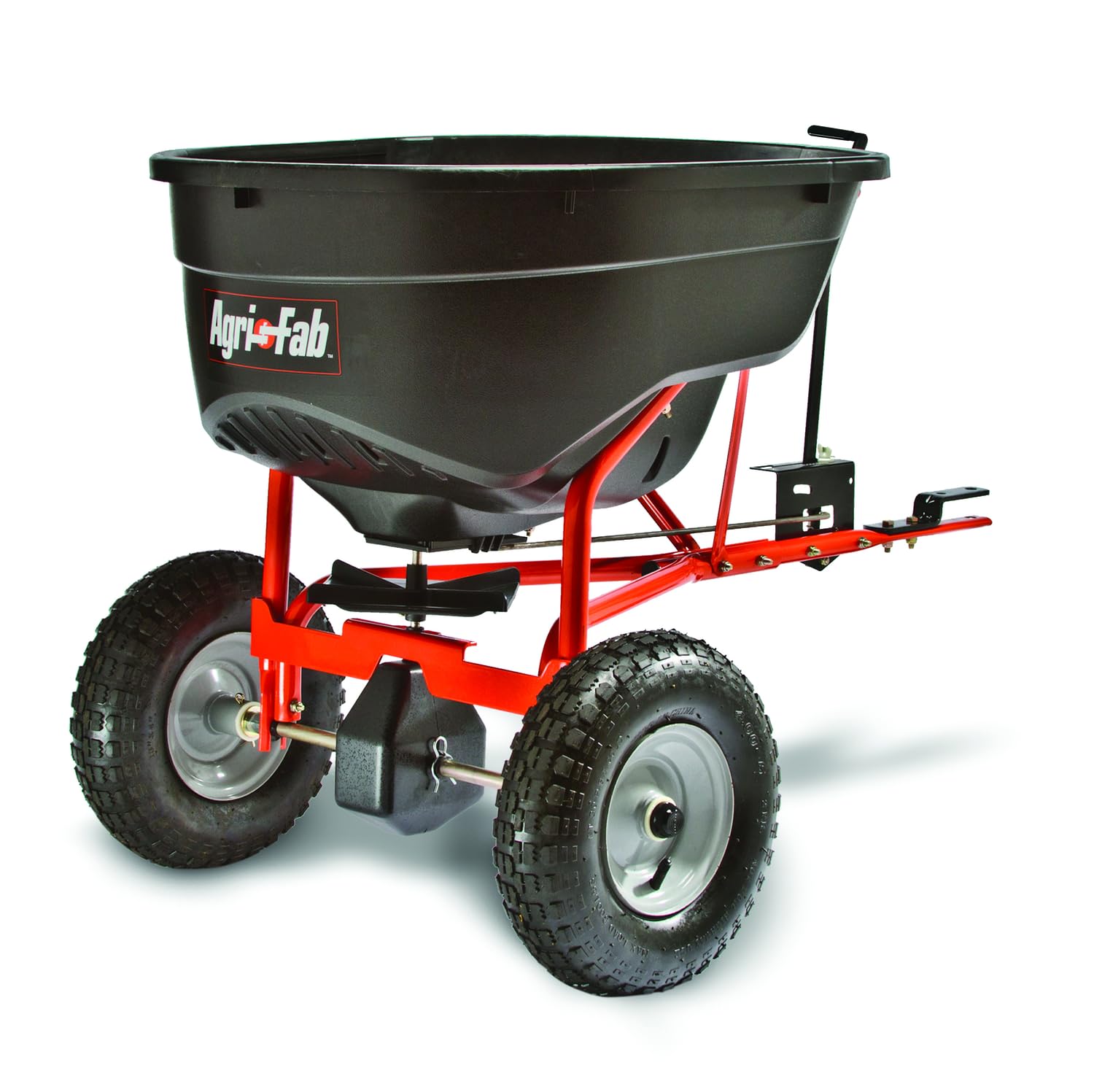
Half an acre of fertilizer in one hopper load, then roll it over for ice melt.
The hopper is the headline: 130 pounds of seed, fertilizer, salt, or ice melt goes in, and it covers up to 1/2 acre — about 25,000 square feet — before you refill. That capacity is what separates a real spreader from a hand-crank toy on a large property. The spread width runs 10 to 12 feet, so each pass treats a wide band of lawn and you spend less time crisscrossing.
Fitment is the other win. The universal hitch connects to most riding mowers and lawn tractors, including Craftsman, Husqvarna, and Cub Cadet models. The frame is 1-inch steel tubing with an enclosed gear house, a poly hopper that won’t rust, a spreader plate, and 13-inch by 4-inch pneumatic tires for rolling over uneven ground. At 29.4 pounds it’s a modest lift onto the hitch.
The parts that get mixed reviews are the ones to understand going in. The gear box is the occasional failure point on some units, and the assembly instructions are the repeat frustration — some buyers sail through, others find them thin. The payoff is a spreader owners rate as holding steady over bumpy ground.
The case for it
- 130 lb hopper covers up to 1/2 acre with fewer refills
- 10–12 ft spread width for fewer passes
- Universal hitch fits Craftsman, Husqvarna, Cub Cadet and more
- 1-inch steel tubing and pneumatic tires built for uneven ground
The honest caveats
- Gear box is the occasional weak point on some units
- Assembly instructions divide opinion — some find them thin
- Salt and ice melt should be cleaned out after use to protect the mechanism
Built for: anyone feeding seed or fertilizer across a half-acre or more who wants fewer trips and wider coverage.
Hesitate if: you want a spreader that ignores instruction manuals — this one rewards patience during setup.
6. Craftsman 42 in Snow Blade for Lawn Tractors

Clear the driveway without once climbing off the tractor seat.
Coming inside after an hour of pushing a shovel is the job this blade replaces. The 42-inch-wide, 14-inch-high steel blade clears sidewalks, driveways, and paths during snowfalls up to 8 inches deep, and it angles left, center, or right to throw snow where you want it. That angle adjustment is what makes plowing feel like driving instead of wrestling.
The seat operation is the real luxury. You raise, lower, and angle the blade from the seat, so a long driveway becomes a series of passes rather than a stop-and-dismount every hundred feet. It mounts to Craftsman T1, T2, and T3 series mowers. The construction is 13-gauge steel with a replaceable scraper blade — a wear part that’s cheap to swap instead of a whole new plow. A single adjustable trip spring lets the blade ride up and over hidden obstacles like a raised curb or a buried paver.
Fair warning on setup: this is the project in the list where assembly can genuinely take a weekend and two people. Instructions divide people, and some units arrive with a part short. Factor that in before the first snow, not the morning after.
What the specs buy you: a 42 in steel blade with seat controls lets one operator clear a deep driveway without leaving the tractor. The trip spring (a safety spring that lets the blade fold back on impact) keeps a hidden curb from ending the season early.
The fit for: Craftsman T1/T2/T3 owners in snow country who want to plow from the seat.
Not the fit for: anyone expecting a same-day bolt-on — budget assembly time and a helper.
7. Craftsman 40 Inch Tow Behind Lawn Plug Aerator

Twenty-four hollow tines that pull actual soil plugs instead of just poking holes.
Here’s the difference a serious lawn person cares about: a spike aerator pushes soil aside, while a plug aerator pulls cores out and leaves them on the surface. This one runs 24 galvanized steel coring points that pull plugs up to 3 inches deep. That opens channels for airflow, water, and nutrients to get down into compacted ground before a spring or fall seeding.
A wide weight tray takes up to 140 pounds of ballast, and that weight is what drives the tines down in tough soil. The 40-inch working width covers ground efficiently, flat-free tires roll reliably across lawn terrain, and it hitches to most lawn and garden tractors. A lift handle makes transport easier, and the whole thing stores vertically against a wall — a real convenience if your shed is already tight.
Owners rate the 24 coring points as good value and expect the galvanized tines to survive repeated passes. Assembly is the usual mixed bag: some find it fairly easy, others say the instructions are unclear. It’s a 78.8-pound unit, so plan the build on a flat surface with room to spread the parts.
The plug-vs-spike call: if your goal is opening up hard soil before overseeding, pulling cores out does more than pushing holes in — that’s the whole reason to pick this over the Brinly spike aerator above.
Choose it for: pre-seeding prep and compacted lawns where you want cores removed, not just dimpled.
Know before you buy: it leaves plugs on the lawn to break down — expect a messy-looking yard for a while.
8. Agri-Fab 44 In Tow-Behind Lawn Sweeper
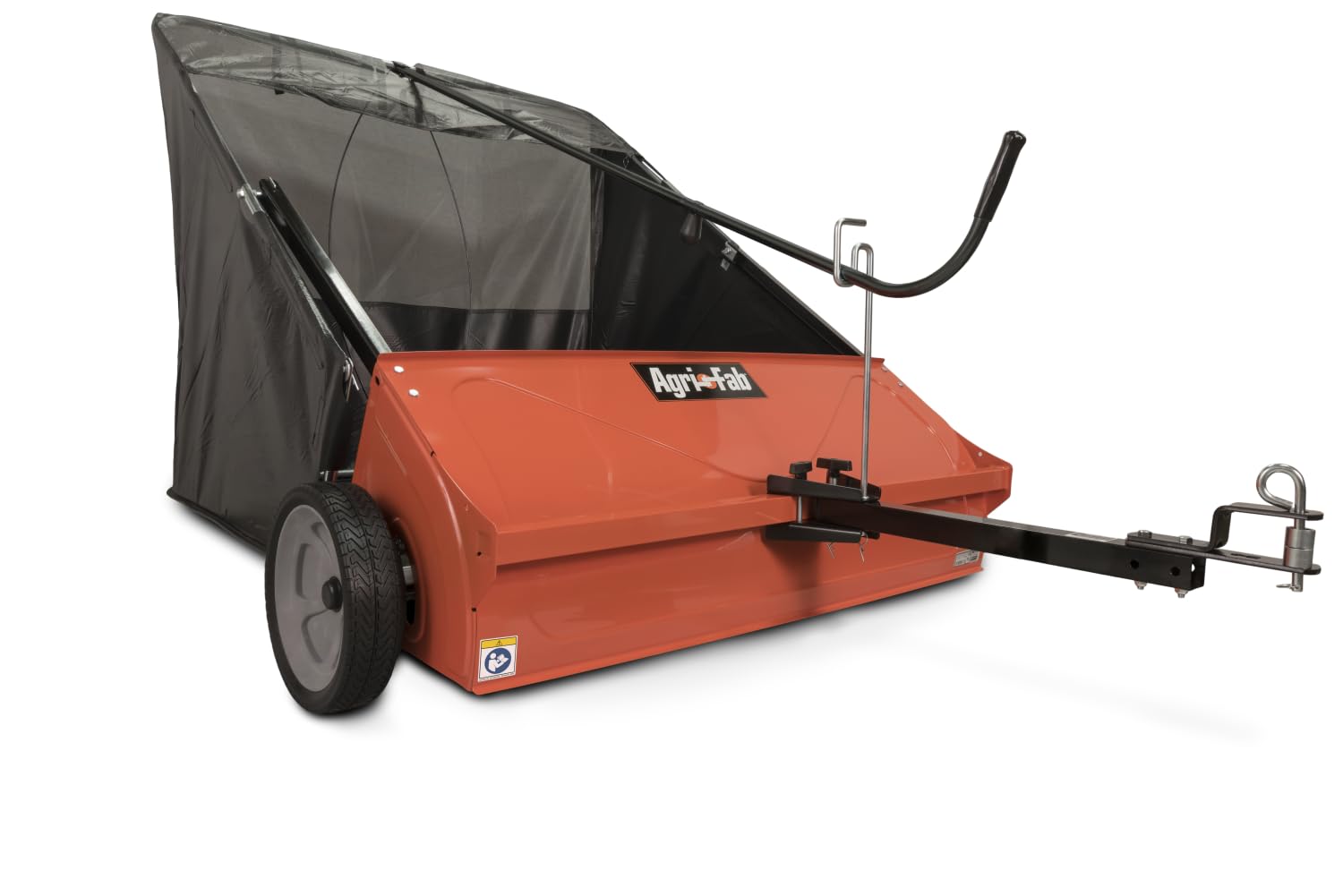
A 28 cubic-foot bag that swallows leaves and clippings and empties without you standing up.
Fall cleanup is where a sweeper earns its place, and this one is built around capacity. The 28 cubic-foot flow-through hopper fills from back to front, so you don’t get a false “full” signal when the front edge loads up. That volume is roughly twice what a traditional 3-bin bagger holds, which means fewer stops to dump. It picks up grass clippings, leaves, and pinecones.
The sweeping action comes from a 5.6-to-1 brush-to-wheel ratio plus adjustable brush height, so the brushes turn faster than the wheels and stay in contact across uneven lawns. The 44-inch width covers ground quickly, and 12-inch by 3-inch tires roll over terrain with bronze brush shaft bushings for durability. The dump-from-seat handle lets you empty the bag without climbing off, and the adjustable hitch lets you dial in the tow position.
The mixed note is build feel — some find it solidly built, others describe it as lighter than expected, and assembly ranges from easy to tricky. At 82 pounds it’s the heaviest piece here, so set it up with room and a second set of hands. Treat the hopper as a debris bag, not a cargo hold, and it does its job.
Where it earns its place: 28 cu ft of flow-through capacity plus a seat-mounted dump handle is a combination aimed squarely at big leaf drops, not small touch-ups.
Worth it if: you have mature trees and want to sweep leaves off a large lawn from the seat of your tractor.
Overkill if: your yard is small — a 44-inch sweeper with a 28 cu ft bag wants space to justify itself.
9. Arnold 46-Inch Snow Blade Attachment
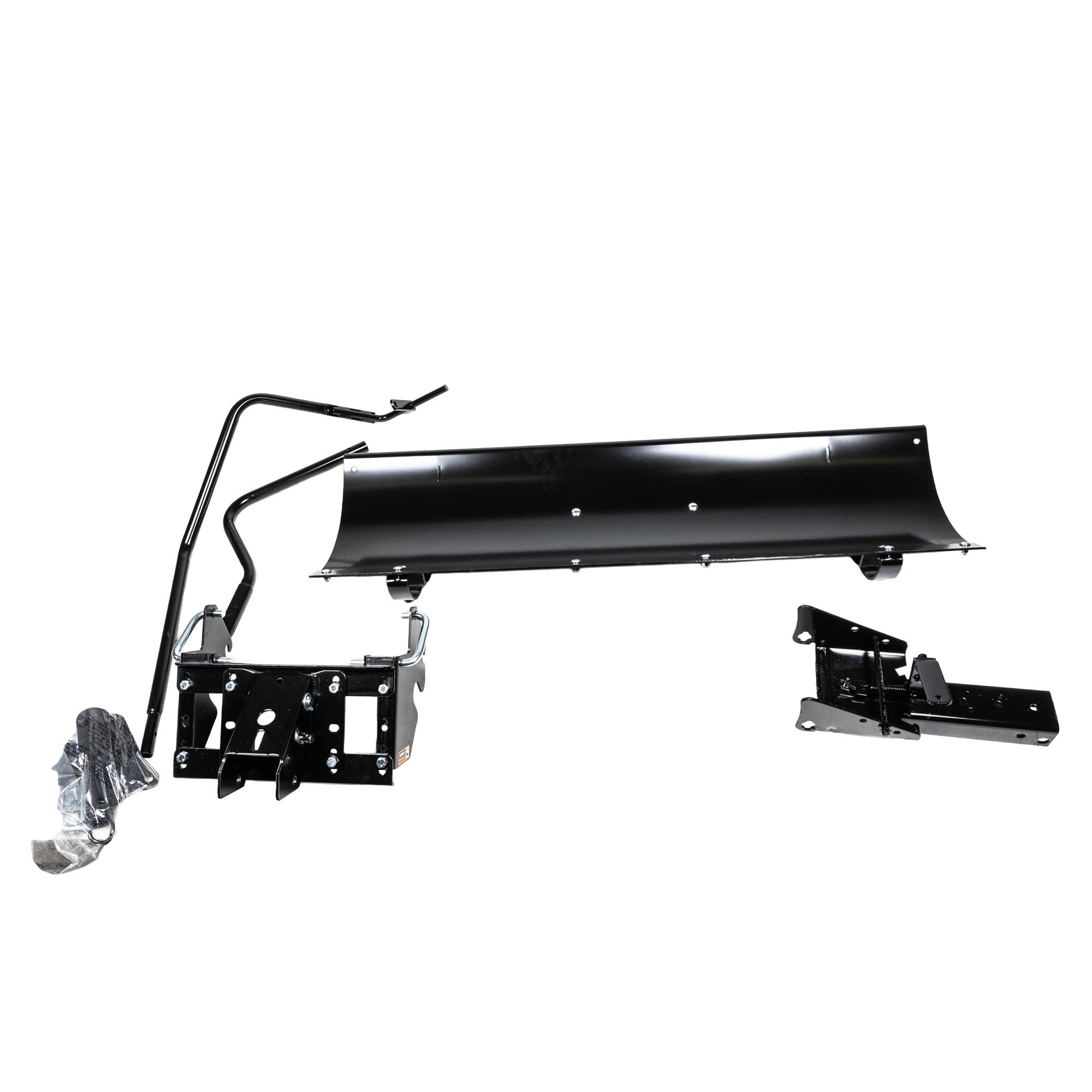
The widest blade here, and the one that drops onto MTD-family tractors with minimal fuss.
At 46 inches of clearing width, this blade beats the 42-inch Craftsman on paper for covering ground per pass — and installation is where it pulls ahead for the right machine. It fits Troy-Bilt, Bolens, Yard Machines, Huskee, and MTD Gold riding mowers from 2001 and newer, plus Cub Cadet XT-1 and XT-2 Enduro Series and Series 1000 and 1500 LT, GT, and LTX tractors. If you own one of those, the fit is the reason to buy it.
The blade angles from straight ahead to 25 degrees left or right for quick-change direction. Adjustable skid shoes let it work on different terrain, including gravel driveways, and the spring-loaded blade return protects the blade and the tractor when it hits something solid. At 30.7 pounds it’s one of the lighter blades here and simpler to hang and store.
Owners praise how easily it installs on Cub Cadet XT-1 and XT-2 machines. The catch is the lift — the blade is described as less sturdy when you’re raising it, so smooth control beats force. Some units also arrive short a part, and the instructions are the weak spot. Check your model number against the list before ordering, because the compatibility is the entire ballgame.
What makes it easy
- 46-inch clearing width for wide passes
- Fits Troy-Bilt, Bolens, Yard Machines, Huskee, MTD Gold and Cub Cadet XT-1/XT-2
- Spring-loaded blade return protects blade and tractor
- Angles 25 degrees left or right for controlled throwing
What to watch
- Feels less sturdy when lifting the blade — use smooth control
- Instructions are the weak point; some units arrive short a part
- Only fits the specific model families listed, so verify yours first
Built for: Troy-Bilt, Bolens, Yard Machines, MTD Gold, and Cub Cadet XT owners who want a wide, easy-install snow blade.
Check twice if: your tractor isn’t on the compatibility list — this blade is only as good as its fit.
Know the Specs
Hitch Type and Fitment
The hitch is how the attachment connects to your machine, and it is the one spec that decides whether the tool works for you at all. A 2-inch receiver is the square sleeve on an ATV or UTV. A Cat 0 or Cat 1 hitch is a three-point mount on a compact tractor. A pin-style tow hitch is the simple clevis (a U-shaped metal loop) most riding mowers use. A universal hitch is designed to fit many mower brands, while a model-specific mount only works on named series. Always confirm your hitch before anything else.
Working Width
Working width is the swath the attachment covers in one pass — a 40-inch dethatcher, a 46-inch snow blade, a 10-to-12-foot spread pattern. Wider means fewer passes and less time, which matters more the bigger your property gets. On a small lot, a narrower tool is easier to maneuver around beds and fences.
Weight Tray and Ballast
Soil implements need weight to bite — a tray rated for 140 or 150 pounds of ballast drives the tines or spikes into packed ground. Without ballast, a spike aerator just skims the surface. The trade-off is that extra weight makes the unit heavier to lift and pull, so keep your tractor’s capability in mind.
Spike vs Plug Aeration
Spike tines push soil aside to make holes; plug tines pull cores of soil out. Both open the lawn, but plugs remove material and leave it on the surface to break down, while spikes leave a cleaner finish. Match the method to your goal — pre-seeding prep usually favors pulling cores.
Common Questions
Will a Cat 1 hitch attachment fit my Cat 0 tractor?
Do I need a 2-inch receiver or a three-point hitch for a ripper?
What’s the difference between a spike aerator and a plug aerator?
How much weight should I add to an aerator’s weight tray?
Will a Craftsman snow blade fit a non-Craftsman tractor?
How long does it take to assemble these attachments?
Can a lawn sweeper pick up pinecones and pine needles?
What does a 12-foot spread width mean for fertilizer coverage?
Do these attachments work on a small yard or only large properties?
Should I clean my spreader after using ice melt?
The Bottom Line
For most people shopping for yard tractor attachments, the winner is the Titan Attachments Hitch-Mounted Ripper. It fits a 2-inch receiver plus Cat 0 and Cat 1 hitches, runs a reversible carbon steel tooth with a protective shear bolt (a bolt that snaps to protect the tooth from overload), and weighs just 21 pounds. That combination of hitch flexibility, a replaceable tooth, and a 21-pound frame is what 600+ owners have rated 4.5+ stars. If your lawn needs thatch lifted, grab the Suchtale 40 Inch Dethatcher and use its 70-pound ballast platform. And for clearing compacted soil before seeding, the Craftsman 40 Inch Plug Aerator pulls cores up to 3 inches deep with 24 galvanized points.
How we choose
We do not accept paid placement. Every pick is matched to a real buyer and a real use-case; we do not hands-on test units.
Sources
Specifications: manufacturer listings and product documentation. Review insights: verified customer reviews, as of November 2026. Pricing: not shown on this page (it changes often); check the current price via the retailer link.
As an Amazon Associate, Tactical Gear Guy earns from qualifying purchases. This does not affect which products we feature.