Specs are compiled from manufacturer listings and verified buyer reviews and can change over time — please confirm the key details on the product page before buying.
Buying a bench vise is really one decision: how hard are you going to lean on it? A bench vise is only as good as the load you put on it. If your work is furniture assembly, small brackets and the occasional pipe, a mid-size vise is plenty. If you bend, hammer, and torque steel every weekend, you want one whose casting will not crack when you put a cheater bar on the handle. This guide separates the high-PSI castings from the light-duty bodies and ranks each vise by jaw width, jaw opening, and throat depth — the three measurements that decide what actually fits between the jaws.
This guide is built by comparing the manufacturers’ published specifications and the patterns across verified customer reviews, so you get each pick’s real strengths and trade-offs instead of marketing spin.
What follows is a plain-English walkthrough of nine real vises, each matched to the jobs it does best, sorted by casting strength and jaw size.
Top Picks

How To Choose The Best Workshop Bench Vise
The mistake most first-time buyers make is shopping by jaw width alone. A wide jaw with a shallow throat cannot hold a deep bracket, and a strong casting with a weak swivel base will twist under load. Four numbers decide nearly everything: jaw width, jaw opening, throat depth, and tensile strength. Check those four numbers on any vise and you can rank it against the rest of the shelf in a minute.
Jaw width, jaw opening, and throat depth are three different measurements
Jaw width is the length of the gripping plates — the widest flat object the vise can bite across. Jaw opening is how far the front jaw travels away from the back jaw, so it sets the thickness of the piece you can clamp. Throat depth runs from the jaw faces back into the body; it tells you how deep a piece can sit before the vise body gets in the way. A vise with a 6-inch jaw and a 3-3/4-inch throat swallows a deep bracket that a shallow 2-1/2-inch throat model simply cannot seat.
Ductile iron versus grey cast iron
Ductile iron bends before it cracks, which is why vice bodies are cast from it. Grey iron is harder and more brittle. For light assembly either casting holds up, but if you hammer, press, or torque, ductile iron bends where grey iron cracks. Tensile strength (measured in PSI, or pounds per square inch) is the number that says how much pull the casting survives before failure — a higher number means the body shrugs off abuse that would ruin a weaker casting.
Swivel base, rotating head, or neither
A swivel base rotates the whole vise on the bench so you can angle the jaws toward you. A rotating head pivots just the front jaw assembly, so you can turn the work without shifting the whole body. Multi-axis vises do both. The catch is that every extra joint is another locking point that must be tight — if a swivel base is not locked down firmly, the vise rocks under a hard cut.
Match the mounting style to your bench
Most full-size vises bolt through the bench into a solid top with lag screws or through-bolts. A clamp-on model hangs off the edge and can be moved. If you work from a rolling cart or a temporary bench, a clamp-on vise makes more sense. On a permanent bench, bolt-down wins — through-bolted to a solid top, the vise will not shift when you lean into a cut.
Side-by-Side Comparison
| Model | Best For | Jaw Width | Throat Depth | Tensile Strength | Amazon |
|---|---|---|---|---|---|
| Yost Vises 760-DI★ Best Overall | Multi-axis workholding | 6″ | 4.31″ | 60,000 PSI | Amazon |
| PONY 6 Inch Heavy DutyBest Value | Tight benches and big clamping force | 6″ | — | 6,000 PSI | Amazon |
| IRWIN 5-Inch (4935505)Home Shop Staple | Home shop all-rounder | 5″ | — | — | Amazon |
| IRWIN 6-Inch (4935506) | Wood and metal mechanics work | 6″ | 2 1/2″ | — | Amazon |
| Wilton 6″ Apprentice | Apprentices and training benches | 6″ | 3-3/4″ | 72,000 PSI | Amazon |
| Wilton 674U Utility | Compact bench with pipe jaws | 4-1/2″ | 2-5/8″ | — | Amazon |
| Forward DT150B | Rotating head for complex work | 6″ | 2 5/8″ | — | Amazon |
| Wilton 450P Multi-Purpose | General workholding at height | 4-1/2″ | 2-1/4″ | — | Amazon |
| Yost Vises ADI-6 | Industrial abuse on a budget | 6″ | — | 130,000 PSI | Amazon |
Detailed Reviews
1. Yost Vises 760-DI Multi-Jaw Rotating Vise
Our pick — 4.5+★ from 900+ verified ratings; the strongest balance of quality and price.
Two axes of rotation, three jaw sets, and a casting that shuts up and clamps.
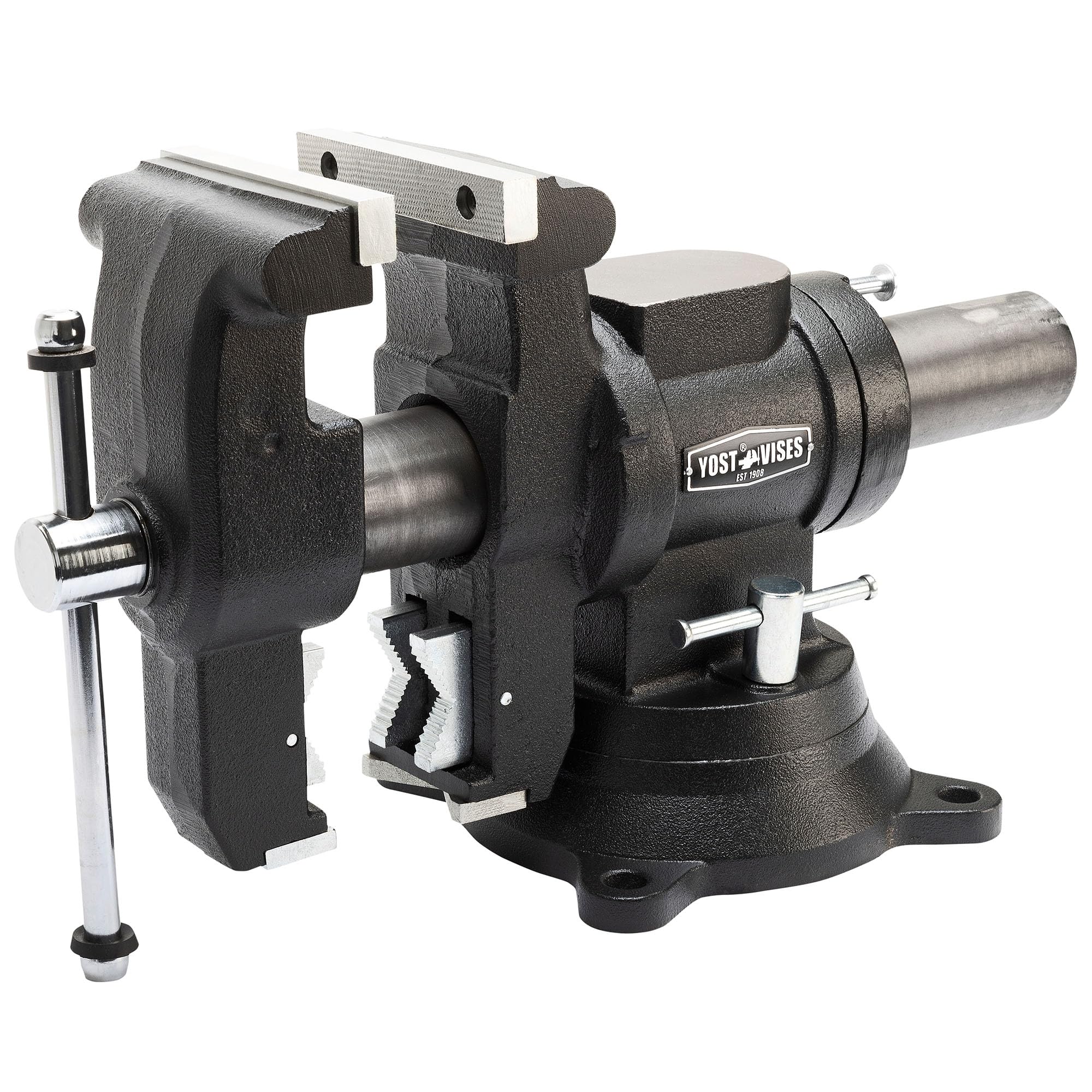
The Yost 760-DI earns the top slot on one thing: it gives you the most workholding positions of anything here. The jaw width is 6 inches, the opening is 5.90 inches, and the throat depth is 4.31 inches — deeper than most of its neighbours by a wide margin. It is cast from ductile iron rated 60,000 PSI, and it weighs 75.8 lbs, so you are bolting something substantial to the bench.
The head is the standout. It rotates a full 360 degrees and locks at twelve different positions in 30-degree steps, while the body swivels on an interlocking V-grooved base with two lockdowns. Three sets of replaceable hardened steel jaws — parallel serrated, pipe, and V-jaws — cover flat stock, round stock, and pipe without swapping anything. What wins the buyer crowd over most is the sheer casting quality, and the durability talk follows close behind — this is a vise people expect to hand down, not replace.
The honest trade-off. The adjustability question is the one that gets debated. The head only pivots freely when the jaws are open, so you cannot swing the head with work clamped in place — you set the angle first, then load the jaws. The other thing: at 75.8 lbs this is over ten times the weight of the PONY 6 Inch, which is a reminder that the multi-axis mechanism is steel, not plastic. Mount it properly and it barely moves.
What the casting gives you
- 60,000 PSI ductile iron body with a full anvil work surface
- 3 replaceable hardened steel jaw sets in one vise
- Head index at twelve positions plus a full 360-degree swivel base
- 4.31-inch throat depth holds deep brackets a shallow vise drops
What to plan around
- 75.8 lbs — you will want a hand to help lift it into place
- Head rotation requires the jaws to be open
- Overkill for someone who only clamps small assemblies
Built for the multi-angle shop: if you cut, grind, and tap on irregular shapes, the 760-DI’s two-axis setup saves you from repositioning work by hand.
Look elsewhere if: you want a simple fixed vise for light home tasks — the extra locking points are wasted on you.
2. PONY 6 Inch Heavy Duty Bench Vise
A 6-inch jaw and 8,800 lbs of clamping force packed into a 7-lb body.
Here is the number that pries this vise into the conversation: 8,800 lbs of clamping force from a unit that weighs 7 lbs. That is dramatically different from the 75.8-lb Yost 760-DI — a vise you can carry with one hand versus one you need two for. The jaw width is 6 inches with a matching 6-inch opening, and it is built from ductile iron with a tensile strength of 6,000 PSI.
What buyers talk up most is the build: the fully enclosed rear keeps dust and debris out of the body, and the upgraded round slide bar slides smoothly under load. The replaceable U-shaped steel piece means the wear part can be swapped rather than the whole vise. The 360-degree swivel base lets you angle the jaws toward you, and it includes the mounting screws and nuts so it goes onto the bench quickly. The size is a running theme — it slots into a corner where a bigger vise would not.
The honest trade-off. The locking mechanism is where the verdict splits. Some find it locks firm, others note the jaws can drift a touch when pulled tight. It is also worth knowing that 6,000 PSI casting against the 72,000 PSI Wilton Apprentice on the same page tells you which one is meant for daily hammering and which one is meant for lighter duty. The 7-lb weight is a gift for portability and a compromise for stability under heavy cuts.
The read: a small, high-force vise for the bench that has no room for a heavy unit. If your work is woodworking, light metal, drilling, and pipe cutting, this delivers serious clamping from a carryable body. Think of it as the compact workhorse rather than the industrial anchor.
Grab this one if: bench space is tight and you want a 6-inch jaw without the weight penalty.
Pick heavier iron instead if: your cuts demand a vise that will not budge at all.
3. IRWIN Tools Multi-Purpose Bench Vise, 5-Inch
A 5-inch cast iron vise that has not cracked on anyone’s bench yet.
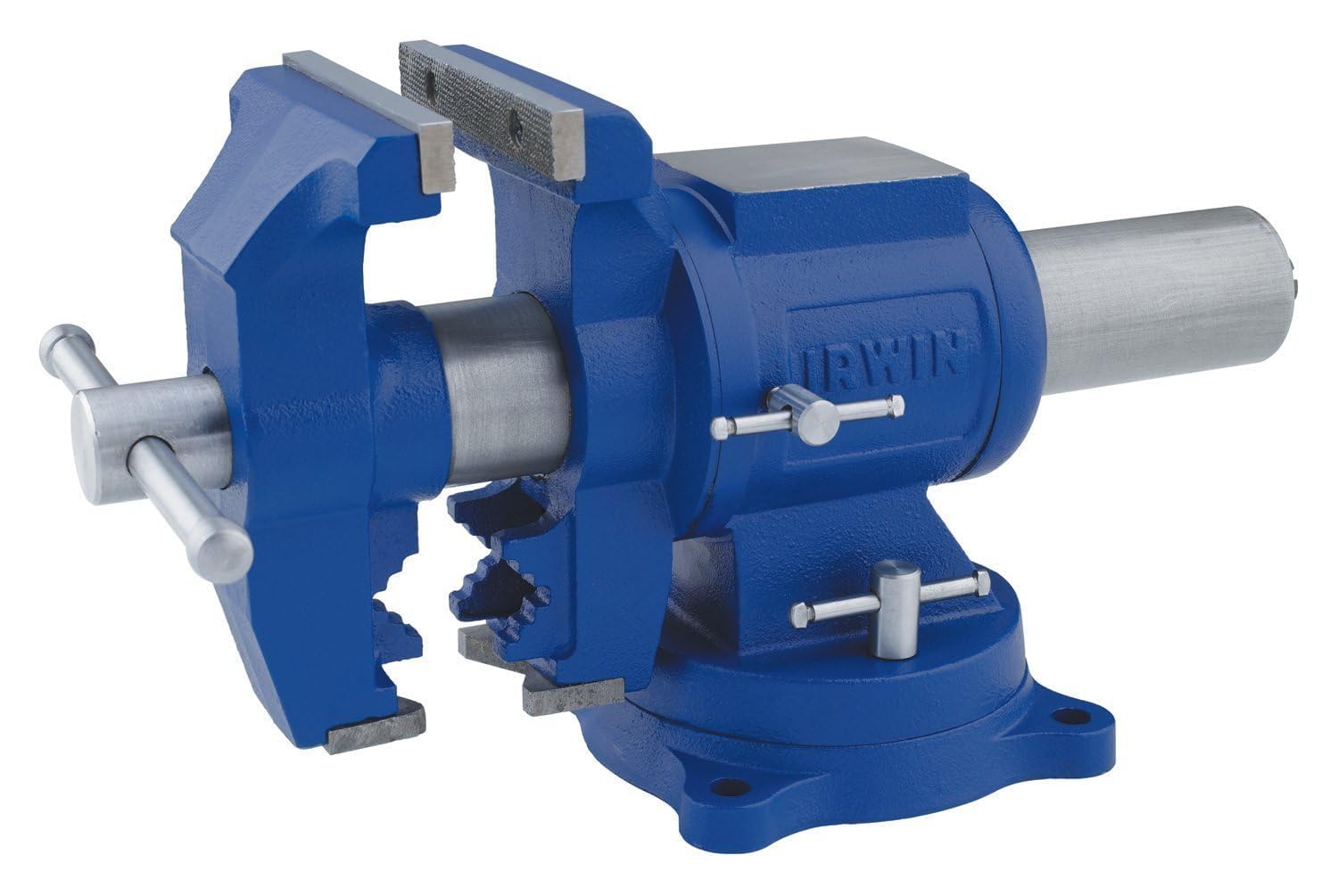
This is the vise you hand to someone outfitting a first garage. It is cast iron, 33.1 pounds, with a 5-inch jaw width, rotating pipe jaws, and a 360-degree swivel base. The fused steel handle makes adjusting the screw feel solid rather than flimsy, and the built-in anvil means you can flatten a bracket without hauling out a separate block.
Unlike the PONY above, the IRWIN carries more mass — 33.1 pounds against the PONY’s 7 — and that extra heft shows up where it matters: the jaw alignment stays tight instead of drifting. The value story is the loud one here, and buyers describe it as a home-quality shop tool that rises above the tool-grade you paid for. Every moveable part feels smooth, and it just keeps coming in handy for jobs you did not plan for.
The honest trade-off. It is a home-quality tool, not a fab-shop fixture — the 5-inch jaw width is narrower than the 6-inch Wilton Apprentice, so wide stock is a tighter squeeze. And 33.1 pounds makes it noticeably heavier than that 25.7-pound Wilton, so lifting it to a high bench with one arm is a two-arm job.
Where it shines: the combination of a 5-inch jaw, pipe jaws, and a swivel base covers most home jobs — cutting, filing, bending, pipe work — without a second vise.
Best for the one-vise garage: if you need a single vise that handles wood, metal, and pipe on weekends, this does all three.
Pass if: your work runs wide stock or you want a 6-inch jaw.
4. IRWIN Multi-Use Bench Vise, Heavy-Duty, 6-Inch

Grey iron machined to close tolerance, with a nut that refuses to wear out.
The 6-inch IRWIN is a mechanic’s tool first. It is cast from high-quality grey iron and machined to close tolerances, so it resists distortion under high clamping pressure, and it delivers more than 3,000 pounds of clamping pressure for heavy-duty jobs. The 2-1/2-inch throat depth is the number that decides what you can hold — this is a shallow-throat vise, suitable for brackets and flat stock, not deep assemblies.
The engineering detail worth knowing is the long-barreled nut dovetailed into the body. That nut is unbreakable in the maker’s wording, and aligning the main screw with it reduces wear, which is the part that usually dies on a cheap vise. A safety stop keeps the slide from separating from the body, and the fused steel handle gives you a solid grip. It weighs 30.9 pounds, so it sits firmly once mounted.
The honest trade-off. Compare its 2-1/2-inch throat depth against the 3-3/4-inch Wilton Apprentice and the difference is plain: the Wilton swallows deep work that this IRWIN will not seat. The other gap: no manufacturer warranty is listed on this model, so you are trusting the build rather than the paper.
Why mechanics like it
- Grey iron cast and machined to close tolerance against distortion
- Dovetailed, long-barrelled nut aligns the screw to cut wear
- 6-inch jaw width for wide flat stock
- Safety stop prevents the slide from pulling out
The limitations
- 2-1/2-inch throat depth is shallow for deep assemblies
- No manufacturer warranty listed on this model
- Grey iron is more brittle than ductile under abuse
Choose it for: flat-stock and bracket work where 6-inch jaws matter more than deep throat reach.
Skip it when: you need to seat a deep casting or want a written warranty behind the casting.
5. Wilton 6″ Apprentice Bench Vise
A 72,000 PSI ductile casting with a lifetime warranty and a bend-first handle.
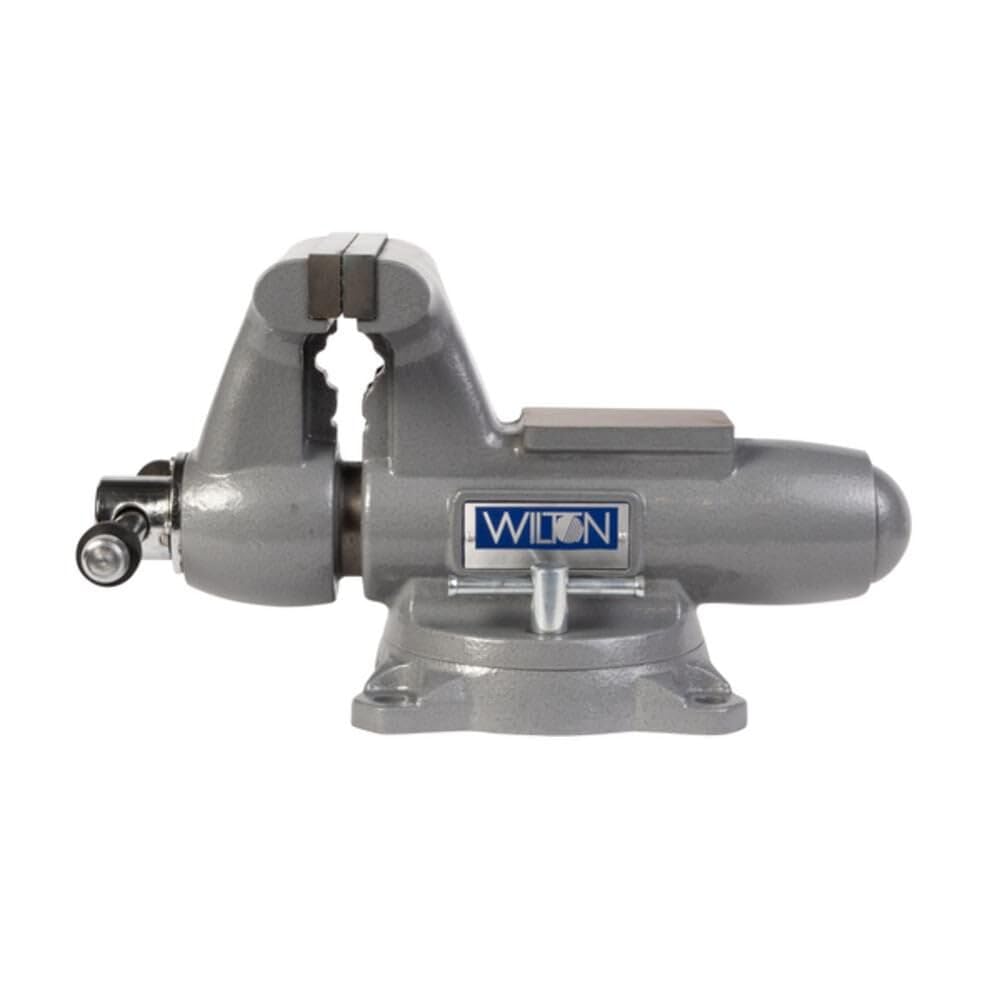
The Wilton Apprentice stacks the biggest strength number against the PONY by a mile: 72,000 PSI ductile iron against the PONY’s 6,000 PSI. That gap is the whole argument for spending up. The body is cast in an enclosed, bullet-style design that covers the spindle for low maintenance, and it delivers up to 8,300 lb of clamping force. Jaw width is 6 inches, opening is 6 inches, throat depth is 3-3/4 inches, and it weighs 25.7 pounds.
The 3-3/4-inch throat is the number that beats the shallow girls — it is 50% deeper than the 2-1/2-inch throat on the IRWIN 6-inch, which means it seats a deep bracket that the IRWIN drops. Built-in pipe jaws hold pipe and round stock from 1/4 inch to 3 inches outside diameter, so most shop pipe work skips a separate pipe vise. Rubber pinch-point guards protect your hands, and replaceable parts — jaw inserts, spindle, handle, nut, lockdowns, base plate — mean you can repair rather than replace.
The honest trade-off. This is a bolt-down vise, not a clamp-on. It uses four 0.51-inch mounting holes and needs a solid bench to sit on. And the handle is designed to bend before the vise is damaged — so if you are the type to slide a cheater bar on for extra leverage, this vise will tell you to stop, physically.
Best for the learner: a full-size bench vise that forgives beginner mistakes without a beginner casting — the lifetime warranty backs it against manufacturer defects.
The one caveat: it is not a press; keep the hammering to the anvil surface and off the screw.
Pick it for: the home shop that wants a strong 6-inch ductile vise with replacement parts behind it.
Not for: someone who needs a portable, clamp-on vise — this one lives bolted to a bench.
6. Wilton Utility Bench Vise, 4-1/2″ (674U)

Half the weight of the big castings, with pipe jaws and an anvil still on board.
For a bench that has to hold a vise and still leave room to work, the 674U is the polite answer. At 16.5 lbs it is lighter than any full-size vise on this list, and the 4-1/2-inch jaw width with a 4-inch jaw opening and 2-5/8-inch throat covers small brackets, pipe, and assembly work without swallowing the whole bench. Replaceable hardened steel serrated jaws grip firmly and can be swapped when they wear.
A 360-degree swivel base with dual lockdowns lets you angle the work toward you, and the built-in pipe jaws handle a range of pipe sizes. The powder coat finish resists scratches, which matters if the vise lives in a garage where it gets bumped. The large anvil work surface means you can shape and form metal without a separate block. What buyers talk up most is the all-round quality, and the value is the second thing they bring up — this is a vise people describe as sturdy and working exactly as intended.
The honest trade-off. The stability question is the one that keeps coming back: some note it shifts a little when locked into position. That is the nature of a lighter casting with a swivel base — if you need dead-solid performance under a hammer, bolt a heavier model down and accept the extra weight.
Good reasons to pick it
- 16.5 lbs is light enough for one person to mount
- Replaceable hardened serrated jaws
- Dual-lockdown 360-degree swivel base
- Pipe jaws plus a large anvil surface
What you give up
- 4-1/2-inch jaw is narrower than the 6-inch models
- Swivel base can shift slightly under hard use
- Lighter build means less hammering momentum
Reach for it if: you want pipe jaws, a swivel base, and an anvil in a vise you can lift and mount alone.
Better to skip if: your main job is hammering steel — a heavier casting holds steadier.
7. Forward DT150B 6 Inch Heavy Duty Bench Vise

A 42-lb ductile vise with a rotating head, V-jaws, and 6,500 lbs of grip.
Three jaw sets put the Forward DT150B in a select club. Top jaws carry a microgroove tooth, built-in pipe jaws handle pipe from 3/5 inch to 2 1/2 inch, and V-jaws grip round stock so it does not spin. The specs are 6-inch jaw width, a 5-inch jaw opening, a 2-5/8-inch throat depth, and at least 6,500 lbs of clamp force. The body is 42 lbs of high-strength cast iron and PSI 60,000 ductile iron.
Both ends rotate: the front head gives a full 360 degrees and the swivel base turns, so you can clamp complex workpieces at awkward angles without unbolting anything. A large reinforced anvil handles grinding, cutting, and tapping, and mounting hardware comes in the box. The quality talk leads on this one, with durability close behind, and the blue finish gets a mention too.
The honest trade-off. Rotation is the debated part — one view is the swivel base is exactly what complex work needs, another is the base does not turn smoothly. New from the start it is worth loosening and re-seating the locks before you rely on them. It is also 42 lbs, so plan the mounting position before you lift it.
My read: the DT150B is the middle path between the big multi-axis Yost and the compact down-bench models — rotating head, deep 6-inch jaw, 42 lbs of ductile body, at a cost tier that sits in the middle of the range.
Suited to: DIY and semi-pro users who turn complex workpieces and want three jaw types in one vise.
Not ideal for: a buyer who wants a swivel base they never have to fiddle with.
8. Wilton Multi-Purpose Bench Vise, 4-1/2″ (450P)

Indexed every 30 degrees, so you can pivot the work instead of your stance.
The 450P is a compact workholding machine. A 360-degree rotating head indexes in 30-degree increments, so you click it to the angle you want rather than hunting for a lock. Jaws are replaceable hardened steel with a serrated pattern, pipe jaws are steel and replaceable, and a V-jaw holds round stock vertically — a detail that matters when you are drilling into a shaft-end. Specs are 4-1/2-inch jaw width, 4-1/4-inch max jaw opening, and a 2-1/4-inch throat, at 21.3 pounds.
A large built-in anvil handles forming and shaping, and the whole thing sits behind Wilton’s lifetime warranty against manufacturing defects. The all-round quality is the trait buyers celebrate, and the second is value — plenty describe it as versatile and smooth for general-purpose workholding.
The honest trade-off. Durability is the debated area — heavy-duty enough for some, not for others. Translation: this is a utility-grade multi-purpose vise, not an industrial casting. The 21.3-lb body and 2-1/4-inch throat are also deliberately compact — a deep bracket will bottom out against the body.
Versatility that earns its keep
- 360-degree head indexed at 30-degree steps
- V-jaw holds round stock vertically for drilling
- Replaceable serrated steel jaws and steel pipe jaws
- Lifetime warranty and a large built-in anvil
Where it stops short
- 2-1/4-inch throat is the shallowest here
- Utility-grade build, not industrial-grade casting
- 4-1/2-inch jaw is narrower than the 6-inch units
The fit is: a home shop that wants indexable angles and a V-jaw without a huge footprint.
Think twice if: you routinely clamp deep castings — the shallow throat gets in the way.
9. Yost Vises ADI-6 Heavy Duty Vise

130,000 PSI austempered ductile iron, geared swivel, and a red coat that stays put.
Nobody on this list matches the Yost ADI-6’s casting. It is made from 130,000 PSI austempered ductile iron — an ADI treatment that toughens the metal beyond standard ductile — with a 6-inch jaw width and a 42-lb body. Compare that to the 72,000 PSI Wilton Apprentice or the 60,000 PSI Yost 760-DI and you can see where the extra strength sits on this page.
The swivel is the clever bit: an interlocking, geared 360-degree base with two lockdowns and a three-hole mounting pattern. It locks at every tooth rather than relying on friction alone, so it does not slip mid-cut the way a plain swivel can. The handle, lockdowns, and replaceable hardened steel serrated machinist and pipe jaws are zinc plated, and a large anvil work surface is built into the top. The red powdercoat gets noticed.
The honest trade-off. The ADI-6 is a professional-grade work bench vise — that is its strength and its cost. It is also 42 pounds, so it is not a bench strip-and-rebuild in ten minutes. And it is backed by a 90-day return with a limited lifetime warranty on the castings, so read the terms before you buy.
Who this is for: anyone who hammers, presses, and torques on a regular basis and wants a body that shrugs it off. If your current vise is cracking at the jaw or flexing under load, the ADI-6 is the upgrade that stops it.
Pick it for: industrial-grade abuse on a home-shop bench, with the strongest casting here and a geared swivel.
skip it if: a mid-strength vise already holds everything you do — the extra strength is wasted.
Know the Specs
Tensile Strength (PSI)
Tensile strength is a measure of how much pull a casting survives before it fails, written in pounds per square inch (PSI). Higher numbers mean a tougher body. A 130,000 PSI austempered ductile iron casting (like the Yost ADI-6) will tolerate heavier hammering and torque than a 6,000 PSI ductile casting (like the PONY) — that gap is not marketing, it is iron chemistry. Match the PSI rating to the work you actually do — a 130,000 PSI body is wasted on light assembly.
Jaw Width vs Jaw Opening vs Throat Depth
Jaw width is the length of the gripping plates; it decides the widest flat piece you can bite across. Jaw opening is how far the front jaw travels, deciding how thick a piece fits. Throat depth runs back into the body; it decides how deep a piece can sit before bottoming out. A 6-inch jaw with a 3-3/4-inch throat holds deeper work than a 6-inch jaw with a 2-1/2-inch throat. Read all three numbers together; a 6-inch jaw with a 2-1/2-inch throat still drops a deep bracket.
Swivel Base vs Rotating Head
A swivel base rotates the whole vise on the bench so the jaws face the angle you are working from. A rotating head pivots only the front jaw assembly, so the work turns while the body stays put. A geared (interlocking) swivel locks by teeth, so it resists slipping better than a plain friction swivel. Every extra axis adds locking points, so pick the number of axes your work actually needs.
Anvil Surface and Pipe Jaws
The anvil is the flat, reinforced section on top of the vise body — it is where you hammer, form, and shape metal. A larger, reinforced anvil takes more impact. Pipe jaws are the smaller V or curved jaws inside the main jaws; they grip round pipe and tube so it does not spin. Replaceable jaws and replaceable pipe jaws mean the wear parts can be swapped instead of replacing the whole vise.
Common Questions
What PSI tensile strength do I actually need in a bench vise?
Will a 6-inch jaw vise hold everything I need?
What is the difference between a swivel base and a rotating head?
Can I clamp a bench vise onto a workbench without drilling?
Does the anvil on top of a bench vise actually get used?
Should I use a cheater bar on the vise handle?
What do V-jaws and pipe jaws do that flat jaws cannot?
What bench vise sizes are available for a small workbench?
How do I stop a swivel base vise from slipping while I work?
Can the jaws on a bench vise be replaced when they wear out?
The Bottom Line
If you want one dependable pick, the workshop bench vise winner is the Yost 760-DI because it packs two axes of rotation, three jaw types, and a deep 4.31-inch throat into a single ductile iron body — the most ways to hold work of anything on the shelf. If you want a strong 6-inch ductile casting with replacement parts and a lifetime warranty, grab the Wilton Apprentice. And if your bench is tight or you need to carry the vise to the job, the PONY 6 Inch delivers 8,800 lbs of clamping force from a 7-lb body.
How we choose
We do not accept paid placement. Every pick is matched to a real buyer and a real use-case; we do not hands-on test units.
Sources
Specifications: manufacturer listings and product documentation. Review insights: verified customer reviews, as of November 2026. Pricing: not shown on this page (it changes often); check the current price via the retailer link.
As an Amazon Associate, Tactical Gear Guy earns from qualifying purchases. This does not affect which products we feature.