Specs are compiled from manufacturer listings and verified buyer reviews and can change over time — please confirm the key details on the product page before buying.
You want tools that were actually built here, with steel and machining you can trust, and you do not want to pay import prices for a label that only sounds American. The picks below are all confirmed United States manufacture, and each one solves a specific job in the shop — clamping miters, checking a blade for square, cutting dowels, carving, turning. Read the short spec notes, match the tool to the work you actually do, and you can stop second-guessing the origin story on the listing.
This guide is built by comparing the manufacturers’ published specifications and the patterns across verified customer reviews, so you get each pick’s real strengths and trade-offs instead of marketing spin.
Some of these are specialty tools you will use for decades, and a couple are everyday squares you will reach for on every single project. Below you will find the honest split between the two, laid out so you can pick the right one the first time with these woodworking tools made in USA.
Top Picks


How To Choose The Best Woodworking Tools Made in USA
The hard part is not finding American tools. It is confirming that the exact tool in front of you was made here, and that its specs fit the work on your bench. A square that is dead accurate but too small for your table saw is the wrong square. A clamp set with the right spread but a weak spring wastes your glue-up time. Start with the job, then the spec.
Confirm the country of origin, not the brand story
A brand can sound American and still import its parts. Look for the listing that states the country of origin as the United States in plain words. Several tools here name their city — Erie, Pennsylvania for Flexcut, Strongsville, Ohio for Woodpeckers, Ramsey, Minnesota for Harrison Specialties. That level of detail is a good sign the claim is real.
Match the accuracy tolerance to the job
A square is only as good as its tolerance — how far off true it can be over its length. Woodpeckers quotes its 6-inch square at within 0.001 inch, and its 12-inch T-square at within 0.004 inch. For furniture joinery and machine setup, those tight numbers matter. For rough framing, a looser tool is fine.
Steel type decides your sharpening routine
A2 tool steel holds an edge and resists wear, which suits a dowel plate you strike repeatedly. 1095 high carbon steel takes a keen edge and sharpens easily, which suits carving blades. Carbide tips on lathe tools can be rotated to a fresh edge and skip sharpening altogether. Pick the steel that matches how much maintenance you want to do.
Buy for the glue-up you actually face
Corner clamping is its own problem. A spring miter clamp set with an adjustable spread covers multiple joint sizes without buying several sets. If you build frames, trim, or moldings, that versatility earns its place. If you never glue a mitered corner, spend the money elsewhere.
Side-by-Side Comparison
| Model | Best For | Origin Claim | Key Material | Headline Spec | Amazon |
|---|---|---|---|---|---|
| Collins Spring Loaded Pliers and 13 Miter Clamps★ Best Overall | Glue-up clamping for frames and trim | Proudly made in the USA | Steel spring clamps | 14 count, 0 to ~2 inch spread | Amazon |
| Woodpeckers Mini SquarePocket Precision | Pocket square for checking a cutting edge | Made in USA | Machined aluminum | 1-1/8 by 2 inch inside, 3.2 oz | Amazon |
| DFM Tool Works Dowel Maker17-Size Dowel Plate | Cutting dowels in many sizes | Made in USA | A2 tool steel | 17 holes, 3/8 inch thick plate | Amazon |
| FLEXCUT Whittlin’ Jack JKN88 | Carving on the go | Made in USA | High-carbon steel | 1.5 and 2 inch blades, ~3 oz | Amazon |
| FLEXCUT Draw Knife KN16 | Shaping logs and rounding stock | Made in USA (Erie, PA) | 1095 high carbon steel | 5-inch flexible blade, ash handle | Amazon |
| Woodpeckers 12 Inch T-Square | Laying out lines and shelf pins | Made in USA (Strongsville, OH) | Machined aluminum | Within 0.004 inch, 12-inch | Amazon |
| Council Tool Wood-Craft Camp Carver | Carving and camp chores | Made in USA | 5160 steel, hickory handle | 1.7 lb head, 16 inch handle | Amazon |
| Harrison Specialties Carbide Lathe Set | Turning without sharpening | Made in USA (Ramsey, MN) | Carbide tips, aluminum handles | 3 tools, 17 inch handles | Amazon |
Detailed Reviews
1. Collins Spring Loaded Pliers and 13 Miter Clamps
Our pick — 4.5+★ from 800+ verified ratings; the strongest balance of quality and price.
Thirteen spring clamps and one pair of pliers that hold a mitered corner shut until the glue sets.
This is the kit for the woodworker whose glue-ups keep sliding open. You get 14 pieces — a pair of spring loaded pliers plus 13 spring miter clamps — and the clamps spread from 0 to about 2 inches, so you do not have to own several different sizes to cover different joint widths. The sharp point pierces the wood rather than slicing the fibers, which leaves a cleaner face than an angled cut design.
What wins people over is the build quality — owners rank build quality first, with functionality a close second. The clamp also works on trim, crown molding, picture frames, and any compound miter project, so one set covers a lot of jobs. The lifetime guarantee backs the whole kit. It is the crowd favorite here, sitting at 4.5+ stars across 800+ ratings.
Here is the catch, and it is a small one: craftsmanship is not the same as finish. A few owners have noted the surface condition of the clamps arriving imperfect, though it does not affect how they grip. Call it a cosmetic quibble on a tool that is judged mostly on how well it holds a joint. The honest sizing: if your shop work is furniture with dovetails and no miters, you will not use this enough to justify the shelf space.
What earns the top spot
- 14 pieces in one set: spring loaded pliers plus 13 miter clamps
- Adjustable 0 to ~2 inch spread replaces several fixed-size clamps
- Sharp point pierces without cutting fibers for a cleaner joint face
- Holds mitered corners shut while glue dries for a quality finish
- Lifetime guarantee and proud USA manufacture
Where it asks more of you
- Surface finish on the clamps is the one recurring cosmetic note
- Overkill if you rarely glue mitered corners
Reach for this if: you build frames, trim, moldings, or crown and want one clamp set that adapts to every corner.
Think twice if: your projects are all square joinery — the miters will go unused.
2. Woodpeckers Mini Square
A 3.2-ounce square that lives in your pocket and tells you instantly whether a blade is true.
At 1-1/8 inch by 2 inch inside dimension, this mini square is built for one job done well: checking the edge of your cutting tools for square. It is machined from aluminum, so it is light, and the dark red anodized finish makes gaps easy to spot. It fits in a pocket or its own custom fitted tray. For scale, compare it to the dowel maker below at 15.5 ounces — this square is 3.2 ounces, so it is a different class of carry.
Accuracy is the thing owners praise most, and portability is right behind it. It is the square you grab to check square on many things quickly, and it is a shop staple for setup work. The anodized surface also means it will not chip your tools when it bumps them.
The honest note is size — it is small by design, and that is the most-discussed point in owner feedback. Some find it well worth the money, others note it is not the cheapest option for what looks like a small piece of aluminum. That is the trade for machining precision into a pocket-sized tool. If you need to check long edges, this is the wrong tool; if you are setting up a blade in tight quarters, it is the right one.
Why it earns its place: It is the setup square you keep on your person rather than in a drawer, machined from aluminum with a finish that reveals gaps at a glance, and it does one job with real accuracy.
The honest check: It is compact on purpose — buyers split on whether the small size justifies the price, so buy it for precision in tight spaces, not for long-edge checks.
Right tool, right hand: a pocket square for tool setup and quick square checks in the shop or on site.
Wrong tool, wrong job: checking the square of a wide board or a full sheet — reach for the 6-inch square instead.
3. DFM Tool Works Dowel Maker
Seventeen holes in a half-inch-thick steel plate that turn scrap into dowels on demand.
When you need a dowel in an odd size, this plate makes it instead of waiting on a store run. The plate is machined and ground from 3/8 inch thick A2 tool steel, a steel chosen to take repeated strikes without wearing out. You get 17 holes in the English size arrangement, with small graduations between sizes so you can dial in a fit. It is hand powered, so no cord or battery enters the equation.
What owners talk about most is quality — owners rank quality above every other trait — with value for money second. The size accuracy with those smaller steps between holes gets steady praise, and the edges come super sharp. For a shop that handles custom furniture and restoration, a plate that matches your exact dowel need is worth the shelf space.
The trade-off is honestly on the record: durability feedback is mixed. The tool is expected to last a long time, but some buyers report sections tearing off during use. Treat it as a precision plate that wants sensible driving force, not a sledgehammer target. And if you only ever need standard dowel sizes, a plate with 17 options is more than you will use.
Bench value: The A2 tool steel body and 17 graduated holes cover nearly any dowel size you need, and the sharp edges cut clean on the first pass.
Sized caveat: Reported tearing on some units means you should drive the dowel with controlled force — the plate is built for precision, and treating it roughly is where it can let go.
Best match: furniture makers and restorers who need a bespoke dowel size and want to cut it at the bench.
Look elsewhere if: you only ever reach for standard dowels — the 17 holes go to waste.
4. FLEXCUT Whittlin’ Jack JKN88

Two blades in a pocket folding knife that lets you rough out and detail in the same session.
Flexcut packs a 1.5 inch detail blade and a 2 inch roughing blade into one folding tool, both machined from high-carbon steel for edge retention. It weighs about 3 ounces and folds to about 4.25 inches, so it rides in a pocket without a bulge. The handle is aluminum with wood veneer inlays, which gives you strength and a natural grip. Both blades come pre-sharpened and honed from the factory.
Owners rank sharpness first by a wide margin, with value for money second. The blades are slightly flexible to absorb pressure, and this is a traditional slip-joint with no locking mechanism, which is exactly the kind of controlled carving knife a whittler expects.
Where the tool demands patience is blade opening and closing. That is the most-discussed point in feedback, and a handful of owners have found the blades stiff enough to need pliers. It is a break-in issue on a traditional folder, not a flaw in the steel — once the joint loosens, it behaves. If you need one-handed flip-open action, this is not that knife.
Why carvers keep one in a pocket
- 1.5 inch detail plus 2 inch roughing blade in one folder
- High-carbon steel for edge retention
- About 3 oz and 4.25 inches folded for easy carry
- Pre-sharpened and honed from the factory
- Ambidextrous aluminum and wood handle
The part that takes patience
- Blades are stiff to open and close at first — some needed pliers
- Slip-joint with no locking mechanism, so it asks for controlled cuts
Fits: the whittler or spoon carver who wants two blades and a pocketable footprint on the trail.
Does not fit: anyone expecting a fast, one-handed locking folder.
5. FLEXCUT Draw Knife KN16

A flexible five-inch blade that bends to the log and strips bark with a pull.
This is the tool for shaping a chair leg, peeling a log, or rounding a handle blank. The blade flexes around concave and convex surfaces, and that flexibility is the whole point — it lets the edge conform to the finished shape and cuts down your sanding time. The 1095 high carbon steel blade takes a keen edge, and the ash handles give you a comfortable grip across a long session. It ships with a leather sheath to protect the edge.
Owners mention it arrives razor sharp and holds that edge through 50 feet of cedar. That matches the strength of owner feedback, where quality and then sharpness define the experience. The flexible blade lets you contour to logs for rounding cuts. Flexcut has been building carving tools in Erie, Pennsylvania since 1992, so the American origin claim is concrete.
Worth knowing: the blade is flexible on purpose, and that same flex means a heavy-handed twist can stress it. It is a controlled-pull tool, not a prying bar. The mixed size feedback reflects that a 6-inch blade is long relative to the pocket Whittlin’ Jack above at 1.5 inches, which is simply a different scale of work.
Where it shines: Bark removal, log rounding, and rough shaping — the flexible 1095 steel blade conforms to curves and saves you sanding time.
The honest limit: A flexible blade wants controlled pulls, so prying or twisting against grain is where it can disappoint.
Pick it for: green woodworking, chair making, and any job where you are peeling bark or rounding a log.
Pass if: you want a rigid bench knife for flat work — this one is built to flex.
6. Woodpeckers 12 Inch T-Square

A 12-inch T-square with a built-in scribing guide and shelf-pin holes machined right into the blade.
Marking parallel lines just got a tool that does it for you. The blade has 1mm holes drilled every 1/16 inch — stick a pencil in one, slide it along the workpiece, and you get a perfectly spaced line that follows the edge of your stock. It also has built-in 1/4 inch holes on 1 inch centers for laying out shelf pins. The scales are laser engraved and accurate within 0.004 inch. The beam design with support lips keeps it from tipping or rolling, so it makes a stable base for accurate marking.
The beveled edges put the scale markings right next to your stock, which is why owners describe the marking as precise. Owners expect the machined aluminum to last a lifetime. It is machined aluminum fitted to a solid billet handle, and it ships with a Rack-It wall mount. Built in Strongsville, Ohio.
The reality check is that a 12-inch T-square is a layout tool, not a shop square for verifying machine setup. It is also a heavier piece than a pocket square — 4 pounds versus the 3.2-ounce Mini Square above. If you are laying out cabinets and shelves, the scribing holes and shelf-pin layout make it earn its keep. If you just need to check a blade for square, a smaller tool does that.
What you get on the blade
- 1mm scribing holes every 1/16 inch for pencil-guided lines
- 1/4 inch shelf-pin layout holes on 1 inch centers
- Scales laser engraved within 0.004 inch
- Support-lip beam resists tipping and rolling
- Rack-It wall mount included
What to weigh first
- 4 pounds makes it a bench tool, not a pocket carry
- It is a layout instrument, not a machine-setup square
Choose it when: you lay out cabinet sides and shelves and want repeated spacing without a tape and a ruler.
Choose smaller when: your task is checking a blade for true — this is a marking tool.
7. Council Tool Wood-Craft Camp Carver Axe
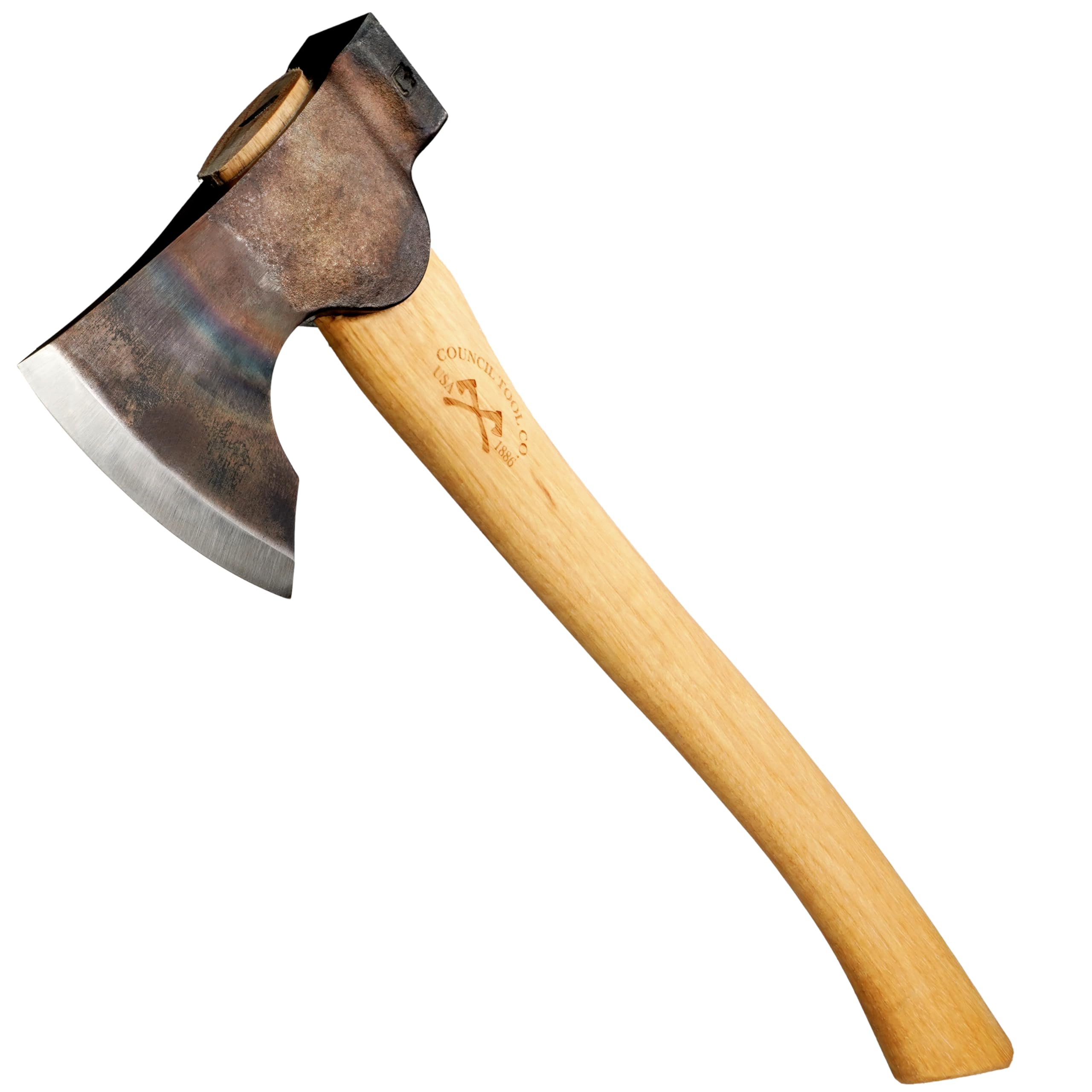
A bearded-blade carving axe that shapes a spoon and splits kindling without switching tools.
This is a dual-purpose axe: it carves spoons and handles with a bearded blade, then handles camp chores and fire prep. The bearded blade gives better control and comfort, and the flat-grind bevels sit at 25-28 degrees on a large bit. The head is forged from 5160 steel, and the hardened poll lets it work as a hammer for driving stakes and pegs. The 90-degree spine scrapes tinder or sparks a ferro rod.
The 16-inch handle is A-grade American hickory, hung proud and secured with a wood and steel wedge. Everything is made in the USA, and it ships with a welted leather sheath for belt or pack carry. Owners rate quality highest, sharpness close behind, then performance and fit. The bearded shape keeps overstrikes from damaging the handle, and the edge is described as tough enough to split logs.
Honest sizing: this is a specialized carver, not a felling axe. The 1.7 pound head is light for big splitting, and it is a premium tool in this lineup. If you want one axe for big rounds, get a full-size felling axe. If you carve green wood and want camp utility from the same tool, this earns it.
The build that matters: Forged 5160 steel, a hardened poll, and a hickory handle pinned with a wood and steel wedge — the pieces that keep an axe solid through real use.
The weight question: A 1.7 pound head is built for carving and camp chores, so leaning on it for heavy log splitting is asking it to do a different job.
The right owner: a green-wood carver who wants one tool that shapes spoons and handles camp chores.
The wrong job: felling big timber or heavy splitting — reach for a full-size axe.
8. Harrison Specialties Carbide Lathe Turning Set

Three carbide-tipped turning tools that skip the sharpening wheel and let you turn right away.
This set of three full-size tools — a Hollower, a Detailer, and a Rougher — is built for the turner who would rather turn than sharpen. Each tool is 1/2 inch square CNC machined in Ramsey, Minnesota. The handles are 17-inch solid aluminum with color-coded foam grips for easy identification, and the overall length runs to 26.5 inches. Each carbide tip has multiple sharp edges you can rotate to a fresh one, and a Torx star wrench is included.
The tools are designed to be kept flat on the tool rest and parallel with the floor. Carbide means no sharpening routine at all. Owners rate quality highest, then durability, calling the construction heavy-duty. The rubberized grips get noted for comfort, and the set suits beginners and intermediate turners alike.
The trade-off is that carbide cutters eventually wear out and need replacing rather than resharpening, and this set is a premium investment. If you already own traditional gouges and enjoy the sharpening ritual, you are paying for a convenience you do not need. If you want to spend your shop time turning bowls instead of honing, that is the whole reason this set exists.
What the set gives you
- Three tools: Hollower, Detailer, Rougher
- Carbide tips with multiple rotatable edges — no sharpening
- 17-inch aluminum handles with color-coded foam grips
- 26.5-inch overall length, 1/2 inch square CNC machined
- Torx wrench included; made in Ramsey, Minnesota
The honest cost of convenience
- Carbide cutters wear out and get replaced, not resharpened
- Premium price tag for a convenience you may already own
Ideal for: turners who want to start turning immediately and skip the sharpening station.
Not needed if: you already turn with traditional gouges and like the sharpening routine.
Know the Specs
Accuracy Tolerance On A Square
This is how far off true a square can be over its length. Woodpeckers quotes 0.001 inch on its 6-inch square and 0.004 inch on its 12-inch T-square. A tighter number matters for joinery and machine setup, where a small error compounds across a cut. For rough work, a looser tolerance is fine.
Blade Steel: A2, 1095, And 5160
A2 is a tool steel that resists wear, which suits a dowel plate you strike. 1095 is high carbon steel that takes a keen edge and sharpens easily, which suits carving blades. 5160 is a tough alloy steel forged into an axe head that holds up to chopping. The steel type sets how you maintain the tool.
Carbide Tips And Rotatable Edges
Carbide is a hard cutting material that keeps an edge longer than steel. On lathe tools, a carbide tip has several sharp edges, and you rotate it to a fresh one when it dulls. That replaces the sharpening routine entirely — until the cutter is worn and needs replacing.
Miter Clamp Spread Range
The spread range is how wide a clamp opens. The Collins clamps spread from 0 to about 2 inches, so one set fits many joint widths. A wider range means fewer clamp sizes to keep on the bench. Match the spread to the projects you build.
Common Questions
How do I confirm a woodworking tool is actually made in the USA?
What does a square tolerance of 0.001 inch mean in practice?
Is the Woodpeckers Mini Square too small for real shop work?
Do the Collins miter clamps work on picture frames and crown molding?
Will the DFM dowel plate cut every size I need?
What is the difference between the Flexcut Whittlin’ Jack and the draw knife?
Do carbide lathe tools ever need sharpening?
Can the Council Tool camp carver split logs or only carve?
Does the Flexcut draw knife come sharp from the start?
How long does a Woodpeckers square last?
The Bottom Line
The strongest all-around buy in woodworking tools made in usa is the Collins Spring Loaded Pliers and Miter Clamps, because it bundles 14 pieces, an adjustable 0 to ~2 inch spread, and a lifetime guarantee into one kit that covers frames, trim, and crown. If you want precision in your pocket, grab the Woodpeckers Mini Square at 3.2 ounces. And for hand-shaping green wood, the FLEXCUT Draw Knife KN16 with its flexible 5-inch blade is the one to reach for.
How we choose
We do not accept paid placement. Every pick is matched to a real buyer and a real use-case; we do not hands-on test units.
Sources
Specifications: manufacturer listings and product documentation. Review insights: verified customer reviews, as of November 2026. Pricing: not shown on this page (it changes often); check the current price via the retailer link.
As an Amazon Associate, Tactical Gear Guy earns from qualifying purchases. This does not affect which products we feature.