Specs are compiled from manufacturer listings and verified buyer reviews and can change over time — please confirm the key details on the product page before buying.
Losing a measurement because the hinge sagged or the numbers blurred is the thing a wooden rule is supposed to prevent. Short answer: buy the STABILA Type 600 if you want a wooden rule that reads in 1/16ths and holds its lock, or the Lufkin 1066DN if you measure in tenths and hundredths of a foot on engineering jobs. The rest of this page covers whether the joints stay tight, whether the numbers stay legible in bad light, and whether the wood is actually straight.
This guide is built by comparing the manufacturers’ published specifications and the patterns across verified customer reviews, so you get each pick’s real strengths and trade-offs instead of marketing spin.
A folding wooden rule is a stiff, self-supporting stick — not a tape measure with extra steps. You can stand it on end inside a doorway or drop it into a hole without the blade kinking. Below you will find which scale system, joint type, and folded length suits your work, so the wooden folding ruler you pick still reads clean and locks straight.
Top Picks


How To Choose The Best Wooden Folding Ruler
You get years of service from a foldable rule when the hinges hold and the timber stays straight — and only then. A folding rule earns its place because it is rigid. You can hold one end in the air and the other end stays put, which a floppy tape cannot do. That rigidity is also the weak point. Every fold you add is a joint that can loosen, so the wood species and the hinge hardware decide the outcome.
Pick the right scale first
The numbers printed on the faces are the hard constraint. Inch-and-fraction rules graduate to 1/16ths along the edges (each mark is one sixteenth of an inch), which suits carpentry, cabinetry, and framing. An engineer’s scale instead reads in feet, tenths of feet, and hundredths of feet — a decimal system used for surveying and civil layout. It will not line up with a stud at 16 inches on center. Mason’s rules go a step further, with brick spacing marks on the inside face. Match the scale to the paperwork you work from, because good wood will not fix the wrong graduation.
Hinge quality is the real lifespan
Brass-plated joints with hardened steel springs give a positive lock — a click you can feel as each section straightens. Brass matters because it resists rust when the rule sits in a damp pouch. Brass endcaps (small metal caps on the tips) stop the wood tips from splitting after repeated drops. Thin, unbranded hinges are where budget rules give up first. They often bend rather than break, which leaves the rule permanently out of true.
Wood, coating, and folded size
Beech and straight-grained hardwood are the two you will see named most, and both hold shape better than soft, open-grain stock. A hard, weather-resistant coating keeps the scale readable when the rule gets wet — that is a scale-protection feature, not a claim that the tool is waterproof. Finally, check the folded length against your pocket. A rule that folds down to roughly 9 to 10 inches disappears into carpenter pants, while a long 6-foot tool that folds bulky ends up left in the truck.
Side-by-Side Comparison
| Model | Best For | Graduation | Length | Weight | Amazon |
|---|---|---|---|---|---|
| STABILA Type 600 (80005)★ Best Overall | All-round carpentry and layout | 1/16 in | 9.9 in folded | 4.8 oz | Amazon |
| Lufkin 1066DN Engineer’s ScaleDecimal Days | Engineers and decimal-foot measuring | 1/16 in | 72 in | 3.2 oz | Amazon |
| Zeluga 23-392 Oversized Brick MasonBrick Course Built-In | Bricklaying and course heights | Vertical inches, both edges | 72 in | 1.6 oz | Amazon |
| Jeemiter 2 Pack Birch Yard Stick | Two-handed shop and home duty | Inch outside, metric inside | 6.5 ft extended | — | Amazon |
| Binzer 6.5ft/2m 5-Pack | Outfitting a whole crew | Inch and metric, outside read | 2 m / 6.5 ft | — | Amazon |
| 2 Pack LifCratms Folding Wood Rulers | Budget spare and light craft work | Inch and metric | 2 m / 78 in | — | Amazon |
| Crescent Lufkin T636N Brick Mason | Brick spacing with a long reach | 1/16 in | 72 in | 1.6 oz | Amazon |
| Stanley 0-35-455 | Metric-only European work | 2 meters | 9.61 in folded | 0.11 kg | Amazon |
Detailed Reviews
1. STABILA Type 600 Folding Ruler, Oversize, Cat. No. 80005
Our pick — 4.5+★ from 200+ verified ratings; the strongest balance of quality and price.
The hinge gets treated like a machined part here, not an afterthought.
The STABILA Type 600 earns the top spot because hardened steel springs and high-strength hinges click each section straight and hold it there while you hold one end in the air. It is the Modular Spacing model with 1/16ths on both edges and outside markings, so it lines up with standard framing and cabinetry work rather than a decimal civil scale. That 1/16ths graduation is the resolution most wood joints and trim reveals are actually cut to.
Premium beech wood sections are chosen to keep their shape over time. A hard-wearing weather-resistant paint shields both the wood and the printed scale, so the numbers survive wet hands and a dirty bench. Contrast coloring and bold numbers keep the markings readable when shop light is poor.
The trade-off is folded bulk — this is the widest rule here by a wide margin. At 2.6 in across versus the Lufkin 1066DN’s 0.63 in, and at 4.8 ounces versus the Zeluga’s 1.6 ounces. That extra timber is exactly what makes it stiff and stable in the hand, but it will bulge in a slim pocket where the lighter rules slip flat. At 4.5+ stars across 200+ ratings, it is the safest single-rule buy here.
oversize bold markings
- Modular 1/16ths scale on both edges with outside readings, so trim and stud layout need no conversion
- Hardened steel springs and high-strength hinges lock each section straight while it is held in the air
- Beech sections and weather-resistant paint protect the wood and the printed scale together
- Bold numbers and high-contrast coloring stay readable in a dim shop or garage
bulky to pocket
- 2.6 in width and 4.8 oz make it the bulkiest rule in this group — not a pocket rule
- White finish shows dirt and paint smears faster than darker timber
- No metric face, so anyone working to millimeters needs a second rule
pro framing work: you want one stiff, dead-straight rule for carpentry, layout, and 1/16ths work you can trust for years.
skip for tight spaces: if your pocket is tight or you measure metric daily, the slimmer Lufkin or a metric-only Stanley suits better.
2. Crescent Lufkin 1066DN Wood Rule
For anyone whose site paperwork never says “and three sixteenths.”
This is the strongest decimal-foot rule in the group, which is a niche inside a niche. The faces are graduated in feet, tenths of feet, and hundredths of feet — the whole point of this rule. The regular outside markings still read in feet, inches, and 1/16ths, so you get decimal readings for layout and grading work plus fractions for everyday carpentry on the same stick. It is measurably slimmer than the STABILA: at 0.63 in wide it is the narrowest rule here versus the STABILA’s 2.6 in, and it weighs 3.2 ounces.
Durability lives in the joints. Brass-plated hinges hold up to repeated folding, and brass end caps stop the tips splitting — the exact failure point on cheap hardwood rules after a season of drops. Red foot figures pop off the white timber so you can spot a whole foot at a glance, which speeds up layout on a busy site.
engineer decimal scale: the reach is not always the stated 6 feet, and that has caught enough buyers to be a recurring grumble. Treat it as an approximate six-footer and confirm against a known reference before you trust it for a critical cut. Durability also splits opinion — plenty find it sturdy, others find the joints looser than expected over time. It still rates 4.5+ stars across 500+ ratings.
engineer calculations: your drawings are in tenths and hundredths of a foot and you want the decimal scale on a slim, light stick.
metric users avoid: you need a guaranteed full 6 feet of accurate reach or you work metric only.
3. Zeluga 23-392 Wood Rule
A rule built around the way a bricklayer actually sets a course.
For bricklaying, the inside scale is what wins it — it lets a mason check course heights without reaching for a tape and a level separately. Vertical inches are graduated on both edges, and the outside face carries regular markings in black. The 1.6-ounce body on a 72-inch rule means thin, light stock that hangs in the hand without pulling your wrist around during a long day of reaching up a wall.
That low weight is a real working advantage: it weighs 1.6 ounces versus the 4.8-ounce STABILA, so it tires your arm less on overhead courses. Folding action lets you stand it in a corner or lay it across a wall opening and read straight off it.
The catch is that light stock has less margin if you lean on it or let it fall off scaffolding, and the white finish marks up with mortar. If you pour concrete and frame walls rather than lay brick, the brick scale earns less of its keep and a 1/16ths rule like the STABILA serves you better. Check that your buying decision hangs on brick spacing before you commit.
masonry layout: bricklayers and masons who need course spacing and vertical inch marks on one light rule.
avoid for finish work: general carpentry where a standard fractional scale is the measurement you actually work from.
4. Jeemiter 2 Pack Wood Folding Ruler
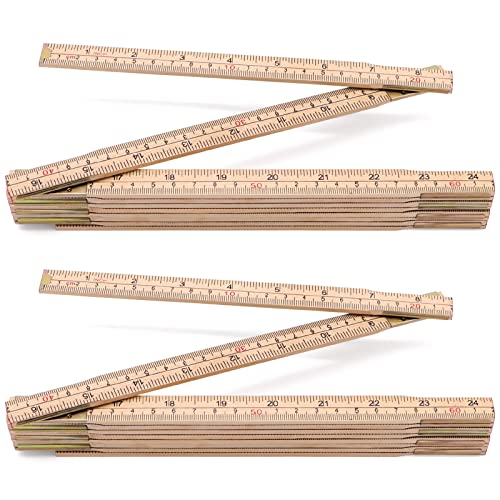
Two birch rules with brass where it counts.
Two brass-jointed rules in one buy is the reason this pair makes the list at all. Made of tough birch with an environmentally friendly coating, each rule is stable and wear resistant for long-term shop use. The brass joints, end caps, and sliding rule are the parts built to last — and those are exactly the components that fail first on cheap hardwood rules.
Each one folds to roughly 9.5″ x 1.5″ x 0.6″, so it slides into carpenter pants without a bulge, and extends to 6.5 ft (2 meters) when you need reach. You get both measuring systems in one tool. The metric side sits on the inside of the folded ruler and the imperial side on the outside, so you choose your units by which way you unfold it.
The design is nimble in tight spots: single-hand operation lets you measure inside a cabinet or up a wall without a ladder, and it is handy for hole depths and squaring boxes, not just flat runs.
two pack value: buyers report the deal itself earns the most goodwill here — two usable rules for the outlay of a single one.
loose hinge tension: durability is the mixed factor, and enough buyers have seen a unit fail early that you should treat the pair as two working rules rather than one rule plus a lifetime spare. Handle them gently on the first few unfolds and check the hinges before you lean your weight on the middle.
spare ruler handy: you want two light, brass-jointed rules for a small workshop, home projects, or a tool bag that loses things.
avoid for precision: you need one rule to survive a commercial site day in and day out.
5. Binzer 6.5ft Folding Ruler 5-Pack
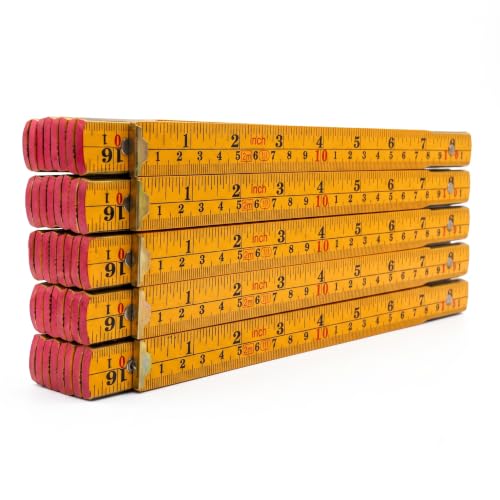
One box that keeps five people from sharing one rule.
Five rules against the single STABILA here — the count advantage is the entire argument for this pack. If you run a small crew, teach a shop class, or keep a rule in every vehicle, buying five at once removes the coordination headache. Each unfolds to a full 2 meters (78-3/4″), which reaches past two yardsticks laid end to end, so doorways and room runs are a single pass.
Straight-grain hardwood with a clear protective coating resists water, mud, grit, and shop chemicals. The markings are engraved and high-contrast: fractional inches to 78-3/4″ on one face, and a full 2-meter metric scale on the other with red markers every 10 cm. Both stay legible in dim shops and on wet sites alike. Brass-plated hinges with a click-detent design lock each segment straight, holding a true edge for layout instead of sagging mid-measurement.
Where this pack asks for care is tolerance — with five rules, each one lives with a bit less individual attention. Enough of them have snapped under gentle use that you should not assume any single stick is a lifetime tool. Readability and wood quality are the other split opinions. What does hold: owners mention the foldability into tight spaces and awkward angles is the specific thing that wins them over. It holds 4.5+ stars across a few hundred ratings.
mixed unit jobs: a crew, a classroom, or a household that needs several good rules and does not want to pay single-rule prices five times over.
skip for heavy duty: you want one heirloom-quality stick — the per-rule refinement is not the same as the single premium picks.
6. 2 Pack Folding Wood Rulers 6.6 Feet

A first folding rule, cheap enough that losing one is not a crisis.
A 2 m / 78 inch measuring range on two rules, with inch and metric units on both sides, is what a beginner actually needs. The tough wood body carries an environmentally friendly coating and folds into 10 sections, which shrinks it to a size that fits in carpenter pants.
At 3 millimeters thick it is slim stock, and 9.45 inches folded makes it easy to stow and store. The listed uses run wide — woodworking projects, tile laying, hardwood floors, DIY craft, and even underwater measuring. That range makes it a general-purpose rule rather than a site specialist.
The honest limit is early durability. Enough customers note a unit giving out right as it comes out of the bag that you should open and unfold both rules before you rely on one. Keep the second as your working spare rather than a shelf trophy. Folded size also means less timber in the joints, so avoid using it as a lever. On value, this pair wins at 4.0+ stars across dozens of ratings.
long span measuring: you are kitting out a first workshop or you need a light double-sided rule for tile, craft, and around-the-house jobs.
avoid rough handling: you plan to lean your weight on it or need it to survive daily commercial abuse.
7. Crescent Lufkin T636N Wood Rule
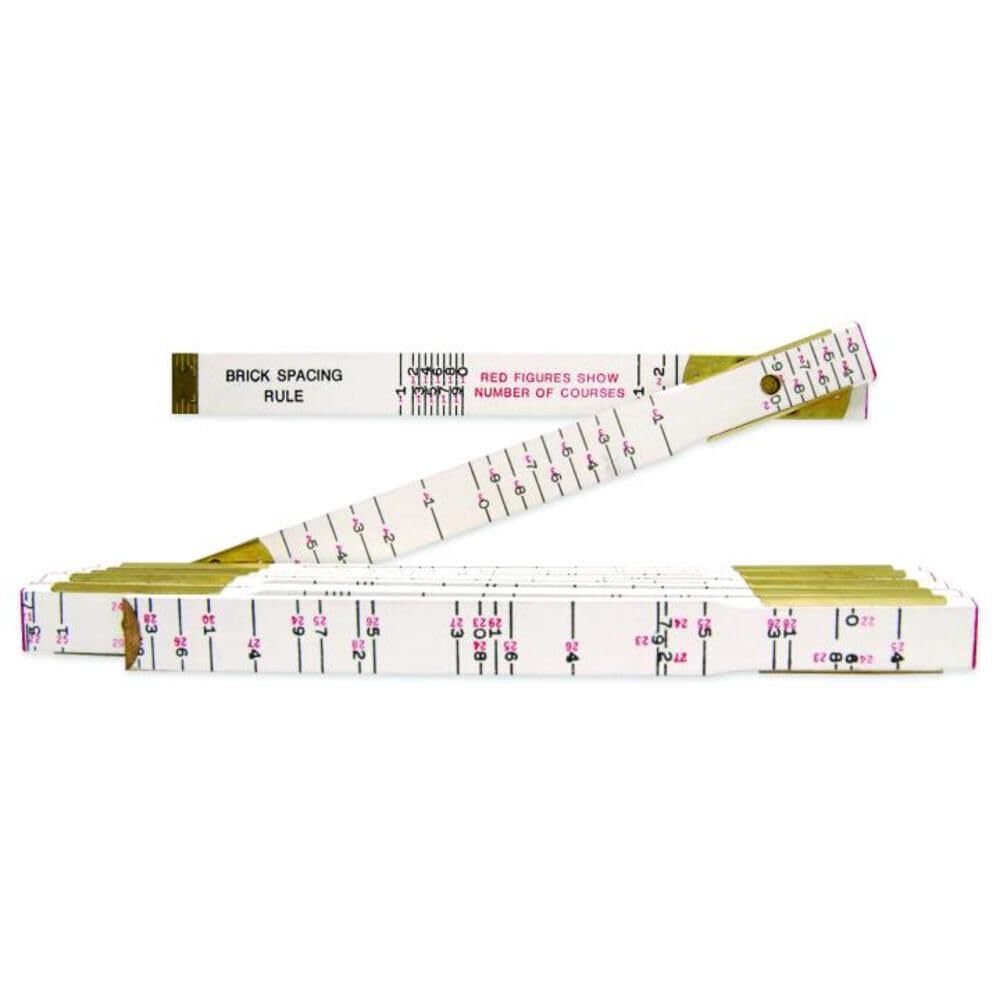
Built for the mason who reads spacing off the inside face, not inches off the edge.
Brass end caps are the differentiator that puts this rule above the Zeluga for a mason — they protect the tips that splinter first after a season of drops. A dedicated brick spacing rule sits on the inside surface, the number a bricklayer actually works from. The outside carries regular feet-and-inch markings graduated to 1/16ths along both top and bottom edges. Six feet long and 5/8 in wide, it is the same working length as the Zeluga.
Brass-plated joints finish the durability story, and at 1.6 ounces it stays light on the wrist through repeated reaches up a course. It rates 4.5+ stars across hundreds of ratings.
The catch cuts two ways: with no metric face and no fractional markings beyond the outside inch scale, this is not the rule for millimeter work or detailed cabinetry. It also asks a bricklayer’s workload — if your days are framing or finish work, the brick scale is dead weight, and the STABILA above serves the same 16ths work more directly.
brick coursing: your day is brick, block, and course heights and you want brass end caps protecting the tips.
skip for cabinet work: general carpentry and finish work are better served by a fractional 1/16ths rule.
8. Stanley 0-35-455 Folding Rule of wood, Tan Brown

Metric only, brass at the wear points, folded small enough to forget it is there.
If every number in your head is in millimeters, this rule has nothing spare to confuse you: wood construction, brass joints and tips, and a 2-meter graduation range with no inches anywhere. That makes it the ideal rule for anyone whose plans, tile sizes, and hardware are all metric, and an inconvenient one for anyone who works in fractions. Folding size is 9.61″ x 1.65″ when closed, so it stows easily in a pouch or pocket.
Weight comes in at 0.11 kg, which keeps it comfortable for extended use and means it hangs from a belt without dragging. The brass joints and tips are the parts that absorb the wear, protecting the corners that would otherwise split.
Two limits stand out. You get exactly one measuring system — no inch face — so metric-only buyers will be perfectly happy while dual-system users need a second tool. It is also a no-frills wooden rule with none of the high-contrast scale treatment of the STABILA or Binzer picks. At 4.0+ stars across several hundred ratings, it is the dependable metric workhorse.
general carpentry: a pure metric folding rule for tile, cabinetry in millimeters, or European hardware.
avoid for wet sites: no inch markings at all, so dual-system users should look at the Binzer or Jeemiter two-way rules instead.
Know the Specs
Graduation range
The graduation range is the smallest mark your rule can measure, and it decides whether the tool suits your job. A graduation range of 1/16 inches gives you the fraction most trim, framing, and cabinet joints are cut to — read it as the finest mark you can trust by eye. An engineer’s scale instead reads in feet, tenths of feet, and hundredths of feet: a decimal system for survey and civil layout that will not line up with a 16-inch stud. Mason’s rules add brick spacing marks on the inside face. Pick the graduation that matches the paperwork or the trade, because the wood cannot compensate for the wrong scale.
Joint type and end caps
The hinges carry the tool’s whole lifespan — they are the first thing to loosen or bend on any folding ruler. Brass-plated joints resist rust when the rule spends the day in a damp pouch. Hardened steel springs give a positive lock: each section clicks straight and holds its position instead of sagging. Brass end caps protect the tips from splitting, which is exactly where soft timber rules fail after repeated drops. A rule with real metal at the joints and caps will outlast one with thin unbranded hardware, even if the wood looks similar.
Common Questions
What is the difference between an engineer’s scale and a regular inch rule?
Will a folding wooden rule actually reach 6 feet?
Can I use a wooden folding ruler for underwater measuring?
Why do the joints on a cheap folding rule fail first?
What does “inside read” versus “outside read” mean on a folding ruler?
Is a folding wooden rule better than a tape measure for framing?
How should I store a wooden folding rule so it stays straight?
What is the brick spacing scale on a mason’s rule for?
Why would I buy a multi-pack of folding rulers?
Does the type of wood really change how long the rule lasts?
The Bottom Line
The safest buy in this group is the STABILA Type 600, because its hardened steel springs, high-strength hinges, and beech sections lock each segment straight and keep the scale readable for years of 1/16ths work. If your paperwork is in decimal feet, the slimmer Lufkin 1066DN gives you tenths and hundredths on the same stick. For brick, the Lufkin T636N with its brass end caps is the professional’s choice, and if you need several rules at once, the Binzer five-pack outfits a whole crew. Match the scale to your drawings, then check the joints.
How we choose
We do not accept paid placement. Every pick is matched to a real buyer and a real use-case; we do not hands-on test units.
Sources
Specifications: manufacturer listings and product documentation. Review insights: verified customer reviews, as of November 2026. Pricing: not shown on this page (it changes often); check the current price via the retailer link.
As an Amazon Associate, Tactical Gear Guy earns from qualifying purchases. This does not affect which products we feature.