Specs are compiled from manufacturer listings and verified buyer reviews and can change over time — please confirm the key details on the product page before buying.
If your splitting axe keeps bouncing off the same round while your back pays for it, the fix is not a bigger swing — it is a wedge. A wood splitter wedge is a thick steel block with a sharpened point or edge that you drive into the end grain with a sledge, so the log breaks along its own grain instead of bouncing your axe. This guide covers seven of them, sorted by what each one does best, so you can match one to your firewood and your hammer weight instead of guessing.
This guide is built by comparing the manufacturers’ published specifications and the patterns across verified customer reviews, so you get each pick’s real strengths and trade-offs instead of marketing spin.
You will see where a diamond-shaped wedge beats a flat one, why head weight and hammer weight have to match, and which models hold their seat in the log. Below is the short list of the wood splitter wedge models worth swinging at this season.
Top Picks
How To Choose The Best Wood Splitter Wedge
Most people buy a wedge after a bad afternoon with an axe, and most people buy the wrong weight. Get the head weight and the striking pattern right and the wedge seats and splits in one or two drives.
Match the head weight to the hammer you already own
A wedge splits by concentrating a heavy steel head on a narrow edge, so the wood gives along the grain. A 4-pound head driven by a 3-pound hand sledge will stall; the same 4-pound head behind an 8-pound sledge bites deep on the first strike. If you only own a standard maul or a light camp hammer, a 4-pound wedge is the sensible ceiling and a 4.5- to 5-pound head wants a real sledge behind it.
Flat chisel versus diamond 4-way
A flat wedge pushes the log apart in two directions. A diamond cross-section, sometimes called a grenade or torpedo shape, weakens the wood at multiple angles so it can break into four pieces in one drive. Diamond designs save strikes on straight-grained firewood but demand more hammer effort per swing, which is why the shape you pick should follow the logs you actually cut.
Why the striking face and the notch matter
You are hitting steel with steel, so the top of the wedge needs a broad, flat face to catch a glancing blow safely. The side notches, where a wedge has them, bite into the log walls to stop the whole tool from popping back out between strikes. A sharpened starting point is the other half of that equation — it seats the wedge in an existing groove instead of skating across the end grain.
Steel and edge care
Drop-forged high-carbon steel is the standard for this class of tool, and heat treatment is what keeps the edge from rolling over. Never strike a wedge with another wedge, never hit a hardened hammer face against another hardened face, and wipe the steel down with the light oil many of these ship with before winter storage.
Side-by-Side Comparison
| Model | Best For | Head Weight | Length | Split Pattern | Amazon |
|---|---|---|---|---|---|
| ESTWING Sure Split Wedge E-5★ Best Overall | All-round firewood splitting | 5 lb | 9″ | Fin-assisted single edge | Amazon |
| Truper 33040 Super SplitterSimple Workhorse | Simple drop-forged workhorse | 4 lb | 6″ | Star / multi-angle | Amazon |
| Redneck Convent 4-Direction Wedge | Stubborn straight-grain rounds | 4.1 lb | 7″ | Diamond 4-way | Amazon |
| Edward Tools Classic Log Wedge | Campfire and cabin kit | 4 lb | 8.5″ | Sharpened flat edge | Amazon |
| Collins Diamond Splitting Wedge | Hard, knotted wood | 4 lb | 7″ | Diamond multi-direction | Amazon |
| Edward Tools Diamond 4-Way | Turning rounds into four pieces | 4 lb | 7″ | Torpedo 4-way | Amazon |
| 1844 Helko Werk Twisted Wedge | Lifetime tool for serious wood | 4.5 lb | 8.25″ | Twisted forged | Amazon |
Detailed Reviews
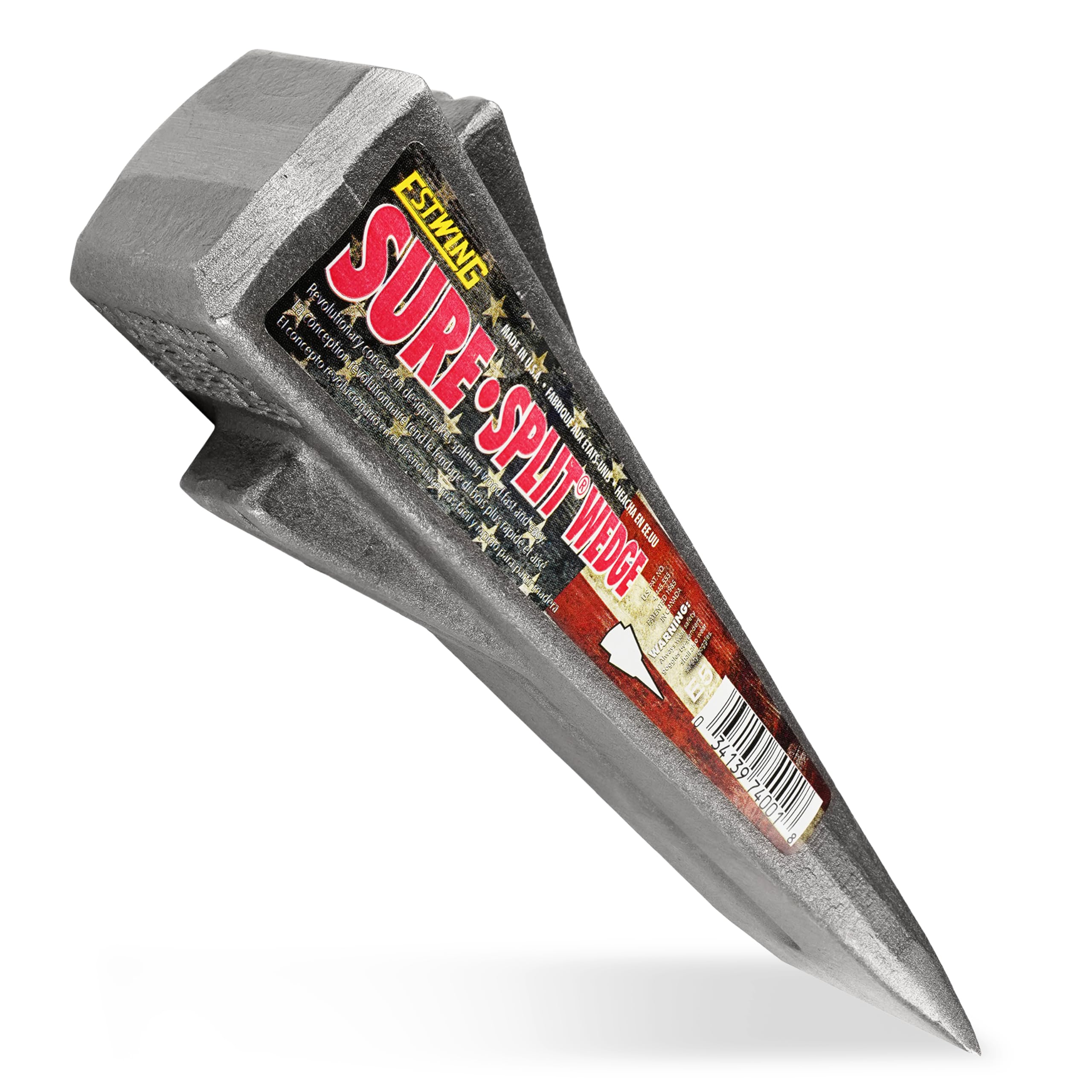
1. ESTWING Sure Split Wedge E-5
Our pick — 4.5+★ from 6,000+ verified ratings; the strongest balance of quality and price.
Five pounds of American steel built to turn a bouncing axe into a finished round.
The reason this one takes the top slot is the weight-to-length ratio. At a 5-pound head on a 9-inch body, it is the heaviest wedge on this list, and it is the longest of the steel wedges here — 9 inches versus the Truper’s 6 inches. That extra mass means each sledge blow drives the steel deeper, which is the whole point of owning a wedge instead of an axe.
The fin splitting design is the other half of the story. Fins run down each side of the body and push outward as the steel drives in, adding separation force with every strike. Tradesmen hand-sharpen the edge at the base so it seats into an existing groove and drives true on contact instead of skating off the end grain. It is made in Rockford, Illinois from American steel and has been since 1923, and the blue finish may arrive blasted or painted depending on the batch.
What wins people over here is the sheer durability — it takes the hardest rounds in the pile without the edge rolling over. The honest catch is that a 5-pound head wants a real sledge or a heavy maul behind it; a light camp hammer will not drive it deep. It is also the longest of the straight-edged wedges here, so if your splitting block sits low, you will be swinging from a taller stance than you might on a 6-inch wedge.
Where the weight does the work
- 5-pound head on a 9-inch body — the heaviest and longest straight wedge in this lineup
- Side fins add outward force with every strike instead of relying on your swing alone
- Hand-sharpened base edge seats into an existing groove and drives true
- American-made in Rockford, IL from alloy steel with a stated 1923 pedigree
Where it asks more of you
- That 5-pound head rewards a full sledge or heavy maul, not a light camp hammer
- Single-edged flat face suits two-way split — the diamond wedges below do four-way
- Finish varies between blasted and painted across batches
Swing it if: you own a sledge or a heavy maul and want one wedge that handles a full winter’s worth of rounds.
Pass for now if: your splitting tool is a light camp hammer — a 5-pound head needs real backing behind it.
2. Truper 33040 Super Splitter Wood Splitting Wedge, 4-Pound
The shortest wedge here, and the easiest one to get started in a cold round.
The Truper 33040 runs 6 inches long with a 4-pound drop-forged head that is heat treated for durability. That shorter body is the practical talking point: it sits low in the round, so a choked-up swing gets it seated before you commit to full force. Compared with the Edward Tools Classic at 8.5 inches, its 6-inch body changes how you stand at the block.
The head is a star pattern that weakens the wood on several angles at once, so it can push a round apart in more than one direction. It is the kind of tool you leave in the truck bed, the shed, the shop, and the cabin — the maker lists every one of those spots — because it disappears into a toolbox without complaint. Truper sells it under the WG-4X code, and it has the no-nonsense feel of a utility tool rather than a showpiece.
Ease of starting is what buyers come back to in the write-ups, and the multi-direction star shape gets its share of praise for working in more than one plane. This is a lean data set compared with some of the others here, so treat it as a proven basic rather than a fully documented favorite. The one thing to know going in: the star head pushes in several directions at once, which spreads force and can feel less decisive on a very soft, stringy round than a single hard edge would.
Bottom line: a compact, heat-treated 4-pounder that starts easily and lives happily in a truck box — the pick for someone who wants a spare wedge in every location and does not need four-way splitting.
Counting against it: the star geometry trades some single-direction bite for multi-angle spread, so soft stringy rounds may need a second strike.
Ideal owner: the person with three stashes — shed, truck, cabin — who wants an inexpensive wedge in each.
Think twice if: you split only huge, soft rounds and want one hard, deep split direction.
3. Redneck Convent 4 lbs Splitting Wedge
A diamond cross-section that cracks one round into four pieces instead of two.
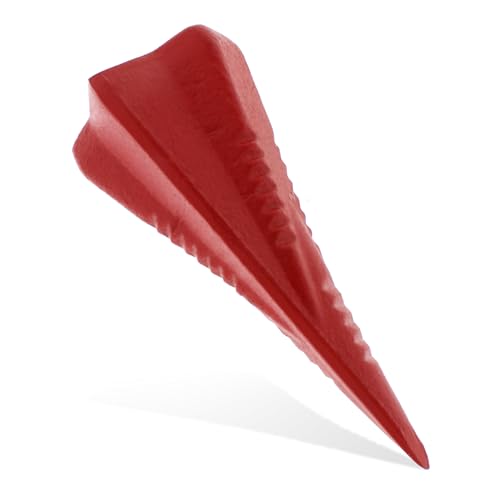
Here is the fastest way to cut your swing count. The diamond-shaped cross section on this 7-inch, 3-inch-wide wedge weakens the log at multiple angles, so a single drive can break it in up to four directions. A flat chisel wedge has to be re-seated for every split; this one lets the geometry do a second and third split for you. On straight-grained oak, hickory, walnut, or sycamore, that is a real saving in hammer strokes.
The body is heat-treated, hardened railway steel in an orange painted finish that resists rust and corrosion. A spherical striking face centers the blow so the wedge drives straight rather than cocked, and a wide flat head behind the point pushes more splitting power into the wood. The notches are the detail that keeps it seated — they bite the log walls so the tool does not pop out between strikes. Its sharpened point makes the first hit easier to start with your 8-pound hammer.
Effectiveness is the note that dominates owner feedback on this one, and the quality of the steel follows close behind it. The maker is explicit about limits, and you should respect them: this wedge is not recommended for knotty woods or large-diameter hardwoods. On super large cuts it has handled the work for some owners, but the design is built around small to midsize logs. Treat the 4-way geometry as a speed tool for clean rounds and reach for something else on a gnarly crotch piece.
What earns it third place: the diamond 4-way head turns one strike into up to four splits on clean straight-grained logs — the highest-leverage shape in this list.
The trade-off to accept: it is expressly not recommended for knotty wood or large-diameter hardwoods, so pair it with a heavier single-edge wedge for the ugly rounds.
Built for: split-firewood volume on clean, straight rounds where you want four pieces per strike.
Look elsewhere if: your pile is full of knots and big crotch pieces — this shape is not recommended for those.
4. Edward Tools Classic Log Splitting Wedge
The long-bodied classic that fits a camp kit and a sledge-hammer strike.
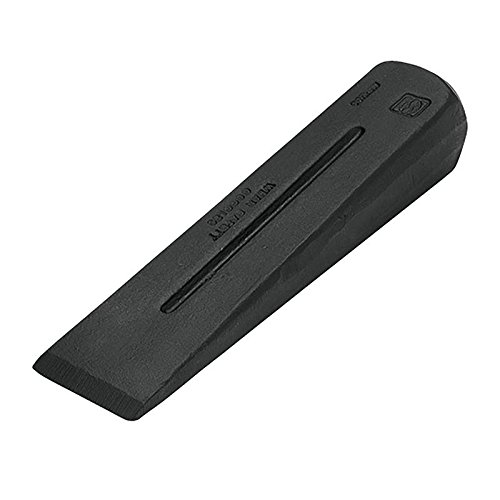
Edward Tools builds this one as a plain, sharpened-edge splitter: you locate the edge in the round, hit the back with a sledge hammer, and the log opens. The streamlined story is the point — there is no four-way geometry to learn and no special technique. At 8.5 inches it is longer than the 6-inch Truper and shorter than the 9-inch Estwing, which puts it in the middle of the length range while still giving you a long body to aim at.
The head is drop-forged steel with a sharpened edge for quicker splitting and a durable finish that shrugs off a season in the weather. The package measures 8.5 by 1.81 by 1.61 inches, which is a useful cue for how compact the tool really is in a pack or tool roll. That 1.81-inch width makes it noticeably slimmer than the Collins diamond wedge, at 3 inches wide, so it slips into a side pocket where a grenade-style wedge will not.
Owners describe it as exactly the tool advertised — good performance, good durability, no surprises. Quality and performance are the recurring themes in the feedback, and a few owners have found a second life for it clearing gentle ice from delicate surfaces, which speaks to the controlled edge. The trade-off is the flip side of that classic shape: a single sharpened edge splits in two directions only, so it will not crack a round into four the way the diamond wedges here can. For campfire-sized wood that is fine; for a cord-a-day pace you will want the four-way head.
Reasons it earns a spot
- Sharpened drop-forged edge that seats and splits with a straight sledge strike
- 8.5-inch body and slim 1.81-inch profile pack into a camp bag easily
- Lifetime warranty from the maker covers the steel for the long haul
- Simple two-way split — no learning curve beyond aim and swing
The honest limits
- Single sharpened edge means two-way splitting, not four
- No side notches or fin geometry to keep it seated between strikes
- Works best with a dedicated sledge rather than a light camp hammer
Pick this one if: your splitting is campfire-scale and you want a slim, warranty-backed classic in the pack.
Keep looking if: you need four-way output or a wedge that resists popping out of slick rounds.
5. Collins 4 lb. Forged Steel Diamond Splitting Wedge, 7-in

The wood grenade that bites hardest on knotted, stubborn hardwood.
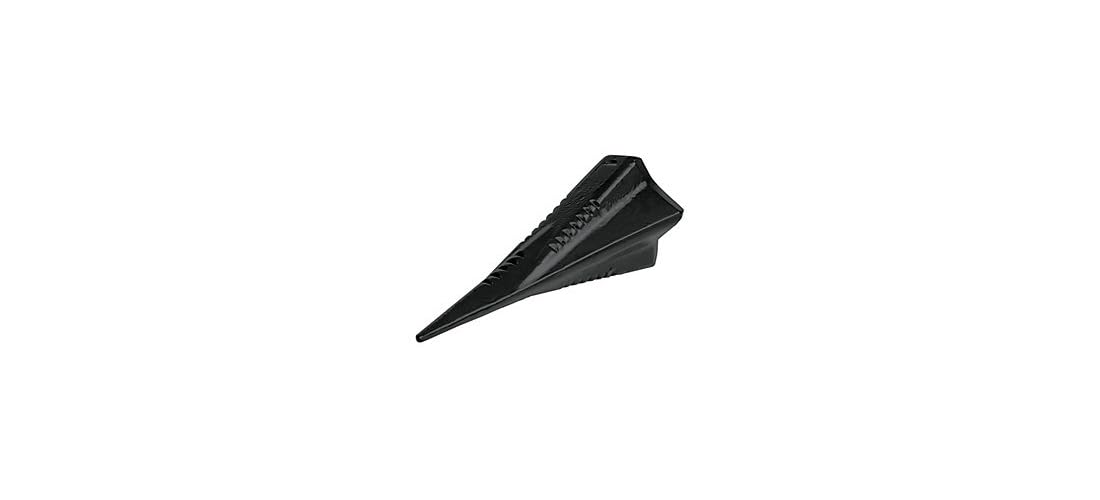
Collins calls this one a wood grenade, and the nickname is earned by the diamond head, which splits in multiple directions instead of just two. If your pile is full of knotted rounds that laugh at a flat wedge, this is the shape built for the job. The head is drop-forged and heat-treated high-carbon steel, hardened to take a beating rather than fold.
The Collins earns its place by how it hits the end grain: its multi-direction diamond face (a head that scores the wood on several planes at once) opens the split outward instead of prying it apart along a single line. That makes it a better fit for hard, knotted wood than the Edward Tools Classic, which relies on a simpler edge. Against the Redneck Convent diamond the picture is less clear — both push four directions, but Collins markets toward hard and knotted wood while the Convent version is not recommended for knots, so the Collins wording fits the tougher pile. At 7 inches long and 3 inches wide, it is a compact, stubby tool that tucks into a small shed corner or a truck side box.
The build quality earns consistent praise, and the split performance on hard, knotted wood comes in a close second — that is the whole reason to buy a grenade-shaped wedge. The honest downside, though, is stability: the diamond face can pop out of slick or frozen rounds more often than a flat-edged wedge with side notches will. The trade is real — bite hard on knots, but plan to re-seat the wedge on smooth green wood. Some owners also find the head shape requires a full committed swing rather than a light tap, so treat it as a two-handed tool.
Where it shines: hard, knotted hardwood that asks for more than a two-way split.
Worth knowing: the diamond face pops out more often on slick or frozen rounds, so keep your stance ready to re-seat it.
Made for: anyone whose firewood is knotted hardwood that resists a flat wedge.
Better elsewhere if: your rounds are smooth and frozen — this head shape needs more re-seating than a flat one.
6. Edward Tools Diamond Wood Splitting Wedge
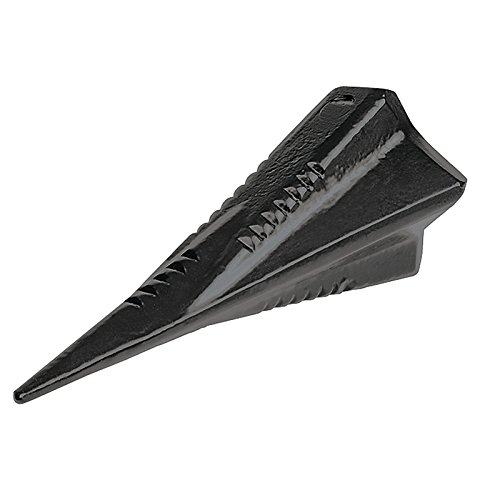
A torpedo-shaped 4-way head with side grooves that keep it wedged until the split finishes.
Pick this one when you want fewer swings and four pieces of firewood per round. This torpedo, or grenade, wedge drives steel through the log with side grooves cut into its flanks — those grooves hold the wedge seated until the wood is fully split instead of letting it back out. At 7 inches by 3 inches with a 4-pound drop-forged head (steel shaped by a single hammer blow for strength), it matches the body size of the Collins and the Redneck Convent, so your choice depends on shape and reputation rather than footprint.
Buyers report that it does the job it was sold to do, and they rate quality just behind that. Edward Tools backs it with a lifetime warranty — a discretionary promise from the maker, not a physical spec. Driving the wedge with a straight sledge on clean rounds is where it feels most natural; on knots, the four-way geometry fights four directions of grain at once and demands more effort per swing than a simple flat edge.
Owners mention mixed results on durability and ease of use — some owners find it very easy to use, others say it takes more effort than expected, and a few have raised concerns about the tip holding up. That matches the geometry: a four-way head does more work per drive, so the force you put in has to be higher. On smooth logs, the side grooves earn their keep; on frozen or slick rounds, the whole tool can still walk out. It is a strong four-way wedge with a realistic caveat — buy it for clean rounds, not for the ugliest pieces in the pile.
The case for it: a torpedo head with side grooves that splits four ways and stays seated longer on clean logs — plus a maker’s lifetime warranty behind the steel.
The catch: four directions of split means more effort per strike, and the tip is the detail that has drawn concern from some owners.
Best for: clean, straight rounds you want to turn into four firewood pieces per swing.
Skip the four-way if: you prefer a light, easy swing — the extra split direction raises the effort level.
7. Helko Werk Twisted Forged Steel Log Splitting Wedge

The handmade German wedge for the person who wants to hand the tool down.
Every spec on the Helko Werk is a buy-once declaration. It is 4.5 pounds of C50 high-carbon steel, 8.25 inches long, hardened to 53-56 HRC — a hardness window in the Rockwell C scale that keeps the edge from rolling over on hard wood. It is hand-forged in Wuppertal, Germany, and the wide striking face on its back is shaped specifically for hammering rather than for show.
The twist is the distinguishing feature. A twisted body design is made to avoid sharp debris chipping, according to the maker, and the wide back face lets you drive it with a real hammer or maul. Compare its 8.25-inch length with the 8.5-inch Edward Tools Classic and you get a nearly identical reach with a heavier head — that 4.5-pound mass matters on big rounds where the wedge needs to sink fast. Some customers note splitting large-diameter logs very well with it, which is exactly the class of wood this tool is built for.
The thing owners praise is the craftsmanship — this is a hand-made tool, not a cast piece, and it feels like one. The 1-ounce oil that ships with it is the maintenance habit rolled in: keep the steel oiled and it will be ready for winter for years. The reality check is value: some owners defend the premium as worth it, others find it pricey relative to the work it does, and you have to decide which side of that line you sit on. It also arrives with an axe guard, which is a storage detail for a tool this nice.
Why it earns its price tag
- C50 high-carbon steel hardened to 53-56 HRC — a hardness window built to resist edge rolling
- Hand-forged in Wuppertal, Germany with a wide striking face for hammering
- Twisted body design specified to avoid sharp debris chipping
- 4.5-pound head at 8.25 inches — heavier and nearly the same length as the 8.5-inch Edward Tools Classic
Where it sits on the fence
- Owners split on value — some call the premium worth it, others find it pricey
- A premium hand-forged tool asks to be oiled and stored with care, not left in the weather
- Smaller owner base means less feedback to draw from than the mainstream picks
For the tool collector: you want a hand-forged German wedge with a wide strike face and a hardness spec you can trust.
Consider the middle picks first if: your budget is tighter and a weight-nailed utility wedge already does the job.
Know the Specs
Head Weight and Why It Is the First Number
Head weight, listed in pounds on every wedge here, is the true driver of split force. A 5-pound head such as the Estwing E-5 drives deeper per strike than a 4-pound wedge, but only if your hammer can deliver the blow. A 4-pound head paired with a light hammer wastes both. Think of the wedge and hammer as a matched pair: real sledge weight behind a heavy head, lighter sledge behind a lighter head. Splitting performance follows that pairing, not the wedge alone.
Length and How It Changes Your Stance
Length matters for how the wedge seats and how you stand. A short 6-inch body such as the Truper holds the round close, and its lower profile makes the first strike easier. A longer 8.5-inch or 9-inch body such as the Edward Tools Classic or the Estwing puts more reach between you and the block, letting you drive with more extension. Match length to how high your splitting block sits; a low block rewards a shorter, more controllable wedge.
Split Pattern: Flat, Diamond, and 4-Way
Split pattern is the geometry that decides how many directions a round breaks in. A flat, sharpened chisel edge pushes apart in two directions. A diamond cross-section such as the Collins or Redneck Convent weakens the log at multiple angles and can crack a round into four pieces in one drive. Four-way heads split more per strike but demand more effort per swing. Pick the pattern by log type: flat for knots and volume, diamond for clean and straight wood.
Steel Type and Hardness
The steel differs between heat-treated railway steel, drop-forged high-carbon steel, and C50 high-carbon steel hardened to 53-56 HRC in the Helko Werk. High carbon and heat treatment are what stop the edge from rolling over during cold-weather firewood work. Any wedge will need an occasional wipe of light oil on the steel — several here ship with that oil — plus a stored-away dry spot between seasons.
Common Questions
What size hammer do I need to drive a wood splitter wedge?
Will a flat wedge or a 4-way diamond wedge split faster?
Can a wood splitter wedge handle knotty or frozen wood?
What is the difference between a splitting wedge and a splitting axe?
How do I keep a wedge from popping out of the log?
Do I need to sharpen a splitting wedge, and how often?
Is a heavier wedge automatically better?
What steel should I look for in a splitting wedge?
Can I use a splitting wedge on a log that is lying on the ground?
Is the German-made Helko Werk worth the price over the cheaper wedges?
The Bottom Line
For most woodpiles, the wood splitter wedge to buy is the ESTWING Sure Split Wedge E-5 — 5 pounds of hand-sharpened American steel with side fins that add outward force on every strike. If your firewood is primarily clean, straight rounds and you want four pieces per swing, grab the Redneck Convent 4-Direction Wedge for its diamond cross-section. And for a slim, warranty-backed classic that slides into a camp bag, the Edward Tools Classic is the one to reach for. Before your first swing, match head weight to your hammer; that pairing decides whether the wedge drives deep or stalls.
How we choose
We do not accept paid placement. Every pick is matched to a real buyer and a real use-case; we do not hands-on test units.
Sources
Specifications: manufacturer listings and product documentation. Review insights: verified customer reviews, as of November 2026. Pricing: not shown on this page (it changes often); check the current price via the retailer link.
As an Amazon Associate, Tactical Gear Guy earns from qualifying purchases. This does not affect which products we feature.