Specs are compiled from manufacturer listings and verified buyer reviews and can change over time — please confirm the key details on the product page before buying.
You want a wooden nesting box that fits your hens, holds together, and is easy to clean. Buy one sized right for your breed, built with joined or interlocked panels rather than stapled scraps, and simple enough to clean that you will actually do it. The six picks below cover everything from a lightweight three-pack you can hang in an afternoon to a two-tier eight-hole unit for a bigger flock, and each one is priced by tier rather than by hype.
This guide is built by comparing the manufacturers’ published specifications and the patterns across verified customer reviews, so you get each pick’s real strengths and trade-offs instead of marketing spin.
Nesting boxes are one of those coop purchases where the wrong build shows up months later as cracked eggs and soggy bedding. This breakdown of wooden chicken nesting boxes covers real sizes, mounting choices, and the honest weak spots on each pick.
Top Picks

How To Choose The Best Wooden Chicken Nesting Boxes
The box itself is simple: a private cubby with a lip to hold bedding and an egg in place. What separates a good one from a frustrating one is how it is built and whether it fits your birds. Work through these four checks before you hang anything.
Match compartment size to your breed, not your coop
A small bantam needs far less turning room than an Orpington. Compartments around 12 x 12 inches suit most standard hens, and some models list interior space of 11 x 12.3 inches per cubby for heavy breeds. Too tight and hens refuse the box or break eggs on the way in; too large and the bedding scatters.
Look at how the panels are joined
Precision-fitted or mortise-and-tenon joints (interlocking tabs that hold panels tight without relying on screws alone) are the tell of a box that will not loosen with weather swings. Stapled or thin-sheet construction is where the durability complaints tend to collect over time.
Decide wall-mount or floor-use before you buy
Wall-mounted boxes keep the box off the coop floor, which makes raking and cleaning easier and lifts eggs away from damp. Freestanding or floor units are simpler to reposition and better if your coop walls are flimsy or you rent the space.
Choose your roof for your climate
A sloped roof sheds rain and discourages hens from roosting on top, which keeps the unit cleaner. PVC roofing over the top adds a waterproof layer, while carbonized wood (heat-treated to resist moisture and insects) helps the body itself hold up outdoors.
Side-by-Side Comparison
| Model | Best For | Compartments | Mounting | Wood / Roof | Amazon |
|---|---|---|---|---|---|
| Matutinus 3-Pack Wall-Mounted★ Best Overall | Small flocks and easy hanging | 3 (13.5 x 13 x 15.5 in each) | Wall or freestanding | Pine, semi-enclosed | Amazon |
| TRYKERPET 2-Hole Wooden BoxHeaviest Build | Floor or wall placement in the coop | 2 (25.6 x 14.96 x 16.93 in overall) | Wall or floor | Wood with PVC roof | Amazon |
| TRINFREE Gold Standard 2-Pack | Barnyard looks in a small coop | 2 (12 x 12 x 15 in each) | Wall-mount | Carbonized wood | Amazon |
| Yhhdjc 4-Compartment Pine | Large breeds and heavy ducks | 4 (11 x 12.3 in each) | Wall or ground | Pine with sloped PVC roof | Amazon |
| Qifeila 8-Compartment with Perches | Mid-size flocks, indoor or outdoor | 8 across 2 levels | Floor, stand, or wall | Solid wood, waterproof | Amazon |
| TRINFREE 8-Hole Two-Tier | Big backyard coops | 8 across 2 levels | Wall-mount | Carbonized wood, sloped roof | Amazon |
Detailed Reviews
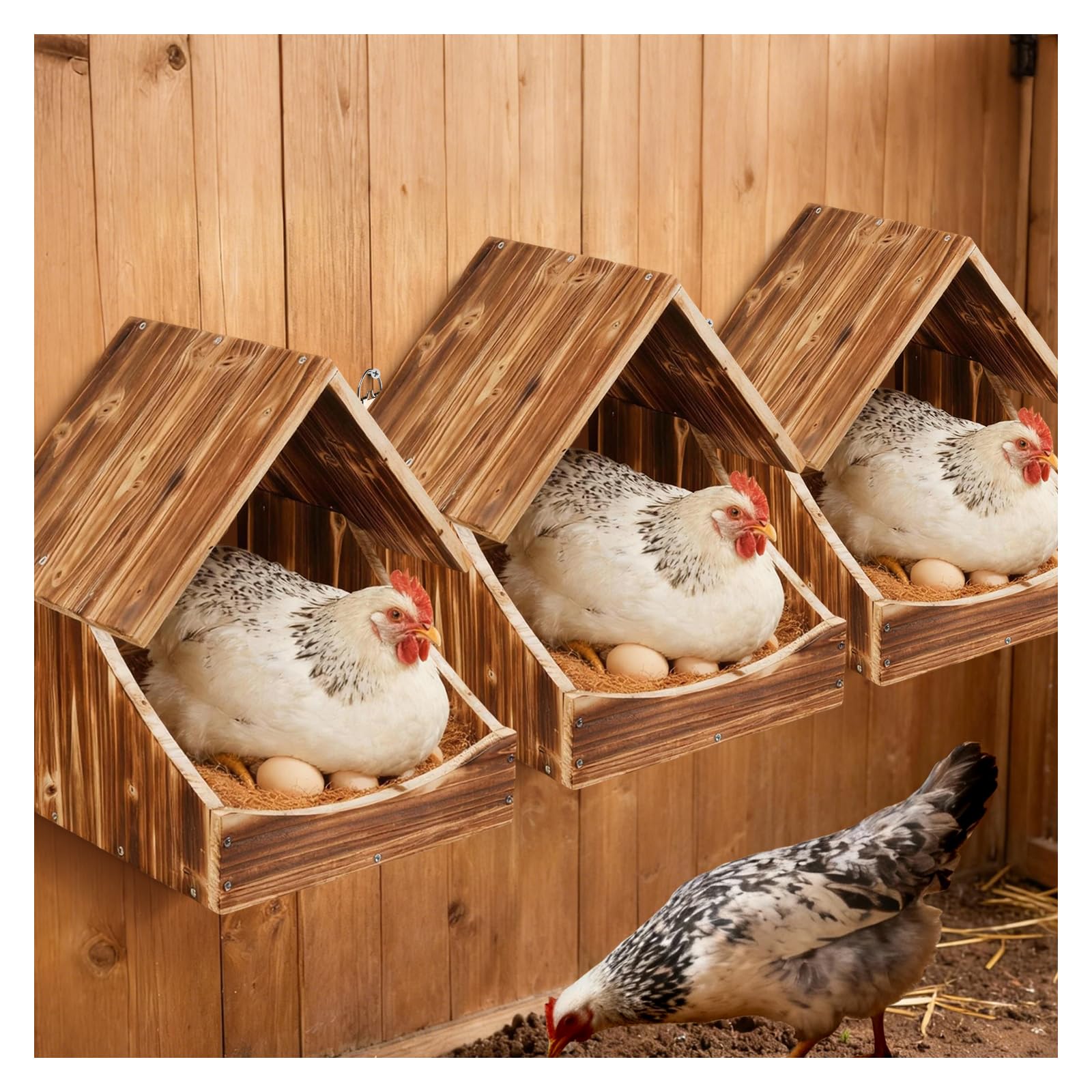
1. Matutinus Chicken Nesting Boxes 3 Pack
Our pick — 4.5+★ from 50+ verified ratings; the strongest balance of quality and price.
Three separate private cubbies that hang on the wall or stand on their own, in one light box.
Three boxes for the price of most single units is the obvious draw here, but the real reason this one takes the top spot is the practical layout. Each compartment measures 13.5 x 13 x 15.5 inches — enough room for a standard hen to step in, turn, and settle without crowding the next bird. You get three private laying spaces from one wall or one floor spot, which suits a small flock of six to nine hens far better than a single deep box.
The semi-enclosed front does two jobs at once. It blocks outside noise and harsh light so a hen feels hidden while she lays, and the raised front barrier keeps eggs from rolling out onto the coop floor. That barrier is the difference between collecting clean eggs and scraping cracked ones out of the shavings. A removable tray is included too, so cleaning is a lift-out job rather than a full disassembly.
Wood choice matters more than most buyers expect. The solid pine body is chemical-free and holds an even interior temperature better than a metal box that bakes in summer and chills in winter. Assembly is straightforward thanks to pre-drilled holes, and you can wall-mount it or set it freestanding depending on your coop. At 5.5 pounds it is light enough for one person to hang — compare that to the TRYKERPET 2-Hole box at 37.8 pounds, which needs a solid floor or serious wall anchoring. What wins people over most is the build quality, with assembly ease right behind it, and the appearance gets plenty of love too.
What earns its keep
- Three separate 13.5 x 13 x 15.5 inch cubbies give each hen her own space
- Raised front barrier holds eggs in instead of letting them roll
- Semi-enclosed design blocks light and noise for calmer laying
- Light 5.5-pound body hangs easily on a coop wall
Where it asks for care
- Pine needs a dry spot or a roof over it to hold up long-term outdoors
- Three compartments can be more than a two-hen flock will use
Go for it if: you keep a small backyard flock and want three ready laying spaces without building anything.
Think again if: your coop is fully open to rain — the pine body wants shelter overhead.
2. TRYKERPET Wooden Chicken Nesting Box 2 Holes
A two-hole wooden box with a PVC roof that you can wall-mount or set on the coop floor.
Step on this one and it is not going anywhere. The 37.8-pound body is the anchor of the whole design — compare that to the 5.5-pound Matutinus three-pack above. That heft is why it reads as stable on a floor or in a run, and it is the pick for anyone who has watched a lighter box shuffle across the coop when a heavy hen hops in.
The PVC roofing is the other practical win. It shields the top of the box and the eggs beneath it from rain and drips, so bedding stays dry and eggs stay clean. Two spacious holes cut the risk of eggs rolling out and breaking, and the wood body keeps the natural look that blends into a backyard setup. Overall dimensions run 25.6 x 14.96 x 16.93 inches, which gives you a substantial footprint to plan around rather than a slim wall piece.
Durability is the one thing buyers report mixed results on, with some noting the box came apart within six months of use. Quality and assembly still lead the feedback, and the sturdiness and versatility get their share of praise. But if you want a box you hang and forget for a decade, treat this as a floor unit that wants occasional checking of its joints. For a small flock of two to four hens in a sheltered coop, it does its job well.
The trade in plain terms: You are buying weight and a waterproof roof at a budget-friendly tier, not a lifetime structure. Check the fasteners each season and it holds up fine in a covered run.
Reach for this if: your hens keep sliding a light nest box around and you want one that plants itself.
Look elsewhere if: you need a box to hang on a thin coop wall with no floor space to spare.
3. TRINFREE Wooden Chicken Nesting Boxes 2 Pack
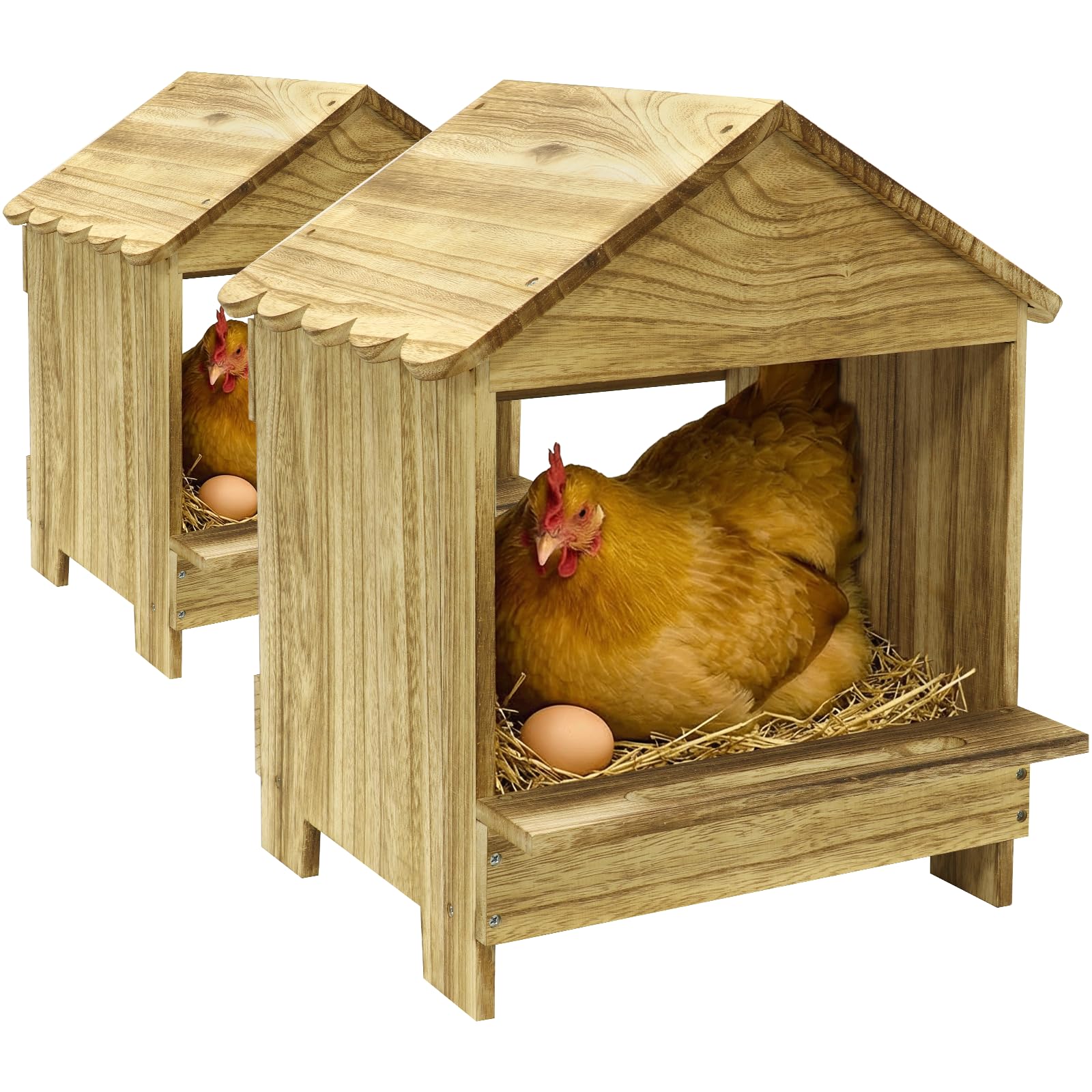
A carbonized-wood two-pack with decorative eave trim that makes the coop look intentional.
At 12 x 12 x 15 inches per compartment, this pair is sized for standard laying hens rather than bantams — and each 12 x 12 x 15 inch compartment is rated to support four to five hens laying daily. The 2-pack’s two single compartments arrive as separate units with hooks and screws, so you can space them across a wall or set them side by side. What buyers praise most is how quickly they go together, with the clear instructions doing a lot of the work. The birds take to them fast, too, which is the only test that really counts.
Carbonized wood is the spec worth knowing here. The wood is heat-treated so it resists rain, humidity, and insects better than raw lumber, which matters if your coop is not fully weatherproof. Add pre-drilled panels and a mortise-and-tenon structure (interlocking joints that hold each piece tight against its neighbor) and you get a box that stays square instead of racking. There is even a farmhouse-style eave trim across the top, a small detail that turns a plain cubby into part of the coop’s look.
The one thing to weigh is covering. These are single open-faced boxes, so they want to sit under a coop roof or overhang rather than flat against an exposed fence. If they are sheltered, the carbonized finish does the rest. For a small flock and a coop you actually want to look at, the pair is a solid mid-range call.
what separates it: The carbonized surface treatment (a heat-treated finish that darkens and hardens the wood) and tight interlocking build put it a step above plain pine in wet climates, so the box resists damp better than untreated wood.
The honest limitation: Neither compartment has its own sloped roof, so plan to mount under cover.
Best matched to: four to ten hens and a coop with a roof overhead and a look you care about.
Not your pick if: you need a self-contained box with its own rain-shedding roof.
4. Yhhdjc Chicken Nesting Boxes 4-Compartment
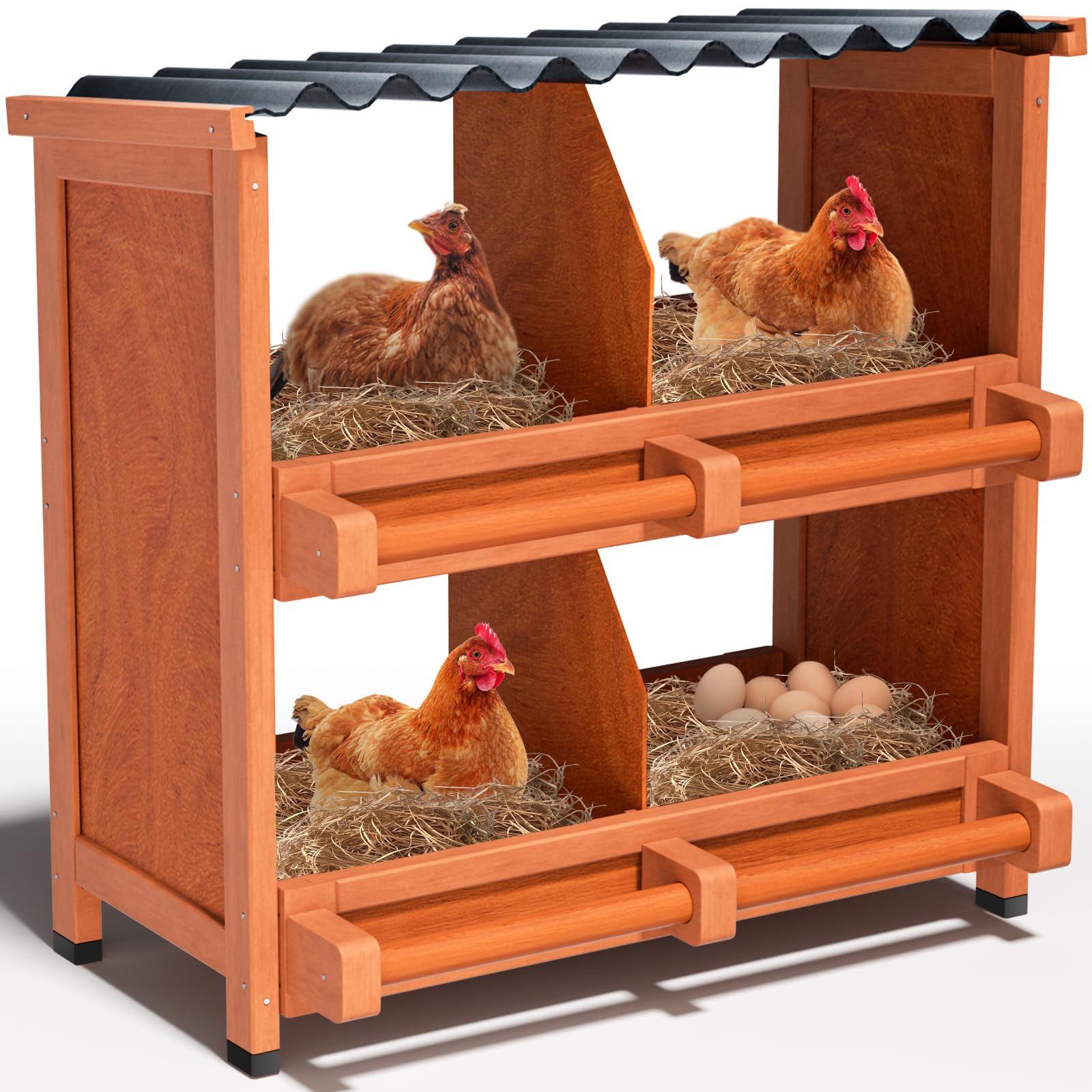
The pick for heavy breeds and ducks, with four wide bays and a build rated to 50 pounds.
Large breeds need room to stand and turn, and this is where this box pulls ahead. Its four independent compartments each measure 11 x 12.3 inches, with a multi-tier layout so the whole unit runs 30 inches long by 30 inches high. The pine structure is rated to support up to 50 pounds, which is why it suits a heavy duck or an Orpington as easily as a standard hen. Compare those 30-inch dimensions to the TRINFREE 2-pack above at 12 x 12 x 15 inches — this one is a much bigger footprint and a much bigger commitment of coop wall or floor.
The perch bar and raised front baffles are the details that keep eggs where they belong. The solid wooden perch lets hens step in and out without slipping or twisting a toe, and the baffles block eggs from sliding forward. The enclosed roof acts as a lid and hides the eggs from predators, so breakage drops and collection gets quicker. Smooth, sanded pine also means no sharp edges to catch a comb or a foot — a real difference from thin metal sheets that heat up in summer.
Assembly is labeled-parts simple, with all screws and nuts included and no special tools needed. You can hang it by the keyhole mounts or set it on the ground. The one thing to plan for is exactly that size — four bays and a 30-inch height need a wall or floor spot that can take it. If you keep a small bantam flock, this is more box than you need.
Why heavy-breed keepers pick it
- Four 11 x 12.3 inch bays for large hens and ducks
- Rated to hold up to 50 pounds of bird
- Perch bar and front baffles protect eggs and toes
- Sloped PVC roof sheds rain and covers the eggs
Before you commit
- A 30 x 30 inch footprint is a lot of wall or floor space
- Overkill for bantams or a flock of two
Good fit for: keepers of large breeds, ducks, or a flock that keeps breaking eggs in shallow boxes.
Pass on it if: your coop has limited wall space or you only keep bantams.
5. Qifeila Chicken Nesting Box 8 Compartment
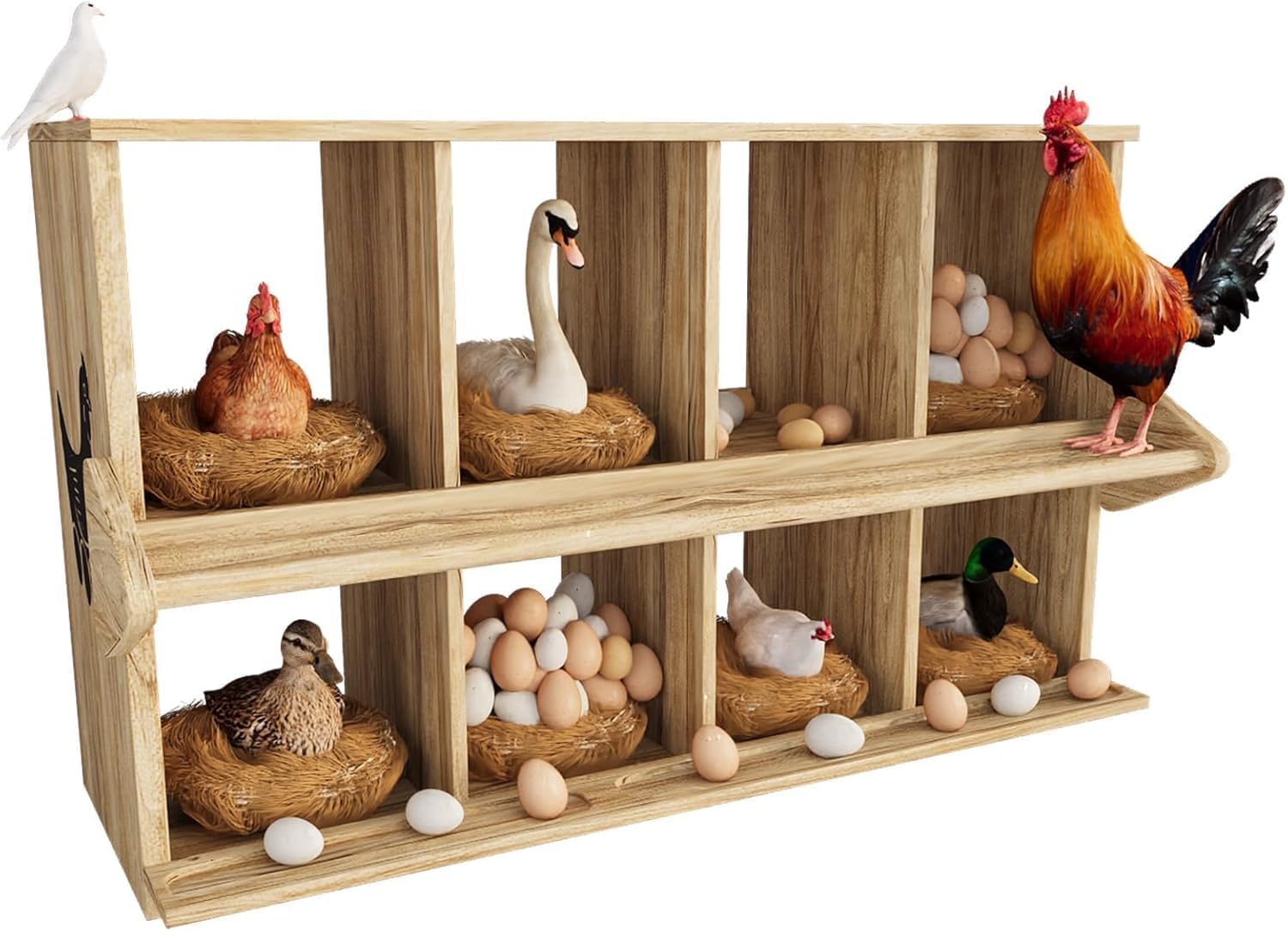
Eight bays on two levels with three mounting options, for a flock that has outgrown a small box.
This is the most flexible unit in the group. You can set it on the floor, on a stand, or hang it on a wall, and the two-level layout gives eight separate compartments for small to medium poultry. The perch design and baffles keep eggs from rolling away, and there is a dedicated collection design that makes gathering simpler. At 48.8 inches long by 17.3 wide and 22.8 high, it is a serious piece of coop furniture — plan your space before ordering.
What draws praise is how simple it goes together, and the look gets plenty of positive comments too. The waterproof finish helps it survive an outdoor setup, and the insulated solid wood body keeps the interior calmer than a hot metal run. It suits chickens, and the maker lists quail, ducks, and pigeons as well. Functionality scores well, which for a nesting box means one thing: hens actually use it.
The size and build need honest sizing. Some buyers find it perfect for their birds while others say it is too small for their chickens, so measure your largest hen against the compartment before you commit. Sturdiness and material quality draw a more mixed read, with some describing the wood as on the lighter side. It is the right buy for a mid-size flock where several small compartments beat two deep boxes, not for someone who wants a tank of a single box.
What it does well: Eight bays plus three mounting choices make it the most adaptable way to add laying space in one purchase.
Weigh this honestly: The wood is not the heaviest on this list, so check compartment size against your biggest hen first.
Worth it for: mid-size flocks that need many separate nesting spots and want to choose the mounting style.
Skip if: you keep large heavy breeds that need 12-inch-wide bays.
6. TRINFREE Wood Nesting Boxes 8 Holes
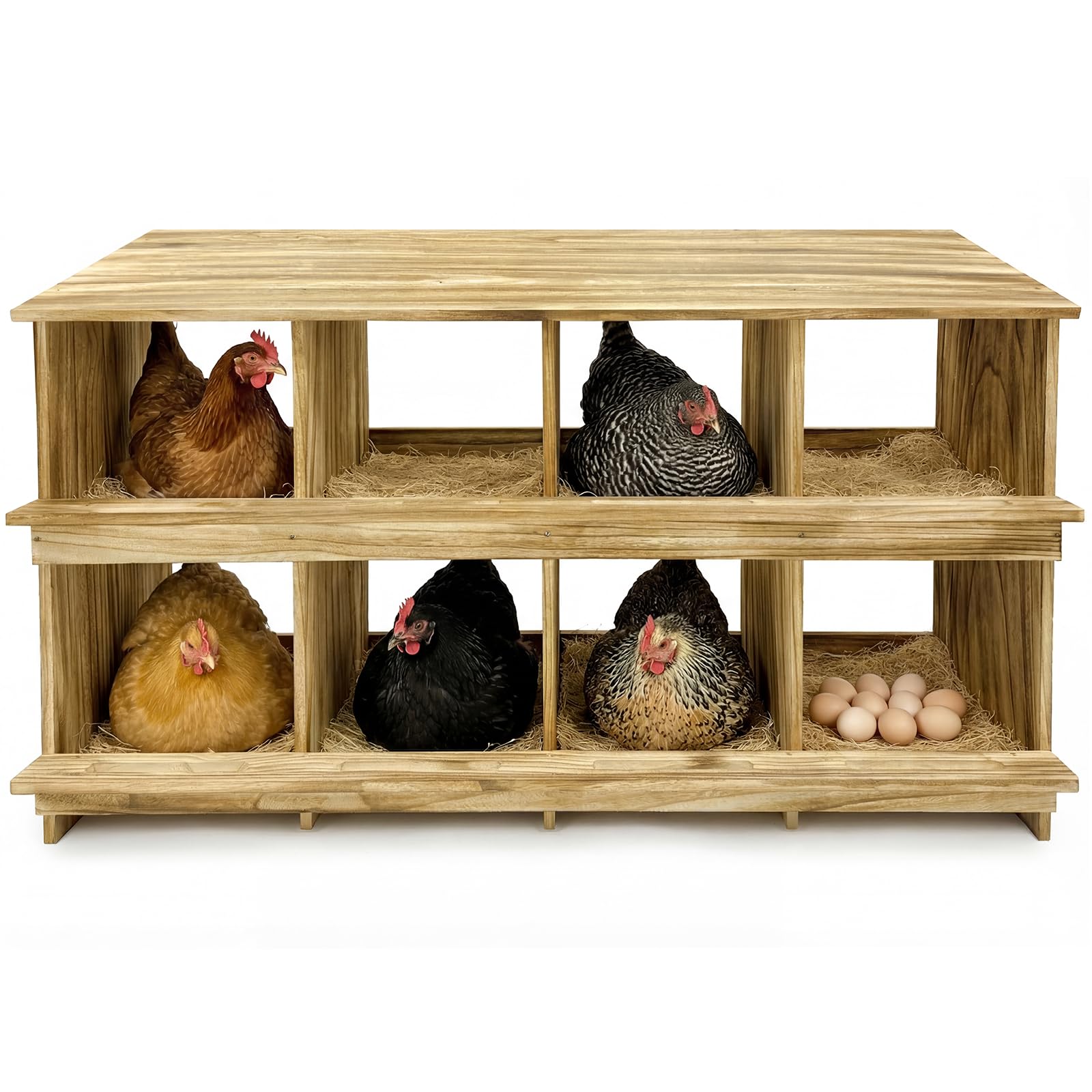
Eight carbonized-wood bays on two tiers, with a sloped roof that keeps hens off the top.
For a big backyard flock, this is the unit that saves wall space. The 2-tier layout fits eight compartments into a 51 x 15 x 28 inch frame, with upper bays of 12 x 12 x 10 to 14 inches and lower bays of 12 x 12 x 11 inches. Each of the eight bays is rated for four to five hens laying daily, so the two-tier build supports a flock of 32 to 40 chickens — pick this when one or two boxes cannot keep up with demand.
Two details make it work outdoors. The carbonized wood resists rain, humidity, and insects for long coop use, and the 18° sloped roof (angled so hens cannot comfortably perch on it) keeps the top cleaner and easier to wipe down. Compare that to the open-topped gold standard 2-pack above, which relies on a coop roof for its cover. A tight mortise-and-tenon structure also means pre-drilled panels lock into a strong, square box quickly.
The honest note is weight and value. It tips the scales at 28 pounds and many describe it as lightweight for its size, so it wants a true wall or a secure floor base rather than a thin fence. Wood quality and value split opinion, with some loving the rustic look and others finding it overpriced for the material. If the flock is large and you want the farmhouse look, the composure of a solid two-tier is worth weighing against those trade-offs.
Clear strength: Eight closed compartments in a compact two-tier frame, with a roof that sheds weather and stops roosting.
The fair worry: Carbonized wood is light, so anchor it properly and it will do its job.
Made for: coops running 32 to 40 hens that need eight bays and a clean, covered top.
Not the one for: tiny flocks or anyone wanting a heavy single box they can drop in a corner and forget.
Know the Specs
Compartment Size and Breed Fit
The interior measurement of one bay — often around 12 x 12 inches — decides whether a hen steps in confidently or fights the box. Large breeds like Orpingtons and heavy ducks need the widest bays and enough depth to turn around. Small or bantam birds can use tighter boxes and will actually ignore an oversized one because it feels exposed.
Wood Type and Weather Treatment
Raw pine is natural and chemical-free but wants a roof or shelter over it. Carbonized wood is heat-treated to resist rain, humidity, and insects, so it holds up better in exposed coops. Neither is a substitute for a dry spot, but carbonized bodies tend to last longer outdoors.
Roof Style and Egg Protection
A sloped PVC roof sheds water and stops hens from roosting on top, keeping the box cleaner. An 18° angle is steep enough that a bird will slide rather than sit. Raised front baffles and lips inside each bay do the other half of the job, keeping eggs from rolling onto the coop floor.
Mounting and Flock Size
Wall-mounting keeps boxes off the floor and lifts eggs away from damp, while floor or stand setups are easier to move and better for weaker walls. Each compartment is often rated for four to five hens, so an eight-hole box can serve a flock of 32 to 40 when the bays are spaced properly.
Common Questions
How big should each nesting box compartment be for a standard hen?
How many hens can one nesting box compartment serve?
Is carbonized wood better than plain pine for an outdoor coop?
Should I wall-mount my nesting box or set it on the floor?
Do wooden nesting boxes need a roof over them?
How do I stop eggs from rolling out of the nesting box?
Are wooden nesting boxes better than metal ones for hot weather?
How do I clean and maintain a wooden nesting box?
Can I use a nesting box for ducks and quail as well as chickens?
The Bottom Line
If you keep a small backyard flock and want a box you can hang in an afternoon, the Matutinus 3-pack earns the top spot — three roomy pine compartments with a raised front barrier and a removable tray, and the strongest overall build feedback in this group. For a heavy floor box with a waterproof PVC roof, the TRYKERPET 2-hole plants itself and stays put. And if your biggest birds need the widest bays, the Yhhdjc 4-compartment pine is the one to reach for, with 11 x 12.3 inch bays and a 50-pound load rating. Whatever you pick, measure your largest hen and your coop wall before you order — that check saves more returns than any spec sheet.
How we choose
We do not accept paid placement. Every pick is matched to a real buyer and a real use-case; we do not hands-on test units.
Sources
Specifications: manufacturer listings and product documentation. Review insights: verified customer reviews, as of July 2026. Pricing: not shown on this page (it changes often); check the current price via the retailer link.
As an Amazon Associate, Tactical Gear Guy earns from qualifying purchases. This does not affect which products we feature.