Specs are compiled from manufacturer listings and verified buyer reviews and can change over time — please confirm the key details on the product page before buying.
A good pair of work coveralls for men goes on over your clothes in one step, so you can crawl under a truck or stand on a cold site without ruining your jeans or freezing your legs. What actually decides whether a pair works for you depends on three things — how it insulates, how it seals out wind and water, and how easily you can climb into it over boots and layers. Insulation you can’t move in is useless on a ladder, and a shell that breathes but tears apart won’t survive a week of site work. Below you get nine pairs compared on exactly those points, so you can pick the one that matches your site instead of guessing.
This guide is built by comparing the manufacturers’ published specifications and the patterns across verified customer reviews, so you get each pick’s real strengths and trade-offs instead of marketing spin.
The picks range from a flame-resistant shell rated for arc flash to a lightweight short-sleeve pair you can wear in summer heat, so the only real question left is what your site throws at you. This breakdown of the best work coveralls for men splits them by job, insulation, and the fit quirks buyers keep flagging.
Top Picks

How To Choose The Best Work Coveralls for Men
A coverall has to survive a specific environment, fit over whatever you already wear, and still let you bend, kneel and climb. You are buying a shell that has to survive a specific environment, fit over whatever you already wear, and still let you bend, kneel and climb. Miss on any of those three and the coverall ends up riding around in the truck instead of working. This section walks through the four decisions that actually change which pair you should buy.
Start With The Job, Not The Look
Welders, electricians and oil-and-gas crews need flame-resistant fabric with a real arc-rating — the ATPV figure in calories per square centimetre tells you how much heat the fabric can block before injury. General maintenance and auto work need a durable cotton or twill shell that shrugs off grease and cleans up. Winter outdoor labour needs insulation plus wind and water resistance. Match the fabric to the job first, because good fit won’t save a cotton coverall in a flash-fire zone.
Insulation Weight And Why It Is Measured In Grams
Insulation weight is given in grams, and the number tells you how much thermal fill is packed into the garment — the Yukon on this list carries 150 g while the HISEA carries 100 g, so you are buying a real warmth difference, not a label. Heavier fill keeps you warmer standing still in wind chill, but it also adds bulk and heat when you are moving. A lighter fill is the smarter pick if you work hard and generate your own heat.
The Fit-Over-Layers Question
Coveralls are sized to go over street clothes, which is exactly why fit is the single most complained-about thing across the category. An oversized cut such as the Red Kap’s lets you layer a hoodie underneath. A stretch-canvas cut such as the Carhartt Rigby moves with you instead of bagging out. Check the maker’s size chart and decide if you want room to layer or a closer, cleaner fit — then read the sizing notes on the product page before you commit.
Zippers, Cuffs And Getting Dressed Fast
An ankle-to-thigh leg zipper lets you pull the coverall on over work boots without taking them off. A two-way front zipper lets you open the top for ventilation or the bottom for a quick break. Rib-knit storm cuffs and snap-closed storm flaps are what stop wind and grit crawling up your sleeves and legs. Leg zippers, a two-way front zip and storm cuffs are what decide whether you reach for the coverall every morning or leave it on the hook.
Side-by-Side Comparison
| Model | Best For | Insulation | Shell | Key Hardware | Amazon |
|---|---|---|---|---|---|
| Carhartt Yukon Extremes★ Best Overall | Cold outdoor sites | 150 g Thinsulate | 6.5 oz, 500-denier Cordura nylon | Ankle-to-thigh leg zippers | Amazon |
| Dickies Short SleeveBest for Warm Weather | Warm-weather greasy work | None | Lightweight wrinkle-resistant fabric | Snap chest and back pockets | Amazon |
| Dickies Long SleeveEveryday Workhorse | Everyday dirt and grime | None | Polyester/cotton twill | Two-way brass zipper | Amazon |
| Red Kap Button-Front | Auto and maintenance work | None | 100% preshrunk cotton | Covered stainless steel buttons | Amazon |
| Just In Trend FR Coverall | Arc-flash and flash-fire zones | None | 7 oz 88/12 FR twill | Two-way YKK FR brass zipper | Amazon |
| ATERET FR Coverall | Budget FR protection | None | 7 oz 100% FR cotton | — | Amazon |
| HISEA Insulated | Cold, wet outdoor shifts | 100 g thermal cotton | Water-repellent high-density canvas | Double-ended metal zipper | Amazon |
| Carhartt Rigby | Mobility-first trades | None | 6.5 oz stretch canvas (98% cotton / 2% elastane) | Hook-and-loop leg openings | Amazon |
| Wrangler Insulated Duck | Hard winter labour | Quilted insulation | Heavy-duty cotton duck | Side-venting leg zippers | Amazon |
Detailed Reviews
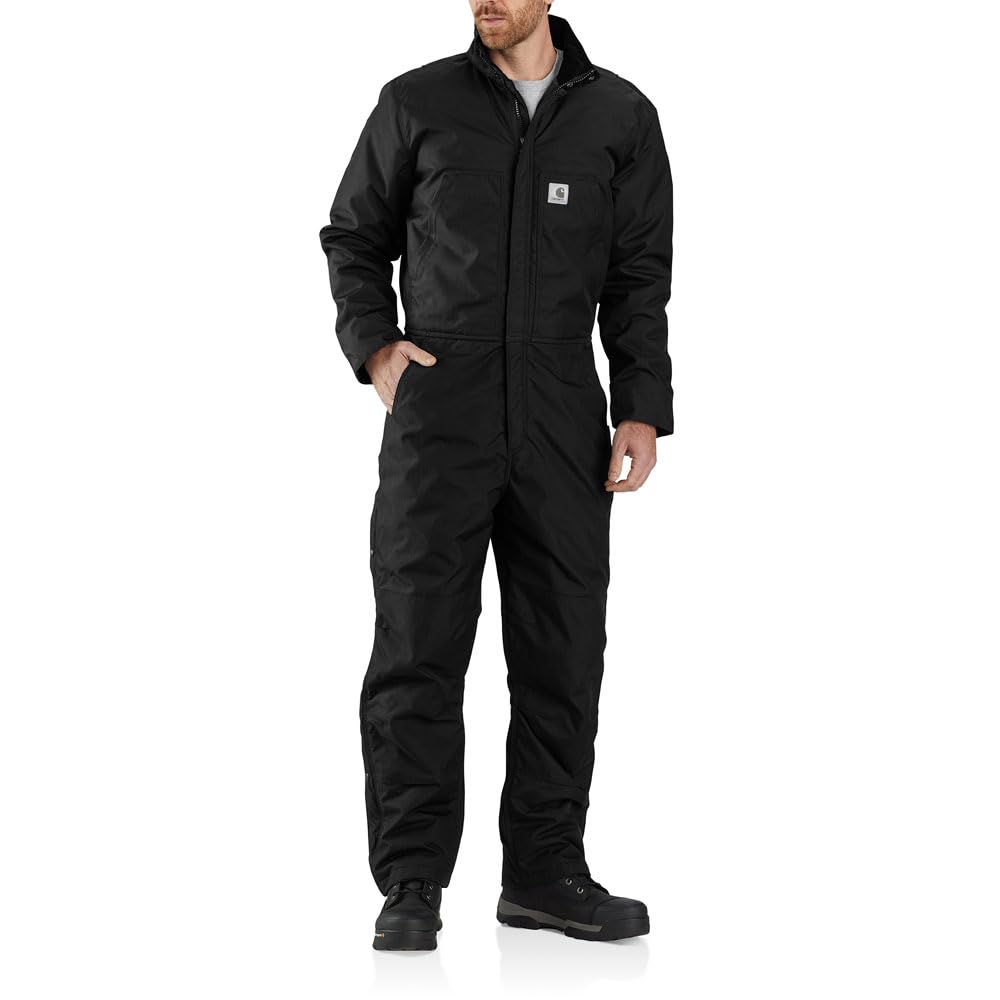
1. Carhartt Men’s Yukon Extremes Insulated Coverall
Our pick — 4.5+★ from 650+ verified ratings; the strongest balance of quality and price.
The pick for standing work when windchill is the whole story of your shift.
The Yukon is the warmest serious shell on this list, and it earns that spot with 150 g of 3M Thinsulate insulation packed inside a 6.5-ounce, 500-denier Cordura nylon shell (a heavy woven nylon that resists abrasion and tears). That 150 g fill is the highest insulation weight here — the HISEA further down carries 100 g — so if you stand around in the cold rather than run around in it, this is the pair that keeps your core warm. Buyers report standing in 20°+ windchill without feeling cold, and warmth is one of the two things that gets praised most across the whole run of reviews.
Where it really separates itself is the sealing. Wind Fighter technology is Carhartt’s name for a fabric build that stops wind pushing through the weave, and Rain Defender is its durable water repellent finish that makes light rain bead and roll off. Rib-knit storm cuffs close the gap at your wrists, and the ankle-to-thigh leg zippers with storm flaps let you pull the whole thing on over boots in seconds and then seal the legs shut again. Triple-stitched main seams and double-layer knees with openings for knee pads tell you this was built for a site, not a costume.
The honest catch is sizing, and it cuts both ways. Plenty of buyers find the fit roomy enough to move in, while a share say it runs too big — so treat the size chart as a starting point and consider what you plan to wear underneath. The two-way front zipper also draws mixed feedback. Neither is a reason to walk away from a coverall that keeps people warm in real windchill; it is a reason to order deliberately.
What Puts It On Top
- 150 g Thinsulate fill — the heaviest insulation weight among these picks.
- 500-denier Cordura nylon shell resists abrasion on rough surfaces.
- Ankle-to-thigh leg zippers make boot-on dressing fast.
- Double-layer knees with openings for adding knee pads.
- Reflective taping on the center back and double front for low-light visibility.
What To Weigh First
- Sizing splits opinion — some find it roomy, others find it runs big.
- Heavy insulation is too much for fast-moving work in mild weather.
- The two-way zipper draws mixed feedback.
Reach for it if: you work outdoors in real cold and want maximum warmth with knee-pad readiness built in.
Think twice if: you mostly work indoors or in mild weather, where 150 g of fill will cook you.
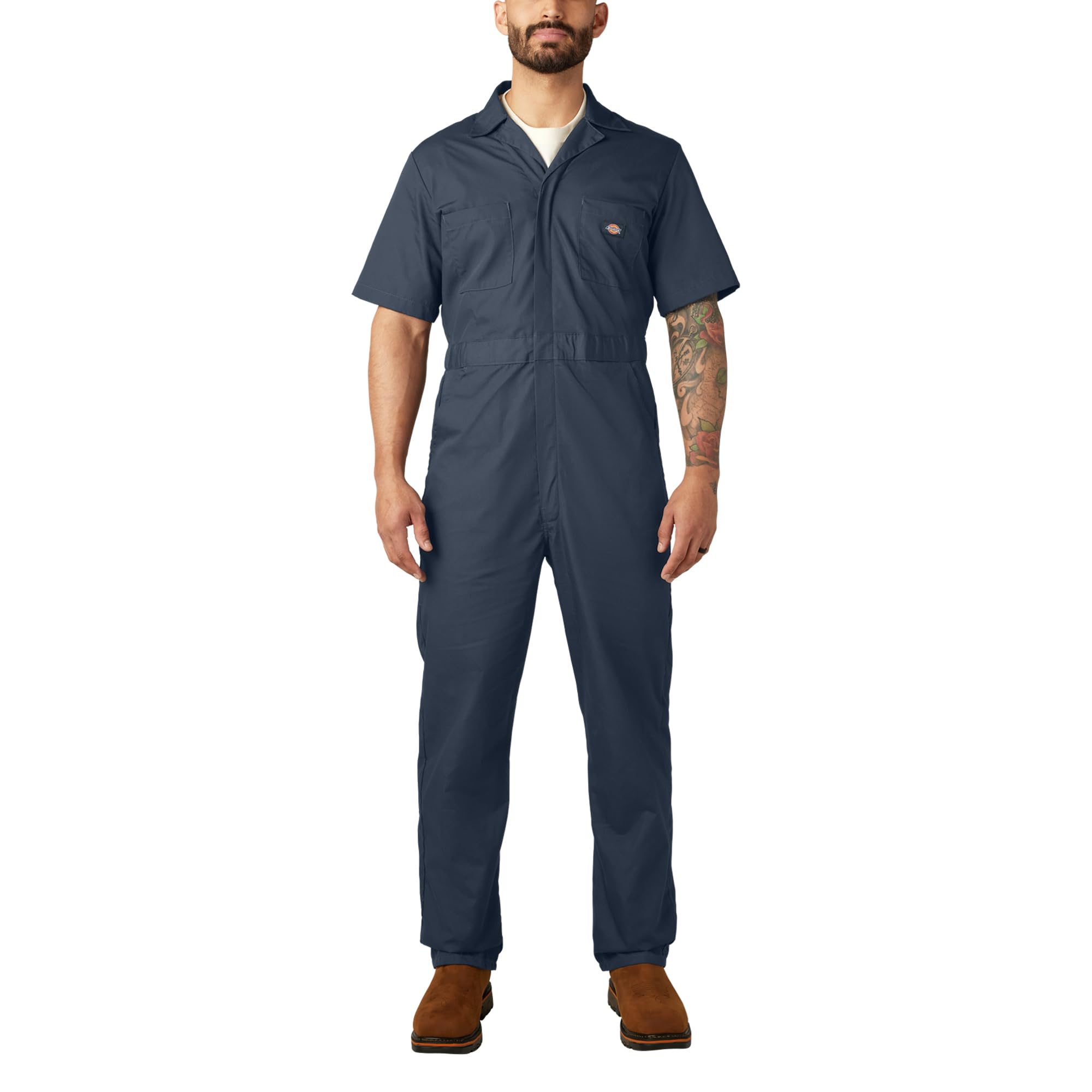
2. Dickies Men’s Short Sleeve Coveralls
A short-sleeve summer shell that slides over your clothes and washes grease out instead of setting it in.
This is the pair you grab in July when you need protection from oil and dirt but not from cold. The short sleeves and lightweight fabric are the entire point — it slips on easily over the clothes you were already wearing, and the wrinkle-resistant cloth with an easy-care stain release finish means a splash of grease washes out instead of setting in. Buyers consistently call the material great for warm weather, and quality sits right beside value as the thing they talk about most.
Dickies built this on a heritage design it has been refining for close to a century, and the modern version trades the old heavy denim and button front for something far easier to work in all day. Elastic waist inserts expand as you bend and twist, so you are not fighting the garment when you crouch under a hood. Storage is handled with large back pockets plus snap-secured chest pockets, and it is sized as a men’s cut with a model number of D33999KHK.
Sizing is the one thing to plan around. It is cut to fit over clothes, and as with every coverall here the fit draws a spread of reactions — some find it just right, others land on a size that misses. Measure against the size chart rather than guessing, and it will do the job it was made for.
Where the value lands: a lightweight, stain-releasing shell that fits over clothes for warm-weather dirty work — exactly the role a heavy insulated coverall cannot fill.
Set your expectation: no insulation and short sleeves mean this is a summer and indoor garment, not a winter one.
Suits you when: the job is greasy, warm and indoors or summer-season.
Not the one for: cold sites where you need thermal fill and full sleeves.
3. Dickies Men’s Long Sleeve Coveralls
Full sleeves, a twill shell, and a brass zipper that stays flat against you.
If your work is dirt and grime rather than cold, this Dickies pair is the straightforward answer. The polyester and cotton twill resists fading, wrinkles and stains, so it looks presentable shift after shift, and the full-length sleeves cover your arms the way a short-sleeve cut cannot. Durability is the second thing that gets called out most across the reviews, behind quality — the heavy-duty cloth holds up, and it keeps your regular clothes clean underneath, which is the whole reason you put a coverall on.
The hardware is where it earns daily use. A two-way front brass zipper with concealed snaps at the neck and waist stays flat so it does not snag or gap, and expandable comfort-waist elastic inserts let the waist give as you move. A ruler and tool pocket on the right leg keeps the thing you reach for most close to hand, and the model number D486110DN confirms the men’s cut.
Fit is the big variable here, and it is the most-discussed topic by a wide margin in the reviews. The consensus is genuinely split rather than negative — plenty of people get it right, some get it wrong. Order from the size chart with your layering plans in mind and check the pockets against what you carry daily before you settle.
Reasons It Stays In Rotation
- Polyester/cotton twill resists fading, wrinkles and stains.
- Two-way brass zipper with concealed snaps at neck and waist.
- Expandable comfort waist with elastic inserts.
- Ruler and tool pocket on the right leg.
Where It Asks Patience
- Fit is the most-debated point — the sizing spread is genuine.
- No insulation, so it is a three-season shell at best.
Your match if: you want a durable, stain-resistant full-sleeve coverall for general dirty work.
Look past it if: you need flame resistance or winter warmth.
4. Red Kap Men’s Button-Front Cotton Coverall

Heavy cotton, covered metal buttons, and pleats that let you reach across an engine bay.
Red Kap made this for the auto bay and the maintenance shop, and it shows in the fabric. It is 100% preshrunk cotton, a heavy-weight cloth that resists grime and stays put wash after wash, and buyers single out the material and its weight as the standouts. Covered stainless steel buttons are the small but smart detail — they protect a paint job from scratches while you lean over a hood, which is exactly the sort of thing that matters in a body shop.
The cut is deliberately oversized so it goes on easily over your clothes, and action-back pleats add room across the shoulders for a wider range of motion. You get two set-in front pockets, two patch hip pockets, two breast pockets and a rule pocket on the leg, so tools and a measuring rule have a home. The package notes put it at 2.95 pounds, which is consistent with the heavy-weight cotton build.
Sizing is the honest trade-off, and it is the most-discussed point in the reviews by a long distance. Buyers describe it as roomy — which the oversized fit is meant to be — and some find it big through the hips and short through the torso. The covered buttons also need a deliberate hand on some units. Neither issues changes what the garment is: a rugged cotton shell for messy work, provided you size with the oversized cut in mind.
The paint-shop detail: covered stainless steel buttons and a heavy preshrunk cotton shell make this the natural pick for automotive and maintenance work where scratches matter.
Fit reality check: the oversized cut is intentional, so expect room through the hips and confirm torso length on the size chart.
Best fit for: mechanics and maintenance hands who want a tough cotton shell over their clothes.
Skip past if: you want a snug, close-fitting coverall — this one is built roomy on purpose.
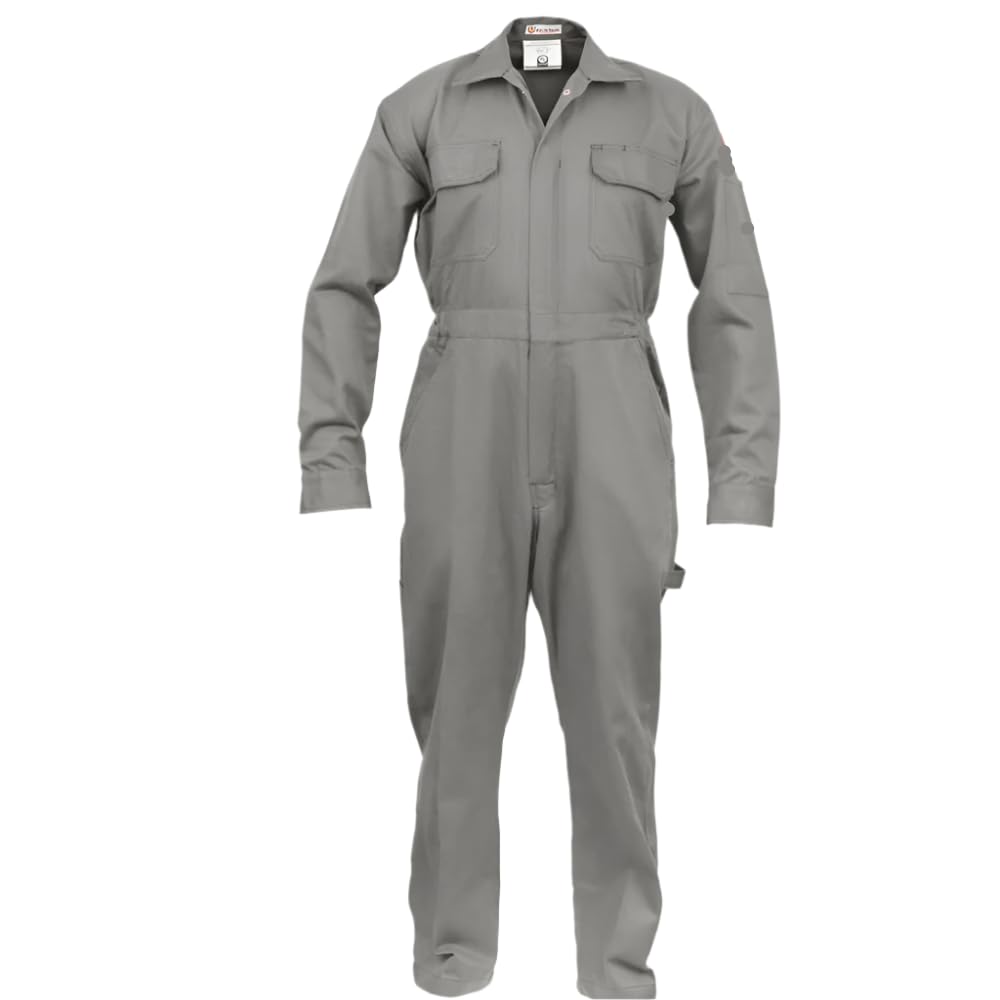
5. Flame Resistant FR Coverall – 88% C / 12% Nylon – 7oz
Certified flame resistance for the trades where a spark is a real hazard, not a nuisance.
This coverall exists for welders, electricians and oil-and-gas crews, and the specs are the reason you buy it. It carries an ATPV rating of 12 cal/cm² — arc thermal performance value, the measure of how much heat energy the fabric can take before your skin would be at risk — and it is rated HRC 2, the hazard risk category for moderate arc-flash exposure. It meets NFPA 2112 for flash fire and ASTM F1506 for arc flash, and it holds a UL certification with three-point verified labeling. For a coverall in a hazard zone, those certifications are the whole buying decision.
The build matches the job. The shell is a 7 oz, 88% cotton and 12% nylon FR twill — breathable enough for long shifts in high-heat environments, and mercerized so it machine-washes with mild detergent and shrinks minimally. You get pearl snap closures, a heavy-duty two-way YKK FR brass zipper, action-back pleats for mobility, a hammer loop, utility pockets, side vents for access to inner layers, and an elastic waist. That is a full working feature set, not a token one.
One practical note from the manufacturer: there may be slight shrinkage due to the FR cotton, so if you plan to layer or want a looser fit, size up. Buyers broadly find it comfortable and good value, with sizing the one split — as with every FR coverall, get your measurements right, because this is not a garment to eyeball.
Why The Certification Matters
- ATPV 12 cal/cm² and HRC 2 rated for arc-flash exposure.
- Meets NFPA 2112 (flash fire) and ASTM F1506 (arc flash).
- UL certified with three-point verified labeling.
- Heavy-duty two-way YKK FR brass zipper and pearl snap closures.
- 7 oz FR twill is breathable for long shifts in high heat.
The Fine Print
- Slight shrinkage possible from the FR cotton — size up if layering.
- Sizing splits opinion, so measure against the chart.
- Must be washed with mild detergent and no chlorine bleach to keep the FR rating intact.
Choose it when: your site demands certified FR protection with a real ATPV rating.
Not your garment if: you only need a grease shell — the FR certification is unnecessary here.
6. ATERET Men’s Flame Resistant Coverall, 7 oz 100% FR Cotton

Flame-resistant cotton without the premium FR price tag attached to it.
ATERET’s entry is the way into FR workwear for people who need the protection but want to keep the spend sensible. The shell is a 7 oz, 100% FR cotton in navy blue — the same fabric weight class as the Just In Trend above, but a pure cotton build rather than a cotton-nylon blend. Value for money is the thing buyers bring up most, which tells you the appeal here is straightforward: flame-resistant construction at the friendlier end of this category.
It is listed under the Palmer Safety name and carries a unisex-adult department designation, so check the sizing chart closely rather than assuming a strictly men’s cut. Beyond the fabric and the FR cotton construction, the listing is thin on hardware detail, so go in expecting a simple working garment rather than a pocket-heavy one.
The clear caveat is fit. Sizing is the most-discussed point in the reviews, and the recurring note is that it runs larger than expected — several people say so plainly. Order down or measure carefully against the chart, and this becomes a lot of FR coverall for the money.
The budget case: a 7 oz 100% FR cotton shell at the entry end of the FR category, which is exactly where value matters most.
The sizing caution: it is reported to run large, so size down or verify measurements against the chart before ordering.
Worth a look if: you need FR cotton protection and want to spend sensibly on it.
Order carefully because: the sizing runs on the generous side, and the hardware detail is limited.
7. HISEA Insulated Coveralls for Men, Winter Water Resistant

Warmth that does not bulk you up, in a shell that sheds a drizzle.
HISEA sits in the balance between the heavy winter Carhartt Yukon and the uninsulated shells. Its 100 g of lightweight thermal cotton keeps you warm without the bulk of heavier fill — a real, measurable step down from the Yukon’s 150 g, and the reason this is the better pick if you want winter warmth but still need to move freely. Warmth is what buyers talk about most here, with quality right behind it, and the loose fit is built to layer.
The outer shell is a water-repellent, high-density canvas, so a drizzle beads off rather than soaking in, and the fabric brings good abrasion and tear resistance for the rough-and-tumble of construction, garage or ranch work. The diamond quilted lining locks in heat, and a full-length double-ended metal zipper with weatherproof snaps makes getting in and out quick. Nine practical pockets handle tools and daily carry.
The zipper gets mixed feedback, with some finding it well-made and others less convinced, and sizing splits the usual way between true-to-size and off. Treat the zipper as a part to use deliberately and confirm your size on the chart, and this is the value-priced winter shell in this group.
Where It Wins The Cold
- 100 g thermal cotton insulation keeps warmth in without heavy bulk.
- Water-repellent high-density canvas shrugs off drizzle.
- Diamond quilted lining locks in heat.
- Nine practical pockets for tools and daily carry.
- Double-ended metal zipper with weatherproof snaps for fast dressing.
Weigh Before Buying
- Zipper quality draws mixed feedback.
- Sizing splits between true-to-size and off — check the chart.
- Insulation is lighter than the Yukon, so not the pick for extreme cold standing work.
Ideal for: cold, damp outdoor shifts where you want warmth with room to move.
Not the top choice if: you are stationary in deep cold — the heavier Yukon fill wins there.
8. Carhartt Men’s Rigby Coverall

Stretch canvas that bends with you instead of fighting you on a ladder.
The Rigby is the mobility pick, and the fabric is why. It is a 6.5-ounce, 98% cotton and 2% elastane stretch canvas — the 2% elastane is spandex-like stretch fibre that lets the cloth give — and Carhartt’s Rugged Flex technology builds on that so the coverall moves when you climb, stretch and kneel. Fit is what dominates the feedback here, with buyers saying it allows room for layers without binding, and sizing earns straightforward praise for being true to size.
Dressing is fast by design. The two-way zip front combines with hook-and-loop leg openings, so you open the legs, step in over boots and close them up without a wrestling match. Two lower-front double pockets have pass-through access to the layers underneath — so you can reach a shirt pocket without unzipping — plus hook-and-loop chest pockets, multiple utility pockets, back pockets and a pen stall on the upper-left sleeve. Adjustable sleeve cuffs with hidden snaps close the wrist gap.
Two things draw mixed feedback: the appearance and the ease of dressing. Some find it looks good enough to serve as a uniform, others are less taken with the look. Neither affects the build, which is a sturdy stretch-canvas shell for trades where mobility decides whether you finish the task comfortably.
Why trades pick it: 2% elastane stretch canvas with Rugged Flex gives real give, and hook-and-loop leg openings make boot-on dressing painless.
The mixed note: appearance draws split opinions, so pick it for how it moves, not just how it looks.
Reach for it when: flexibility on ladders and in tight spaces is your top priority.
Pass on it if: you want a traditional stiff-canvas look — this one is built to stretch.
9. Wrangler Men’s Insulated Duck Coverall

Heavy duck, quilted warmth, and knees that bend where your knees bend.
Wrangler built this for hard winter labour on construction sites, farms and ranches. The shell is a rugged, heavy-duty cotton duck — a tightly woven cotton that resists wear — backed by thick quilted insulation that traps core warmth and shields you from freezing temperatures. Insulation and the pocket layout are the two things buyers mention most, and one rider reports being comfortable in 30-degree weather. Quality and warmth sit at the top of the feedback in equal measure.
What makes it usable in real work is the articulation. Elbows and knees are cut to bend naturally as you climb, stretch and lift, and a hidden double-layer knee barrier adds durability when you kneel on rough ground. Side-venting leg zippers let you pull it on over bulky boots, and a heavy-duty metal front zipper seals it up. Storage covers a zippered chest pocket, an arm tool sleeve, a side leg pocket and a reinforced tape measure patch.
Durability is the one honest question mark, and it is a mixed picture rather than a settled verdict. Some report the fabric tears and that the garment does not hold up through repeated washing, while others are happy with the build. If your work involves heavy abrasion against rough surfaces, weigh that against the deep warmth you are getting.
The Winter Argument
- Heavy-duty cotton duck shell with thick quilted insulation for extreme cold.
- Articulated elbows and knees bend as you climb and lift.
- Hidden double-layer knee barrier for kneeling on rough surfaces.
- Side-venting leg zippers clear bulky boots.
- Zippered chest pocket, arm tool sleeve, leg pocket and tape measure patch.
The Durability Question
- Durability draws mixed feedback — some report tearing and wash wear.
- Heavy insulation runs hot for anything but genuine cold.
Made for you if: you work outdoors through deep winter and need real insulation with articulated mobility.
Consider the Yukon instead if: long-term abrasion resistance is your biggest worry.
Know the Specs
Insulation Weight (Grams)
Insulation is measured in grams of fill, and more grams mean more trapped warmth. A 150 g coverall such as the Yukon holds more thermal fill than a 100 g one such as the HISEA, which makes the heavier garment the pick for standing still in wind chill and the lighter one the pick for moving work. Lightweight thermal cotton and quilted insulation do the same job at different weights — match the figure to how much you move and how cold your site gets.
Shell Fabric And Denier
Denier is a measure of fibre thickness — a higher denier means a heavier, tougher yarn. A 500-denier Cordura nylon shell resists abrasion far better than a light twill, which is why it suits rough surfaces. Cotton duck and stretch canvas trade some of that toughness for breathability and give. Pick the shell to match your environment: nylon for abrasion, twill for grease, stretch canvas for mobility.
FR Ratings: ATPV And NFPA
ATPV stands for arc thermal performance value, measured in cal/cm², and it tells you how much heat energy the fabric blocks before your skin would be at risk. NFPA 2112 covers flash-fire protection and ASTM F1506 covers arc flash. HRC 2 is a hazard risk category for moderate exposure. If your job involves welding, electrical work or petrochemicals, these ratings decide whether a coverall is fit for purpose at all.
Zippers, Cuffs And Leg Openings
The hardware decides how fast you get dressed and how well the cold stays out. Ankle-to-thigh leg zippers let you get in over boots without removing them. Two-way front zippers let you vent the top or open the bottom. Rib-knit storm cuffs and snap-closed storm flaps seal the wrist and leg gaps. A heavier brass or metal zipper holds up to daily use better than a light one, and weatherproof snaps add a second line of defence.
Common Questions
What should I wear underneath work coveralls in cold weather?
What is the difference between ATPV and NFPA 2112 on FR coveralls?
Do work coveralls run true to size?
Can I get work coveralls on over my boots quickly?
Are insulated coveralls too warm to work in?
How do I wash FR coveralls without losing the flame resistance?
Is a cotton duck coverall better than a nylon shell for winter?
Do I need flame-resistant coveralls if I am not a welder?
What are pass-through pockets on coveralls for?
Can knee pads be added to work coveralls?
The Bottom Line
The pick that does the most jobs well is the Carhartt Yukon Extremes — 150 g of Thinsulate insulation, a 500-denier Cordura nylon shell, wind and water resistance, and ankle-to-thigh leg zippers make it the most complete cold-weather coverall here. If your site calls for certified FR protection, the Just In Trend FR Coverall carries the full set of ratings — ATPV 12 cal/cm², NFPA 2112, ASTM F1506 and HRC 2 — that the job demands. And for movable warmth on damp outdoor shifts, the HISEA Insulated Coveralls trade some fill weight for bulk-free mobility and a water-repellent canvas shell.
How we choose
We do not accept paid placement. Every pick is matched to a real buyer and a real use-case; we do not hands-on test units.
Sources
Specifications: manufacturer listings and product documentation. Review insights: verified customer reviews, as of November 2026. Pricing: not shown on this page (it changes often); check the current price via the retailer link.
As an Amazon Associate, Tactical Gear Guy earns from qualifying purchases. This does not affect which products we feature.