Specs are compiled from manufacturer listings and verified buyer reviews and can change over time — please confirm the key details on the product page before buying.
If your picture breaks into squares during the evening news, the fix is usually not a bigger amplifier — it is a directional antenna pointed correctly at the towers. A Yagi design focuses reception in one direction instead of grabbing signal from every angle. That focused pickup is why a Yagi holds a channel when a flat indoor panel drops it. This guide sorts the current field by what actually decides reception: element count, stated range, mounting hardware included, and whether the cable comes in the box.
This guide is built by comparing the manufacturers’ published specifications and the patterns across verified customer reviews, so you get each pick’s real strengths and trade-offs instead of marketing spin.
The right pick depends on tower distance and whether you are mounting on a roof, in an attic, or on an RV. Below you will find range, element and cabling differences spelled out side by side so you can match one to your address. Every set here is a genuine directional Yagi built for outdoor mounting, which makes this yagi outdoor tv antenna shortlist a fair fight on range alone.
Top Picks


How To Choose The Best Yagi Outdoor TV Antenna
The first thing to settle is distance. Grab your address and a signal map, note how far the nearest broadcast towers sit, then treat every antenna’s claimed range as an optimistic ceiling rather than a promise. A Yagi that claims 200 miles will not pull a clean picture from 200 miles through a hill. It will, however, hold steady at a realistic fraction of that number if you aim it well and mount it high.
Directional means aiming matters
A Yagi antenna listens strongest along the axis of its boom — the long spine the elements sit on. Point that boom at the towers and you get gain and rejection of signals from behind. Point it sideways and you get neither. That is why these antennas have a fixed, no-rotor structure: you aim once during install and leave it. Plan the aim before you climb the ladder.
Element count and boom length
More elements along a longer boom generally mean more gain and tighter focus. The Stellar Labs unit is the extreme example here with 91 elements on an 87.2-inch boom. Longer booms catch more signal but need more room and more rigid mounting. A compact Yagi suits an attic or a tight eave; a long one wants open roof space.
What ships in the box
Cable and mount are the hidden cost. Some antennas include a J-pole and 40 feet of RG6 coax; others ship the antenna and hardware but leave the coax for you to buy. RG6 is the thicker coax that loses less signal over a run, so a longer included cable is worth real money on a roof install.
Side-by-Side Comparison
| Model | Best For | Stated Range | Channels Listed | Mount and Cable | Amazon |
|---|---|---|---|---|---|
| RCA Compact Outdoor Yagi ANT751E★ Best Overall | Attic and roof installs on a budget | 70+ miles | 100 | Mast and clamp, coax sold separately | Amazon |
| PBD Amplified Outdoor YagiBest Signal Booster | Weak-signal areas needing a boost | 120 miles | 3 | 40FT RG6 cable included | Amazon |
| McDuory UHD-3968 YagiBest Budget Roof Mount | Budget roof or attic mount | 70+ miles from towers | — | Pre-assembled, no tools | Amazon |
| CEKAY Outdoor Yagi | All-metal build with cable and J-pole | 70 miles | 100 | 40FT RG6 cable and J-pole | Amazon |
| GE Outdoor Yagi 33685 | Multi-TV homes up to 80 miles | 80 miles | 200 | J-mount, mast clamp, bracket | Amazon |
| Five Star Upgraded VHF/UHF | Long-range aim with a splitter | 200 miles | 100 | 40FT RG6 cable, J-pole, splitter | Amazon |
| Five Star Outdoor 200 Mile | Feeding several TVs from one mast | 200 miles | 100 | J-pole and splitter included | Amazon |
| Stellar Labs 91 Element Yagi | Deep-fringe rural reception | — | 56 | Antenna only | Amazon |
| Winegard HD7694A | Harsh-weather coastal and rural roofs | 45 miles | 36 | Antenna only | Amazon |
Detailed Reviews
1. RCA Compact Outdoor or Attic Yagi HD TV Antenna ANT751E
Our pick — 4.0+★ from 12,000+ verified ratings; the strongest balance of quality and price.
The proven all-rounder: a compact Yagi that tucks into an attic and still pulls a clean picture.
The crowd favorite here runs on a 2-pound frame and reaches up to 70+ miles from the broadcast towers, which covers most suburban addresses without a mast full of metal. It handles both UHF and VHF stations (the two bands over-the-air TV uses) and is built to receive 4K, 8K and 1080p broadcasts. The 75-ohm impedance matches standard coax so the signal travels to your TV without a mismatch. Owners consistently report steady reception with no dropouts and a sharp picture free of pixelation.
Where it separates from the pack is the aiming help. The free RCA Signal Finder app works like a digital compass that points you toward the strongest cluster of channels, so you are not guessing which way to turn the boom. Installation is genuinely tool-light: the design arrives pre-assembled with an easy-lock fold-out UHF reflector and snap-lock elements. You get the mast, locking mast clamp, mounting hardware and a 75-ohm matching transformer in the box — but note the coax cable is sold separately, so budget for an RG6 run before install day.
The one honest snag is channel coverage, which splits opinion more than any other trait: for some addresses it grabs every station in range, and for a few it lands on nothing. That is the nature of a directional antenna — if the towers sit behind a ridge from your roofline, no compact Yagi will rescue you. Across a huge base of owners, the four-star-plus average suggests a clean result is likely if you mount it high and aim it with the app.
Where it earns its keep
- 70+ mile reach on a 2-pound chassis that fits an attic or eave
- Signal Finder app takes the guesswork out of aiming the boom
- Snap-lock elements assemble with minimal tools
- Full UHF and VHF coverage with 4K and 8K support
What to plan around
- Coax cable is not included — buy an RG6 run separately
- Channel coverage is the most divisive trait; fringe terrain can disappoint
Reach for this if: you want a compact, app-aimed Yagi for an attic or roof within 70+ miles of the towers.
Look elsewhere if: your towers sit behind a hill and you need every last mile of gain.
2. PBD Amplified Outdoor Yagi TV Antenna HJK544
Built for weak-signal addresses where the towers are far and the airwaves are crowded.
This is the amplified pick, and the number that matters is 120 miles of stated range against the RCA’s 70 miles. When your towers are distant, that headroom is the whole argument. The amplifier inside uses automatic gain control (a circuit that boosts weak signals without overloading strong ones) alongside a high-gain low-noise amplifier and an LTE filter. That filter cuts interference from nearby 4G and 5G mobile signals, which is a real problem in dense areas where cell traffic muddies the TV band.
Frequency coverage runs across VHF 170 to 230MHz and UHF 470 to 860MHz, with full support for 720p, 1080i, 1080p and 4K. The directional structure is fixed with no rotor, so once the boom is aimed at your towers the setup stays put. Assembly is mostly done for you — only a few elements need joining — and the light frame is easier to carry up a ladder and aim. It ships with a power supply adapter and 40 feet of RG6 coax, so the cable run is covered.
The trade worth naming: adding amplification means adding a power adapter, so you need an outlet or power source near the mount for the amp to work. This is a weak-signal specialist, not a one-size answer — if you live close to the transmitters, the extra gain can be more headache than help.
Why the amp pays off: 120 miles of reach plus an LTE filter for crowded airwaves, and the 40 feet of RG6 means you are ready to mount on day one.
The catch to weigh: it needs power at the mount for the amplifier, so plan an outlet before you climb.
Suits you when: your towers are far out and cell towers are chattering nearby.
Think twice when: your mount has no nearby power for the amplifier adapter.
3. McDuory UHD-3968 Outdoor Yagi Antenna
The no-tools workhorse that shrugs off bad weather and picks up the local lineup.
Support for 1080i broadcasts with up to 70+ miles from the towers is the headline here, and it covers both UHF and VHF bands across 170 to 230MHz and 470 to 860MHz. It runs as a passive antenna with no amplifier, so there is no power adapter to feed — just a straight coax run to the TV. That simplicity is the appeal for a first-time installer who does not want an extra electrical decision on the roof.
This antenna is built to keep working through bad weather: the maker describes it as sturdy and lightning protected, so a storm is less likely to knock out your picture. Buyers most often report clear reception that survives a storm and a lineup that reaches 30+ channels. For local channels within roughly 20 miles, the range holds up well — that is the realistic balance for a passive Yagi (an antenna with no powered amplifier) pointed at nearby towers.
Setup is the easiest part — most of the antenna arrives pre-assembled and only a few elements need joining, with no tools required. For a nearby roof or attic mount, though, it is a straightforward value play.
Go for it if: you are within a couple dozen miles of the towers and want a passive, no-power install.
Pass on it if: your towers are far out and you need amplifier-level gain.
4. CEKAY Outdoor Yagi TV Antenna with 40 ft Cable & J-Pole

All-metal construction and a bundled cable-and-J-pole kit for the installer who wants it all in one box.
Here the build is the story: an all-metal Yagi designed to take heat, rain, wind and snow without flinching, with a structure meant to minimize interference from rough weather. The short-and-long of it is durability — a metal body and a stated 1 Year Warranty put it ahead of plastic-bodied rivals when the roof takes a beating. Range is listed at 70 miles with a high-gain design covering both UHF and VHF.
This one is the most complete kit of the value set. You get the antenna plus 40 feet of RG6 coax and a J-mount in the box, which is exactly the hardware a roof or RV install needs. Full support runs from 720p up through 1080p, 4K and 8K, over a 170 to 860MHz working frequency, and it is NEXTGEN TV (ATSC 3.0) compatible — the newer broadcast standard as it rolls out in your area. The channel ceiling is listed at 100.
Against the McDuory above, the extra you pay buys the metal body and the included cable and mount rather than more reach. The honest catch is that some very hilly or distant terrain still needs you to aim carefully, and the metal frame carries a bit more heft up the ladder than a plastic unit. Assembly is minor and tool-free, so the ladder time is short.
What sold the crowd
- All-metal body rated for heat, rain, wind and snow
- 40FT RG6 cable and J-pole included — no separate cable run to buy
- crisp local reception, with installers praising the clear instructions
- ATSC 3.0 ready for the next broadcast standard
Where it asks more
- Metal construction adds weight to haul up the ladder
- 70-mile range means careful aiming still matters in hilly terrain
Best fit for: roof and RV installs where you want the cable and J-pole bundled with a tough metal body.
Skip if: you are chasing the longest possible reach rather than the toughest build.
5. GE Outdoor HD Digital Yagi TV Antenna 33685

The name-brand Yagi for a whole-house setup: 80 miles of reach and an included J-mount.
This GE earns its spot on channel pickup: owners rave about it most, and the common report is a crisp picture with no pixelation (blocky breakup on screen). That clean picture matters when several TVs are pulling from one antenna. The stated range runs to 80 miles from the broadcast source, so it can pull in towers farther out than the 20-mile balance of the passive Yagi above. It works with all brands of TVs and converter boxes, so it slots into whatever you already own, and the channel ceiling is listed at 200.
The mounting kit is genuinely complete: a weather-resistant mounting bracket, mast clamp and J-mount let you fix it to a wall, roof or standard antenna mast. It handles HDTV, VHF and UHF, is 4K Ultra HD-ready, and is NEXTGEN TV (ATSC 3.0) compatible for the newer standard. GE backs it with a limited-lifetime replacement pledge and free U.S.-based technical support. Use the included Signal Finder-style channel scan after install to lock in your lineup.
A fair caveat on the physical side: the size draws mixed reactions, with some loving the compact profile and others finding it smaller than expected — so check the footprint before you commit to an attic spot. Instructions have also drawn some gripes, so plan on a couple of scans to dial it in. Neither of those changes the odds of a clean picture for a multi-TV home inside 80 miles.
What lands the picture: channel reception is the strongest theme, with a 200-channel ceiling, 80-mile reach and a full J-mount kit in the box.
Small print to respect: a smaller-than-expected footprint and instruction gripes mean you may need an extra channel scan or two.
Made for you if: you are feeding several TVs from one mast within 80 miles and want a familiar brand behind it.
Look past it if: you need maximum boom length and fringe-distance gain.
6. Five Star Upgraded VHF/UHF Outdoor Yagi Antenna

The headline distance spec in this field — a 200-mile claim wrapped around a splitter for four TVs.
Five Star pushes the range number harder than anyone here, claiming up to 200 miles of 1080p and 4K reception for both VHF and UHF. The extended boom and larger receiving elements are pitched as the reason it reaches further than a compact unit. It ships with a 40-foot RG6 cable run and a J-pole, plus an optional TV splitter to feed up to four TVs from one antenna. ATSC 3.0 ready rounds out the modern-broadcast side.
The honest read on that 200-mile figure: Five Star itself notes that station count depends on your location and geography, and signal strength depends on distance from the transmitters. So treat 200 miles as a ceiling, not a guarantee. Owner results are mixed on exactly that — some addresses report strong channel counts while others see far fewer, and the practical range lands well under the advertised number in hilly or tree-heavy spots. That is the nature of pushing distance with a directional antenna.
The upside is the kit and the gain potential. The 4-TV splitter is genuinely useful in a multi-room home, and the long, large elements are built to grab more signal per aim. If you have a clear shot to distant towers and want to feed several rooms, this is the range play. If you are close to the transmitters, the ambitious reach is overkill and a compact pick will do the job more simply.
The distance case: a 200-mile stated reach with a 40FT cable, J-pole and 4-TV splitter makes it the multi-room long-range option.
Set expectations: the 200 miles is a best-case ceiling — real results depend heavily on terrain and distance to the towers.
Worth it when: you have a clear line to distant towers and want one antenna feeding up to four TVs.
Overkill when: you sit close to the transmitters and just need a simple nearby install.
7. Five Star Outdoor 200 Mile Long Range Yagi Antenna

A bigger boom, a splitter in the box, and a brochure claim of 200 miles.
If you want the most antenna Five Star makes, this is it: a longer boom and larger receiving elements than the compact competition, pitched for 1080p and 4K reception claimed up to 200 miles. The box is the deepest of the set — antenna, mounting bracket, J-pole, and a TV splitter, with clear assembly instructions. That splitter lets one mast serve multiple TVs without extra hardware.
Its case is simple: one mast feeds a splitter for the whole house instead of a single screen. It handles both VHF and UHF, is ATSC 3.0 ready, and mounts on a roof, attic, chimney, eave, mast or wall — with or without a direct line of sight per the listing. The 200-mile number carries the same caveat as its sibling: the maker notes reception varies with local towers, trees and obstacles. Real reach will depend on your terrain.
One practical habit worth adopting with any long-range Yagi: run a channel scan on your TV after setup, then rescan monthly and any time a channel drops — the subscription-free feed stays current that way. The trade for the long boom is a bigger physical footprint on the roof, so give it open space and a rigid mount.
Right choice if: you want a big-boom, multi-TV setup with a splitter and J-pole already included.
Consider the compact pick if: your roof space is tight and the towers are close.
8. Stellar Labs 91 Element Long Range Yagi Antenna 30-2370

A 91-element monster built for rural valleys where everything else gives up.
The number that defines this pick is 91 — the element count on an 87.2-inch boom, which is by far the longest and most heavily loaded Yagi in this field. More elements mean more gain and a tighter focus, and the corner reflector design adds front-to-back ratio so signal from behind is pushed away. For a rural valley with towers far off, that directional muscle is the whole point. The channel list is set at 56.
Owner experience backs the fringe-focused design: it pulls in a wide channel count in difficult spots, holds long-range reception, and assembles easily with solid construction. It is a serious piece of hardware for a serious signal problem. That said, it is a UHF-focused long-range tool rather than an all-in-one kit, and it ships as the antenna — you will supply your own mount and cable.
The honest catch is the instructions. Paperwork quality is the one recurring gripe on this one, so expect to lean on a signal map and some patience when you aim it. The 87-inch boom also needs real roof space and a rigid mast to avoid flex in wind. For a rural install with open roof space, though, the 91 elements and corner reflector do real work.
Why it is the fringe pick: 91 elements on an 87.2-inch boom with a corner reflector give it the most gain potential of the set.
The cost of all that metal: a long boom needs open roof space and rigid mounting, and you supply the mount and cable.
Built for: rural and valley addresses where distance and terrain defeat compact antennas.
Not for: tight roofs or anyone wanting an all-inclusive cable-and-mount kit.
9. Winegard HD7694A Heavy-Duty Outdoor Yagi TV Antenna
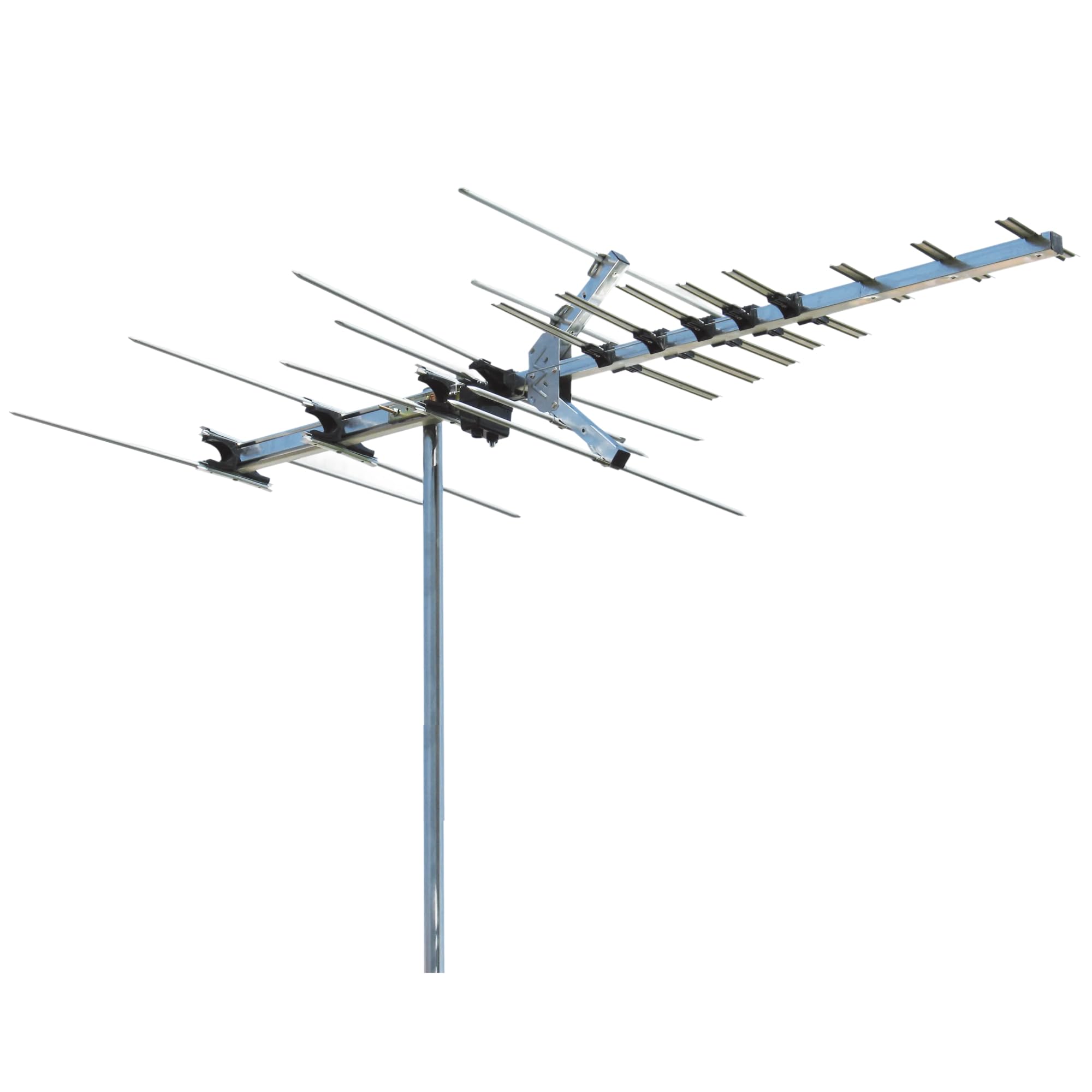
Zinc-plated steel armor for a roof that takes salt air, wind and years of weather.
The build is the differentiator here: high-quality zinc-plated steel for corrosion resistance, designed to stand up to harsh weather and strong winds. At 11.3 pounds it is a substantial piece of metal, and that heft is the point — it is meant to stay put for years on a coastal or exposed roof. Reception covers High-VHF and UHF in high definition, with a stated range of up to 45 miles or more, aimed squarely at rural and suburban addresses. The channel list is set at 36.
Winegard’s RV Halo app includes a TV Channel Finder utility that helps you place and aim the antenna for the best signal, which pairs well with a directional, non-amplified design. Buyers report solid pictures from all the major broadcast stations, strong VHF pickup, and more than 40 channels in good spots. It is NextGen TV and 4K Ultra HD compatible and built on decades of American antenna design.
The clear caveat: 45 miles is a shorter stated range than the long-distance picks, and at this premium spot on the list some find the cost hard to swallow. This is an antenna you buy for the build, not for fringe reach. If your towers sit close and your roof faces tough weather, the trade favors you; if you need extreme distance, aim elsewhere.
The case for the steel
- Zinc-plated steel fights corrosion and stands up to strong winds
- RV Halo app’s Channel Finder helps you aim it precisely
- Strong VHF and UHF pickup with solid pictures from major stations
- NextGen TV and 4K Ultra HD compatible
Where it holds back
- 45-mile stated range is shorter than the long-distance picks
- At 11.3 pounds and a premium spot, it is a build-first purchase
Go here if: your roof faces salt air or hard weather and you value a corrosion-resistant steel build over raw distance.
Keep looking if: your towers are far away and you need the longest reach available.
Know the Specs
Stated range in miles
Range is the number on the box that describes the best case for a clear line to the towers. Terrain, trees and building height all cut into that number, so an antenna claiming 200 miles can still deliver a clean picture at a much shorter real distance, or struggle at 200 through a hill. Use the claim to compare antennas, not to predict your exact result.
Directional gain and aiming
A Yagi listens strongest along its boom, so where you point it decides everything. More elements and a longer boom tighten the focus and boost gain. The trade is that aiming gets more critical: a laser-aligned boom rewards you, a sloppy aim costs channels. That is why an aiming app and a clear signal map are worth more than another foot of boom for most homes.
Impedance and cable
The 75-ohm impedance rating shared across these antennas is the standard match for TV coax, so signal transfers cleanly to your set. RG6 is the thicker coax that holds signal over longer roof runs, which is why a bundled 40-foot RG6 cable is real value. If coax is not in the box, plan a proper RG6 run — not a thin patch cable.
ATSC 3.0 and NextGen TV
NextGen TV (ATSC 3.0) is the newer over-the-air broadcast standard rolling out in many areas. An antenna labeled NextGen or ATSC 3.0 ready can receive it as it becomes available where you live. It is forward-looking rather than a guarantee of more channels today, but it means the antenna will not be obsolete as the standard spreads.
Common Questions
How far will a Yagi outdoor TV antenna really reach?
Do I need an amplified or passive antenna?
What is the difference between UHF and VHF channels?
Will a Yagi antenna work in my attic instead of on the roof?
Does the antenna come with a cable and mount?
Why am I only getting a few channels after installing a long-range antenna?
Can one antenna feed more than one TV?
What does ATSC 3.0 or NextGen TV support mean for me?
Which band should I check before buying — High-VHF or UHF?
How do I aim a Yagi antenna without a signal meter?
The Bottom Line
For most homes, the strongest all-round choice is the RCA Compact Outdoor Yagi ANT751E — a compact 2-pound frame, 70+ miles of stated reach, and a free Signal Finder app that takes the guesswork out of aiming. If your towers are far and cell traffic is heavy, the amplified PBD adds 120 miles of reach and an LTE filter. For tough weather on a coastal roof, the zinc-plated Winegard HD7694A is the build-first pick. And for deep-fringe rural terrain, the 91-element Stellar Labs brings the most gain potential. Point it once, mount it high, and rescan — that is where a clear picture comes from.
How we choose
We do not accept paid placement. Every pick is matched to a real buyer and a real use-case; we do not hands-on test units.
Sources
Specifications: manufacturer listings and product documentation. Review insights: verified customer reviews, as of November 2026. Pricing: not shown on this page (it changes often); check the current price via the retailer link.
As an Amazon Associate, Tactical Gear Guy earns from qualifying purchases. This does not affect which products we feature.